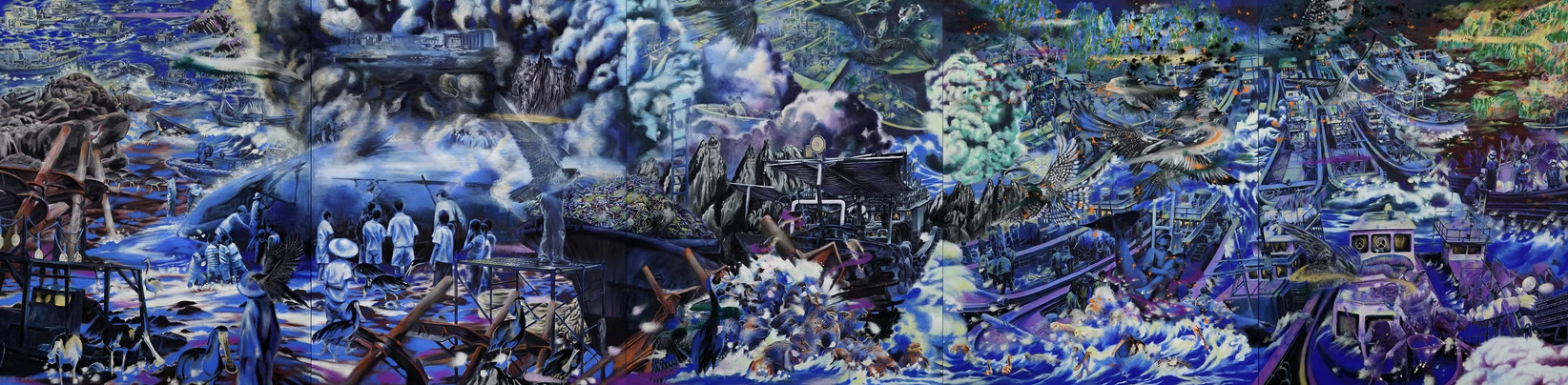
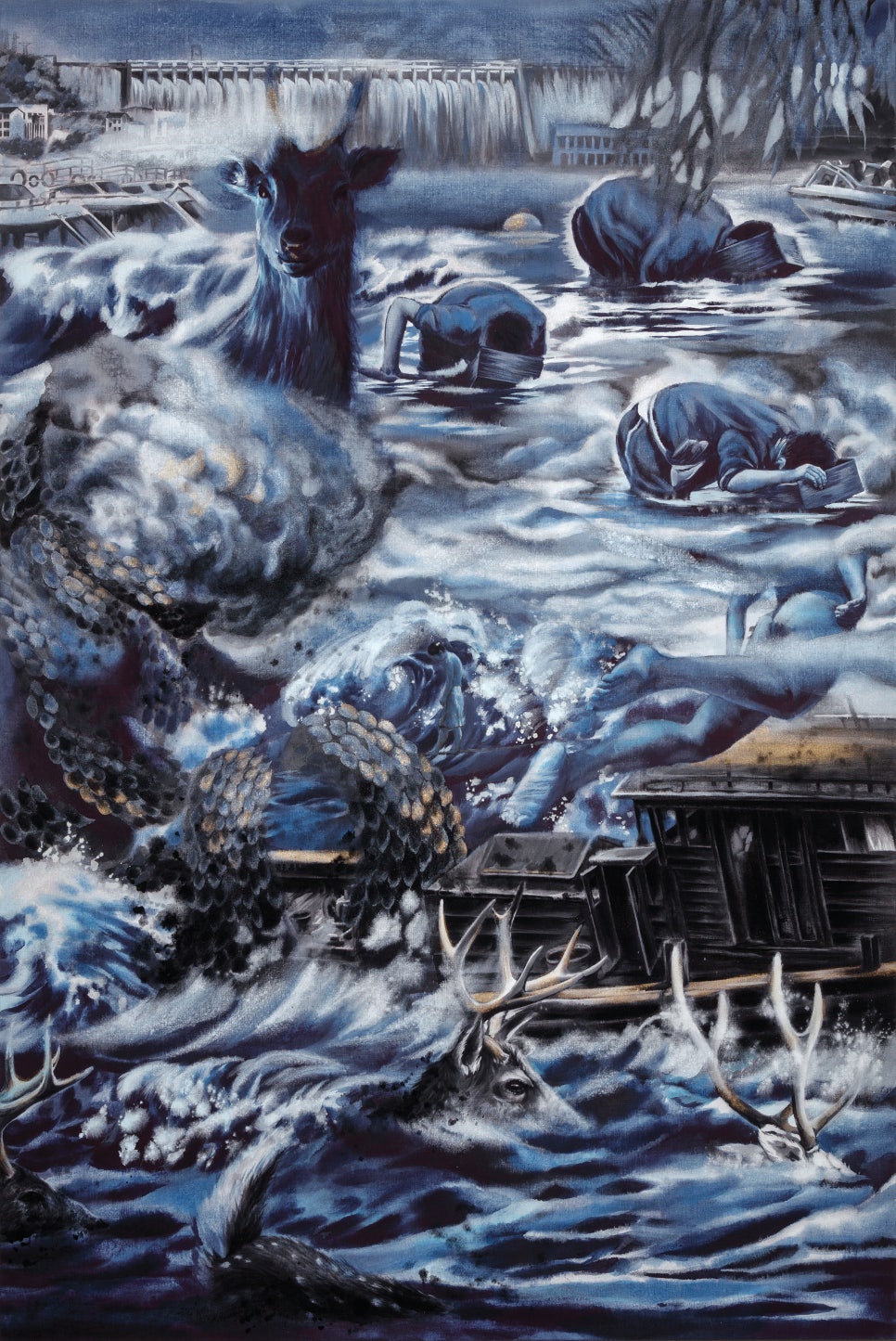
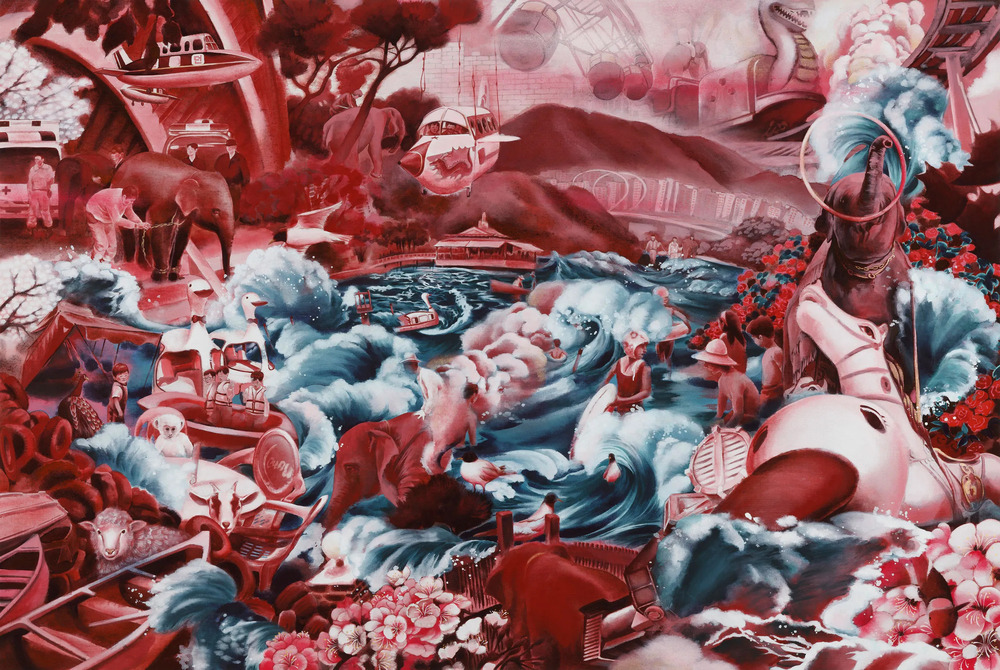
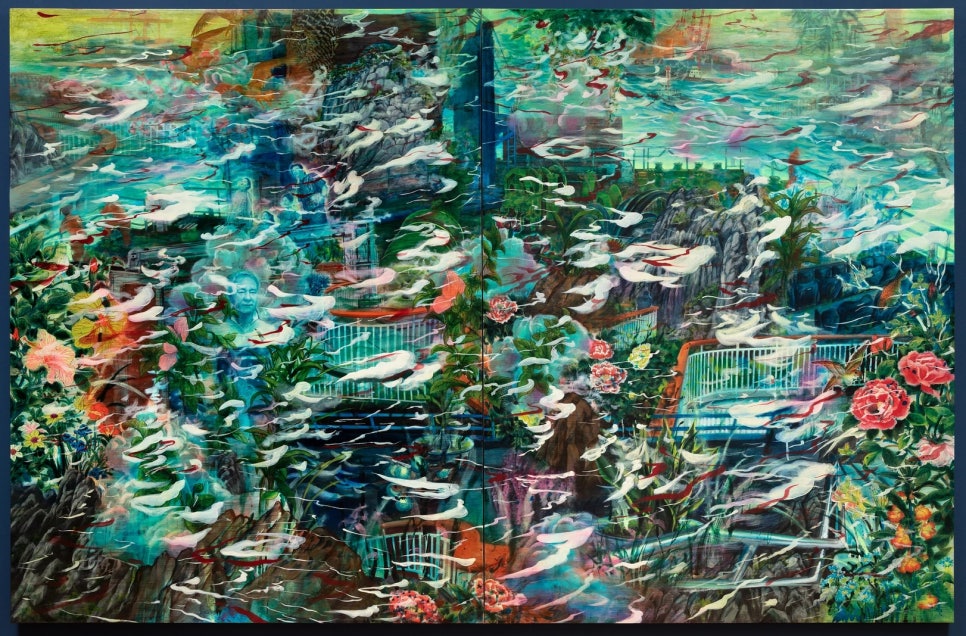
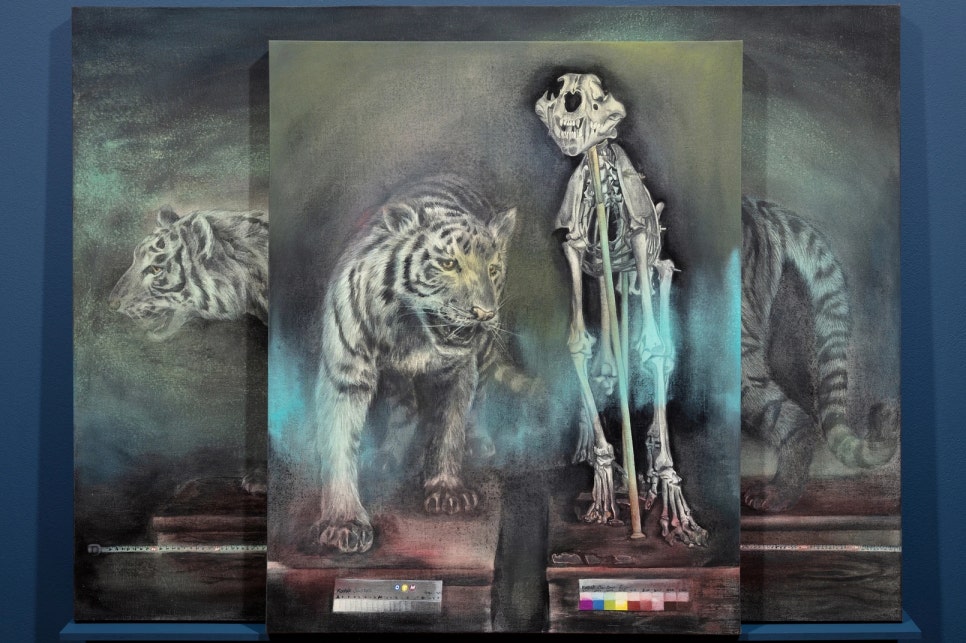
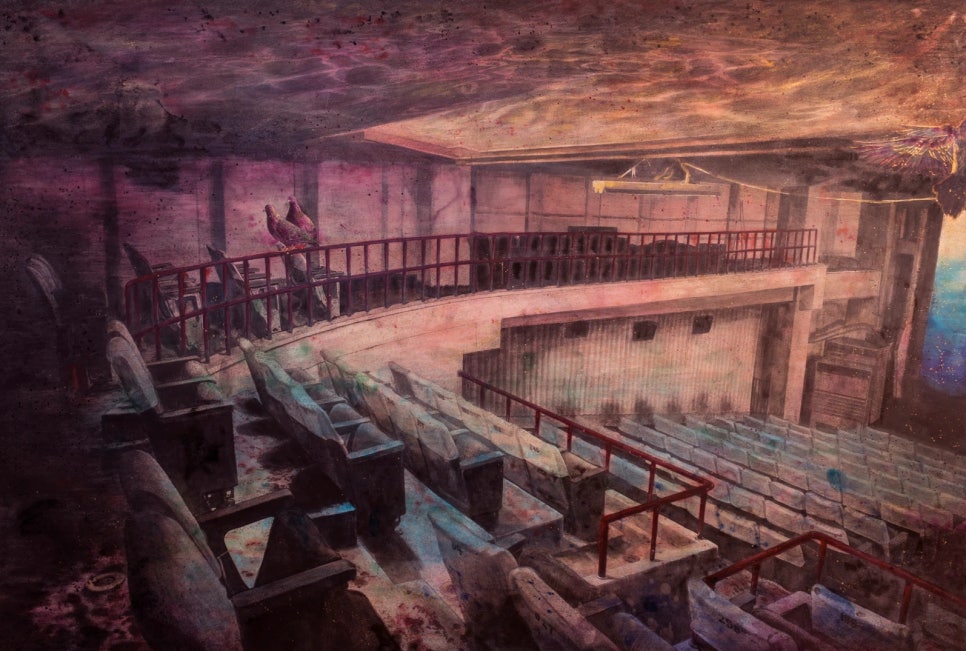
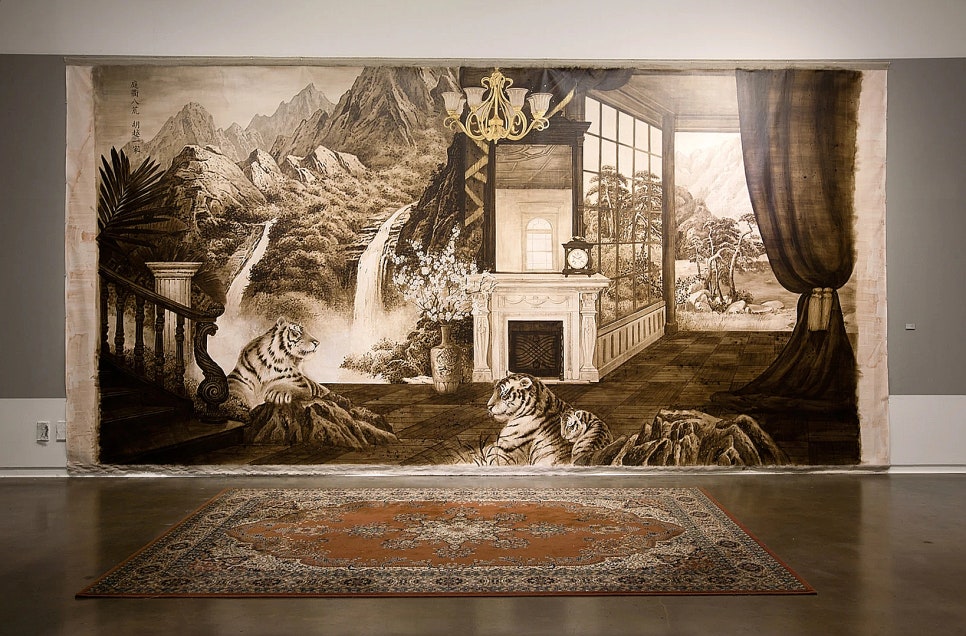
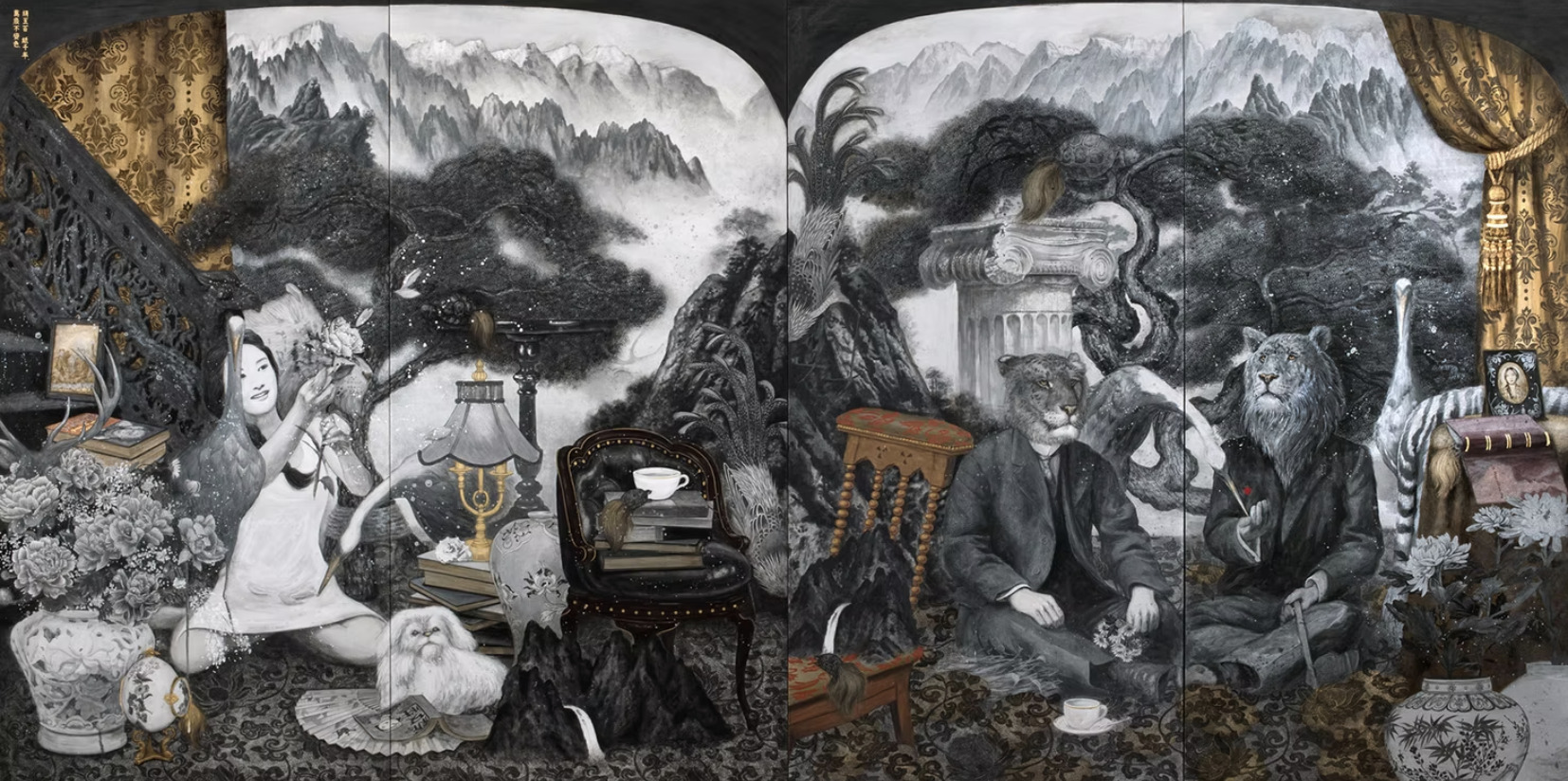
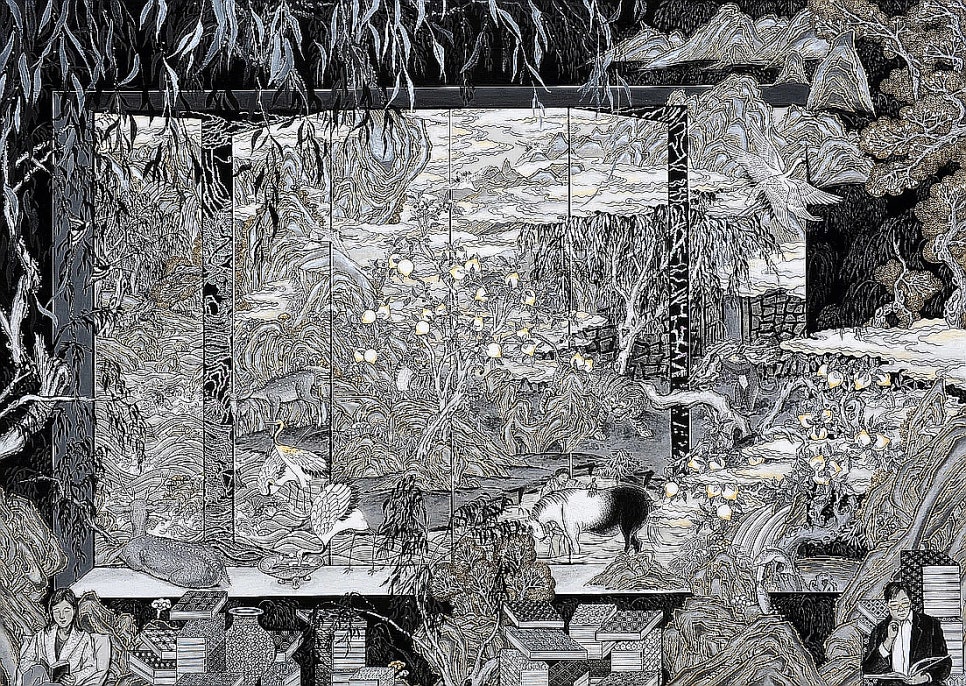
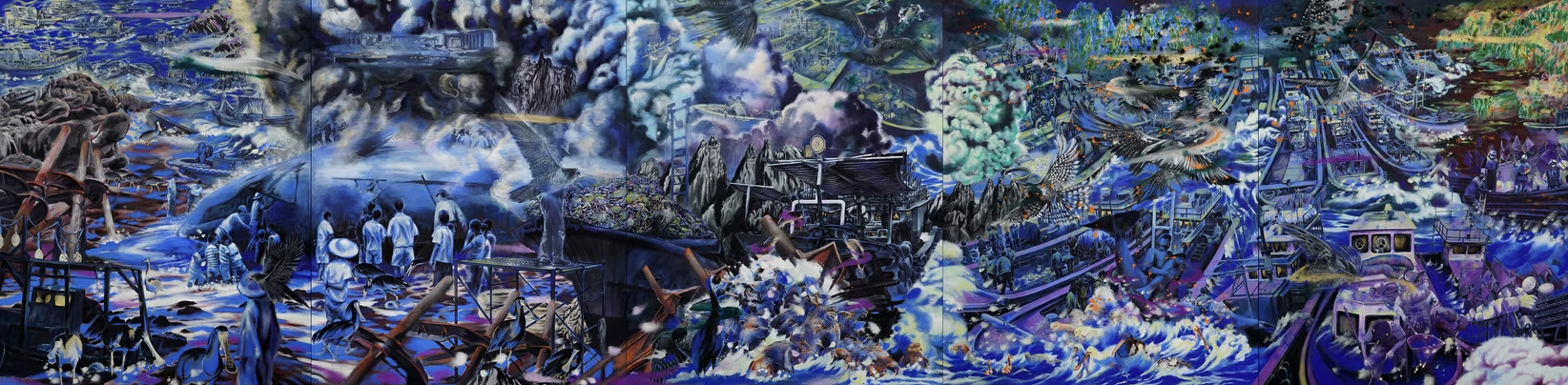
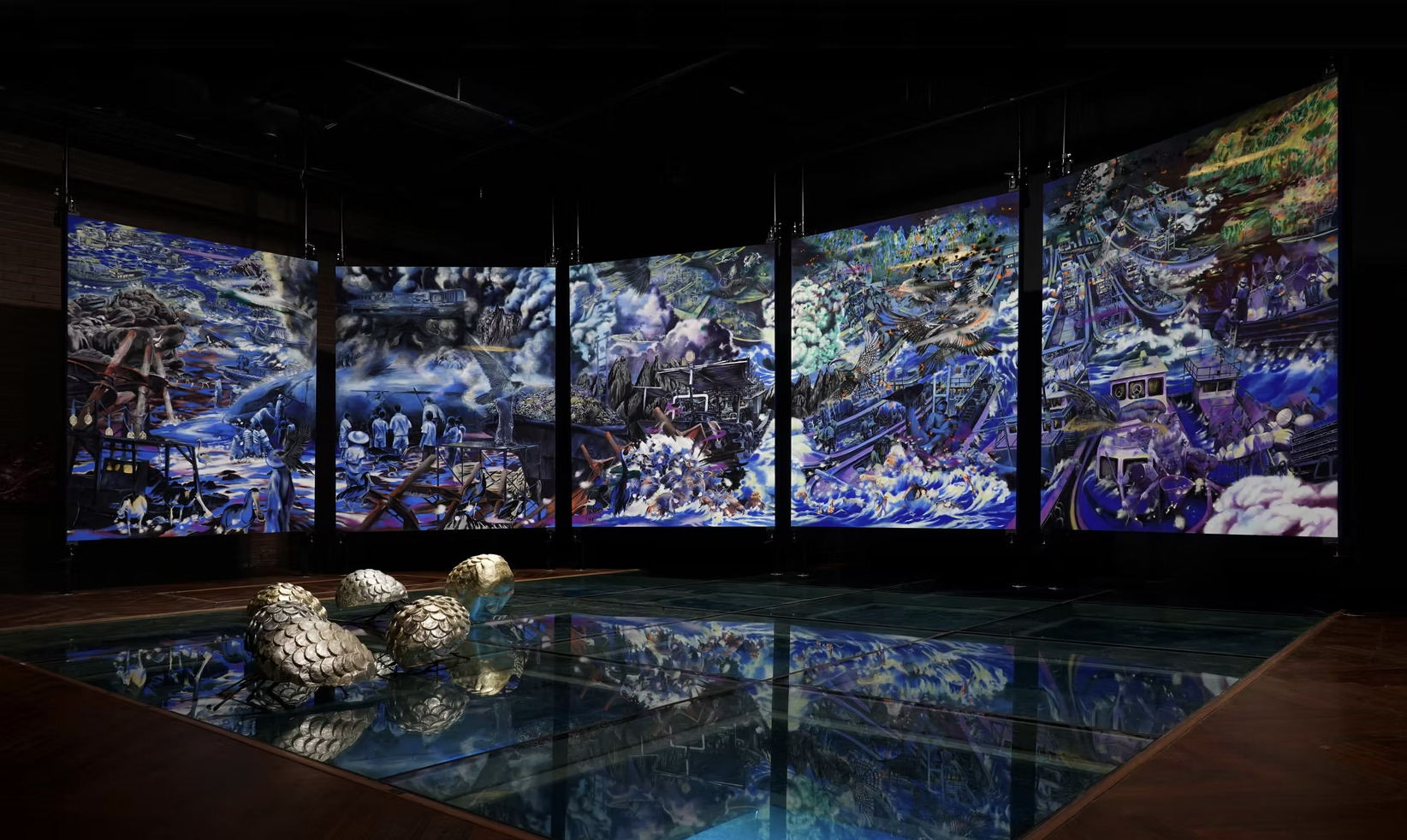
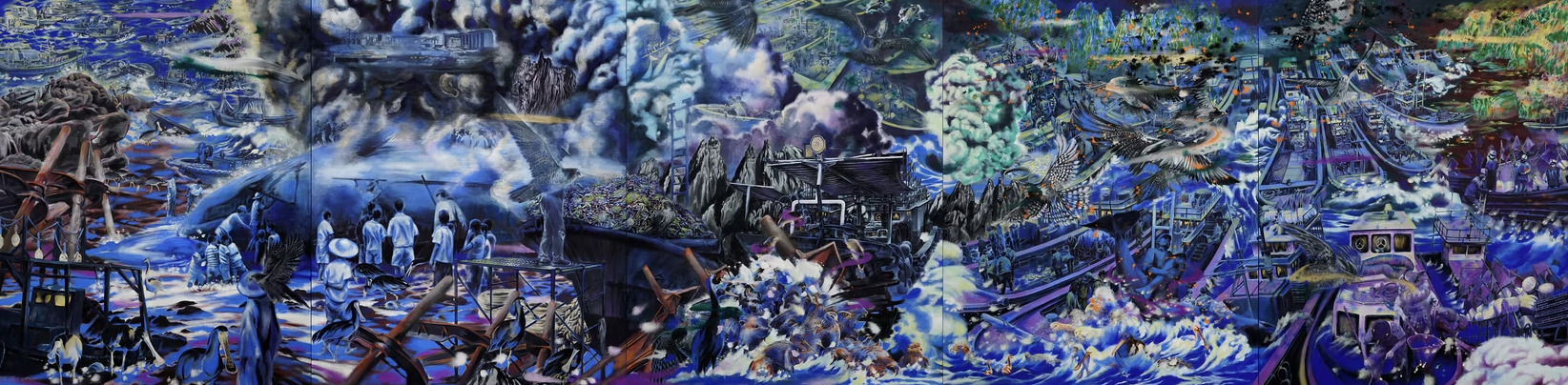
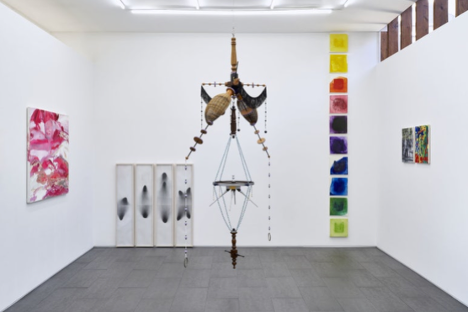
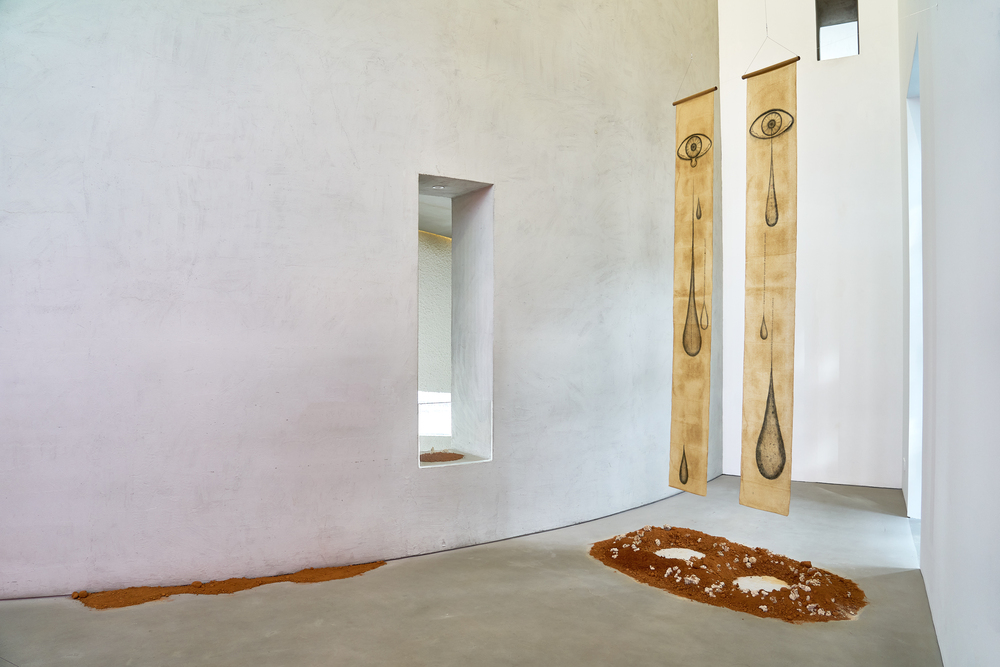
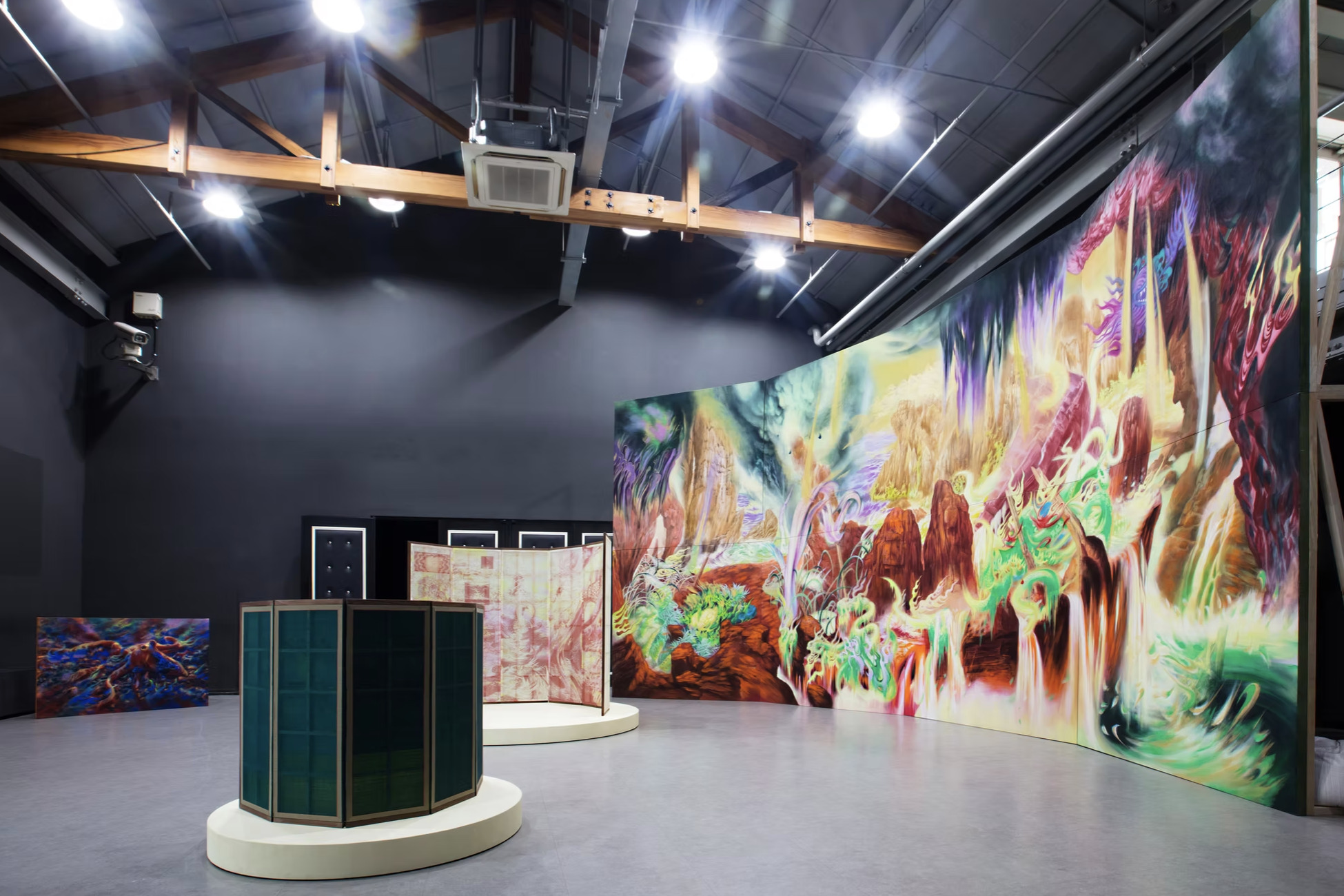
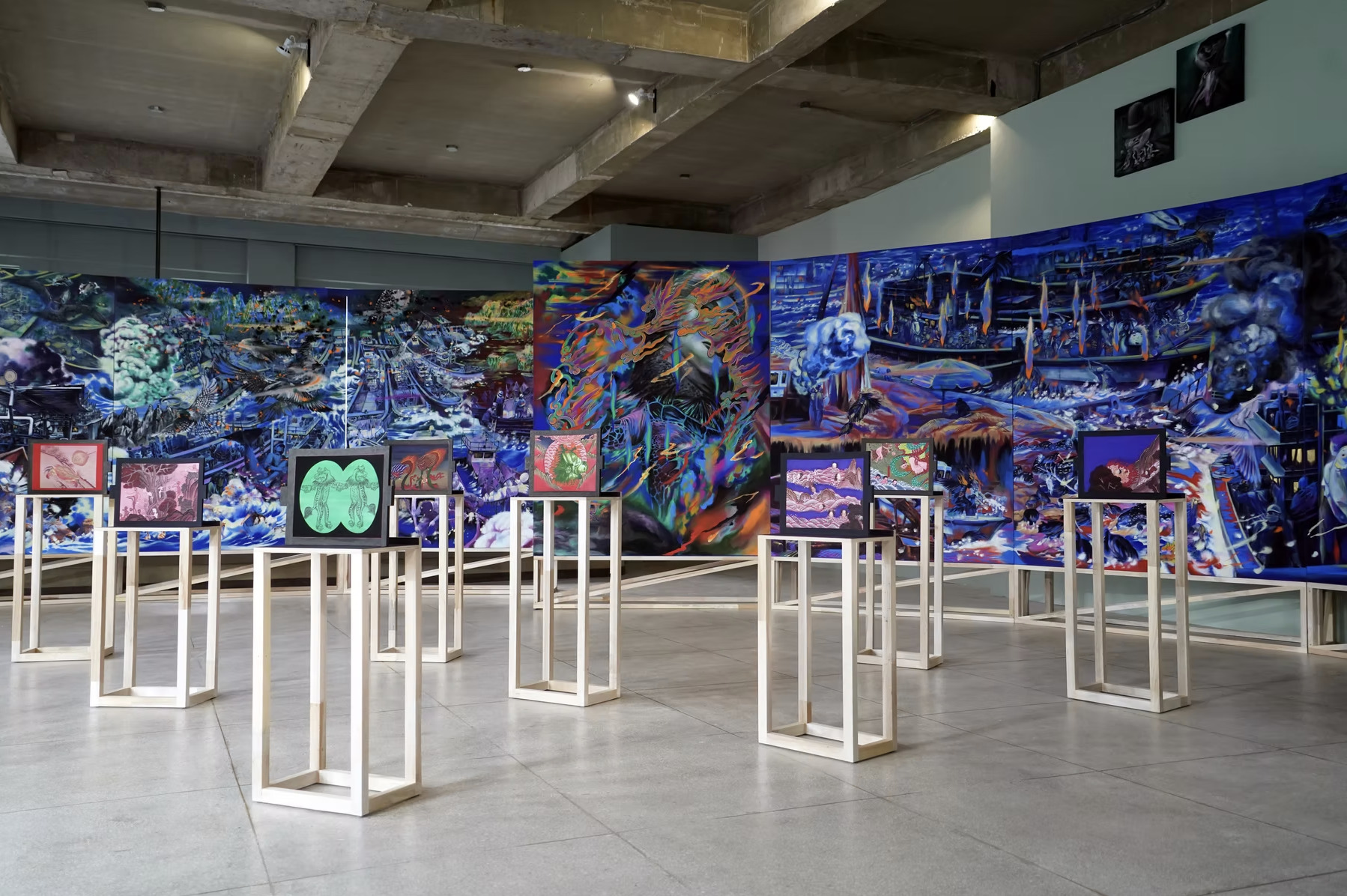
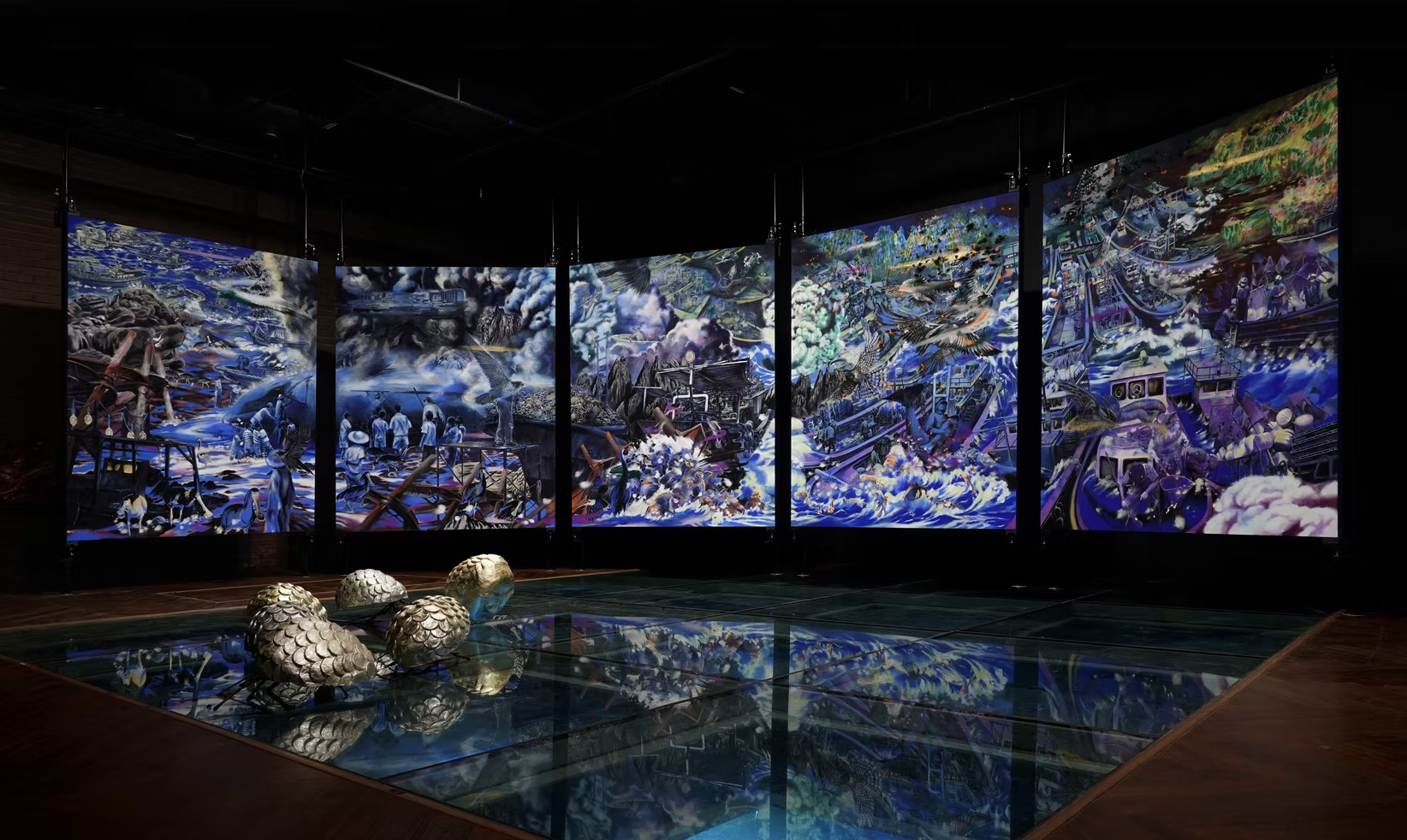
One needs to dedicate a certain amount of time to observing Naomi’s Lost Village on the Sea (2022), whose large scale reaches 227 cm in height and 910 cm in width. In the painting, truly numerous things exist: fishing and merchant boats, a whole variety of birds, fishers and whalers, undulating waves and smokes, rocks and mountains, factories, fishing tools and large anchors; all gathered together to create a spectacular scenery.
The title of Lost Village on the Sea (波市) indicates a market on the sea where fishers and merchants trade the harvest on boats docking near fisheries. The seasonal fish market on Yeonpyeong Island, which used to open every yellow croaker season, was especially famous. Following the schooling croakers, boats entered its port after a boatful of harvests from around Daecheong, Eocheong and Baekryeong Islands on the Yellow Sea.
Fisher and merchant boats from all over the country swarmed and entangled to the extent of creating a ground and covering the horizon on the ocean. In the early 1970s, a newspaper article must have described it a “spree on the sea.” However after the mid 1970s, when the yellow croaker disappeared from the Yellow Sea, the seasonal fish market on Yeonpyeong Island had to close.
According to Naomi, the production of Lost Village on the Sea began from a photograph capturing a floating market on the Korean west coast in the 1930s. Since then, she has collected all ranges of material around floating sea markets.
The whaling scene in Lost Village on the Sea refers to materials related to Oriental Whaling Company’s business that flourished until the early 1930s, while various appearance of birds is linked to their disappearance caused by the ecological imbalance during reclamation and development of the west coast area.
Here, along with whaling scenes from the 1930s, we can also find the 1960–70s landscape of seasonal fish markets, along with more recently developed industrial districts in the coastal area. Within the generous plane of Lost Village on the Sea, all different things from here and there, the past and the present unfold simultaneously.
Conversing and clashing, they create an idiosyncratic energy. It is thanks to this energy that Lost Village on the Sea feels as lively as a scene as if it was happening in front of the viewer’s eyes. What does this energy tell us? I’ve just written that it “feels as lively as a scene that is happening in front of the viewer’s eyes,” yet the seasonal fish market disappeared a long time ago. The market was discontinued already in the 1970s and currently it is hard to find people who even remember the scene.
In that sense, Lost Village on the Sea might appear as a painting expressing certain affection or nostalgia toward things that have lost energy and disappeared or are destined to do so, a work that provokes the sense of loss or melancholy. However, I can hardly discover any trace of melancholy from this work. The scene has surely disappeared, yet doesn’t feel extinct, probably because of the idiosyncratic liveliness that I sensed standing in front of the work.
Naomi is interested much in things that are considered to have lost their energy, dead as well as in phenomena of where they yet can function in a lively way. For example, The God of the Sea, God Who Crossed the Sea (2022) centers an interview with Jeongja Lee, a female shaman who serves General MacArthur as her major god and tells us about “the god of the sea” and “the god who crossed the sea.”
Those are stories about Ungyeo (熊女) from the myth of Dangun (壇君) erecting as a 18–meters–high statue of “the goddess in white” in a park in the Yanbian Korean Autonomous Prefecture, China; General MacArthur embodied as a statue in Manila, the Philippines or as a god of the ocean in shaman Lee’s world.
In the first place, I am amazed by the persistent vitality of beings who continue to live without changing. But soon, my gaze directs toward altering things instead of the unchanged; toward the unappreciated ones in other words, which the believers of deeply rooted archetypes might consider as superficial trivialities.
How can lost vitality in things be regained? According to Hal Foster, artists attracted by so–called “archival impulse” attempt to recoup failed visions in (...) everyday life into possible scenarios of alternative kinds of social relations” or pursue “partial recovery of the utopian demands” through “new connections.” The unexpected connection of ‘Ungnyeo’ and ‘goddess in white’ definitely creates an idiosyncratic energy.
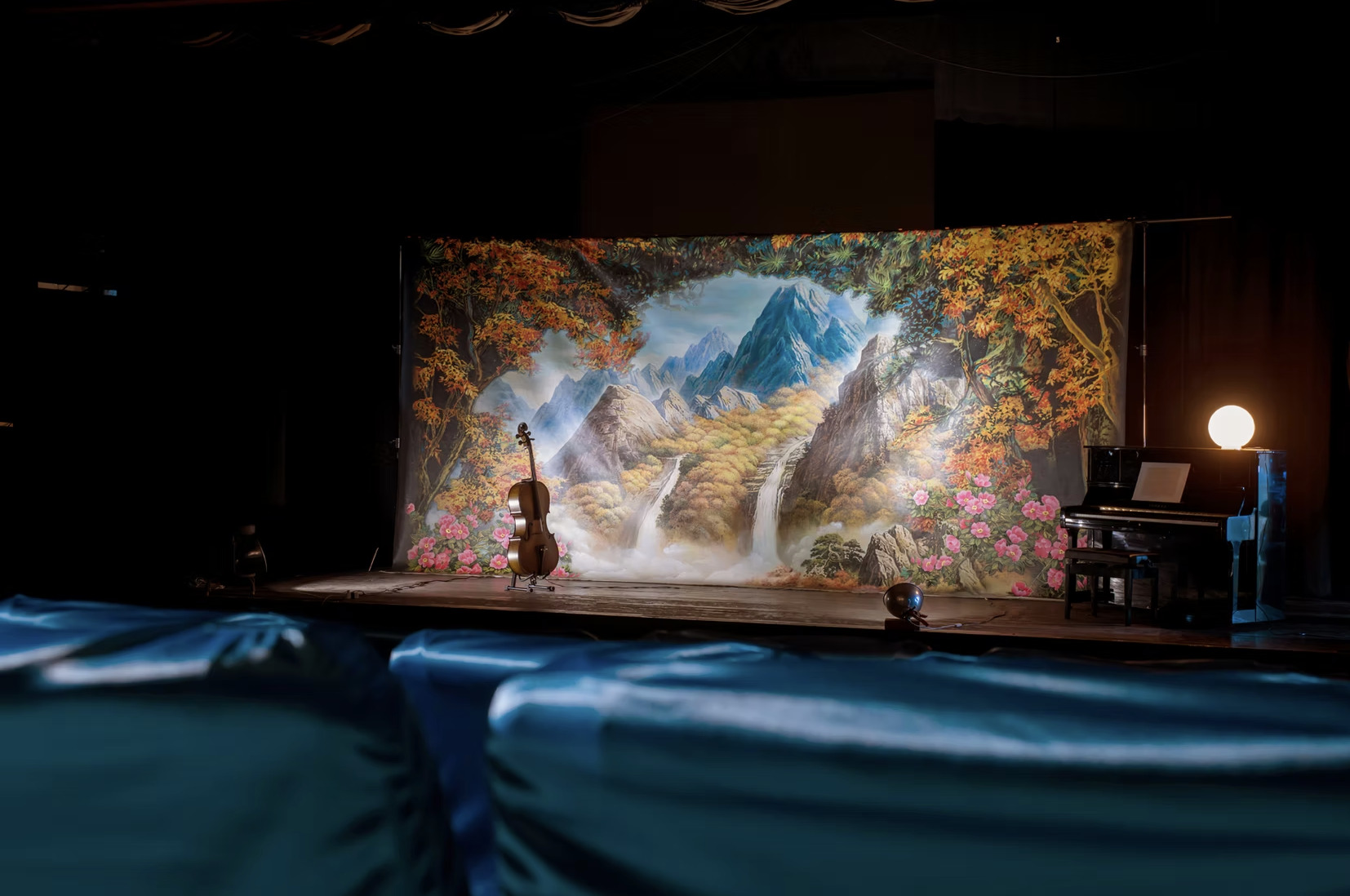
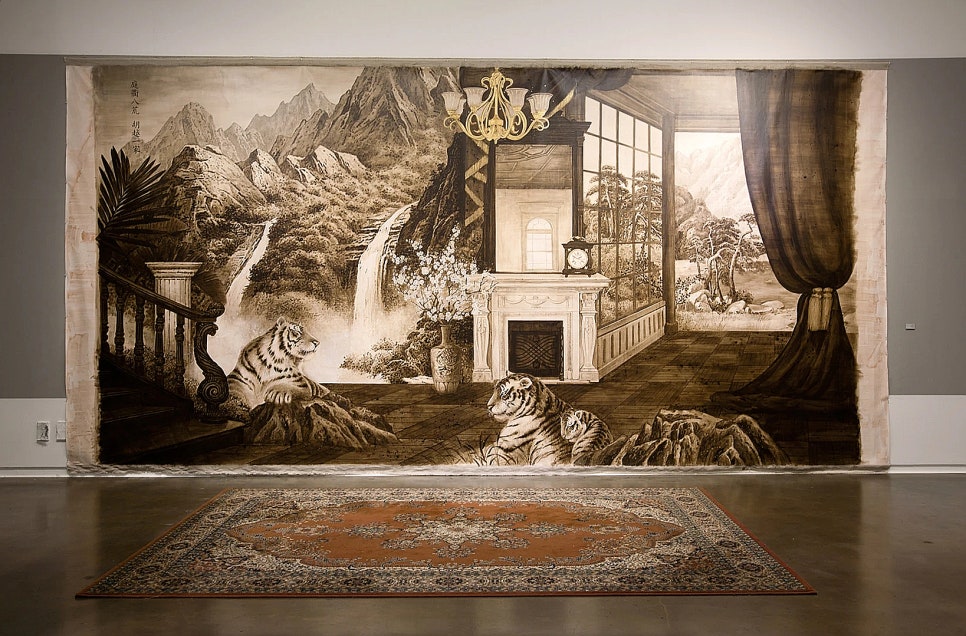
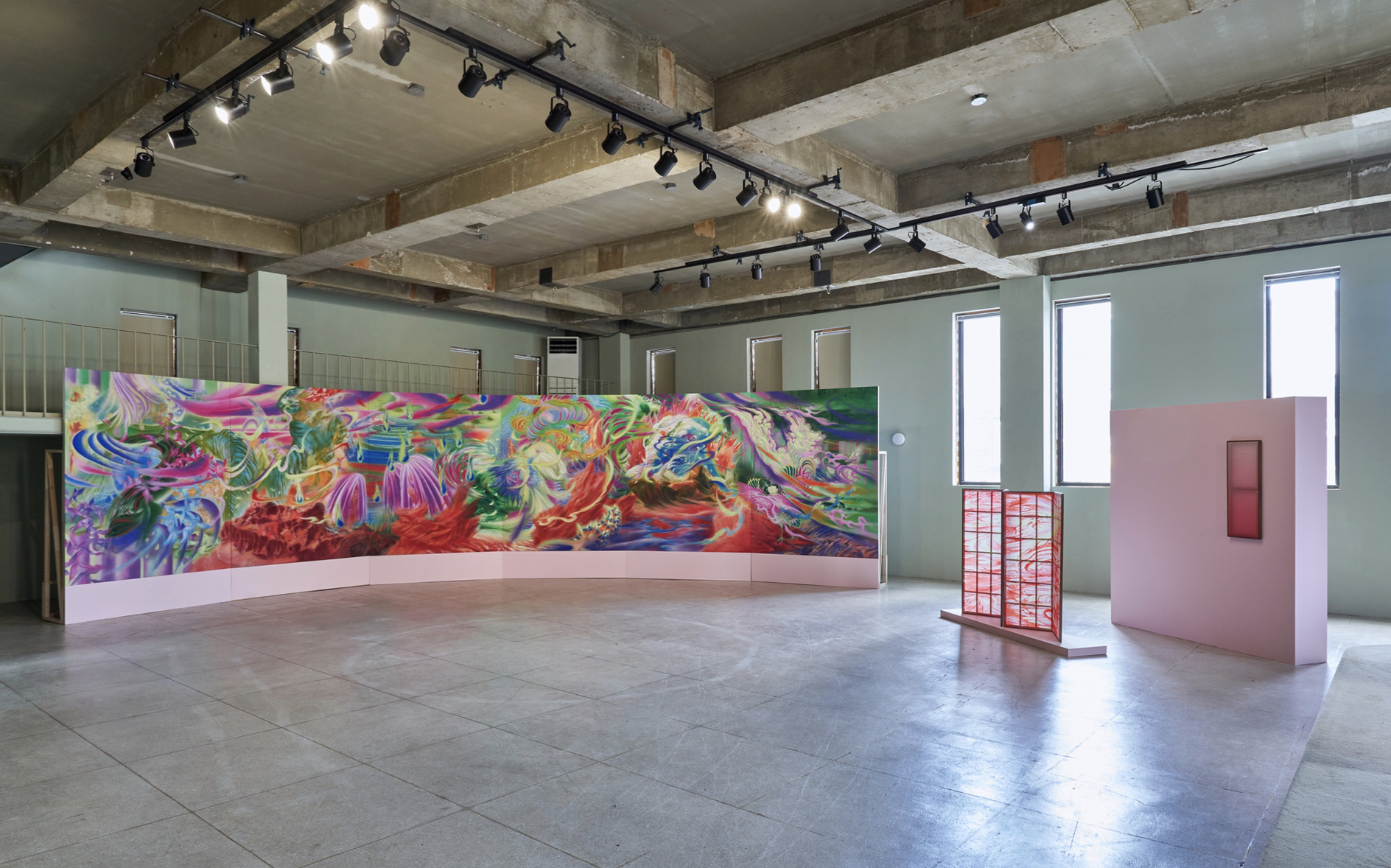
What about the case of Lost Village on the Sea? We need to acknowledge that most of Naomi’s works including Lost Village on the Sea aren’t only large–scaled but also take up the form of lengthy panoramas. At times, her works actually curve like a literal panorama or are divided in two as dioramas, surrounding the viewers. As the artist describes, here she “developed the narrative in dioramic form.”
It is hard to imagine a curving format for painting, yet in art history, the surrounding medium or form of painting actually existed, namely as ‘folding screens.’ Like how acquainted Korean idioms describing something to be “as if surrounded by folding screens on all four sides,” or “stone walls enclosing like a folding screen” tell us, folding screen is defined as a medium that “surrounds” and “covers.”
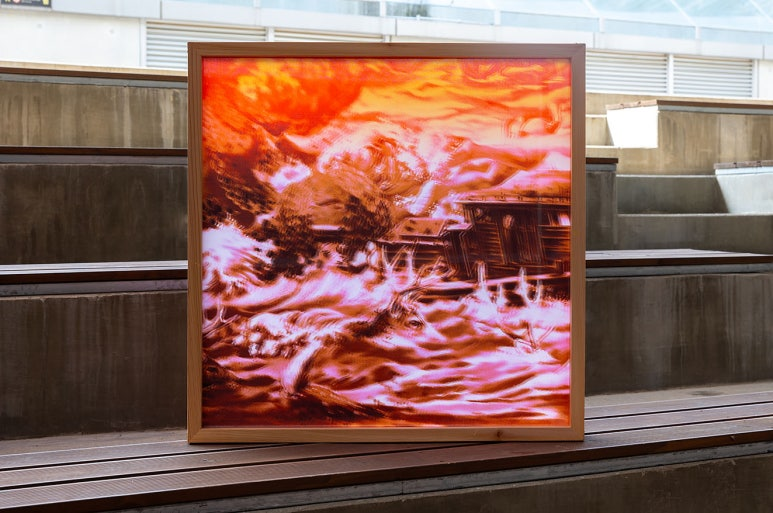
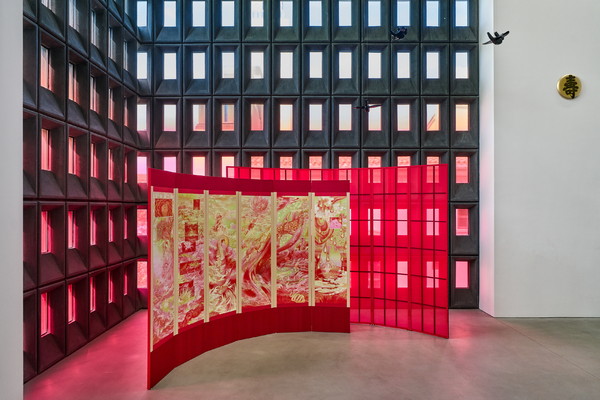
What is interesting here is that the folding screen not only “closes” but also “unfolds,” as “a landscape that unfolds like a screen.” The screen unfolds to surround one. Since a while, Naomi has been experimenting with the medium or form of folding screen. Among such attempts, Waterspout (2014) takes up the form of a folding screen, while Imaginary Gardens With Real Toads (2019) visualizes its structure.
It is interesting to observe how the artist’s recent work such as Lost Village on the Sea goes beyond the form of ‘folding screen’ and evolves to that of ‘panorama (diorama).’ This indicates that she is more actively experimenting with a form that curves and surrounds.
Panoramic expressions adhere to descriptions that it “drastically changes,” “shifts,” “appears translucent,” and “quickly passes.” In old newspapers, we can read expressions that something “turns one vertiginous like a panorama in a chain.” During the Japanese Occupation of Korea (1910–1945), panoramas were also called ‘lively scenery (活画).’
Yet what do the viewers see surrounded by scenery surrounding them like a panorama? Theater designer Edward Gordon Craig, who experimented with rectangular screens similar to folding screens, emphasized immersive stage rather than plots or lines for the viewing experience, as a stage for “pure viewing.” Within a state where “things pass by quickly,” eyes can only immerse in the act of viewing.
This state of being “immersed in viewing” would be the goal of Lost Village on the Seaa, whose “narrative develops in dioramic form.” Of course, Lost Village on the Sea is similar to diorama, yet it isn’t one per se. Therefore, it cannot realize the perceptive condition of a panorama in actual sense. For the same reason, the state of ‘enchantment’ immersing into the act of viewing doesn’t last long.
However, this brief moment of immersion will genuinely be a surprising moment when disappeared things could finally recoup. People in the past used to say unforgettable images vividly resurge in a dying person’s mind like in a kaleidoscope. I believe Lost Village on the Sea is a painting that awakes such an enchanting experience.