I find myself pondering what a “painting” is. What first brought this essential question to mind was a tremendous preoccupation with a certain person’s act of painting. It was around this time five years ago that I first stood in front of an image by this person. Appended to a landscape painted after ten circuits around a neighborhood was the description “water and steamed rice.”
At the time, an image of water and rice appeared in my mind and quickly vanished. But the sight of two words placed side-by-side lingered for some time after that, somewhere in my body. It was like a trace on my person—perhaps the eyes, the mouth, the mind, or the chest.
I was curious whether the actual thing referred to by this was the painting I had seen or the painter’s actions in seeking out the right textures of language while creating her image. Her painting was marked by a texture that could not immediately be put into words. It also bore similarities to the textures of the words she had given as a name. When trying to think of what a “painting” actually was, I could not help imagining that person at work.
When I visited Leehaiminsun’s studio, she had amassed a stack of old paintings in her studio, and as she gradually recalled their back stories—things only she knew—she seemed to be searching for ways of bringing out what had not yet been fully said. She told me that there were images that she really wanted to depict, but that they did not really allow themselves to be painted.
When I asked what they were, she said she wanted to create an image of a deeply dug spot outside that was covered over with floorboards, but this had not really worked out so far. The image that those words evoked briefly appeared in my head and disappeared, and I found myself quietly troubled by the artist’s situation—having something that she could not express, being unable to yet paint what she wanted to.
Seeing her at a loss for words, not able to render the commonplace scene of floorboards covering over sunken earth, I found myself pointlessly curious to see the image that still hadn’t come to her mind. Might I find a way by lifting the covers on the stacks of paintings in every room?
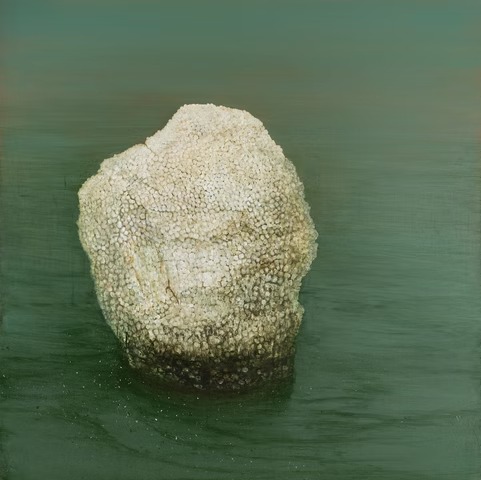
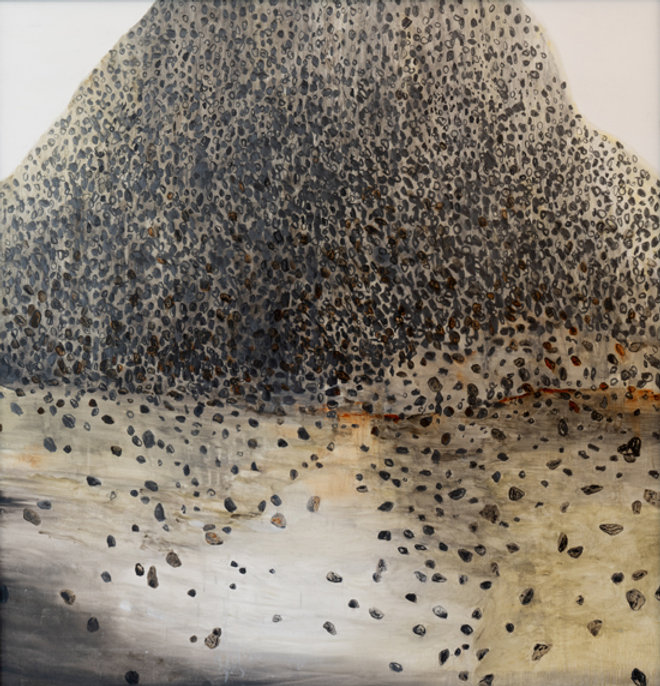
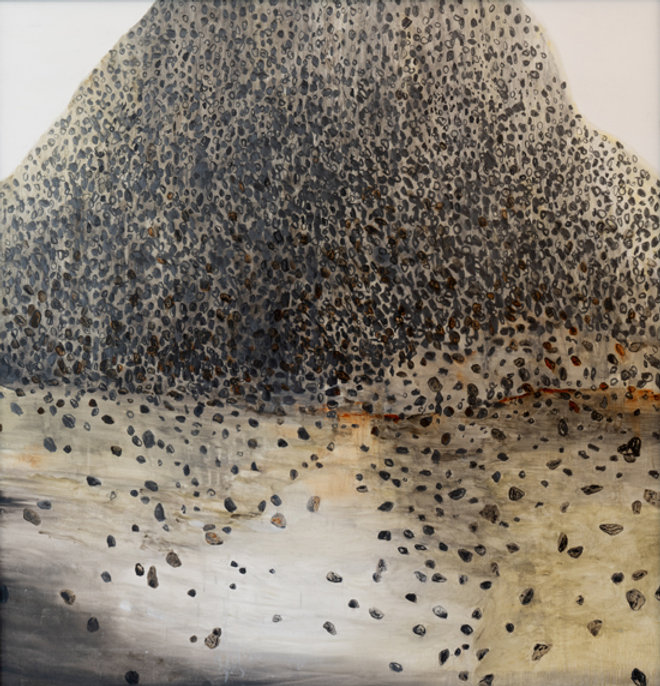
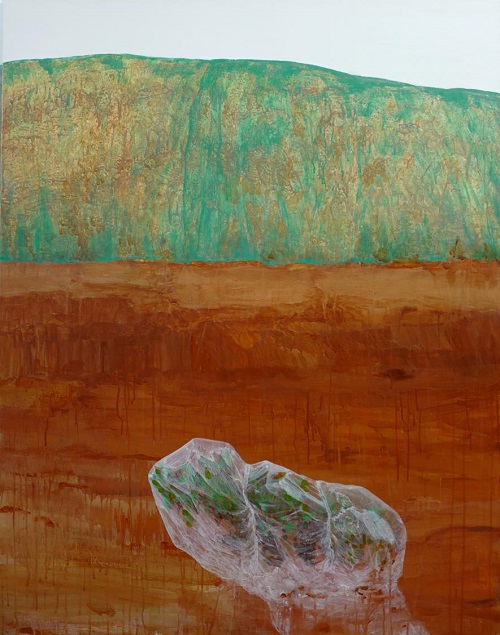
The painting that she was working on at her studio around that time was Where the Man Who Lost His Golden Tooth Headed For (2018). What was it that kept summoning him before her? How much had she painted the stones covering the tall mountain? The pebbles rolling down to the ground from the mountain’s summit are met again and again by a slow gaze that passes over the mass.
Or perhaps the gaze is sparsely cut by the textures of the rocks, which seem embedded in a void spanning the distances from the faraway summit to the ground right before me. Leehaiminsun created granite textures of stones and an empty mountain covered with them, and I quietly look to see what it was that she intended to depict.
Then I suddenly arrive at a kind of optical illusion with the textures of the tiny stones that cover the empty mountain surface, where I cannot tell whether it is a mountain or stones that she has painted. At that instant—the moment when the stones and empty mountain are no longer distinguished but appear as a “painting” with a single texture—it occurs to me that this place “where the man who lost his golden tooth headed for” might not be a landscape, but instead the emptiness of a blank page where a picture was placed.
Perhaps it needed some tangible texture to cover that voidness. That texture is then shifted into the weight of “something” as it is overlaid on the forms of two people clutching each other. The sense of weight created by those figures’ isolation and the sense of robust, no longer separable movement among the incomplete forms in The mass_8 (2018) allude to a presence unified with that—one that might break apart into the textures of stones again at any time.
In short, the two human figures who clutch each other, as if oddly isolated at the painting’s center, carry all the textures of stone on their bodies. Rocks like heads, fists, and knees are formed like part of their person: behind their curving backs, over their opened elbows, under their kneeling feet.
Thus, the role of the stones—which had assumed responsibility for the painting’s texture with their smooth irregularity, as if part of some ruse—is shifted over once again to the true weight of experience inscribed on living bodies. Just as urgency and emptiness come together in the body of the “man who lost his golden tooth,” different weights coexist side by side in the painting, as if they might condense with the excavated textures and evaporate.
We cannot tell whether the man who lost his golden tooth exists inside the painting or outside it. There are also elements I did not notice even after looking for some time: a piece of fruit positioned straight over the outstretched elbow between the two people, as well as another stone painted with equivalent weight beside it, as if striking a balance.
Seeing this unexpected shape standing straight in an unpredictable place, it seemed as though the meaningless actions of these two isolated individuals in an utterly empty setting were a struggle to sustain such meager weights. It felt quite plaintive, and it spurred me to look back through my own pointless thoughts. Then I found myself thinking once again of the artist as seen from behind, lingering in front of these shapes.
I quietly thought of her raising and lowering her brush and pencil in turn, over and over, and of what was going through her mind when she decided at some point to paint a single piece of fruit over the two figures’ interlocked elbows and lone, modest stone. Perhaps this was the place he was searching for—the place that the person who wished to create an image headed for. A distant, utterly unknown place deeply imbued with a weighty emptiness, where incomplete forces intersected, not easily detectable by anyone.
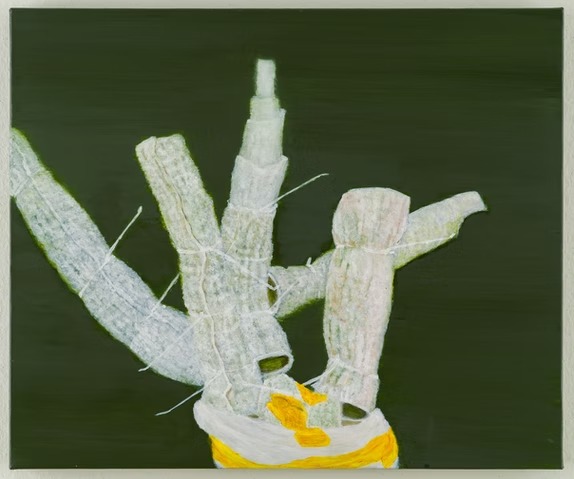
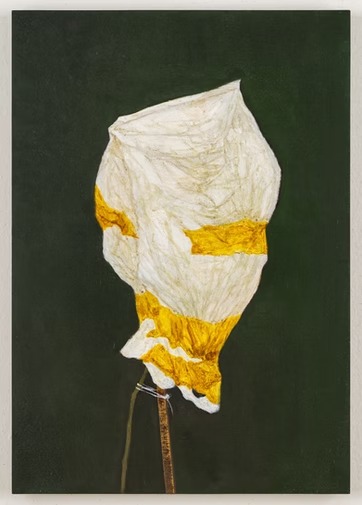
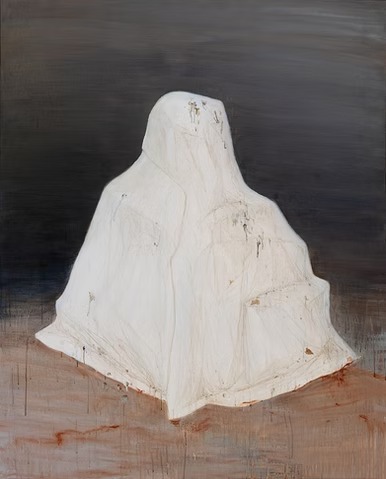
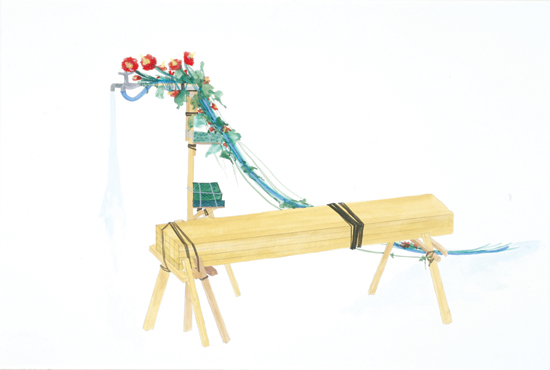
Leehaiminsun refers to this place as the “outside.” In a dark, indeterminate location, she has painted images where something is covered with incomplete elements, like a temporary screen, and given these paintings that seem to show nothing the title of Outside (2018). She has literally sought out uncertain presences—witnessed occasionally on the fringes of daily experience, as if abandoned outside in a kind of loose, distant outdoor landscape—and transferred their textures into painting.
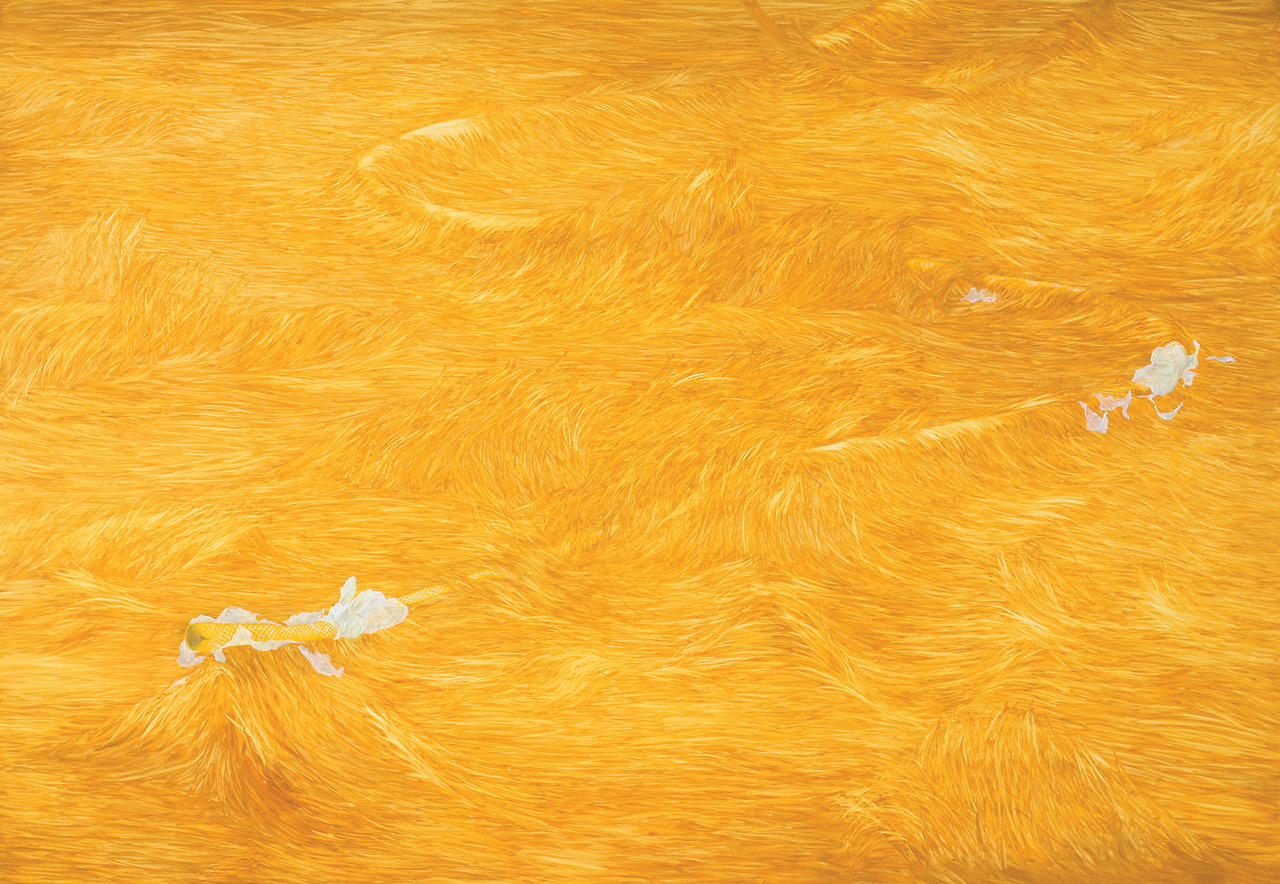
What she is painting is texture. Perhaps what I have often referred to as the “textured surfaces” in her paintings might, on closer examination of her images, exist somewhere outside, in a place where the surplus elements of form, daily experience, the world, and forces have been pushed out. Leehaiminsun focuses on the frail textures possessed by objects and landscapes that are nothing and nowhere, and thus alienated from the gaze.
These are what she brings into her images. The textures of an “outside” alienated from the gaze are transformed into the surface textures of a painting. Appearing like a label next to her work’s title is a straightforward description that reads “acrylic paint on cotton.”
This speaks to the impoverishment of superficial representation in painting, like an illusion of form, while at the same time expressing that this is a surface of contemplation, achieved through mutual adaptation between the material reality of an inexpressible form and the substance of acrylic paint on fabric. The texture of a material as both a painted surface and the surface of a form bears a resemblance to the inexpressible ideas of an artist who has long observed landscapes that exist outside.
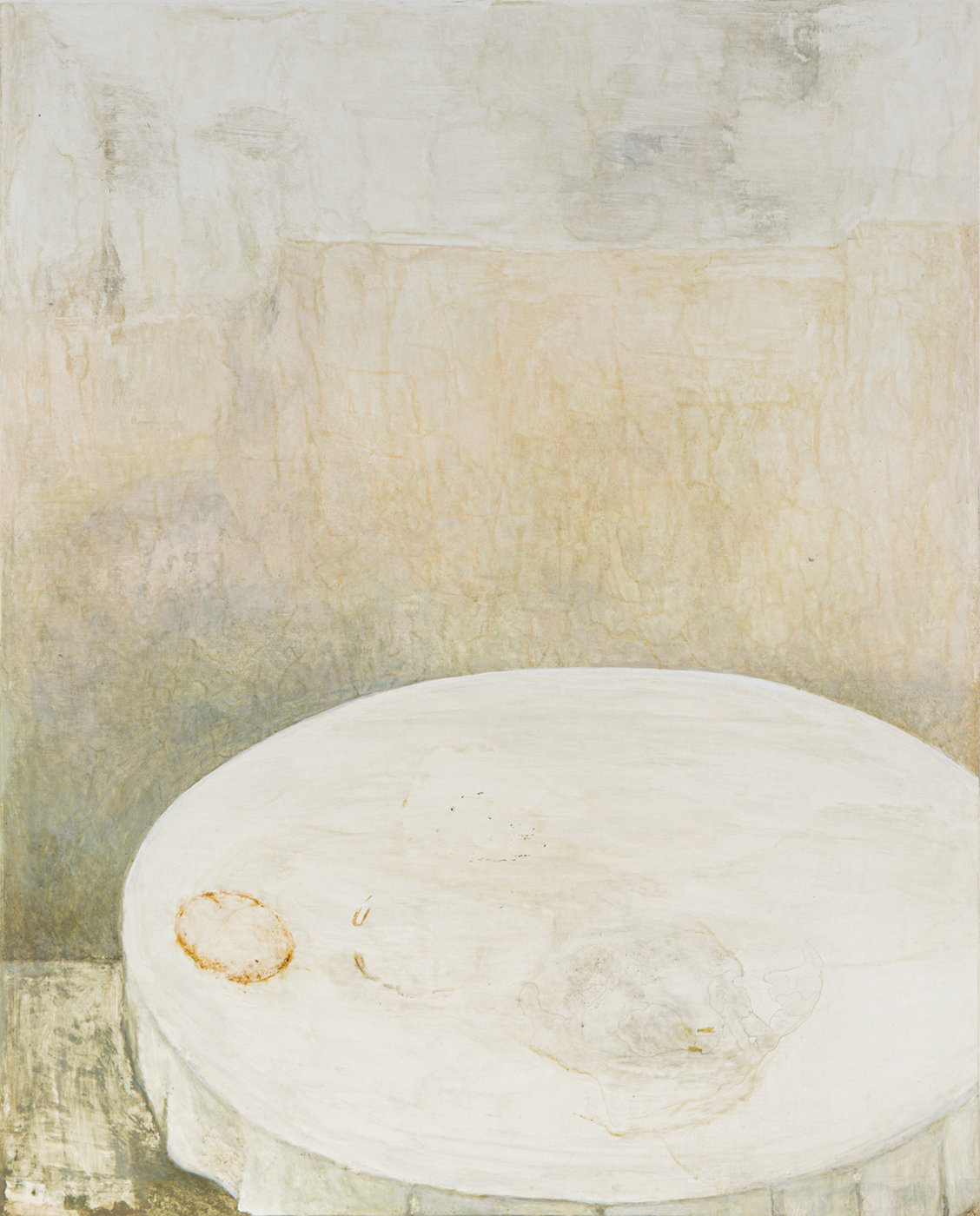
I turn my attention back to the images that she has painted. I stop trying to imagine the entity concealed within the white fabric without thickness, and I begin looking at each of the forms realized through acrylic paint on cotton. The emptiness on the white fabric is filled with the differing textures of faint presences: stagnant water, a dead moth, bird droppings, streaks of rain, dust gathered in folds, and the splotches left where something has ceased to flow.
The artist’s ideas move closer to alienation—from the inside or on the outside. To transport the textures of alienated forms (or the weights of those textures) into her images, she assumes responsibility for both the unrevealed reality and the superficial isolation from the painting. Such sentiments are deeply evident in her work Strong wind (2018).
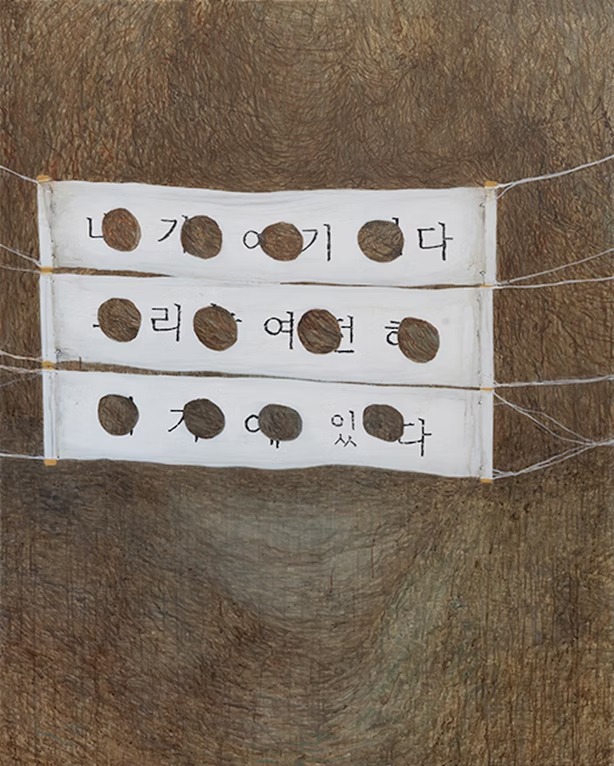
There is no “strong wind” in the image she has created. It boasts no climax, yet there is a repetition of weighty gestures that resemble a kind of silence in the face of a strong wind. The work recalls A Place without a Climax: Pose (2017), which I saw at a solo exhibition last year: using powerful textures, it draws an analogy between the concrete existence of displaced presences on the outside and the power of public expression.
The statement “We are here” speaks to the absolute presence of “we” who “are” “here.” Leehaiminsun sustains this public statement with the slender cords of a white banner and an excess of makeshift holes. Rather than expressing the reality of what those words mean, she seems to be attempting a form of self-sufficiency from alienation and isolation, in order to sustain the words when the strong winds blow.
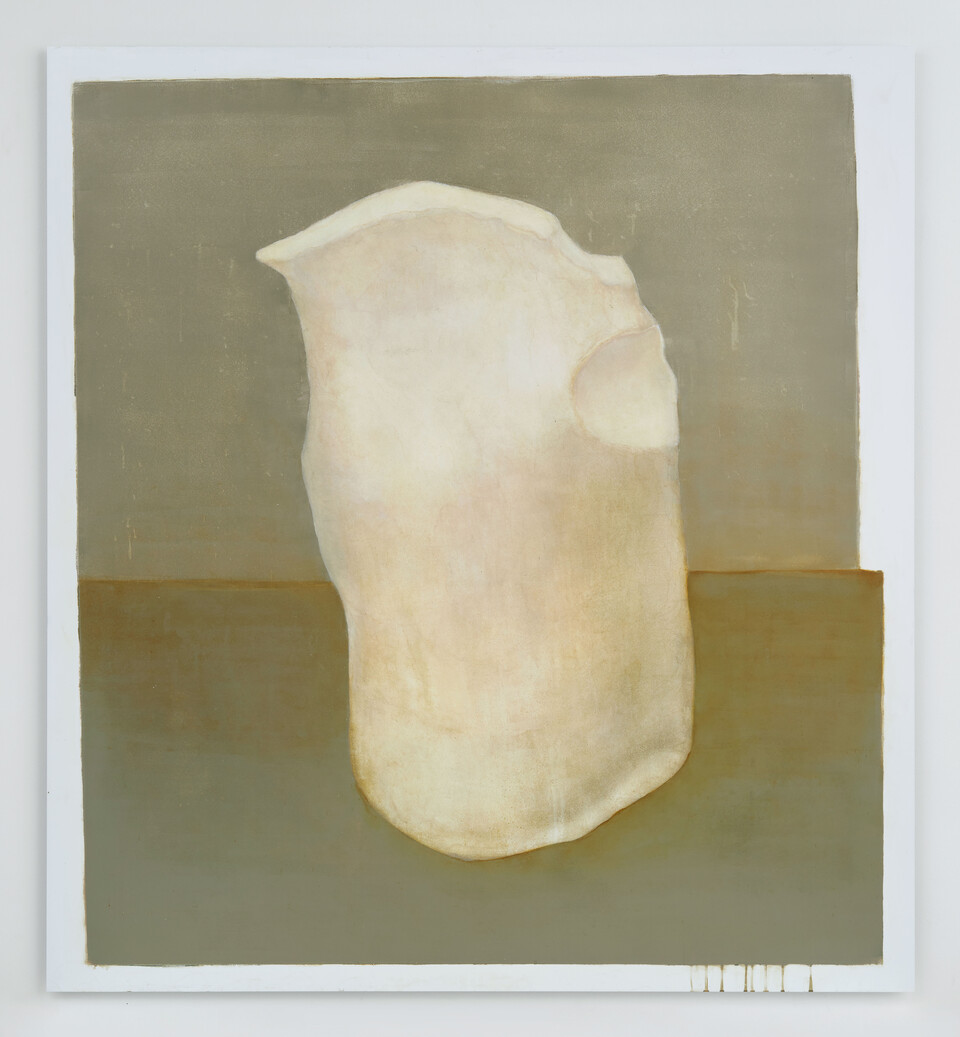
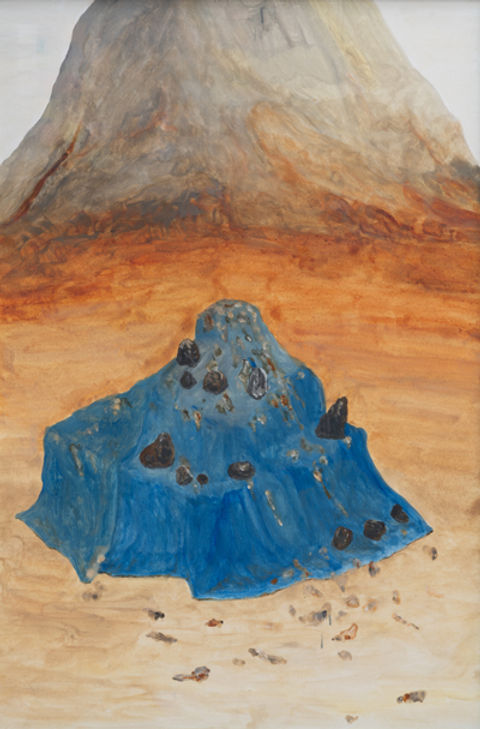
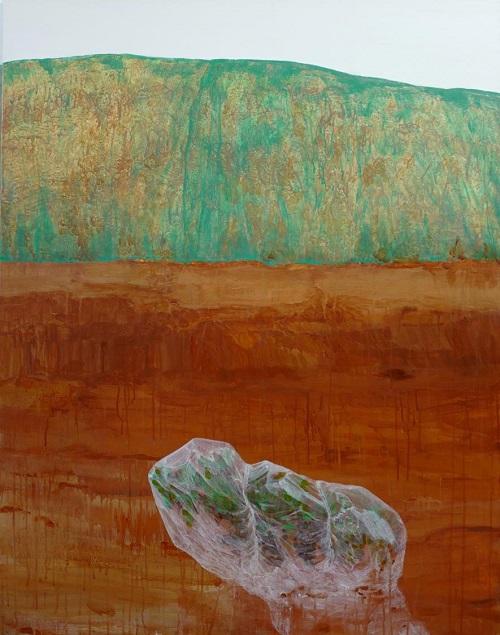
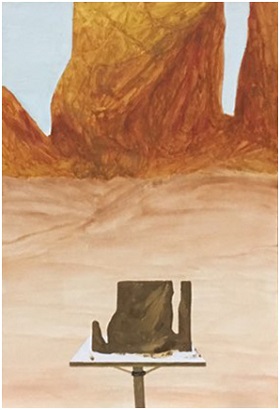
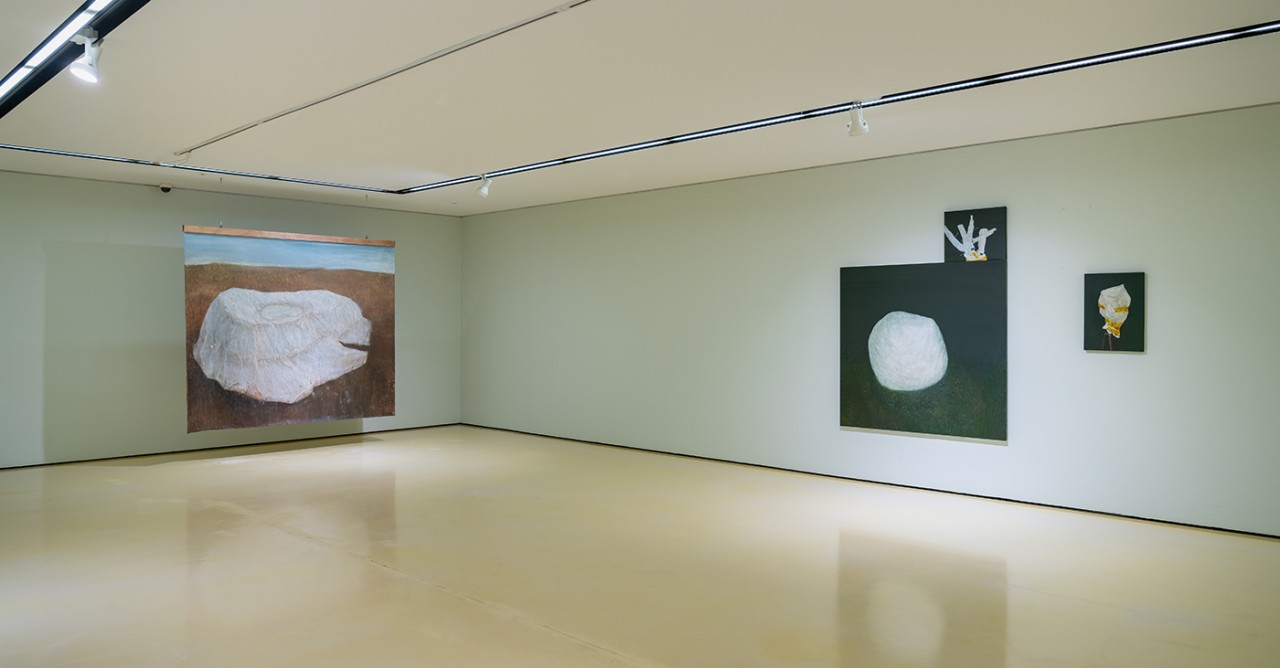
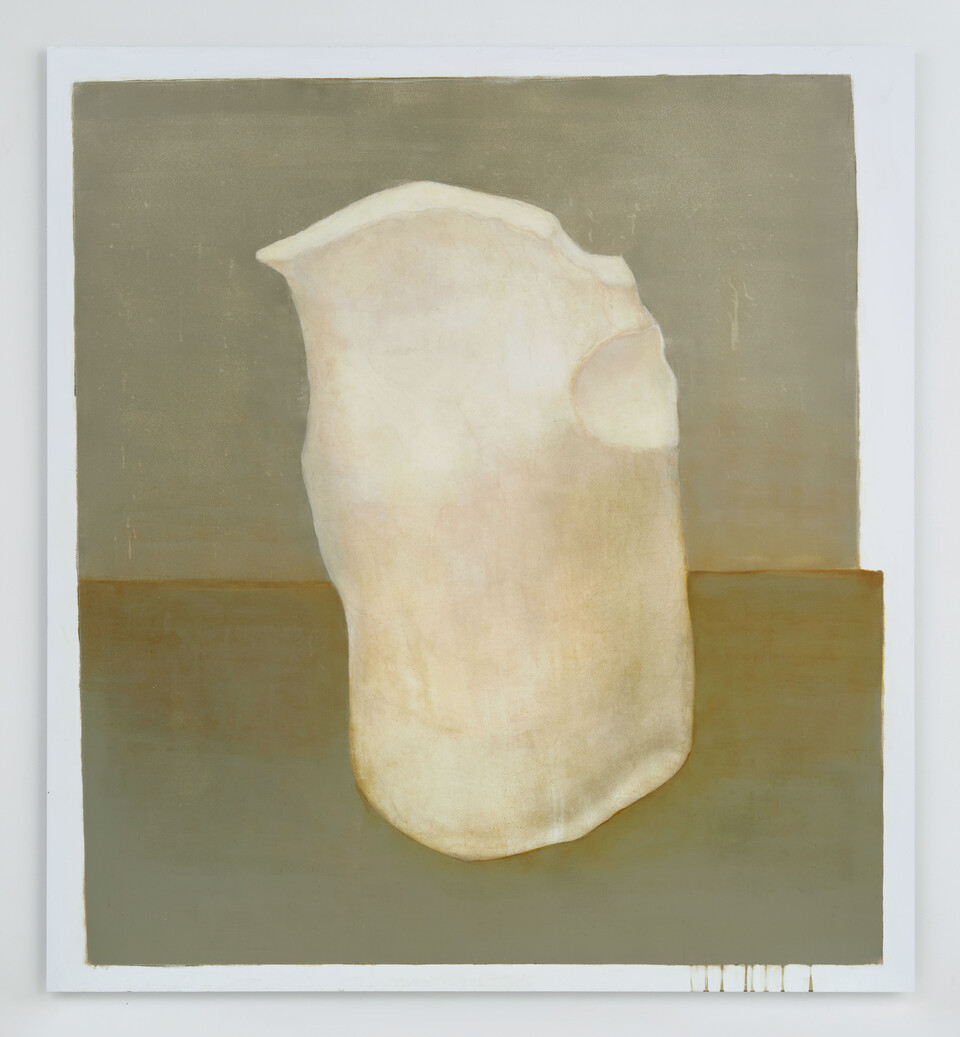
In the series ‘The mass_0’ (2018), the center of the canvas is occupied by an “outside” landscape, against the backdrop of a mountain bereft of anything besides earth and stone, as if baring its flesh. Alternating once again between the weight and texture of shapes, it evokes the motions of a person creating a painted surface.
Just as the artist circled a neighborhood ten times to produce the outside landscape and sticky textures of “water and steamed rice,” she discovers temporary landscapes, untouched by words and gazes, and transforms them into paintings with robust textures. Yet her paintings also resemble the surfaces of the temporary landscapes she is constantly encountering.
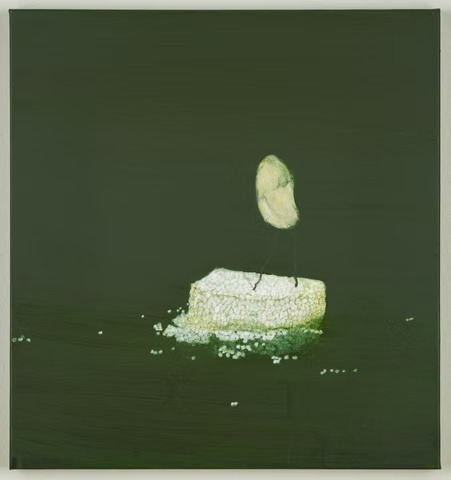
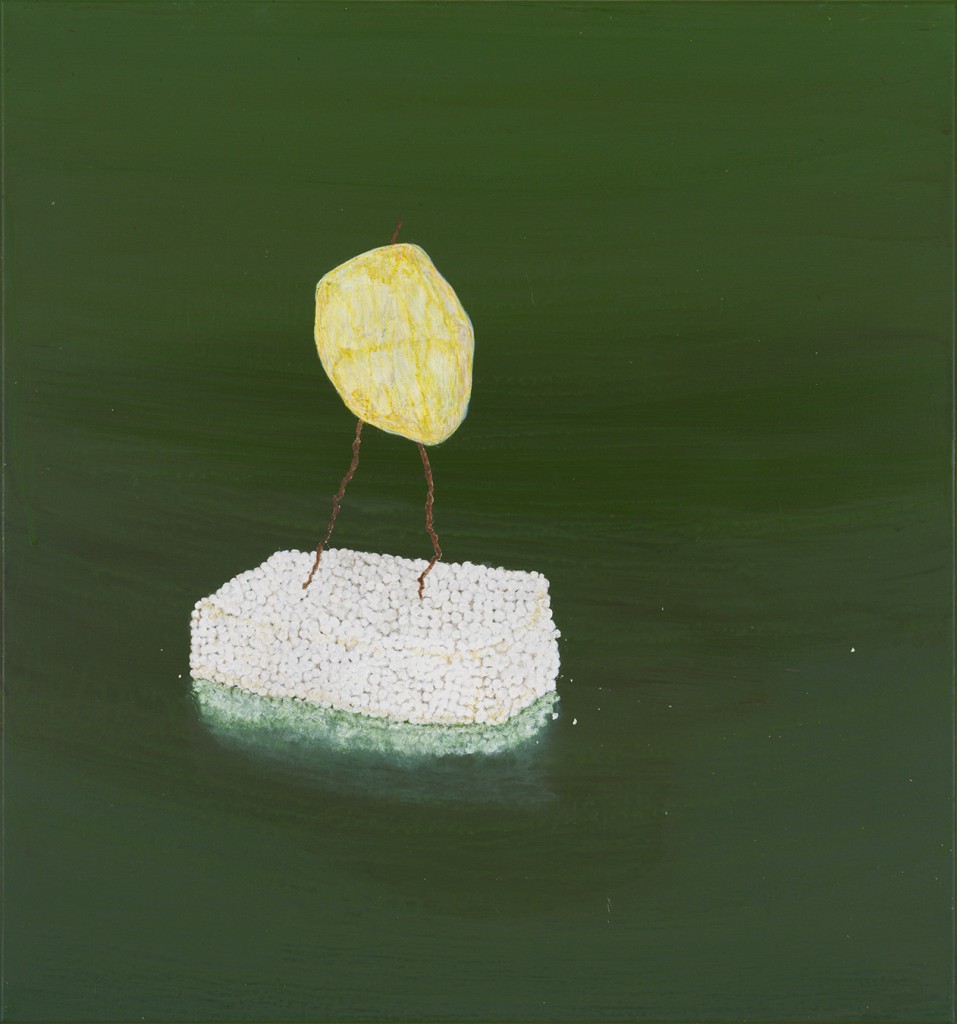
I now find myself thinking of the ways in which the painted textures on paper existed self-sufficiently in series that I had observed long before, including Turing around tench time in town (2012–2013), Inanimate Subject (2016), and ‘Seongmi Coming from Mount Seongmi’ (2016–2017). In each case, images rendered in small and ambiguous form were stood up self-sufficiently against temporary supports of branches and Styrofoam, rather than being hung on walls or placed in frames.
This appeared to be quite a significant decision—allowing the viewer to connect with the weight of a painted surface that robustly withstands the larger emptiness behind the small, frail canvas. I found myself remembering this when seeing three works from the series ‘The mass_0’. Like the raw flesh of an undefinable emptiness, the textures of the small muddy masses and tiny stones—placed weightily over covers that reveal nothing—appear clear and complete when compared to any other forms.