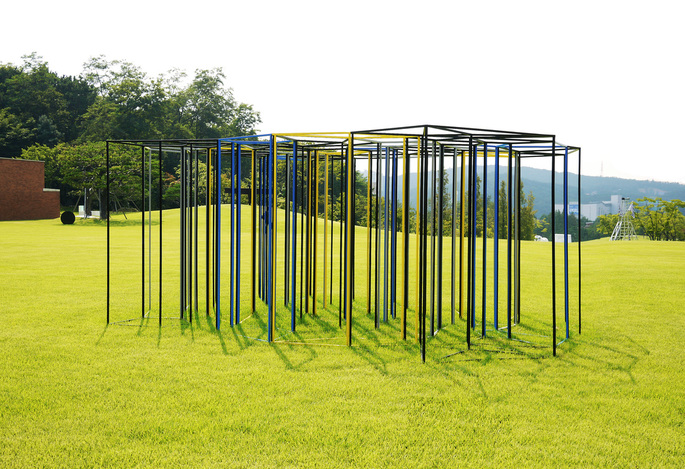
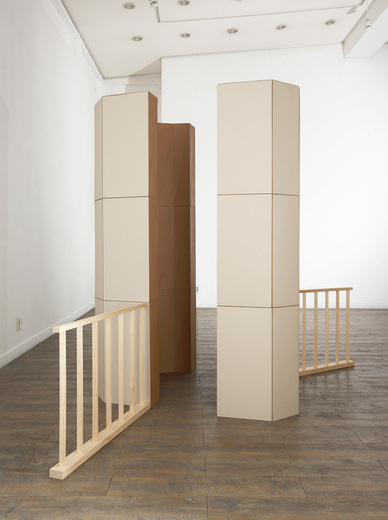
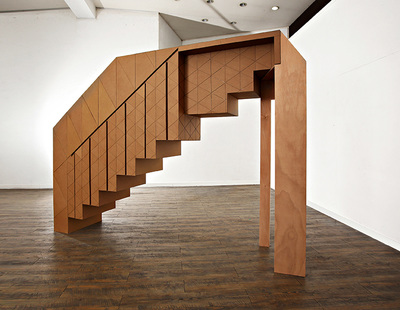
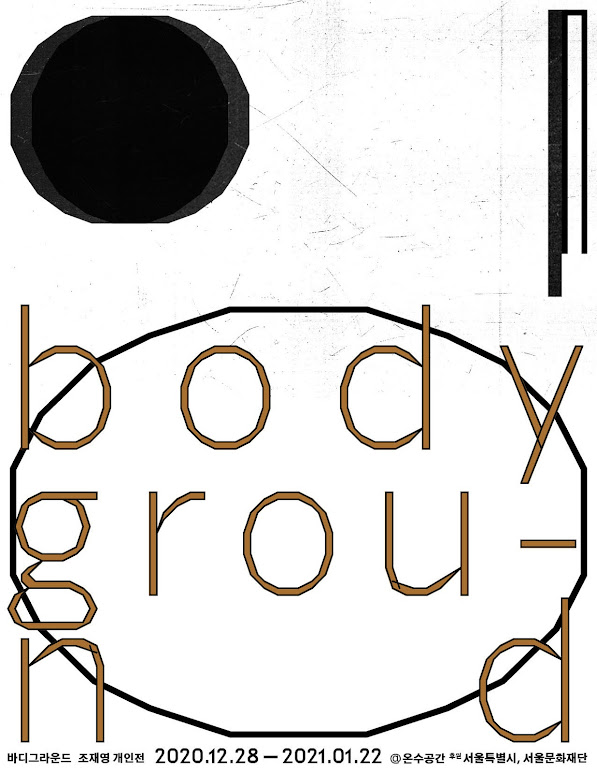
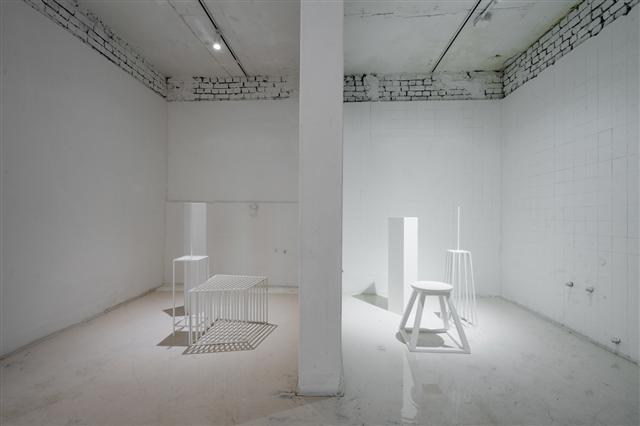
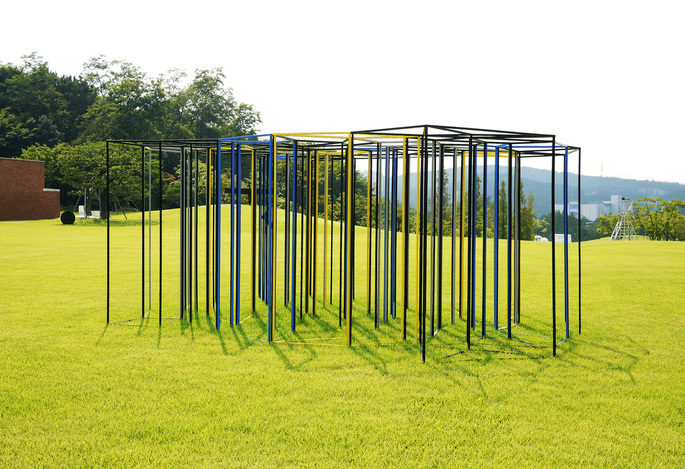
Poster image of 《Body Ground》 © Onsu Gonggan

From Polygonal Polyhedra: Between Proliferation and Mutation, Constraint and Control

1

It is not easy to identify the objects referenced by Jaiyoung Cho's polyhedral forms constructed from polygons. Because objects are translated into numerical values as both indices and referents ("The emergence of a geometric form as the final work also means that the object has been perceived as a number."), they seem, conversely, to be referenced precisely in order to be quantified and transformed.

The process of examining an object's framework and form before reassembling it necessarily involves the deletion and omission of its function. Consequently, Cho's work does not conclude simply with dismantling and reconstructing forms; it also encompasses the interpretive act of reconnecting the assembled objects and reading backwards through the fragmented results. Her practice unfolds within a temporal process that continually oscillates between making and critical reflection.

The artist determines the length and angle of each individual piece to produce component drawings before assembling polygonal polyhedra. Rather than preparing a completed sketch in advance, however, she continually alters the trajectory of the form as it develops, attaching each piece in response to the evolving structure.

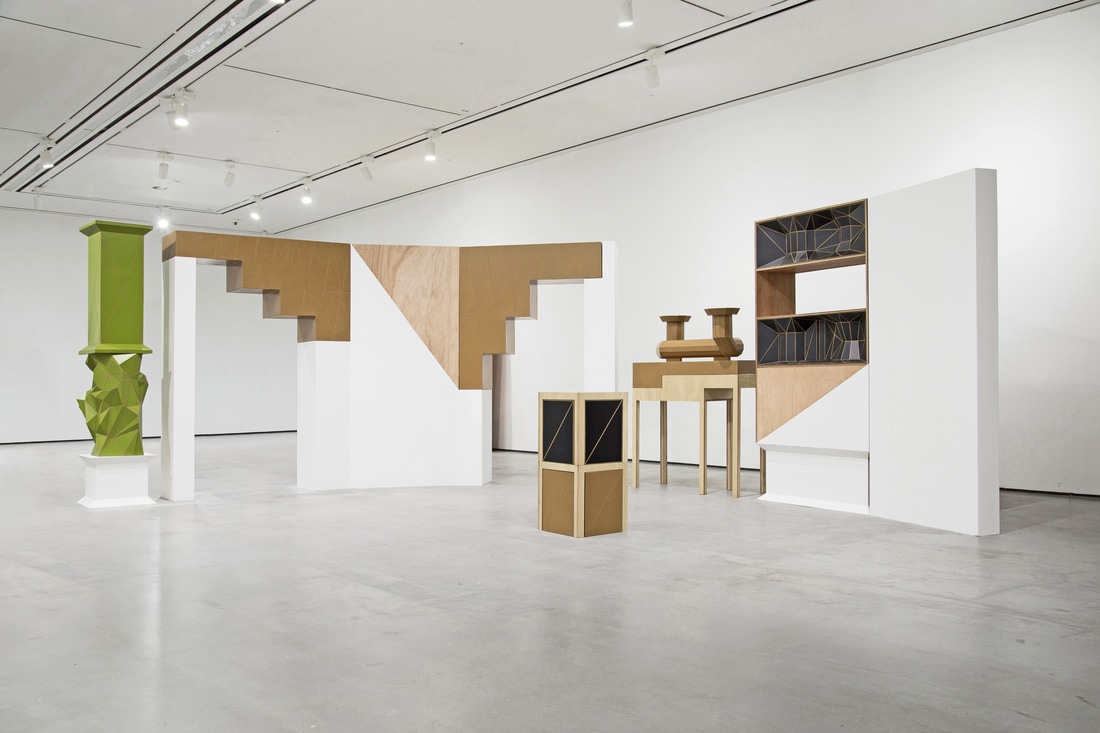
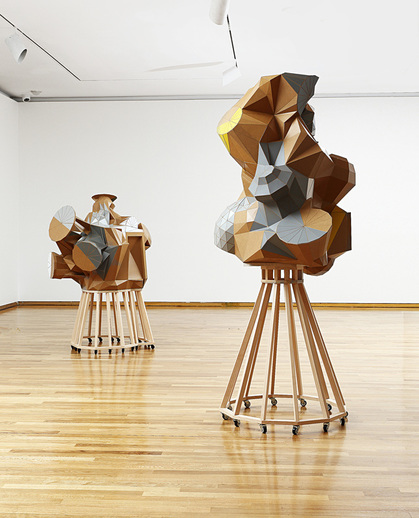
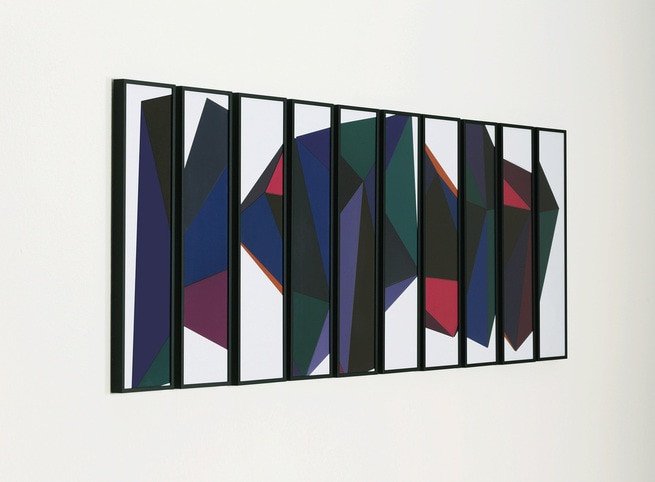
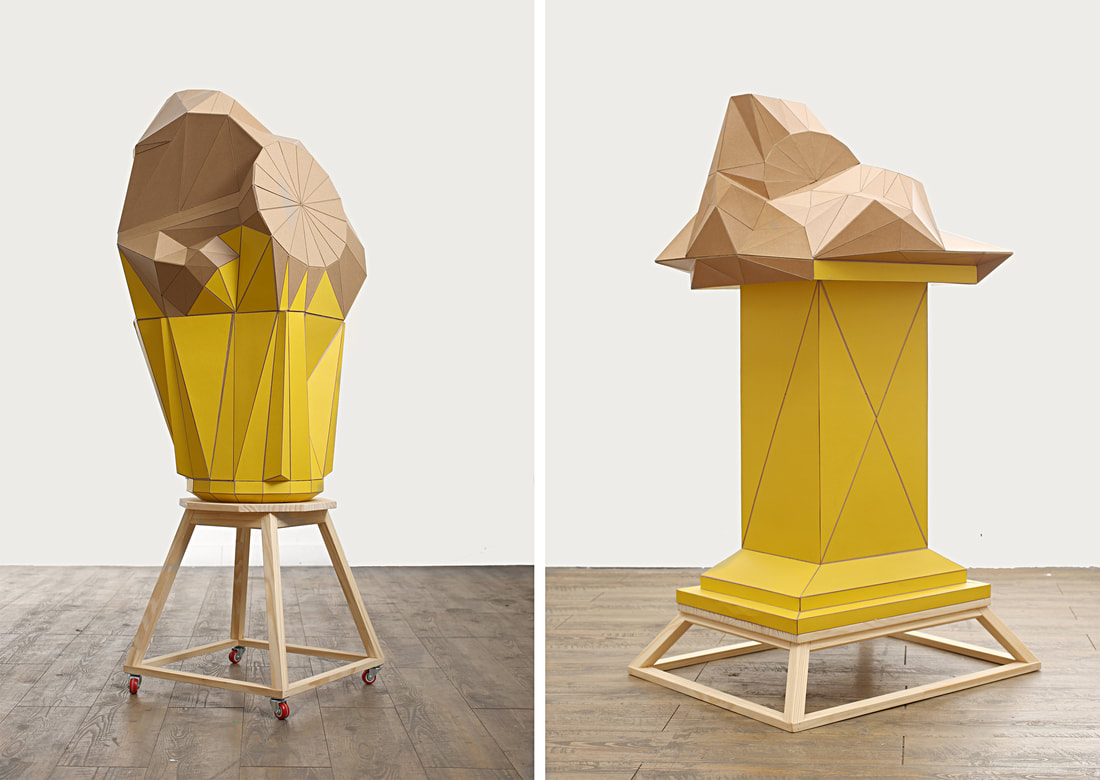
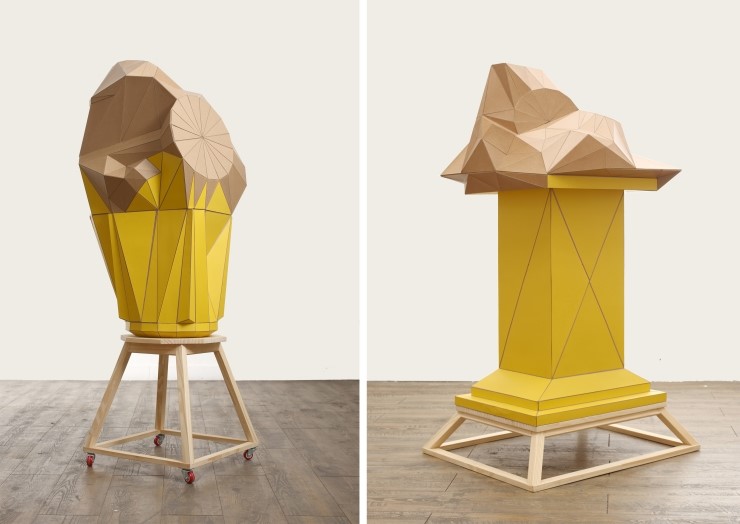
Although the work appears as though it might have been designed using 3D modeling software, it is in fact grounded to a remarkable extent in repetitive manual labor. Cho cuts cardboard according to carefully determined outlines, dividing it into planar facets to construct abstracted forms, occasionally covering their surfaces with adhesive cellophane to introduce color.

This method of building form through dismantling and erasure presupposes rigorous calculation, while simultaneously allowing for spontaneous variations to emerge and be incorporated throughout the process. As calculations accumulate, the assembled objects proliferate and mutate. Whether this sustained labor serves to express the artist's subjectivity remains uncertain.

More significant, however, is the fact that under the artist's direction, mathematical coefficients become the means through which the variables of disassembly and reconstruction are systematically absorbed and orchestrated.


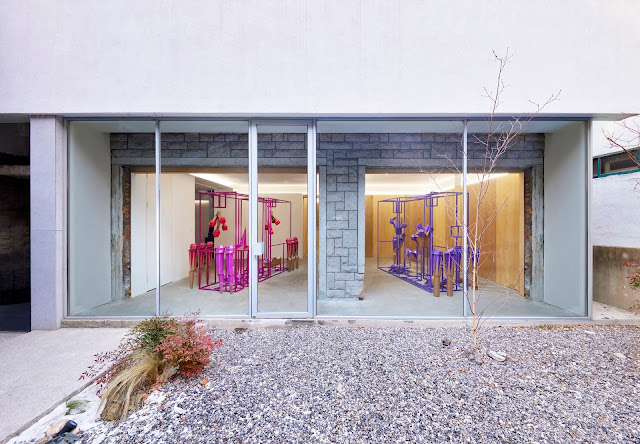
Installation view of 《Body Ground》 © Onsu Gonggan

The practice of translating objects and spaces into polygonal units, fragmenting them, and reassembling them establishes a formal system in which objects and landscapes alike converge as assemblages of discrete pieces. The particularity of individual objects and the material world is reduced to quantified fragments of cardboard, uniformly divided into polygonal structures before being recomposed.

By translating heterogeneous subjects into a common structure and material—abstracting them through a specific medium and modular system—Cho's process recalls the logic of commodity exchange, in which diverse values are standardized through a common currency. The angular cardboard fragments function as minimal units.

As these individual pieces interlock, they increase or diminish the complexity and volume of the overall form, simultaneously distorting and reconstructing the referenced object. Reassembled through particular planar configurations, the resulting objects may transform independently according to the numerical relationships among their constituent pieces or connect with other measured forms.

The process of outlining and subdividing forms into polyhedra thus appears to expand the grammar of the object—from object to body, furniture, architectural structure, and ultimately landscape. Yet such distinctions remain retrospective interpretations. In reality, the boundaries between object, landscape, and body are never clearly fixed.

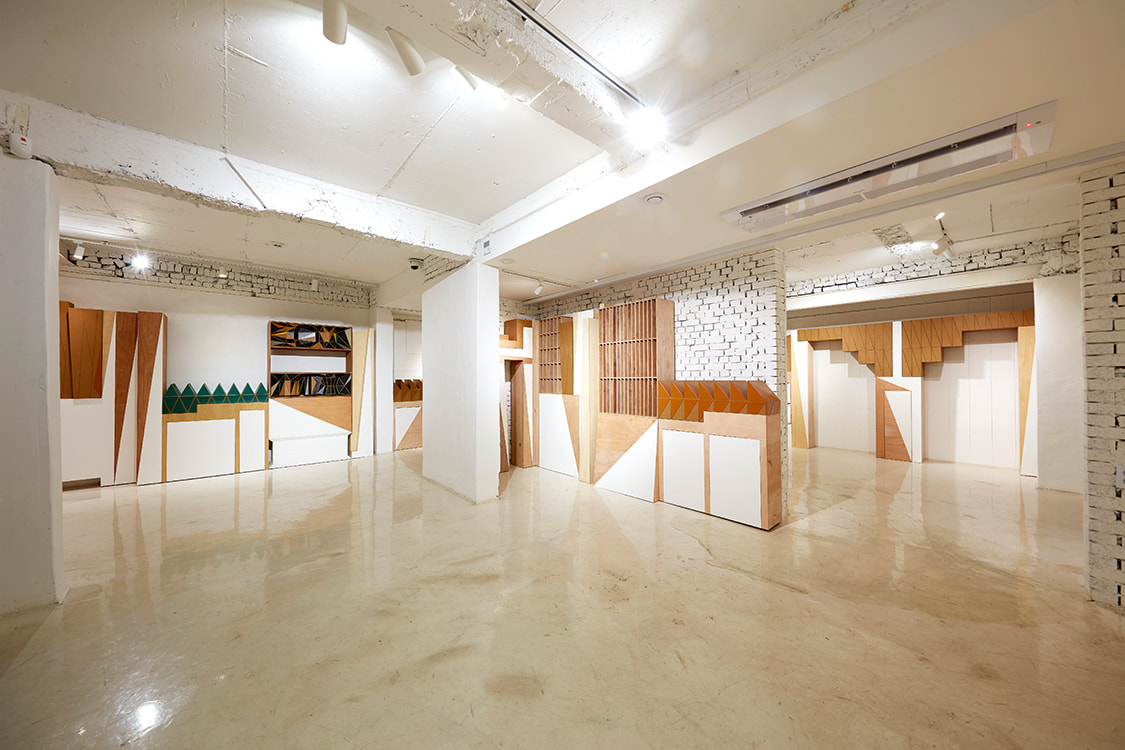
Rather, through the very act of fragmentation, transformation, and construction, objects become intertwined with space itself, engaging critically with the architectural structure of the exhibition site.

In order to construct these dismantled forms, Cho first measures the object as a referential model, then rereads its function and structure against the contexts and hierarchies through which it operates. This preliminary process of critically examining the dominant order embedded within the object is indispensable in determining the direction of its reconstruction.

She investigates how an object is produced, what functions it performs, how architectural structures regulate movement, and what kinds of order they reinforce, continually expanding the scope of her inquiry. At the same time, this process attends to everything that these systems of order have omitted or excluded while preserving and enforcing their own structures.

Her methodology therefore translates the ordering principles of objects and spaces while simultaneously exposing their contingent and mutable nature. Filtered through polygonal cardboard structures, the resulting forms no longer resemble their original referents in any direct or analogous way. Works such as Monster (2016) and Alice's Room (2017) exemplify this approach.

By fragmenting and dismantling objects, these works redirect attention beyond established systems of order. In expanding the limits of the object, they also seek the gaps within dominant norms and the spaces that lie outside them. Yet the forms that emerge from these interstices are themselves fragmented into measured polyhedral structures, inevitably absorbed into the comprehensive logic of cardboard polygons.

Is it possible for critical representation, which resists the order of objects, to sustain itself without generating another order of its own? Cho's work further suggests that systems of representation opposing structures of violence are themselves not entirely free from violence, even when that violence is critically appropriated.

Ultimately, although her objects translate and transform existing forms through their own sculptural logic, they do not seek to escape order altogether. Instead, they focus on reconstructing the organizational principles of objects themselves into a critical sculptural language.

Even as assembled and transformed entities, these objects can never become fully independent of order. Existing as distorted images, they propose either another order or a meta-order, continually extending the threshold of form itself.



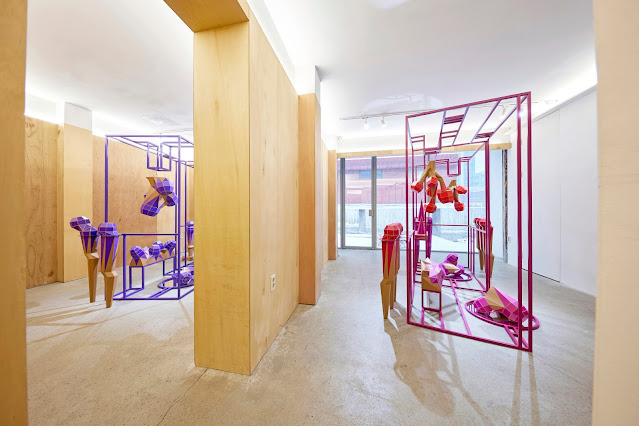
Installation view of 《Body Ground》 © Onsu Gonggan

Can Cho's methodology, then, be understood as a representational order devised to critically reconstruct the binaries of domination and subordination, rule and deviation, by cutting across them? As the result of cutting and folding, her objects assume distorted, hybrid contours that retain traces of the forms from which they originated.

The act of examining and emptying out hierarchy and function unfolds simultaneously with the process of hollowing and assembling cardboard structures. As one critic has observed, they resemble "a mandala in which times and places overlap toward an absent center, where part and whole continuously reflect one another." The quantified index of the object remains, in the words of Yoo Jin-sang, only as a "shell."

In this sense, Cho's methodology may be understood as a technique of constructing skeletal forms through the shells of dismantled objects and spaces. Yet it would be insufficient to interpret these works merely as peeled surfaces or as objects emptied of temporal and functional significance.

To grasp the ontological weight and poetic force of these heterotopic forms—which erase ideal spatial order, fragment, dismantle, and invert existing structures—it is equally necessary to consider the labor, techniques, and materials through which they are produced.

Cho's work points toward a world filtered through the quantified order of cardboard, or rather toward the transformation of a worldview itself. Even if the divided planes are understood as the object's shell, each individual facet is the result of carefully calculated lengths and angles, executed with precision developed through disciplined craftsmanship that minimizes error.
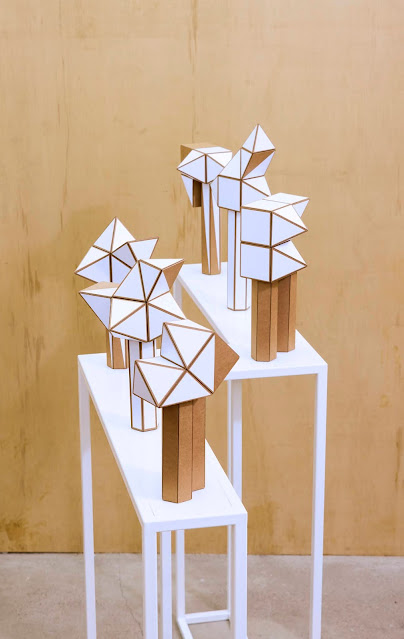
Although the forms may appear accidental—and the artist does not entirely reject chance within the process—they are ultimately shaped through incisive judgment and meticulous calculation that dissect and dislocate the underlying order of objects. The shells that erase the structure of the organic body demand considerable manual labor and technical expertise.

They simultaneously dismantle the very structure separating shell from underlying tissue while reconstructing skeleton and flesh through the shell itself. The order established by these dismantled shells destabilizes the hierarchy between object and pedestal, as well as the vertical hierarchy of sculptural composition.
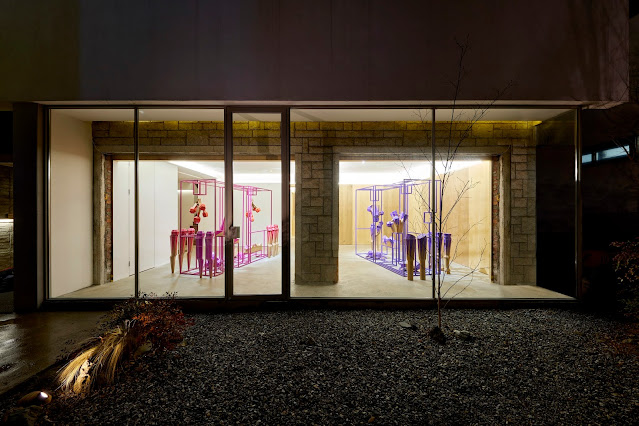
By layering shells upon one another or attaching new shells onto existing ones, Cho alternately accumulates and erases traces of movement. Through this grammar of the shell, she dismantles and simultaneously renames the object, emptying the conventional framework of both function and form while presenting the emptied condition itself as the object.

The material qualities of cardboard—despite its rigid appearance, a substance that is nevertheless relatively fragile—strongly evoke objects and landscapes understood as shells.

Because of its vulnerability to deterioration, cardboard resists becoming easily fetishized as an art object. Even when measures such as humidity control or varnish coatings are introduced for preservation, the temporality of the work is governed less by the finite duration of exhibition than by the time of its making and the subsequent periods during which it circulates, is stored, damaged, repaired, or ultimately discarded.

Its temporal logic thus privileges transformation over preservation. Rather than existing as a fixed form maintained only for the duration of an exhibition, the work appears to be governed by a repetitive cycle of construction, preservation, alteration, aging, and eventual decline.


Installation view of 《Body Ground》 © Onsu Gonggan

2

As the title 《Body Ground》 suggests, Jaiyoung Cho's 2021 exhibition at Onsu Gonggan signals a shift in her material focus toward the body. Implicit in this transition is the notion that the subject who has long measured and quantified objects and spaces has likewise fragmented its own mode of existence through the same calculative mode of thinking.

As Cho has remarked in interviews, the process of translating objects into polyhedral forms also entails directing the critical gaze through which she deciphers the order of things back upon herself. Although the object is fragmented into polygons, the body that anchors this process to a human scale is itself transformed into an object of analysis.

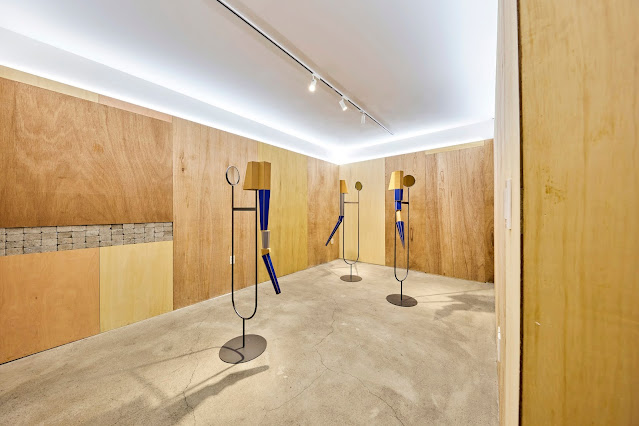
Despite taking the body as its subject, the exhibition offers viewers little possibility of identifying complete bodily forms. It is difficult even to determine which body part is being represented, let alone whether the form belongs to a human being or any living organism at all. The transformed body undergoes a process of destruction.

Rather than reproducing the human body through measurable proportions, the works more closely objectify the body itself, rendering it into an impersonal thing. Fragmented, standardized, and transformed through quantification, these objects are less governed by the formal framework of the human figure or the distinction between interior and exterior than permeated by the logic of the shell.

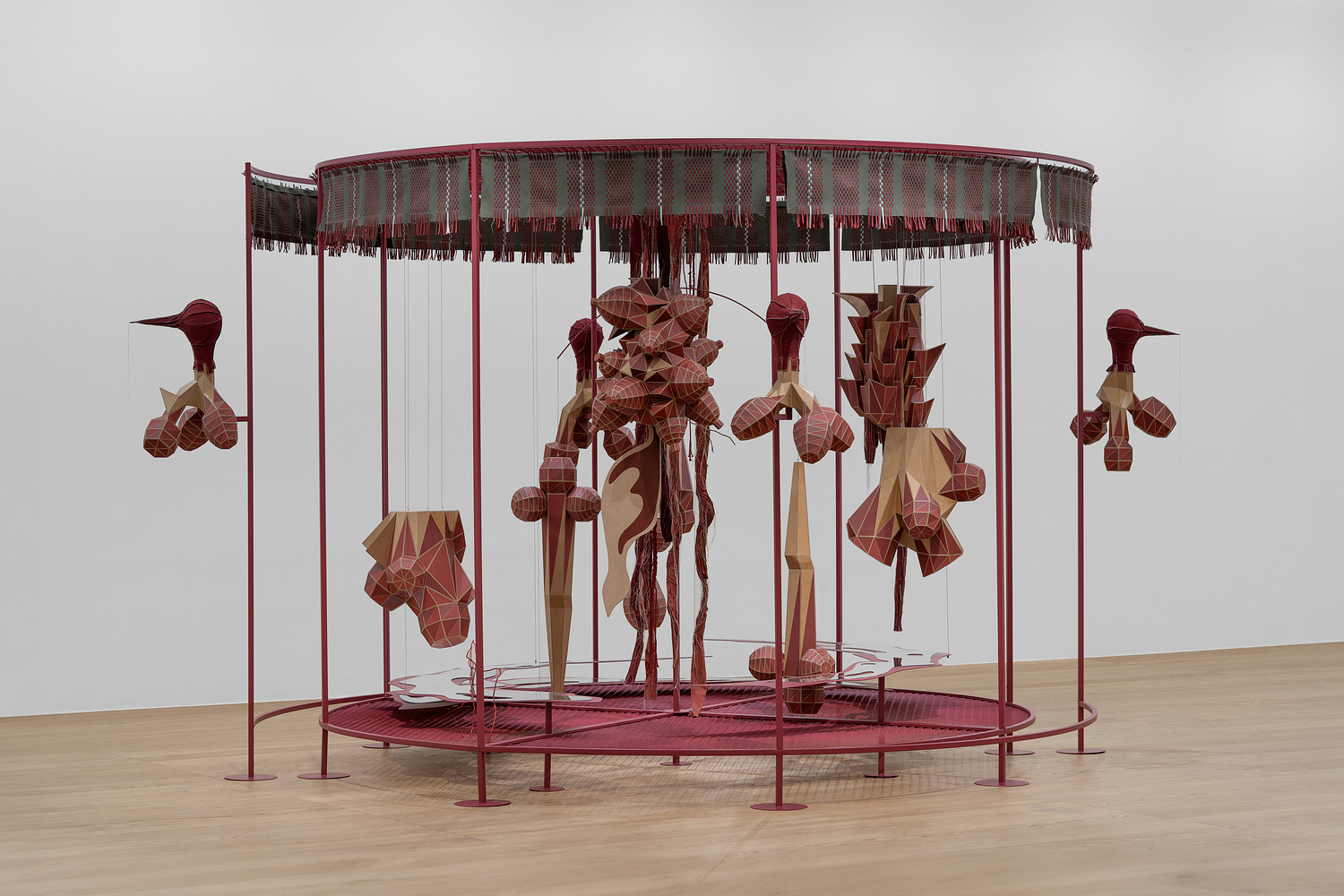
They assume abstract forms in which internal organs appear to possess skeletal structures, limbs seem severed or displaced, and anatomical parts are improbably grafted elsewhere. Suspended forms resembling trunks stripped of their branches and roots, interwoven with protrusions and thorn-like appendages, correspond to what the artist describes as "a condition in which previous modes of perception have become powerless while new modes of perception have yet to solidify."

They are therefore less representations of transformed bodies than cross-sections of transformation itself. Once again, no complete blueprint is provided. Instead, quantified fragments maintain only a minimal degree of formal resemblance to one another while preserving the faintest structural continuity. The repeated proliferation of morphological variations barely attests to their origin in the human body.
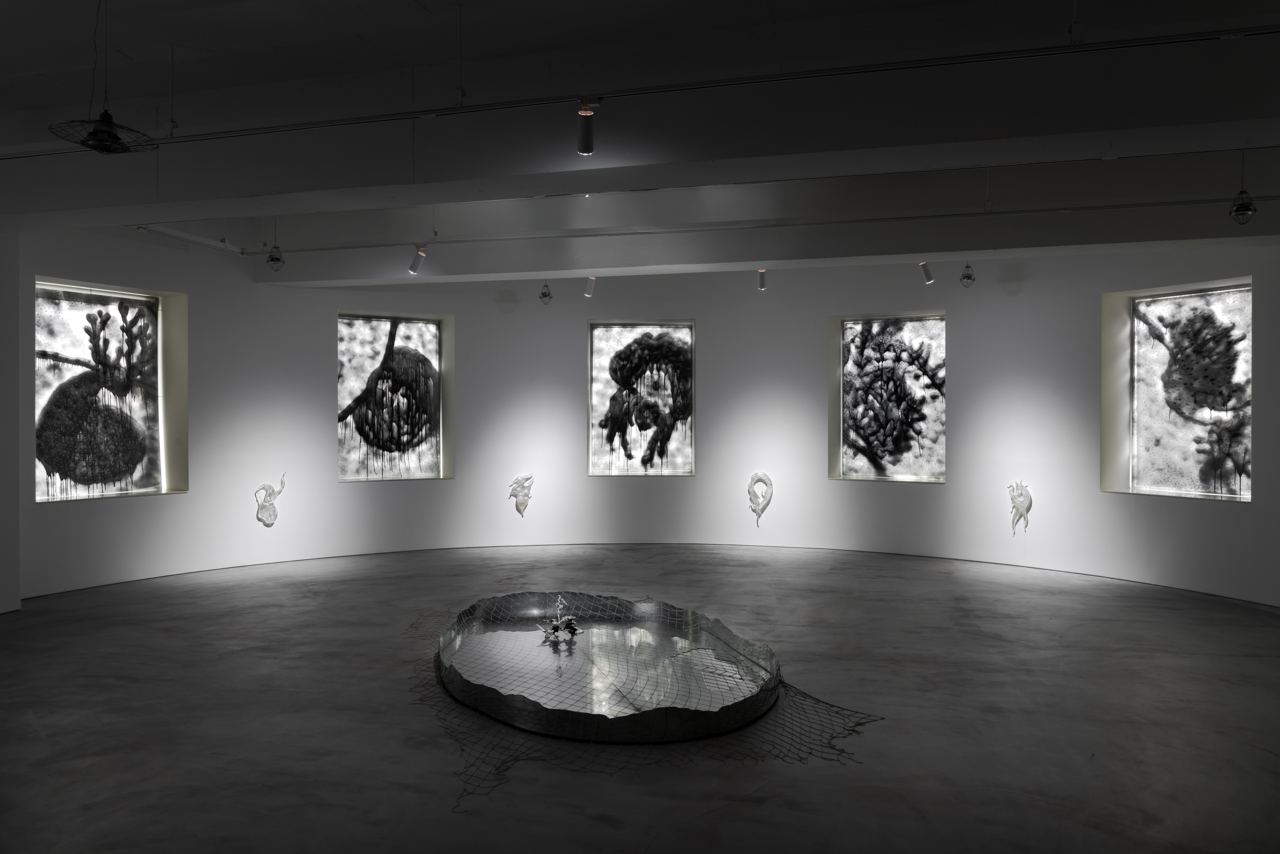
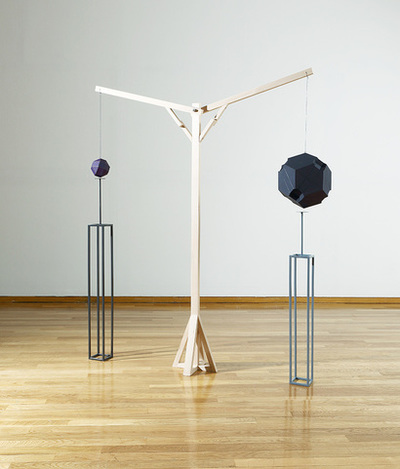
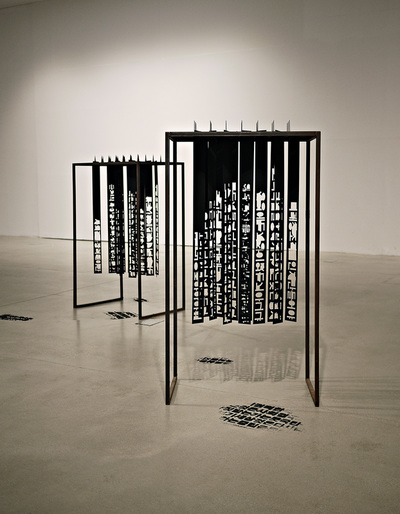
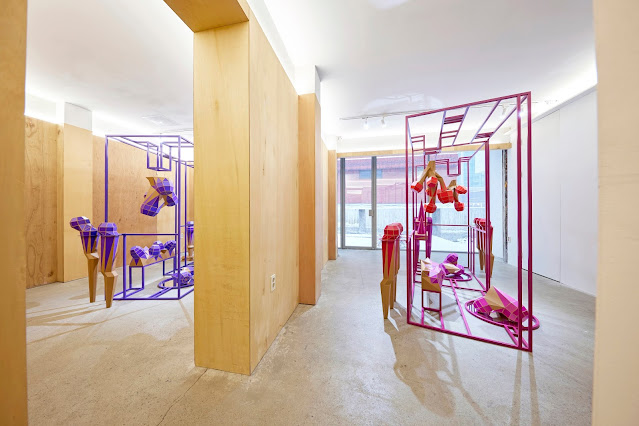
Meanwhile, the metal support structures functioning as skeletal frameworks evoke model-kit sprues from which individual components may be detached and assembled at any moment, or cages holding disarticulated body parts. While both the supports and the objects possess a degree of autonomy, they remain mutually dependent.

The objects do not exist as fully independent entities; suspended from or inserted into the framework, they are able to stand upright and occupy their designated positions only through this relationship. The support structures that sustain these mutated forms guarantee the independent configuration of each unit, yet simultaneously constrain them by providing that very support.

In this sense, within Cho's process of measuring objects and translating them into polyhedral forms, the support structure signifies an underlying conceptual skeleton that organizes and sustains architecture, objects, and bodies alike. The pedestal and the object become hybrid forms, composing bones and protrusions, tentacles and internal organs, transformed into architectural body-objects infused with blood-red adhesive cellophane.

Though these clusters of objects dislocate the bodily framework, they never entirely sever themselves from the body's centripetal force. Rather than presenting coherent organisms, they appear as shells fragmented into isolated components—bodies marked by vivid violet and pink vitality, yet whose essential quality lies precisely in their mutability, compelling the viewer to suspend judgment.


Installation view of 《Body Ground》 © Onsu Gonggan

The tension between centrifugal and centripetal forces operating between the polygonal objects and their supporting structures is condensed in the mirrors incorporated into the framework. Attached to the skeletal supports, the mirrors exist as extensions of both object and structure while endlessly reflecting one another and directing the viewer's gaze toward the interior of the framework itself.
They attempt to recognize their own form and grasp the image of a complete body, yet because they remain fixed to the objects, they can never capture a whole figure, instead recalling the parable of the "blind men and the elephant." The convex mirrors, which reflect distorted images, do not establish a hierarchy between impaired vision and an idealized, complete body.

Rather, they continually cast doubt on the very notion of what a complete elephant—or by extension, a complete body—might be, generating a process of visual reflection and deconstructive questioning.

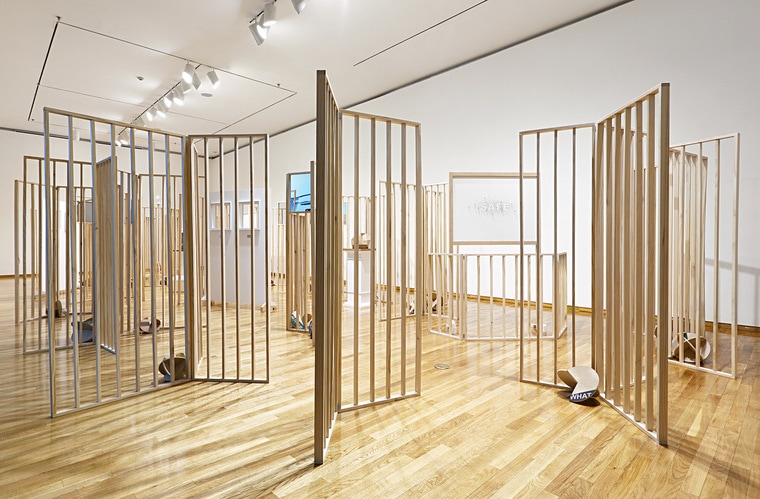
At the same time, the mirrors' distortion of reflected forms recalls the order of fabricated objects fragmented into polyhedral polygons through the scattering of light, while projecting these fractured images onto the architectural space of the gallery, itself enclosed by irregularly assembled plywood walls. In doing so, they extend the sculptural logic of reciprocal dependence and deconstruction throughout the exhibition environment.

In this sense, the cardboard works present the body as a ground in which established norms are dislocated and transformed, while simultaneously asking how such displaced bodies continue to be regulated and standardized. The ontology of emptiness contained within these shells—which, through diversified mathematical measurements, are capable of generating seemingly infinite combinations—at first recalls Alain Badiou's ontology, in which mathematics serves as the condition for thinking infinity.

Yet the proliferation and division of cardboard forms that mark this infinite void also evoke the utilitarian logic of capital, a system that governs not only transformation and dismantling but even the (im)possibility of such acts through standardized units. This simultaneously calls to mind Donna Haraway's cyborg feminism, in which the female body, historically exploited and objectified through patriarchal technologies, appropriates technology to construct human-machine interfaces as conditions for new productive assemblages and unexpected forms of solidarity.

At the same time, it also recalls Hal Foster's hesitation toward such visions, his reminder that even these future-oriented projections remain inseparable from mythic narratives and speculative scenarios.

Through translation and transformation, Cho explores the possibility of escaping the established order of the body. Yet the ontological weight and structural logic that she attributes to the body remain filtered through the shell.

This flattening of existence opens new possibilities for translating sculptural form, while simultaneously risking the reconfiguration of those forms into a kind of sculptural freak show, once again bound together and subordinated as objects for exhibition. Even so, what the artist ultimately refuses to relinquish may be the agency she has wrested from contingency and chance, from systems of constraint and objectification.


Installation view of 《Body Ground》 © Onsu Gonggan

The object, endowed with both an objectified body and a skeletal framework, has been broken apart yet continues to be folded back together. Even as it exceeds or falls short of formal completion, it maintains a state of tension and equilibrium with its supporting structure. Although object and support rely upon and depend on one another, their intimate proximity simultaneously becomes a site of mutual reflection and latent antagonism.

Even as the support classifies, confines, and restrains the objects, each object continues to fragment, proliferate, and mutate according to the logic of the polygon. The scene in which repeatedly severed and divided bodies coexist in antagonistic relation to the very apparatus that cuts and regulates them appears to diagram both the dismantling of form and the conditions for its reconstruction.

Moreover, insofar as these forms reorder the conditions of existence through practices of de-subjectification, restraint, and bodily reconfiguration, they resonate with the ways in which the structures of BDSM—an umbrella term encompassing Bondage/Discipline, Dominance/Submission, and Sadism/Masochism—are translated into sculptural representation.

Put differently, this echoes Cho's methodology, in which the mathematical measurement of polygons governs bodily dislocation: the body is bound to the support structure while simultaneously performing an endless process of deformalization. Although the work rejects both function and fixed meaning in pursuit of meaninglessness, this sculptural practice is sustained by the exhaustive labor of dismantling carried out under the order of number.

This leaves us with several critical questions and challenges for the artist. If the process of constructing polygonal forms by hand were to be accelerated through graphic software capable of generating rapid proliferation and mutation, what kinds of sculptural negotiations would the artist need to secure? Would a process that exceeds the Gestalt threshold of human perception ultimately overwhelm the artist's authorial agency?

What distinctions, for instance, might emerge between the artist's intuitive decisions and the proliferative capacities of artificial intelligence? Such questions extend far beyond the simple matter of choosing one tool over another. Another question likewise follows: can the material mutability of cardboard and its inherent fragility be overcome?

Yet this issue reaches beyond material concerns alone. It also asks us to reconsider the effects of preserving, monumentalizing, and ultimately fetishizing works that have continually embraced transformation—an outcome the artist herself has arguably sought to resist. How might one critically engage the art object as fetish while simultaneously breaking through its logic?

These deliberately provocative questions ultimately demand that the artist's own methodology be fragmented, abstracted, and reconfigured once more. The process of assembling cardboard fragments is now directed not only toward the object but toward the artist's methodology itself.
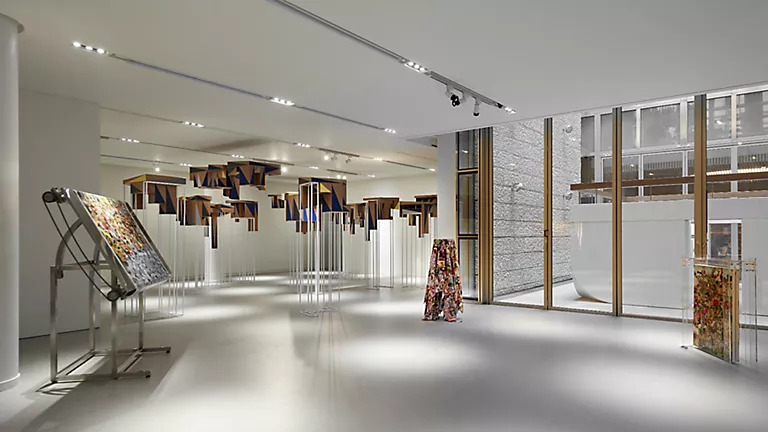
Cho's practice of measuring the order of objects and spaces before meticulously dislocating and recombining them has thus far depended upon her own subjective judgment and embodied labor. She has continuously separated and reconnected cardboard forms, conceived as accumulations of planes, with support structures functioning as skeletal frameworks, cutting across conventional distinctions and hierarchies.
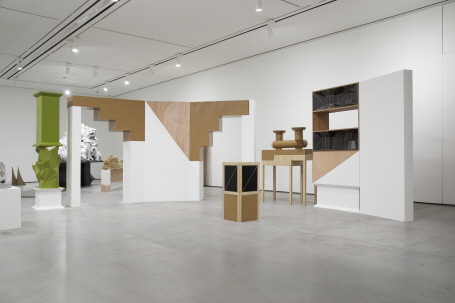
At the same time, she has sought to recover those scenes, names, and moments omitted by the established order of objects. If, until now, the artist has maintained authorship through labor-intensive processes while accepting the material vulnerability of her works, the next stage of her practice may require placing authorship itself into a state of negotiation, tension, and productive conflict as her sculptural methodology evolves.

What strategic or methodological transformations will be necessary for the artist to sustain this practice? The challenge of critically renewing fetishism and homogenization now hangs upon the sharp-edged surfaces of her cardboard polygonal polyhedra.

References