FOOT NOTES
no.1-10
1. Landscape, Painting
In the history of painting, landscape has always existed as trees and forests, mountains and stones, water and sea, while only very gradually producing changes in its status and difference. It is certainly true that the period in which nature or village scenes, in a somewhat conventional form, receded far into the background of iconic figures or events was incomparably longer than the period in which they did not.
To attach the name “Landscape” to nature, which had been omnipresent like air or standing like the backdrop of a stage, was therefore a fairly modern act of naming, and to make “landscape painting” independent as a front-stage genre was also part of a Western project.
However, it feels meaningless to sharply distinguish or historically trace the tradition of expressive landscape in Korean painting history, which was influenced by Chinese painting for a long time, and its gradual transition into true-view landscape; the classical styles and idealized landscape designs that developed in Italy, England, France, the Netherlands, and elsewhere after the Renaissance; or the changing concept of landscape being consumed in painting today.
In contemporary painting, nature and landscape are politically charged in content and visually imitative, but from a broader perspective they remain a form of personal editing within a humanistic frame, and a curtain onto which the inner self is projected.
It is necessary to reconsider, in reverse, the transition from landscape to landscape painting—that is, the fact that it had not been so before. For instance, in the eighteenth century, as Italianate landscape painting became fashionable, the English came to realize that their own countryside could also become a subject of painting.
If we recall the process by which Claude-Poussin-style pastoral landscapes were taken as a canon and then adapted into a landscape painting style suited to England’s climate, environment, and society, we can understand that transferring nature onto canvas was a highly artificial process of fabrication, a cultural product connected to the architecture, landscape gardening, and literature of the time, and a process of institutionalization.
The total amount of communication, digital technology, and physical and virtual experiences of the world also provides points of distinction in how natural and urban landscapes are produced and consumed as images today. Yet in the process by which landscape is reorganized into landscape painting, the most essential mediating term is the artist. That alone remains unchanged.
2. Jpeg
-joint photographic coding experts group
Developed by the JPEG committee. It is a standard technology for compressing still images such as photographs for use in communication. The person who creates the image can adjust the image quality and the file size. JPEG was designed for the compression of full-color and gray-scale images, and it shows advantages in photography and art-related work.
Along with GIF, it is one of the most frequently used formats on the internet. Compared to GIF, it has better data compression efficiency. In addition, while GIF can display 256 colors, JPEG can display 16 million colors, making it suitable for high-resolution display devices.
Another useful aspect of JPEG is that the person creating the image can adjust the quality of the image and the size of the file. For example, if one tries to compress a large image file into a very small file, the image quality decreases accordingly. However, by using JPEG compression technology, one can adjust this appropriately and compress the image without damaging it.
*Source: Naver Knowledge Encyclopedia(original source: Doosan Encyclopedia), search term: JPEG
3. Stone, Rock
For me, having frequently moved my place of residence from the provinces to new towns and from one place to another(this refers to the writer), stone is not so much something defined by geological classification as it is a “natural object” like Dokbawi in Bukhansan, a shining architectural “material” like the marble that forms the façade of a modern building, and a “building material” like cement or brick that makes up the gray-toned scenery distinctive to residential neighborhoods on the outskirts.
In a sense, houses, roads, and mountains are all stone. In other words, stone is not so much an intersection of certain material properties as it is the hardest and largest aggregate mass composing this world.
Stone as natural object/artificial object is the unconscious; one cannot ignore the subtle signals it conveys. Stone, which once rose upright with dense solidity, was a wedge that raised urban civilization and supported fields and rivers, but as it was continuously gouged, cut, and ground down, it soon lost the complete totality of stone itself and the placeness in which it had been rooted, remaining before us as urban residue to be dealt with, as industrial waste.
*Source: , 『Research, Re:Research』, written by Juri Cho, 2016, Seoul: Matter and Nonmatter
4. Serbia
Today, I will introduce a travel destination that may be somewhat unfamiliar: the Balkan Peninsula!
The Balkan Peninsula is located in southern Europe, and the countries belonging to it include Greece, Albania, Bulgaria, Romania, #Serbia, Montenegro, Slovenia, Croatia, Bosnia and Herzegovina, and Macedonia.
Representative tourist attractions in Serbia include Republic Square, Skadarlija Market, and Skadarlija Street located between the two. Skadarlija Street is the art street of #Belgrade, and is said to have been a major stage for so-called bohemians. It is said to be a place where pretty cafés and restaurants, various flowers, and paintings on buildings harmonize, so it seems like a good place to take photographs~
*Source: Naver Blog “25 Minutes Every Day, Engoo Video English” – Getting Help from Locals, Balkan Peninsula Travel Information, author: Andoo
5. Quarry, Site
“A major change occurred at Yongma Waterfall Park beginning in 1961. During the Japanese colonial period, stones used for construction work were quarried from the quarry in Changsin-dong, Jongno-gu, and after liberation, in order to supplement the shortage of aggregate, Yongmasan became Seoul’s new aggregate quarry. This site, which was used as a quarry for approximately 27 years until 1988, later opened in 1993 as Yongma Stone Mountain Park, and in 1997 its name was changed to Yongma Waterfall Park. ……
In this way, the rock cliff of Yongmasan, once an aggregate quarry, has now been transformed into the largest artificial waterfall in the East. The enormous Yongma Waterfall, 51.4 meters high, is guarded on both sides by Cheongnyong Waterfall on the left and Baengma Waterfall on the right, presenting a refreshing scenic view together with its distinctive topography. Along with the magnificent spectacle of the waterfall, a pond of approximately 700 pyeong spreads out beneath it.”
*Source: “An Old Quarry Transformed into the Largest Waterfall in the East,” Seoul Living Guide Seoul& Reporting Team, Kim Wonjeong, Public Relations Officer, Jungnang-gu Office
6. Travel, Writing
『The Travels of Marco Polo』 is the greatest medieval bestseller, often described as the most widely read book in Europe after the Bible. The title The Travels of Marco Polo gives the impression that the book is a travelogue recording impressive scenes. In fact, it is different. Its original title is 《The Description of the World(Divisament dou Monde)》.
Polo sought to contain comprehensive information about regions Europeans had not visited. He described in detail geographical locations, the religions and living customs of inhabitants, languages, political situations, and more. This means that the goal of the oral account was not “the creation of strange tales,” but “the systematic and accurate transmission of information.”
Polo seems to have anticipated, from the time he dictated it, that his book would be treated as an absurd story. Therefore, throughout the book, he repeatedly inserted phrases such as “no one will believe it without seeing it,” “it is difficult to believe even when heard,” and “you must know this point.”
He also asserted that “my testimony is correct and true, without any falsehood,” and that “if I did not have written down the various marvels I had seen directly or heard to be true(through my dictation and Rustichello’s transcription), thereby failing to let people know these facts, it would be a very great sin.”
*Source: Marco Polo’s The Travels of Marco Polo, Dr. Jang Wonjae’s “Wouldn’t You Like to Know?,” 『The Korea Economic Daily』,
2017.4.17
7. White
Long ago, while hearing the story that the Inuit people were said to have countless expressions for white snow, I could not help but feel moved by and long for the rich and delicate imagery of light created through the correspondence between a specific natural environment and the language of an ethnic minority.
In reality, this was an overinterpretation caused by a Western anthropologist’s misunderstanding of the agglutinative structure of the Eskimo language, and it is said that even though the Inuit live surrounded by snow, they do not use hundreds of words for the color white.
*Source: 『White Rhapsody』, written by Juri Cho, 2017
8. Geometric
Geometry: A branch of mathematics that studies figures and the properties of the space they occupy. It began in the ancient Orient, and elementary geometry was systematized by Euclid of Greece. Today, this has been further developed into various fields and methods, including analytic geometry, differential geometry, projective geometry, and topology.
Geometric: Relating to or based on geometry. Or something of that kind.
*Source: Google Dictionary, search date: 2020. 6.7
9. Amusement Park
As urban space expanded and became more densely populated, the demand for natural environments increased. Between the sixteenth and nineteenth centuries, cities in Europe and the United States improved their urban environments by creating public open spaces, green areas, squares, parade grounds, promenades, public gardens, and so on.
By the nineteenth century, many European cities had grown in scale and become industrialized. A large portion of the population lived in these industrial cities, while most non-urban areas were rural, and primordial nature became rare. Within the city, spaces of nature were civilized reproductions of primordial nature and were regarded as beneficial.
In Korea, after Gakguk Park(各國公園) was established in the foreign settlements of Incheon in 1888, Japanese Park[East Park, 1890], Independence Park(1897), Hwaseongdae Park, Tapgol Park, Yongdusan Park in Busan, and Dalseong Park in Daegu were subsequently created. However, systematic urban park development was not carried out through the Japanese colonial period and the Korean War.
From the 1960s, however, rapid industrialization and urbanization increased the need for clean and green spaces for rest, and demand for parks grew due to rising national income, increased leisure time, and changes in values.
*Source: Online Encyclopedia of Korean Folk Culture, keywords: amusement park, park, author: Lee Jawon(Department of Geography, Sungshin Women’s University), 2009
10. Drawing from Life
A translation of the word sketch. It refers to on-site studies that quickly depict a subject. Originally, in China, xiesheng meant painting flowers and birds(or sometimes landscapes), and referred to depicting a subject directly without relying on imagination.
*Source: Dictionary of Art Terms, 1998, Korean Dictionary Research Publishing Editorial Department
“To understand the meaning of drawing from life, one can compare the difference between Greek sculpture and Roman sculpture. Greek sculpture represented visualized phenomena in an idealized form, whereas Roman sculpture grasped things phenomenally. As this developed into the Renaissance, scientific inquiry into depicting what was visualized established the techniques of perspective and chiaroscuro in drawing from life.
Based on these techniques, the content of drawing from life also shifted toward grasping what appears in the mind when the objective is perceived by the subjective. In other words, it developed humanistically from xiesheng(寫生, drawing life) to xiexin(寫心, drawing the mind).
Therefore, today, when a painter draws from life, it should be understood not merely as an act of structurally understanding a phenomenon in order to turn it into painting, but as an act expanded to include the most human content. In this sense, the English phrase ‘drawing from life,’ which corresponds to ‘sasaeng,’ directly expresses the meaning of the term.”
*Source: Online Doosan Encyclopedia
ENDNOTES
no.1-2
1. Kayoung Choi
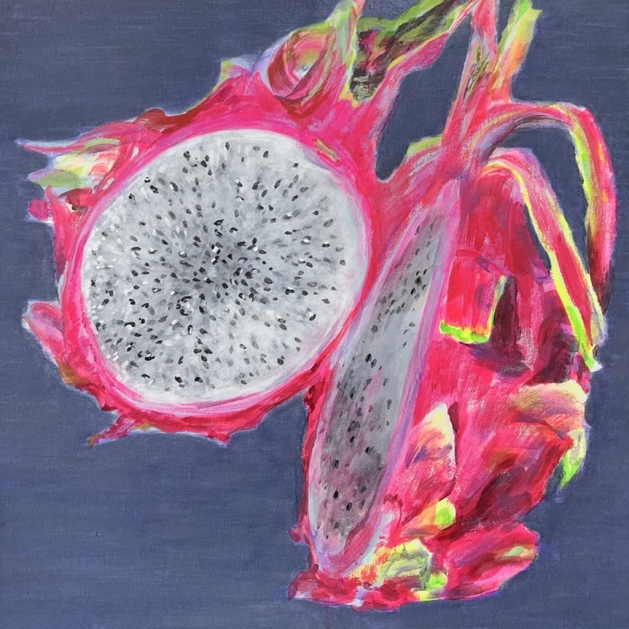
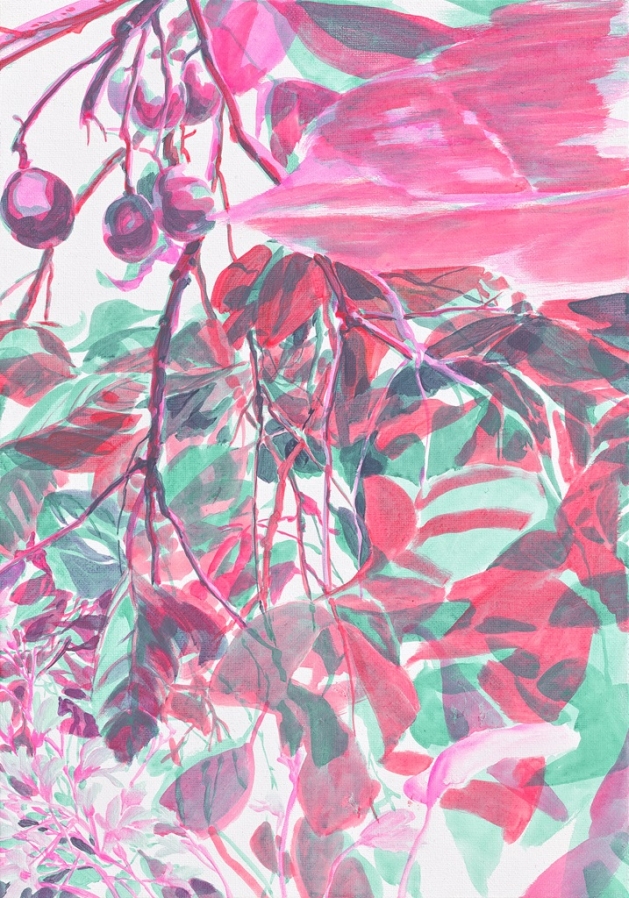
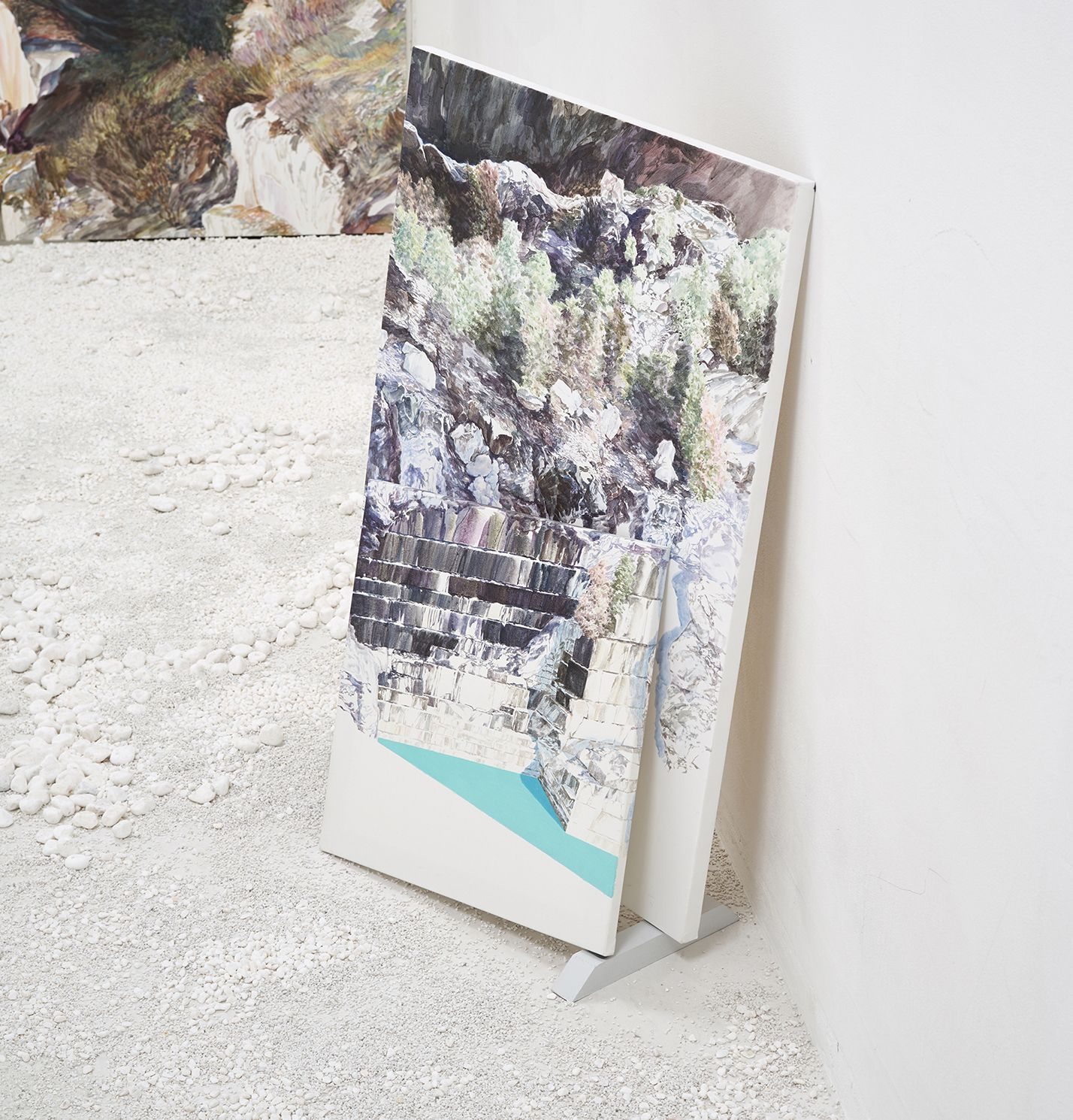
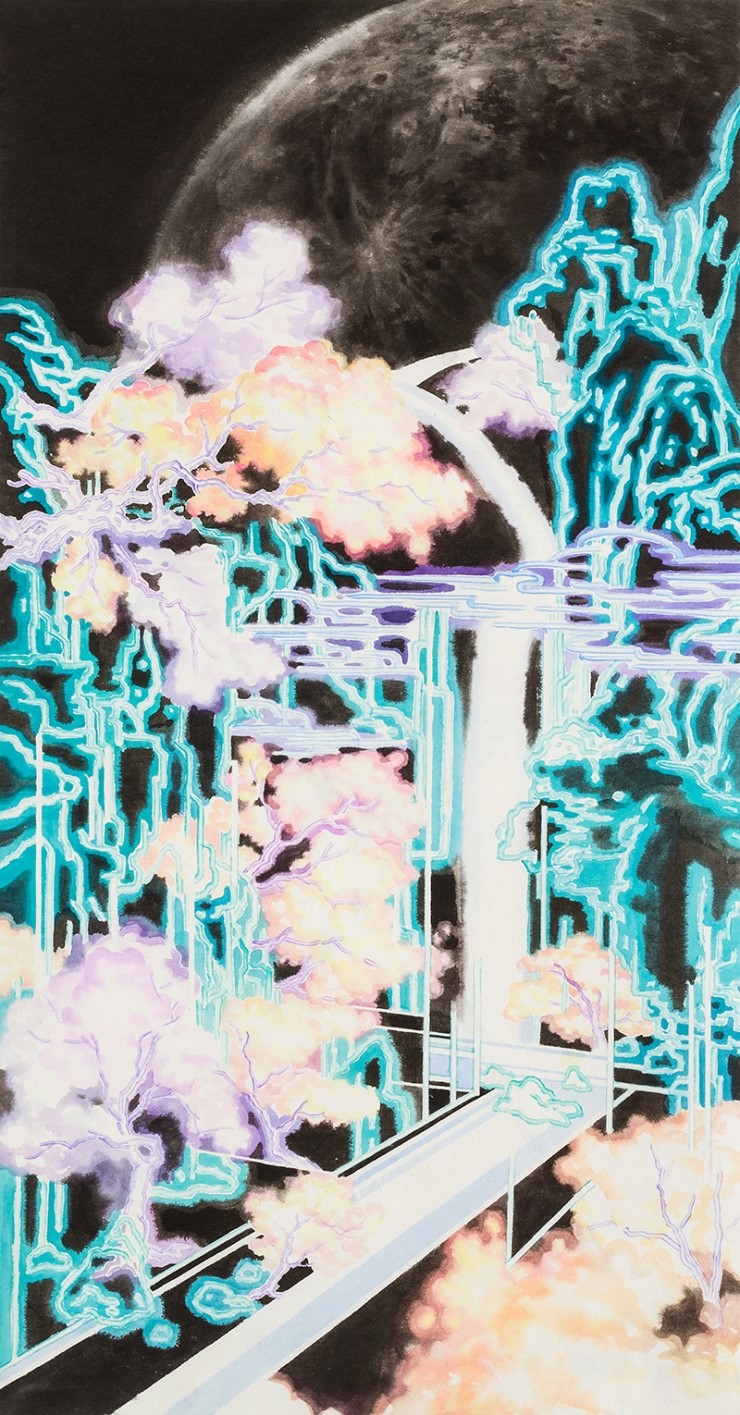
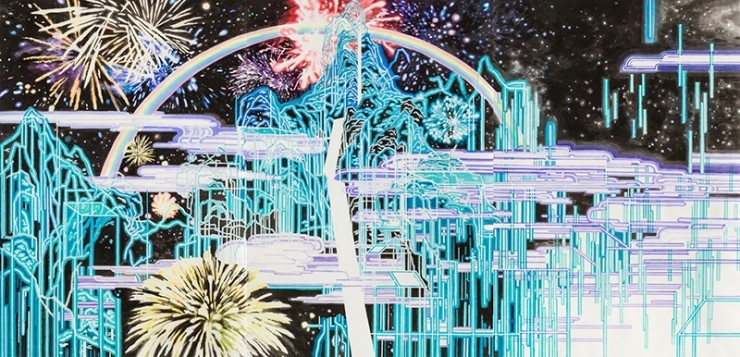
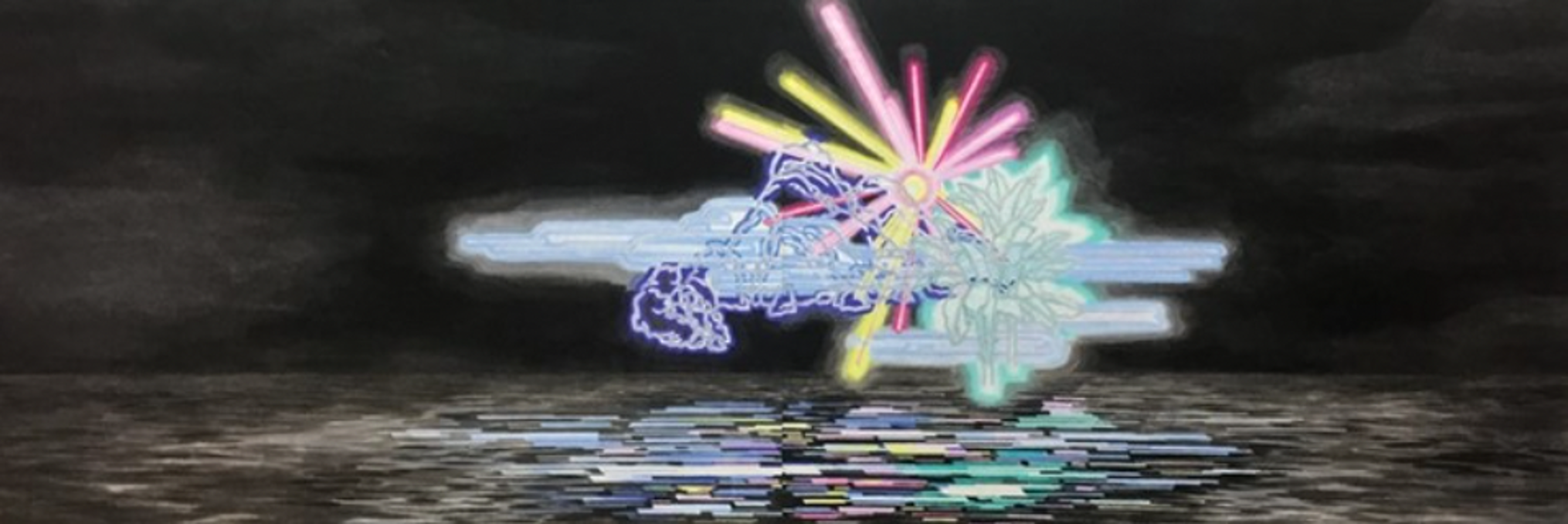
The artist’s previous exhibition titles include 《Shadows of Invisible Things》, 《In Search of a Piece of Rainbow》, and 《An Easily Found Landscape》. The artist’s journey in search of the invisible, the obscured and discarded, and the impossible to represent may, primarily, stem from a boredom with historically established words and images, and on another side, may originate from a longing, yearning, or obsession with places never visited, or places too harsh to visit, despite the development of travel and communication.
Today, when everything is distributed thickly with excessive mass, an exodus from everyday life is, conversely, the act of carefully seeking out sparse and faint landscapes, and it entails deliberately devising cumbersome rules and creative processes. For instance, this is the mission of today’s artists and the method carried out by professionals whose work is to invent visual images.
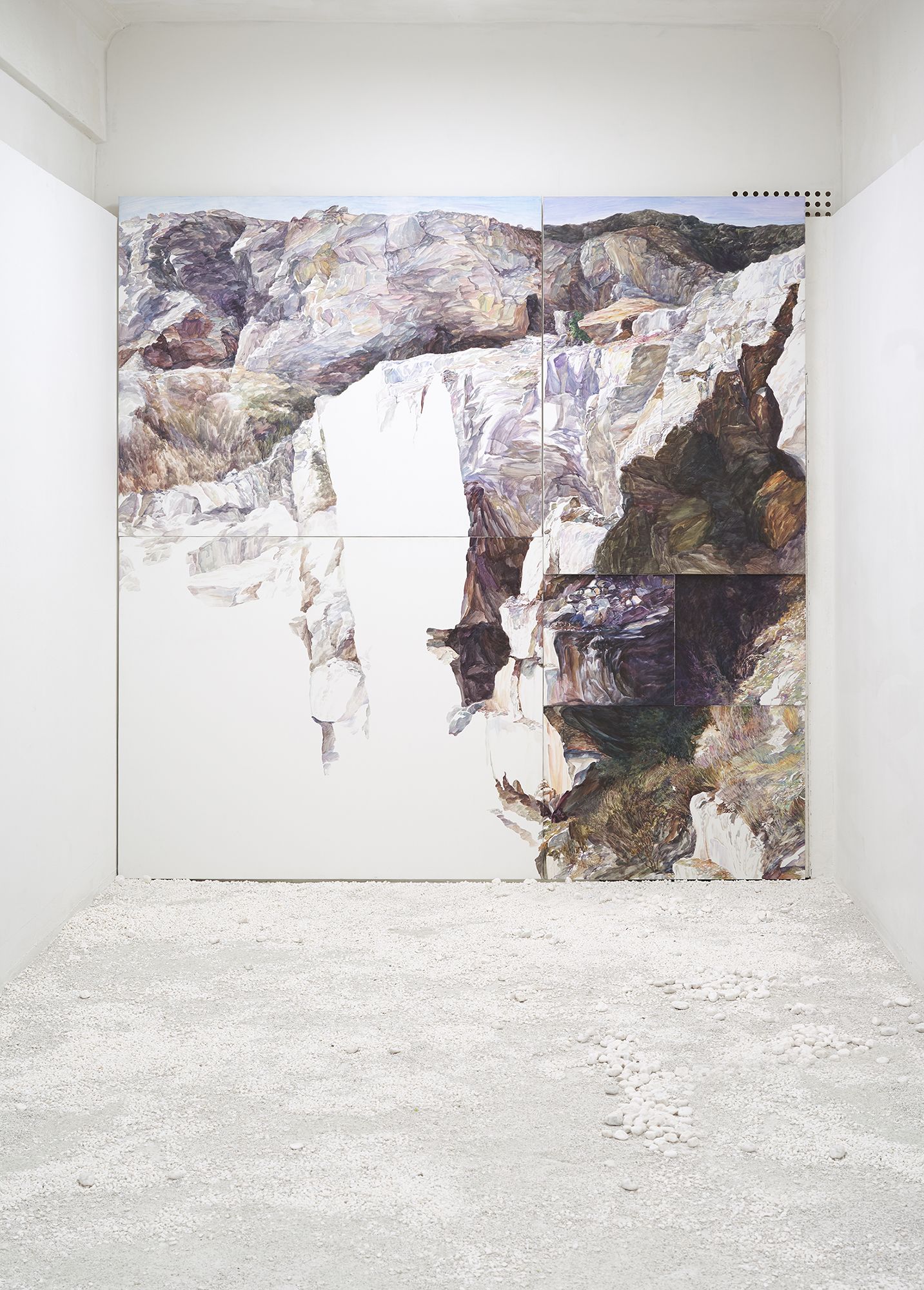
Clearly cutting out the things one desires, deleting the landscape outside the frame, or filling it with something else. The artist’s editing practice generally places the surface of the canvas as an empty canon and proceeds as a solitary act of filling it, using the physical movement of the artist as its motor. All of these are experiments based on visual-perceptual thinking.
Is the artist’s act of painting something different? Broadly speaking, yes; locally speaking, somewhat. This may be due to the arrangement and collision between the basic habit of “drawing from life” that began in Eastern painting and the individual’s rich sensibility unrelated to it.
Kayoung Choi’s process of landscape painting is closer to work on a timeline into which information-based conversation, the sending and receiving of correspondence, and the individual’s active imagination strongly intervene. By richly extending the process of waiting and communication, and by projecting psychological states of imagination and hypnosis, it seems to relay the time that flows before painting and outside the picture plane.
For this reason, if it is compressed only as “work that depicts things never directly seen,” something will surely be omitted. Painterly generation that compresses personal stories and its resulting values cannot be compressed without loss like JPEG; they will not be able to withstand the unknown-excessive state like Polo’s travelogue; and they will be neither as accurate as an encyclopedia nor as fresh as a review on a travel blog.
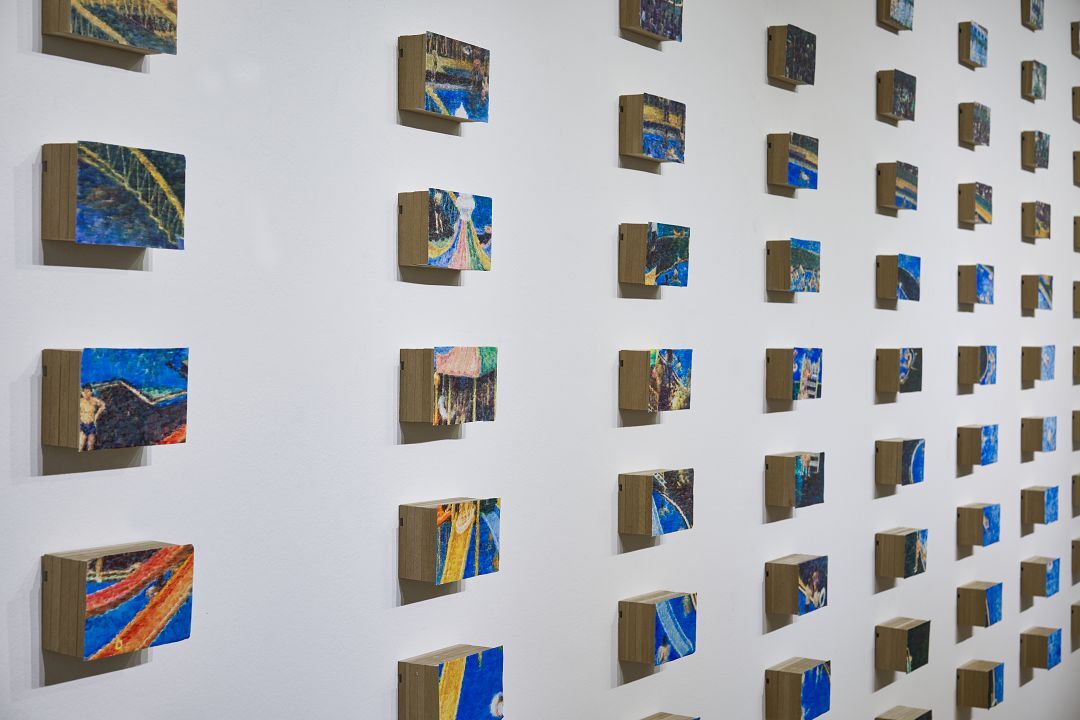
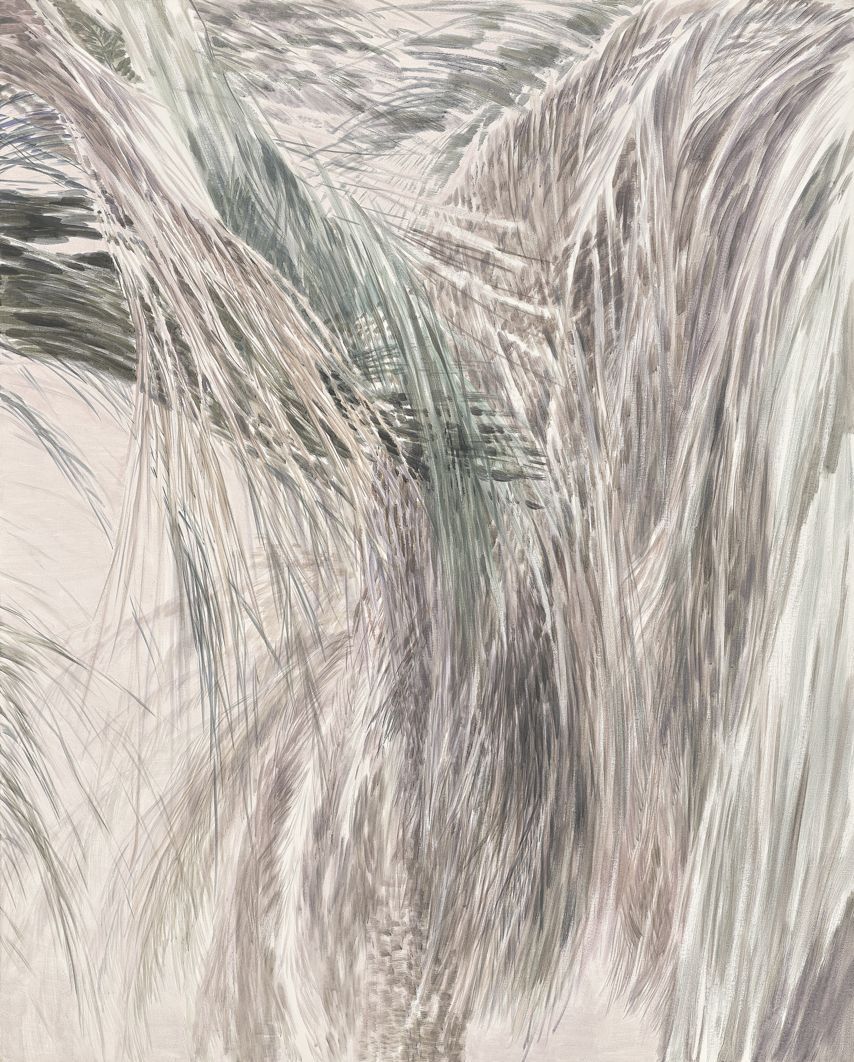
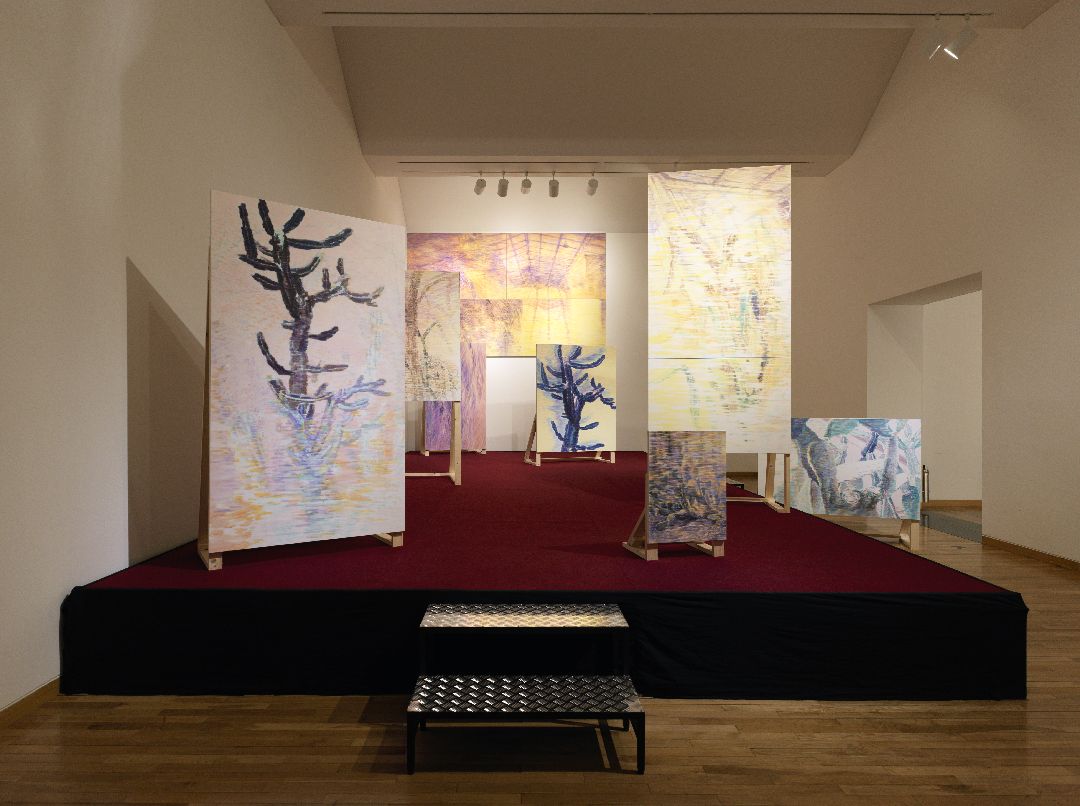
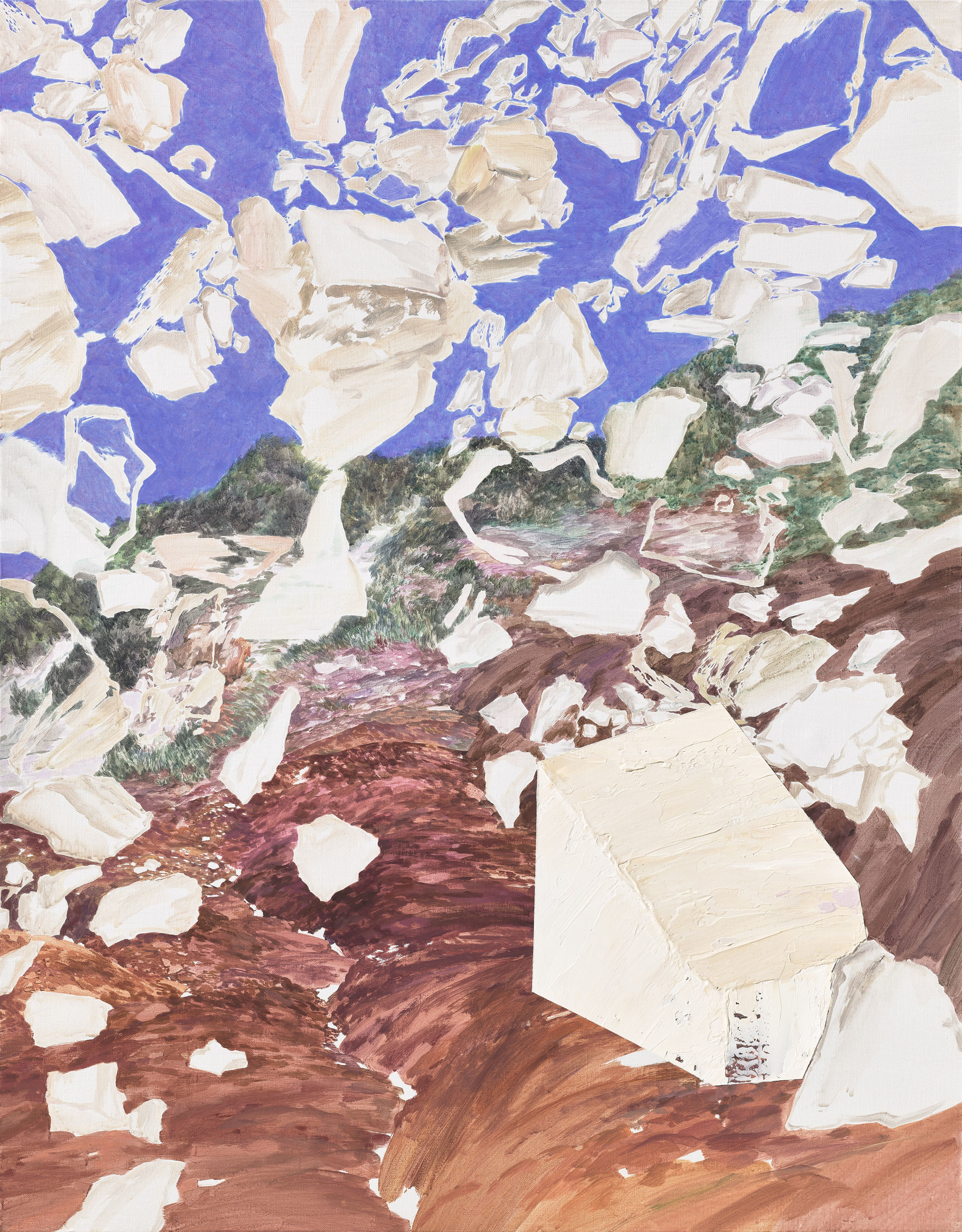
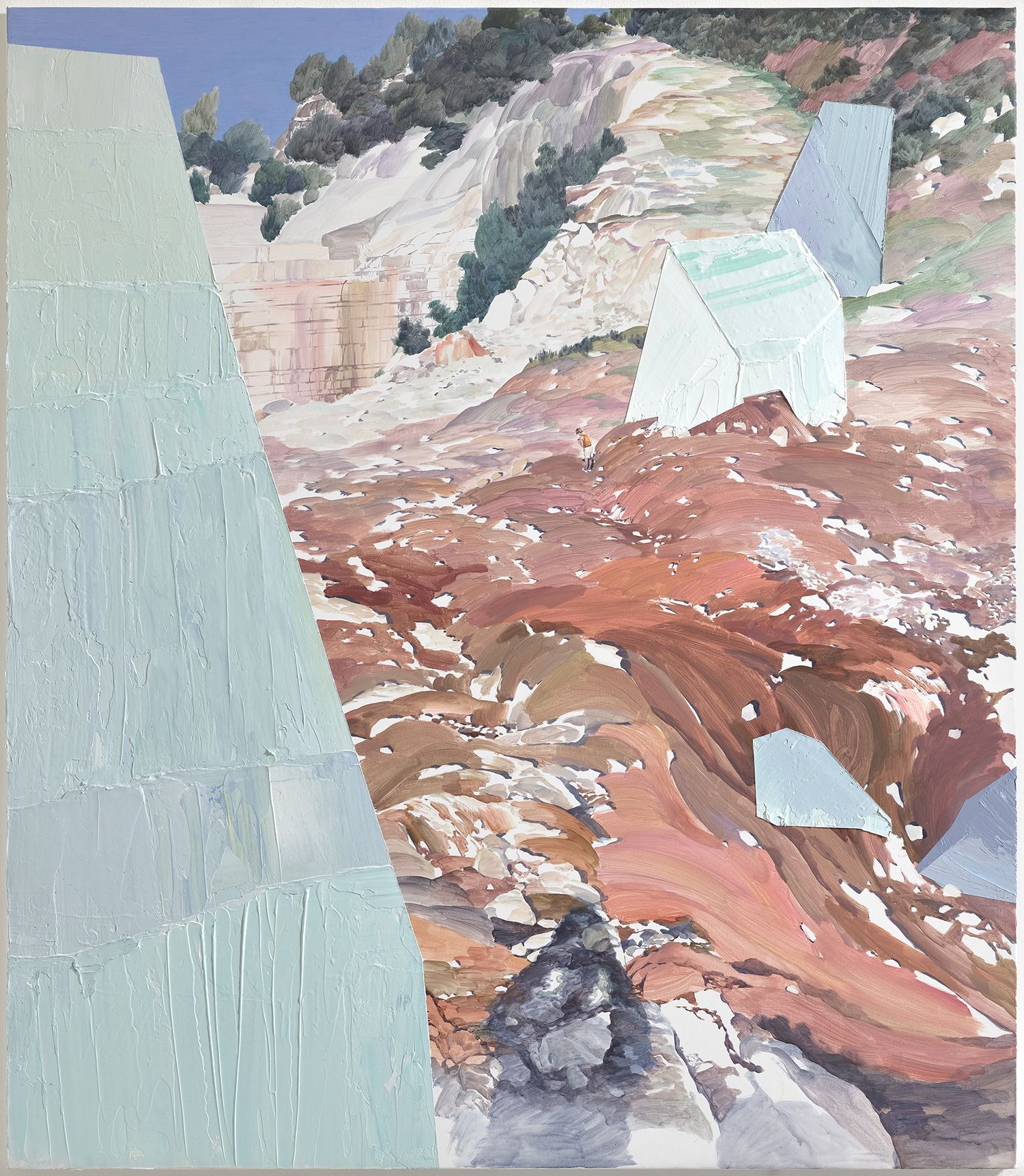
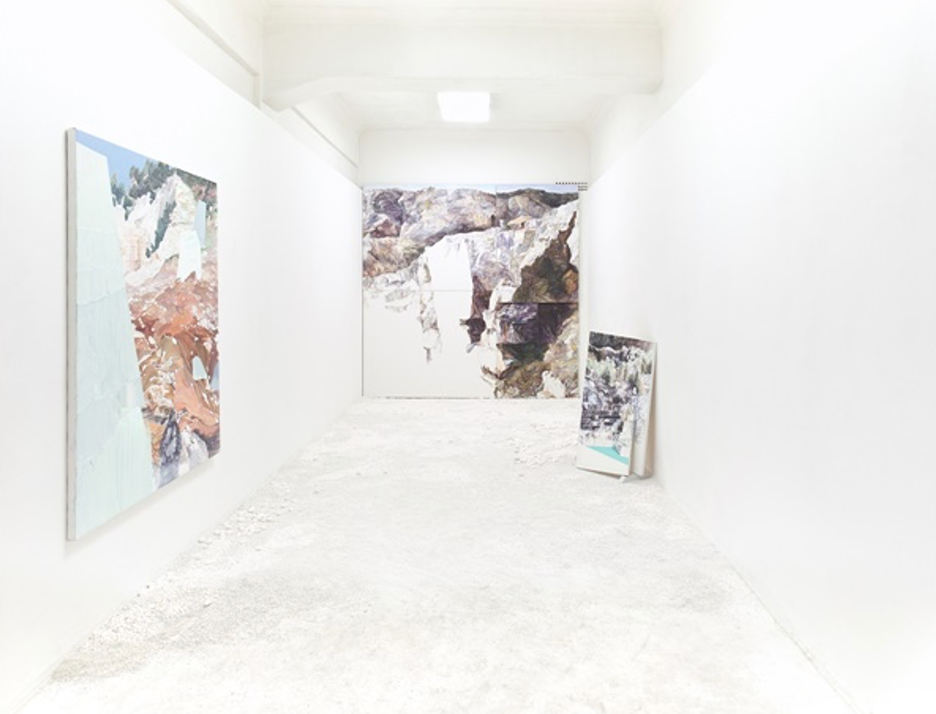
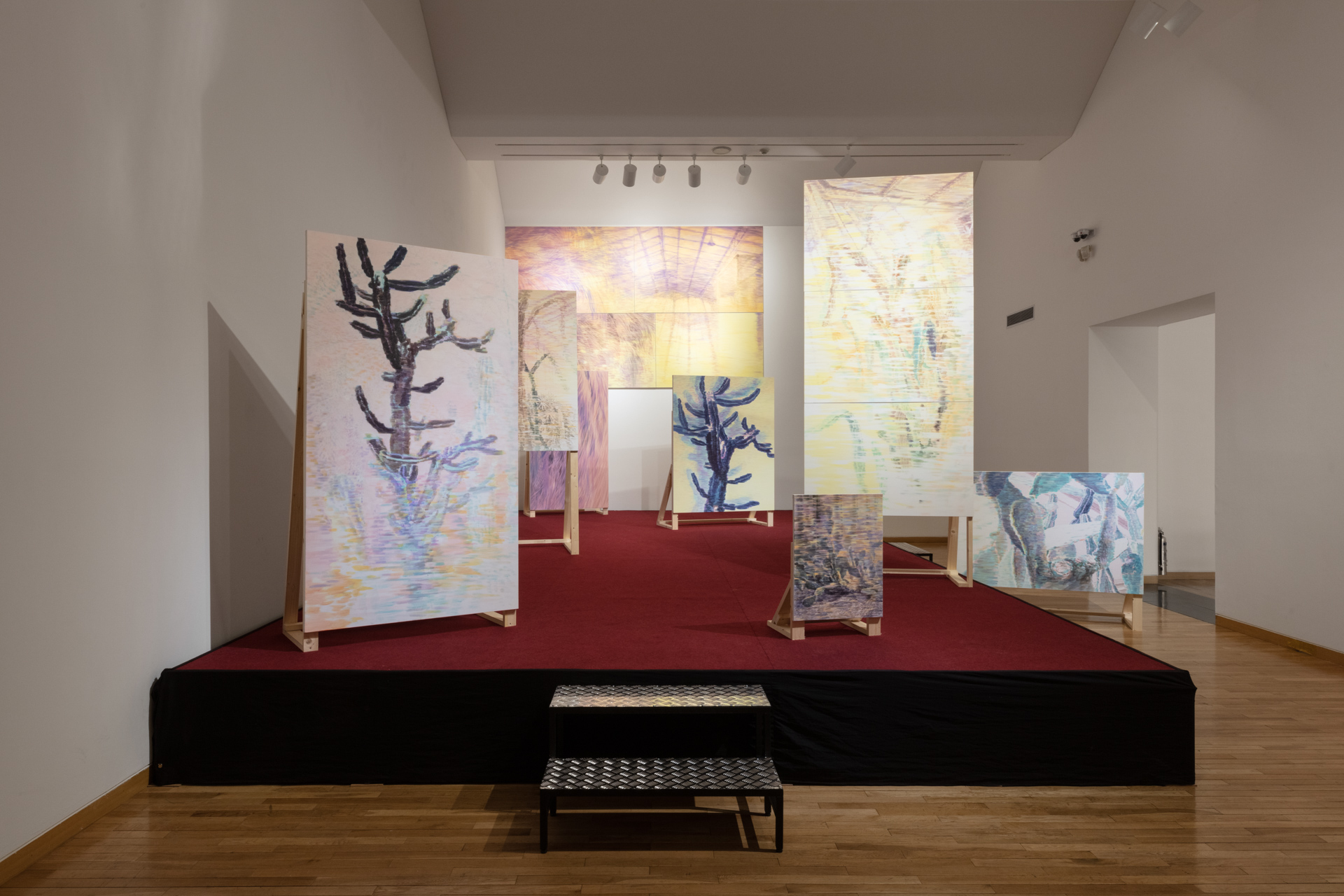
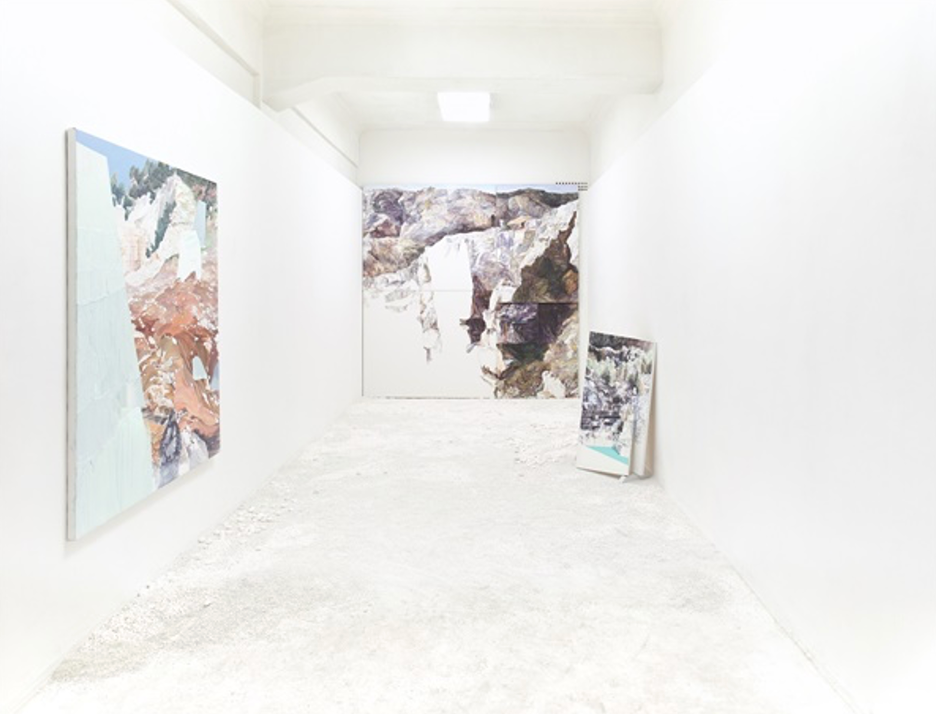
The exhibition is a landscape crystallized like a shining crystal, and is therefore exceptionally beautiful and peaceful. The artist’s techniques as a painter who fills the surface while moving between imagination and representation, as well as her attempts to construct the entire exhibition space, are already mature.
In the exhibition space, through flat works and three-dimensional installations, perhaps what the artist has represented and relayed is not the landscape itself, but rather unknowable things such as the varied processes of the act of drawing, stories evaporated behind places, legitimate misunderstandings, stories clothed in brushstrokes, and inevitably fabricated impressions.
Rather than offering the artist trophy-like glittering words, perhaps innocent questions full of doubt and impressions full of misunderstandings may be more helpful.
2. Commentary Note: Landscape Foot, Painting Tail
Professionally, I write three or four exhibition prefaces, six or seven artist essays, and more than twenty artwork descriptions a year. In the case of artist essays, the usual order is to write one or two texts commissioned by people who know of each other’s existence to some extent, three or four texts commissioned by art institutions, and, occasionally, one text for someone I have never met.
Unless there is a particular reason to refuse, I tend to write at a pace that does not fall too far behind the cycle of exhibitions.
The method and order of communication are as follows: confirming the artist’s thoughts as revealed in creative notes or previous portfolios, the characteristics of that person’s language and thinking, and the methodology of visualization; meeting once or twice to confirm what I am curious about and to have conversations based on new discoveries; roughly determining the title and writing strategy from the intuitive impressions and unrefined thoughts received at the first meeting if possible; and writing the text over two or three weeks in accordance with the other person’s situation and pace, then seeking their agreement and opinions.
The text commissioned for the catalogue of Kayoung Choi’s solo exhibition 《A Serbian Mountain, a Quarry, Venčac》(Art Space Hyeong, 2020) is a kind of commentary modeled after footnotes and endnotes, and was written through the process of judgment and conception described above. The title “Landscape Foot, Painting Tail,” which will probably not appear in the place of the catalogue preface, is a cluster of words assembled in various ways after checking the pagination in the catalogue editing process.
“Foot” corresponds to footnote, and “tail” corresponds to endnote in Korean; it is a kind of wordplay in which these are joined again to landscape and painting.
Rather than taking the form of a preface or afterword, it was a process of searching for words that would naturally supplement and explain Kayoung Choi’s writing and painting. I had imagined a state of writing like an absurd commentary bot that builds another layer premised on a distance similar to the relationship between the artist herself and M, who had sent photographs from a foreign country by email.
The ten words that appear in the short text led me to bring in fragments of the same words found in texts I had previously written, internet articles of shallow depth about Marco Polo’s travelogue, and particular words such as quarry and amusement park—in other words, natural-historical sentences that seem to have taxidermied the placeness of ruins and romance likely to exist in every city in the world.
Perhaps, compared to the total amount of communication and the density of friendship between Kayoung Choi and M, the quality of the conversations and mutual understanding exchanged between me and the artist was much thinner. Nevertheless, the fact that a painting is painted and a text is written is a matter of this world. Just as Marco Polo’s travelogue became literature that can be enjoyed without needing to question whether it was an empirical record.
The Serbia quarry work will, in itself, be a sequel to previous work and a prequel to some series that will appear next, and I am curious. Just as the usage of meanings differs slightly between “a place that does not exist” and “a place that has disappeared,” I am curious about the gap between the landscapes of “a place that exists” and “a place that came to exist” in the next work. And about the sorrowful nostalgia for a time and space never experienced.