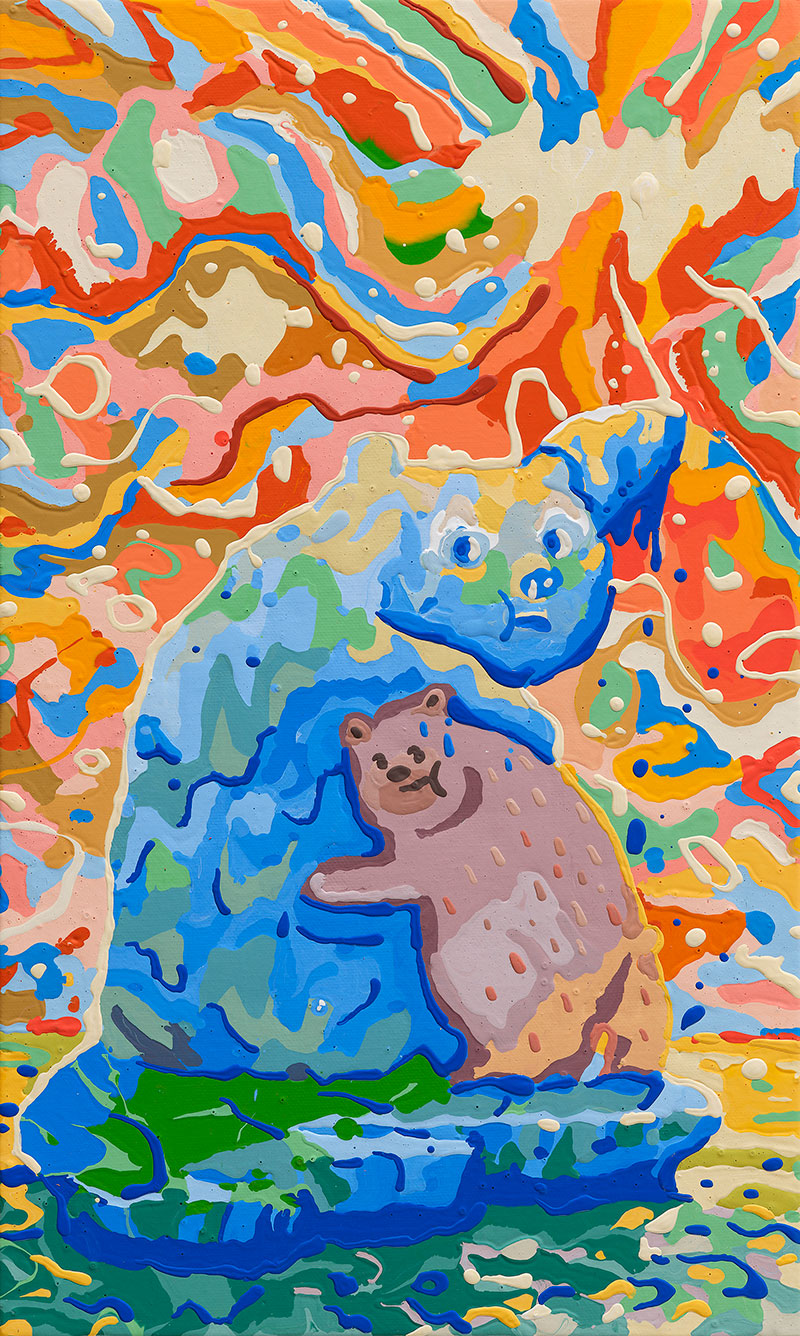
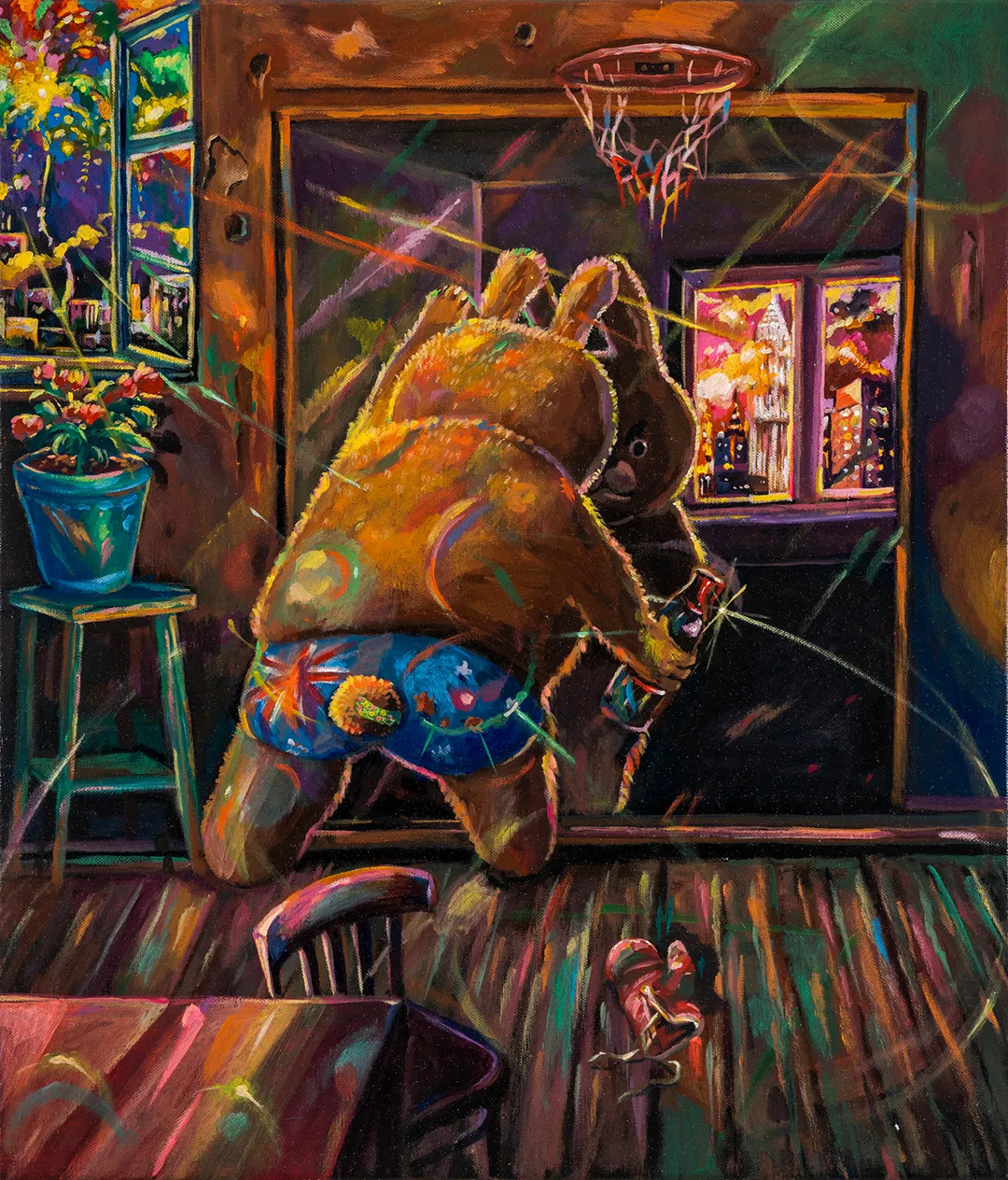
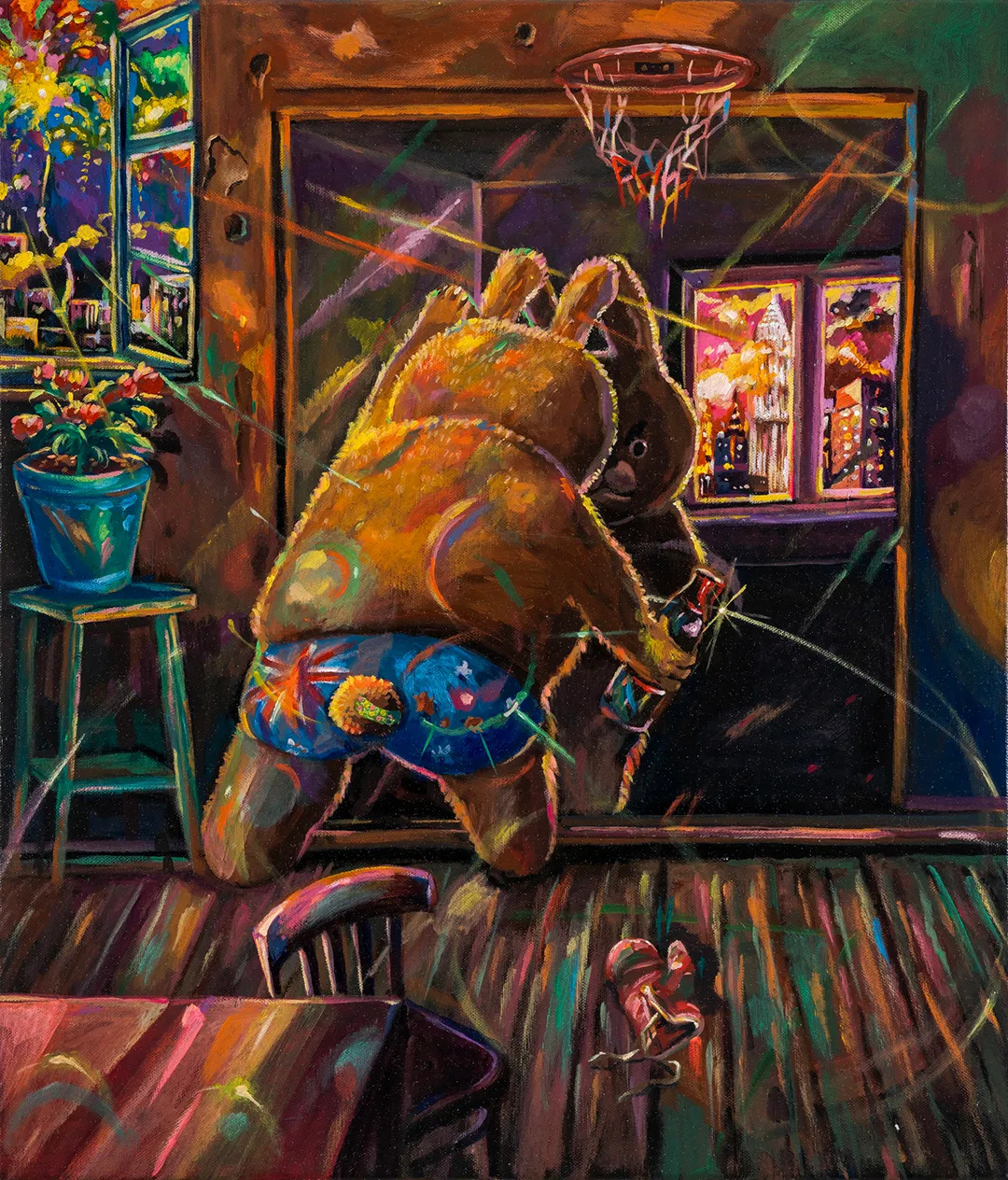
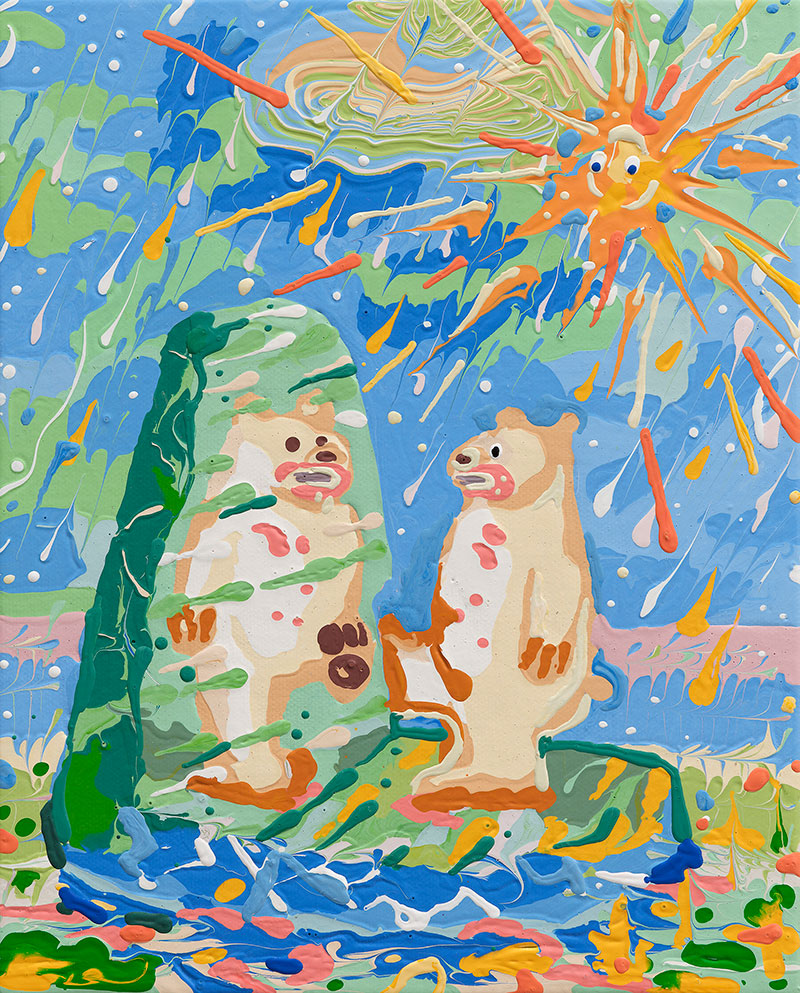
Bae Yoon Hwan, Untouchable Bonnie, 2022, Acrylic on canvas, 53 x 46 cm © Bae Yoon Hwan

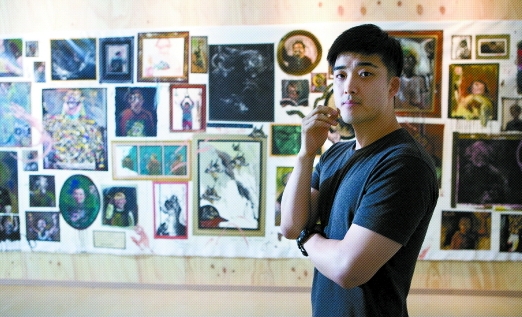
Painter Bae Yoon Hwan constructs fables from social absurdities and feelings of defeat experienced in everyday reality. In his paintings, public issues and personal experiences intersect in humorous ways. The keywords that run throughout his artistic practice are satire and humor. Through whimsical characters and witty storytelling, he sheds light on marginalized beings while exposing the naked realities of human desire.

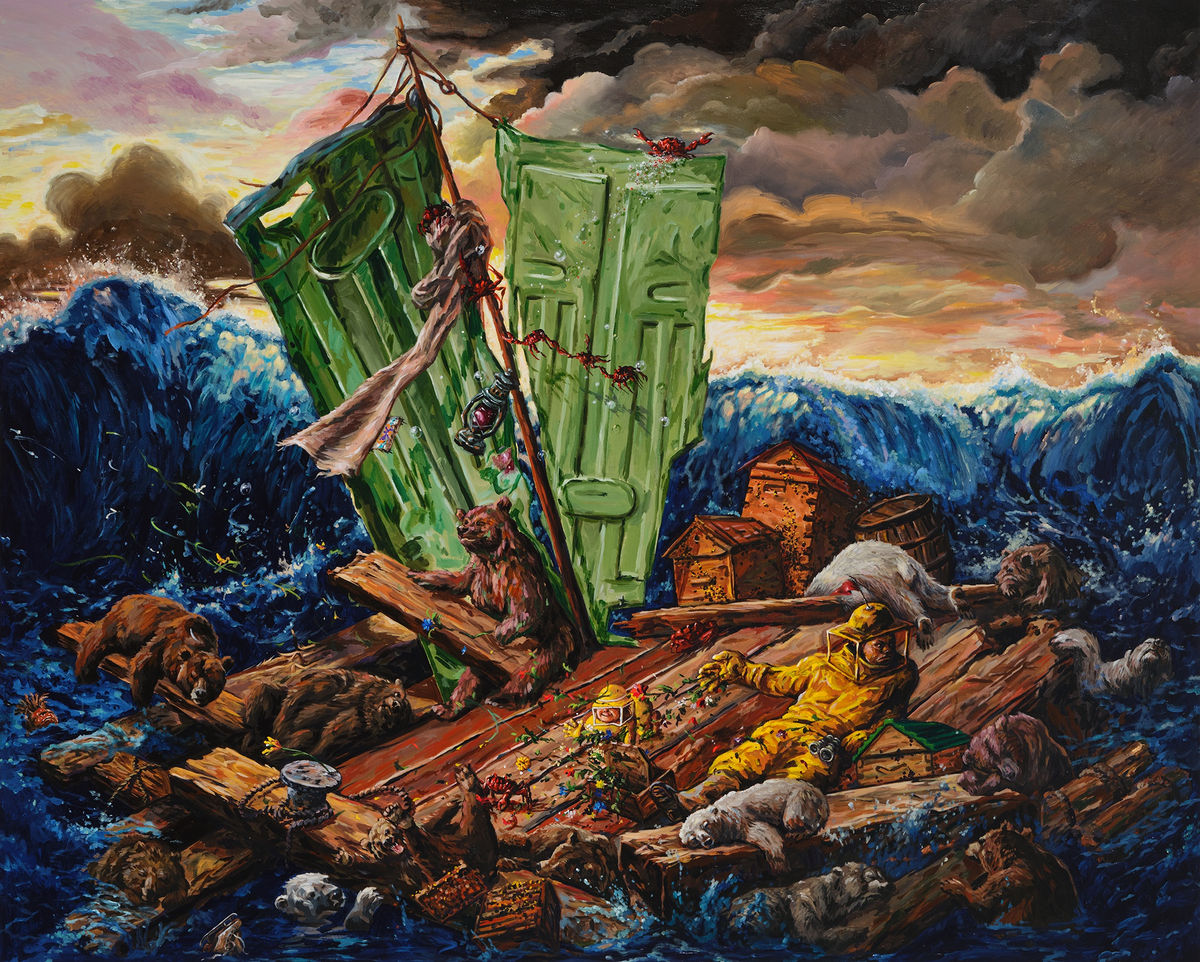
Having initially reinterpreted Romanticism, he has recently expanded his concerns to encompass global environmental issues. Through anthropomorphized animal imagery, he projects the contradictions of contemporary society.

Bae translates social contradictions into pictorial narratives through the language of fable. Issues such as capitalism, environmental destruction, and regional self-interest—some of the most pressing concerns of contemporary society—are woven together with his direct and indirect experiences and transformed into stories. Although these subjects might easily appear heavy-handed, his paintings maintain a distance from overt seriousness.

Instead, his canvases are populated by charming animals that seem as though they have stepped out of a storybook. Rabbits, koalas, polar bears, wolves, and other anthropomorphized characters gather together to enact narratives that communicate complex themes in an accessible and engaging manner. Underlying this visual language is Bae’s distinctive use of satire and humor.

Satire and humor are forms of critical expression, yet they differ fundamentally from criticism in its conventional sense. If criticism seeks to correct errors through logical and direct argumentation, satire and humor operate through wit and playfulness. Satire attacks the causes of a problem by rendering its targets ridiculous, while humor portrays those affected by a problem in an amusing manner, encouraging sympathy and understanding.

Unlike criticism, which can sometimes appear difficult or alienating, satire and humor engage emotion, leading viewers not only toward rational reflection but also toward empathy. Not serious, yet sincere—this is where the strength of Bae Yoon Hwan’s paintings resides.


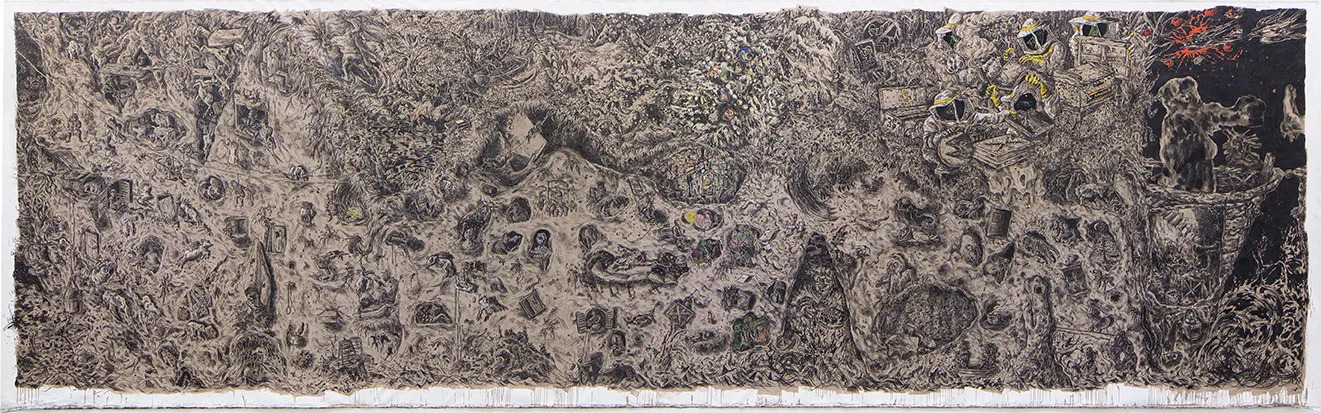
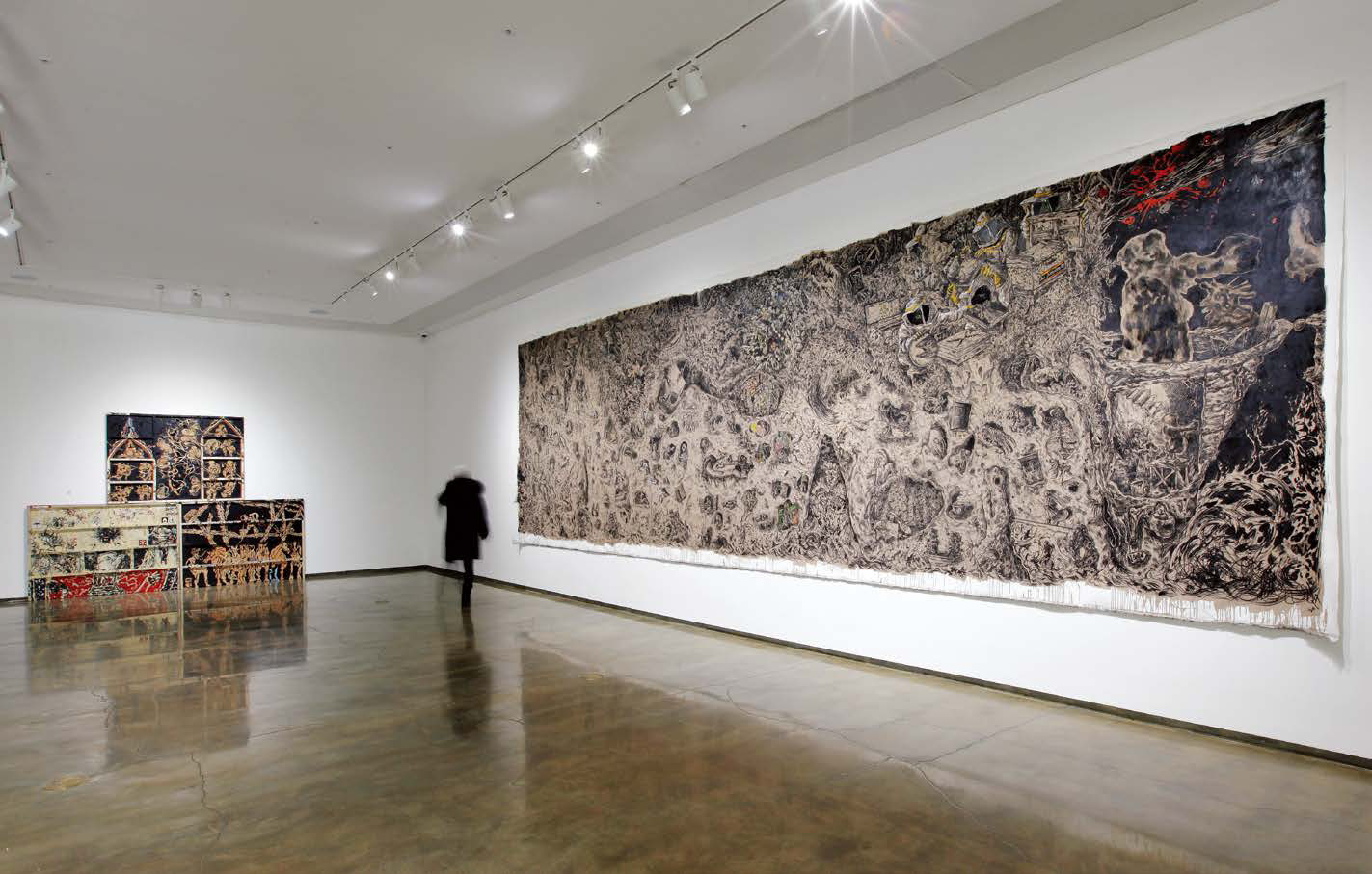
Bae Yoon Hwan, Breathing Island, 2017, Acrylic and oil pastel on canvas, 270 x 880 cm © Bae Yoon Hwan

The Periphery of the Art World: Inferiority as a Source of Strength

Even without invoking notions of elitism, the art world has its centers—certain regions and institutions that occupy positions of influence. It is not uncommon for young artists working outside these centers to experience a sense of marginalization. Bae Yoon Hwan was no exception. Born in Chungju, he loved drawing but had little interest in academic study.

He enrolled at Seowon University and later entered graduate school at Kyungwon University, largely because it was close to his aunt’s home. After graduation, he embarked on his life as an artist, but uncertainty remained. People around him looked on with concern, as though thinking, “Another unemployed person has emerged,” and beneath it all there lingered a persistent sense of defeat.

Rather than succumbing to these feelings, Bae chose to transform them into positive energy and channel them into his work. “This is not a story about surviving on hardship alone. That minority sensibility actually gave me strength. Perhaps it would be more accurate to say that sadness and anger became my driving force. More than wanting revenge on those who hurt me, I wanted to transform those emotions into artistic energy.”

As a result, his early works contain more direct traces of lived experience than his recent paintings, which often adopt a fable-like atmosphere. The central theme of Bae’s early work can be summarized as the existential choices one makes within the inescapable conditions of life.

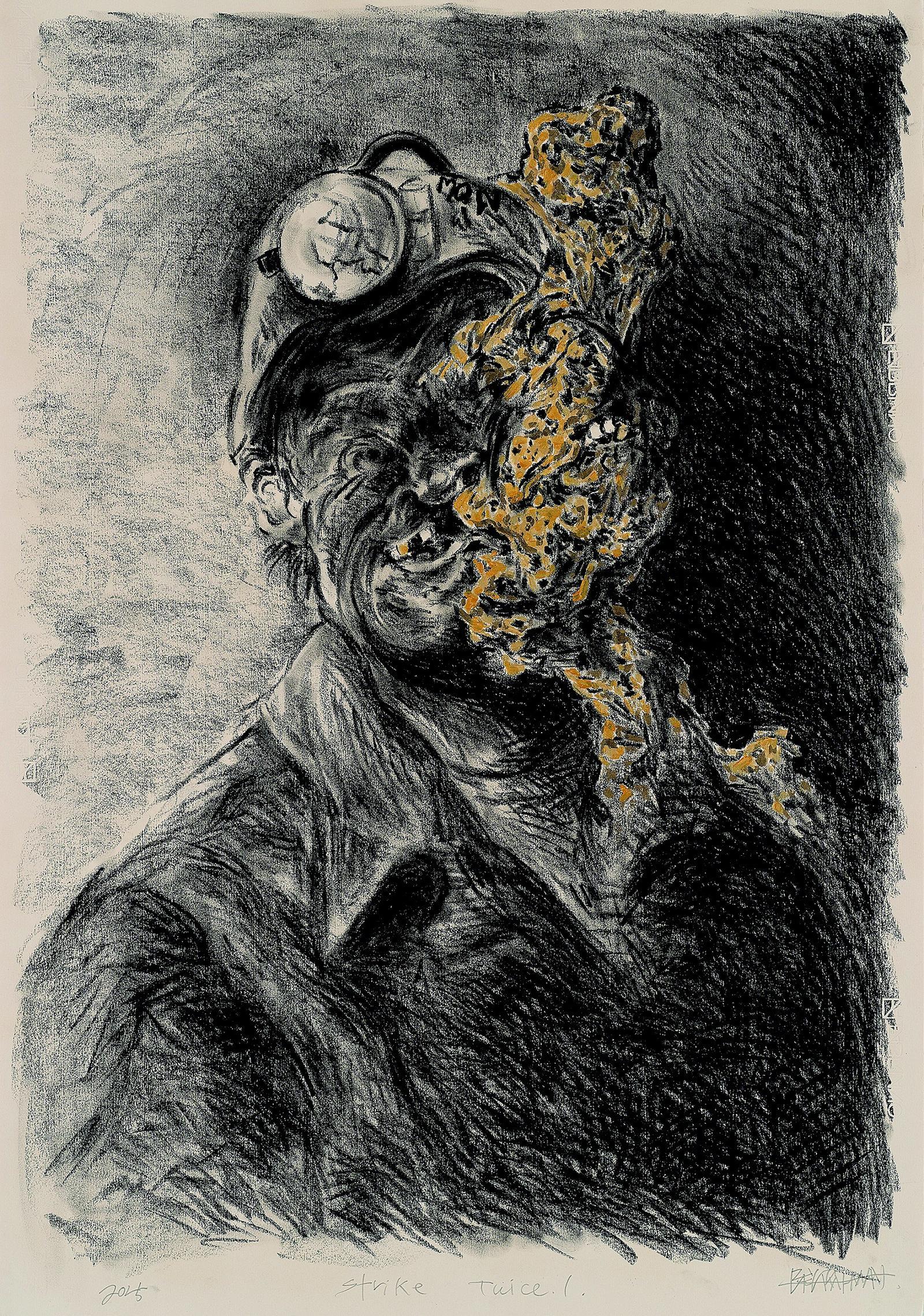
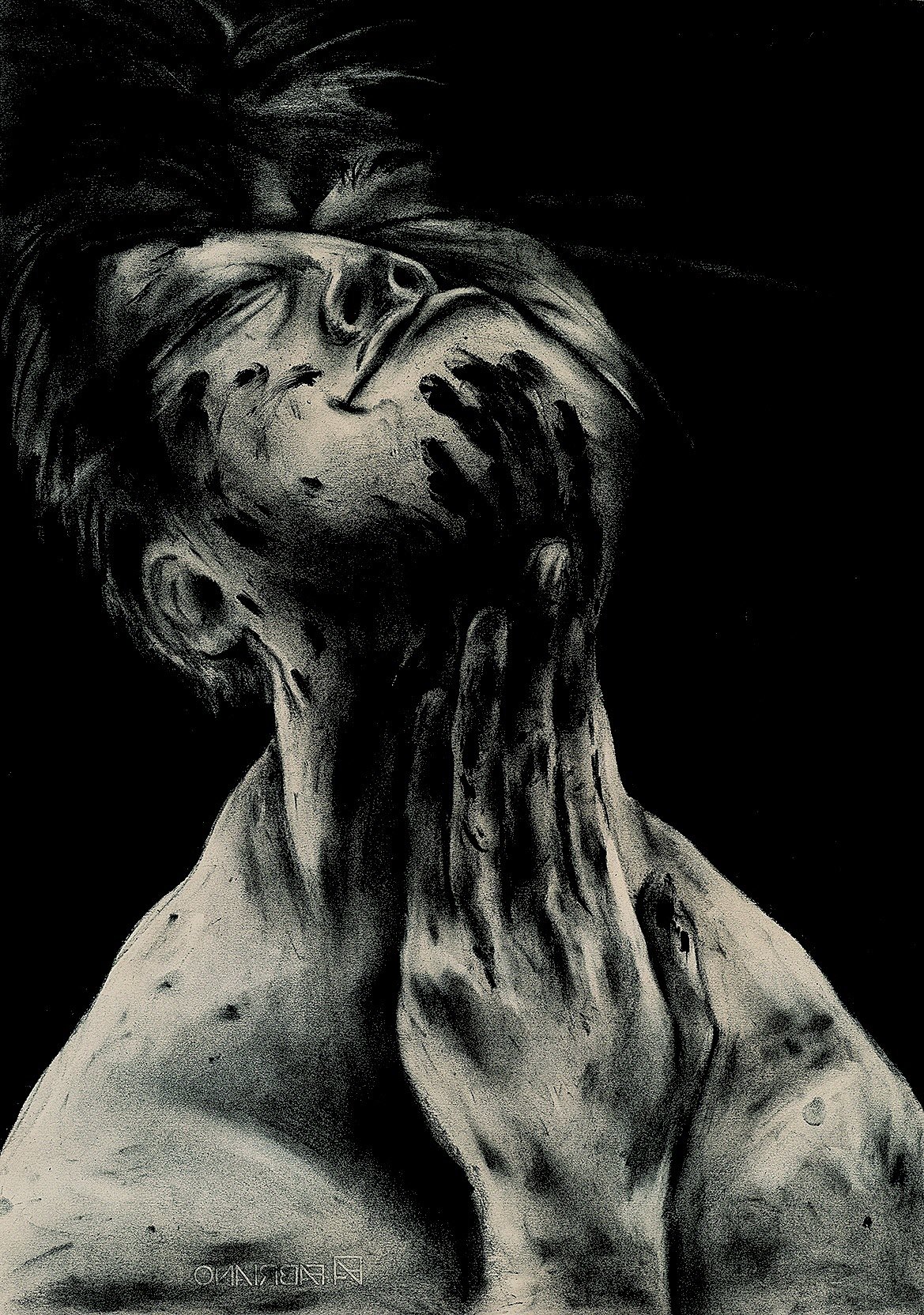
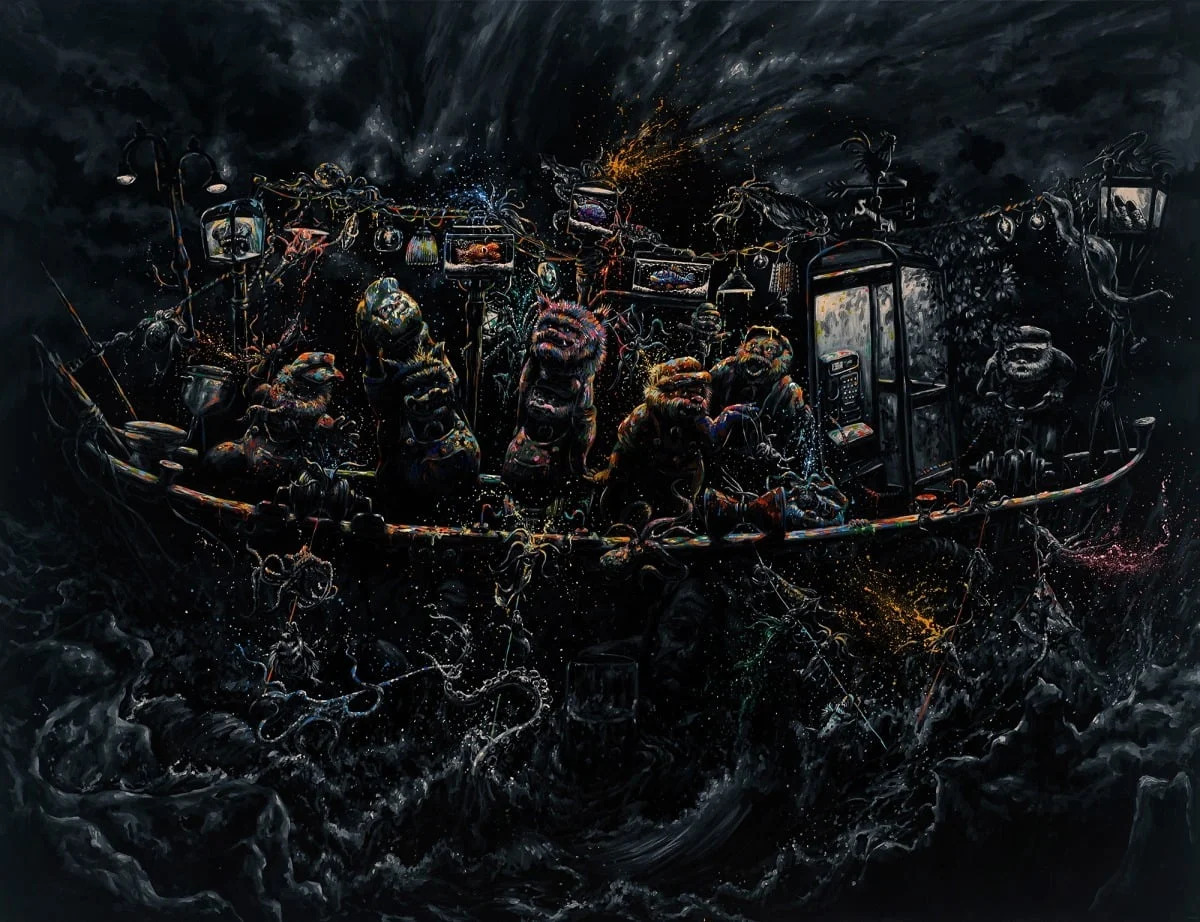
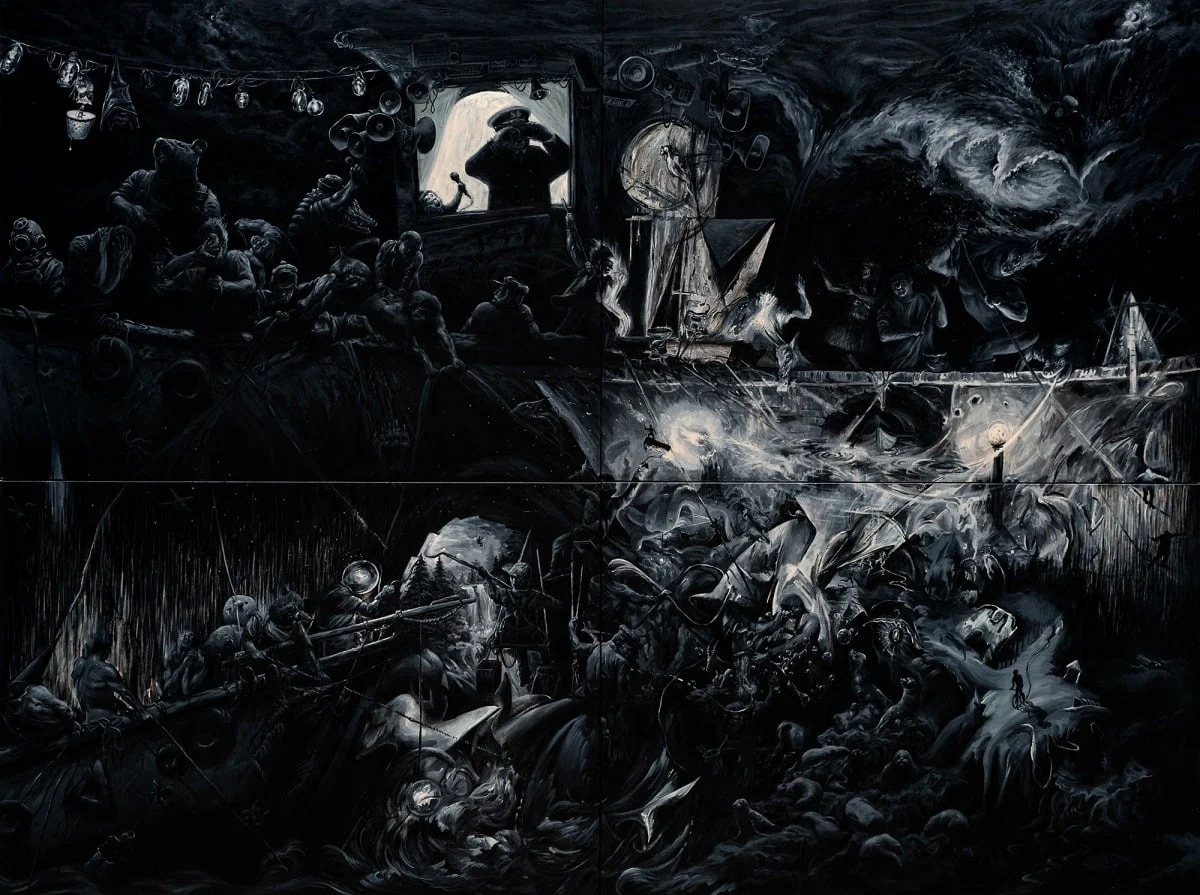
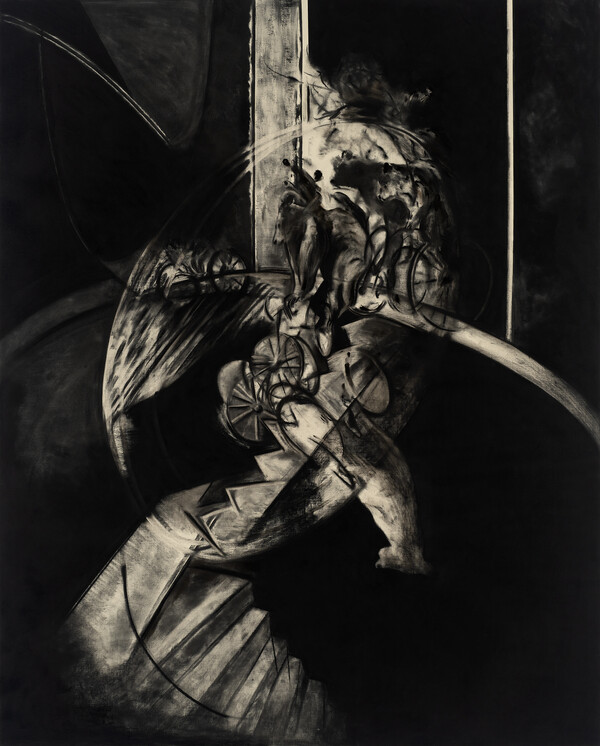
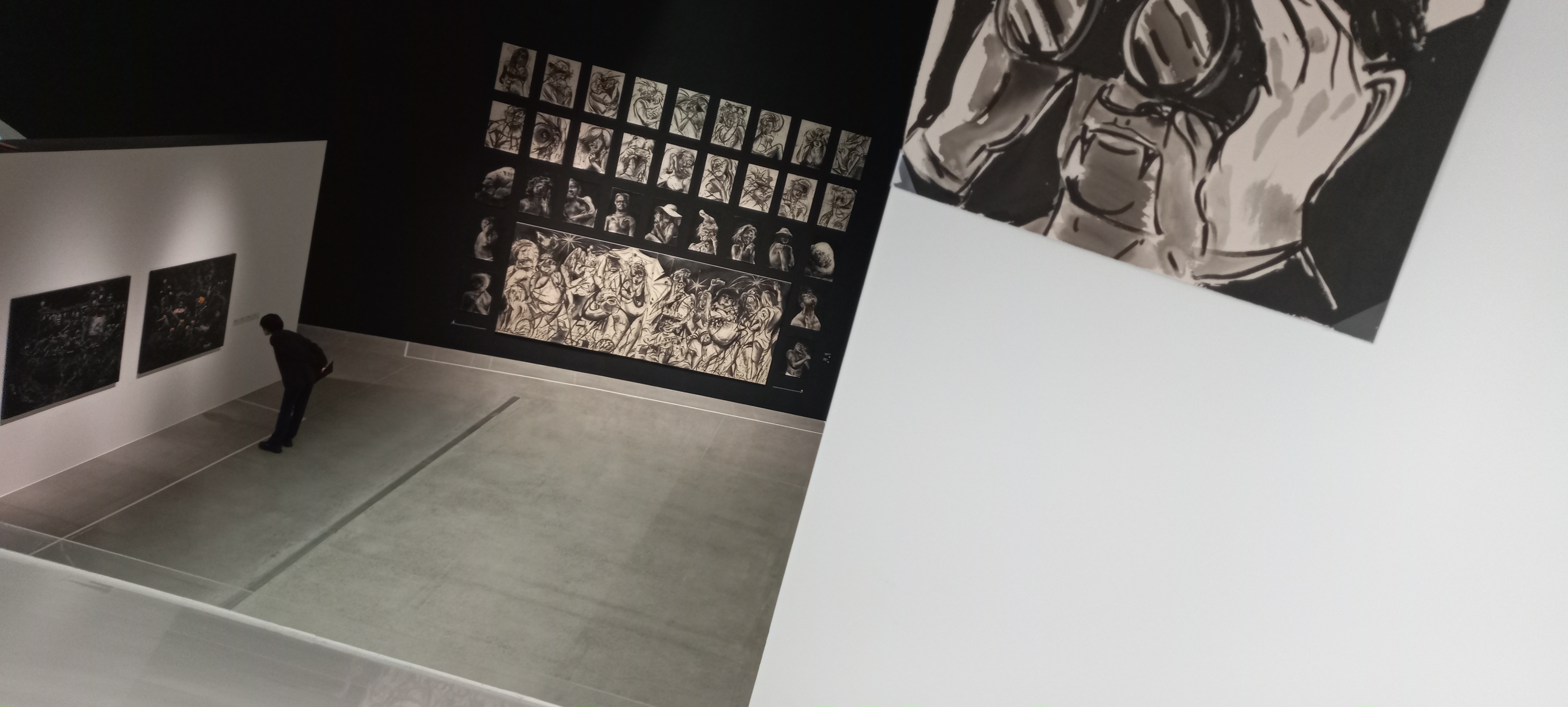
Reflecting imposed social realities, he frequently worked in monochrome or with a limited palette, drawing inspiration from Gustave Doré and Francisco Goya to depict the darker aspects of society as observed in everyday life.

His series SucheoJakju (2012) and IpcheoGaejin (2012) depict scenes from dogfighting arenas. In one image, dogs watch a fight unfold; in another, a defeated dog writhes in pain after the contest has ended. “When I stand facing a wall and paint, it feels like a problem I must overcome, or an opponent I must fight.”

Like an artist grappling with a canvas as though biting into it, struggling to wrest something from the surface, effort does not necessarily guarantee results. Yet Bae ultimately arrives at the conclusion suggested by the Buddhist phrase suchŏjakju ipchŏgaejin—“wherever you stand, become the master of that place; wherever you are, let it be truth.” Success or failure aside, one must simply do one’s best.

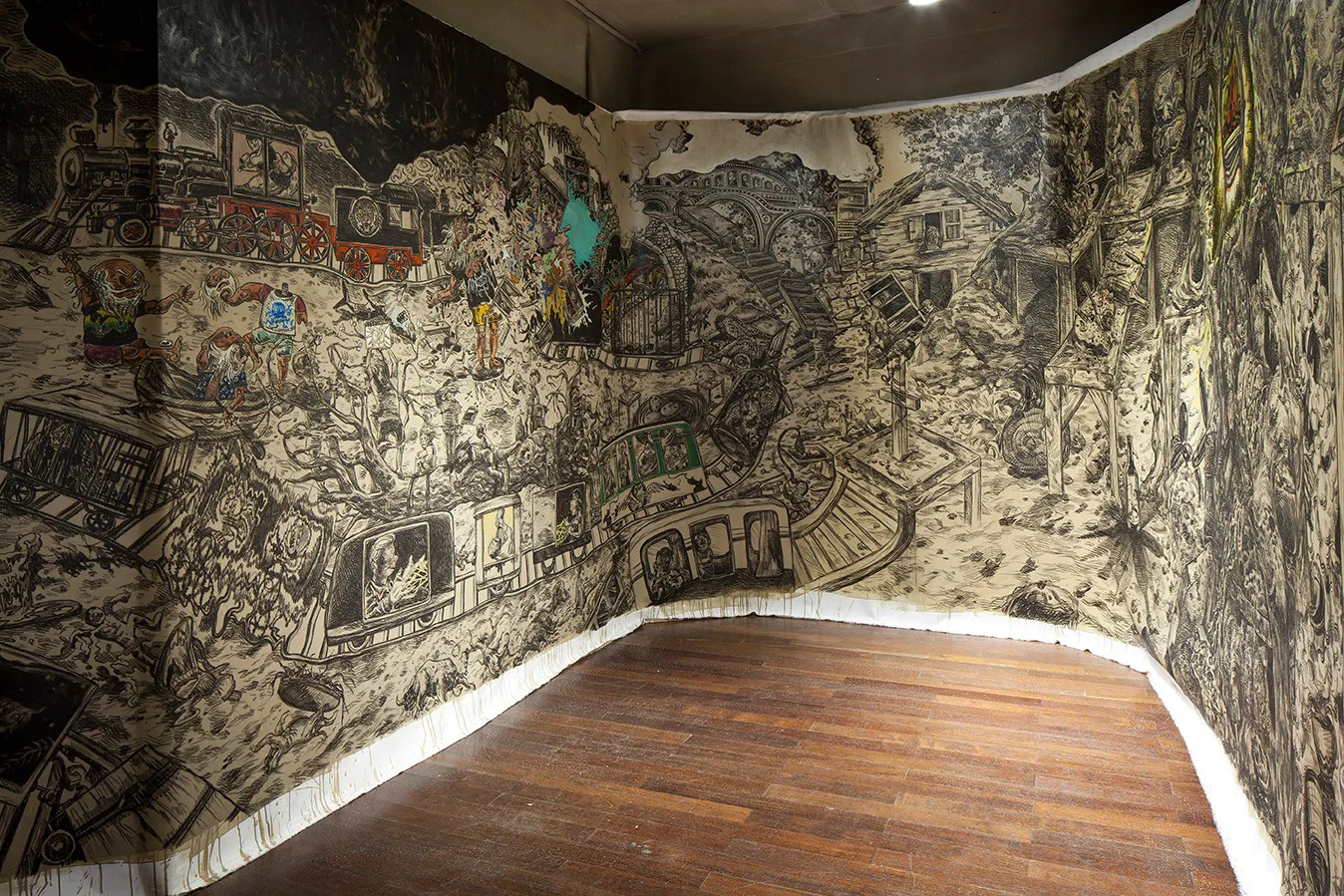
In Cliff Hanger (2014), Bae expanded these concerns into a broader reflection on society as a whole. Painted on a length of fabric fixed to a wall, the work presents a panorama of subway passengers. Figures cling precariously to overhead straps, a woman hurriedly eats toast, a painter wears clothing stiffened with dried paint, and distorted faces exaggerate the strains of daily existence.

Together they form a portrait of contemporary life, populated by individuals enduring each day as best they can. “When I took the subway home after part-time jobs, I would see people barely holding themselves upright on the straps, people carrying the smell of grilled meat. On this subway, endlessly circling through the curves and cycles of life, we were all hanging on together, trying somehow to make something of ourselves.”

Although rendered in a dark and rugged atmosphere, this is not the entirety of the painting. Alongside the weight of reality runs a persistent glimmer of hope—an inner light that refuses to be extinguished.

Like painters who continue to paint despite repeated declarations of the ‘death of painting,’ the figures in the work embody a condition that is both precarious and full of possibility. To the artist, this state resembled the countless routes and trajectories traced by passengers moving through the subway system.



Bae Yoon Hwan, WAS IT A CAT I SAW?, 2014, Acrylic and oil pastel on canvas, 217 x 5000 cm © Bae Yoon Hwan

WAS IT A CAT I SAW? (2014) is a large-scale painting that brings together political events, stories, fables, and personal experiences encountered by the artist. Stretching fifty meters in length, the work was exhibited with a portion of the canvas remaining rolled up, intentionally provoking curiosity.

The composition, in which numerous episodes intertwine without a fixed sequence, serves as a metaphor for the way social issues shape individual lives and are, in turn, returned to society. Reflecting this structure, the title itself takes the form of a palindrome. The phrase, which reads the same forwards and backwards, originates from the Cheshire Cat in Lewis Carroll’s novel Alice’s Adventures in Wonderland.

When Alice asks for directions, the Cheshire Cat replies, “That depends a good deal on where you want to get to.” The theme that runs through Bae’s earlier works—the idea of becoming the master of one’s own life regardless of circumstances—continues here as well.

In Breathing Island (2017), meanwhile, Bae experimented with automatism. The work assembles thoughts and emotions drifting through the artist’s mind, alongside animals and artistic materials, to create a landscape of the inner self. Bae has compared the work to Italo Calvino’s novel The Baron in the Trees. In the story, the protagonist climbs into the trees to escape his authoritarian father.

Yet the trees are not a place of retreat; rather, they allow him to observe the world from a certain distance. Calvino’s trees function in much the same way as Bae’s island.

The island, upon which everything that constitutes the artist is expressed, becomes both a site of self-discovery and a means of establishing distance from a former self in order to embrace change. Through this process of reflection, the artist ultimately bid farewell to what he calls his “black period.”


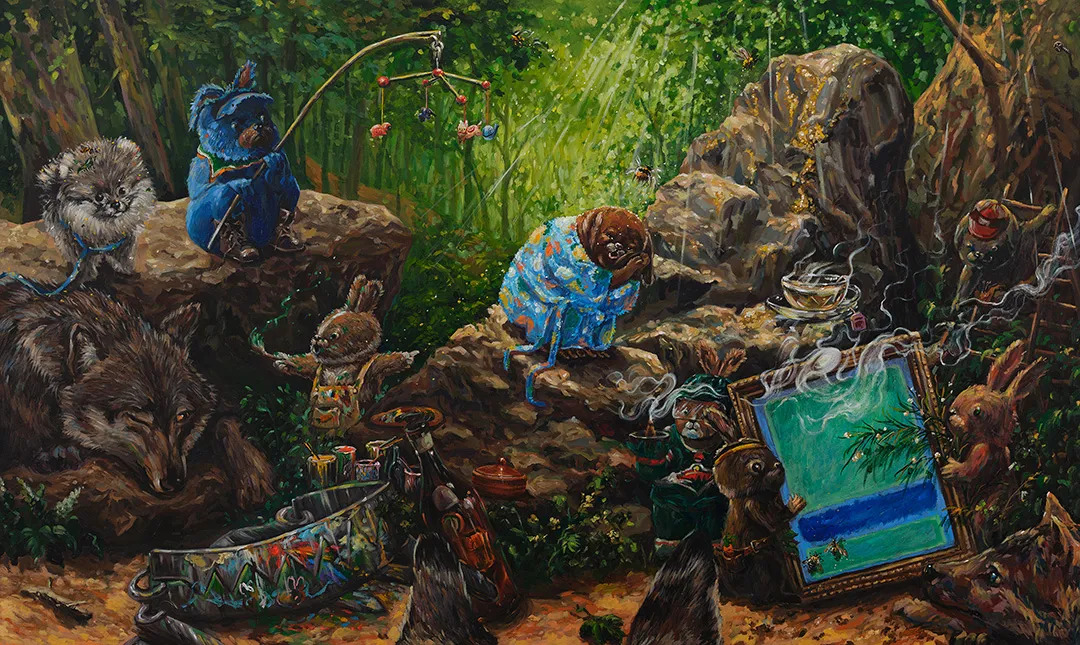
Bae Yoon Hwan, Lullaby for Fangs, 2022, Acrylic on canvas, 97 x 162.2 cm © Bae Yoon Hwan

The Aesthetics of Humor Grounded in Sincerity

Bae Yoon Hwan’s early works often took the form of expanding his personal experiences and emotions into broader social contexts. For the artist, sadness and anger were both a source of motivation and a means of escape. He believed that by laying bare his pain through painting, it might eventually disappear or be forgotten.

Yet the act of revisiting wounds through representation sometimes revived past suffering or forced him to confront once again the immense barriers imposed by reality. He also began to recognize the limitations of working predominantly in black. The monochromatic palette, initially adopted to emphasize formal qualities, gradually came to feel as though it constrained rather than enabled depiction.

With these realizations, the artist parted ways with monochromatic painting following his solo exhibition 《Lobster Quadrille》 (Chapter II Yard, October 15–November 28, 2020). He began employing a broader range of colors and reversed his previous trajectory, shifting from the personal toward broader social concerns as the point of departure for his work.

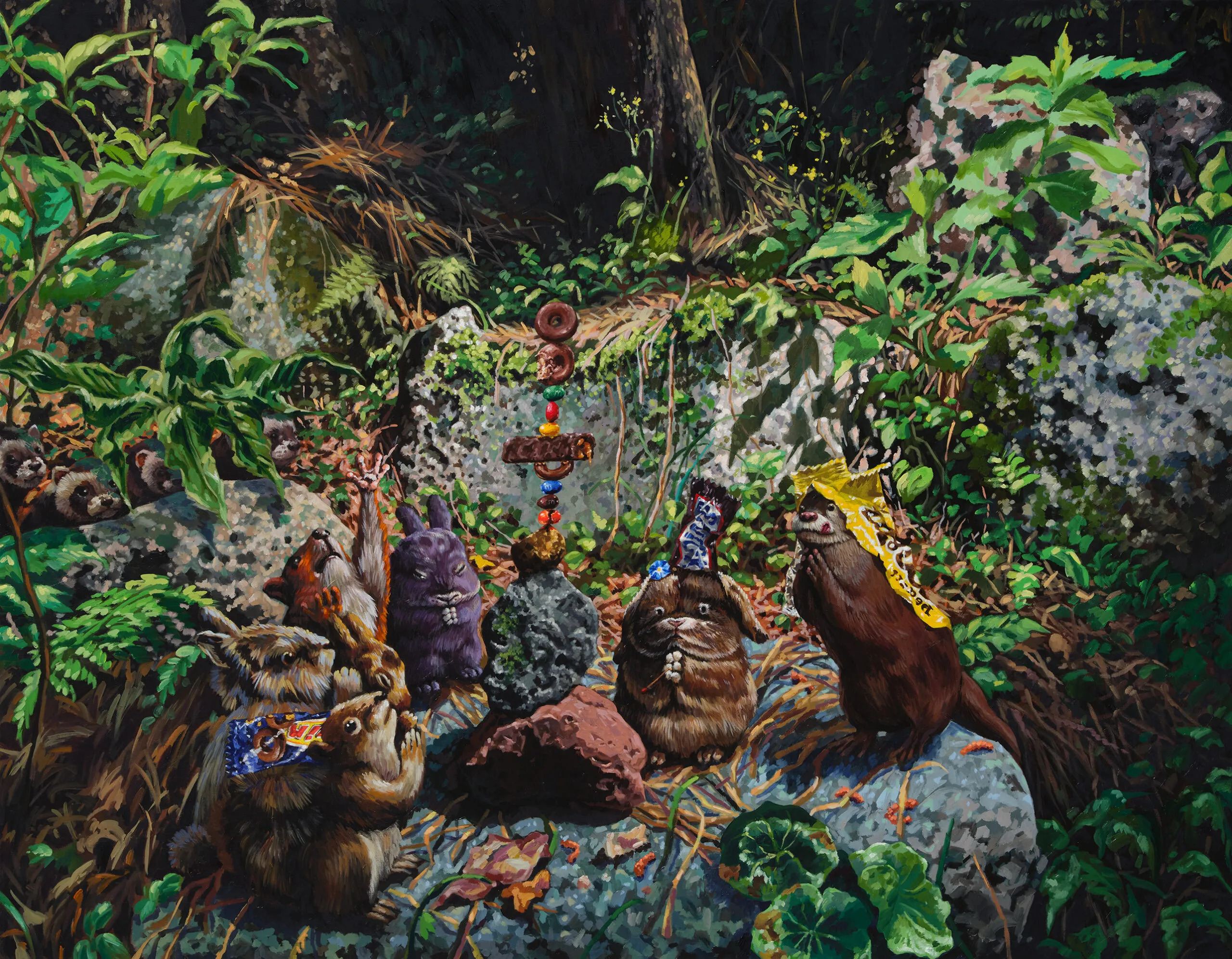
His solo exhibition 《What? In My Back Yard?!》 (Gallery Baton, June 29–July 30, 2022) marked a turning point in this transformation. The new theme that emerged was the environment. The artist was drawn to environmental issues because they allowed him to engage with global concerns without relying on personal narratives.

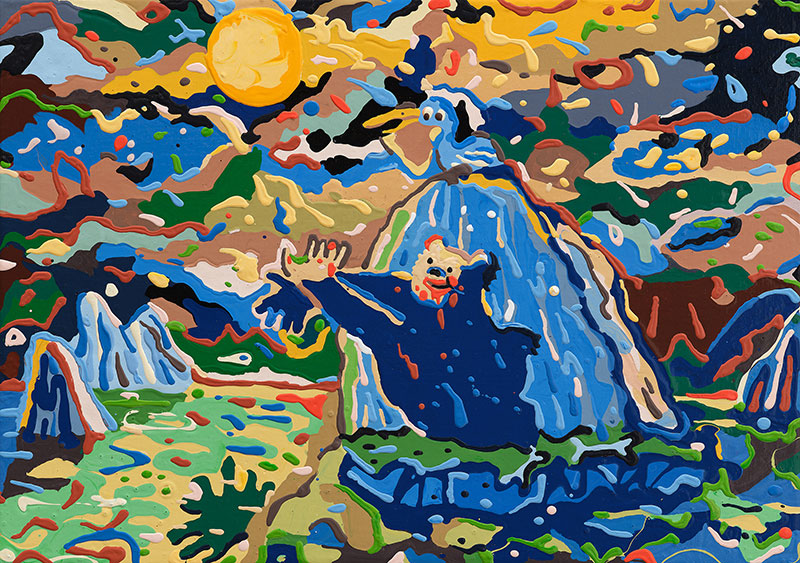
Using the phenomenon of NIMBYism as a key motif, he depicted situations in which indiscriminate development threatens animal habitats. Although the animals have lost their homes and are driven out by humans, their expressions appear closer to mischievousness than anxiety.

The fact that environmental issues need not be framed through individual experience also suggests, conversely, that they can feel less immediate on a personal level. Bae addresses this distance through humor. Rather than attempting to persuade viewers directly, the playful expressions of his characters encourage empathy for the realities they face.

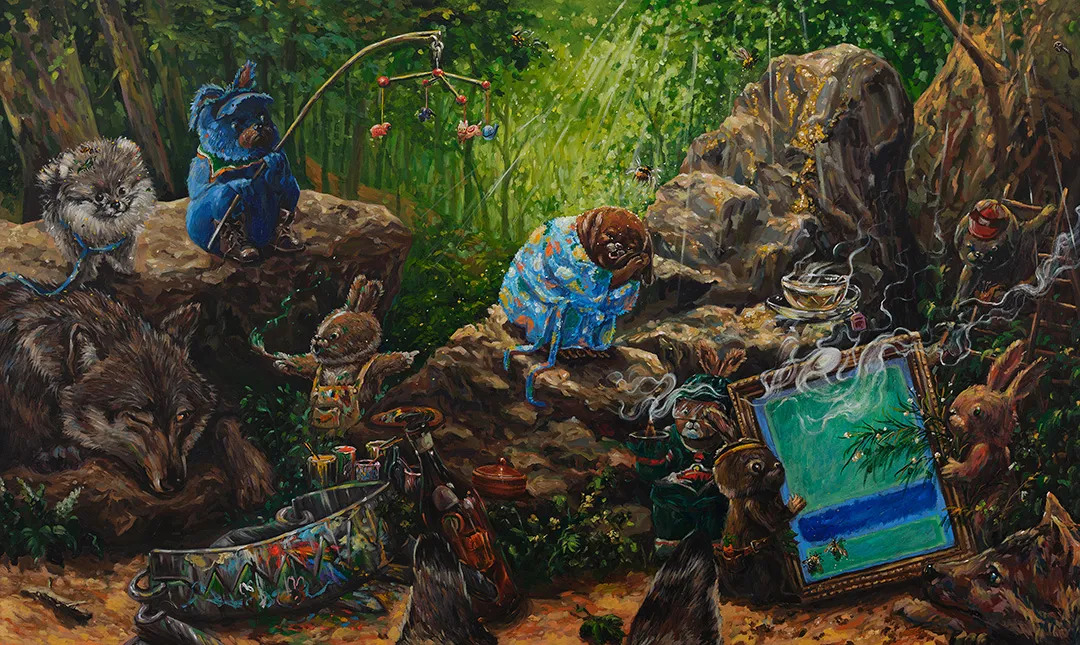
Lullaby for Fangs (2022) draws on animal management policies in the United States and Australia. The painting features an exhausted-looking wolf alongside a comically disguised rabbit. Once listed as an endangered species but later targeted for population control by the U.S. government due to increasing numbers, the wolf suffers from insomnia, haunted by the possibility of becoming prey at any moment.

In contrast, Australia designated rabbits as harmful animals yet ultimately failed to control their population. Bae imagines a scenario in which the rabbit offers the wolf survival strategies derived from its own experience of persistence and adaptation.

The sight of a rabbit busily arranging mobiles, scented candles, and alcohol in an effort to lull its natural predator to sleep, while the wolf lies passively and follows its guidance, evokes a kind of fairy-tale utopia. One might argue that a more appropriate image for a work addressing animal protection would be a wolf reduced to skin and bone, its suffering rendered in graphic detail.

Even sleeplessness may seem a modest concern when compared to starvation or death. Yet viewers often linger longer before images that invite laughter and empathy than before those that rely on brutality and realism. It is here that the humor in Bae Yoon Hwan’s paintings derives its strength.


Bae Yoon Hwan, Rumble & Crumble, 2022, Acrylic on canvas, 162 x 390 cm © Bae Yoon Hwan

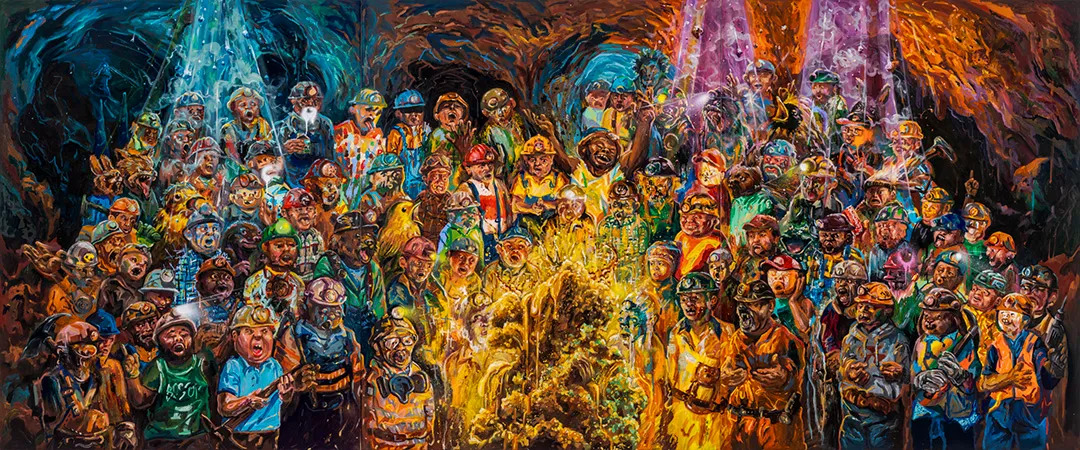
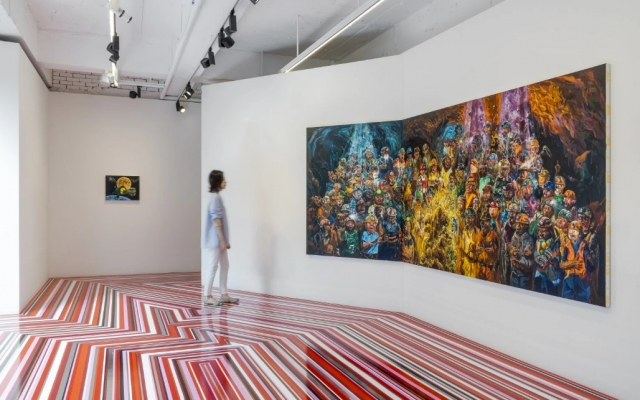
If Lullaby for Fangs demonstrates Bae Yoon Hwan’s sense of humor, then Rumble & Crumble (2022) reveals the sharpness of his satire. Set within a collapsing gold mine, the miners are more captivated by the gold before them than by the disaster unfolding around them. Canary birds, long used to detect danger in mines, raise their voices in warning, yet the miners hear their songs only as celebratory music marking the discovery of more gold.
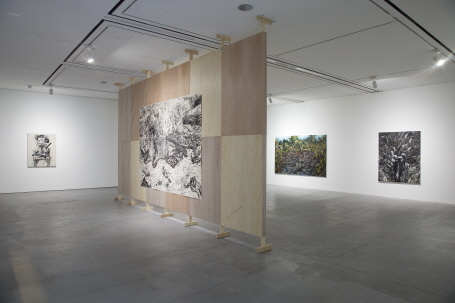
On a direct level, the work critiques the worship of wealth; more indirectly, it points to a contemporary society that remains fixated on development and profit even in the face of urgent environmental crises. 

The artist stages the interior of the cave as though it were a party venue. Multicolored lights illuminate the figures, who hum tunes, raise their hands in celebration, and revel in the moment. Yet the light entering through cracks in the ceiling signals an impending catastrophe, while the miners’ excitement only hastens the cave’s collapse.

The more humor the painting appears to contain, the more disturbing the imagined aftermath becomes. And to viewers who laugh at the miners’ foolishness, the work poses a question: is our own enjoyment not also built upon disaster?

Although Bae has consistently engaged with social issues, he has repeatedly resisted being labeled an “artist with a social conscience.” “I don’t donate to Greenpeace. I just sort my recycling properly and still drive a diesel car. You could say that I use social issues as material, but isn’t it enough if people see something and feel something, even for a moment?”

His interest in animals whose habitats have been destroyed emerged during a period when he was shuttling between banks because of real estate concerns. Hearing this, it becomes easier to understand what allows his paintings to resonate with viewers. As Bae himself suggests, he is neither a socially engaged activist nor a moral crusader.

He is an ordinary person, wavering between feelings of inadequacy and desire. Yet precisely because of this, audiences—equally ordinary people—can approach his subjects with ease. His paintings do not lead viewers toward values through lofty theories or difficult language; instead, they open a path from the everyday toward broader questions and concerns.

References