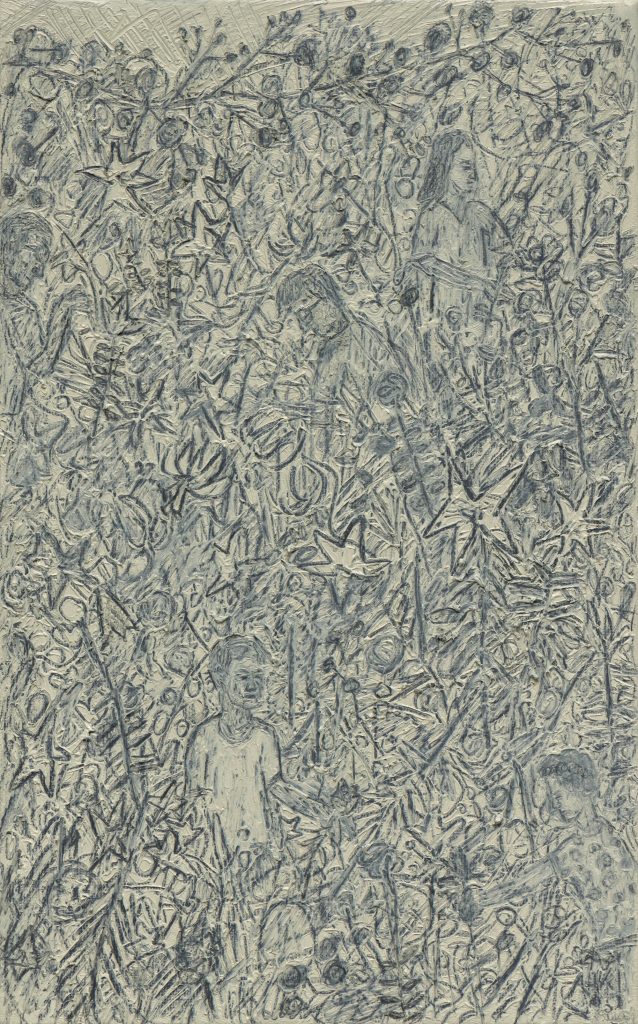
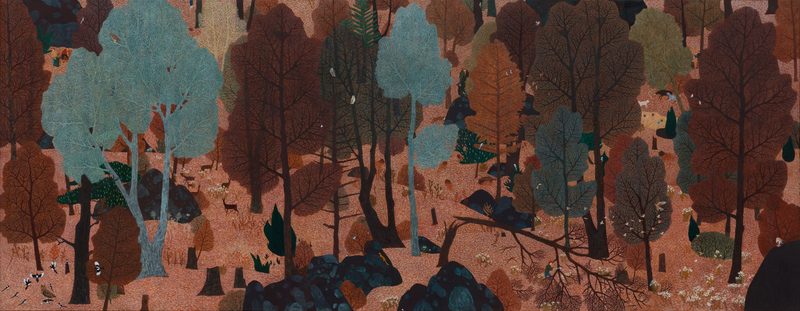
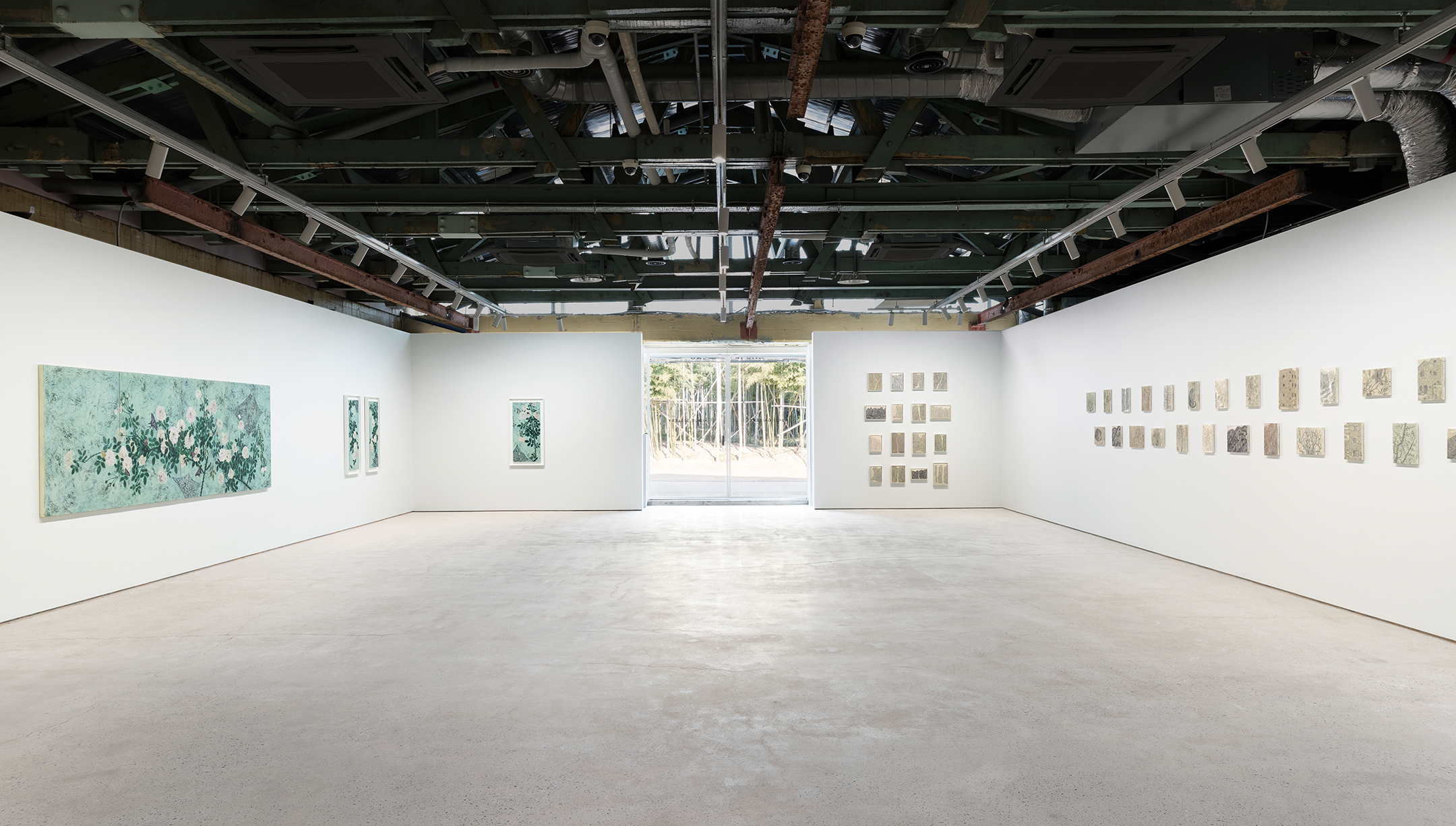
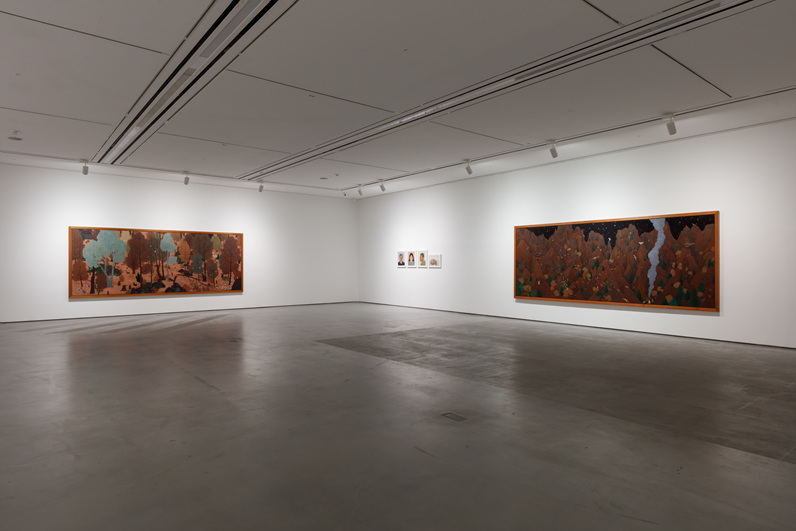
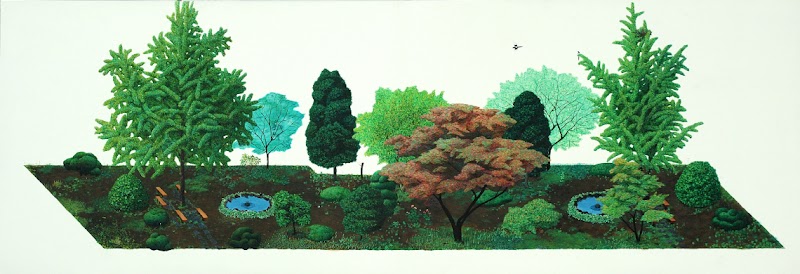
Seeing a figurative painting over four meters in length in a gallery has become a rare experience. Moreover, the large-scale, highly detailed works that Sungsic Moon presents in this exhibition—such as Interior of a Forest (2015–2016) and Night (2015–2016)—unfold panoramic forest scenes through countless delicate brushstrokes describing branches and leaves, inspiring admiration above all for their labor-intensive execution.
Yet when one considers that contemporary viewers spend more than three hours a day, on average, looking at the small vertical interface of a smartphone, these vast compositions resist being apprehended in a single glance.
Much like audiences who, upon spotting an animal or a hunter hidden within the painted forest, immediately reach for their phones to capture the detail, the expansive image is less likely to envelop the viewer as an environment or spatial experience than to be received as fragmented information.
Like Shakespeare’s classic A Midsummer Night’s Dream, in which dreamlike events unfold simultaneously within a dense forest, these two works likewise stage a multitude of incidents against a woodland backdrop: the brutal struggle for survival among animals and the various “uncanny” acts committed by humans who occupy the apex of the food chain.
Between the trees appear packs of animals devouring one another, hunters aiming rifles at them from a distance, and, near the upper edge of the canvas, the dangling legs of a suicide victim hanging from a tree, recalling the aerial acrobat in Manet’s A Bar at the Folies-Bergère.
These devices possess a certain predictability, as though one were participating in an Easter egg hunt in which expected symbols are hidden exactly where one anticipates finding them. They are all familiar signs of the “uncanny.”
The artist’s concern with human life emerges even more clearly in his bold black-and-white drawing series. The drama of men and women loving, fighting, aging, and dying produces a subtle discomfort, akin to contemplating a contemporary version of the Ten Commandments.
This unease stems not merely from the candor of the imagery, but from a sense of identification whereby we understand the sorrow, aging, desire, and anger of these figures while simultaneously feeling burdened with a moral responsibility toward them, as though being quietly admonished. Old Son and the Older Mother (2013) presents an inverted Pietà: an elderly son cradling his even older mother upon his knees.
The mother appears small and rigid, almost like a carved wooden doll. Rendered solely through variations of black-and-white tonalities painstakingly woven together stroke by stroke, the work embodies the terror of time, the imminence of death, and the complex emotions surrounding one’s mother as the origin of life. It is an image that few viewers can confront with ease.
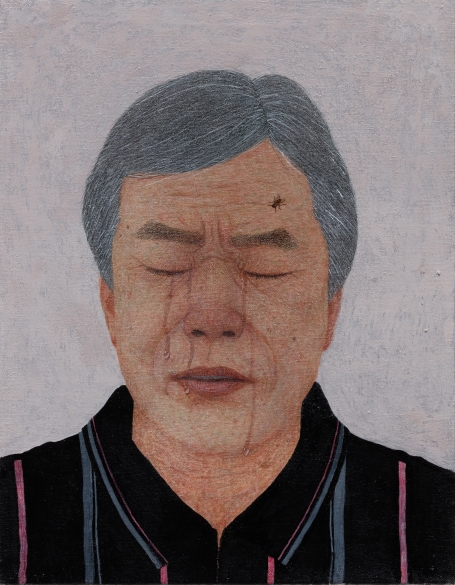
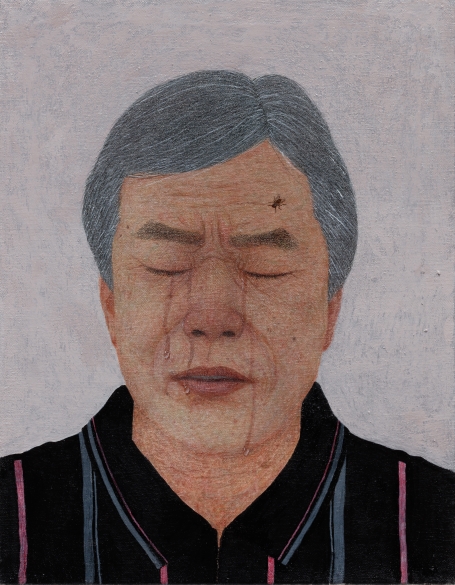
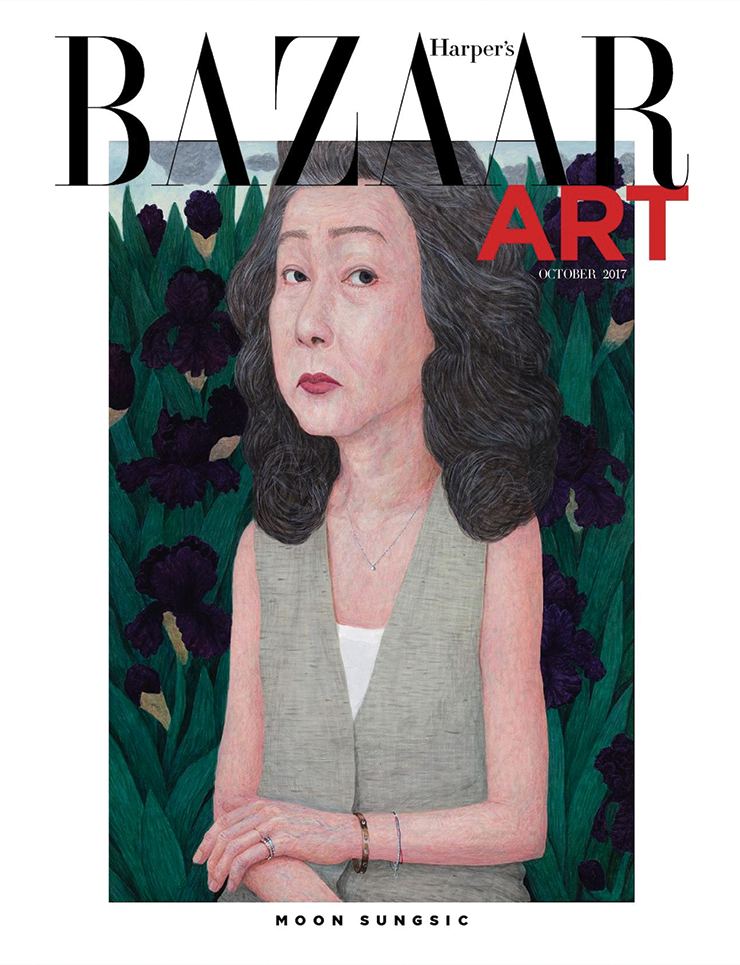
Among the exhibited works, there is a particularly notable prevalence of adults in tears. In the four-part portrait series Human. Tears. Fly. (2015–2016), one encounters unfamiliar scenes from everyday life: middle-aged figures with closed eyes shedding streams of tears, a woman covering her face with her hands, and an elderly man lying with his eyes shut as tears begin to fall.
These adults are rendered with the same meticulous precision seen elsewhere in Moon’s work. Not only the bead-like tears, but also the textures of skin, wrinkles, age spots, and capillaries are carefully depicted. In this respect, the viewer may find more pleasure in examining these works closely than in confronting the overwhelming scale of the artist’s monumental paintings.
Despite their hyperreal treatment of surfaces, the faces retain traces of caricatural distortion and formal abstraction reminiscent of the drawings discussed above. As a result, the figures feel less like portrayals of actual individuals than like character-like presences. Each portrait is accompanied by a single fly. In a still life, a fly might evoke the sweetness of flowers or fruit, or signify the process of decay leading toward death.
Here, however, the flies perched upon the figures remind us once again that these are painted beings and that their sorrow, too, exists on the level of pictorial rhetoric.
From the monumental paintings to the black-and-white drawings and even the nude croquis executed in bold ink lines displayed outside the gallery, the exhibition reveals both the artist’s sensitivity and spontaneity in handling different media, as well as his sustained and serious engagement with a wide range of painterly approaches.