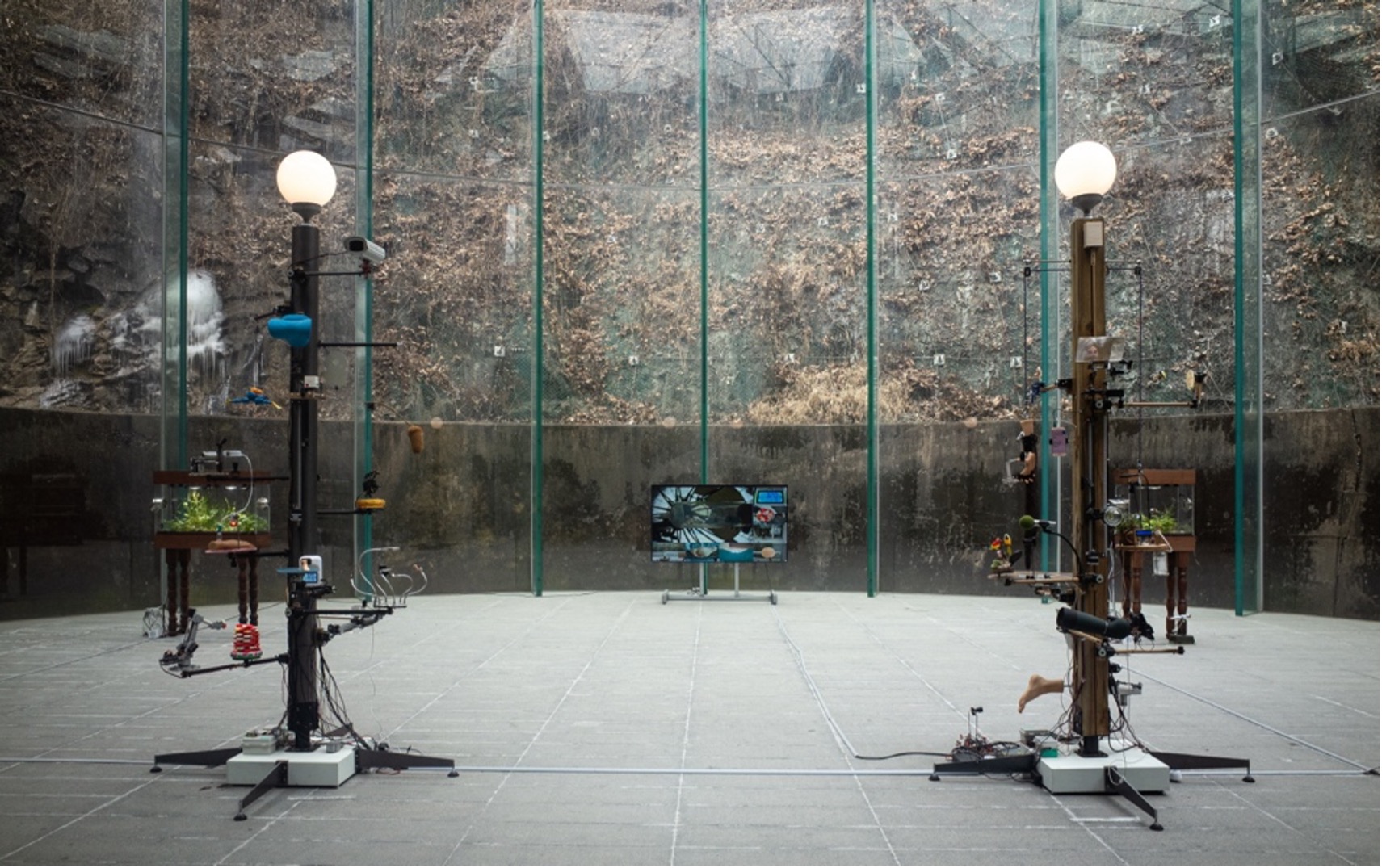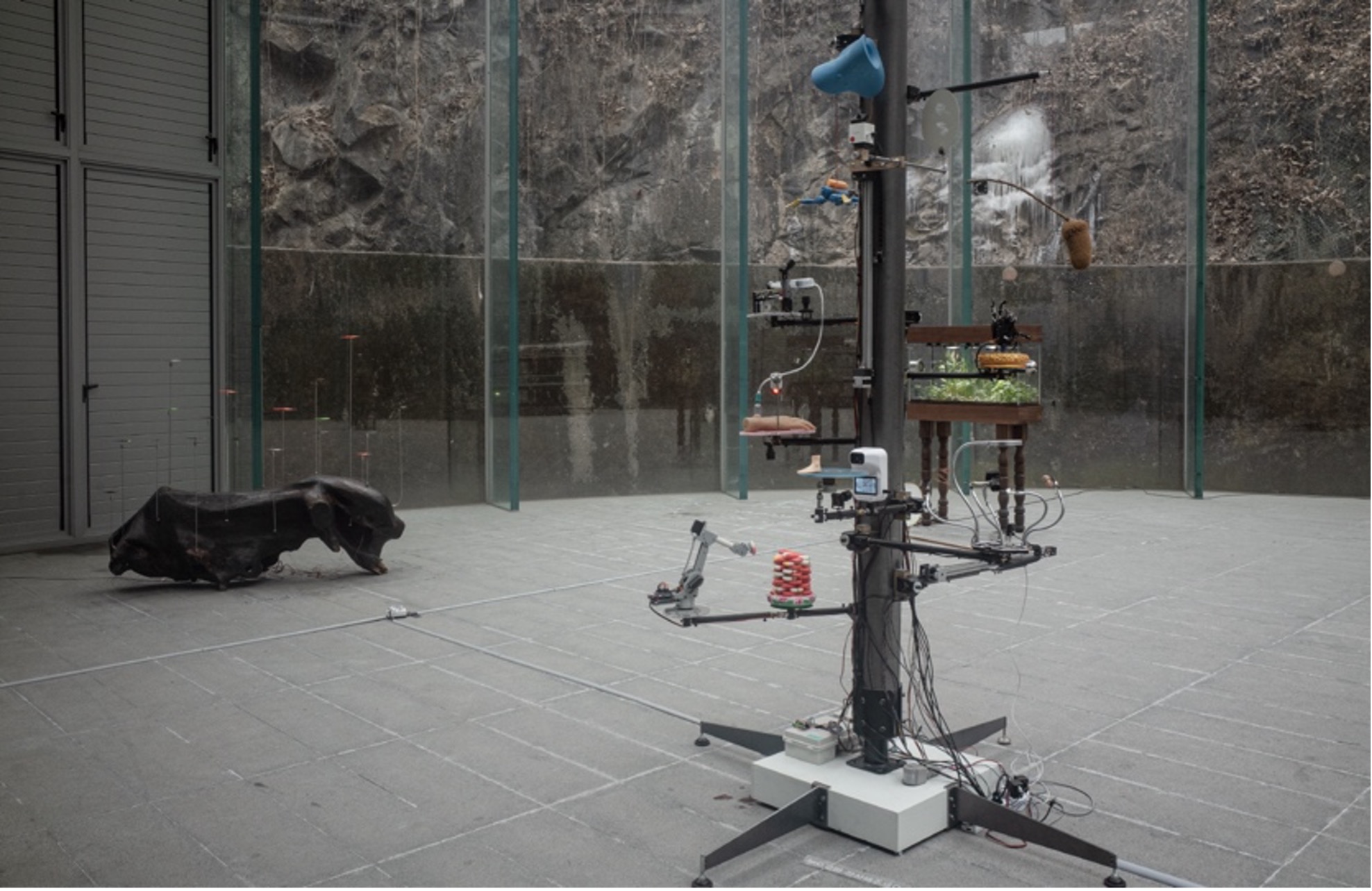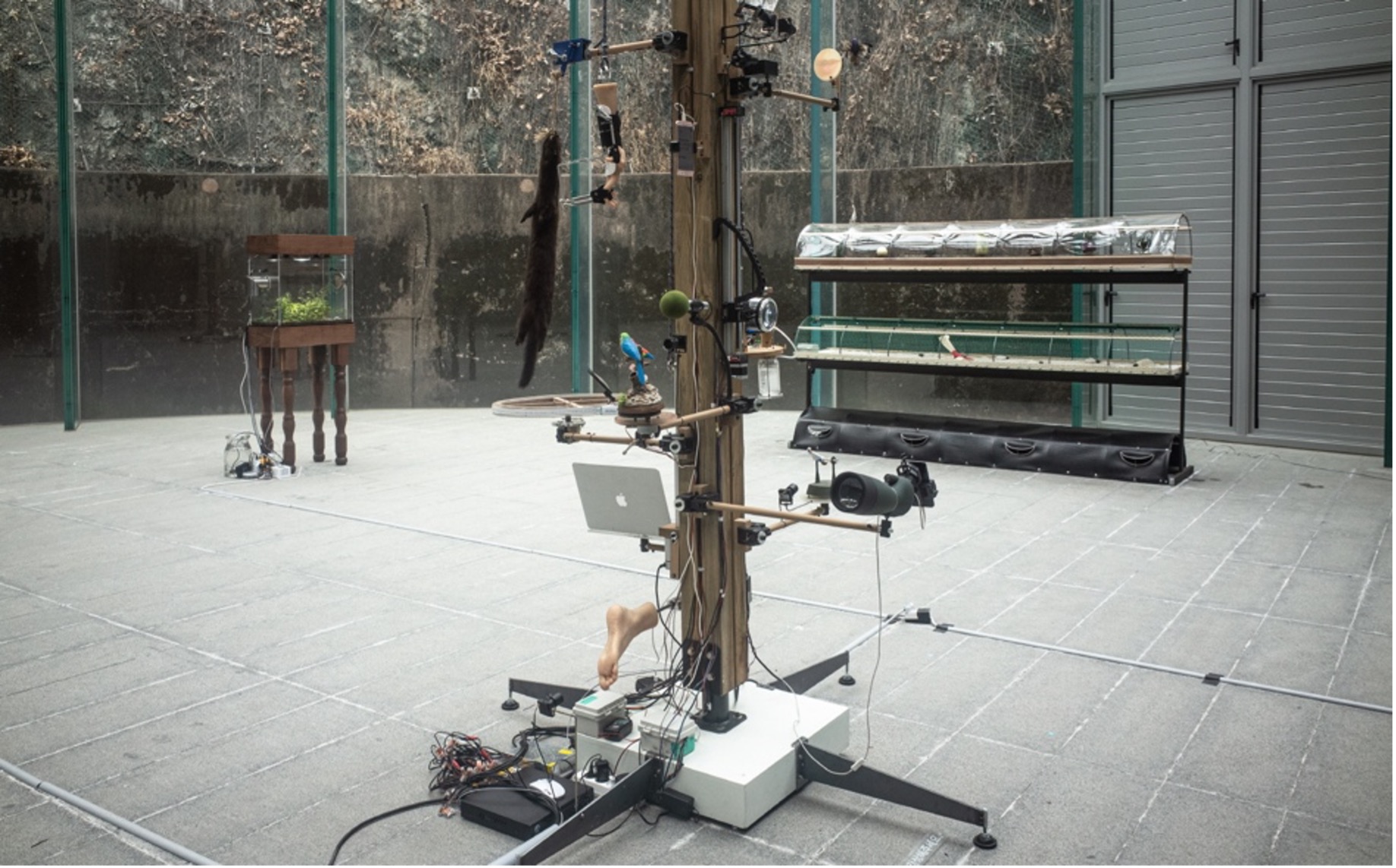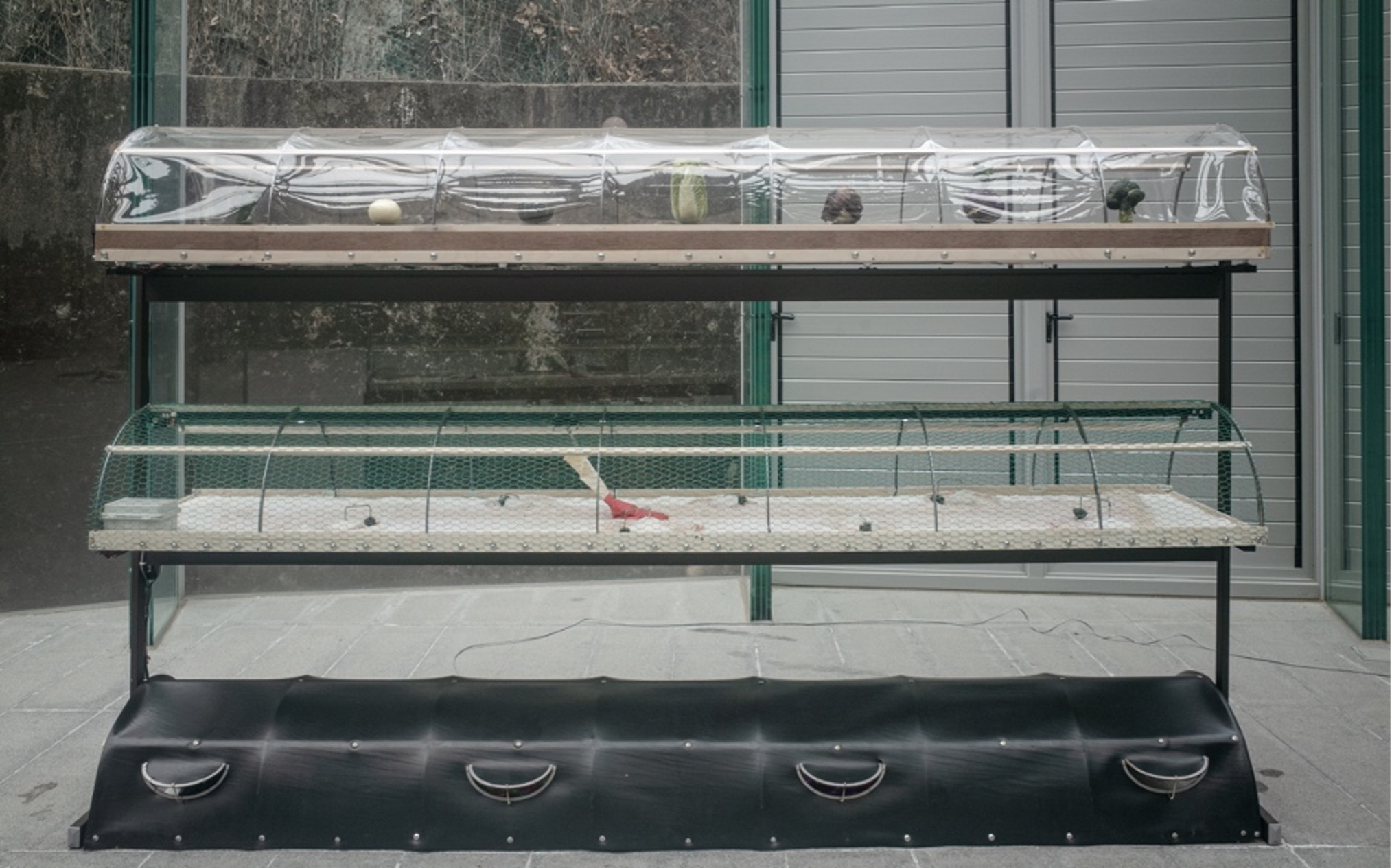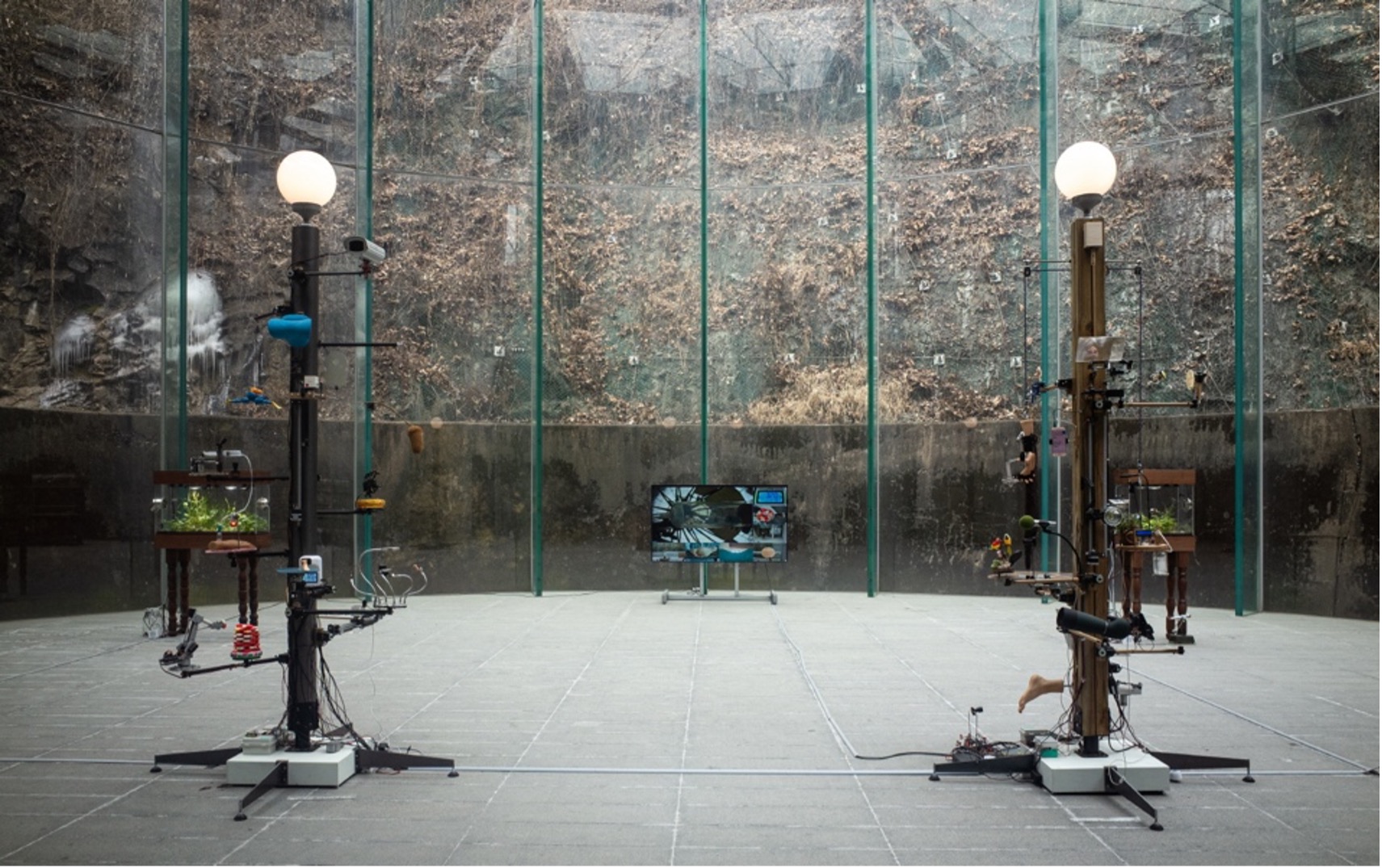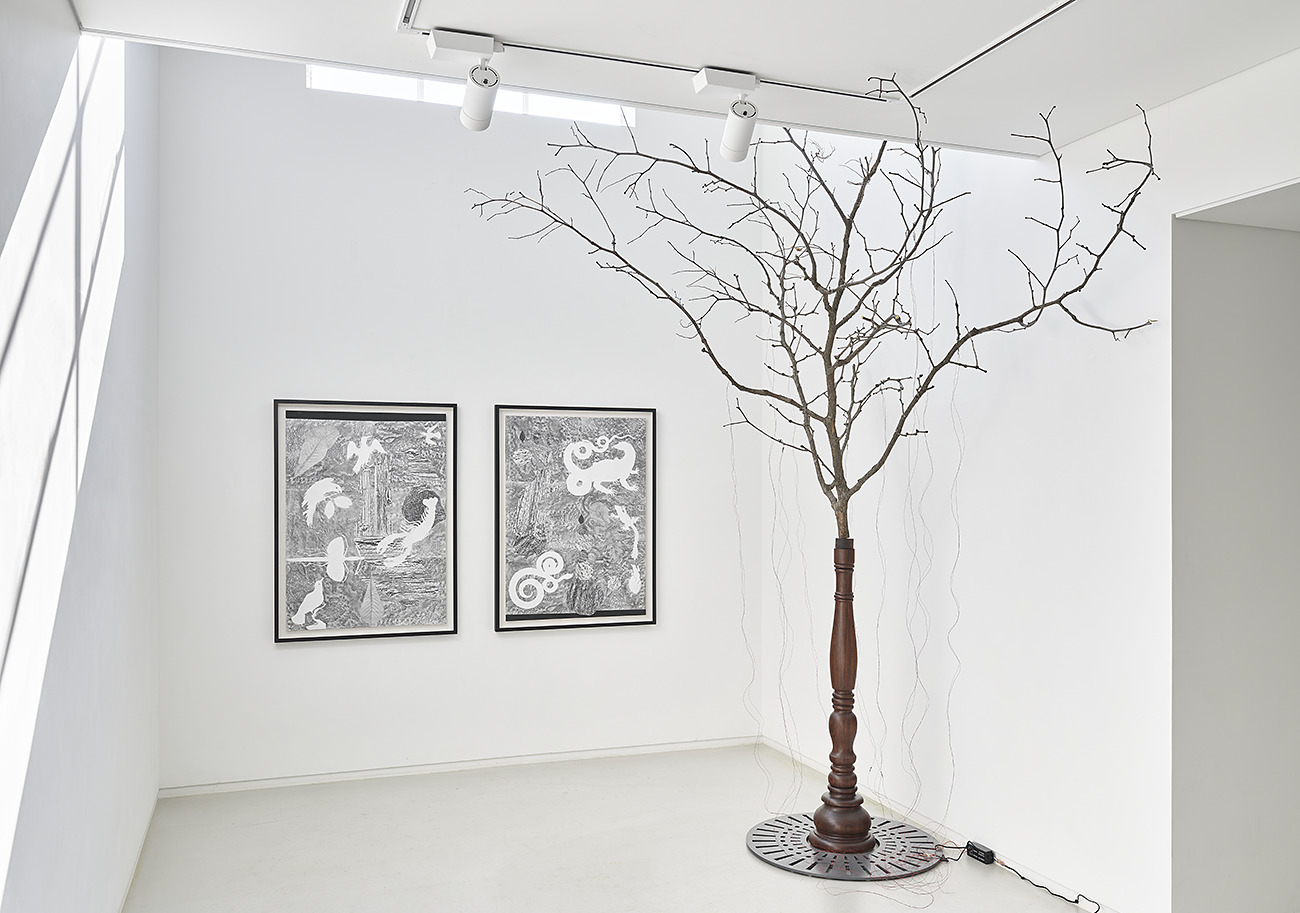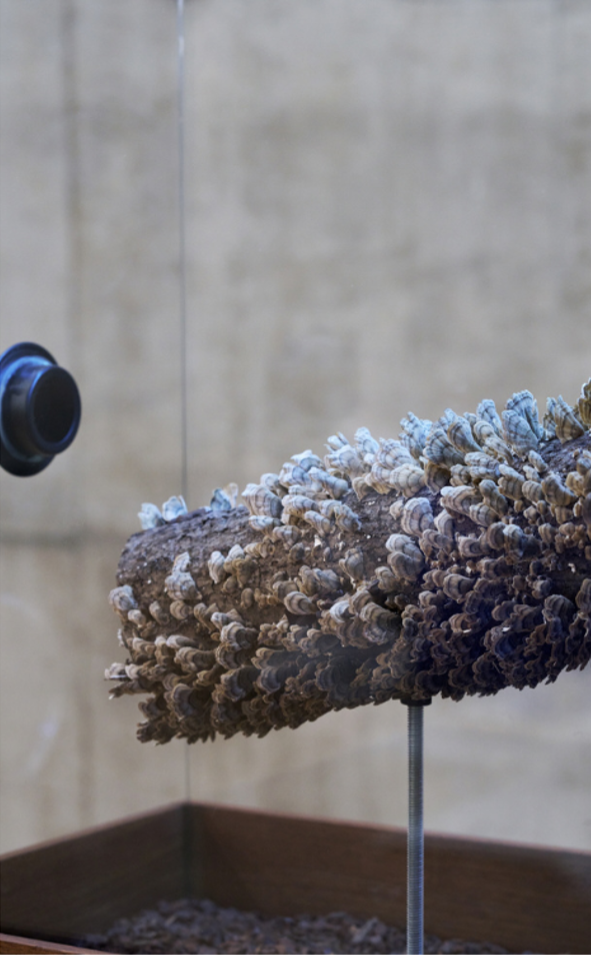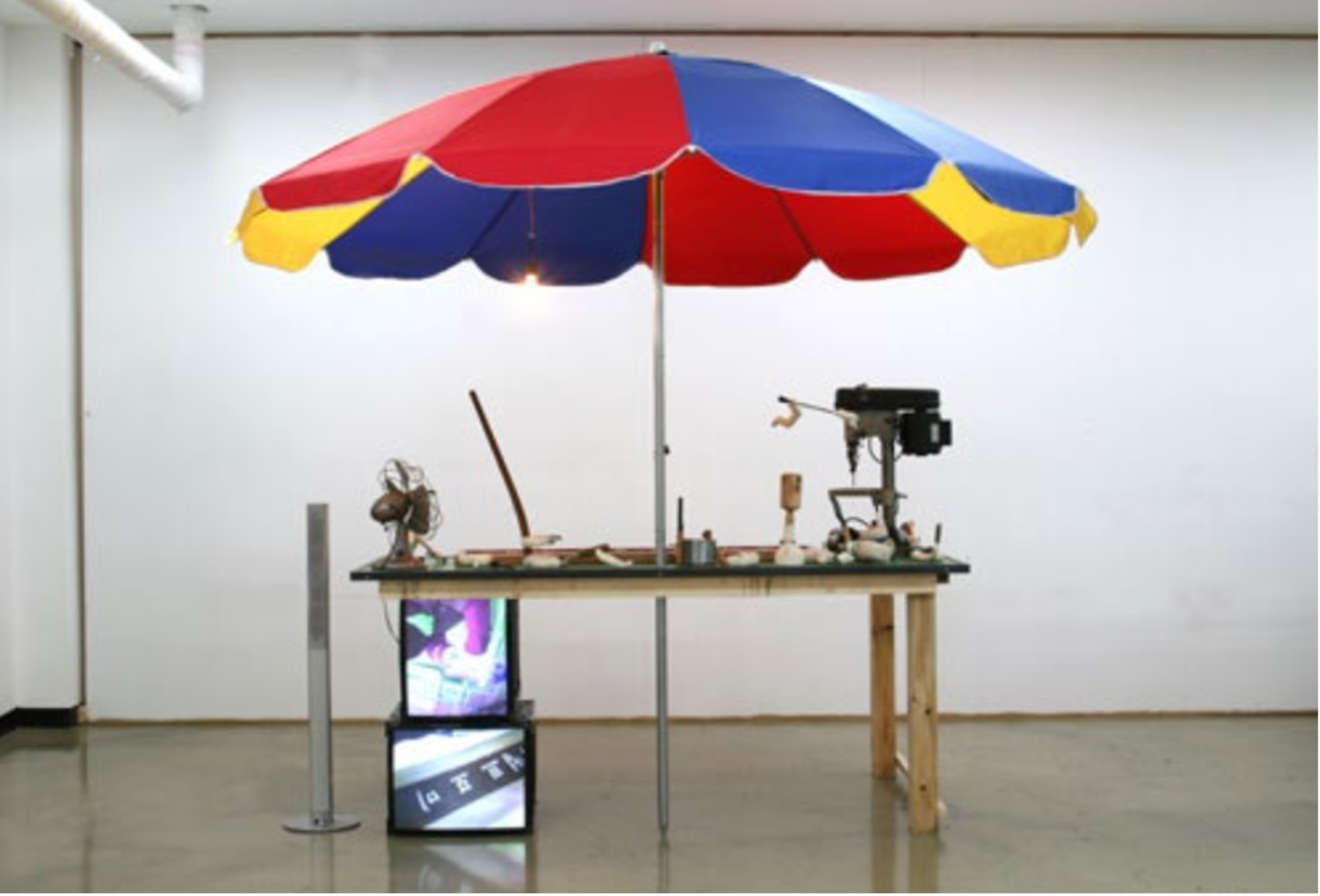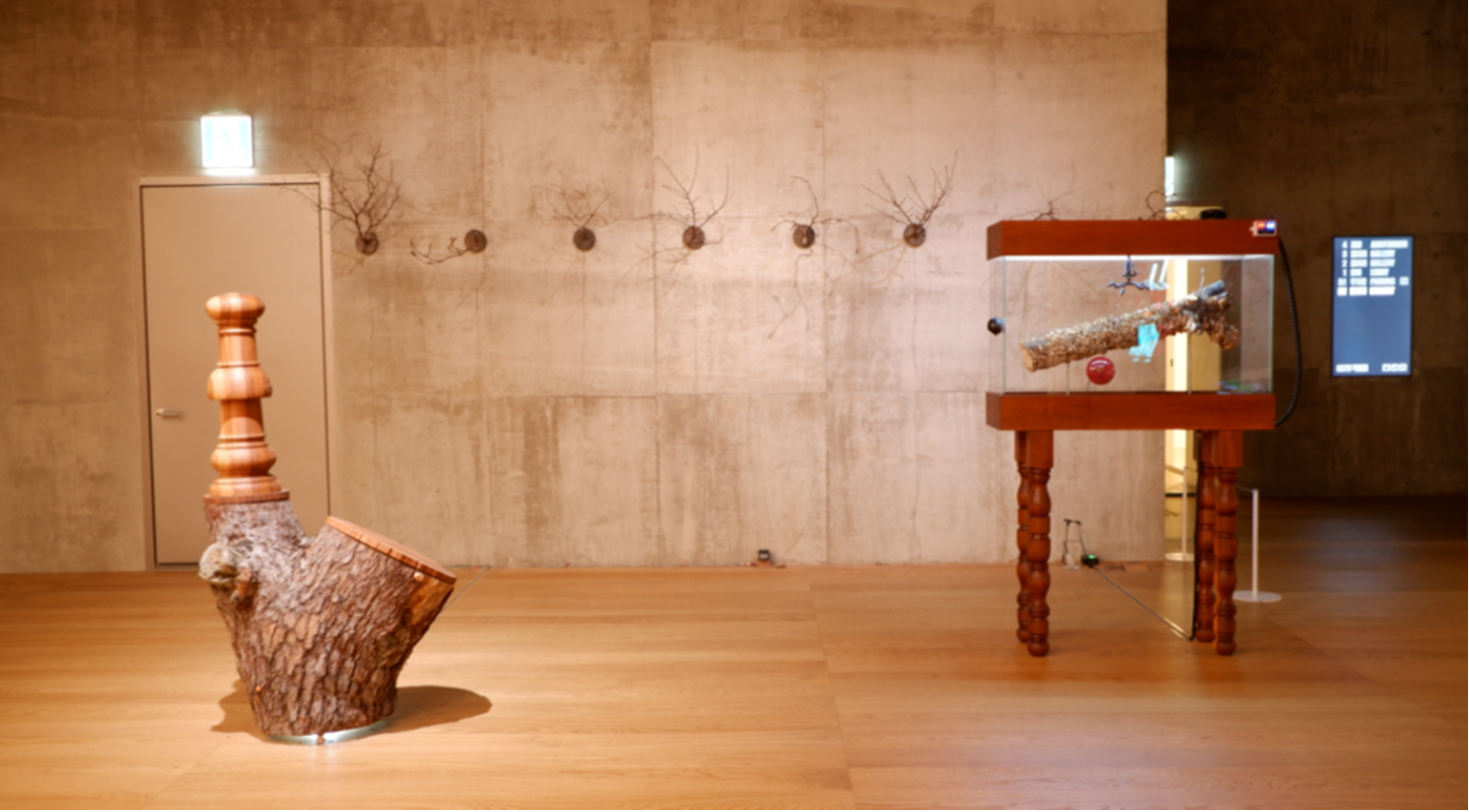

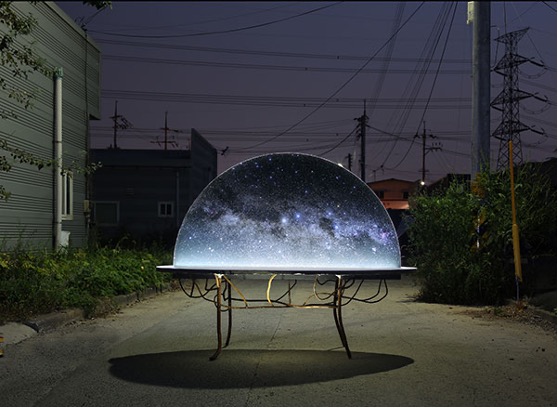
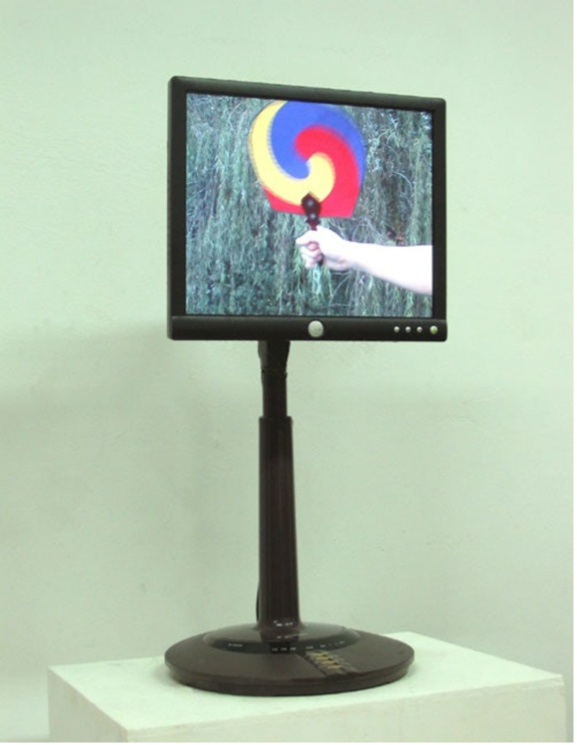
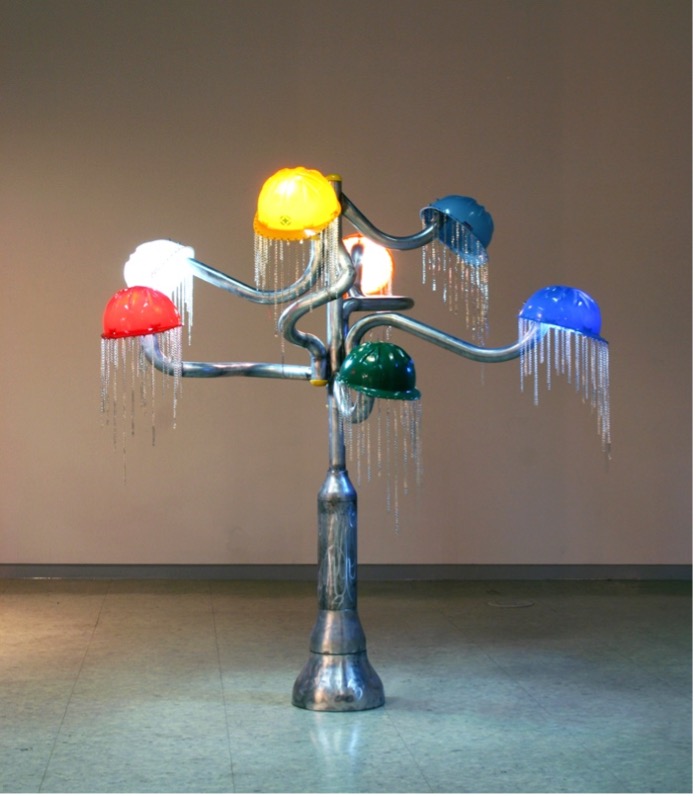
Yoo Hwasoo, 《The Place of Weeds》 (December 10, 2021 – January 9, 2022, Culture Tank T1 Pavilion) Exhibition View © Kim Minkwan

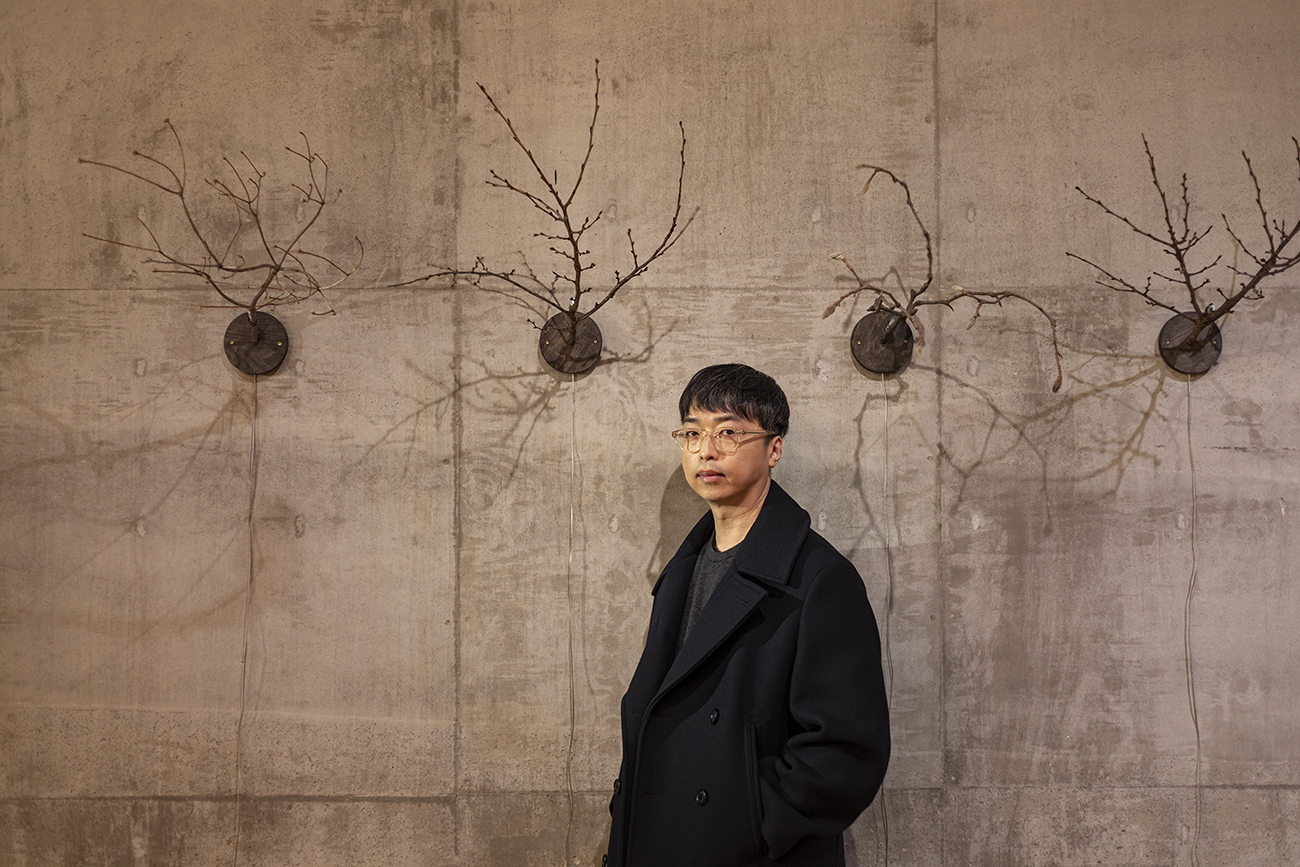
Yoo Hwasoo’s The Place of Weeds was structured to align with the characteristics of the transparent circular pavilion. A pair of vertically-oriented works were positioned at the center of the entrance, serving as an ambiguous gateway, while the remaining works were arranged along a horizontal axis in parallel. The symmetrical layout consists of SMART (2021, 180×50×150 cm, wooden log, drone parts) and Working Holiday (2021, 300×60×175 cm, wood, iron, salt, red pepper powder, motor, LED, humidifier, fan, vegetables) on either side, with The Place of Weeds (2021, 150×50×175 cm, 80×50×175 cm, 100×5×5 cm, smart farm system, weeds, wood, moss) distributed behind them. This layout corresponds to the core content unfolding beyond the entrance.

At the innermost section of the space, a CCTV system is installed, capturing footage linked to the various elements in Daisy and the Strange Machine (2021, variable dimensions, mixed media). The video footage gradually transitions from smaller screens to a single large projection.
 
Why Does This Function?

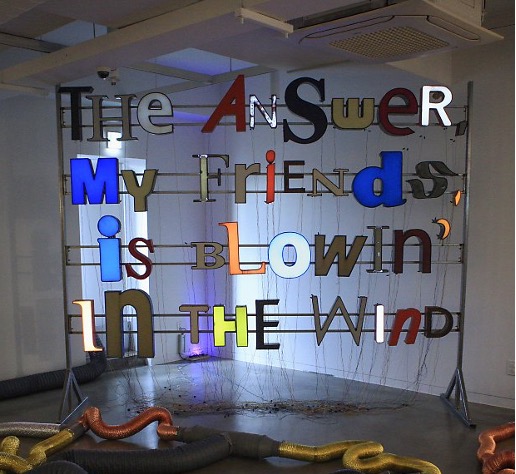
SMART (2021, 180×50×150 cm, wooden log, drone parts) is positioned to the left of the entrance, while the left side of Daisy and the Strange Machine (2021, variable dimensions, mixed media) is visible from the front. © Kim Minkwan

With its spacing at the entrance and the arrangement of similar iconographies, Daisy and the Strange Machine suggests an ambiguous unity while simultaneously indicating fragmentation. Rather than forming a transitional threshold, it establishes a blurred boundary—creating tension with the external space while also directing movement toward other works deeper inside.

These exposed machines reveal their mechanisms, appearing as barely functioning entities disguised in metaphors drawn from reality. The conveyor belt, endlessly looping like a hamster wheel, serves as both the physical engine of this assemblage and a key symbolic element. However, it is ultimately destined to stop—either due to a power outage or the eventual expiration of the motor. The description of it as “barely functioning” is not an anthropomorphic analogy but rather a fundamental observation: it does not imply that the machines lack sufficient energy or fail to operate smoothly. Instead, the predetermined, staggered movements of the machines are intentional—outcomes of the artist’s calculations, repurposing, and spatial composition. Their function is not solely a human reproduction but an autonomous mechanical system.

In Daisy and the Strange Machine, hands and feet move through vertical-horizontal coordination and rotational motions, each directed toward distinct pathways—left and right. This segmentation prompts an exploration of bodily unity and synthesis. The objects in this work appear to be intentionally repurposed readymades, not as representations of deteriorating machinery but as compressions of the world into a single structure.

This work raises the fundamental question: “Why do these objects move?” The vertical axis is marked by a spherical light at the top, aligning with the spatial characteristics of the Culture Tank T2 pavilion, which features glass ceilings and walls. The vertical structure is extended through the horizontal motion of the machine components.

Yoo Hwasoo, from the left: The Place of Weeds (2021, 150×50×175 cm, 80×50×175 cm, 100×5×5 cm, smart farm system, weeds, wood, moss), the right side of Daisy and the Strange Machine (2021, variable dimensions, mixed media) when viewed from the front of the entrance, and Working Holiday (2021, 300×60×175 cm, wood, iron, salt, red pepper powder, motor, LED, humidifier, fan, vegetables). © Kim Minkwan

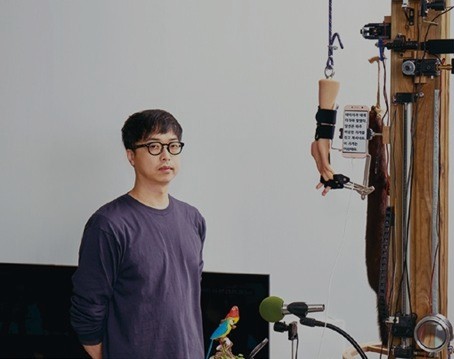
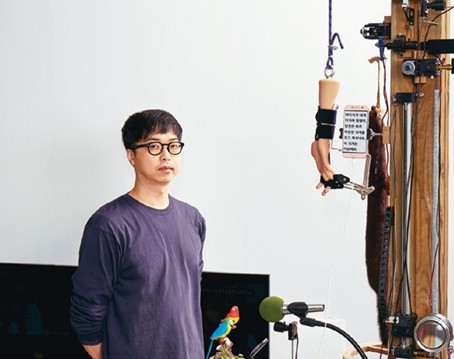
From the point where an inverted ‘doll-face weight’ passes through a mirror and expands into a fragmented reflection, the right section of Daisy and the Strange Machine extends downward on both sides. On the left, a mannequin’s right hand is fitted with a posture corrector used for physical therapy or rehabilitation. Nearby, a bird is positioned in front of a mirror, alongside a smartphone screen displaying real-time text and a hanging otter doll (left), which is juxtaposed with another mirror (right). Below them, a microphone captures sound from its surroundings, while an artificial tree with a perched bird (left) sits above a potted plant connected to a water bottle. Additionally, a telescope, a somersaulting doll, a laptop (right), and a foot-shaped object occupy the lower section.

The laptop, microphone, and smartphone form a single unit. The laptop is running a program that translates a science fiction novel by Kim Choyeop into German. This process extends into voice assistance, with the microphone capturing the sound, while the words appear fragmented on the screen, undergoing transformations in meaning.

On the left side of Daisy and the Strange Machine, elements such as a CCTV camera and a wooden pillow appear first. Moving left to right, a diver figurine (left) is positioned beside an oval-shaped screen displaying sign language interpretation performed by Jang Jinseok (right). Further down, a hand receiving cupping therapy (left) is placed alongside a hanging plant and an upward-reaching mechanical hand (right). Below, a pile of red jade spring cookies traditionally used in ancestral rites (left) is arranged next to a mechanical hand holding a single cookie and a mannequin foot severed at the ankle, rotating on a circular platform. Additional elements include a mirror reflecting movements by Kim Wonyoung, a contactless thermometer that automatically measures temperature when passed by, and an installation where feathers, weeds, and fruits are fixed onto curved microphone stands (right).


Connection, Translation, Representation

Daisy and the Strange Machine is extended through CCTV footage, effectively integrating itself into the surveillance system. The captured movements are processed through multiple screens, assembling an illusion of unity from fragmented perspectives. This system evokes the fallacy that a sum of disjointed parts can construct a complete reality. Conversely, fragmenting the whole into isolated representations dismantles any notion of coherence, replacing it with scattered, disconnected impressions.
In this context, Daisy and the Strange Machine does not merely replicate human figures but absorbs and reduces alienated entities into its surface. Simultaneously, its structural elements evoke lingering traces of illness and death—manifested through various prosthetics, medical tools, and organic-inorganic hybrids.

Multiple layers of translation permeate the installation: voice-to-text software, sign language interpretations, and subtitles. A contactless thermometer endlessly repeating “Normal temperature” symbolizes the mechanical mediation of human perception. Daisy and the Strange Machine constructs meaning through its “strange” interrelations—between language, artificial-natural hybrids, and the liminal boundary between life and death.

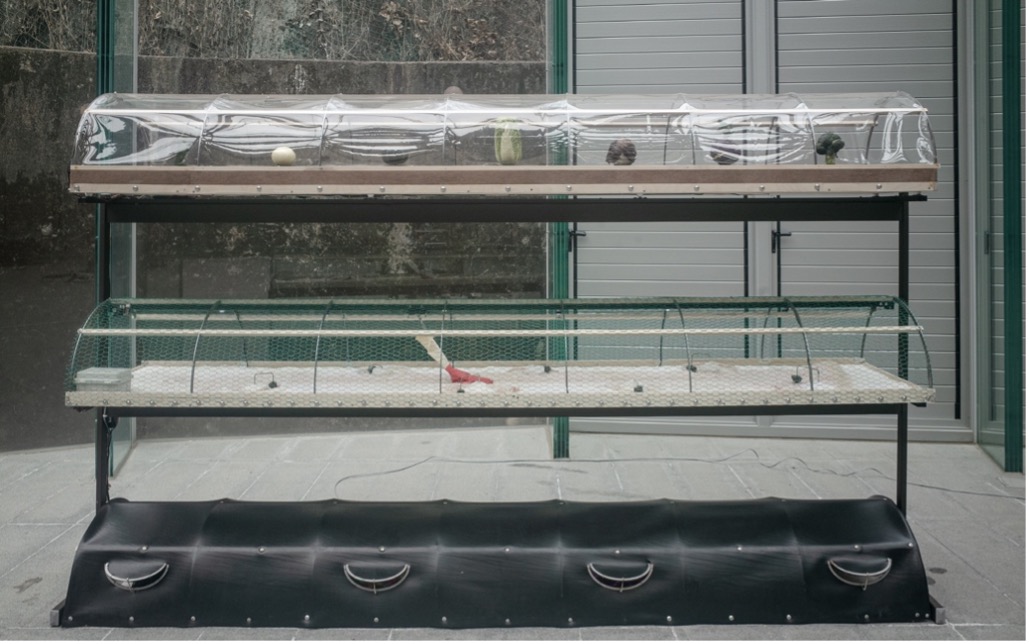
Yoo Hwasoo, Working Holiday (2021, 300×60×175 cm, wood, iron, salt, red pepper powder, motor, LED, humidifier, fan, vegetables). © Kim Minkwan

These mechanical devices establish a more direct relationship with life in The Place of Weeds and Working Holiday. SMART is an installation where pinwheels with drone blades are attached to holes in a piece of deadwood, creating a fusion of artificial and mechanical elements derived from nature. In this sense, it follows the same trajectory as Daisy and the Strange Machine. Meanwhile, The Place of Weeds quite literally creates a "place for weeds" within a glass enclosure, providing automated watering and controlled conditions for their growth. The exhibition title, The Place of Weeds, functions as a metaphor, extending the theme of mechanical movement being dismissed as something meaningless, just as weeds are often considered useless. The exhibition layout also reflects this transition—starting with mechanical elements and exposing the re-creation of the world, before ultimately leading to a space where actual life exists.

Unlike The Place of Weeds, which serves as both a primary application of a smart farming system and an ornamental installation forming a self-contained unit, Working Holiday emphasizes the presence of life while also focusing on a simulated representation of an artificial world. This work is composed of three vertically layered sections. The topmost level contains a display case filled with dried vegetables such as cabbage and napa cabbage, each occupying a separate compartment. The middle layer, with a floor covered in salt, features two different motor-driven movements: six objects rubbing against the surface in circular motions, and a red rubber glove that drags across the floor as it moves back and forth along the structure’s length. The latter’s subtle, strained movement is striking—it serves as a metaphor for the lives of foreign workers laboring in kimchi factories in Paju. The gap between the hook holding the glove and the floor highlights the precarious status of the glove itself. The lowest level is a black plastic greenhouse, concealing its contents from view. The entanglement of human labor within the cycle of commodities and agricultural products is apparent here. (One could categorize these three layers according to the Lacanian triad: the Real, the Symbolic, and the Imaginary.)

If the ontology of labor (and the worker as the "Other") is relegated to the implicit, unseen depths of the lowest layer—the black box—then the labor represented in the middle layer becomes partially exposed within the reality of its immediate conditions. Meanwhile, through another layer of labor, agricultural produce is eventually transformed into commodities, completing the process of commodification through an act of imagination.

In The Place of Weeds, the preceding “clunky, slow movements” of machines serve to dismantle the illusion that machines operate smoothly and flawlessly. At the same time, this challenges such an illusion by drawing an analogy between machines and the human body. The fragmented and deteriorating flow of movement is, above all, deeply human—it resembles a form of performance. Various living organisms inhabit The Place of Weeds.

Both Daisy and the Strange Machine and Working Holiday serve as the exhibition’s central thematic works. Daisy and the Strange Machine, which juxtaposes translation barriers with the translation of sign language for the hearing impaired, extends into an allegory linking humans and machines through themes of illness and impairment. Meanwhile, Working Holiday compresses the world into a microcosm, constructing a clear perspective from an external viewpoint by presenting the laborer’s form as an equivalent to exploitative conditions. The former draws the viewer into its complexity and, in doing so, creates a degree of opacity that renders its mechanical elements difficult to decipher. The latter, by contrast, creates distance between the viewer and the surface, allowing for a panoramic gaze.

Ultimately, these two works embody two distinct ways of perceiving the world, demonstrating different entanglements with reality. In doing so, they synthesize two modes of engagement: the structure of surface and the surface of structure.

References