Memory is powerless. The powerlessness of memory concerning a lost object is especially often confirmed. It continually evokes the absence of the object, while at the same time clinging to a request for presence and a return to the past. Yet what is expected of memory — to call presence and the past into the here and now — fails every time. There is no trace of being alive there. As time here flows helplessly on, memory fades again.
To respond to a certain loss solely with memory is powerless to the point of foolishness. Yet every year, people speak of memory. Under the time defined as “after Sewol,” our society has continued to summon memory and repeat those words. And it has done only that. Even though there is almost nothing that can be done by memory alone.
Meanwhile, memory causes us to lose the power to think through many things surrounding the event of that day. In recalling the urgency that was almost surreal, the people struggling to survive, the families who eventually lost them, the TV broadcasting live the process of a water burial, and all of us who had to sit before it in blank despair, memory itself became insufficient.
It could no longer exert the force that had until recently summoned tears and anger.
This problem of memory is superimposed as it is onto the dimension of images. First, there are images that function as memory and claim to preserve memory. Photography represents this kind of image. A lost object is contained in a photograph. Moreover, the photograph becomes the result of immediately capturing the being while alive, right there on the spot.
However, while looking into a photograph, the viewer realizes that the form in the photograph can never become the being they knew. (Is this, too, the powerlessness of memory?)
The face in the photograph does not show the small habits of the being I knew, expressions that would make the fine hairs stand up and crease their brow. No, the face is moving even more violently away from that being. How can the figure in this photograph be called “he,” who was beside me and has disappeared?
Then, is there no way for memory to escape its own powerlessness? To say it quickly, there is no way except to accompany memory with other actions around it. Action would begin with clarifying the identities of what surrounds memory.
Action begins from concretely grasping, defining, and reflecting on the things that caused the event of loss, the things caused by the event of loss, the relationship with the lost object, and the attitudes of those facing loss. The question then passes back to the image.
What can an image do concerning loss, concerning time that has already passed and beings that have been lost? Is an image that crosses beyond memory possible? Can an image truly open the dimension of action?
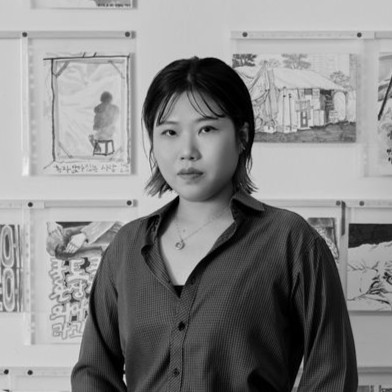
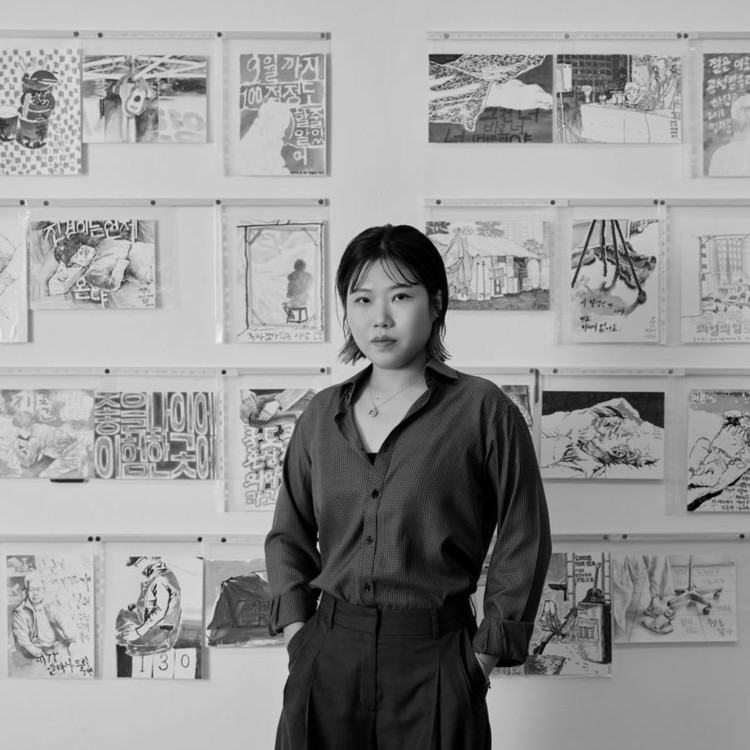
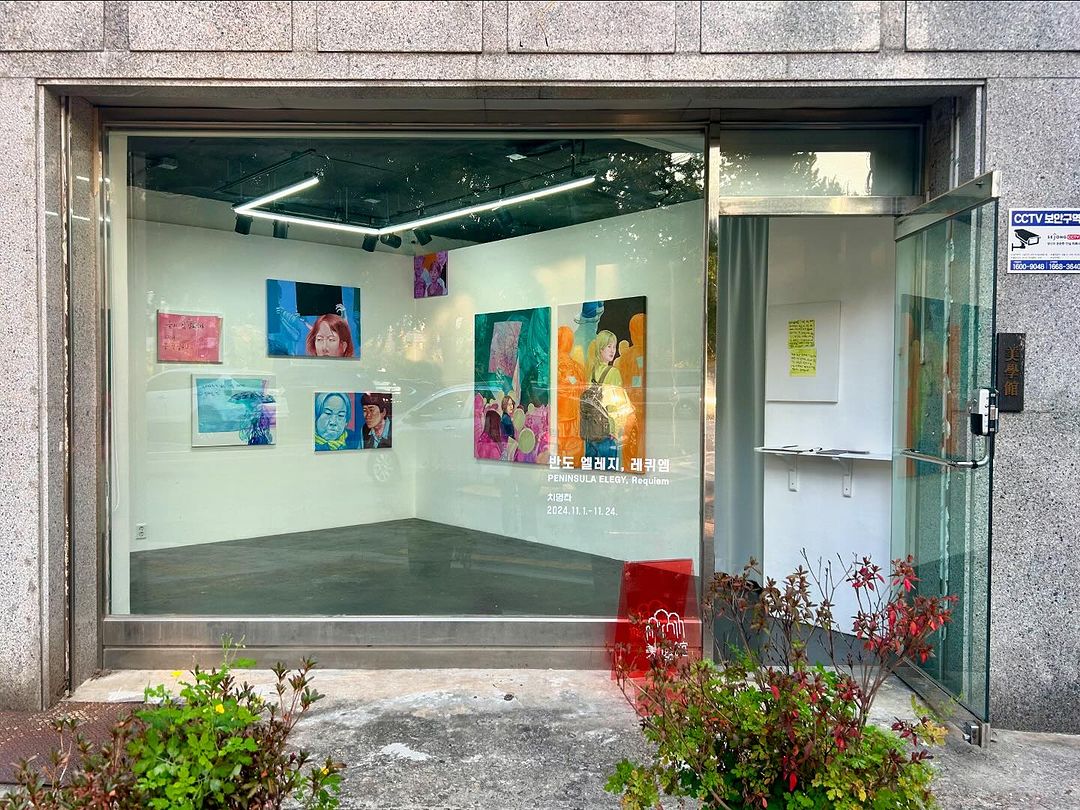
Critical Hit paints for this solo exhibition 《Under the Paper》(Post Territory Ujeongguk, Seoul. 2022). The artist paints on single sheets of paper by diluting highly saturated pigments with water. She unfolds into images stories she has seen or heard from near or far. Most often, they are stories of loss, and stories of phenomena or people who have faced loss, sensed the signs of loss, or remained after loss.
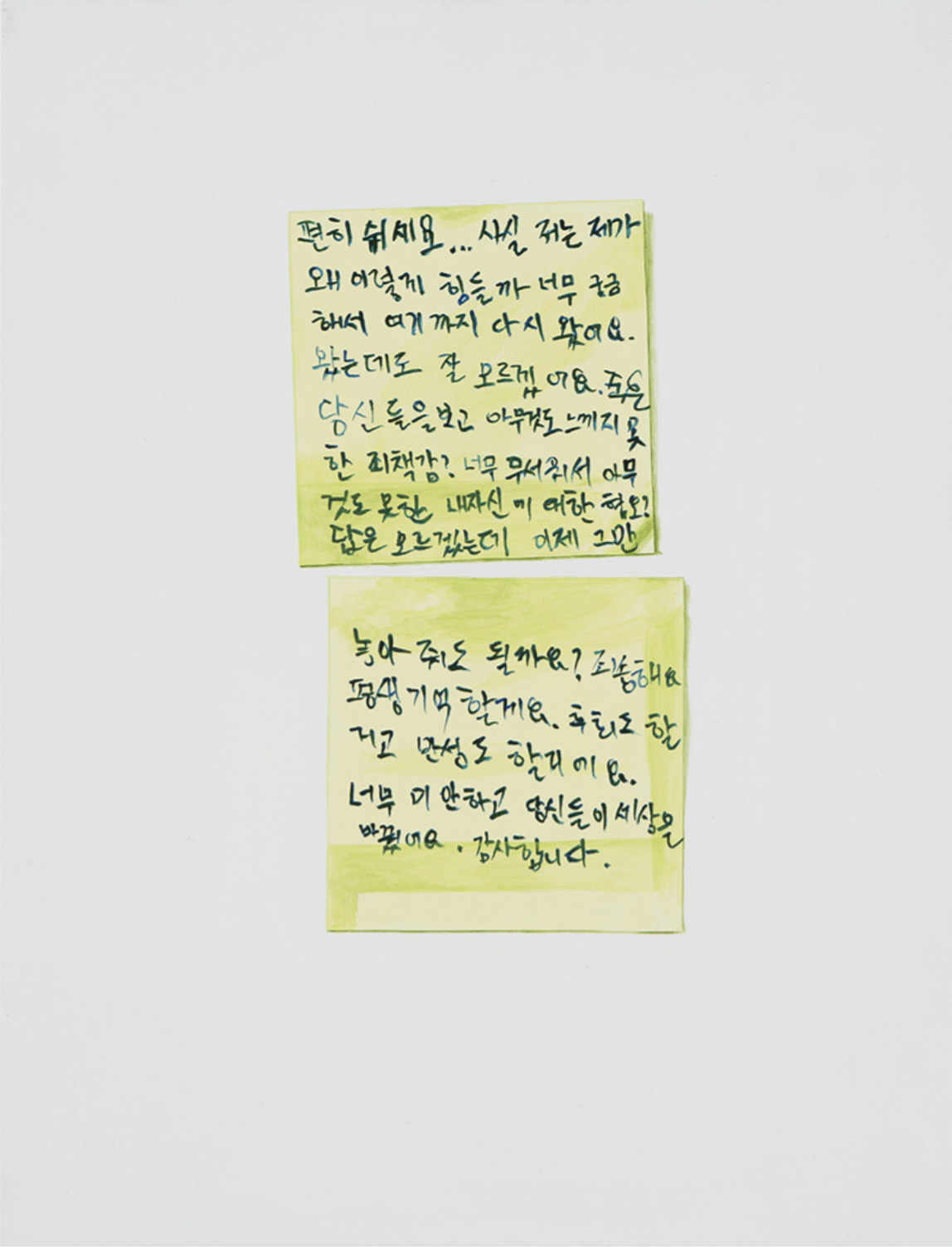
Yet a single painting does not intend to contain a narrative precisely, nor does it clearly point to a particular person or object. It does not serve testimony or memory, nor does it give mourning a particular form. Rather, it tries to operate as an image concerning lost beings, and concerning the act of remembering them.
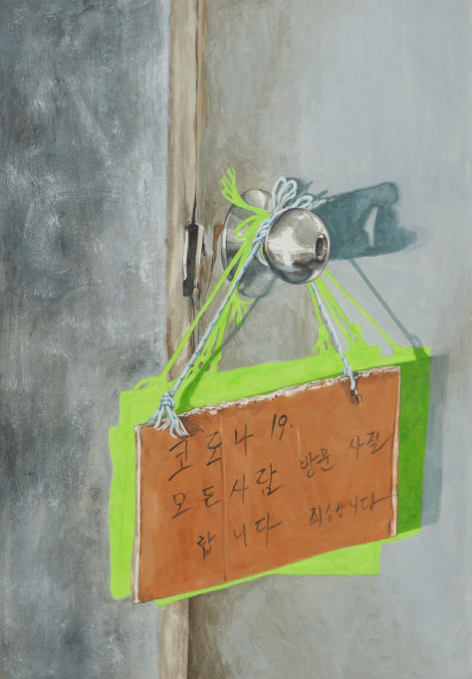
Looking more specifically, first, Critical Hit’s paintings(the ‘Under the Paper’ series(2022)) do not follow or evoke the mechanism of memory. In her paintings, forms are proposed and combined in a much more allegorical way, and the image operates as image.
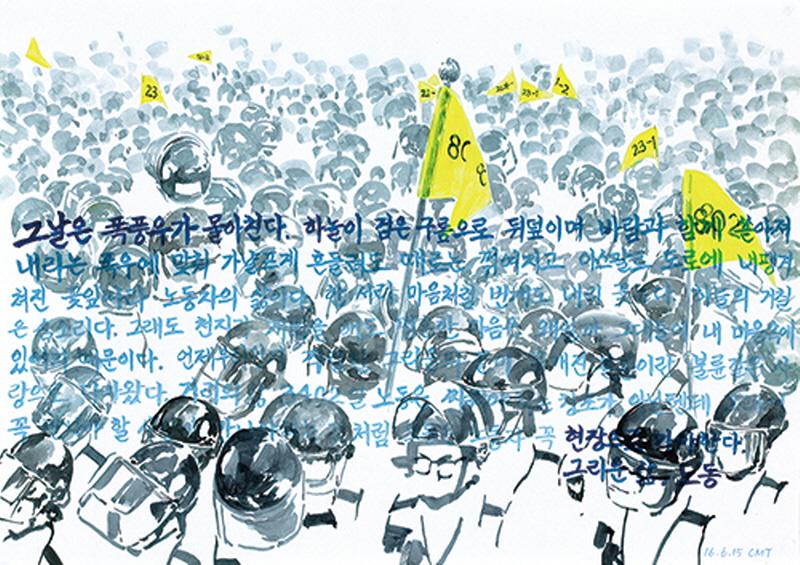
For example, an umbrella rising and spreading upward while surrounded by traffic cones, a cream bun and a carton of milk left alone on the floor, a tree trunk inside the mouth of someone presumed to be a foreigner, a strong current of water piercing through a hospital bed, and a red pen standing while supporting the world. These are the list of mimetically drawn icons that appear in Critical Hit’s paintings.
But this is not all. Apart from translating the visual forms before my eyes into words I know, these icons cannot create a semantic system of verbal language. Unlike the semantic system of language, which weaves contexts between words and words, each unit of form placed on a flat surface neither urges context to ripen nor, of course, succeeds in doing so.
That is why viewers keep wanting to find the meanings created by the “seemingly recognizable” forms drawn in those paintings, and why, even if they continue to face the surface, they cannot easily complete a narrative.
The problem is that the structure and icons of these paintings that Critical Hit draws, which seem knowable and unknowable at once, originate from reality. Viewers of the paintings begin to make meaning of them by overlaying afterimages of something they had previously seen in reality. But they do so with afterimages.
Images of past time overlap within present images, and the image discovered through this painting now will connect to some other image encountered later.
The viewer can imagine a human being(a homeless person) beneath an umbrella surrounded by a device closed inward and outward(traffic cones), people spending the day relying on distributed simple meals(cream buns and milk), the hospital bed with a white sheet forgotten while death toll statistics accelerated(the current passing through the bed), and the people who passed over it.
Also, an after-school teacher or home-study worksheet instructor(red pen) who lost their livelihood in an instant under the direct impact of COVID-19, and a foreigner who can neither reveal their own history hidden inside the mask nor appeal to anything through it. Such beings come to mind one after another in light of certain images seen before.
There is another characteristic point held by the paintings in 《Under the Paper》. It is the form of the “portrait.” In most cases, a portrait places exactly one person within a single frame.
The format of the “portrait,” in which the subject stands facing a chosen direction such as the front or side, and composes themselves(to meet the eyes of the viewer looking at the painting), was transferred intact into photography after photography became widely distributed.
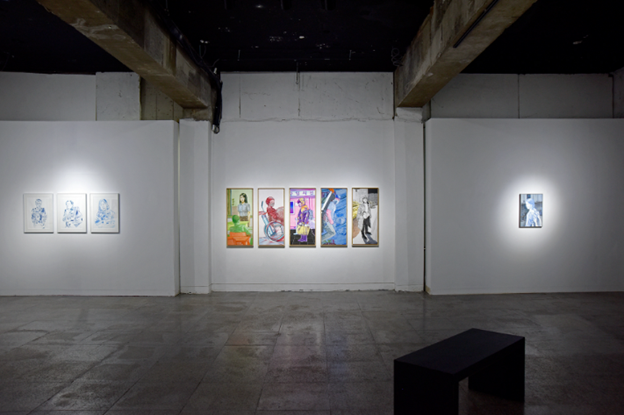
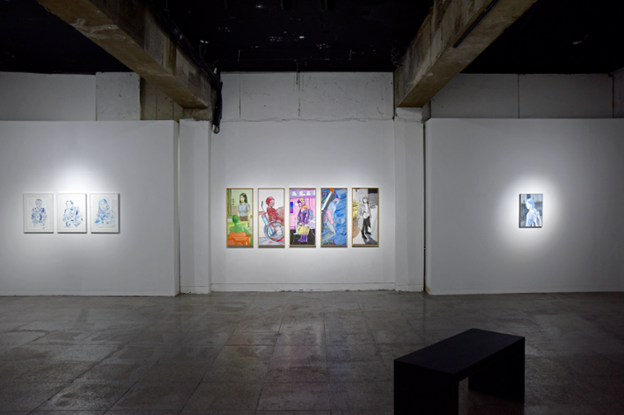
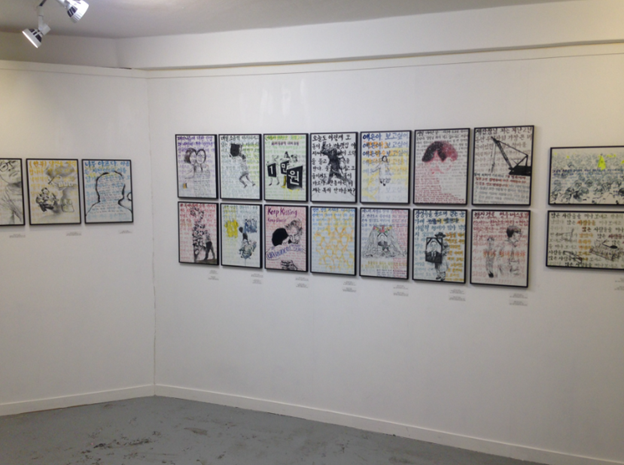
At this point, it must be mentioned that many of the paintings in this exhibition place one person filling the frame on paper that is not very large. These figures each have their own expressions and look at the viewer as directly as possible.
Among them are a person in a wheelchair(1,560,000 won, 2022), a person lying in a hospital bed(10 Hours, 2022), a person standing in the middle of the street wearing a mask(Six Times, 2022), a person standing in front of a temporary COVID-19 screening station(Seven Days, 2022), and a person unable to shake off the hands clinging to their shoulders and back, calling them forth(Under the Paper, 2022).
Notably, attention is drawn to a “portrait” of a figure holding the portrait photograph of a deceased person. According to the artist, the three paintings occupying one wall of the exhibition space were “drawn very quickly.” Compared to the fact that the “portrait format” generally takes one person as its subject, there is something in these paintings that cannot simply be passed over.
It is because of another portrait(the funeral portrait) at the chest of the person who is the subject of the portrait. Ultimately, in this painting, Under the Paper(Three Portrait Units), one person and the protagonist in the blurred funeral portrait held in that person’s arms are present together. And the painting functions in itself as mourning.
“Mourning” is commonly described as the feeling of sorrow over the death of another and the process of overcoming that sorrow. However, the most important point in that process is to think about why “the death of another” calls forth a sorrow that shakes “me.” Total sorrow occurs because the other had belonged to a part of the subject. In other words, the loss of the other is the loss of a part of the subject herself.
This loss brings about an eternal change not only inside the subject but also in the world to which the subject belongs. Under the Paper(Three Portrait Units) clearly takes the form of a portrait that depicts one person, but it is a painting that confirms that this person is originally constituted by another. It takes on the role of mourning that makes us face the problem of loss.
In her paintings, artist Critical Hit allows each image to appear only as image, intending that the viewer actively think about the problems behind it. Believing in the power of fragmentary combinations of concrete forms whose meanings do not fully ripen, she proposes that viewers actively overlay other images they have often witnessed in everyday life.
Furthermore, she recommends contextualizing the events before and after the losses implied by each painting. In the process, someone will confirm that “under the paper,” also the title of the exhibition, refers to an important physical property of these paintings, while at the same time indicating the harsh reality of foreigners, patients, disabled people, elderly people, and homeless people whose lives stood at a crossroads because of a single administrative document.
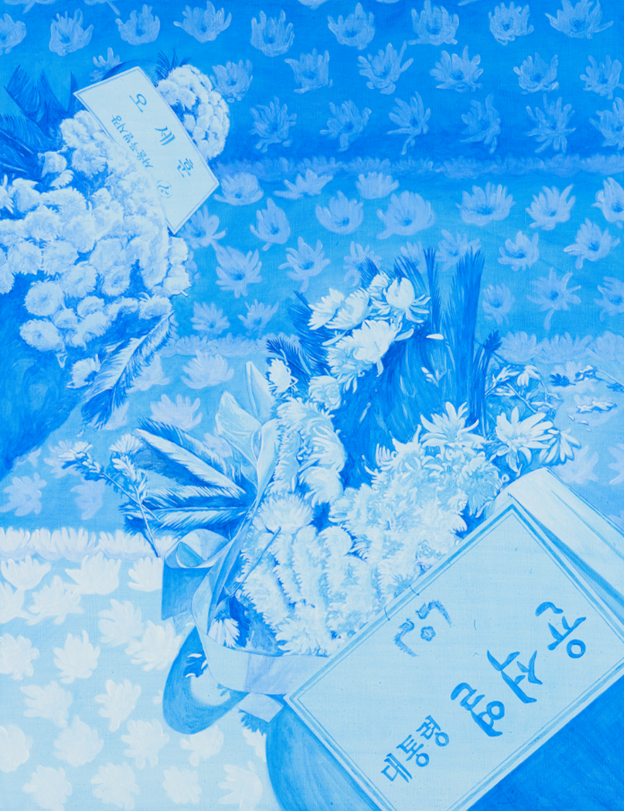
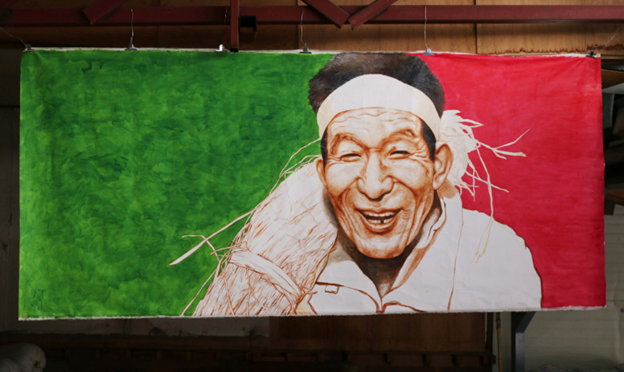
Lastly, the large “chrysanthemum” painting(Untitled, 2022) spread out in front of these many portraits must be mentioned. This work is installed as a three-sided panel, taking the shape of embracing the entire exhibition space and the viewers. Untitled(2022) is also clearly distinguished from the other exhibited paintings in that it is uncolored.
For this painting, the artist planned a form composed only of black lines, restraining color as much as possible. And, likewise, she worked on a single sheet of paper without another support behind it. The thin but enlarged paper reacts very sensitively to humidity, temperature, and light, and is easily deformed.
When humidity rises, the paper crumples, and if it is also exposed to high temperature and direct sunlight, the white ground fades and changes. Although such transformation did not become visibly apparent during the relatively short exhibition period, the artist said she had taken even that process into account.
If the change had become visible, the symbolism held by the “chrysanthemum” — that is, the dynamics of commemoration and memory — would have stood out more.
A painting that relies only on thin paper is clearly fragile. Even on the physical level, it collapses too easily, and it also maintains a distance from active “action.” Therefore, it would not be unreasonable if someone spent the entire time discussing how powerless images and so-called “art” are in relation to these papers. But the power of images lies in another dimension.
It lies in the fact that images mediate imagination for the viewer, induce active knowing, and trigger in that viewer an action that crosses beyond memory. Images lift something up and make it move. Critical Hit’s act of drawing includes such a small action of hope.