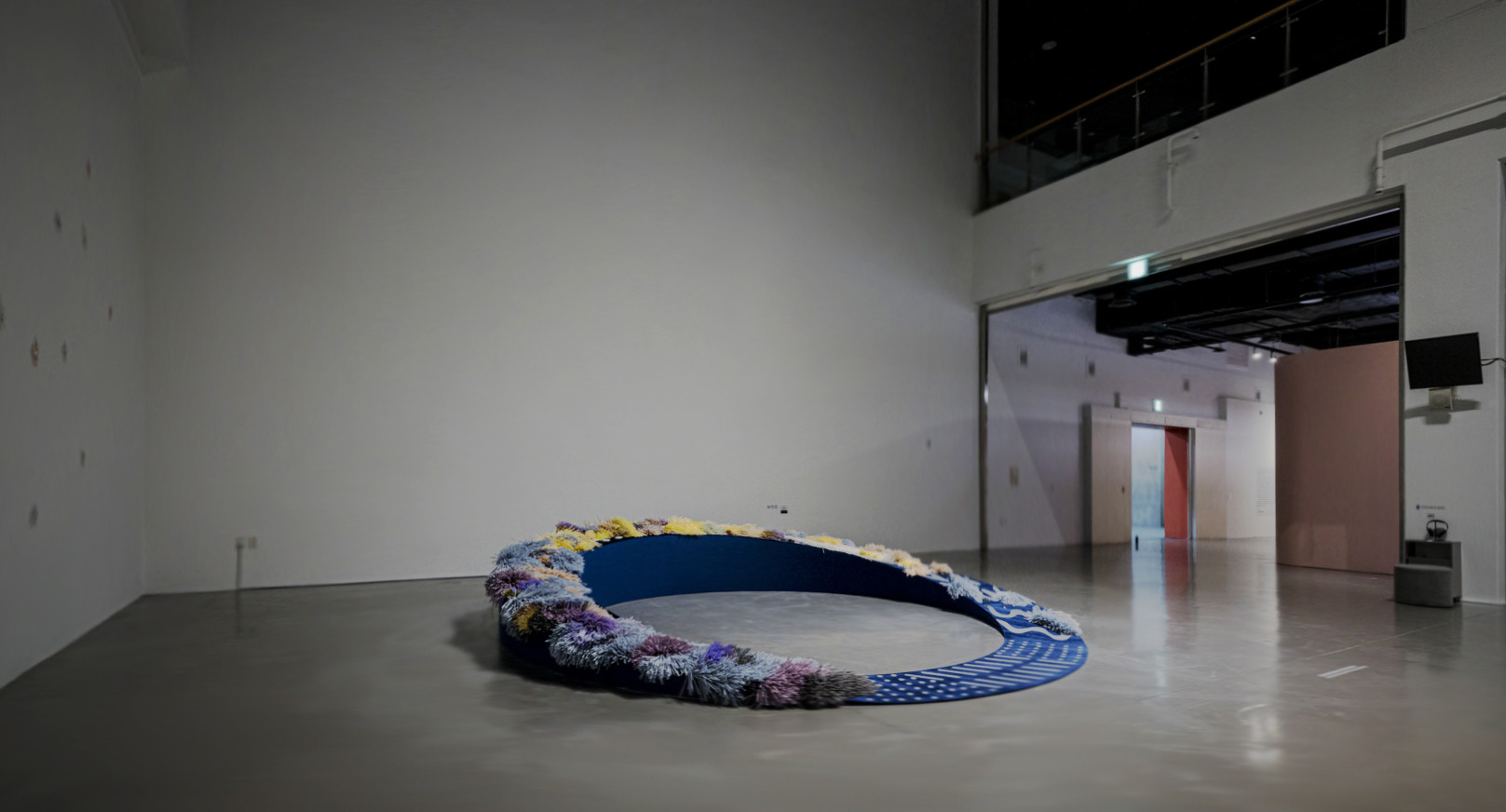
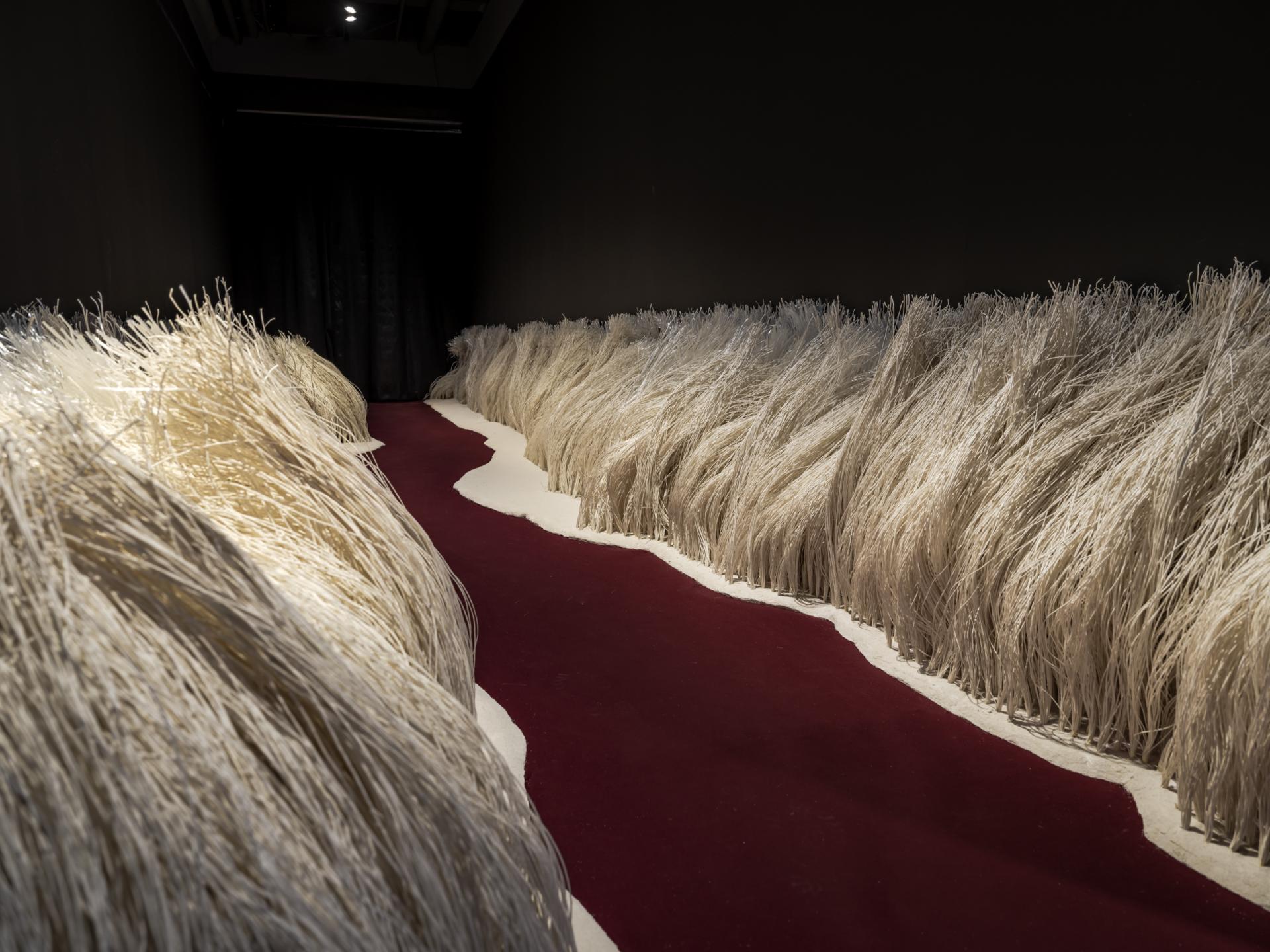
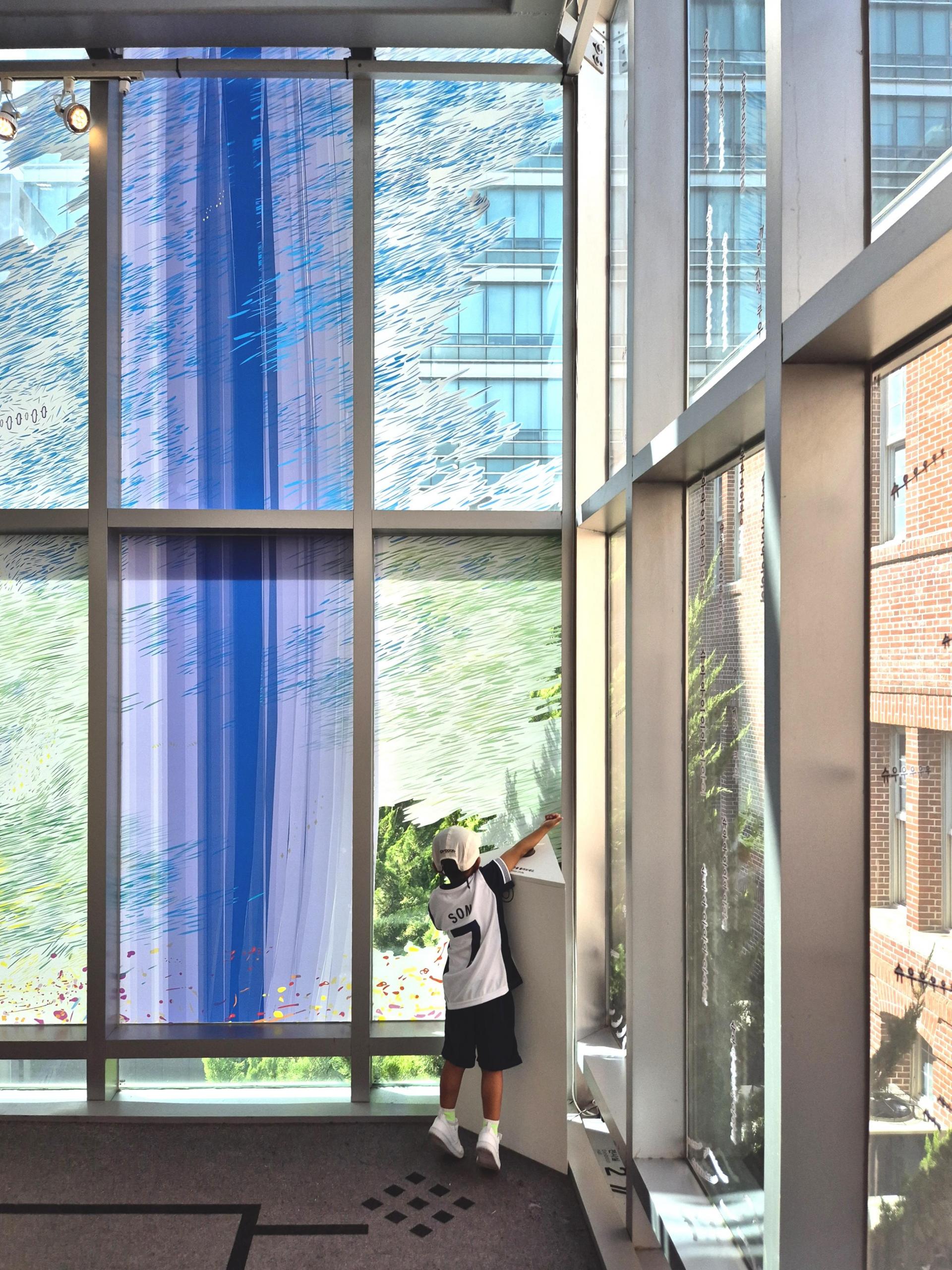
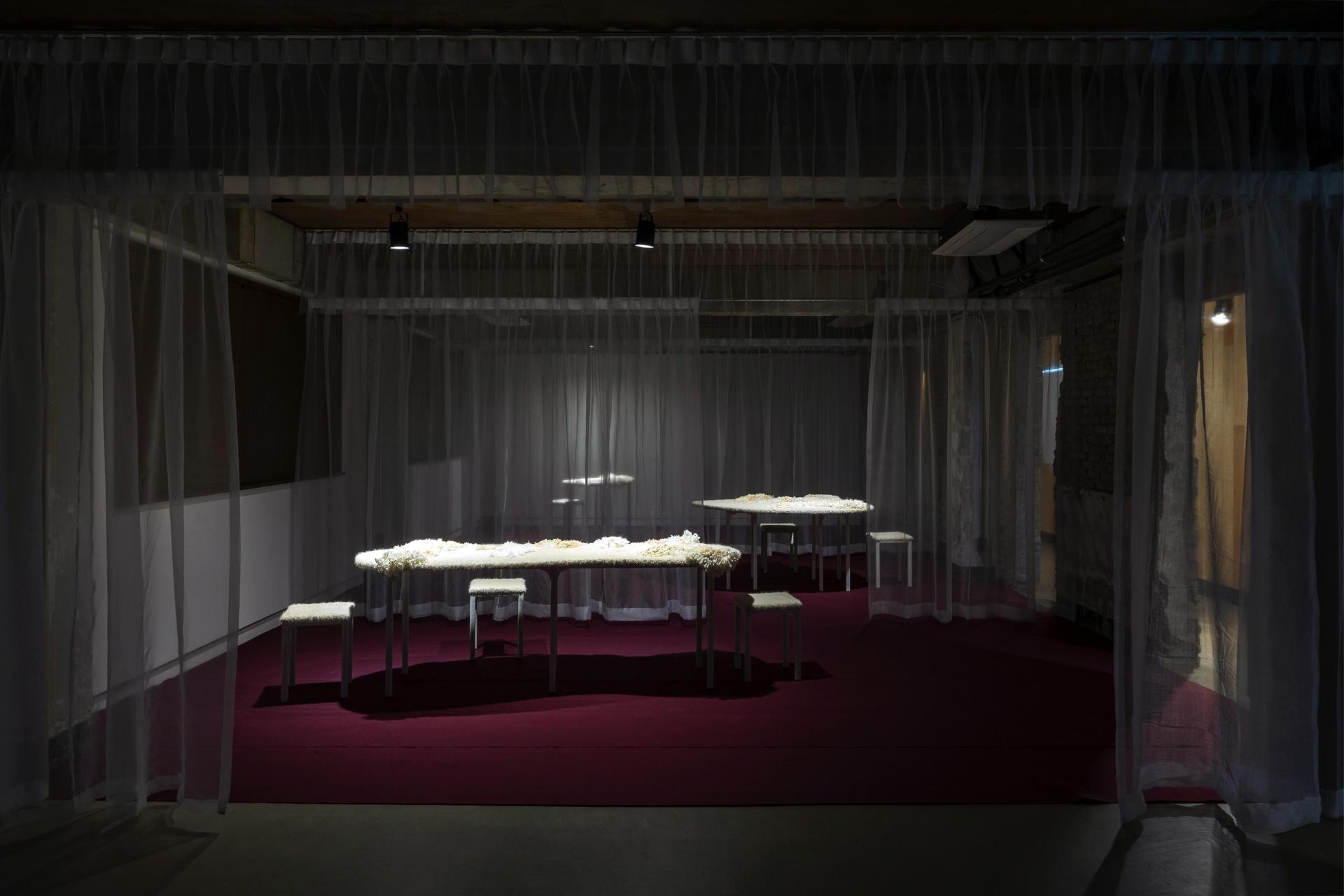
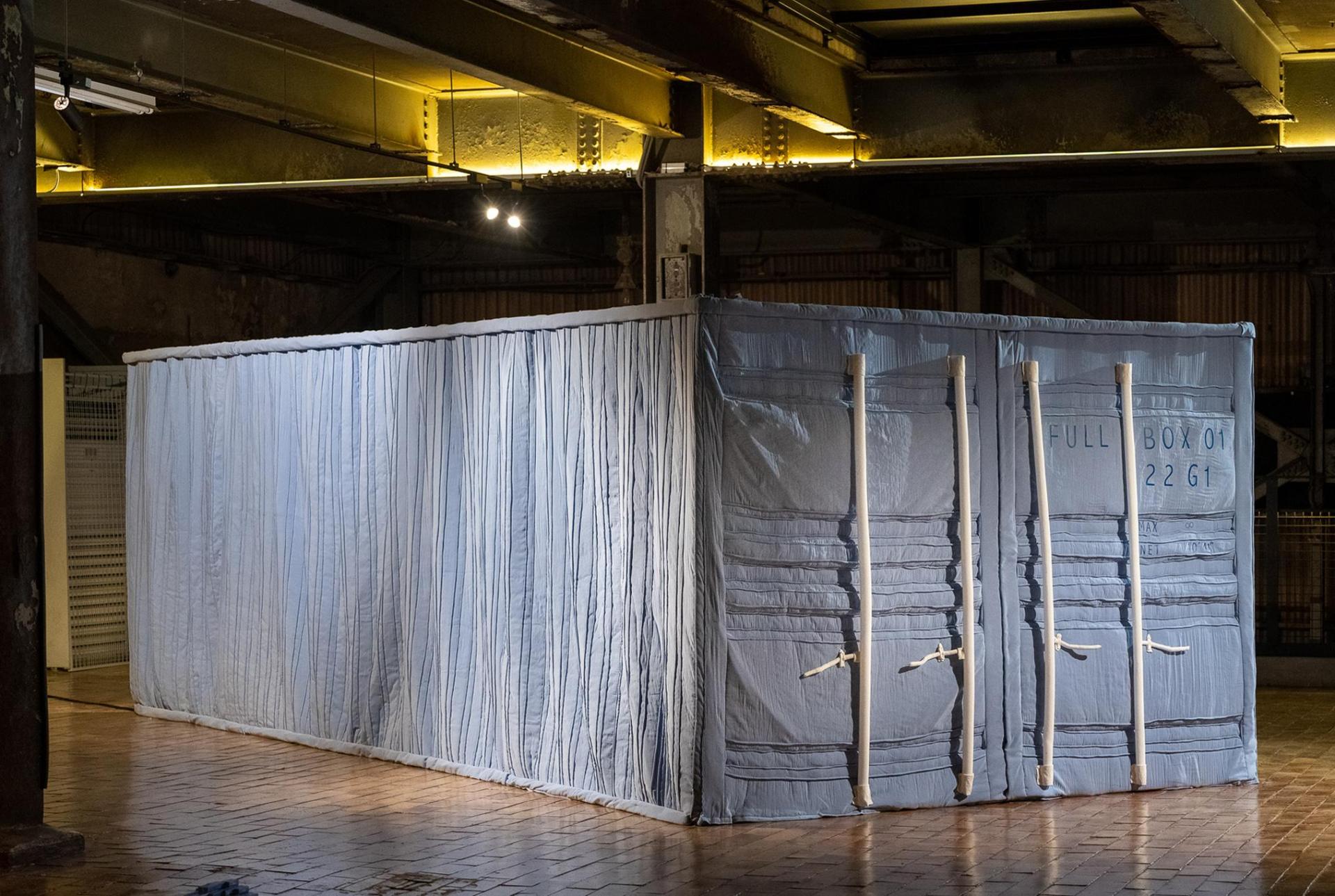
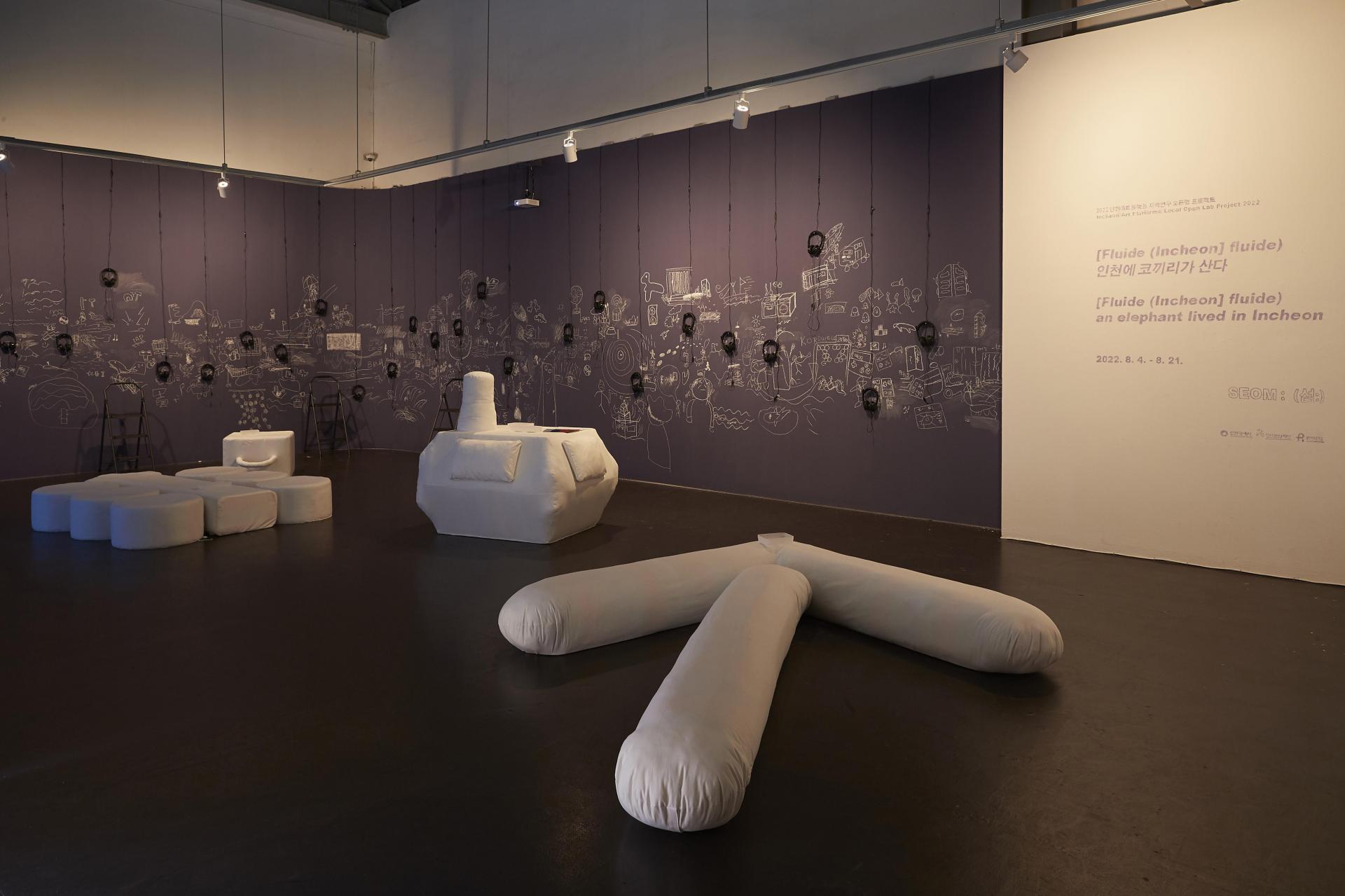
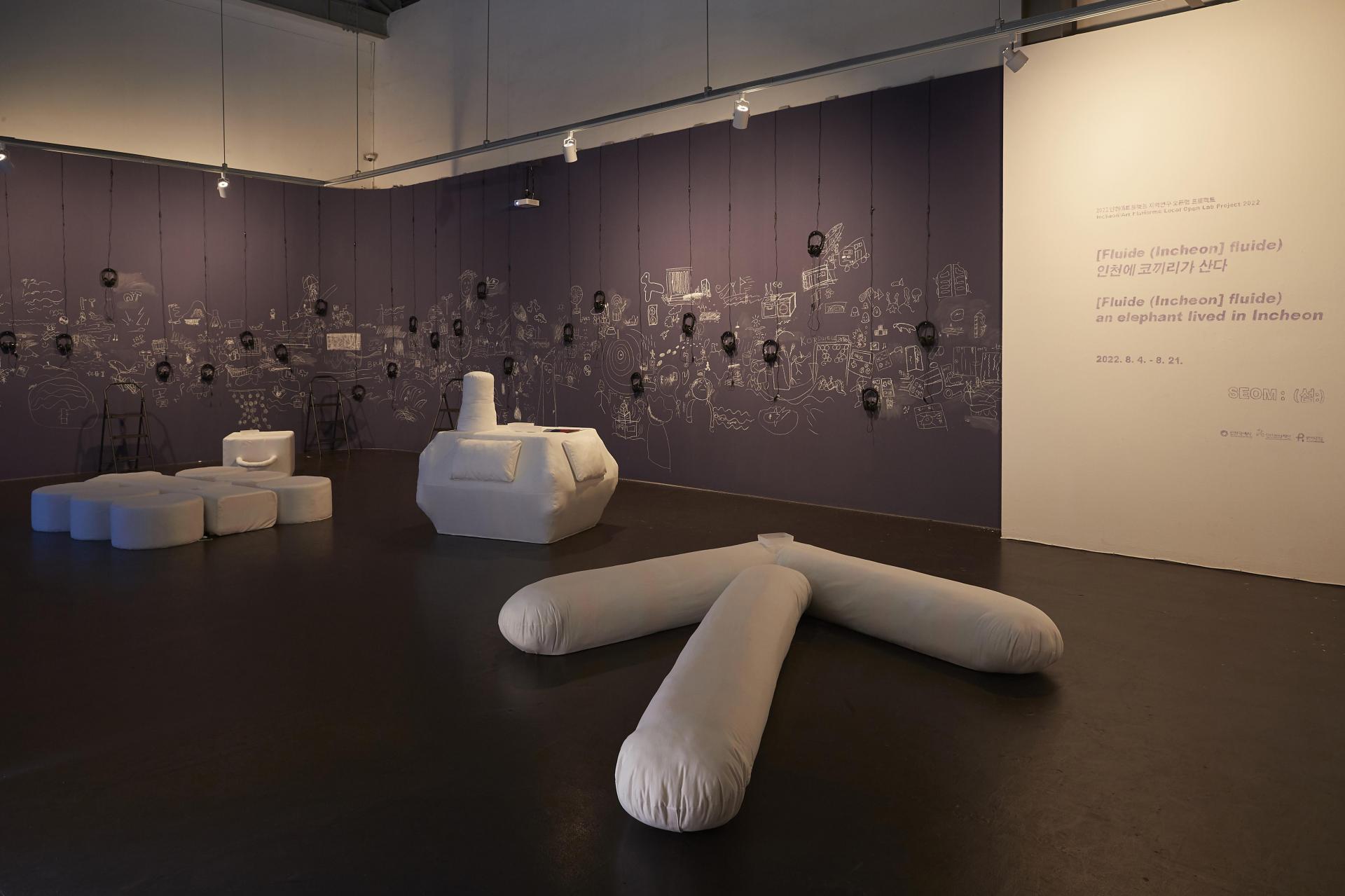
Installation view of 《[Fluide (Incheon] Fluide)- 'An elephant lived in Incheon'》 (Incheon Art Platform, 2022). Photo: Dongkyung Kwak. © Incheon Art Platform

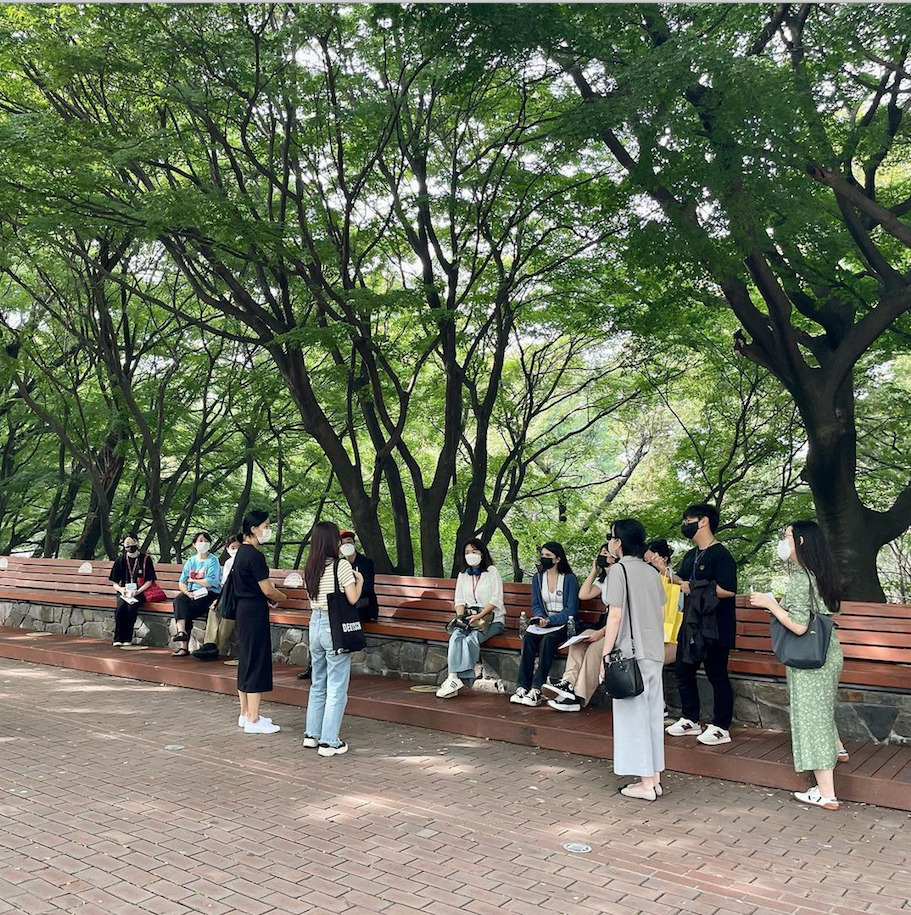
SEOM:’s local research open-lab project 《[Fluide (Incheon] Fluide)- ‘An Elephant Lives in Incheon’》 is an exhibition composed of a participatory installation and video work using images and sounds collected through a regionally connected workshop for citizens.

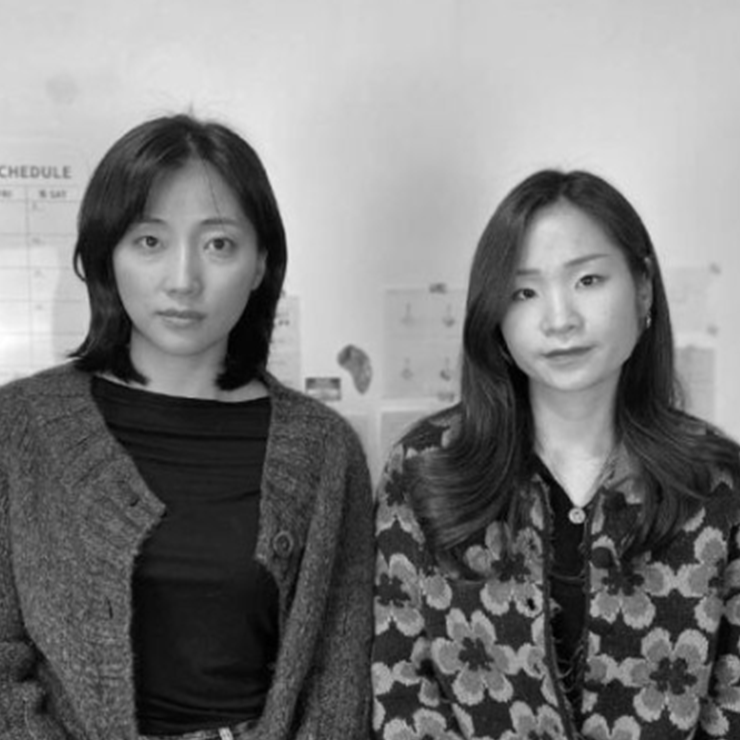
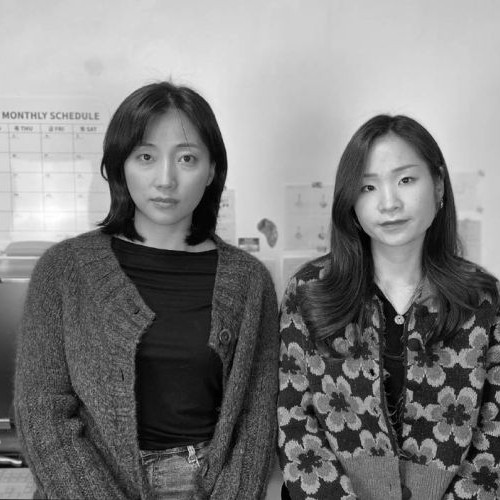
This exhibition, the first project presented together by the two artists Seo Hanee and Um Yeseul under the team name SEOM:, was created through a workshop involving children and artists from the Incheon region.

Seo Hanee researches the context of space through painting and installation, while Um Yeseul primarily works with sound installations using everyday sounds; together, they shaped the framework of the project and explore the possibilities of contemporary art content that can be drawn from Incheon.

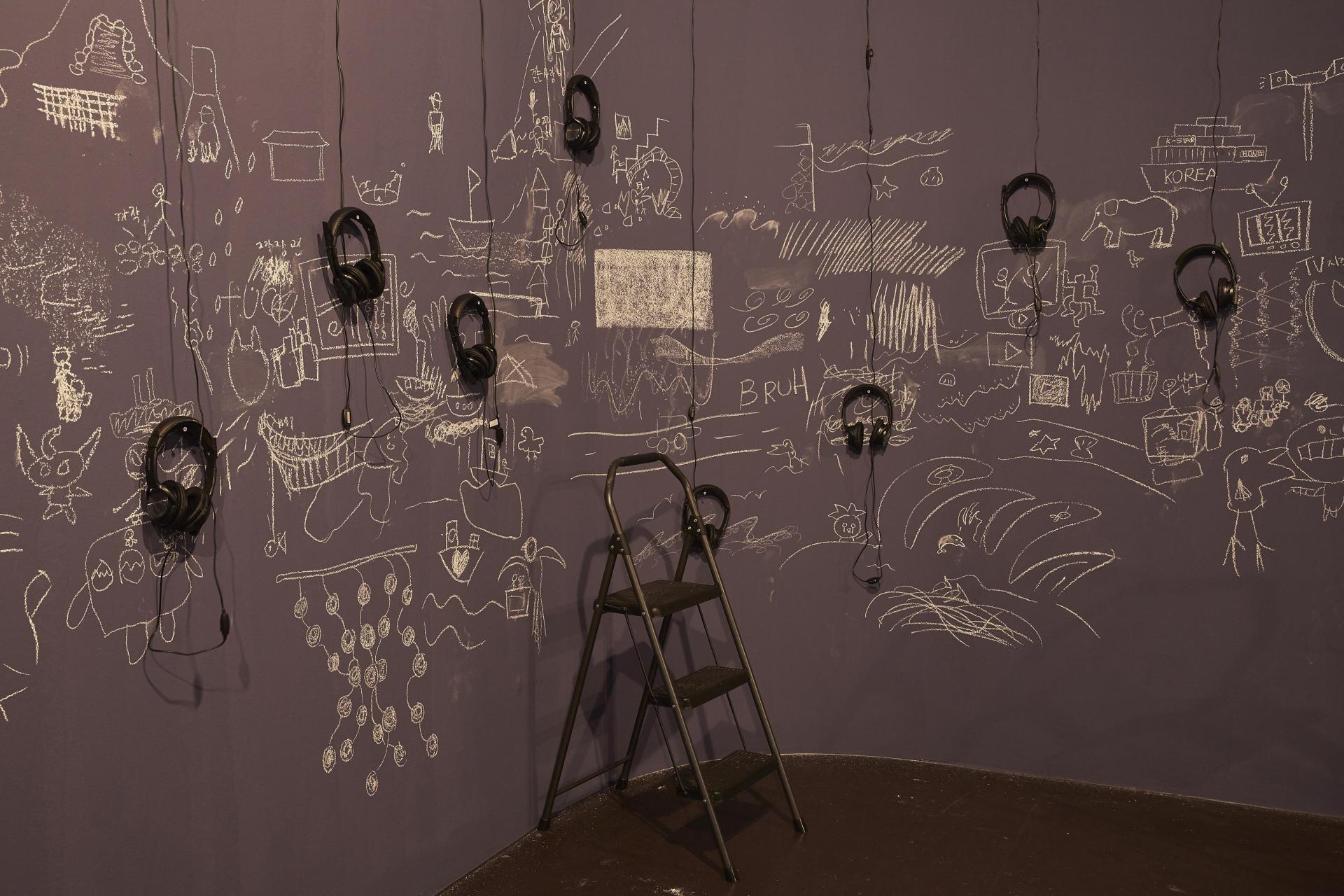
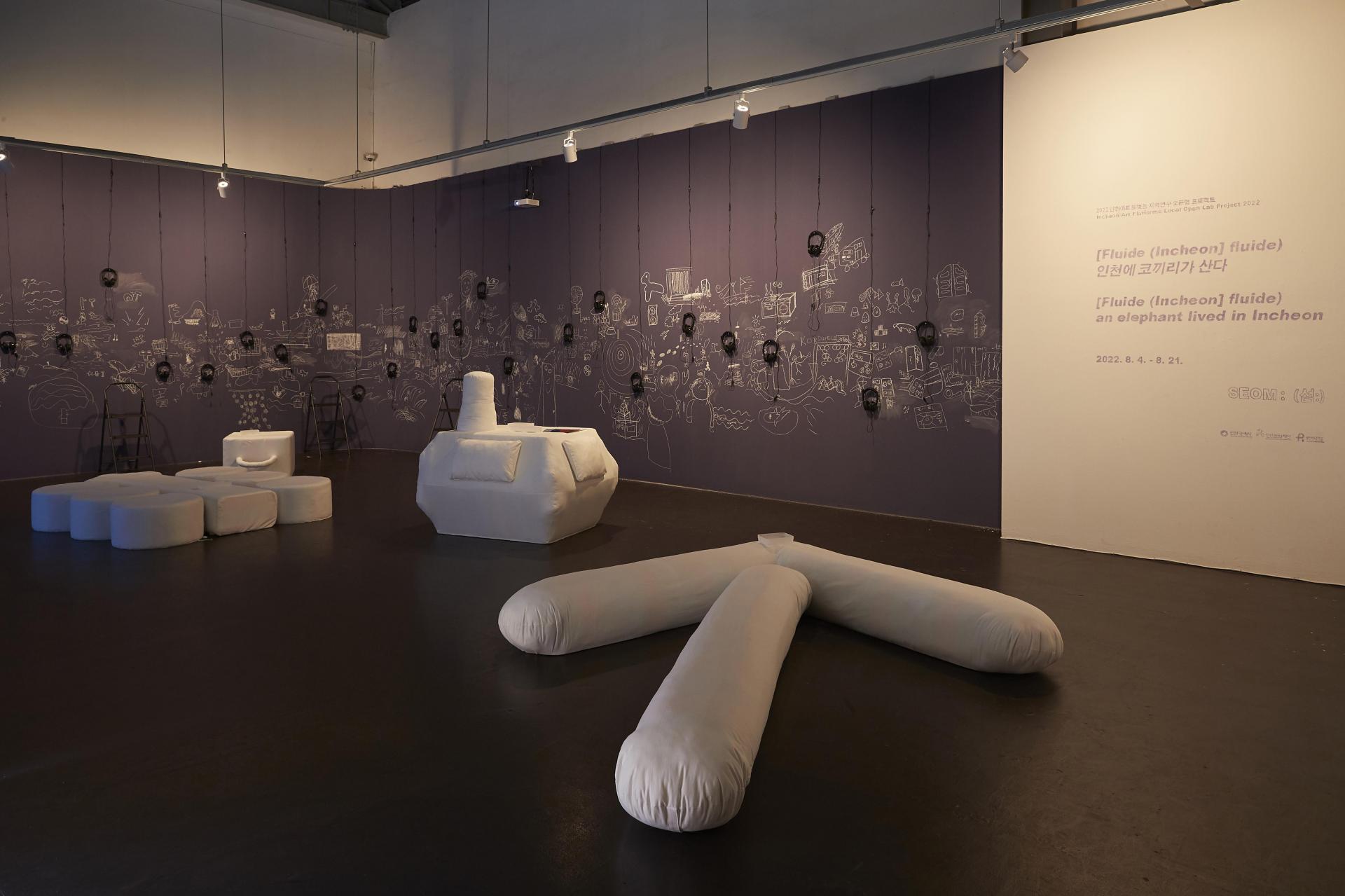
Upon entering the exhibition hall, the audience immediately encounters a space enclosed by a massive grayish-purple wall and the work Sound Wall(2022), which forms the central axis of the exhibition. This work is installed with headsets hanging down from above, allowing viewers to follow the wall and listen to various sounds collected in Incheon.

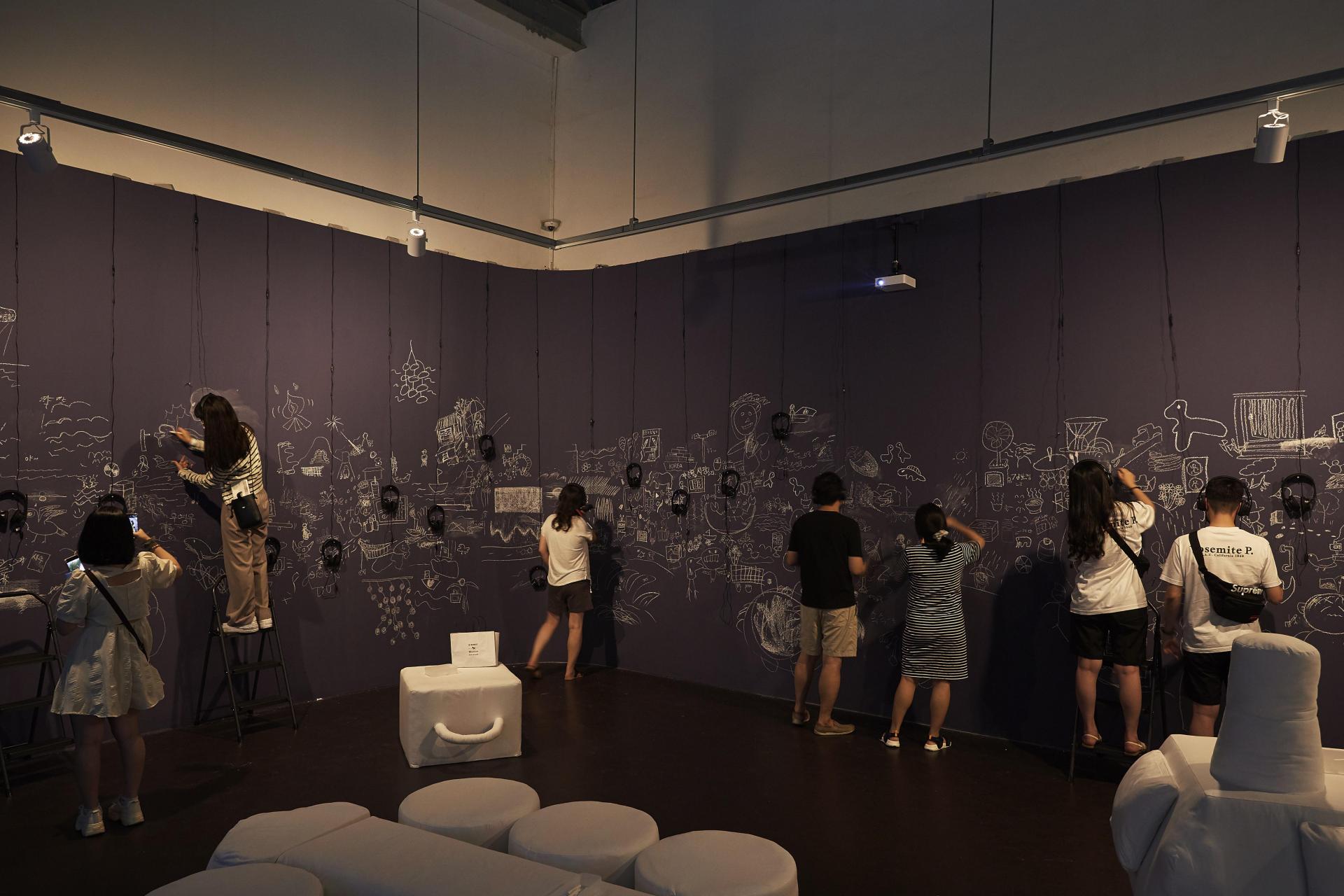
The short, repeated sounds are familiar to some and mysterious to others, making each person imagine different things in their mind even while listening to the same sound. In the center of the exhibition room, large white sculptural forms(Figure I-IIII, 2022) are placed like furniture, with white chalk placed on top so that viewers can listen to the sounds and directly draw on the wall the images that come to mind.

Without much guidance, people naturally move around, listen to sounds, find blank spaces on the wall, and draw pictures. Some look at the drawings made earlier and try to infer the sounds, while others check the audio sources and compare their own senses with those of others. No correct answer is ever given; only countless possibilities for stories pile up between sound and image.

Taking a step back and looking around the whole space, the exhibition hall unmistakably resembles a children’s playroom. The lump-like sculptures padded with soft lining and covered in fabric, and the murals where children and adults alike innocently show off their skills, are all collective creations made through free imagination by borrowing the form of “play.”

As time passes, the sound wall becomes filled with drawings, and the story evolves into something increasingly dense and interesting.

If Sound Wall is the development, in the form of a collaborative work, of the first workshop in which participants listened to the sounds of Incheon and drew pictures and made sculptural forms together with children, then the video work An Elephant Lives in Incheon(2022), which forms another axis of the exhibition, is the refined development of the second Runtime Workshop conducted with fellow artists.

Originally, this workshop was intended as a place to explore the narrative possibilities that could be extracted from the various sound drawings made by children, but it is said that the initial attempt to derive a linear story was quickly thwarted in the face of the children’s imagination.

In the end, the workshop concluded by confirming the possibility of an open narrative based on a shared sense grounded in the visual similarities among the drawings and on images distinguished by an imagination that departs from everyday life.

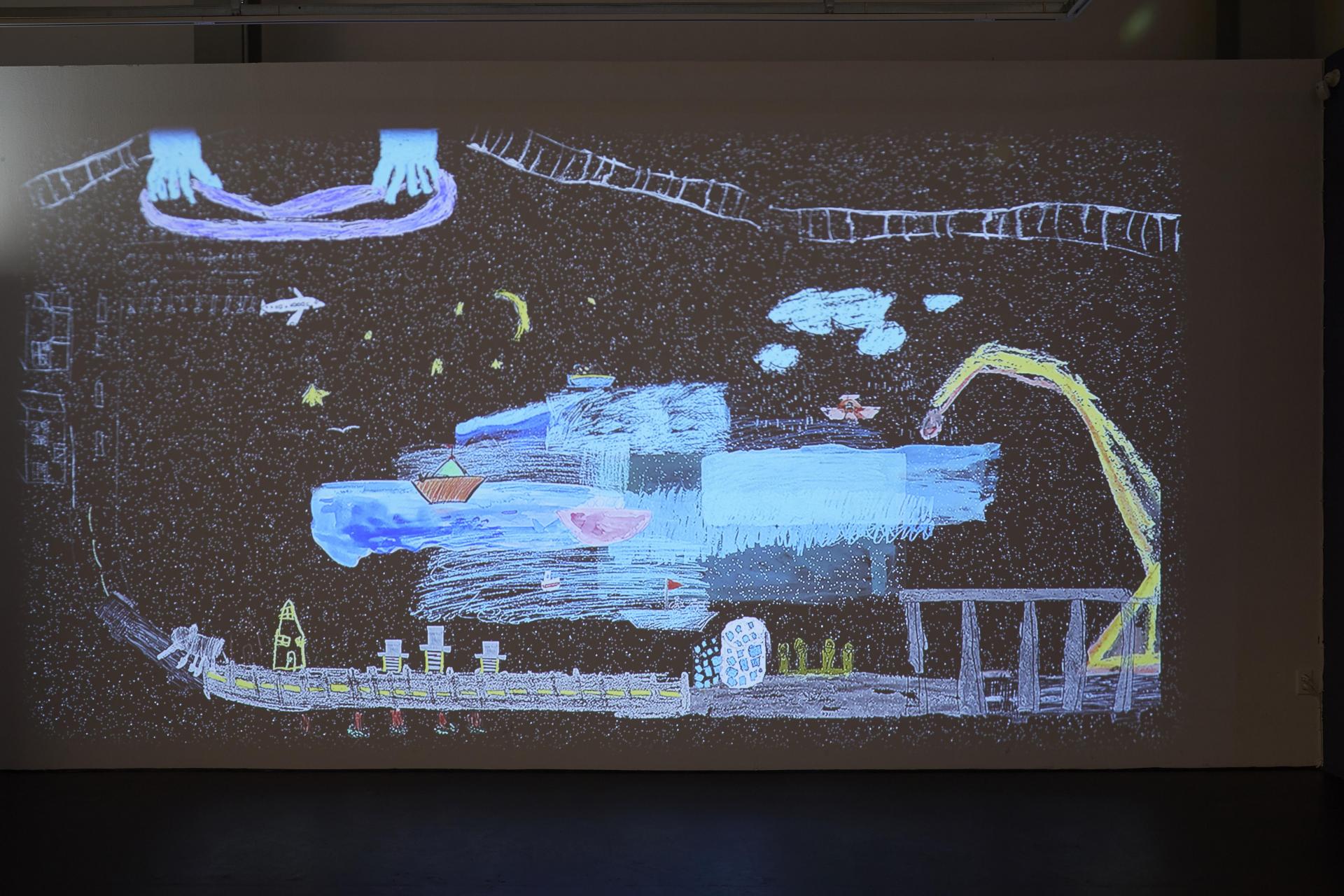
SEOM:’s six-minute-and-forty-second single-channel video An Elephant Lives in Incheon excerpts some of the children’s drawings, reconstructs them on screen together with sound, and gives them movement, unfolding a beautiful and mysterious story that takes place in a virtual space never before seen or heard.

On the screen, an elephant splashing across waves on a rainy day appears in close-up and then slowly recedes; when rain falls from clouds floating in space, the sea that had appeared as one breaks apart into multiple pieces and gathers again. The elephant runs down a runway, swims through space, and travels by boat.

Small boats drifting here and there, a train running along a Milky Way railroad, colorful stars popping out into the darkness like popcorn… Without a clear narrative structure of beginning, development, turn, and conclusion, the mysteriously connected sounds and images in the video propose open interpretation to the viewer and stimulate the imagination.


Installation view of 《[Fluide (Incheon] Fluide)- 'An elephant lived in Incheon'》 (Incheon Art Platform, 2022). Photo: Dongkyung Kwak. © Incheon Art Platform

From the moment of their formation, SEOM: clearly oriented themselves toward work containing spatiality and temporality while pursuing synesthetic artistic experiences. Even after applying the specific location value of Incheon, they did not let go of their concern for the universality and expandability that art projects based on locality can easily miss.

Rather than borrowing the conventional images and symbols that are easily associated with the region of Incheon, they sought to focus on the process by which stories are made in the region and on the nature of the stories that survive.

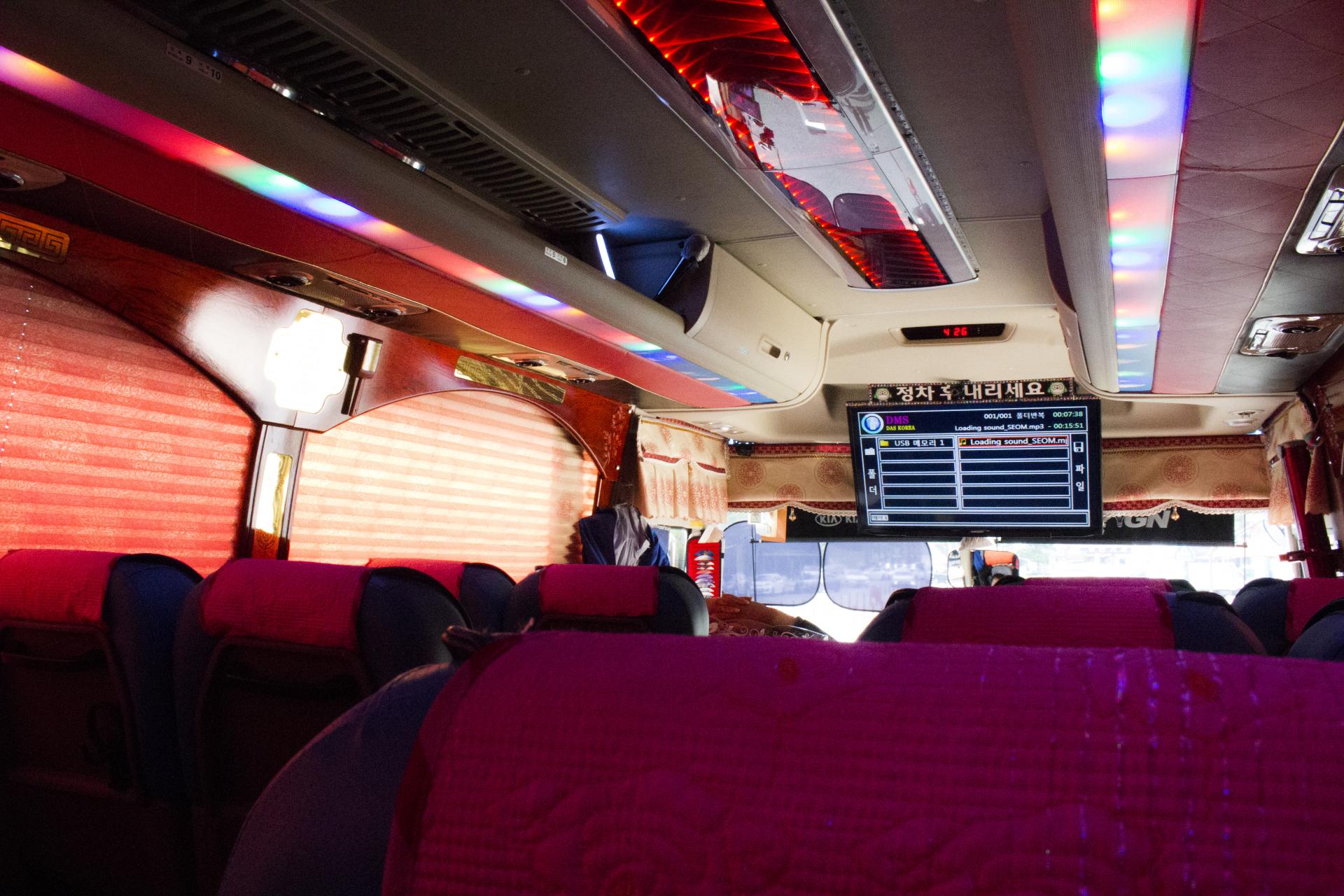
In this way, the sounds of ship horns, yeot being cut, Disco Pang Pang rides, arcade game melodies, subway arrival chimes, and ships rubbing against one another are removed from their existing situational contexts and reborn as new stories in children’s sketchbooks and on the sound wall of the exhibition hall, drawing out an implicit agreement regarding the existence of an elephant living in Incheon.

There is a saying: “It is like the blind describing an elephant.” It is a proverb used to refer to cases in which one interprets the whole based only on partial experience, without fully grasping the actual substance. Yet if we think about it carefully, most of the legends and folktales we know began from partial and private imaginings and interpretations of slightly special phenomena around us.

Oral folktales such as “The Brother and Sister Who Became the Sun and the Moon,” the legend of the Sacred Bell of Great King Seongdeok known as the Emille Bell, and the numerous place-name legends handed down in each region are all products of people’s imagination layered over perceptible phenomenal realities such as color or sound. These extraordinary narratives, once formed, are embellished over time, gain vitality, and leave long-lasting, deep impressions on us.

In participatory works, including oral literature, that leave open the possibility of change at the stage of creation and are formed through the involvement of many people, a relational aesthetics emerges in which the original artists and participants, and participants and other participants, influence one another and discover the order and balance of the work.

The creative processes of the sound wall’s viewers—such as implicitly avoiding repeated images when drawing, adjusting the size of their own drawings in consideration of the overall composition of the screen, and creating points of emphasis—show in real time the process of generating narrative that the artists had sought to reveal from the planning stage.

From this point of view, I think SEOM:’s 《[Fluide (Incheon] Fluide)- ‘An Elephant Lives in Incheon’》 may be a rare example among projects combining local research and art that does not miss the two values of universality and specificity.

With the region of Incheon at its center, the exhibition follows the classical progression through which a community narrative is formed, and succeeds in drawing out the curiosity of participants and viewers through easily understandable language.

At the same time, by fully making use of the strengths of artists capable of eliciting synesthetic artistic experiences, they guide the audience’s movement and control sound to stage the exhibition environment as a playground. They also place within the exhibition a polished sample of storytelling such as An Elephant Lives in Incheon, presenting the expandability of stories in a well-structured composition.

In these aspects, one can faintly imagine the many conversations and multifaceted considerations shared by the two artists during the project period.

Together with the story of Incheon that begins with “An elephant lives in Incheon,” the story of the artists SEOM: has also just announced its beginning to the world. Since they have completed the intriguing first sentence, said to be the most difficult part of writing, it is now time to watch, with anticipation and excitement, what people and events they will encounter as they make the next story.

References