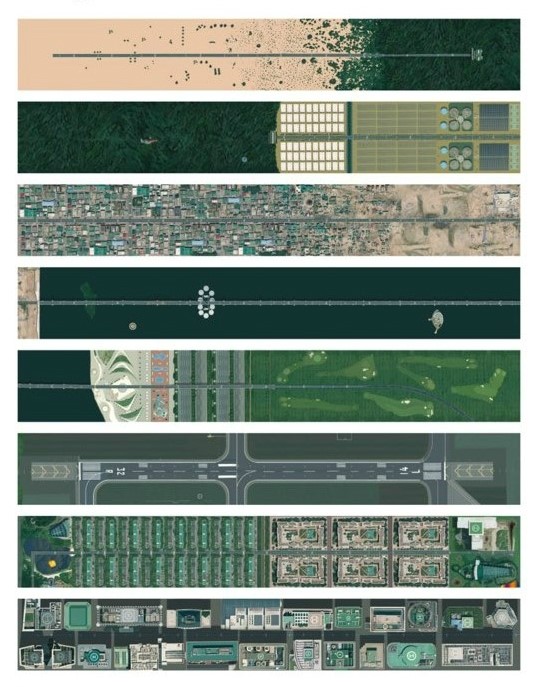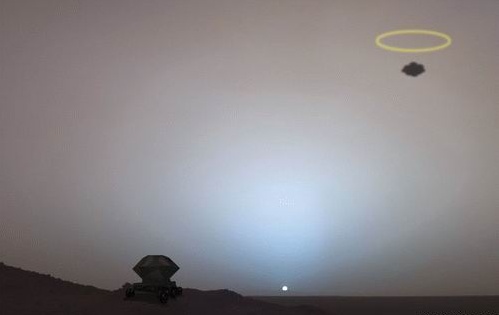


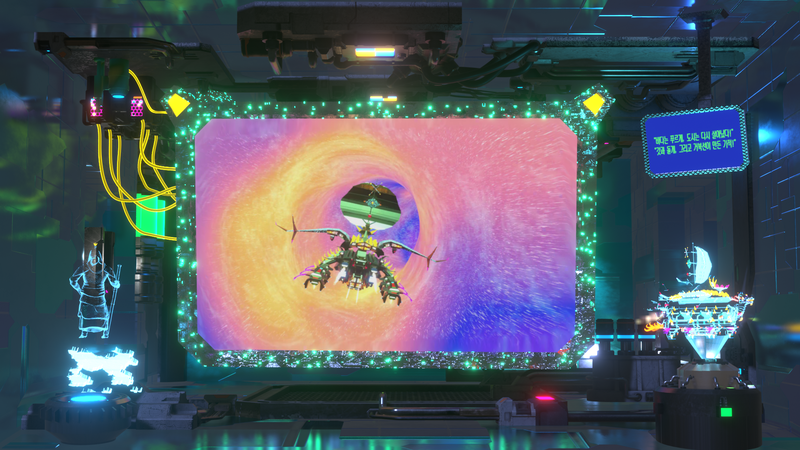
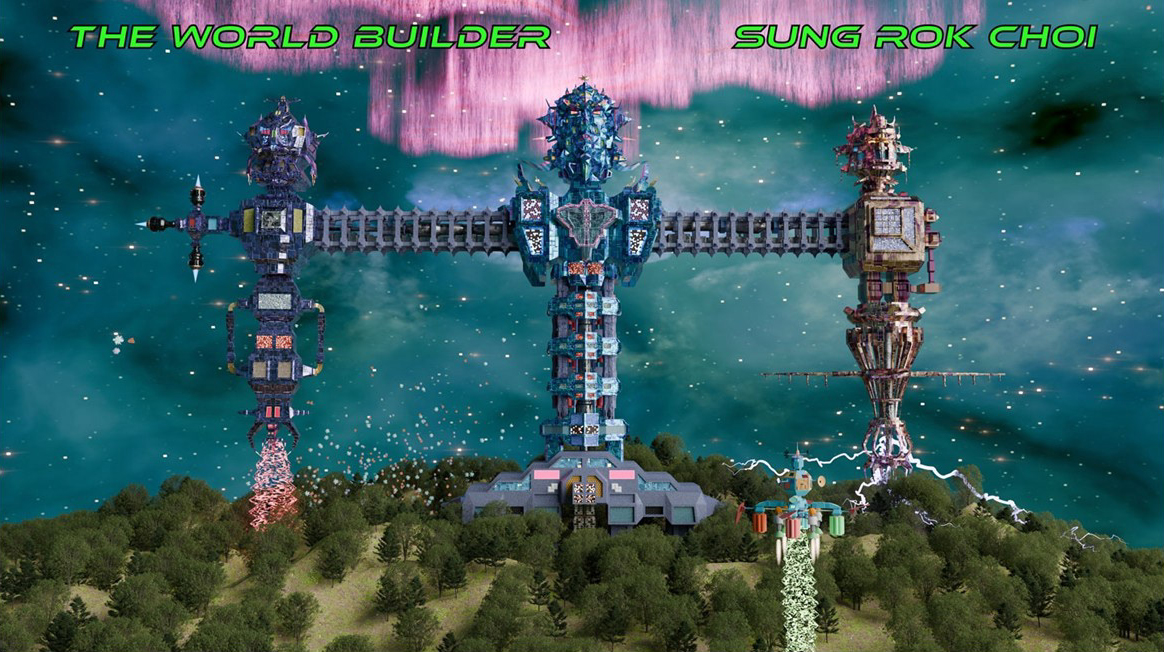
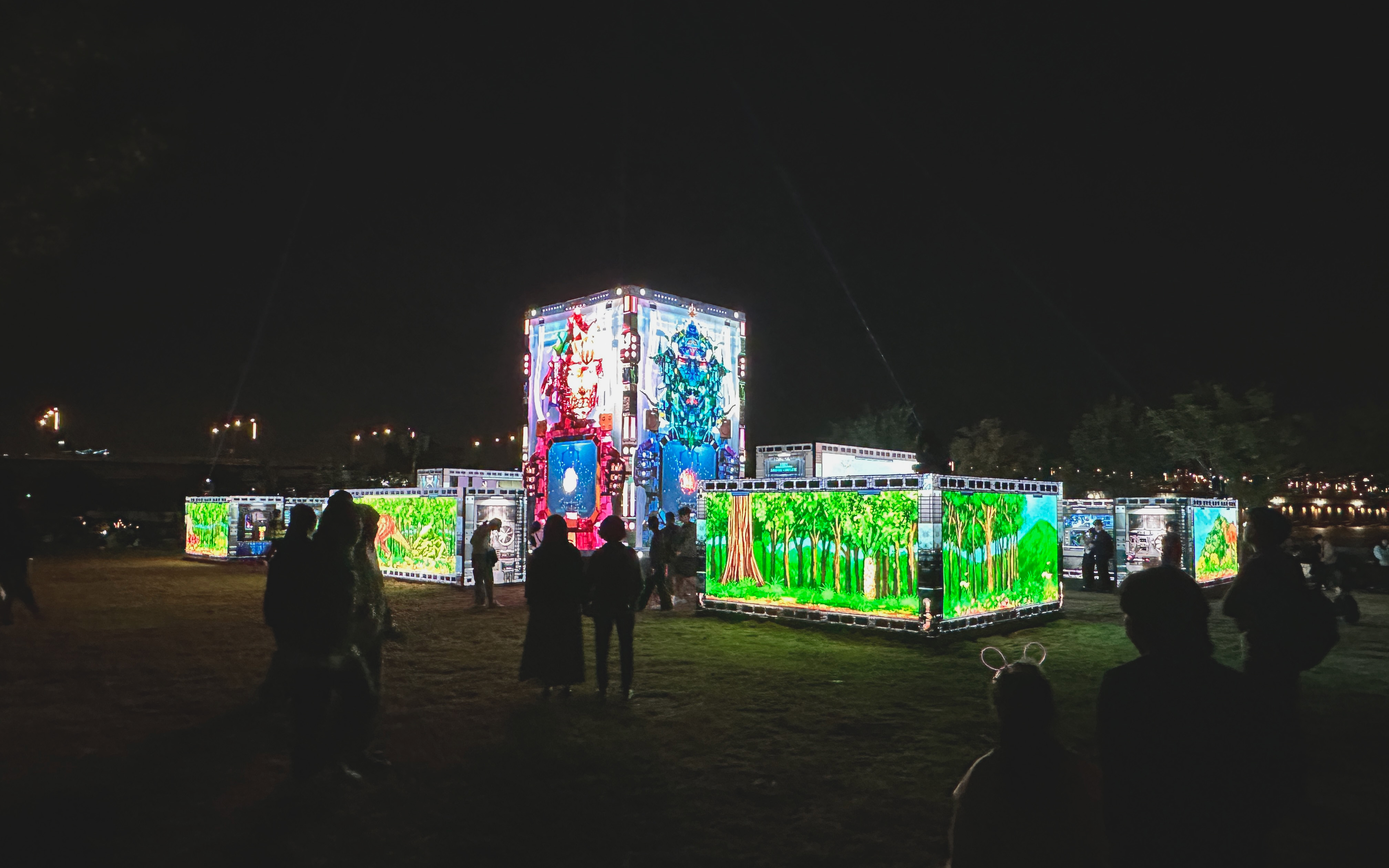
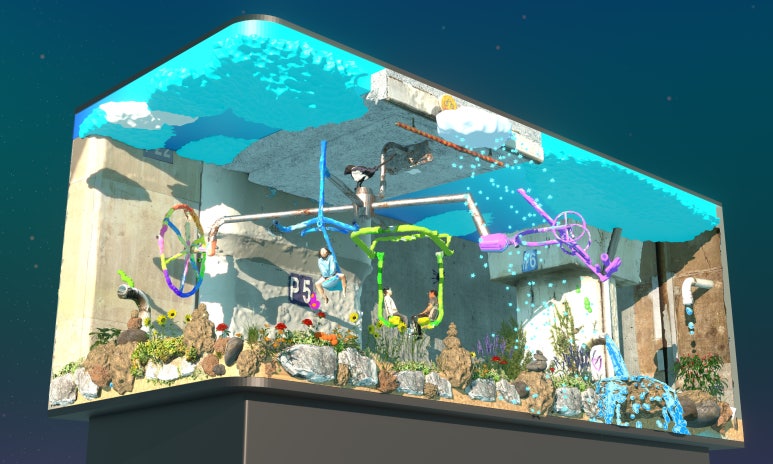
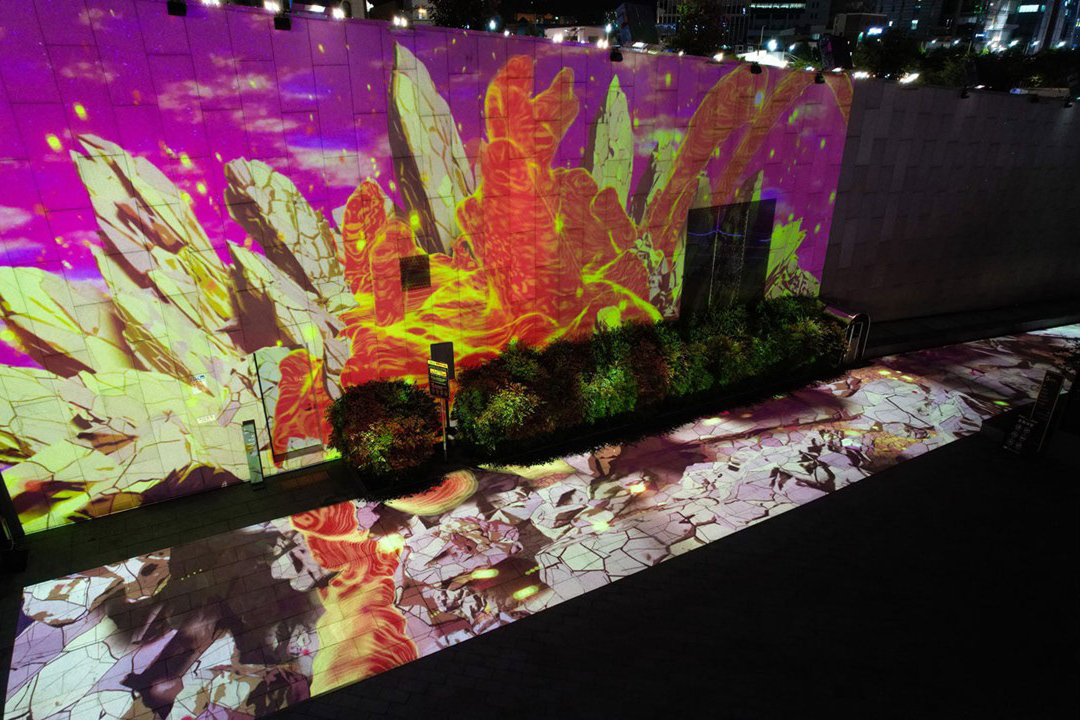
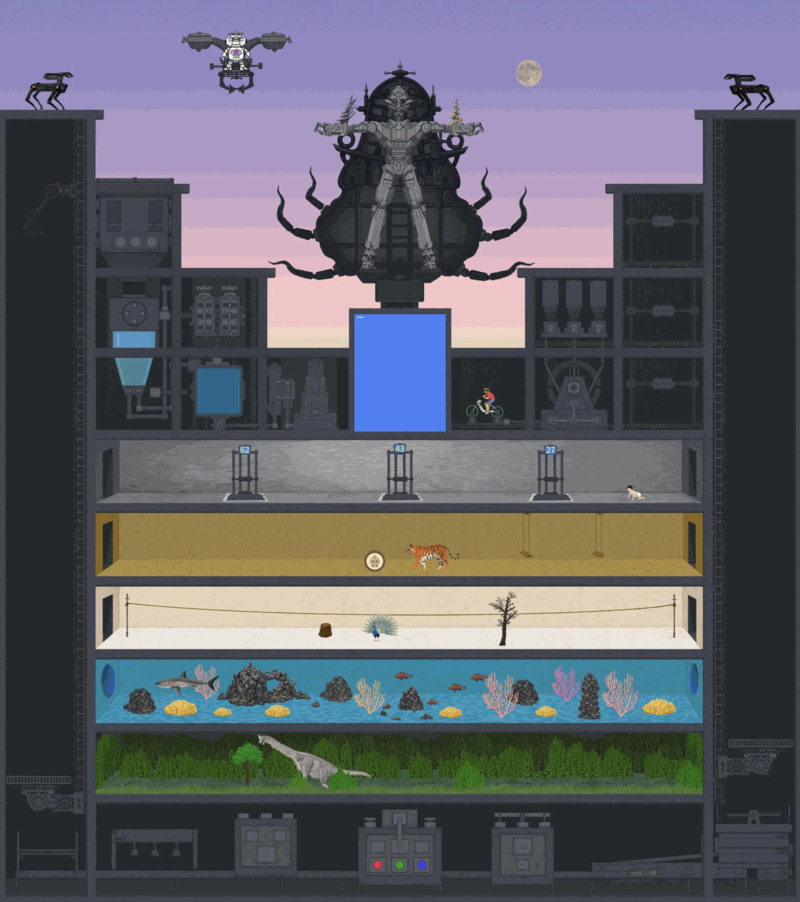
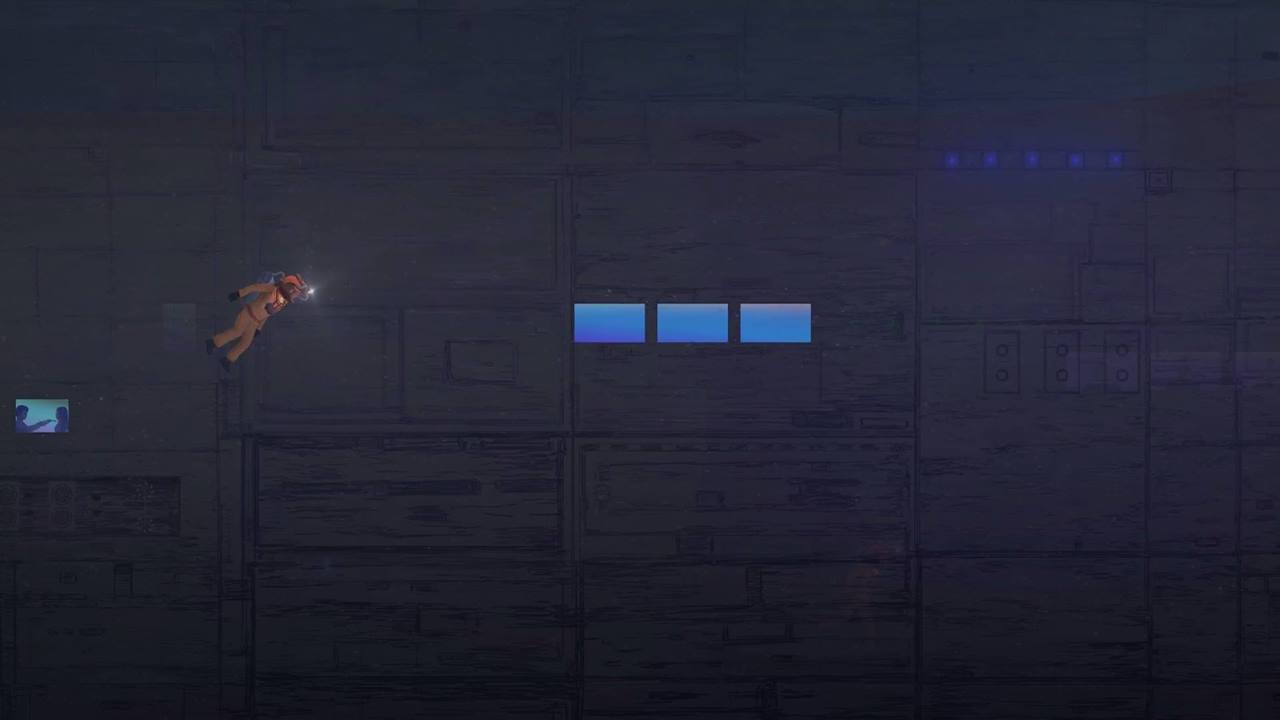
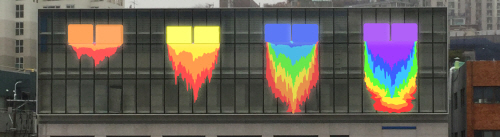

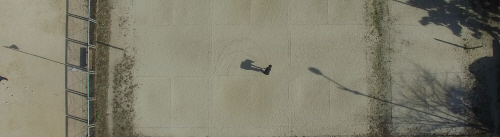

Sung Rok Choi, Scroll Down Journey, 2015, HD 2D animation, 6 min 20 sec © Sung Rok Choi

#1. Fixed Entities, Changing Realities

A small automobile appears at the center of the screen. The camera rapidly follows its movement. Everything changes at a breathless pace, yet both the automobile and the screen remain fixed. Even as familiar landscapes rush past, the car remains anchored at the center of the frame. Only the trail of smoke behind it reveals its movement, suggesting that it is racing toward some unknown destination.

In this way, Sung Rok Choi’s new work Scroll Down Journey presents a changing reality through the perspective of a fixed entity. Rather than the entity itself changing within reality, reality instead shifts and races around the fixed entity.

Historically, reality—the world—has existed for us as a fixed constant. What changed was always the “self within the world,” and from this perspective we became accustomed to the viewpoint of moving entities themselves. Countless media forms have reflected and focused upon our reality-world, yet in order to obtain a precise image, the entity required to move has always been the very medium illuminating the world.

Such a grammar derives from the projection of vision rooted in “Being-in-the-world” (In-der-Welt-sein), yet despite this, we have also imagined a world-environment that responds to shifts in the subject’s gaze as we explore our surroundings. Paradoxically, this desire of the subject emerged most naturally within virtual game environments that presuppose a certain distance from reality itself.

The simulated environments of games established another world that points toward reality while simultaneously overturning the structure of Being-in-the-world. This is precisely why Sung Rok Choi’s work resembles the visual logic of a game screen.

Although the landscapes within the work are created from actual scenery through computer animation, it is difficult to locate traces of such real-world referents within the image itself. The screen instead directly presents a meticulously constructed artificial world in its own right.


#2. The Dialectics of Vertigo and Scrolling


Following the earlier proposition that the reality-world surrounding us moves around a fixed self, the question that emerges concerns whether such a world remains perceptible to us at all. The fact that the subject within the screen remains fixed may function, from the audience’s perspective, as a stabilizing factor that renders the rapidly changing landscapes secondary.

Yet this sensation arises only when observed from the detached standpoint of a third-party spectator. What we must instead consider is the gaze of the subject that confronts change while remaining fixed in place. The ability to move the world itself in order to obtain a desired perspective may metaphorically be understood as the acquisition of an omniscient viewpoint capable of scrolling across the entirety of the world.

However, once environmental transformations accelerate beyond a certain threshold, our vision inevitably reenters a stage in which perception becomes limited to selecting viewpoints within a still-manageable cognitive range. If we imagine such a world fully present before our eyes, we are naturally exposed to a form of dizziness or vertigo beyond our own control.

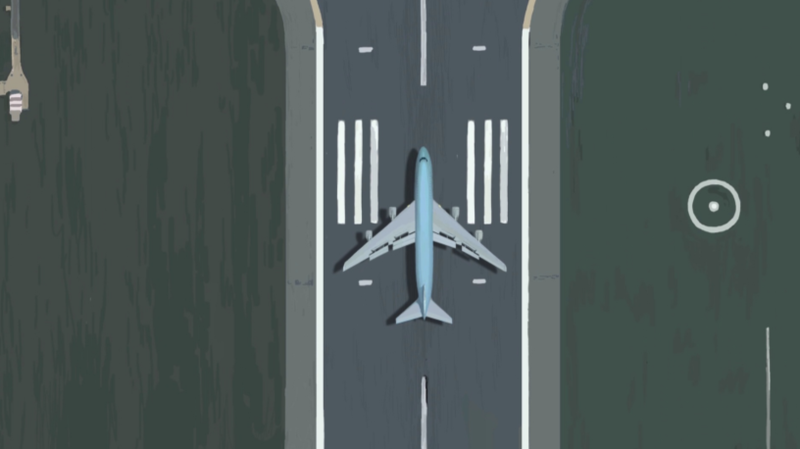
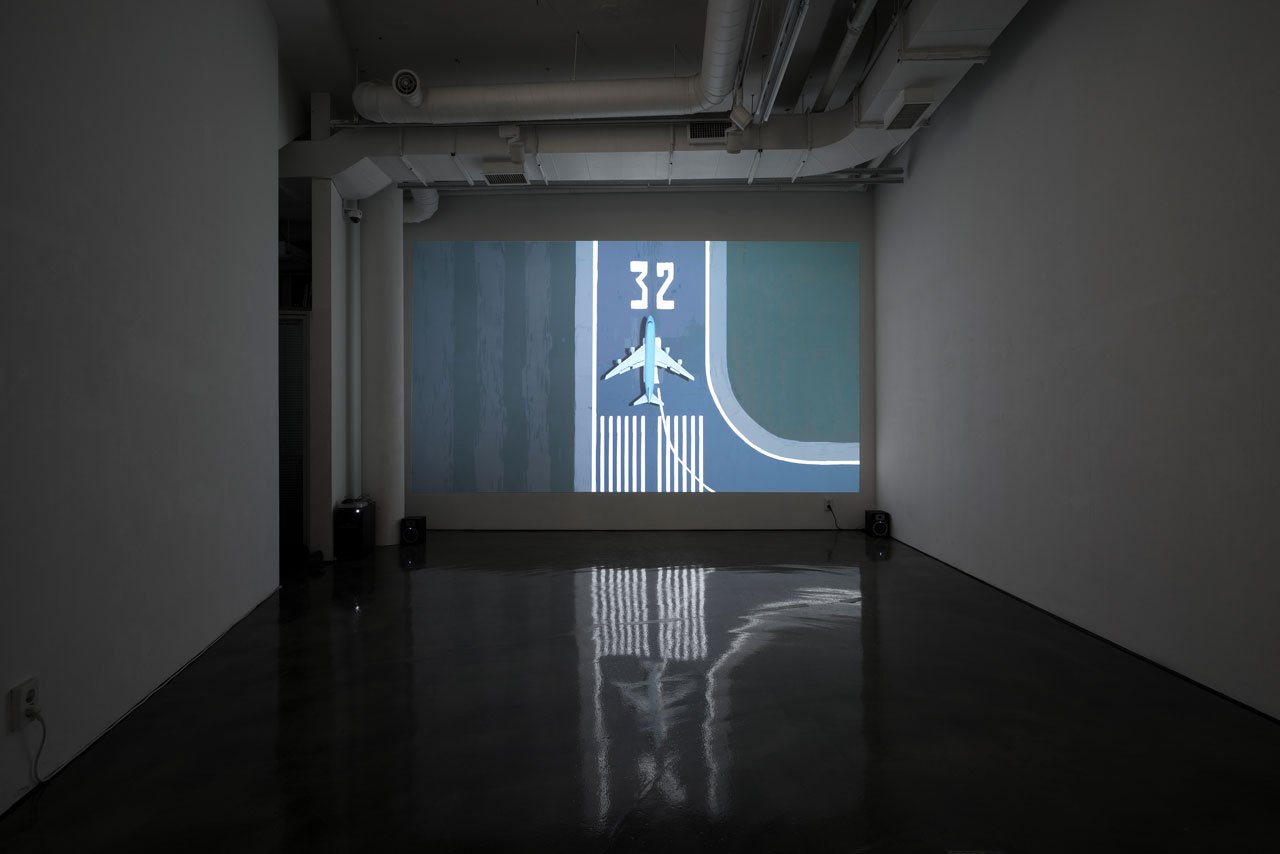
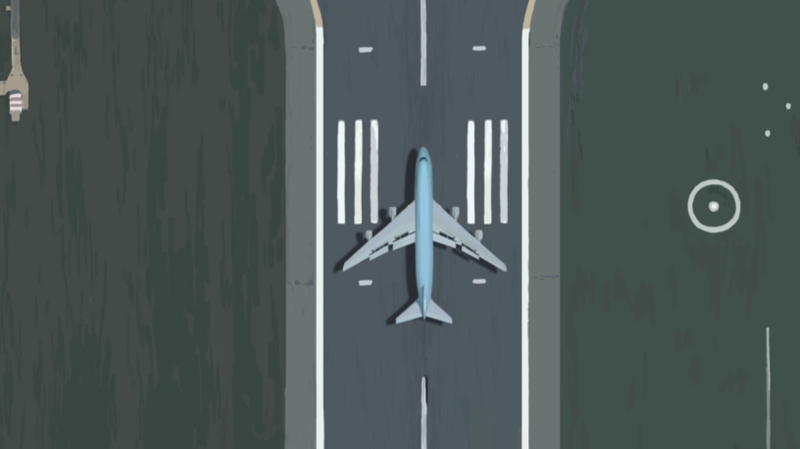
Just as we begin to acclimate ourselves to this disorientation, the automobile within the screen departs from the center. What becomes particularly intriguing is that as this central subject withdraws, other entities emerge in its place. Replacing the automobile, a massive airplane fills the screen as it lands at an airport, momentarily restoring a visual regime distinct from the earlier subject-centered gaze.

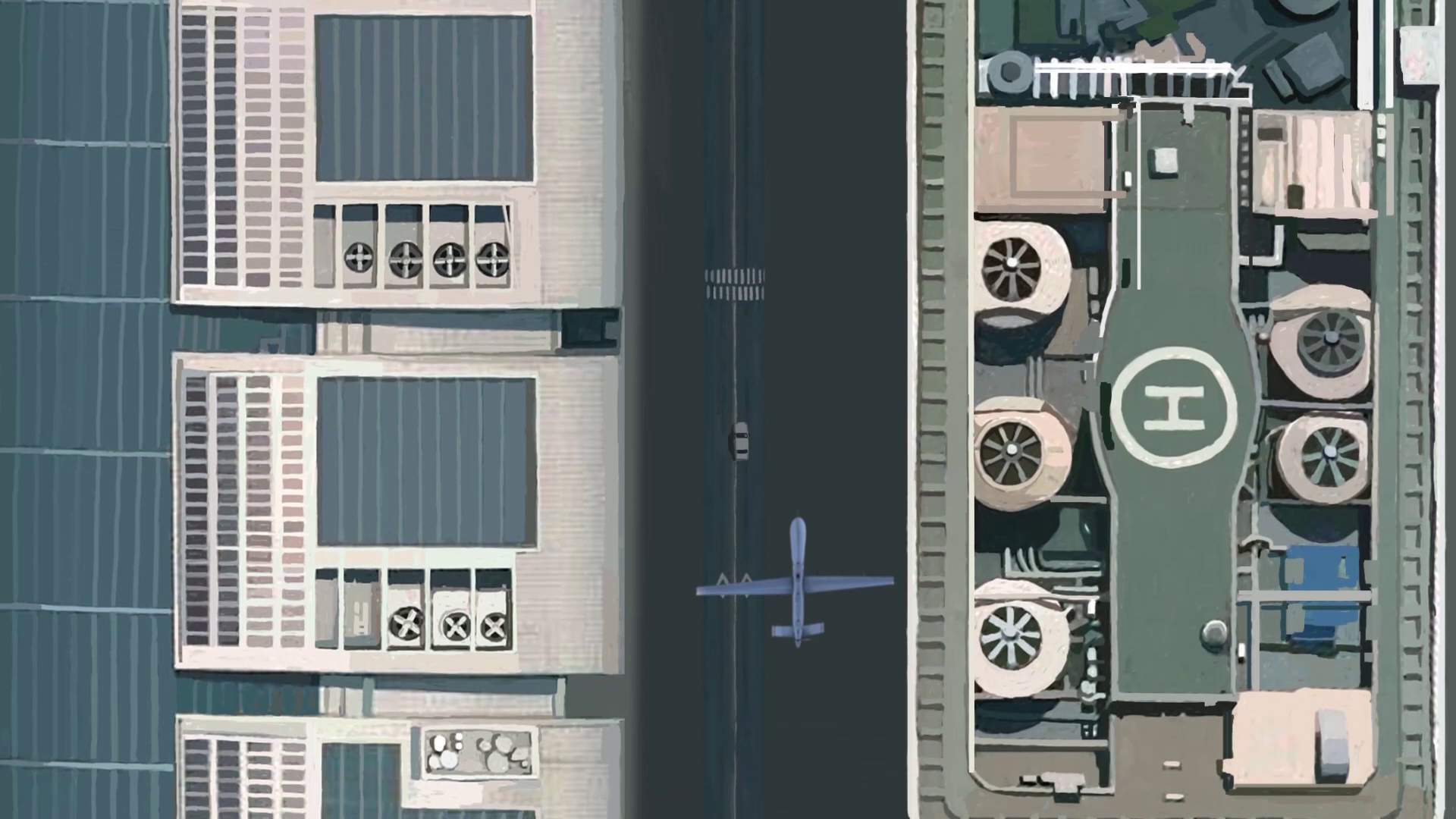
Yet the airplane soon disappears from the frame immediately after landing. The entity demanding closer attention is the surveillance aircraft that quietly appears alongside the automobile’s return. The surveillance aircraft supplements these two visual systems while simultaneously functioning as a mediator binding the real and the virtual worlds into mutual dependence.

The closing sequence of the work ultimately reminds us that this scrolling world—the virtual planar world itself—was nothing more than an extremely thin and superficial surface.

As the surveillance aircraft, the mediating device, vanishes beyond the screen, the automobile that had guided the image through a centered perspective leaves behind the fragile plane and plunges into endless darkness. In this way, the scrolling of a subject-centered virtual world comes to an end.


#3. Becoming-Ghost as a Visual Assemblage

The expansion of human vision through media has long been one of the most fundamental themes in media theory. Although the arguments advanced by Marshall McLuhan and the Canadian school were later contested or remediated by other theorists, they nonetheless established a dominant framework through which media has been understood.

Media enabled the overcoming of bodily limitations, while forms of perception once dependent upon singular senses came to recall a mediated corporeality composed of multiple sensory systems. Yet the expansion of vision made possible through artificial eyes and mediated sight was fundamentally grounded in the ubiquity of vision itself.

Media combined their own formal characteristics with the categorical limitations imposed by the human body in order to generate eyes dispersed everywhere. As a result, we became capable of traversing multiple points of view, assuming god-like perspectives and even experiencing gazes from beyond the frame.

Yet another form of vision now emerges—one derived from the essential properties of media itself: a ghostly mode of perception inhabiting the interstitial spaces generated by mediation.

From this perspective, the series ‘A Man with a Flying Camera’ and ‘I Will Drone You’ may be understood as presenting a new visual regime. The ghost, functioning as a mediating existence situated between worlds, occupies neither the omniscient viewpoint of the past nor the anthropocentric perspective moving between first- and third-person positions. Instead, it inhabits an ambiguous positionality somewhere in between.

At the same time, it is strongly endowed with the ubiquitous qualities inherent to media itself. Thus, while characterized by aerial vision through floating entities such as surveillance aircraft, this gaze cannot be understood as a controlling perspective akin to that of surveillance cameras.

It remains constantly present beside us, yet is never directly synchronized with the world we inhabit. It presupposes a certain distance, and for that reason differs fundamentally from conventional binary systems that conceive inside from outside or outside from inside.

The frame remains fixed while entities move within it. Yet the frame itself does not shift in accordance with the movement of those entities. Employing aerial cinematographic techniques utilizing drones, these works operate through the paradoxical condition in which drones are assigned conceptually ambiguous yet simultaneously precise locational values. Consequently, they continue to function as organic airborne bodies independent of human movement itself.

Ultimately, however, the point at which we are recognized as visually expanded beings lies in a mediating gaze that surpasses the binary opposition between human subject and media. It is a perspective functioning as an integrated assemblage—a projected entity existing at a ghost-like point or altitude beyond human existence, yet never entirely separate from us.

References