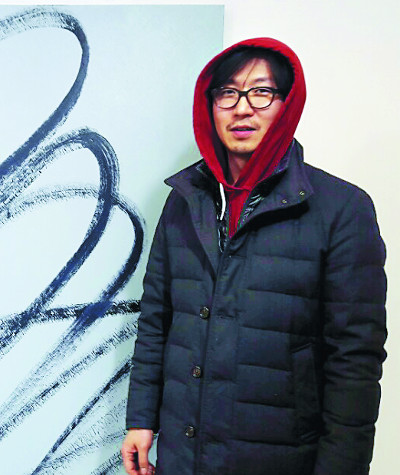
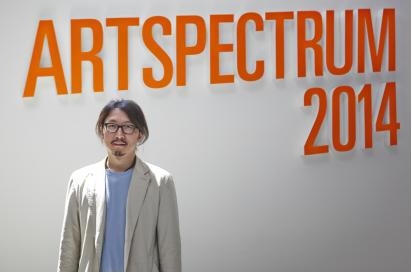
Artist Lee Wan was born in Seoul in 1979 as the eldest son in a family of musicians. He graduated from the Department of Sculpture at Dongguk University in 2004 and has since held five solo exhibitions.
Since presenting a series of amusement-ride works composed of hybridized objects in his 2005 solo exhibition 《Riding Art》 at Ssamzie Space, Lee Wan has continuously employed everyday objects as a means of expressing the social realities he observes and experiences.
The artist has recalled that the society he encountered after graduating from university felt much like an amusement park. His first impression upon entering society was that everyone seemed to be living within a meticulously designed system created by someone else, passively responding according to intentions already determined for them.
Although amusement rides largely share similar structures, people feel fear when ghostly imagery is imposed upon them, while images of smiling faces from around the world produce feelings of peace and comfort. Through such situations, the artist came to recognize reflections of the society in which we live.
A defining characteristic of the works produced between 2005 and 2007 is that the viewer’s physical experience is positioned as an essential condition of the work itself. During this period, Lee Wan concentrated on constructing conditions through which other senses — such as touch and weight — might expose the limitations of vision as the dominant mode of perception.
Lee Wan understood society as a structure of illusory images represented through simulacra, and believed that escaping such structures required awakening through “real” experience beyond visual imagery. The unfamiliar devices produced during this period therefore ultimately function as mechanisms for the “correction of perception.”
One of the earliest works he produced was Slide (2005). Consisting of two slides connected on either side of a central staircase, the work can only be understood through direct bodily experience. When a viewer climbs the stairs in order to ride the slide, the slide positioned in front of them lowers downward, preventing the viewer from sliding and forcing them instead to walk back down the very staircase they had climbed.
Those who mount the structure expecting the conventional experience of a slide encounter instead a strange and disorienting experience, tilting their heads in confusion as they are compelled simply to “walk back down” a work that refuses to conform to the accepted concept of a slide.
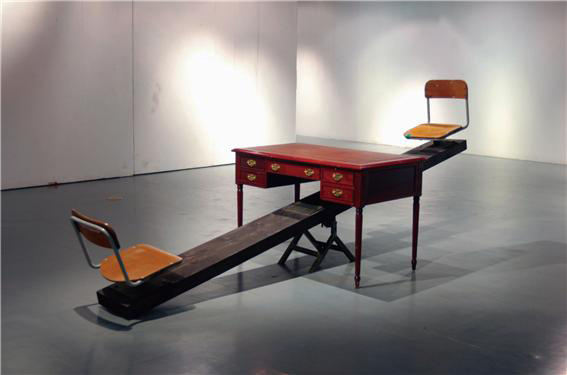
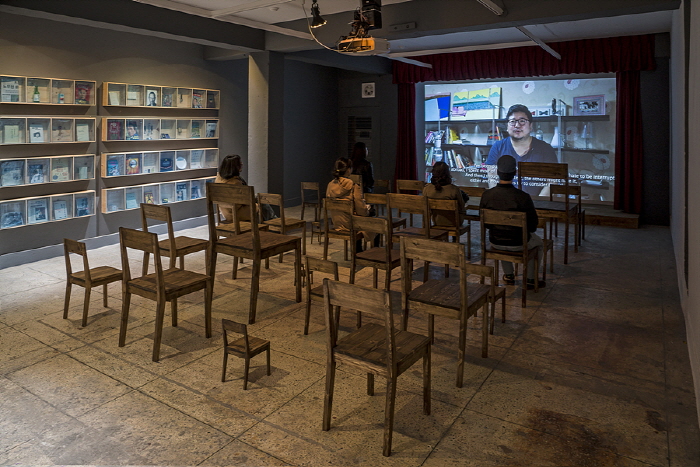
Merry-go-round (2005), a work consisting of school desks and chairs placed in lieu of carousel horses atop a circular platform rotating twice per minute, was constructed from discarded classroom furniture personally collected by the artist. Unlike actual amusement-park carousels modeled after horses and adorned with fantastical colors, Lee Wan’s work seats children upon wooden desks and chairs.
Similarly, in Wonder Wheel (2005), desks and chairs hang in place of the usual passenger cabins, while the structure itself can only be operated manually by someone physically turning it. In both works, the primary-colored spectacle associated with amusement rides is entirely absent.
Instead, old wooden school desks alone compose the artist’s amusement-park series, producing the strange sensation of simultaneously studying and riding an amusement attraction. These experiences are clearly distinguished from the conventional expectations typically associated with amusement rides.
Another work from the same series, Tricycle (2005), combines two heterogeneous objects into a single form. The artist removed the legs from a worn office chair used by adults and mounted it onto a child’s tricycle, producing a hybridized vehicle. Preserving the original functions of both the bicycle and the chair, Lee Wan’s Tricycle appears to wait for someone to ride it.
Whereas Marcel Duchamp employed the ready-made to draw specific objects into an aesthetic order while stripping them of their original functions, Lee Wan instead foregrounds the contradictory situations generated through new combinations of objects whose original functions remain intact.
Although his works preserve the functional structures of existing amusement rides, they produce experiences subtly distinct from those conventionally expected. Moving beyond the institutional boundaries of the museum, these works encounter viewers directly within everyday spaces.
Lee Wan has recalled that the exhibition achieved explosive popularity among audiences, especially children, yet he also came to experience firsthand the limitations of communication through these interactions. Around Children’s Day, various institutions frequently invited him as a “children’s artist,” and he has noted that participation in exhibitions whose directions did not align with his intentions ultimately left few surviving works from that period.
The conceptual concerns underlying the works were, in many respects, obscured by the playful qualities of the amusement rides themselves, resulting in a failure to fully communicate their meanings to the public. This experience led the artist to pursue methodologies aimed more explicitly toward adult audiences.
The ‘Book Sporting Goods’ series produced after ‘Riding Art’ reveals attempts to overturn the values embedded within existing social structures. Within society, individuals are hierarchized according to socially sanctioned measures such as wealth or status, producing distinctions between those considered more valuable and less valuable.
Lee Wan felt that the society he experienced similarly organized people according to hierarchies of knowledge and information, and he therefore adopted books as his material. Although books are fundamentally composed of similar sheets of paper with comparable weight and color, certain books — such as the Bible — become objects treated with reverence, while others, like the free magazines commonly found in subway stations, are casually discarded or torn apart.
Lee Wan thus attempts to reorganize books according to the criterion of weight, rather than according to the values assigned to their contents. When books intended to nourish the spirit become exercise equipment judged by physical weight, heavier books acquire greater value regardless of what they contain.
In works such as Dictionary-Dumbbell (2006), the artist suspends an English-Korean dictionary on one side and a Korean-English dictionary on the other, producing a visual experience in which the values assigned to two languages — and, by extension, two nations — are rendered equivalent.
Slot Machine (2006) likewise reveals Lee Wan’s attempt to overturn the paradigms embedded within already dominant social structures. In this work, the artist stacks multiple slot machines into the form of a tower. Each machine retains its original functionality, yet with one crucial alteration: Lee Wan removed all of the images printed on the three rotating reels inside the machines and replaced them with blank white reels.
Because slot machines are designed as devices created to generate profit, they are ultimately programmed to return less money than they receive. In other words, whether or not money is paid out does not truly depend on which images appear on the reels; rather, the machine has already been systematically programmed to determine when and how much money it will release in order to maintain profitability.
Through this work, the artist suggests that although people believe themselves to be endlessly receiving information through what they see and hear in mass media, invisible rules nonetheless govern the operation of larger systems, and individuals ultimately come to desire the desires socially produced for them.
The works produced between 2007 and 2008 temporarily set aside Lee Wan’s earlier overarching concern with creating “real” and subversive experiences capable of disrupting vision as the dominant mode of perception, instead focusing more directly on the generational consciousness experienced by the artist himself.
The works from this period address the social perceptions and personal sense of helplessness shared by those born in the early 1980s, including the artist. Rather than demonstrating active engagement with politics or society, this generation often appears to retreat into imagined utopian spaces detached from reality.
Tell Me (2007), exhibited at Art House Gallery in London, demonstrates formal characteristics distinct from Lee Wan’s earlier works. As the object-based works from his early career rapidly gained attention and were repeatedly exhibited, many of the works themselves became damaged through overexposure.
As a result, the artist entered a period of psychological exhaustion — a kind of slump — alongside the deterioration of the works themselves. During this period, together with several artists including Park Jun-bum and Ahn Doojin, Lee Wan formed an artist collective called “Manual Type,” through which they launched a website and organized exhibitions independently.
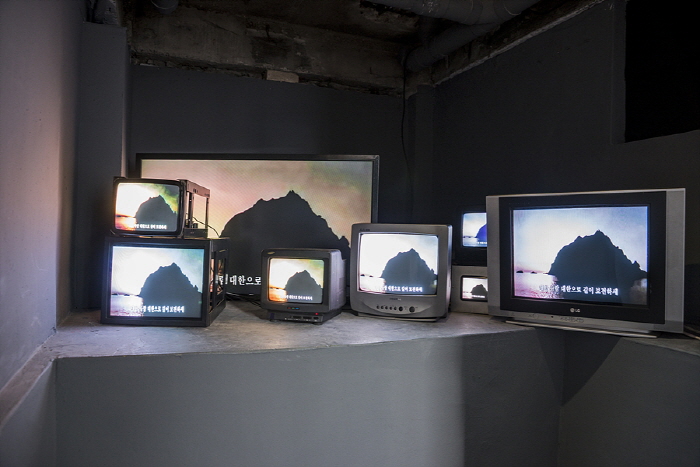
Tell Me was presented as part of a group exhibition held in Seoul and London with support from the Seoul Foundation for Arts and Culture. Under the premise of creating an exhibition addressing the relationship between South and North Korea, Lee Wan attempted to articulate his own position regarding inter-Korean relations.
Unlike his father’s generation, which directly experienced war as a matter of survival, Lee Wan belongs to a generation raised within the relative comfort established by their parents. Accordingly, the work visualizes, quite literally, a condition of “not really knowing much about North Korea.” For the artist, the first images that came to mind when thinking about North Korea were red lettering in a formal Korean script and photographs of Kim Il-sung.
Against a red background, Lee Wan inscribed in white the lyrics of “Tell Me,” the hugely popular song by the Wonder Girls at the time. Although the work was exhibited in a third-country context, the artist deliberately chose neither to translate the text nor to explain the work, instead leaving viewers free to interpret it through their own frameworks of understanding.
In fact, the London organizers questioned whether the work conveyed a communist message and even requested that its installation location be changed. Despite consisting merely of the lyrics of an ordinary love song, audiences unfamiliar with the Korean language nevertheless experienced discomfort when encountering the work. In this way, the piece satirizes situations in which various relationships become misaligned and incapable of reconciliation.
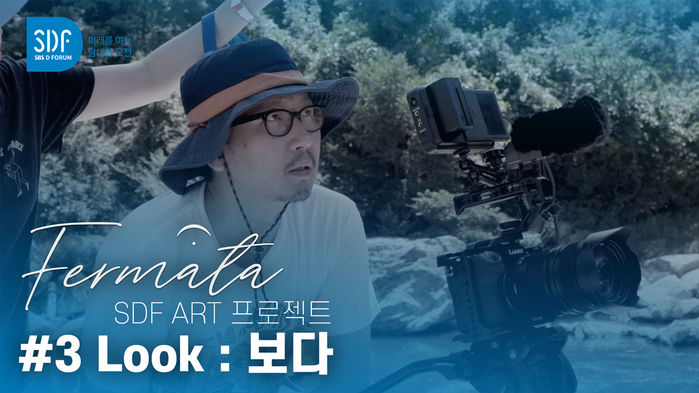
The person who ultimately handed a camera to Lee Wan during this period of artistic exhaustion was none other than Joonbeom Park. Having recently gone through a breakup, lacking money, and continuously struggling with how to further develop the object-based works he had been making, Lee Wan encountered the video camera as a crucial turning point.
One day, several friends visited his studio carrying a birthday cake. After they left, the artist sat absentmindedly staring at the partially eaten cake and suddenly noticed that spring had arrived there as well — in the form of mold. Green and black mold began to spread across the white cream like newly sprouting leaves emerging in springtime.
Amid a period of uncertainty in which he could not foresee even the immediate future, the artist came to realize through mold that even poison can contain the arrival of spring. A recurring characteristic throughout Lee Wan’s three video works is that the scenes he records all suggest forms of cyclical process.
Such circulation may appear physically — as in objects literally rotating — or conceptually, recalling cyclical structures such as the Buddhist notion of reincarnation. Another defining feature of Lee Wan’s video works is the consistent presence of music. Each video contains a specific narrative structure, and the artist incorporates music in order to guide viewers toward the emotional condition necessary for receiving the messages embedded within the work.
In 2009, Lee Wan returned once again to the use of everyday objects in works exposing the errors of visual illusion. At the time, the artist found himself living a monotonous routine, endlessly moving back and forth between supermarkets and home, when he suddenly experienced a moment in which every product displayed in a supermarket appeared to him as though it were an artwork.
He became fascinated by beer cans densely covered with small print indicating that one ingredient had been imported from the United States, another from Australia, processed in China, and distributed by a Korean company. What interested him even more, however, was the way people interacted with these products.
Whenever he handed someone a beer can, everyone instinctively opened and drank it. Very few people, as Lee Wan himself had done, looked at the object as though contemplating an artwork or considered using it for any purpose other than its intended function.
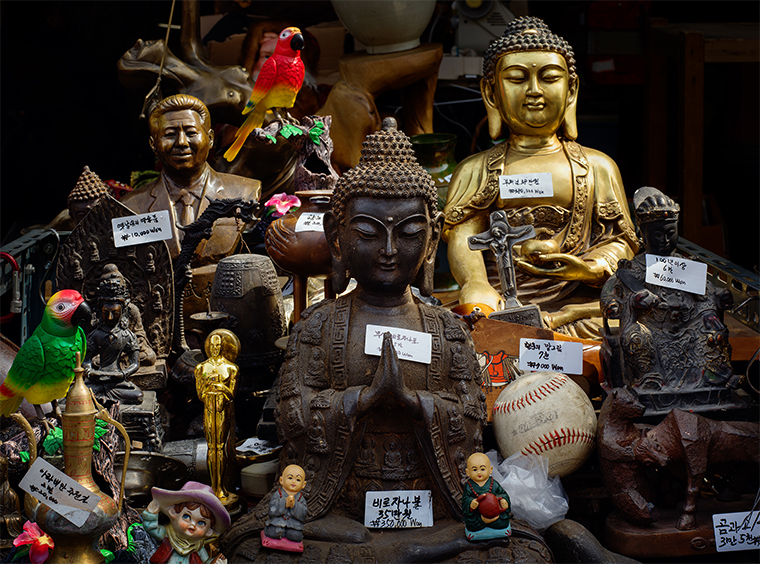
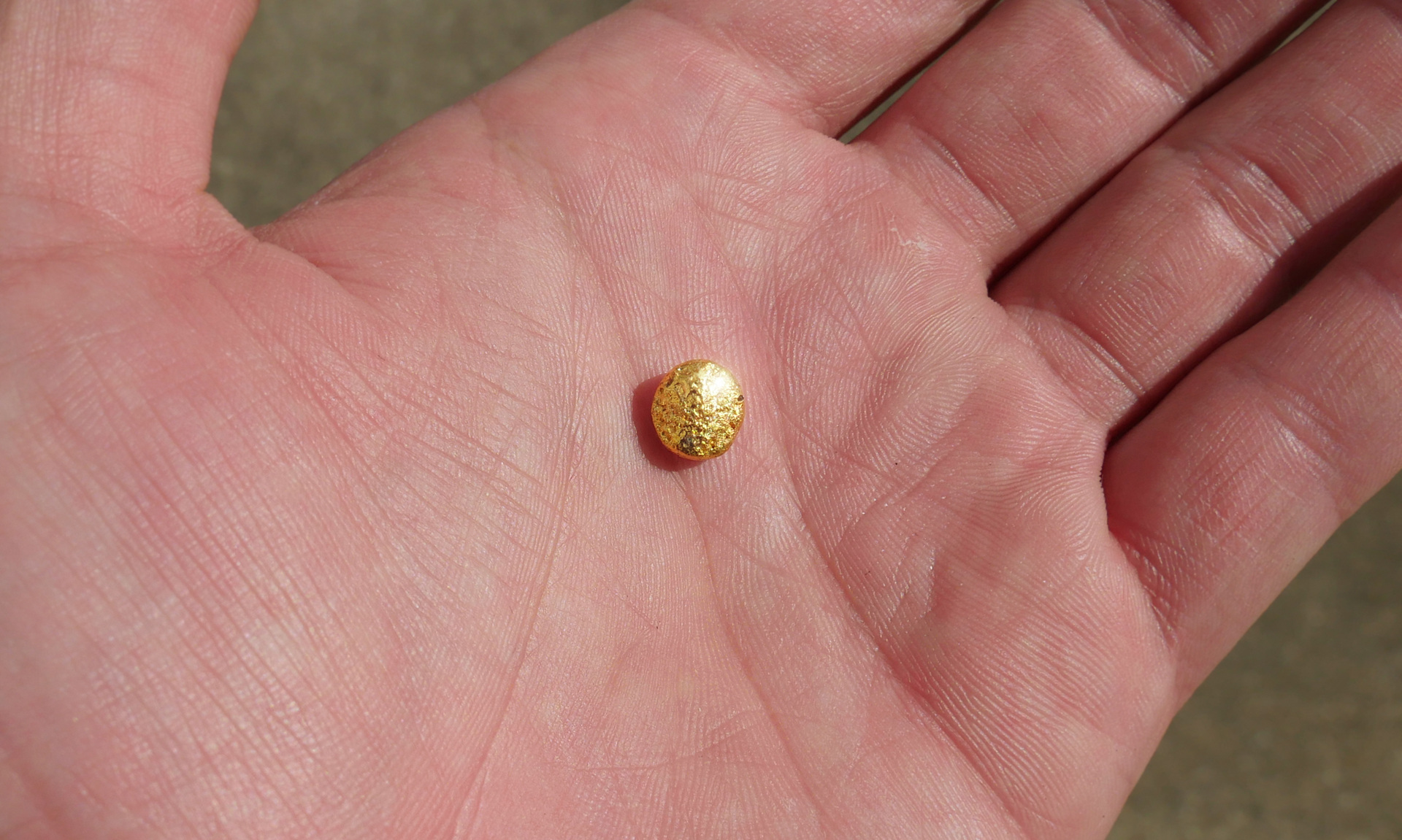
From this observation, the artist arrived at a new approach: since people inevitably perceive and use objects according to already familiar modes of recognition, he would preserve the external appearance of objects while altering their material composition. The baseball made of chicken meat emerged from precisely this intention. Lee Wan ground chicken meat, mixed it with liquid plastic, poured the substance into a Styrofoam mold, and allowed it to harden into the form of a baseball.
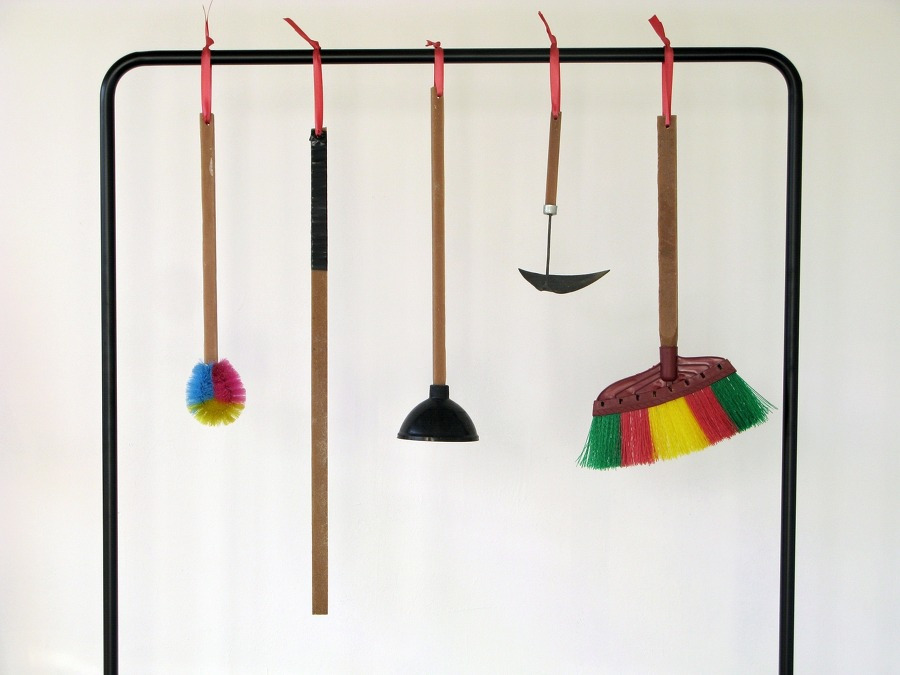
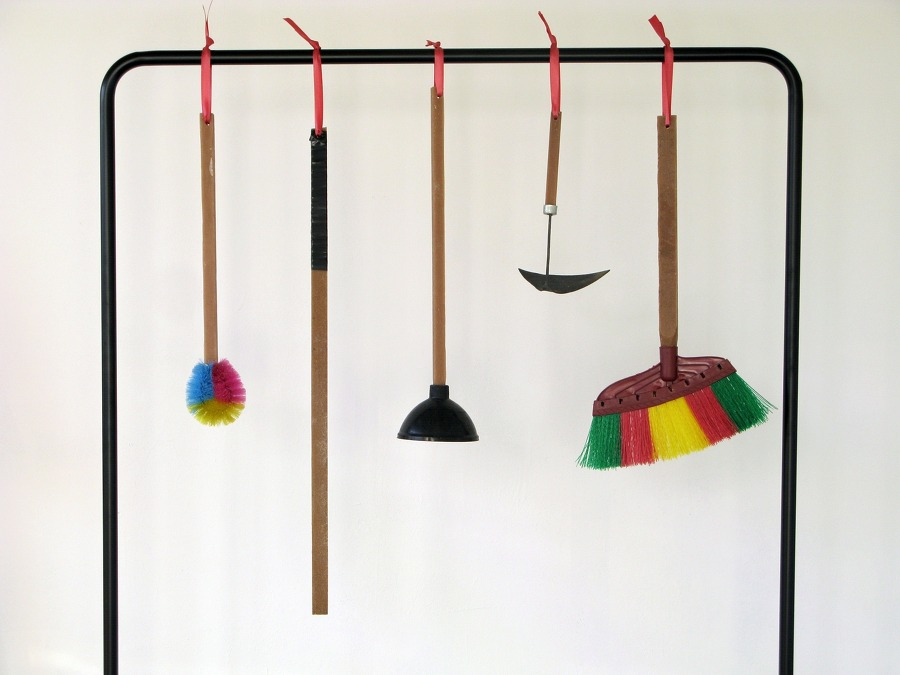
The series that followed consisted of plywood-like boards made from beef. Cutting these beef-based boards into different forms, the artist wrapped tape around some to create clubs, attached sharpened metal blades to others to produce sickles, and added brushes to others to form brooms.
Certain wooden fragments became crosses through the addition of other objects, while others were cut into circular forms and transformed into mirrors. By attaching different objects to beams made from mixtures of beef and plastic, Lee Wan generated entirely new systems of value.
Viewers encountering crosses or brooms immediately associate them with familiar concepts, yet once they discover that these objects were in fact constructed from ground beef, they experience a profound sense of shock. The artist recalls that some viewers, upon learning the true material composition of the works, expressed disgust and even left the exhibition space.
Through these reactions, Lee Wan sought to address the fact that people do not truly perceive the essence of objects themselves, but rather see and judge according to preexisting assumptions and fixed ideas.
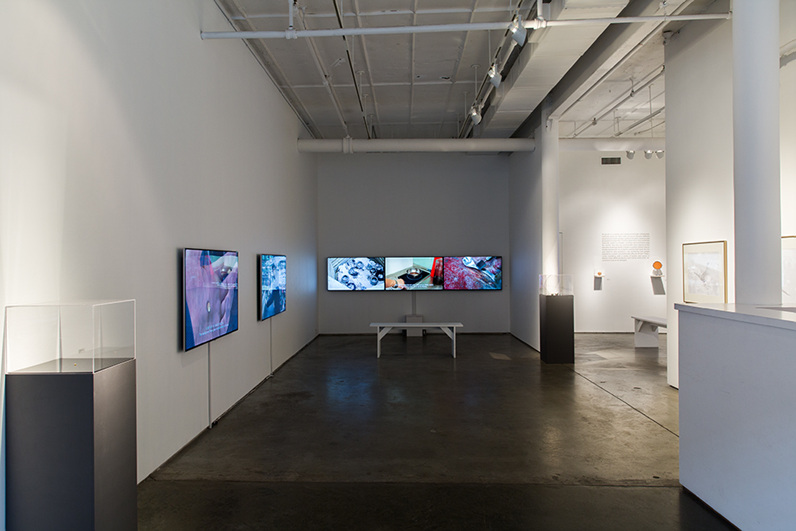
In his 2010 solo exhibition at Art Space Hue, Lee Wan presented works that reversed the logic of his earlier practice. Whereas previous works had produced different kinds of objects from the same material, these new works instead applied a single criterion to entirely different objects. If the earlier works revealed the gap between vision and reality in relatively direct ways, his practice after 2010 became increasingly conceptualized.
The criterion he imposed involved repeatedly sanding the surfaces of objects until they became smooth. Bronze mirrors from before the invention of modern mirrors, for example, were produced through the continual polishing of bronze surfaces. Other materials, however — such as bricks — could never achieve a mirror-like finish regardless of how much they were polished.
To Lee Wan, this method resembled a society in which identical standards and measurements are imposed upon countless individuals in order to determine success and failure. Feeling skeptical toward standardized criteria that encourage difference to be understood as error, the artist collected everyday objects such as desk legs, paving blocks, asphalt fragments, and shoe brushes, sanded portions of each object identically, and displayed them upon white tables.
The title of works such as Evidence of Irreversible Standards on Them was assembled from words the artist regarded as significant within the notes he produced while working.
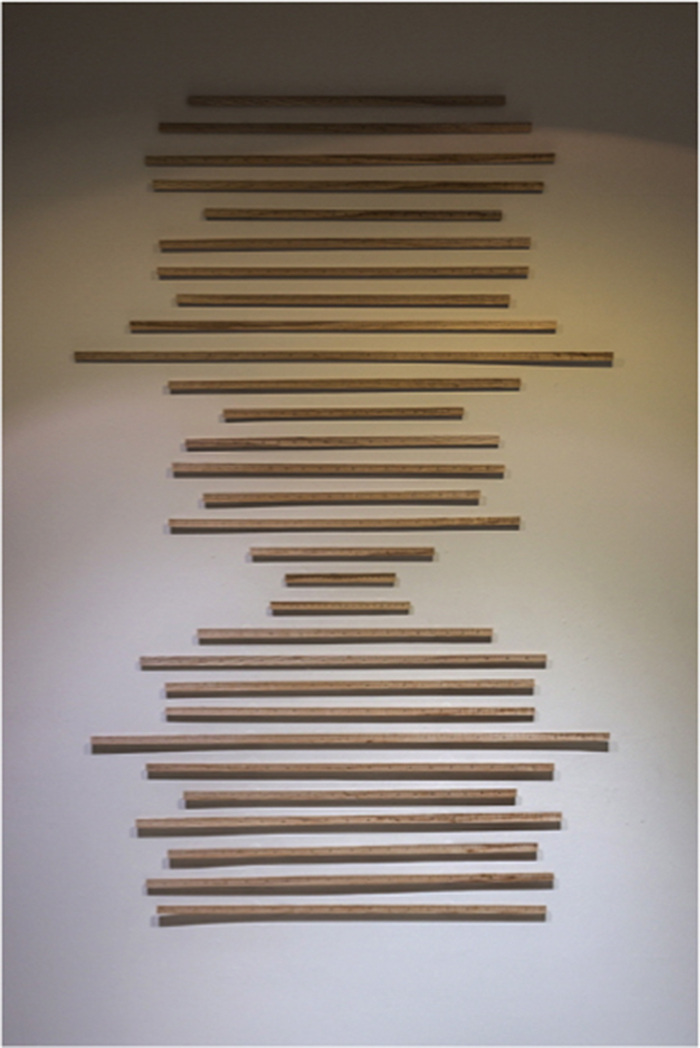
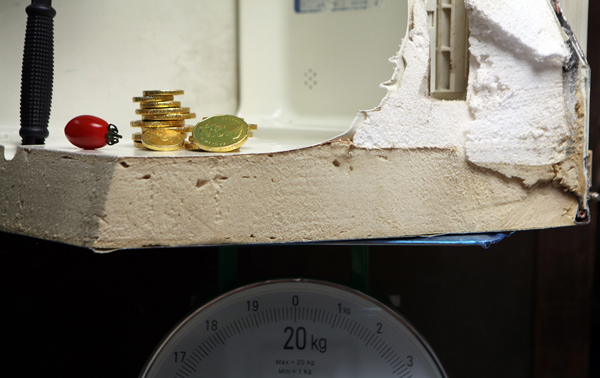
How to Become Us likewise applies a single criterion uniformly across multiple objects. Wanting to avoid selecting standards dependent upon particular ideologies or value systems, the artist instead chose the physical criterion of weight. In order to standardize objects according to what he considered the fairest and most objective measure possible, he first selected sixty everyday objects.
After weighing them all and calculating the average, the result came to exactly 5.06 kilograms. Certainly, the objects attain a stable and equalized condition according to the objective criterion of weight. Yet from the standpoint of the objects themselves, such a process might also be understood as an act of profound violence.
Stripped entirely of their original functions, cut apart and recombined, the sixty objects no longer retain any purpose beyond satisfying the imposed requirement of weight itself. The recomposed masses adjusted to 5.06 kilograms were not forms intentionally designed by the artist. And yet, despite being works created by a visual artist, they unexpectedly produce powerful visual effects precisely through this process.
Lee Wan is an artist who rapidly moves from one work to the next as new ideas emerge. Having lived through an era in which information technologies evolved rapidly — from pagers to CD phones, the internet, mobile phones, and now smartphones — artists of Lee Wan’s generation have inhabited a world defined by the accelerated circulation of information.
Lee Wan similarly maintains an openness toward new experiments and themes in his artistic practice. Some critics, however, argue that because the visual forms of his works continuously change and because he employs a wide range of media, his practice can appear insufficiently serious or lacking in consistency.
Yet the artist’s works are ultimately translations of the messages he seeks to convey into particular forms. Although the outward appearances of the works may differ dramatically, the conceptual concerns underlying them remain remarkably consistent — perhaps more so than in the practices of many other artists. And it is precisely this consistency that makes Lee Wan’s future work all the more compelling to anticipate.