Practicing Extended Gardening
#1. The biomes of Papua New Guinea are relatively isolated from
external predators and climate change, and therefore free from the usual
pressures of survival. The birds of paradise that live in these conditions
devise their own methods of seduction in order to mate. One of these birds, the
bowerbird, is known for bringing together all kinds of shiny objects in
garden-like shelters. Bowerbird males, which are polygamous by nature, do not
concern themselves with childcare. In addition, they build bowers, a type of
shelter traditionally made with sticks, more as a means to attract females than
as a nest, spending much of their time decorating it, except for the three
months when they molt. Male bowerbirds will collect different kinds of
color-specific materials or objects. Anything which has a certain color to it
or is shiny becomes potential nesting material. Among the things they collect
are leftovers, garbage, and plastic jewelry discarded by townspeople or left
behind by visitors. Another skill the bird has is the ability to mimic the
sounds of its environment—they can copy
the sounds of other animals and even machines.
#2. Carl Ferris Miller, who was born in the United States in 1921,
was assigned to Okinawa, Japan as an interpreter officer in April 1945, and
came to Korea as a naval intelligence officer with the Allied forces in 1946.
He took a job at the Bank of Korea in 1953 and was naturalized in 1979, taking
the Korean name Min Byung-gal. Over the course of his lifetime, Miller studied
Korean plants and created an arboretum. He lived much of his life alone,
cultivating his arboretum in Cheollipo, before dying in 2002. He promoted the
environment and plants of Korea through seed exchange programs with overseas
societies, and as early as 1978, he discovered a new plant that was the result
of a natural hybridization of the holly tree and Horned Holly. The plant,
which grows only on Wando Island in Korea, was recognized as a rare species and
named “Wando holly.” It was
later registered as Ilex x Wandoensis C. F. Miller & M. Kim with
an international botanical society. Today, the Cheollipo Arboretum he left
behind opened to the public in stages, starting in 2009.
Today, although their intentions may be different, we may be able
to begin discussing Kang Seung Lee’s work by overlapping the bowerbird’s
behavior and doing three things: explaining the behavior of the male bowerbird
as a decorative act that defies uselessness, even if it is not practical;
making the assumption that it is a courtship gesture, but not solely for the
purpose of mating; and imagining the function of this behavior as a way to
gather or alert other birds by mimicking the sounds of the environment. The
bowers in Papua New Guinea, often referred to as “gardens,” are the result of the collection and arrangement of surrounding
objects, thus becoming part of the landscape. As a result, if we turn our
attention to the life of Min Byung-gal, we can also consider migrating to and
settling down in a foreign country, thereby revealing the invisible to the
outside world and consequently expanding connections with the outside world.
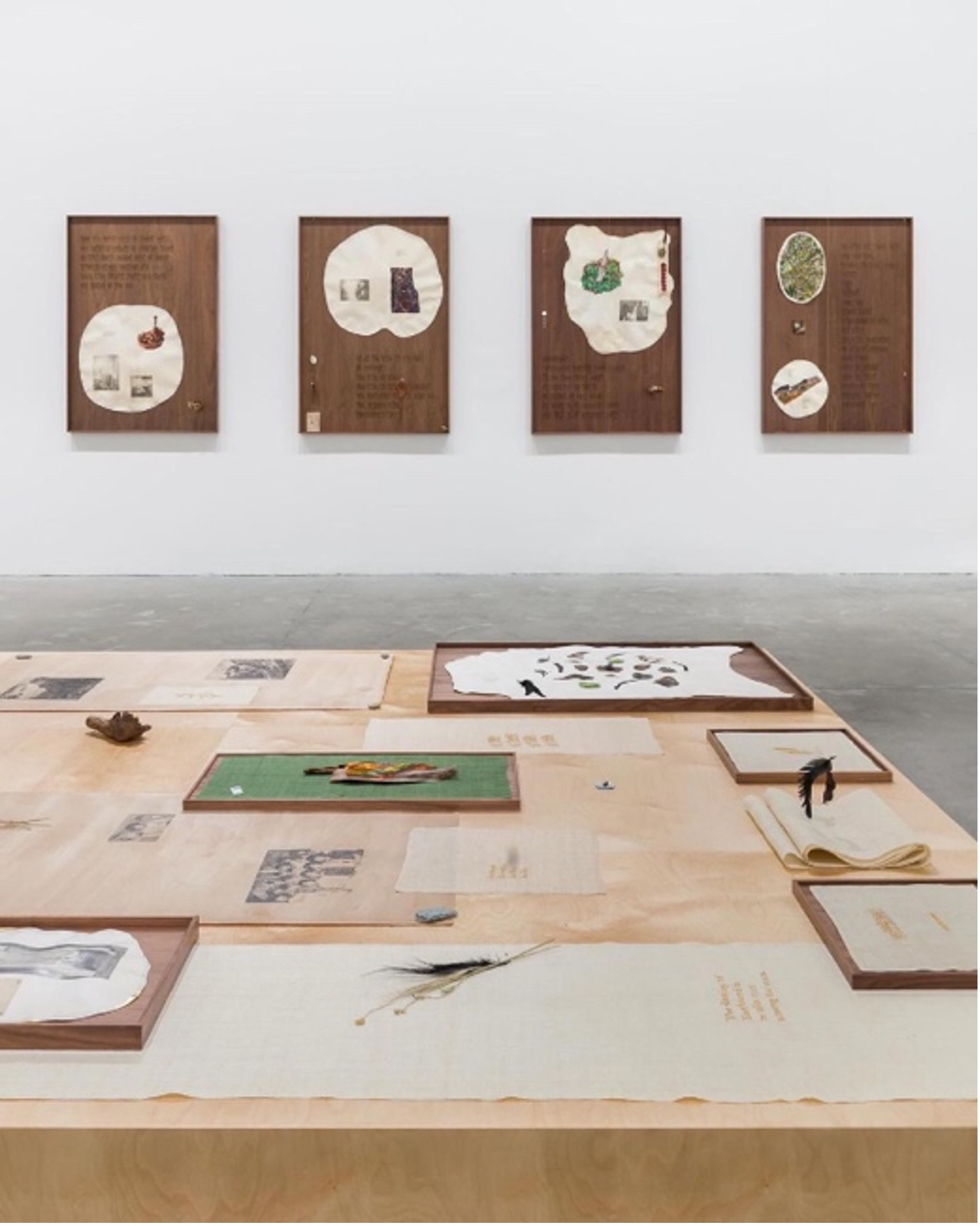
Kang Seung Lee, who is now based in the United States, used the
concept of a “garden” as the theme of his first solo exhibition in Korea in November
2018. Held at ONE AND J Gallery, Garden showed a place and loss—somewhere to remember loss—with the activity
of gardening used to visualize a place for memory and mourning. In other words,
the exhibition showed forms of art though gardening. Taking soil from Tapgol
Park (formerly referred to as Pagoda Park) and Namsan Mountain, as well as Prospect
Cottage in England, and then burying it in a “place
beyond,” the artist stages a burial ritual, while also
carefully utilizing small objects in the process.
Tapgol Park and Namsan Mountain, both located in Seoul, are places
where gay and transgender people used to cruise in the past—and today where they still gather at night—and
have always harbored the shadows of physical contacts and encounters that have
not been officially recorded. Like unnamed sand and weeds, these people have
long been uncounted or rejected, and often portrayed as perverts who occupy
sparsely populated urban spaces, as well as disorderly boundary-crossers who
are vulnerable to crackdowns and public scrutiny. Moreover, the spaces they
occupy are often referred to as slums and remain in need of maintenance and
development.
For Garden, the artist calls on Joon-soo Oh, a longtime
member of the Korean gay men’s human rights
group Chingusai, which has been active in the inner city of Seoul for thirty
years. At the same time, Lee connects to the garden of British queer filmmaker
Derek Jarman. Surrounding a cottage on a barren plot of land in Dungeness,
Kent, southern England, Jarman arranged waste materials from the beach and
planted grasses and flowers native to the coast. With no fences and not a
single tree taller than an adult, the space is still visited by people. Today,
it is an empty area in a public space, a dark site where people meet with a
collection of trash and native plants from the area, and a garden where
anything can find its way in, even during times of constant management because
there is no fence there. Lee’s work of bridging the gap
between Joon-soo Oh and Derek Jarman invites anonymous members of the public to
take part in the garden, those who might otherwise be wandering around a public
space and waiting for someone, and welcomes the uninvited by overlapping
private land touched by an individual on top of a public space. This can also
be approached as an attempt to intervene in the order of the plaza by making
those who have not been publicly recorded in the city’s
history appear in the public space, demanding a share of the citizenry in the
process.
The act of burying things, which takes place in both
locations, intertwines pairs of differences, whether they are places
and times, lives and life circumstances, public and private lives, or
memories of the two men who are bound together by similar sexual
orientation and illness. The two unrelated men, Oh and Jarman, shared a common
life as homosexuals who died of HIV/AIDS in 1998 and 1994, respectively. Even
now, HIV/AIDS, a global epidemic that was often stigmatized as a “gay cancer” in the past, evokes images of
mourning and funerals over the garden here in England. A kind of patchwork that
connects the Korean park which functioned as a nighttime ghetto with the garden
of someone who would have wandered through a park also extends to the actual
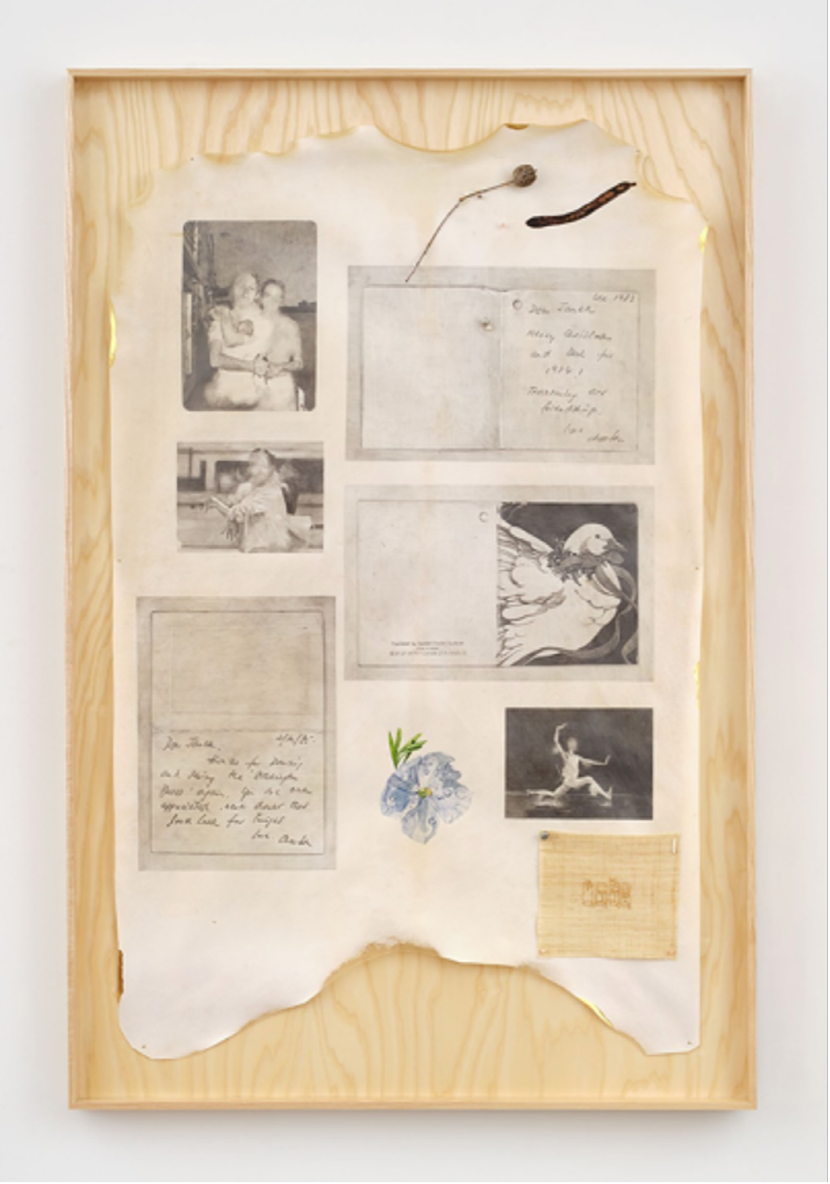
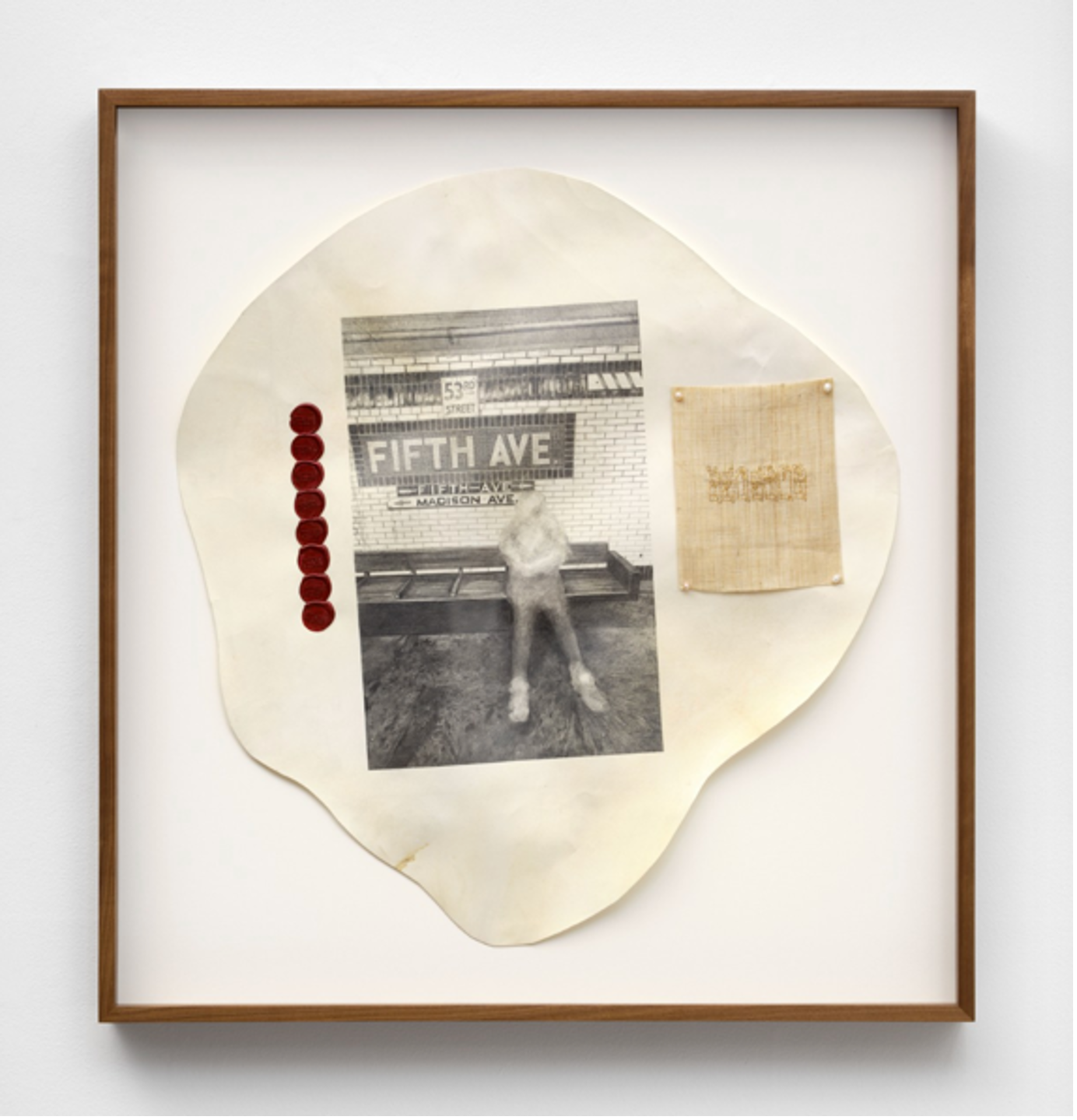
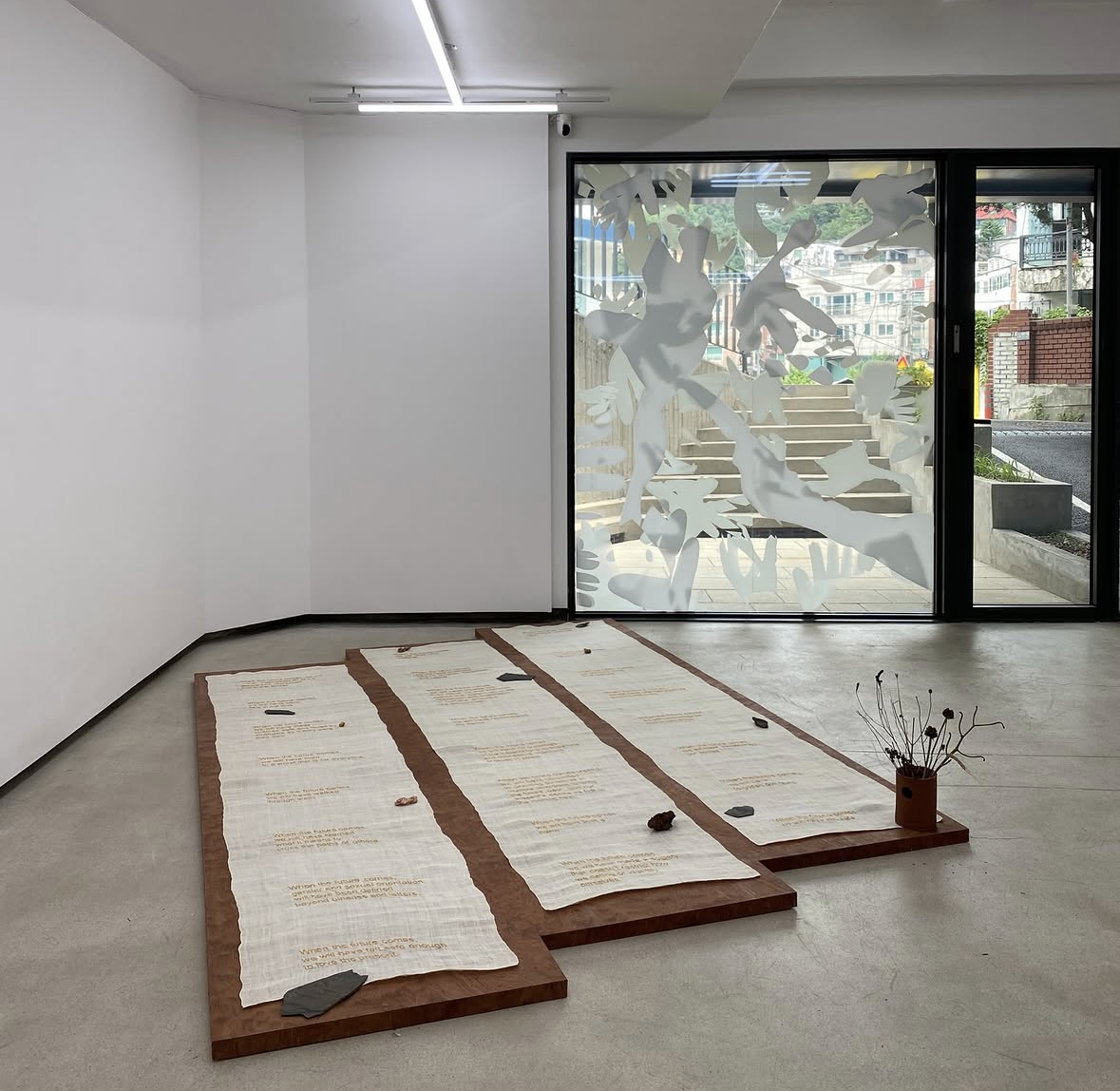
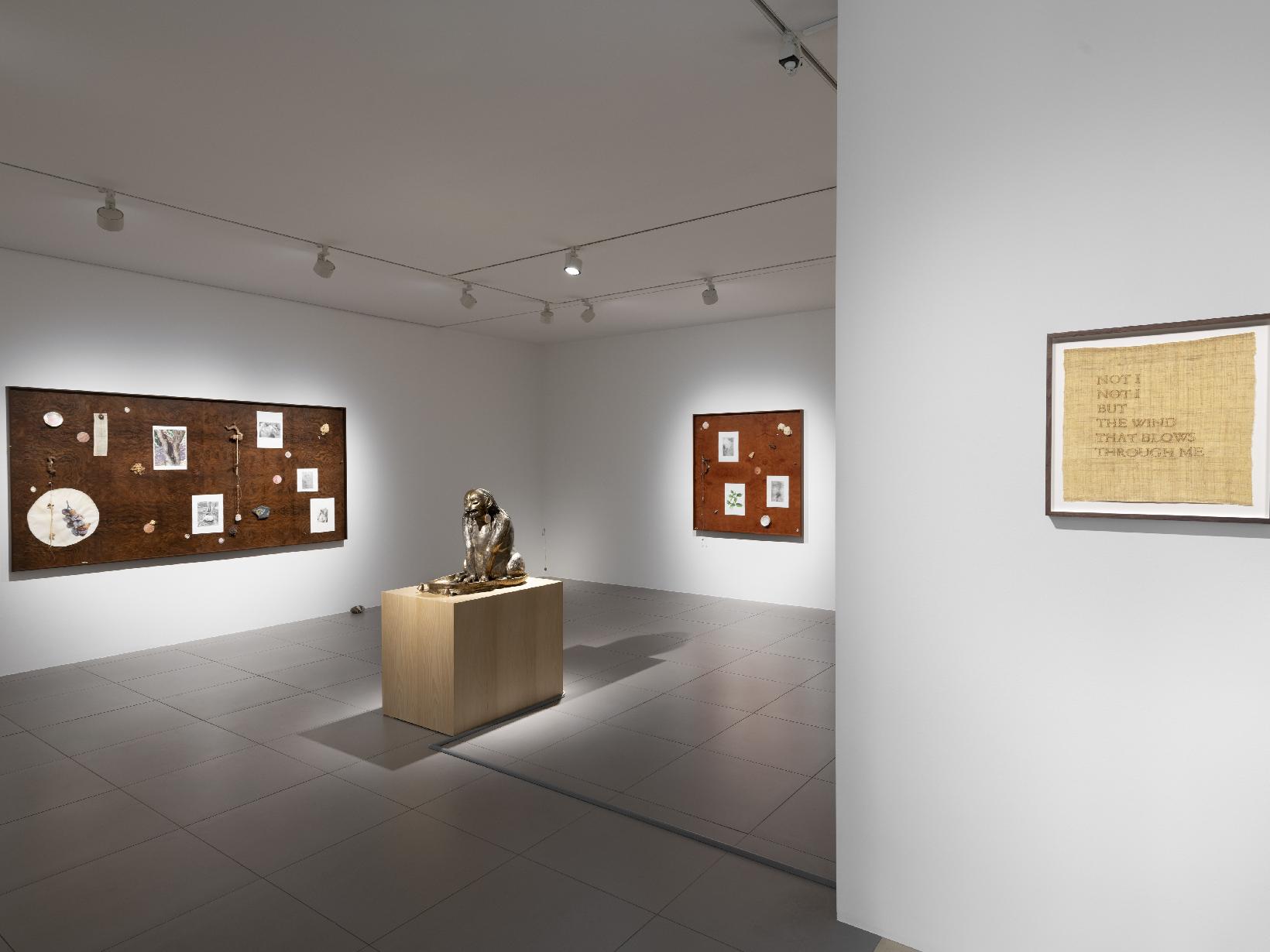
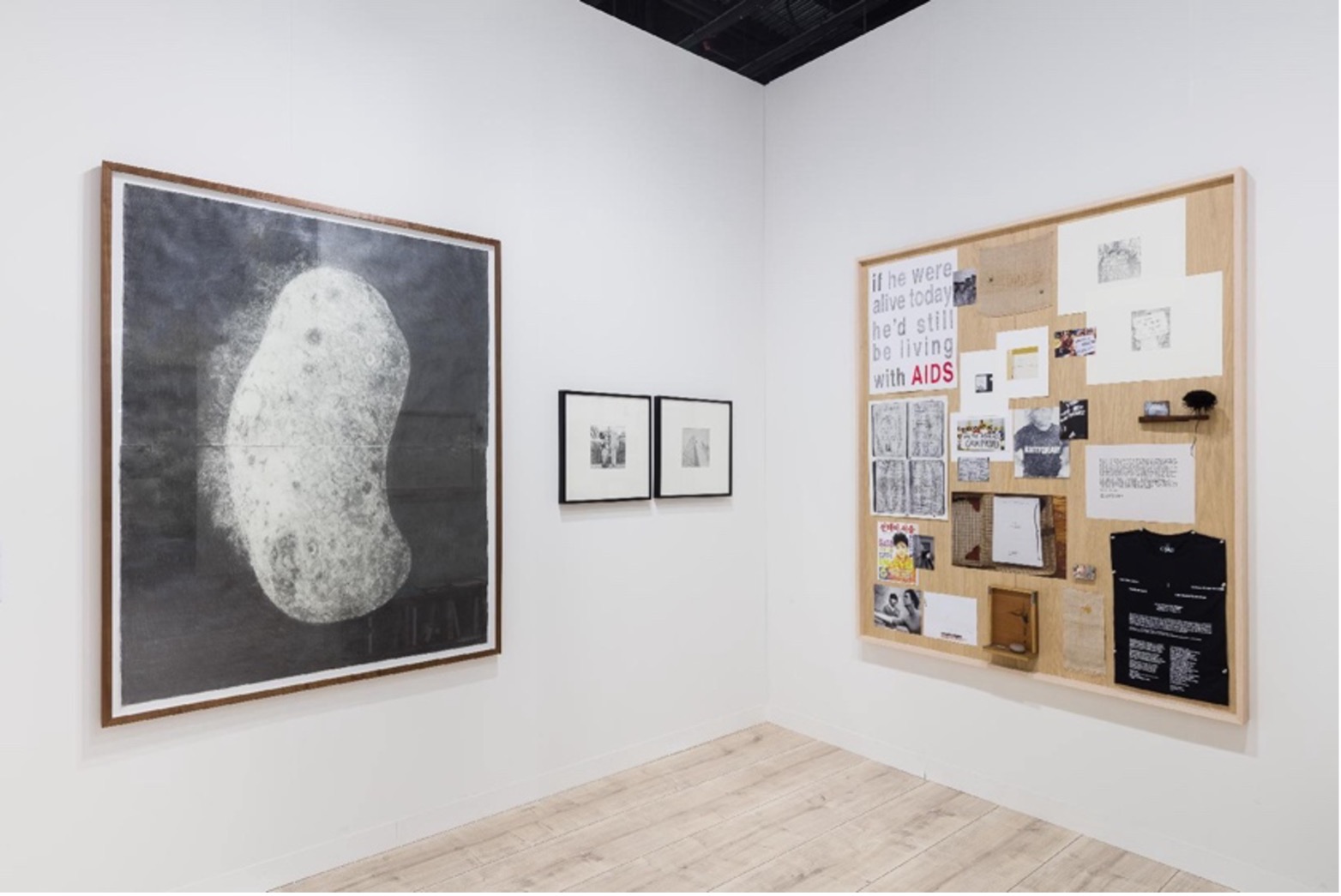
stitching of the artwork. The artist embroiders hemp cloth with gold thread,
the objects he embroiders being either shapes designed from excerpts of texts
from his research or images of small objects. On top of the ritualistic
documentation of burying materials collected from one place in the other place,
the method of using handicraft-based labor to add the meaning of mourning to
the artwork is reminiscent of a work for which quilting—a traditional craft still practiced by some North American families—was used to preserve the records and faces of the deceased in fabric
throughout North America and elsewhere during the HIV/AIDS crisis, while
simultaneously recalling the shrouds that cover the body.
The work of interconnecting not only what is remembered but also
how it is remembered shows that the semantics behind gardening as an art form
is extended beyond the simple act of planting flowers and trees. Gardens are
somewhat conservative in that they involve the selection and placement of
plants in a fenced-in space and the creation and maintenance of artificial
landscapes. Crucially, however, gardens cannot help embracing changes, such as
decaying and renewing themselves. Unexpected animals arrive to nest or trample
on the grass. Sometimes seeds fly in from outside the boundaries and weeds
grow. The landscape changes with the weather and the seasons. The act of
gardening utilizes even these changes as elements of creation and appreciation.
Kang Seung Lee shows exquisite skill in expanding the formats of gardening
while making the gardening methodology compatible with a white cube, library,
and museum. At the point where gardener and artist become one and the same—yet diverge as art—Lee manages to reference
Derek Jarman’s gardening practice of collecting useless
materials, though in the place of uselessness, he superimposes the strands of
ethnographic history. He then follows the sparse traces of history, devises a
methodology to reveal them, and intervenes in the linear order of time and
space. In such a way, the artist’s experience of
migrating from Korea to the United States may have served as the background and
motivation for sculpting the unilluminated from the uneven histories of race
and gender to bring them into contact with someone else in a different space
and time to create a synergistic sensibility.
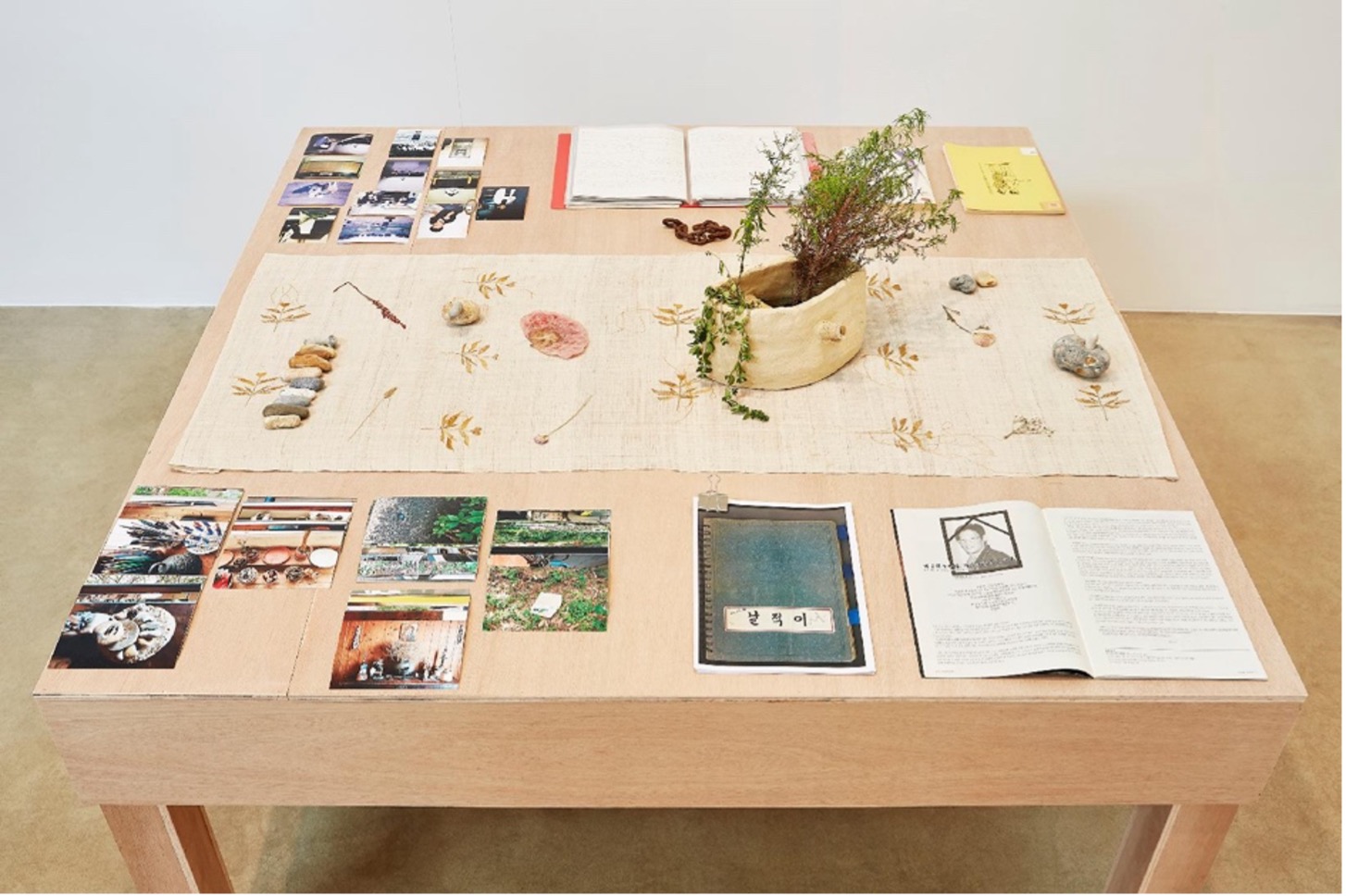
The sensory labor in a garden presents a formal extension of
artistic creation followed by curatorial practice. The artist arranges
reference materials, drawings, and objects in the exhibition space, connecting
and reorganizing their own narratives and subject matters. The connections are
not made at random, but use specific keywords as quilting points. Images of
HIV/AIDS, queerness, missing histories, and shame are private, and they lead to
an attempt to intervene in the previously natural order of the white cube with
faces and names that were only treated as private and have never been
publicized. What is noteworthy is that the act of collecting and arranging
images of fragments and parts of people’s lives confesses not only forgotten memories but also attempts to
remember them as inevitably fragile. The act of searching for traces of
memories leaves the existence of a void, while connecting partial sentences,
images, and fragmentary objects, rather than recreating them with the intention
of fully restoring memories. Although the arrangement is incomplete and fluid,
it holds the possibility that various meanings can be discovered from it. By
collaging drawings and installations, the artist invites viewers to come and
make the effort to connect and rediscover the meaning of each. This leaves
clues—about the bowerbird, the life of Min Byung-gal,
and the Mnemosyne Atlas methodology—that can be
aesthetically appropriated with gardening as a link. Thus, while strongly
connecting the physiology of the bowerbird and the life of Min Byung-gal, both
of which inspire critical interpretations of gardening as an extended field of
art, Kang Seung Lee directly recalls Derek Jarman, who spent his later years
tending to Prospect Cottage in Dungeness. Furthermore, Lee even alludes to the
Mnemosyne Atlas methodology that Avi Warburg used to construct art history,
weaving together disciplines and histories regardless of source or material
much earlier than that. Ultimately, the incompletely recorded materials of
these precarious people lead to a present-day practice that connects at the
artist’s fingertips the vulnerable aspects of memories
that history has overlooked.
Expanding Connections by Starting from Imperfections
The conceptual meaning of a garden—which requires researching the space and its surroundings, and
constantly managing and refining all of it—is both a
motivation and a reason for summoning the places of those who have always been
consumed with an image of shame only. The attempt to connect gardening as a
methodology of artistic work opens up the possibility of expanding the
interpretation of gardening as well as its skill in the curation of art spaces.
In the exhibition QueerArch, held at the gallery Hapjungjigu
in October 2019, the attempt to grope for disturbing faces in the media and
unremembered communities became more serious. Here, Lee was not only an artist
but also a curator and exhibition director. As he organized an exhibition that
connected “queer” with “history” as
the main keywords, he called on artists and colleagues from all walks of life.
(To be more precise, in Lee’s own mind, these people
became immediate colleagues of his by being called upon to work together.) If
the faces in the drawings are objects of mourning and memory, fellow artists
and activists remember and honor them based on the drawings and give them
contemporary meaning.
It was at QueerArch that Lee’s curatorial practice really came into its own. In the 2019
exhibition at Hapjeongjigu, he invited artists to participate in the act of
collecting and arranging, and encouraged them to create artworks based on a
public archive named the Korea Queer Archive. Fashion designer Kim Se Hyung
(a.k.a. AJO), archivist and researcher Ruin, artist and stage performer Moon
Sang Hoon, drag performer Azangman, visual designer Kyungmin Lee, and sculptor
Haneyl Choi were invited as Lee’s colleagues to
participate in the exhibition and present queer histories, as well as to
present queer collecting and archiving practices related to queer histories.
Although it falls under the category of art curation, the attempt to gather
fellow queer artists, give them a mission based on Korean queer history, and
exhibit their proposed works also had the effect of creating a temporary sense
of community. The participants researched the reference materials and recreated
formats that reflected their own context. This, of course, was based on thirty
years of LGBTQ+ activism, which had continued to demand a place in the public
realm for LGBTQ+ people who had historically been forced to live in
marginalized environments. It is worth remembering that while the previous
Garden exhibition was made possible with the help of Chingusai, a Korean gay
men’s human rights group that Joon-soo Oh was an active
part of, QueerArch was able to take their materials out into the open and
display them or utilize them as material for the exhibition through a
collaboration with the Korea Queer Archive. Conversely, collecting materials by
tracking a community, and coming up with devices to preserve them, can actually
contribute to the community. Therefore, the inclusion of collaborating artists
in the exhibition credits is a reminder that Lee’s
exhibition cannot remain a personal achievement and narrative. The work of
organizing the exhibition by making connections inside and outside of art
allows us to perceive a queer community that has once again responded to a
crisis, that is, the contour of a queer community in which members sought each
other out in order not to be isolated in a crisis, and that sought safety and a
new tomorrow through a crisis.
Furthermore, Briefly Gorgeous, an exhibition held at Gallery
Hyundai in 2021, shows how archival practices should respond to a situation
where the past cannot be fully summoned and the present is in crisis. In the
shadow of social disasters, including the outbreak of epidemics, everyday
social inequality and discrimination are magnified. Vulnerable places and
groups are targeted and attacked, and those who are not counted as citizens are
not included in those to be protected through the prevention of disasters. The
garden work of uprooting diseased branches and species is carried out in the
world as discipline, confinement, targeting, and stigmatization in a
life-or-death environment. In the midst of any pandemic, confused authorities
and the media take pointless ad hoc measures, while being quick to target
specific groups, accusing them of spreading a contagion through their senseless
disregard for taking any precautionary steps. Yet the people they target are
often the most vulnerable and in desperate need of community. In 2020,
migrants, delivery workers, and gay men in clubs were vilified with spreading
COVID-19. Early the following year, a series of transgender suicides made news
in Korea.
The disaster of a disease-ridden epidemic is nothing new. For the
2021 exhibition, Lee thought back to Asian artists among the artists who died
or survived the HIV/AIDS crisis, including photographer Tseng Kwong Chi, who
was born in Hong Kong and died in New York in 1990, and Goh Choo San, a
Singaporean choreographer and ballet dancer who brought fame to the Washington
Ballet in the 1980s. In addition, he juxtaposed drawings of the late Kim
Ki-hong, a South Korean transgender activist and music teacher, and the late
Sergeant Byun Hee-soo, who was forcibly discharged from the Korean Army after
undergoing gender reassignment surgery, both of whom died in early 2021. His
process of shedding new light on them is often described as an attempt to
challenge not only heteronormativity but also white-oriented queer histories.
Recently, he seeks to sculpt forms of connection by extending his artistic
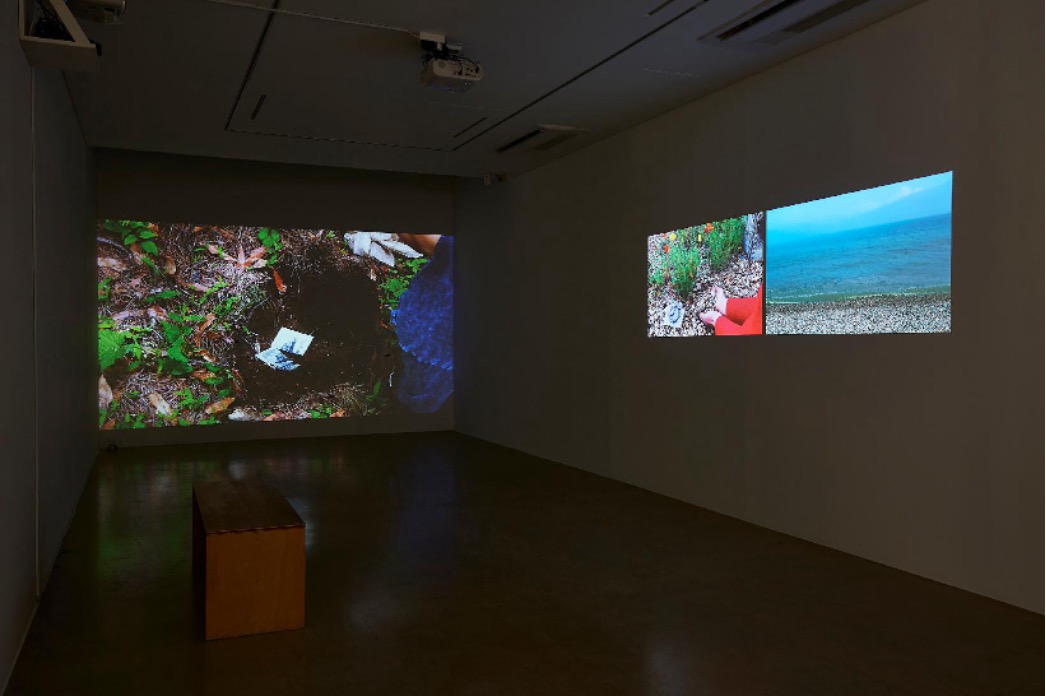
attempt to ever-present contemporary crises. Photographs and video footage,
ceramics and canvas paintings, notes and doodles, flowers and grasses, and maps
all showed a careful arrangement of fragmentary images, texts, and objects,
rather than being something definitive or monumental. The reconstructions,
which reference patchworks and mosaics, integrate past and present times—those who stood or fell in different regions and contexts, and
contemporary perceptions and sensory elements—while
maintaining a particular sense of place. Together with El Salvadoran writer
Beatriz Cortez, the artist asked his colleagues what a “queer future” would look like, and then
asked them to complete their sentences in the future tense: “When the future comes, I will…” Those
sentences would have been a collective mantra that gathered the longings of
individuals dreaming of an ideal future instead of the status quo based on the
faded records of those who had not been counted in the trajectory of history
and on the desire of the person seeking to find those hard-to-find records.
In the basement of the exhibition hall, the logo of Itaewon’s King Club, a nightclub that was targeted during the COVID-19
spread in Korea, set up as an assembled puzzle-like object, with music
playlists from fellow artists played in a club-lit space. While the lights, a
mirror ball, and objects unfolded to the music in the basement, archival
materials were placed on the first floor, while the second-floor walls were
covered with hand-drawn faces. The exhibition was organized so that visitors
could explore the underground club, the archive on the first floor, and the
specific faces and traces of one’s life on the second
floor. This came about as a result of observing queer spaces in Korea and
reorganizing the flow of their functions in the building structure of the
museum. An example of memories and a sense of community being embodied in a
specific space seemed to have been organized in a more community-oriented form
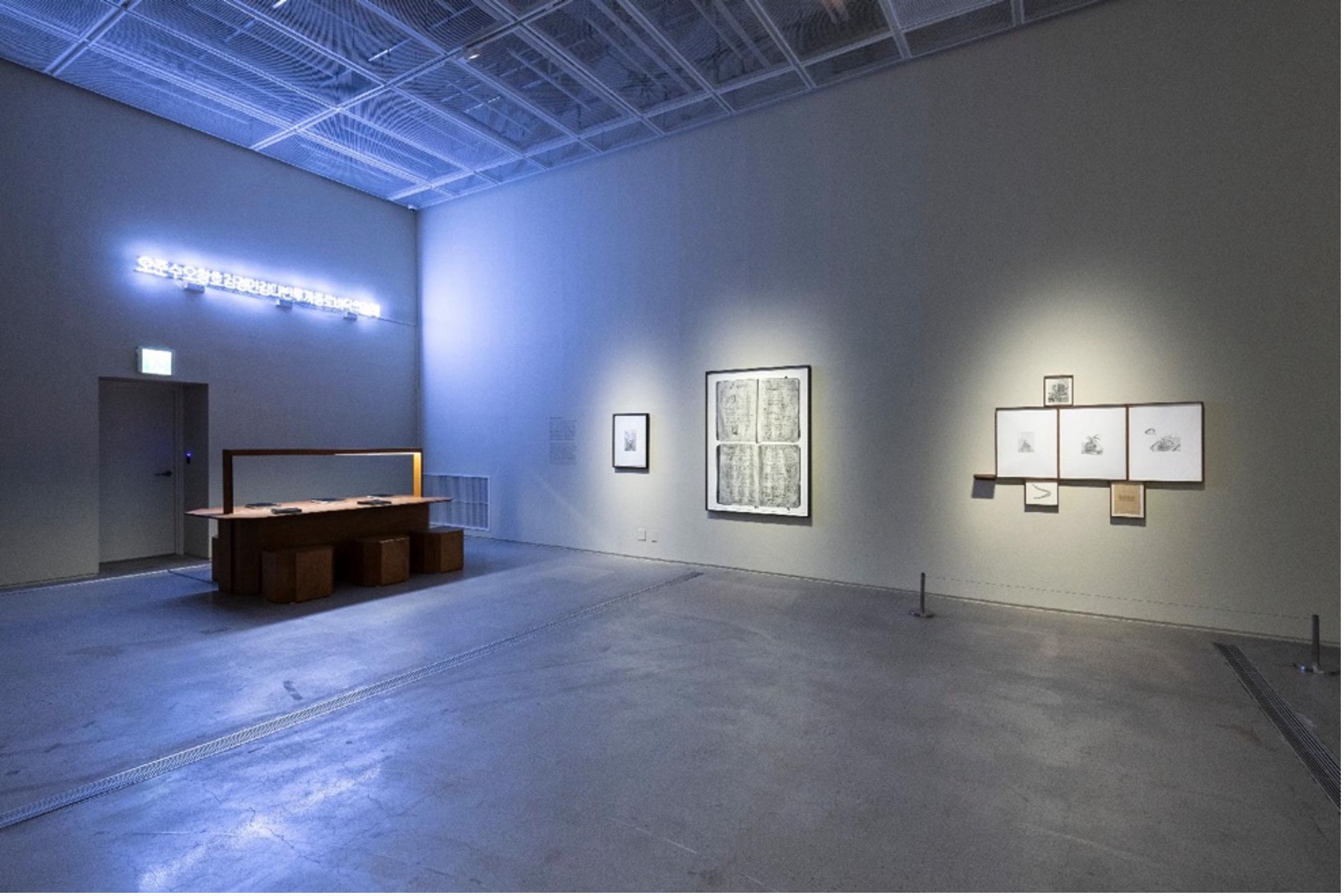
than in the special exhibition Looking for Another Family (2020), which was
held at the MMCA Seoul a year earlier than Briefly Gorgeous. For the 2020
special exhibition, Kang Seung Lee created a lounge-like reading space. The
books selected by literary critic Hyejin Oh, while wary of being treated (as
described by Oh at the time) as “a synecdoche of a
certain purposive intellectual history or a fetishized object of queer
heterotopia” or “an obsession
with the queer,” constituted an arbitrary and fluid
network, revealing that this exhibition space also has the meaning of a
temporary occupation. However, unlike Lee’s intention,
the open space became the hub of the exhibition, giving the impression of
connecting the works by other artists around it. The viewers wandered around,
thumbing through materials and looking at videos and drawings. The arranged
shelves and furniture functioned as partly closed partitions and, at the same
time, fences that blurred the boundaries between the two—and yet also connecting the two. In and around them, Lee displayed a
collection of queer-specific content and images. The nature of the site, where
a community’s private history and archives are knotted
together in a public space, was reminiscent of the ghettoized nature of a
certain group (such as queer people, for example), but also of the design of
urban spaces that connect in all directions.
However, the work at the special exhibition may have left a
different impression on visitors than Lee’s Covers (QueerArch) (2019/2020), in which he collected
the covers of publications covering queer-related papers, magazines, and books,
made them into scrapbooks and wallpaper, and pasted them all over the
exhibition space. The work, which seemed to encompass everything at once, gave
the impression of overwhelming the space by spreading
vertically and horizontally the recorded materials and research of
those who have somehow created their own language and grammar despite being
placed in a peripheral position within the existing market and system. Indeed,
it created the effect of a quantitative spectacle, while also relying on an
archive that spans the keyword and framework of “queer.” Although this is not like the direction of Oh’s notes from the earlier book selection, we need to keep in mind
that this is another limitation of the work: it simply cannot be
all-encompassing. Lee’s work, which is incomplete and
promises to be endlessly continued, focuses on admitting that nothing can be
fully collected and given meaning, and not on uphold an exclusive identity by
giving meaning to everything. Thus, a methodology that is close to a
collectomania emerges as one of selection and editing when it comes to
exhibition curatorial practices, including archival spaces. In this case, the
markers of whose point of view or criteria have been applied complement each
other by inserting collective opinions into empty spaces and by embracing ways
to secure and organize a space where we can examine those opinions one by one.
The imperfection of memories and conservation are the inevitable limitations of
any community and the basis of all connection.
Disturbing Memories and a Tangled Future
Lee overlaps the records of public and private lives, featuring
past figures and surviving subjects—as well as the memories of life and death—all
in one exhibition space. The artist juxtaposes subject matters with different “grammar” (i.e., ways of interpreting things
or people) and value, while also reinterpreting discovered reference materials
and proposing new “grammar”
rules. This artistic practice follows the unfair context in which the lives of
others are obscured, and reveals those people who have been filtered through
this unfairness.
However, the virtue of being revealed also becomes a concern for
exposure. This is because the lives and faces introduced in art spaces can be
easily bleached as objects of representation and aesthetic representation. We
may suspect one thing here: The traces of people’s lives that the artist has drawn from—the
representations that failed to be remembered earlier—may
serve to remember and introduce the times and faces he tried to draw from while
only giving them meaning as the lives of the Others. Or, on the contrary,
does the work of targeting the Others not easily leave behind an attitude of
respect and consideration? In other words, the attitude of respect for
vulnerable records and objects secures the virtue of giving public meaning to
the memories, people, and materials that the artist has unearthed by presenting
them in the exhibition hall. On the other hand, there is also a concern that he
may inadvertently capture someone as the Other. This concern acts as a
reason for doing nothing more than intervening in the targeted beings and
renewing their time in the form of art. In other words, there is an essential
dilemma in dealing with the Other: the revealer and the revealed are not placed
in equal positions. When other people’s bodies, their
sensory representations and records, and their lives and histories are placed
in the forgotten and obscured realm, they are once again framed as
the Other that should be discovered and named.
One-sided referencing & representation, and the attitude of respect and
consideration seem to be contradictory, but they are common in that they
separate the subject from the Other without doubt. Therefore, the position of
the Other as an archival object once again summons the status of the subject
who collects, edits, reconstructs, and uploads it to the art space. Although
the two kinds of attitudes may reflect on themselves, do they not inevitably
uphold the position of the artist as a reflective subject who reveals and
rearranges subject matters that remain hidden? What kind of destructive force
can this subject secure? In addition, how can the lives and bodies that appear
at the invitation of the artist go beyond restoring honor from the past shame
and continue with their disturbing values and desires?
Before answering those questions directly, let us shift or
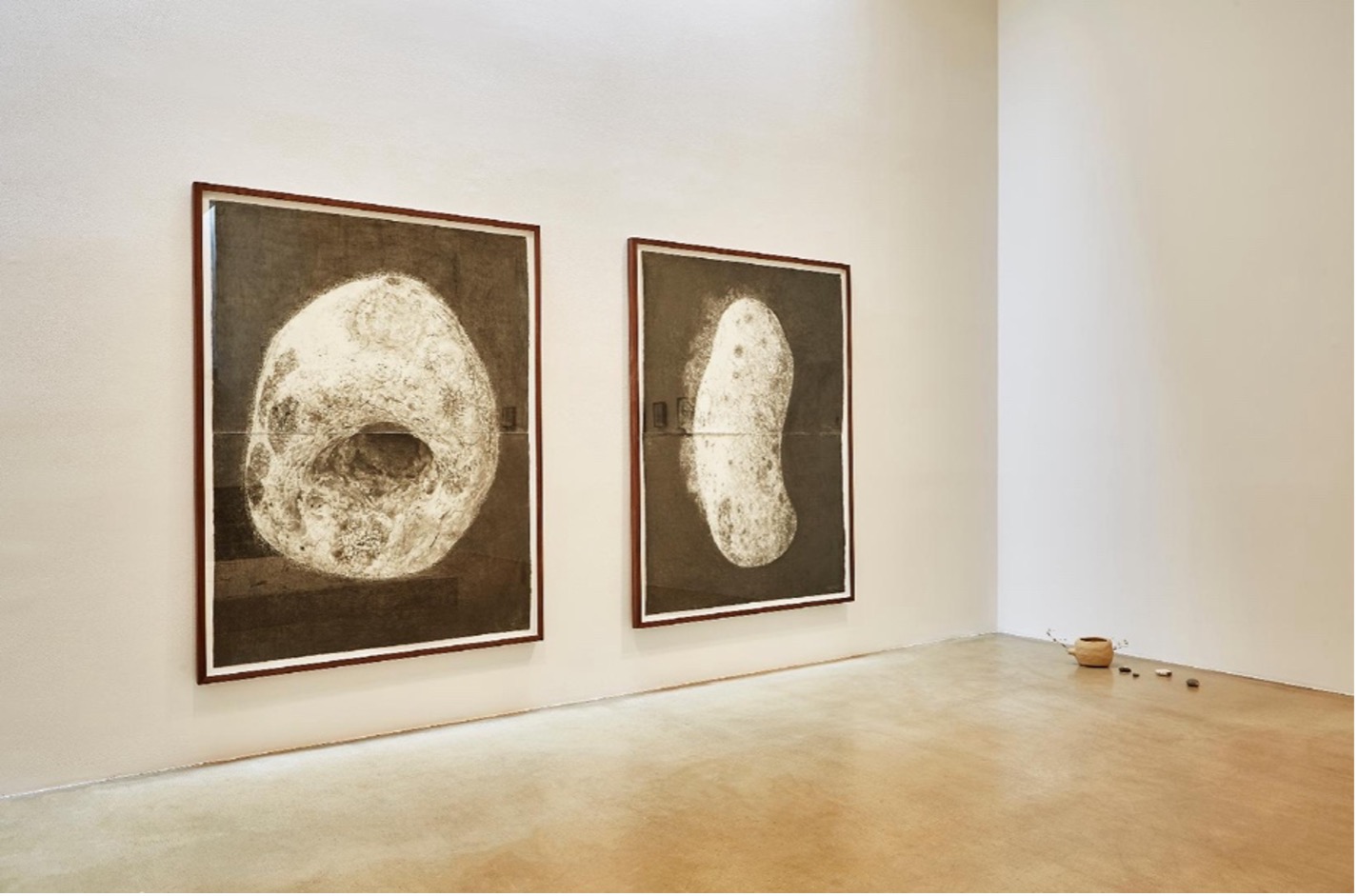
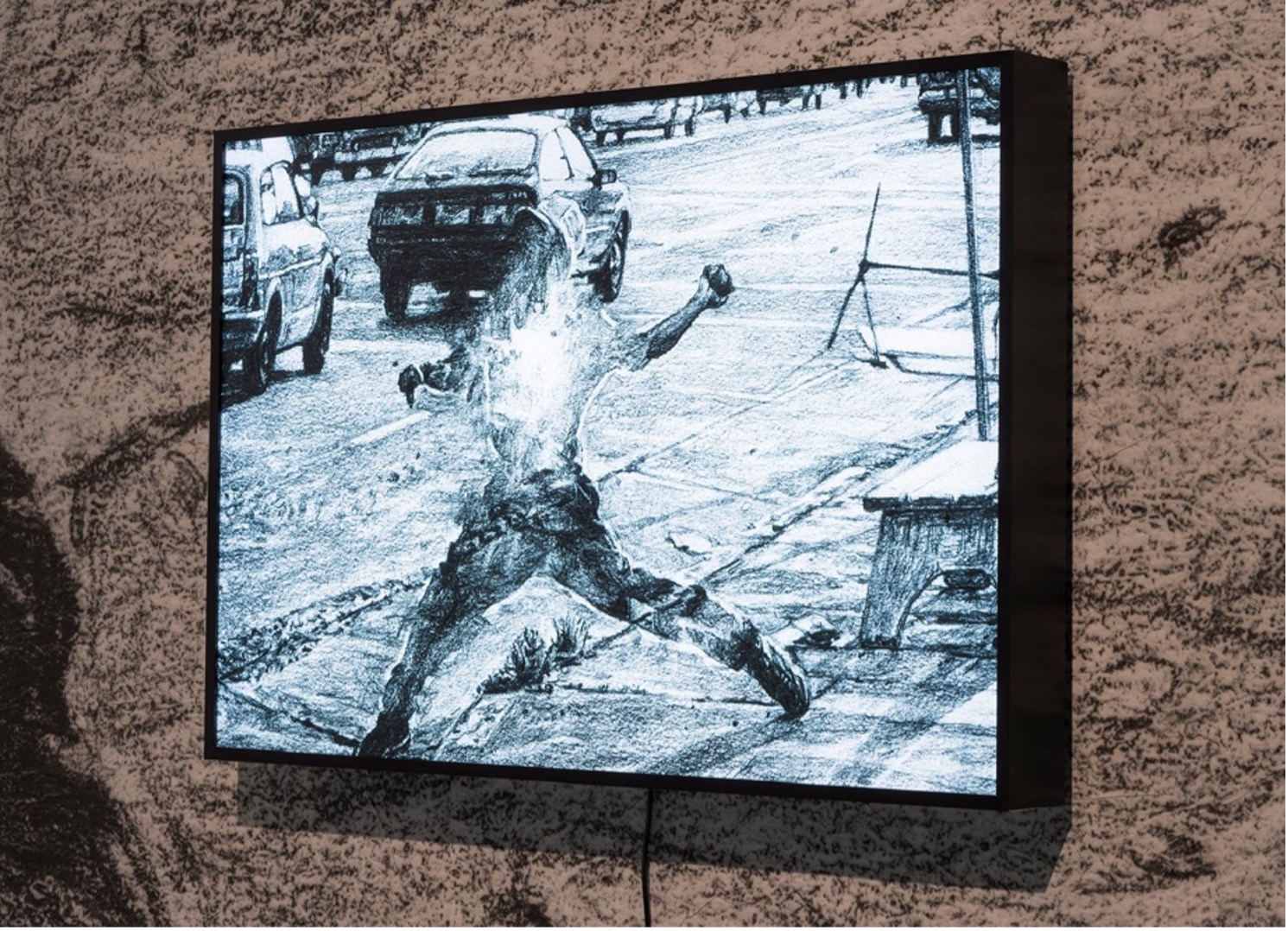
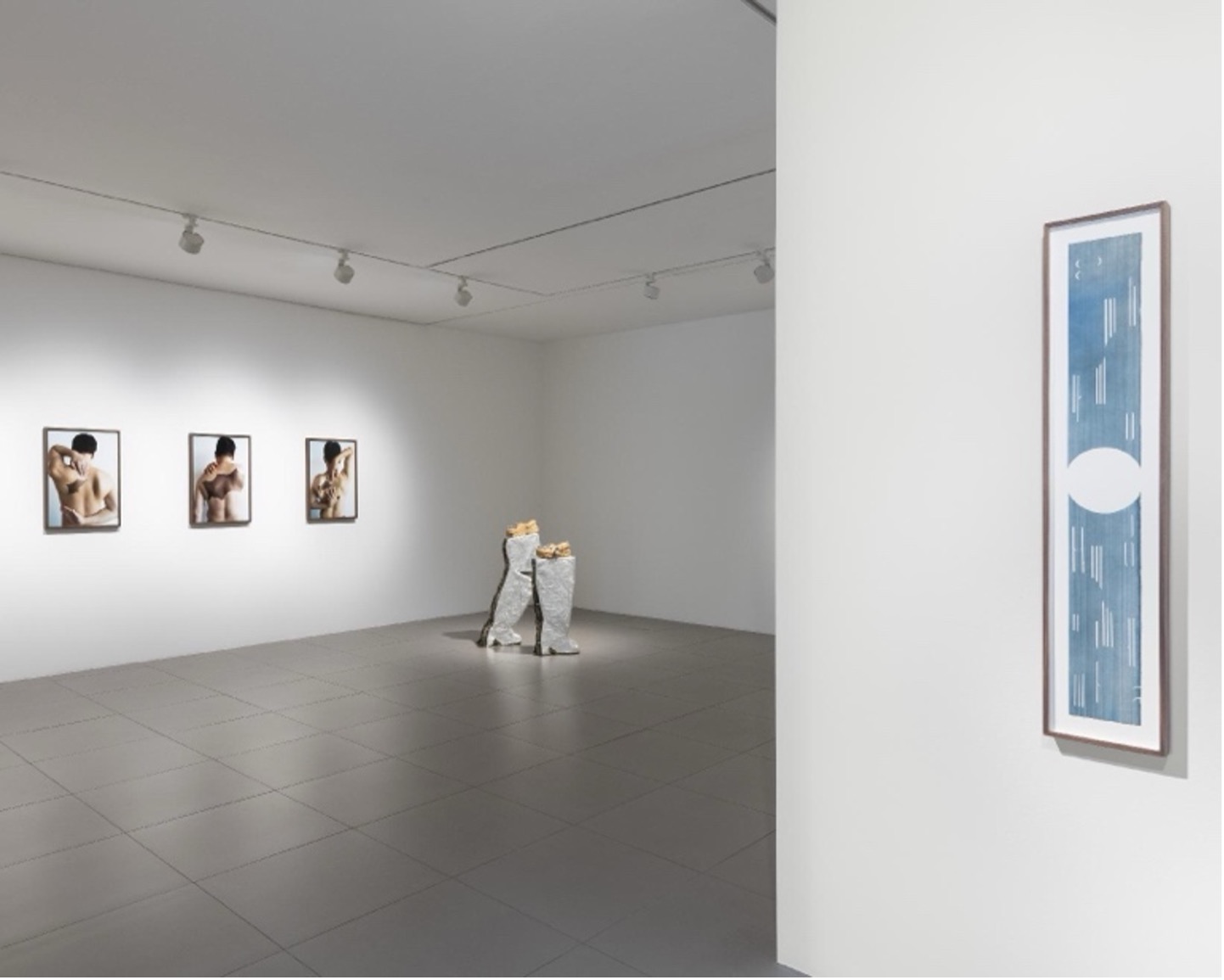
attention to the drawings for a moment and take a slight detour. The pencil
(graphite) drawings, which delicately match the light and shade, as well as the
tone, encompass a variety of subject matters, not only figures but also
newspaper articles, local vegetation, and pebbles. In short, he does not miss
any letter of any word, any crinkle in the paper, or any holes in the stones he
comes upon. However, rather than describing the subject matters with lines of
conviction, his pencil wanders across the canvas like a smudge, making and
crushing shapes, with the trajectory of this crushing creating the shapes.
Sometimes figures are drawn partly erased. The marks of erasure and crushing
remain like smoke or stains, appearing as the evaporation of a figure’s place. This is both a meticulous depiction of the time he failed
to capture and a gesture of refusing to be captured in the first place by
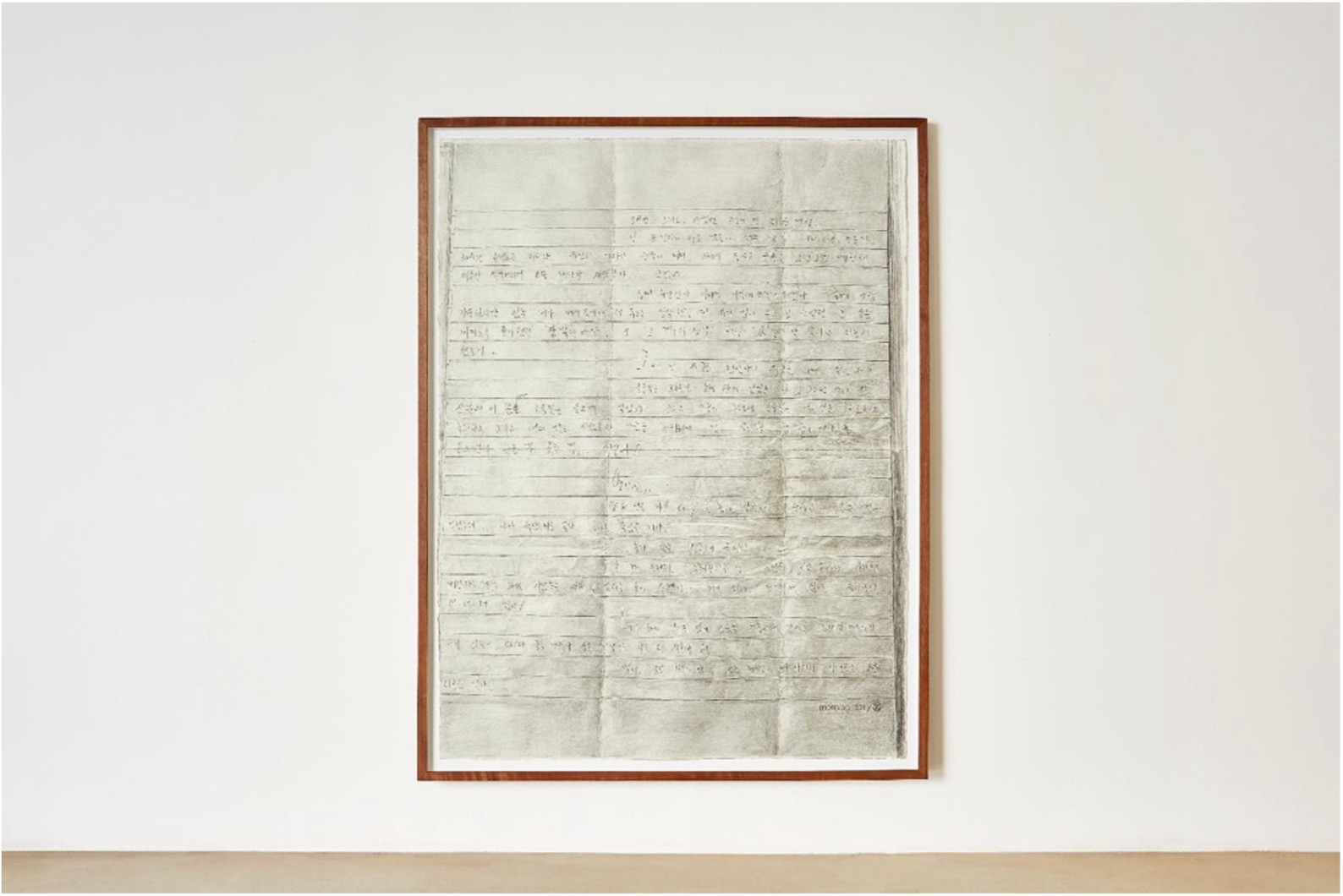
leaving the faces of others as ghosts. He thoroughly draws the records in his
hands, but leaves them blank or burns the corners to create soot, as if to
admit that he cannot fully capture them. At this point, it would be easy to
categorize his work as a typical representation of the inability to capture the
faces of others.
Lee’s drawings also
include renditions inspired from the photo series East Meets
West (1979-1989) by the aforementioned photographer, Tseng Kwong Chi. The
way Tseng practiced his art during his lifetime leaves clues as to how and
approach Lee’s drawings differently. Wearing sunglasses
and dressed in a Mao suit, Tseng Kwong Chi pressed a button in his hand to take
pictures in front of iconic and typical American and European landscapes. The
resulting pictures are said to have performed a stereotype perceived by the
eyes of others looking at Asian people. The recorded materials frame one’s isolation as being part of the landscape, and show the tension and
competition of the gazes that refuse to be captured by hiding the artist’s own eyes. In Kang Seung Lee’s case, he
draws the photographs someone left behind, erasing the person’s face rather than trying to recreate it, and imagining the spot
where it was erased. The artist’s painstakingly precise
depiction suggests that the motivation for his drawings is the impulse to
thoroughly express a longing for the memories that cannot be fully recalled and
restored. Additionally, the method of erasing and leaving empty spaces in
drawings makes a critical reference—from a contemporary
perspective—to Tseng’s tireless
attempts to devise a form of visualizing himself while at the same time
distancing himself from the lens through which people of color were viewed. It
would not be unreasonable to approach this as an exquisite form of
memorializing an artist who passed away from HIV/AIDS. For him, Lee took into
account the concern that the perspective Tseng took during his lifetime might
be captured as an archetype of a possible choice by an East Asian artist who
lived in the developed world.
Conversely, how should we understand Lee’s conflicting modes of representation that bring to the forefront
the faces of Joon-soo Oh, Kim Ki-hong, Byun Hee-soo, and other unnamed queer
figures from the past? The statuses of those who can claim citizenship by
revealing themselves and those who erase themselves from the race, nationality,
and gender stereotypes that imprison them are not that far apart. However, it
is important to note that the choice to reveal or not reveal depends on the
local political situation, who is the Other that is represented as an object of
art, what lifelong attitude the person expressed during their lifetime, and the
social context in which it was formed. There are people who have resisted the
power of representation that categorized them as subordinate subjects and
repeatedly reproduced stereotypes. Beyond them, we also need to remember the
names and faces that those people—those same people who
had not been recognized behind the over-represented—desperately
tried to leave behind.
We need to note that the method of representation, that is, one
which is devised by looking closely at the environment of those who lived in
those days, continuously reconstructs relationships by looking at the context
of the time and leaving room for reinterpretation from a contemporary
perspective, rather than only looking at others who have lived or died earlier
as the objects. Thus, Lee not only invites fellow artists, writers, activists,
and others to engage in critical archival practices as he seeks to interconnect
contemporaries but also to include artists of past generations as contemporary
colleagues, invoking the methodologies of art practiced during their lifetimes
to renew and give new meaning to these methodologies in the present.
Lee’s collage-like
arrangements and drawing methodology have recently been presented in the form
of gestures, on the stage and on the screen. Clad in the easily forgotten
rhythms of the body, the artist takes up the motions of the past and creates
contemporary gestures. In fact, he designed a font derived from the American
Sign Language used by Chinese-American artist Martin Wong, who died of AIDS, to
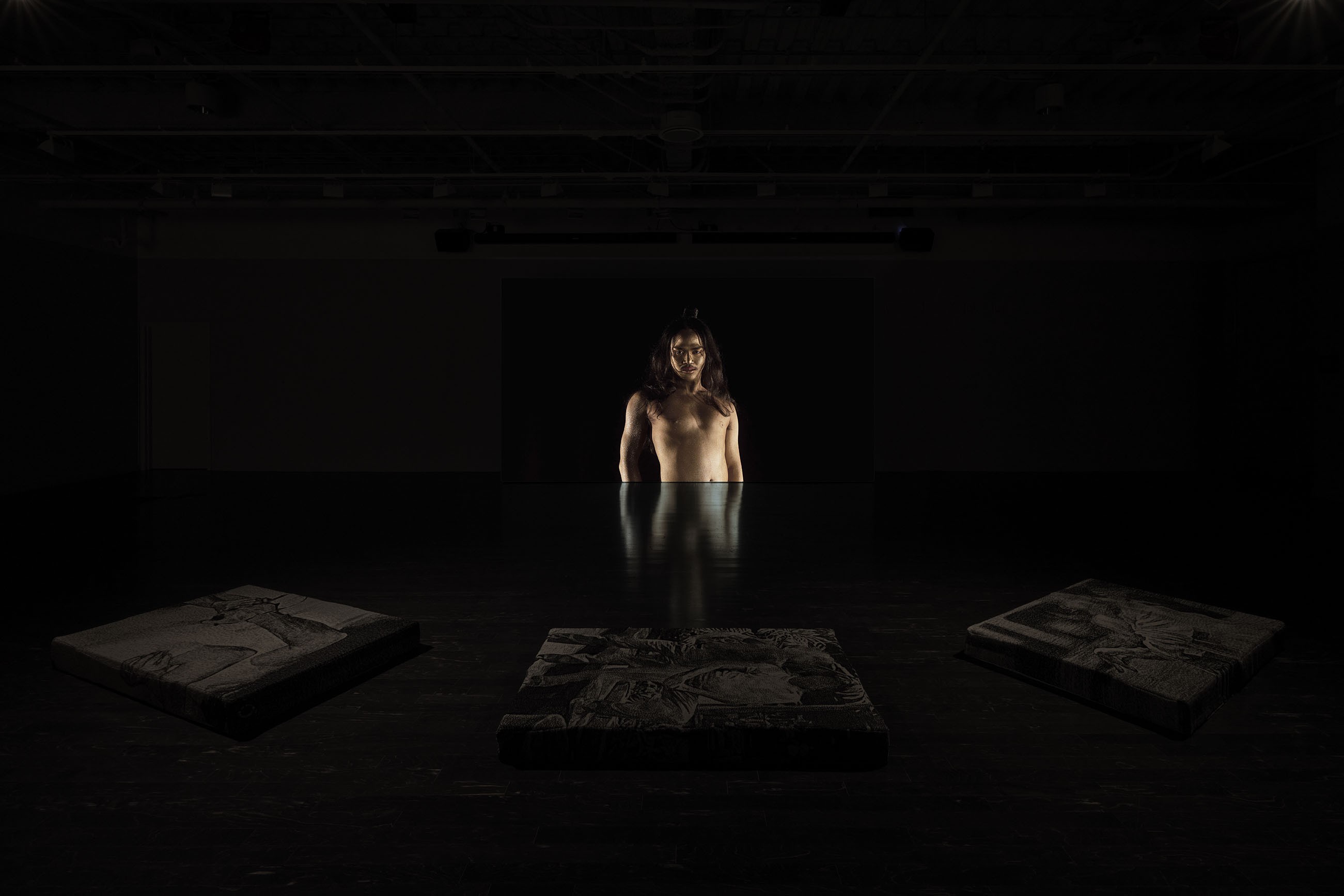
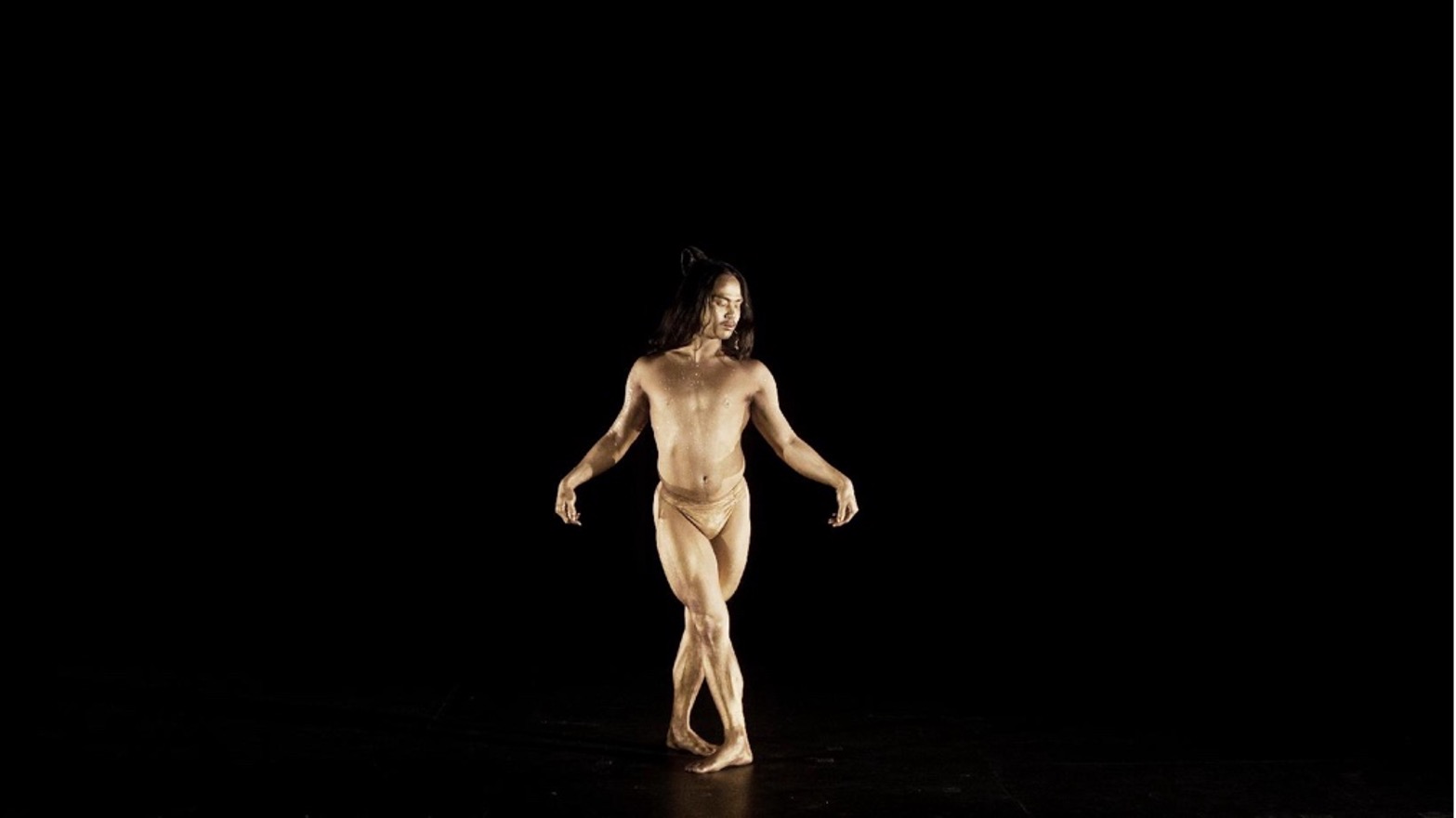
apply it to sentences in Lee’s own works. In The
Heart of A Hand, Filipino transgender/nonbinary choreographer Joshua Serafin
deconstructs Goh Choo San’s 1981 dance Configurations
to set it to the music of Seoul-based transgender musician KIRARA. The artist’s call to remember and adopt the gestures of queer artists—but also to express one’s own disturbing
gestures and gazes right now—may be a prelude to a more
radical gesture: While adopting the past as an artist-subject, he cannot simply
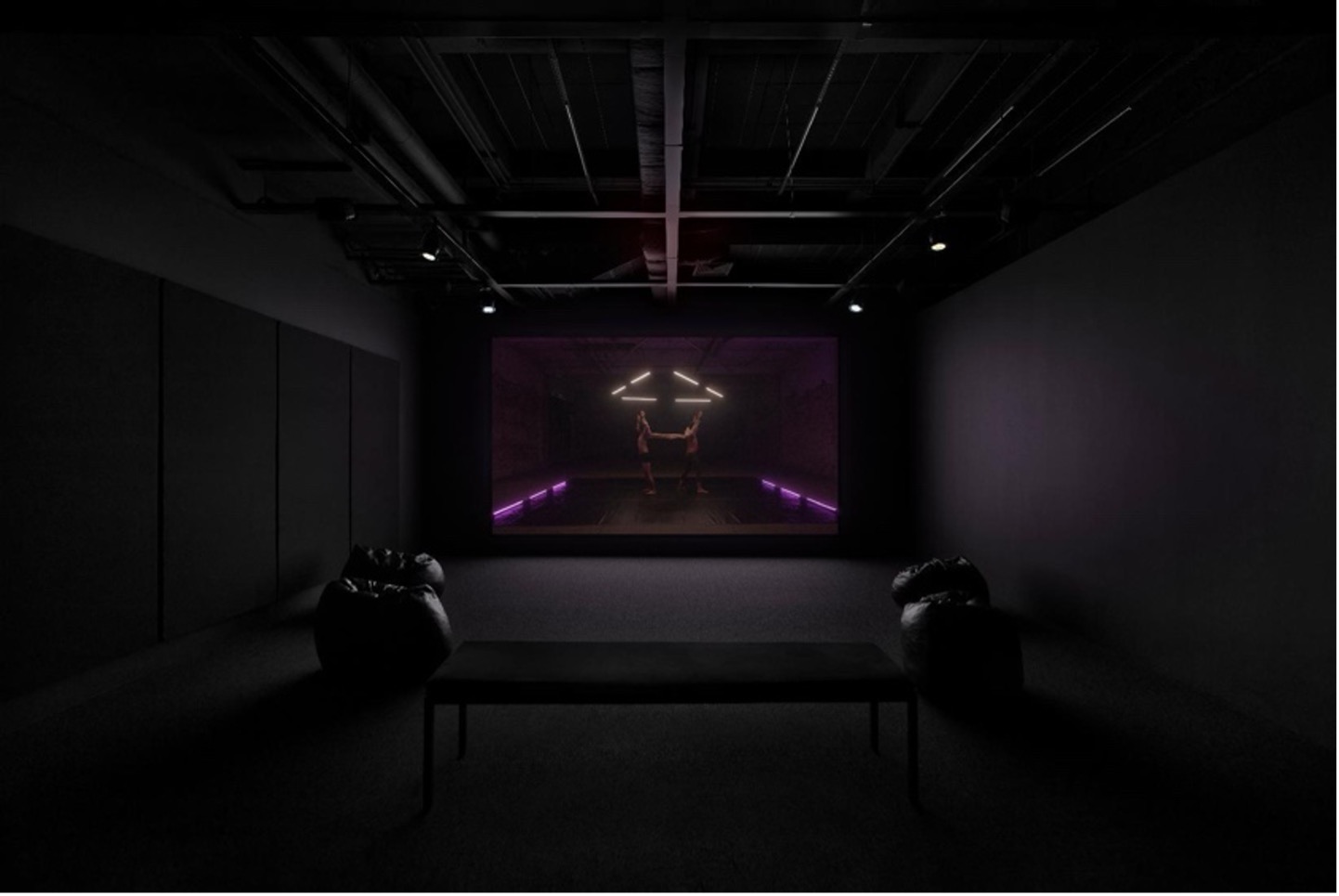
make divisions between the past and present. Lazarus, which premiered at
the Korea Artist Prize exhibition, referenced and networked simultaneously,
like the release of a held breath. Based on Goh Choo San’s original ballet Unknown Territory and recreated by
choreographer Daeun Jung, two male dancers express their interaction with each
other by donning and doffing costumes with two dress shirts sewn together up
and down, in reference to Lazarus (1993), the last known work of
Brazilian conceptual artist José Leonilson. By incorporating text from queer
Chicano artist Samuel Rodriguez’s 1998 experimental
video Your Denim Shirt and transcribing it into a font using the
American Sign Language invented by Martin Wong for his paintings, and by
collaborating with L.A.-based filmmaker Nathan Mercury Kim and using KIRARA’s music, the creation process is in the form of condensing the
separation between past and present, as well as the collaboration of
contemporary artists, onto a single stage. This allows for the prospect that
his future work may attempt to cross-reference and even appropriate between
collaborators and references. It invites us to examine the marks of faces and
bodies that appear erased in Lee’s drawings, and the
outlines of faces and bodies that reappear from them.
If the above stages imply complex references and processes, asking
the viewer to make an intellectual effort to appreciate them, his objets d’art reveal the process of more intuitively disparate contexts
meeting in a material way, meaning viewers can see this aspect concentrated
throughout his ceramic works. He collects soil from different places, kneads
it, fires it in a kiln, and makes pots, which he then fills with other soil and
transplants plants grown by a person he remembers. While the objects intersect
different points of reference, each material functions as its own indicator of
memory, and the viewers can savor and connect with the memories by alternating
between the captions and the ceramic objects. The methodology of ceramics is a
mashup of subject matters and materials beyond collection and collage, opening
up the venue for networking through a stage where gestures and rhythms are
generated again, not only referencing and paying homage to the past but also
weaving in collaboration with contemporary living artists.
Conclusion
The journey of expanding the collaborative relationships with a
work’s references and renewing them by crossing the
boundaries between the two reminds us that the artist-subject is also dependent
on the time of others, that the artist is in a state of decay and imperfection,
and, as a result, that he can only survive by being captured and occupied by
others. He proposes the phrase “Who will care for our
caretakers?” by American lesbian poet Pamela Sneed as
the title of his Korea Artist Prize 2023 exhibition. Written while
having her colleagues pass away during the AIDS crisis in the 1980s and 1990s,
the sentence looks beyond the perspective of the mourning survivor to recognize
that the mourner in the here and now can also be someone else who will die damaged
at any moment. It passes through the challenge of the time to rethink—beyond the one-sided memory of a single party—a shared life lived, mutual care, tangled care that surpasses the
care system and the care industry, and the social structure of care for sharing
the anxieties of life around poverty and aging beyond the exclusive family
model.
In an interview for the Korea Artist Prize 2023, Kang Seung
Lee described himself as a messenger. This somewhat qualifying expression
asks that he examine what languages he needs to master in order to connect
different times and regions, and what devices he needs to employ in order to
articulate and secure a life worth living. It goes beyond compiling records and
reference materials and organizing exhibitions, and asks him to take up the
position of a director who re-invents gestures from the past that have not been
given meaning, and to then make them appear on stage. Furthermore, contemporary
collaborators and colleagues are asked to provide an opportunity where
co-creation can continue to generate discussion and discourse based on
cross-reference and coordination. This suggests that the work of remembering
and the work of unlocking time can happen simultaneously. A more perceptive
reader may even recognize that this act of unearthing and connecting has been
described as queer temporality, but it is not so different from the practice of
democracy.
Kang Seung Lee put the images of shame at the forefront. Those
people who were constantly “discovered” or “caught” in the
titles described with revelry and disturbance, and who could easily evaporate
as objects of “reportage,”
instead appear in the limelight. The image he put on the forefront of the
exhibition is that of a group of people who, in the face of a violent outside
gaze, were decorating themselves in a dark place at night very disturbingly,
and left behind the image of themselves as if for commemoration. Of course,
society would not have perceived the decorations they wanted to show off as
harmless. Considered perverted, disturbing, and not to be seen in public, they
were constantly subjected to crackdowns and gossiped about, but in the end, they
refused to give up their expressions and performances and kept themselves
attached to the screen on which they were performing. It is not a jump in logic
to interpret this as a hope and a sign of fragile connection amidst struggle,
degradation, isolation, and a legacy of gardening that each of them must have
cultivated. The attempt to push his work based on memory and collection into
the possibility of radical care leads to an attitude of collaboration which
presupposes that—like those who mourn, discover
something for mourning, and have difficulty remembering someone fully—one’s work is dependent on the traces of
others. Calling on colleagues and devising attempts to reproduce the programs
of community may very well be the efficacy of the art that Kang Seung Lee has
maintained throughout his career.
The impossible attempts to convey the temperature of one’s unreachable body exceeds the artist’s
capacity as a subject. At the same time, however, these attempts connect
through him. He continues to create and devise places to create a time to come
and a time to open up, finding colleagues and connections along the way. While
walking through the thoughtfully collected and rearranged exhibition, I
consider the forms of aesthetic touch that the artist has been devising, and
think how and to whom this time will open or close.