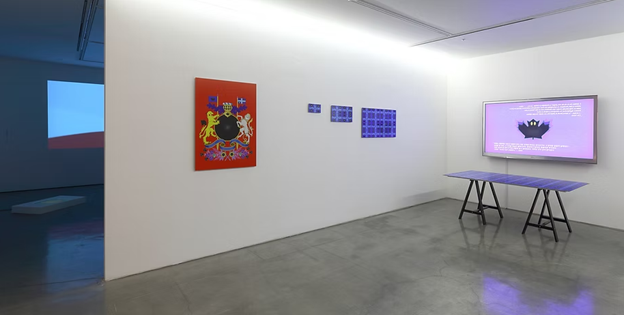
1. In the description of Only Those Who Are About to Leave See Everything, which is both the title of this exhibition and its titular work, the artist defines both as “letters.”
“I dream of flying while confirming my coordinates within the viewpoint one has when an individual tries to leave their current state, within multilayered memories. I put this journey into the form of a letter.”
In fact, many of his audiovisual works often refer to or vary the form of the epistolary text, and what is interesting is the point at which the artist confesses that the reason he “makes music or writes letters while moving” is “because he cannot sleep while moving.”
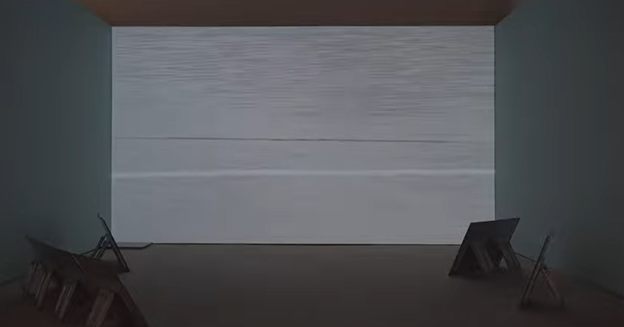
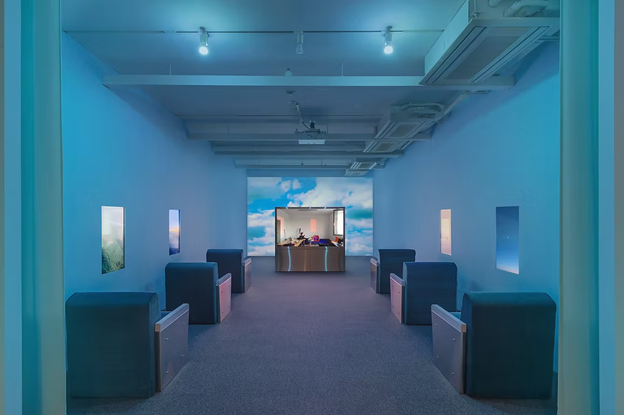
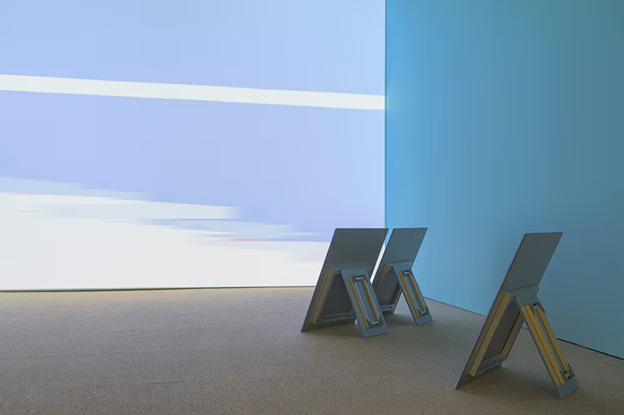
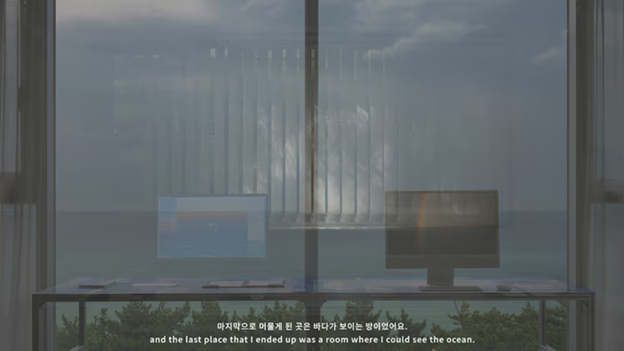
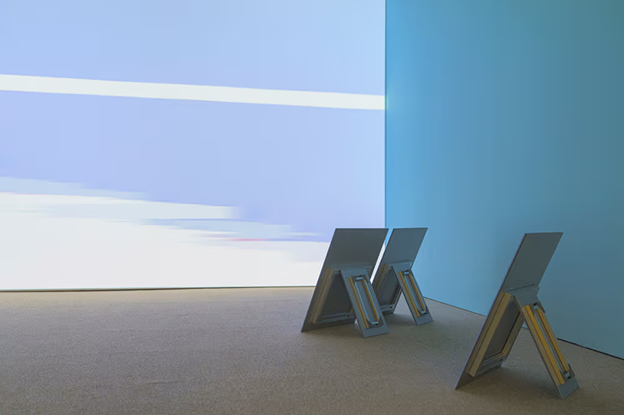
Only Those Who Are About to Leave See Everything is an audiovisual work of over 40 minutes, in which images of a series of countries and places where the artist has stayed and departed over the past ten or so years, or images of sky and land captured from airplanes, continue one after another.
In between them, the artist inserts Gm and Gn, that is, the greetings “good morning” and “good night,” which occupied the core of the 2018 exhibition 《BGM》, and as one watches, one experiences the moment when their meanings as morning greeting and evening greeting become so faint that they implode. Not only day and night, but even the change of place and time itself becomes meaningless.
In fact, he confesses that he is “a person who lives irregular time no matter where he stays,” and in the sense that he “makes music or writes letters while moving” because he “cannot sleep while moving,” his works may be called products of his “insomnia.”
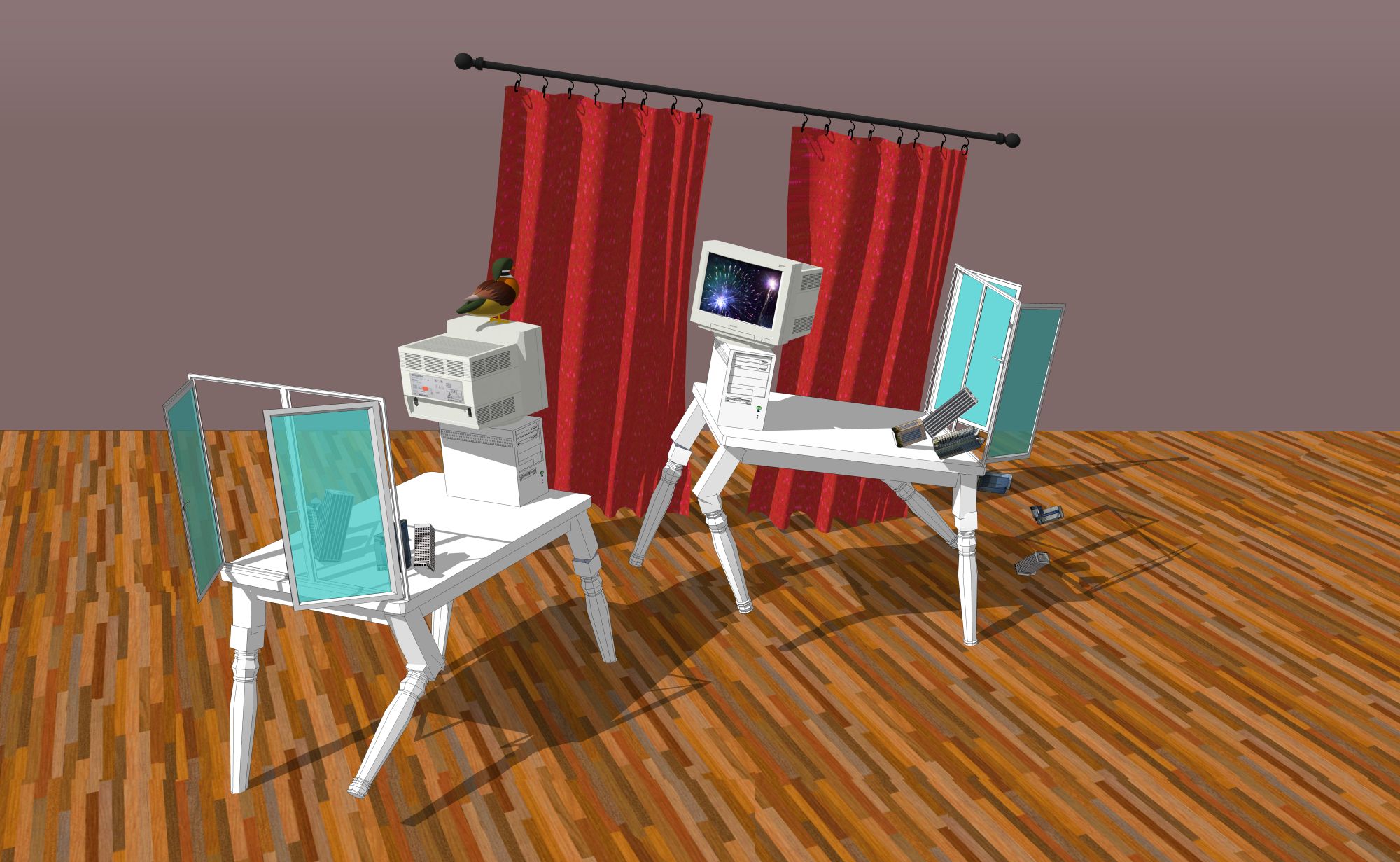
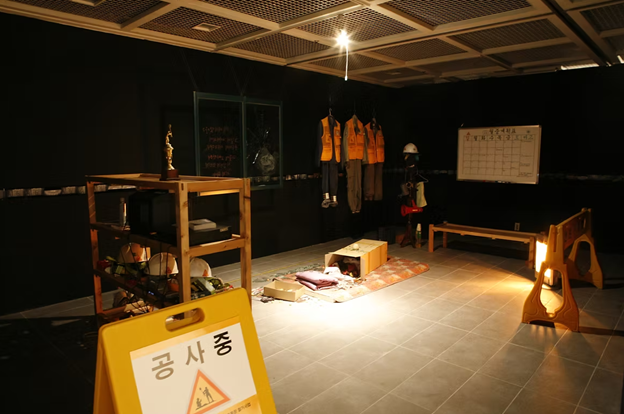
On the one hand, this is directly connected not only to the fact that his previous exhibitions have explored unstable and temporary forms of dwelling that traverse movement and departure, or the distinction between day and night (Painting for Movement(2008), Midnight Parade(2010), Temporary Enterprise(2011), New Home(2012), the ‘Korean Refugees’(2014-) series, the ‘BATS’(2016-) project, and BGM(2018)), but also, as Strike, Sync evokes, to the fact that in 2012, when more and more people were being pushed by the waves of annually rising housing prices to move, he “would visit ‘new houses’ left empty under construction and sleep together with them.”
2. Yet the status and implications occupied in his work by sleep in a more fundamental sense, or rather by its absence and its continuous process of encroachment, are revealed more concretely in the characteristics of the soundscapes we experience in his work.
In general, his works are calm in auditory terms, which for some people may mean that they are “sleepy.” It is not easy to hear the artist’s own voice there, and even if sound is heard, the decibel level is rarely high. The onomatopoeic “hoho” that he often uses in emails or on social media is also situated in a register between “bursting laughter” and “smile.”
This is connected to the fact that, “like quietly screaming online as a child,” he “made music during the time when he did not speak.” Considering the common understanding that “a song is lyrics set to melody,” this is probably why in his work one does not hear “songs,” but instead reads quiet sentences for a long time.
The problem lies in the paradox that the “sleep” induced by his work, and at the same time the very condition of its possibility, is in some fundamental sense both something the artist wants and something he hopes will not happen. Who would want someone to sleep while watching or listening to one’s work? Have we ever seen a viewer or listener say, without sarcasm, “This work was so good,” “It was so good that I fell asleep while watching it”?
3. I once recalled, in an essay I wrote for the catalogue of his 2018 exhibition 《BGM》, that one of those who answered “Yes,” or rather “If so, then all the better,” was the composer Max Richter, who has gained worldwide resonance over the past several years.
Richter created Sleep, music as a “gigantic lullaby,” with the hope that the audience would fall asleep, and the eight-hour performance was actually filled with bed-like cushions on which listeners could fall asleep whenever they wished.
This lineage of music, often labeled “post-minimalism” together with figures such as Nils Frahm, literally repeats minimal, minimum notes and rhythms in a simple and “machinic” way, yet by performing them “live,” “quietly, or stoically, exhibits the points of wear and rupture that the body, as a cabinet of fatigue and exhaustion called the ‘human,’ can (or cannot) endure.”
The fact that the artist opened the 2018 exhibition 《BGM》 with the confession, “I was a person who pushed myself quite hard,” that in the process of such “pushing too hard” he developed a tumor and even underwent surgery, and that he lost a musician who compressed and crushed the music he had worked on throughout his life and a friend who quit art, together with the fact that “the administration changed, but the world did not change much,” explained the simplicity of the codes that repeatedly run through his soundscapes.
4. The paradox of the elective affinity that Cha Ji Ryang’s works, made through this encroached sleep and its absence, form again with sleep updates in contemporary terms the problem posed by Inextinguishable Fire(1969) by Harun Farocki, the German filmmaker and outstanding audiovisual artist who passed away several years ago.
As is well known, in this work Farocki, taking as his background the Vietnam War—a “Hot War” that swallowed not only the United States and Europe but also Korea in the East under the name of the “Cold War”—brilliantly captured the problem of “the Unrepresentable.” The title “inextinguishable fire” refers to the “napalm” that U.S. troops dropped in order to clear the jungle.
After reading a letter from a Vietnamese woman who lost consciousness and was hospitalized after this horrifying bomb—which burns at 3,000 degrees, cannot be extinguished even on water, and melts skin down to the bone when it touches the human body—fell near her, Farocki looks directly into the camera and presents us, the viewers, with a kind of aporia, which may be roughly paraphrased as follows.
“If we are to let you know how horrific a weapon napalm is, we would have to show you the wounds it left on this woman’s body. But if the wounds are so horrific, you will close your eyes, and if you close your eyes, our attempt to call attention to them will not achieve its intended effect.”
Then what are we to do? If showing it will make people close their eyes, yet the atrocity is too horrific to convey only in words without showing it, how can it be communicated through the medium of “film”?
The aporia that oscillated in this way between the demands of visibility and invisibility, or the ethics of their limits, is something Cha Ji Ryang’s recent works can be said to have sensuously refined, not so much on the level of visuality itself, but on the level of auditory perception linked to it, through the instability of dwelling that breaks down the boundary between day and night and the changed status of “sleep” that accompanies it.
5. The problem is related to the fact that while the sentence “Only those who are about to leave see everything” contains a certain “will,” our world—whether it is Korea, Malaysia, Germany, or the United States, whether one calls it “neoliberalism” or “cognitive capitalism”—is transforming all of us, day by day, into people who must be ready to leave at any time, and we too are living, or disappearing, while adapting to this.
Can the gap between the two truly be filled? In other words, the valley between those who have come to see everything through a departure imposed upon them on one side, and those who “have seen everything” through the will to leave on the other. That is, the vibration, or drop, between “will” and “obligation.”
Nietzsche called such will “Amor fati,” meaning “love of fate,” but the “Amor Fati” more familiar to us is probably the “hip trot” sung by Kim Yonja, which she initially rejected because it was in the unfamiliar EDM genre, but which for unknown reasons climbed back up the charts, was misunderstood as “Amor Party,” and became briefly popular—in a sense, even “caricatured.”
In a world where the boundary between day and night has disappeared, in a world where the recommendation that one should reduce sleep even by one hour if possible is accepted as natural, can our labor truly be confused with dance? Is this coercion truly our “fate,” and our “party”? This question can also be varied as follows. What exactly is “everything” seen by “those who are about to leave”? It is the image of a world in which boundaries are being nullified.
In From Voice to Body, when he recalls “clouds”—which Damisch once formulated as “bodies without surfaces (corps sans surface)”¹—and evokes the “childhood dream” of becoming “a bodiless being,” and in After Life, which “streams” in the tradition of the triptych extremely peaceful videos of everyday life filmed while he was staying in the provinces, he overlaps “my world, where nothing touches, where nothing happens, where no words are spoken” in his own voice with the voice of a child.
These are internally linked on the level of this “nullification of boundaries.” In particular, the point at which the “afterlife,” composed of images of this world, is turned upside down into “my world, where nothing touches, where nothing happens, where no words are spoken,” forms an interesting pair with low-resolution works of degraded data streaming such as Surfing and Black Wave, which Steyerl once defined as the “poor image.”
In a world where the boundaries between heaven and data noise, day and night disappear, and everything merely flows (as data), what meaning do the greetings good morning and good night have?
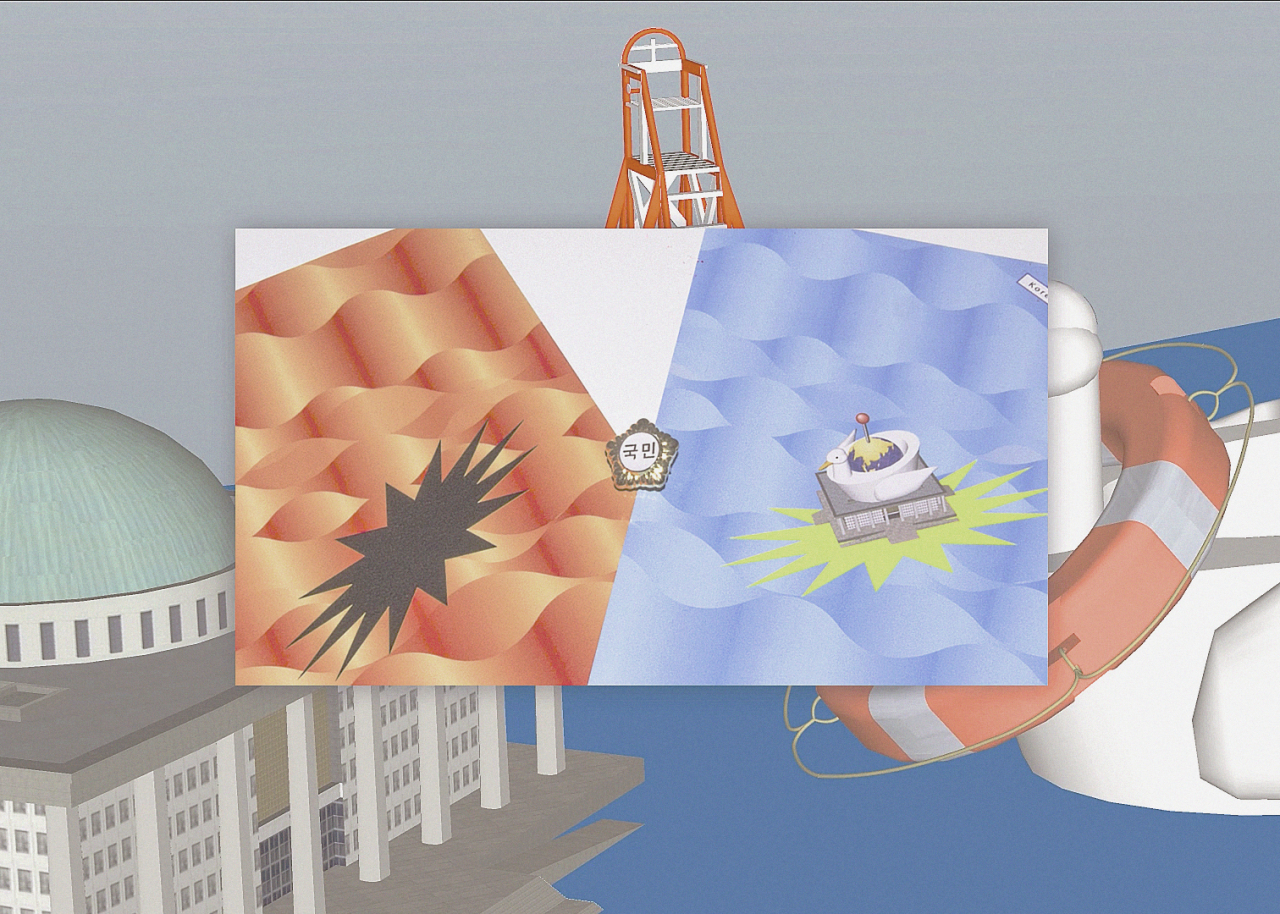
In this context, it sounds paradoxically appropriate that on “the day when sad news kept coming,” the piece he played—again without lyrics—was “March for the Beloved.” In twenty-first-century Korea, where it has become highly likely that Chun Doo-hwan, the person ultimately responsible, would die a “natural death” despite evidence that martial law troops shot at protesting crowds with machine guns, could “Gwangju 1980” have perhaps scattered indistinctly into everyday life?
6. In a report published in 2015, the average sleep time of Koreans was 7 hours and 49 minutes, more than 30 minutes shorter than the OECD average of 8 hours and 22 minutes, placing Korea last among the 18 countries surveyed. What exactly does it mean to say that “only those who are about to leave see everything” in a world where night and day, this world and the next, heaven and hell become increasingly indistinguishable?
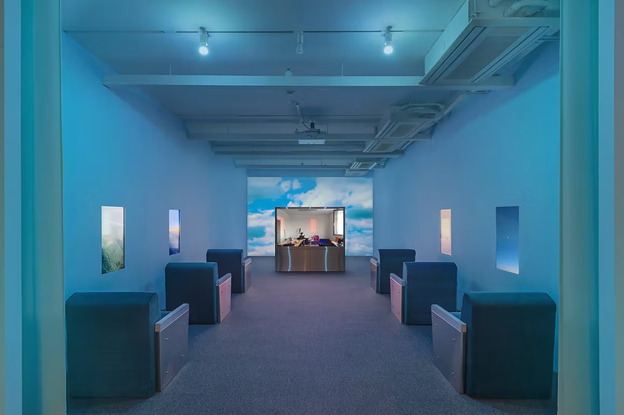
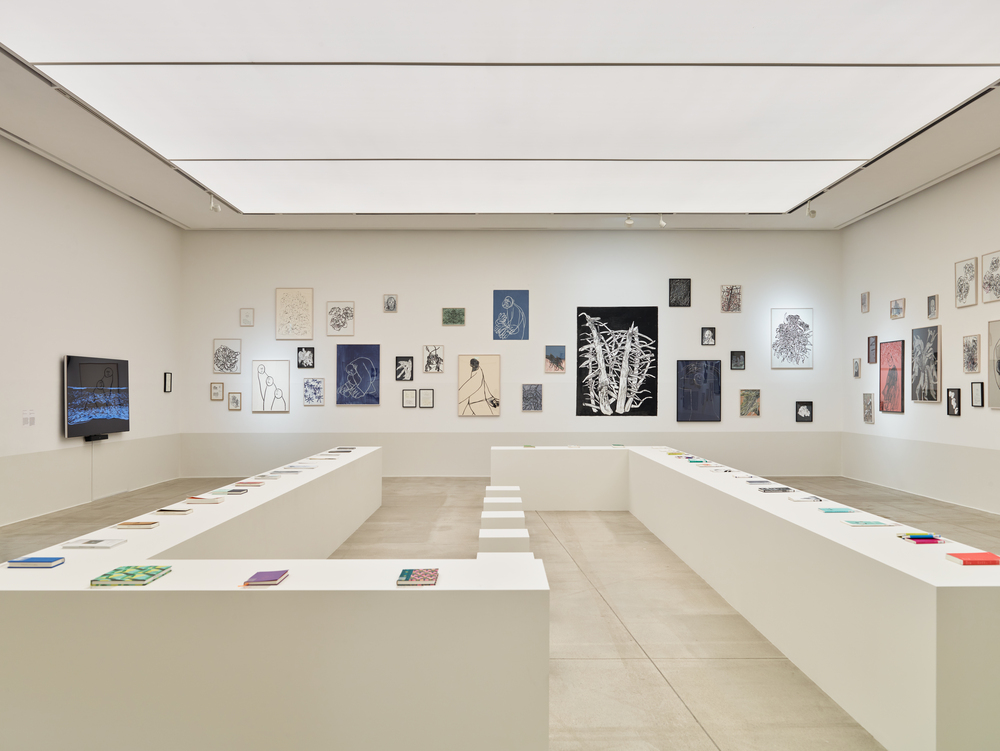
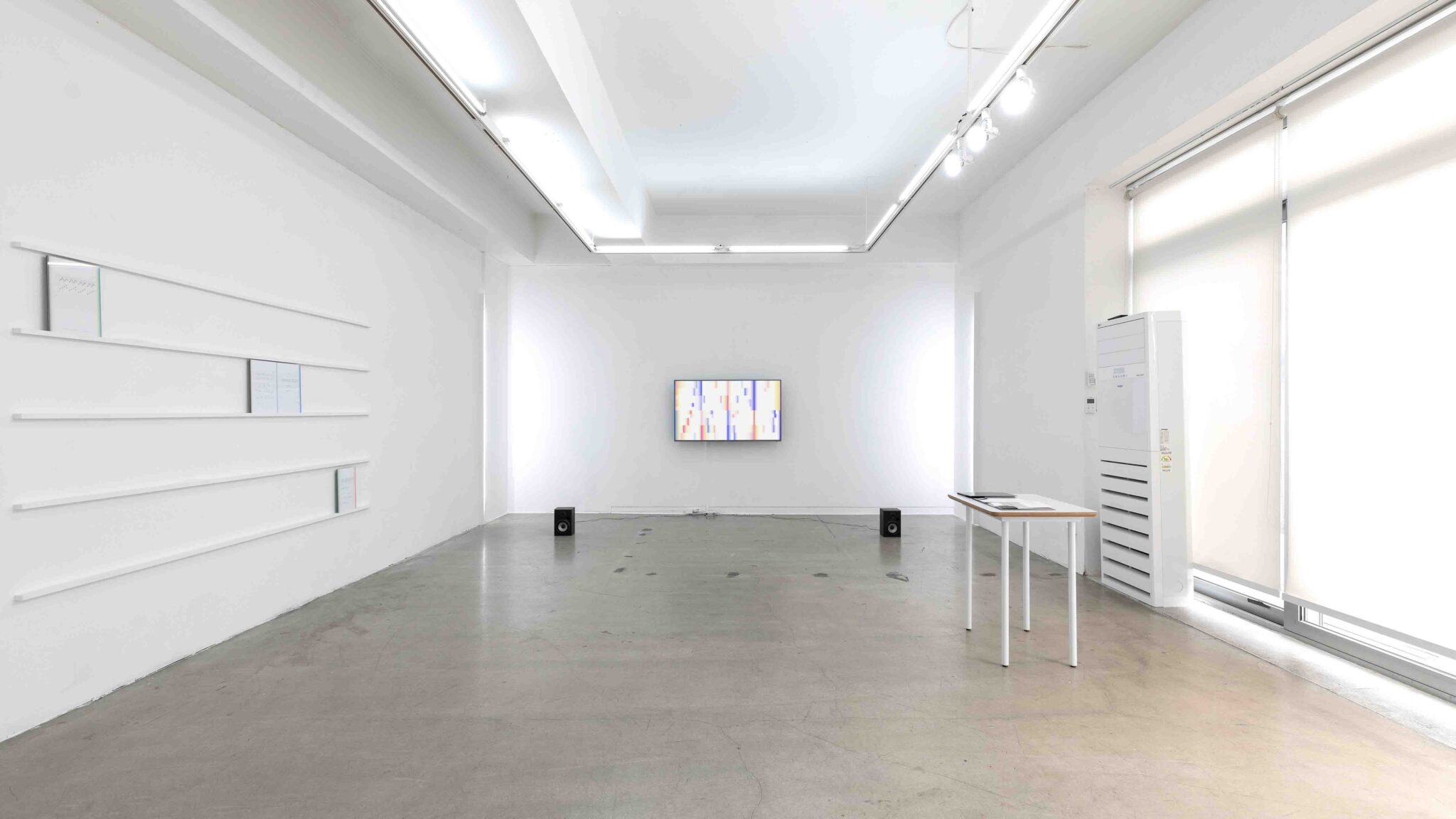
Does it mean that we too must leave in order to see everything? Cha Ji Ryang’s exhibition, realized as a “virtual gallery” in a world where the concept of “site-specificity” has become meaningless not aesthetically but ontologically, instead lets us hear, from time to time, low sounds and whispers that seem to flow from “those who have seen everything and left.”
There may therefore be some who complain that they fell asleep, or that they cannot hear songs. Yet listening to those who have seen everything and left while reducing sleep may also mean hearing the sounds that are heard, or not heard, between sleep and song, and perhaps witnessing, like a miracle, the world that flickers and manifests there like a broken fluorescent light.
1)Hubert Damisch, Théorie du Nuage: Pour une Histoire de la Peinture, Paris: Seuil, 1972, p. 170.