Methods of Exploring Reality and
Objects
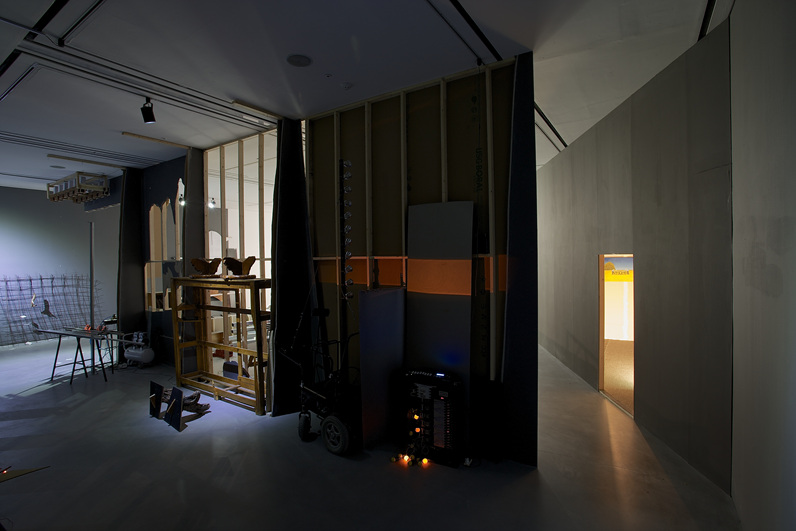
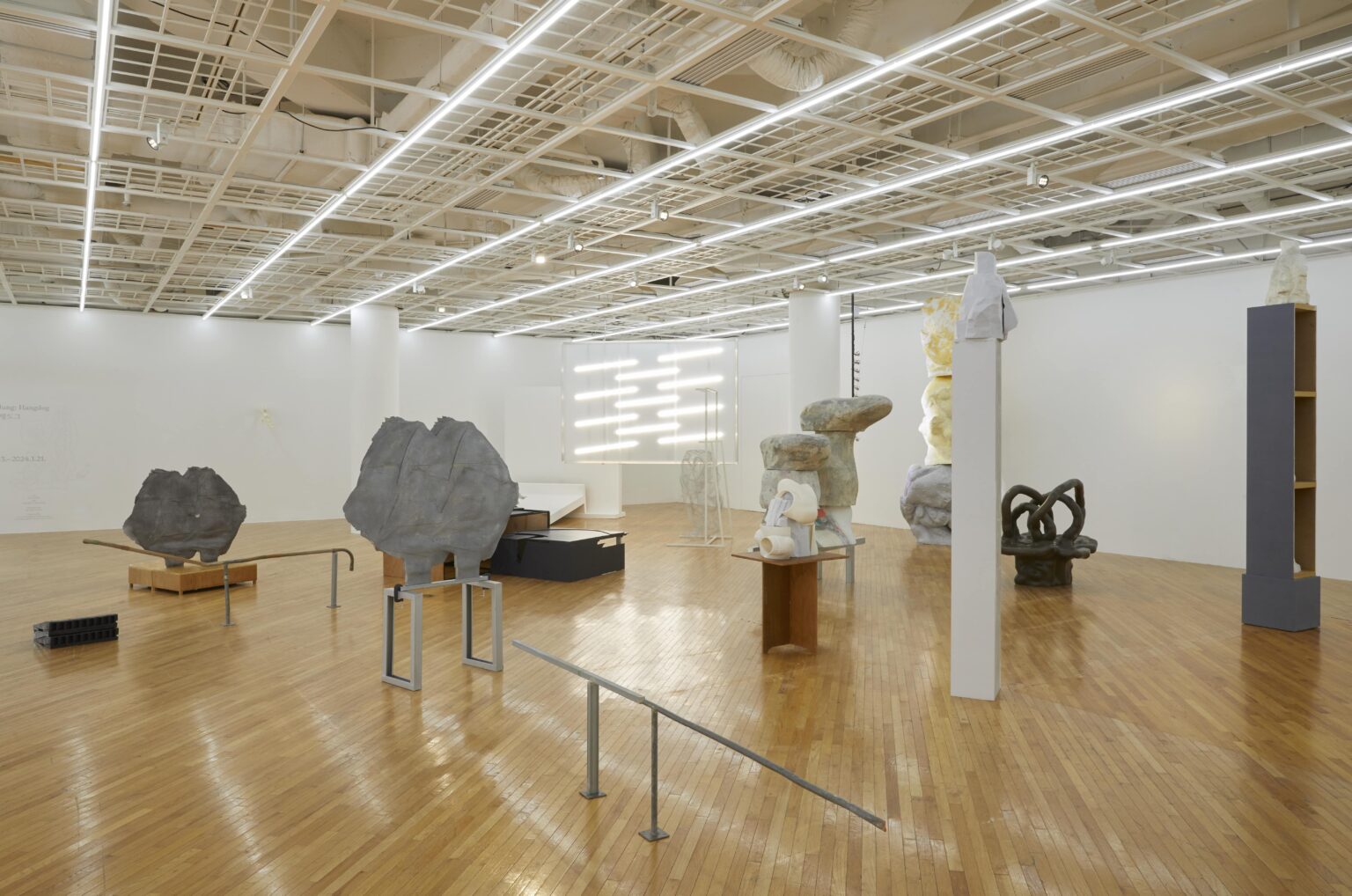
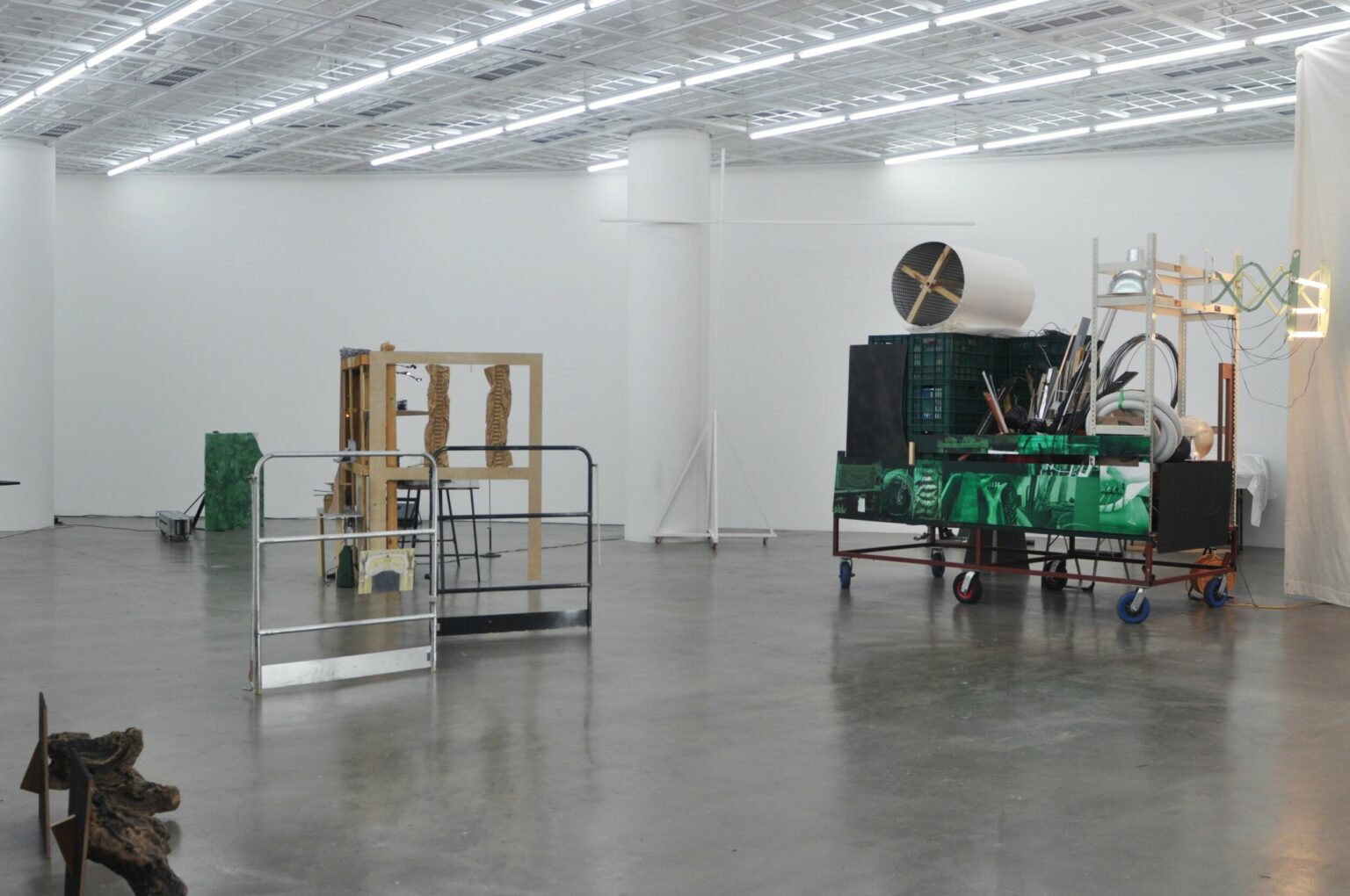
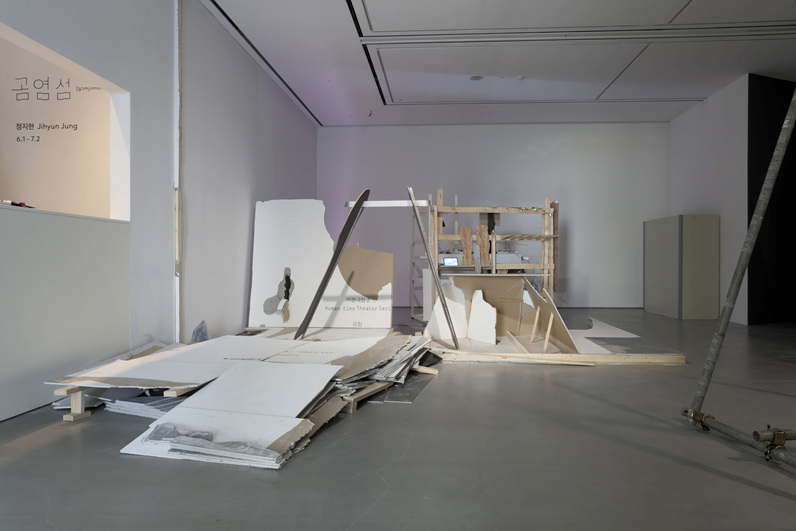
In his more recent exhibition 《ONE-A-DAY》 (Art Sonje Center, 2019), Jung’s work
demonstrates a clear shift in both method and form following 《gomjumsum》. The scenes he constructed in this
exhibition appear as accumulations of close investigations into individual
objects. However, these works were not conceived as components of a
pre-arranged scene.
Rather, they suggest a consideration of the meaning of objects
that give rise to the condition of “sculpture” itself. The tactile sensation of
objects at the fingertips, their weight, texture, form, and color, as well as
their temperature—and perhaps even their utility—are gradually redefined
through Jung’s process. As this process accumulates, these elements are
articulated according to his own system. In doing so, Jung appropriates objects
that were not originally his own—objects brought in from the outside—and
internalizes them as his own.
If Jihyun Jung’s recent practice can be
described as a “time of exploring objects,” then the way in which he derives a
conclusion from this inquiry—the completion of the work—lies in refining its
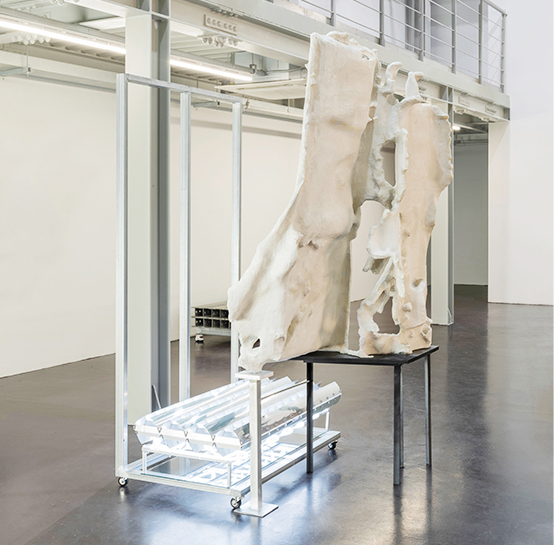
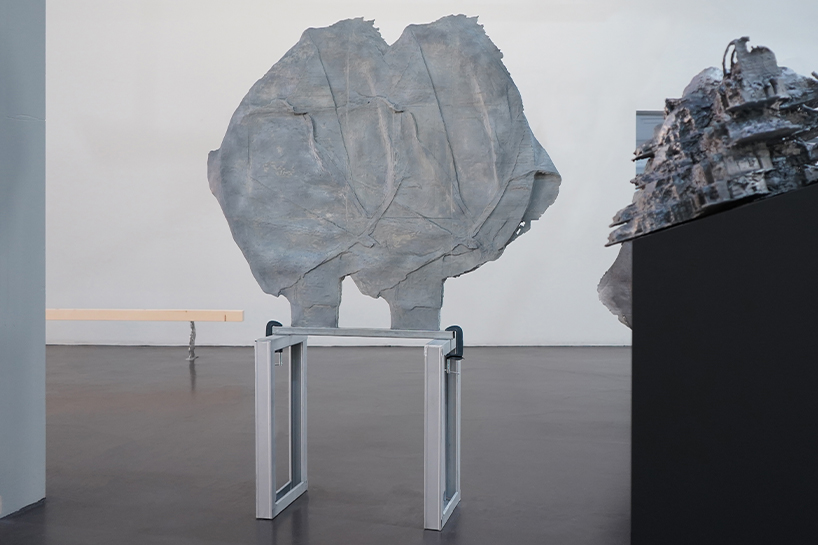
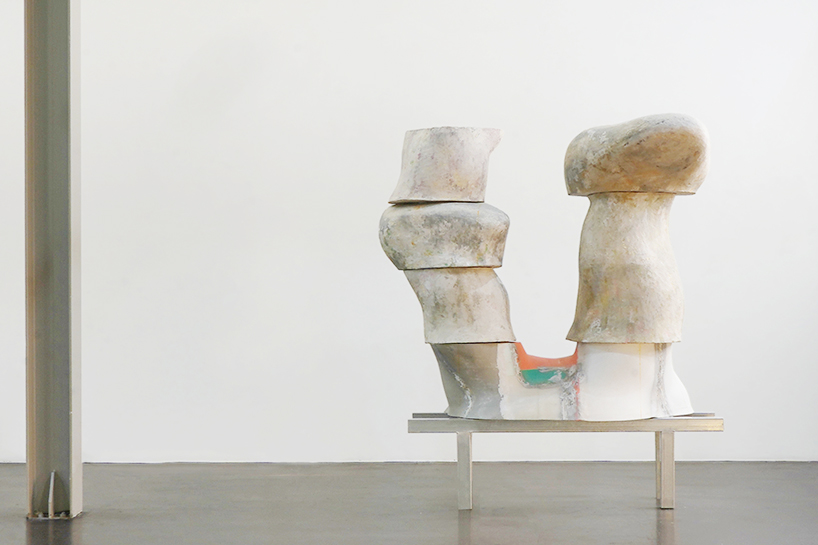
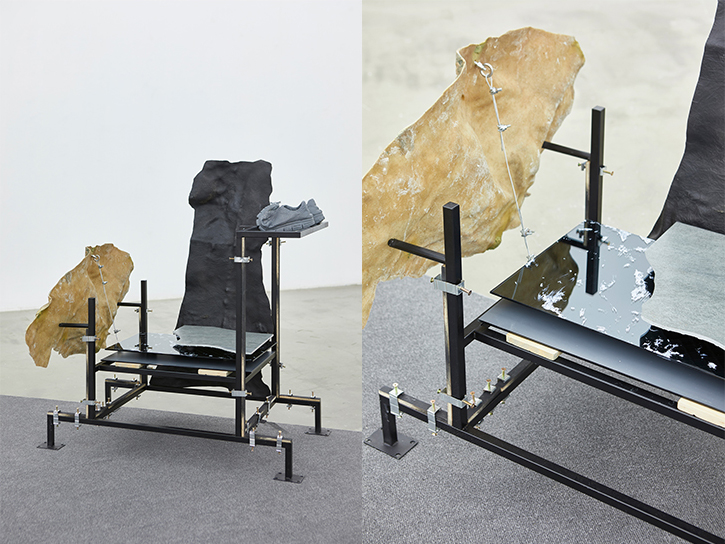
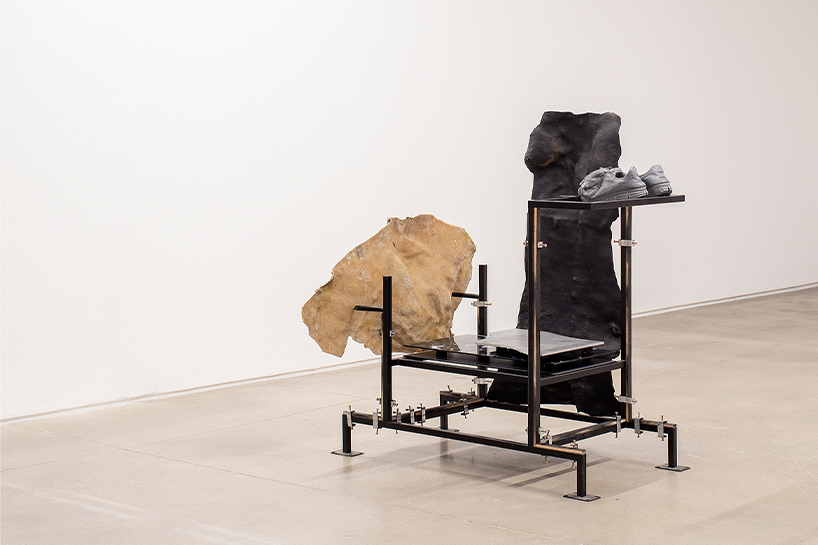
form. His recent work Rock Book (2018) offers a concise
example of this process of contemplating the formal characteristics of objects.
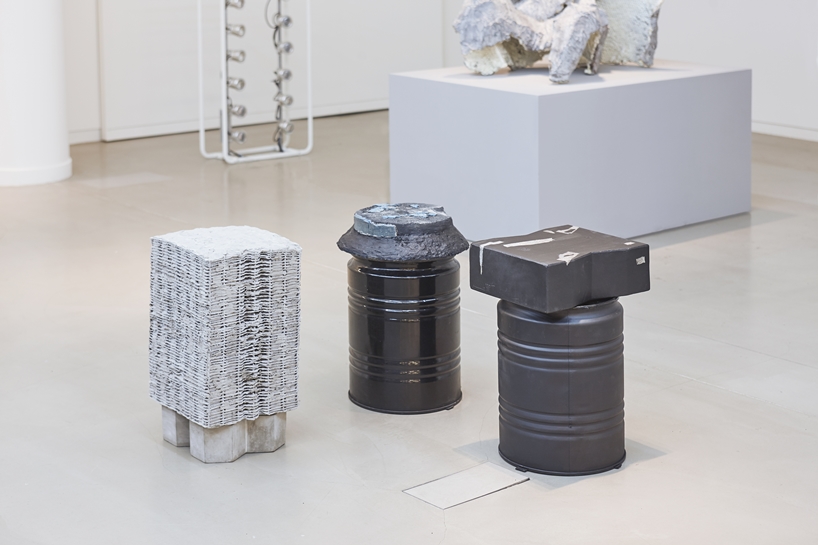
He brings together materials such as steel, glass, and tile, along with a
sculptural element resembling a sneaker, binding these components with a steel
frame suggestive of furniture. In one part of the work, he minimizes the
sculptural process—whether physical or chemical—thereby preserving the formal
origin of each material while arranging them in layered formations.
In
contrast, on the other side, he places a sneaker form bent outward beyond the
plane of the floor. This element captures a fleeting moment of applied force:
the worn sneaker is physically reshaped and repeatedly coated with automotive
primer, preserving the instant of energy exerted upon it.
By assembling a clearly
dynamic sculptural element alongside static materials into a single mass, Jung
appears to study objects in order to locate an equilibrium of energy. He seems
to consider what the most “ideal” form might be when materials of differing
properties and directional energies are combined.
In Jung’s work, objects originating from
disparate contexts converge toward a shared purpose, forming an integrated
ecosystem. The ecosystem he constructs through objects ultimately becomes a
world of images. Here, “image” does not simply refer to something physically
flat, but rather to a form or figure (像).
While these objects and
images, drawn from everyday life, may exist for others as fragments of
something vaguely familiar, Jung’s aim is not to reproduce such familiarity.
Instead, he cuts, processes, and edits materials with recognizable origins to
construct images. As seen in Rock Book, this compositional
strategy disrupts and betrays the expected flow of perception, compelling the
viewer to confront the materials that constitute the image—that is, the
fragments themselves.
Perhaps this is precisely the purpose behind Jung’s
construction of images. Louis Althusser once noted that while there is
undoubtedly a relationship between thought and reality, it is not a direct
relationship with the real itself, but rather a relationship of knowledge—of
adequacy or inadequacy. A “real” relationship, he argues, is one that is
immanent to the object itself, while thought remains knowledge about it
(whether adequate or inadequate).
This perspective seems to partially reflect
Jung’s philosophy of objects. Rather than striving to define objects within a
system of knowledge, or to establish the grounds upon which forms can be
classified, Jung focuses on the problem of form inherent in the object itself,
seeking ways to reveal the essence of the real. For Jung, then, the act of
contemplating a heightened sensitivity toward objects—though grounded in what
is physically present and tangible—momentarily transforms into a metaphysical
and abstract inquiry.
In a conversation I had with Jung around
this time two years ago, he spoke about the challenges of living as an artist
within contemporary society, referencing the writings of sociologist Kim
Hong-Jung. According to Kim, the age of iconoclasm (破像) is one in which the development of affirmative imagination has become
meaningless.
Yet even within this condition, there remains a force upon which
we can rely: the ability to endure, as it is, the disillusionment embedded
between the reality we inhabit and the unconscious, and the attitude of seeking
traces of hope within those fragments. For those who have come to believe that
the utopian visions once imagined by art have vanished, and that the social
foundations upon which they depended have collapsed, there is nothing left upon
which to further build or develop.
Yet, by quietly enduring this
disillusionment, gathering the already shattered images, recomposing them, and
holding onto the possibility that may emerge from such contingencies, one may
continue a personal struggle that sustains life through hope. For Jung, whose
artistic practice is intimately bound to such a mode of engagement, the
exploration of the form and essence of objects becomes a way of actively
existing within society.
Thus, the act of constructing images—even if those
images may eventually disappear and remain nothing more than forms without
economic utility—serves as evidence of his existence. The power of images to
unsettle what has long been assumed and believed ultimately becomes the driving
force that will continue to propel Jung toward the act of making.