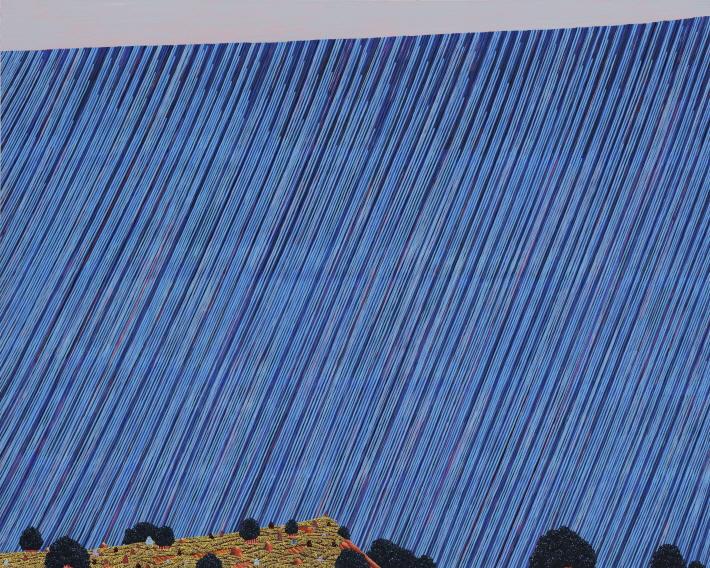
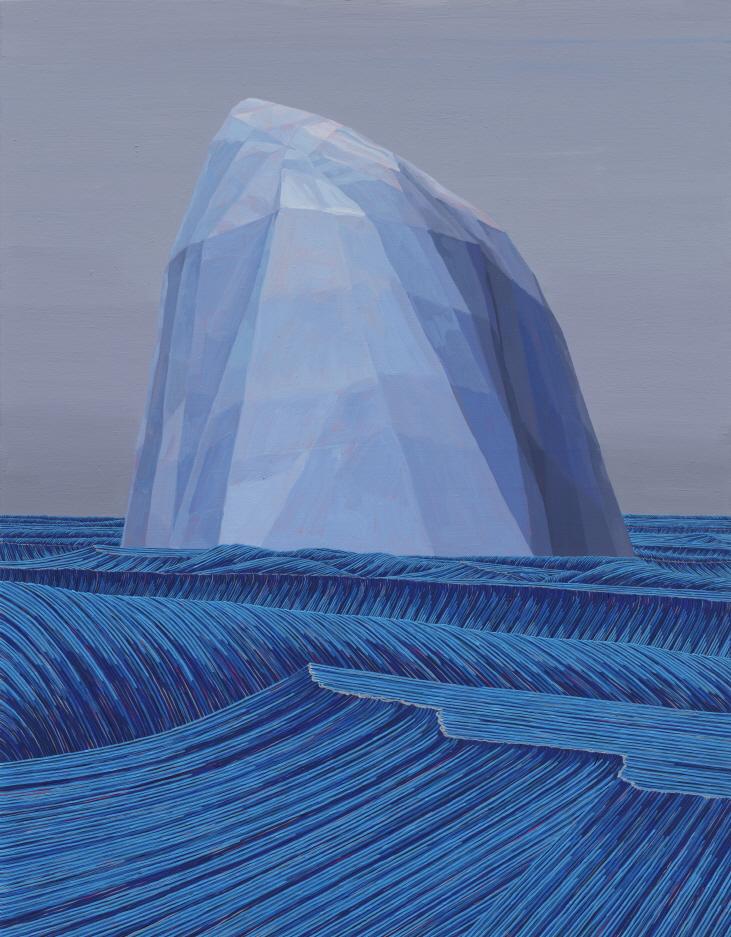
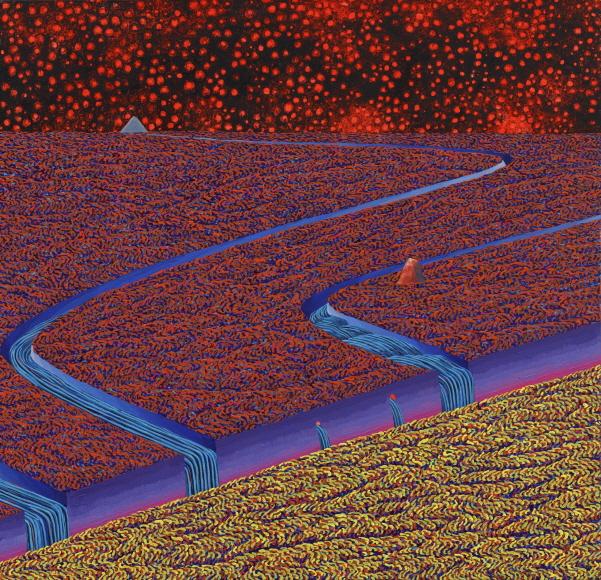
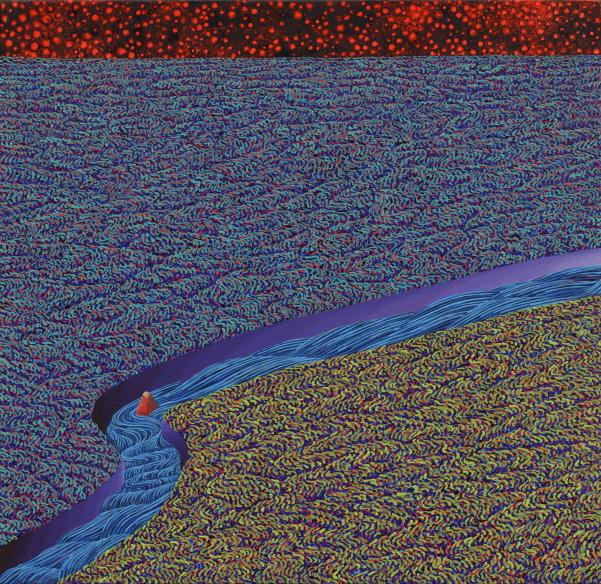
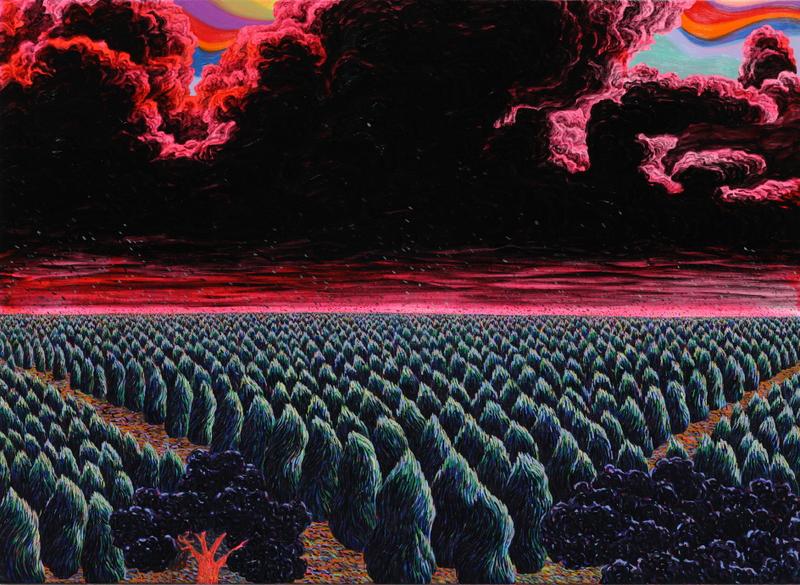
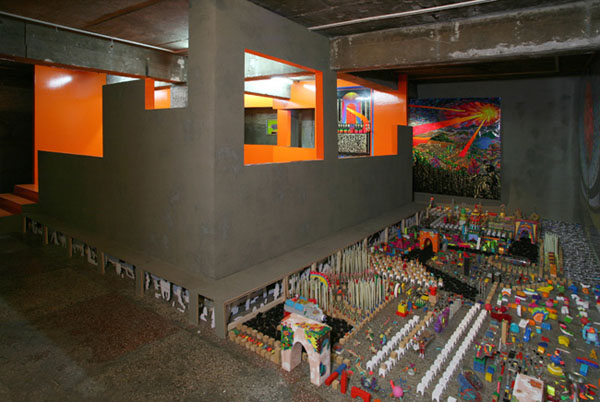
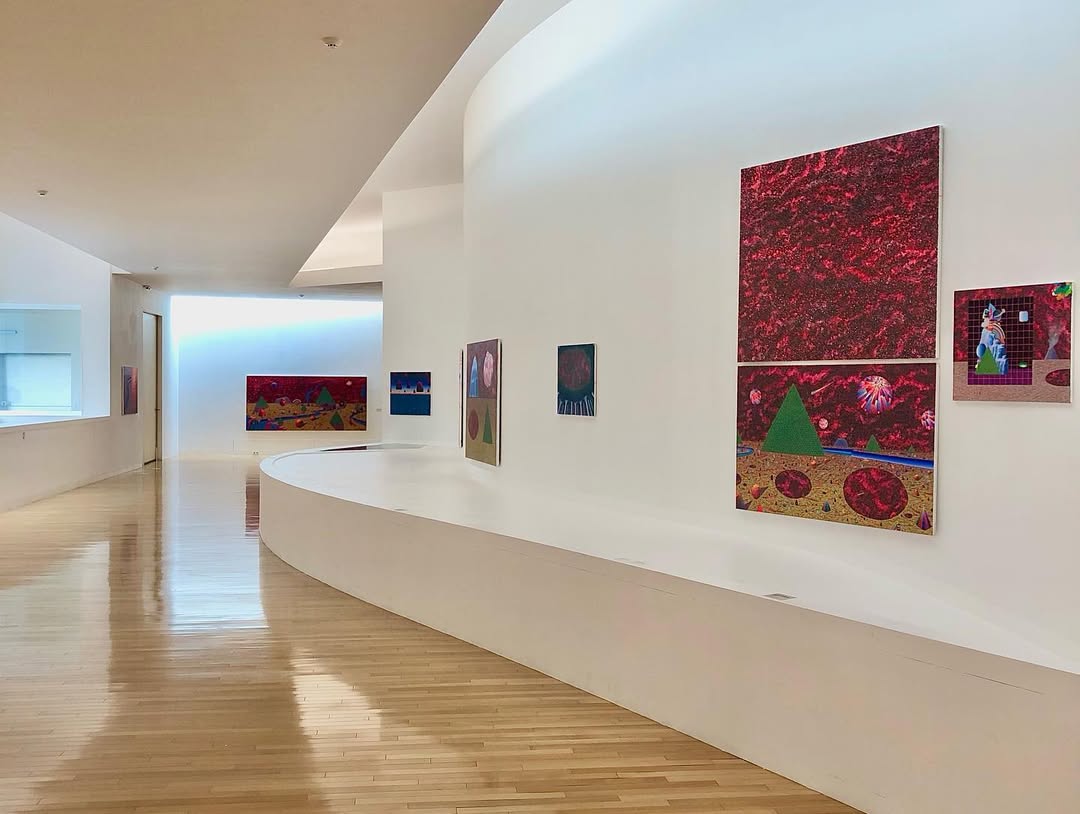
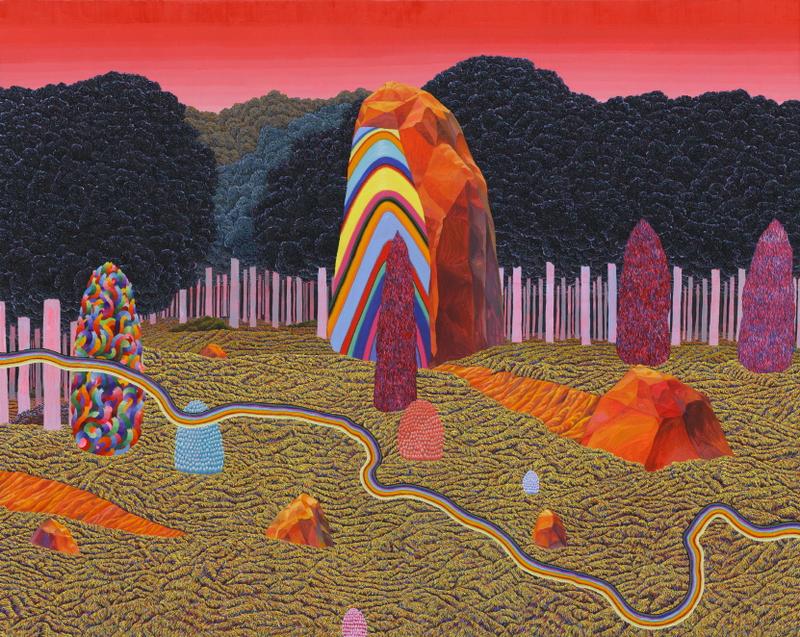
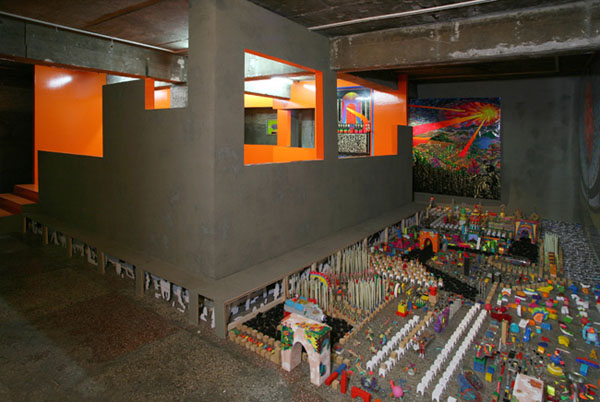
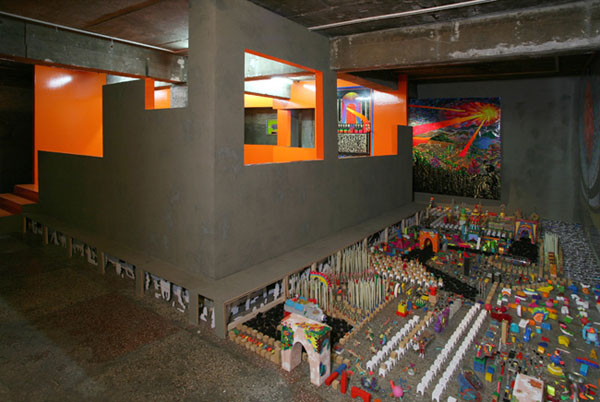
As in Ahn Doojin’s exhibition held several years ago at another alternative space, the exhibition hall here is also staged as a kind of sanctuary. Whereas the exhibition at Brain Factory adopted the format of ceiling paintings, an altar, and a space entered after removing one’s shoes, at Sarubia the structure of something resembling a building is constructed around a pillar in one corner of the gallery, while paintings and objects occupy the remaining space. Occupying the largest area of the dark underground exhibition hall, the central structure—illuminated far more intensely than its surroundings—is painted in a dizzyingly vivid orange.
Compared to the paintings and objects crowded with swarming tiny elements, the platform, forming an abstract plane, becomes visually overwhelming through the sheer vitality emanating from color itself. Ahn Doojin’s paintings are filled with fantastical and bizarre imagery, and this monochromatically treated abstract structure functions as an entrance into those worlds. The platform, which viewers must ascend and descend by stairs, is pierced with openings in multiple directions. Its walls, marked by various protrusions and indentations, become a sort of observatory from which the surrounding space may be viewed.
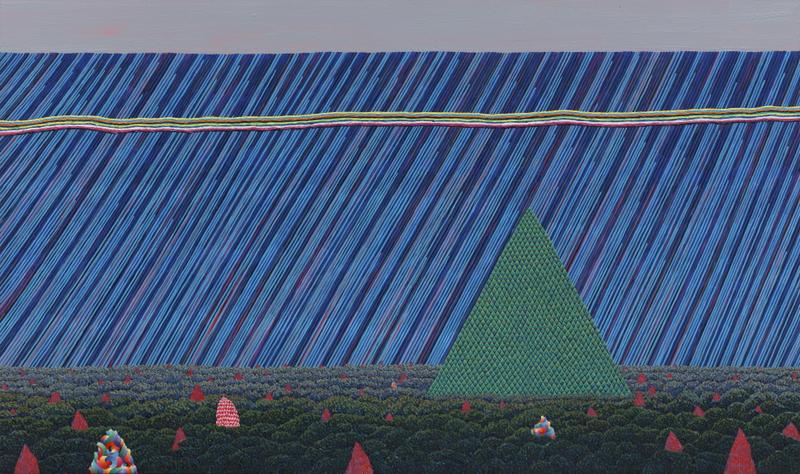
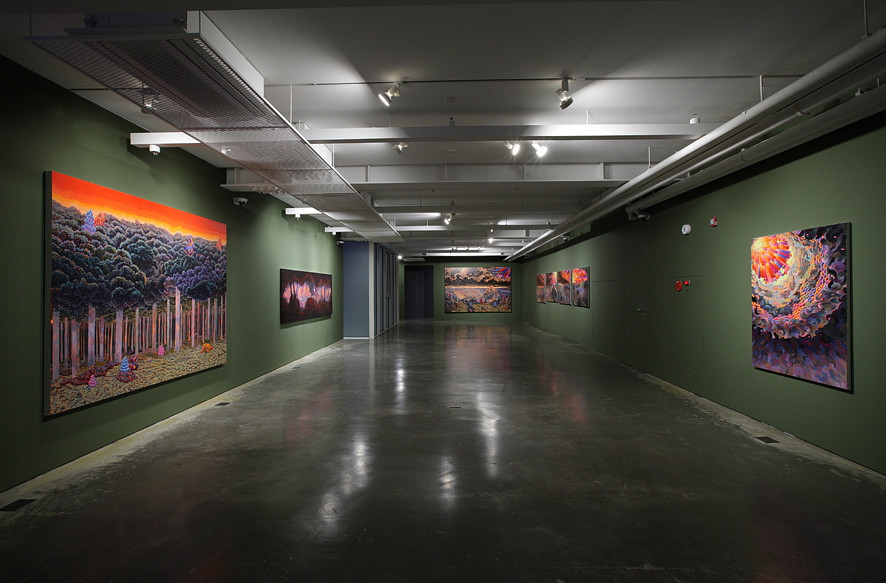
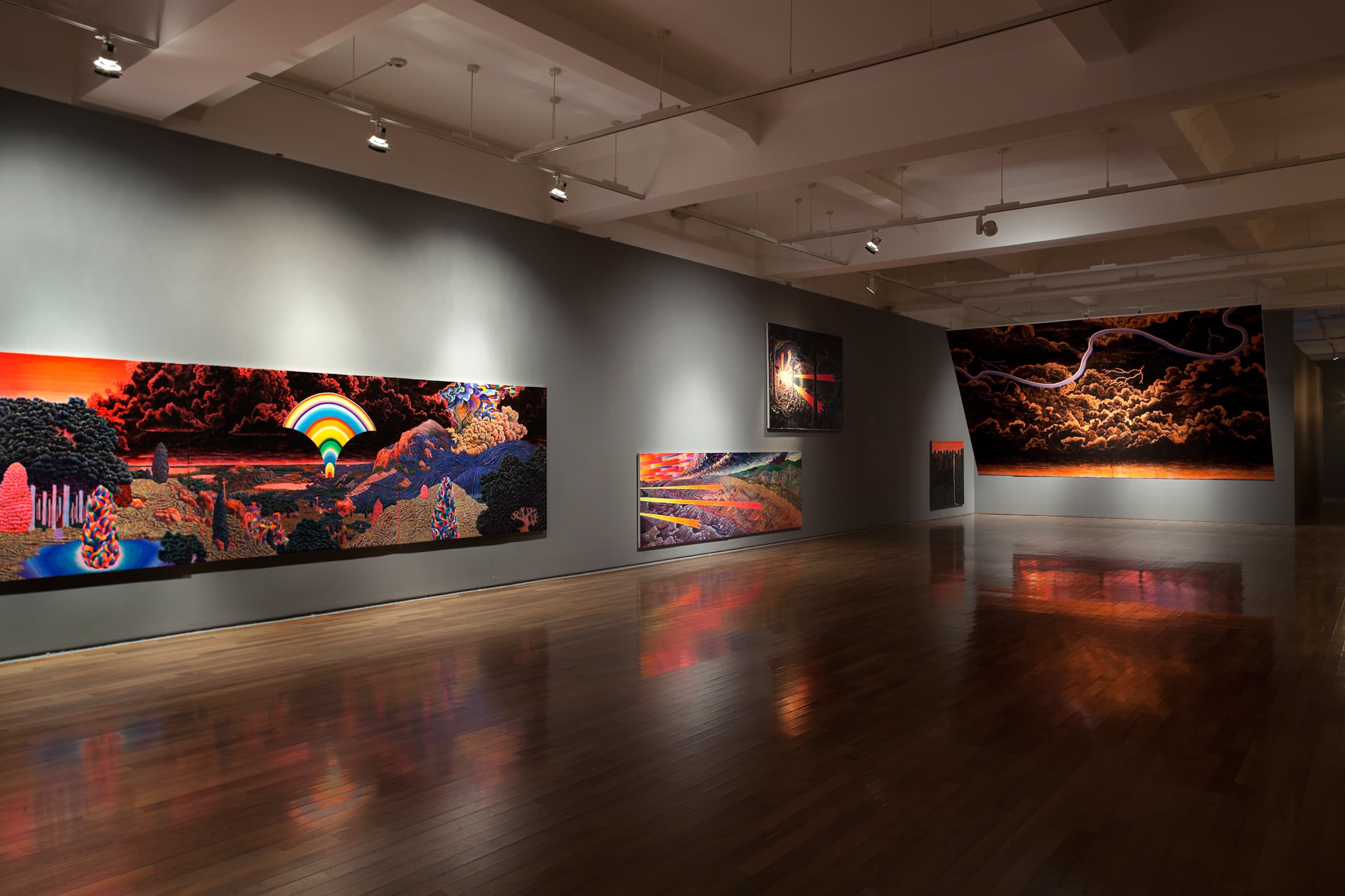
Large and small paintings hang upon the walls, all visible from atop the platform. The scale of each painting changes according to its distance from the platform, and each painting serves as a backdrop for the tiny objects installed beneath it. For example, smaller paintings are placed closest to the windows, while those farther away possess grand perspectival scales. There is also a door that viewers may open and close themselves; behind it, covered with writhing multicolored patterns, appears a knight rushing urgently toward some unknown destination.
Passing through the door connected to a small tunnel carved into Sarubia, one enters a room with two opposing windows opening outward on either side. Resembling a small monk’s prayer chamber, the space emits a quiet glow through windows painted with pigments that create a stained-glass effect, alongside another window shaped like the façade of a Gothic cathedral.
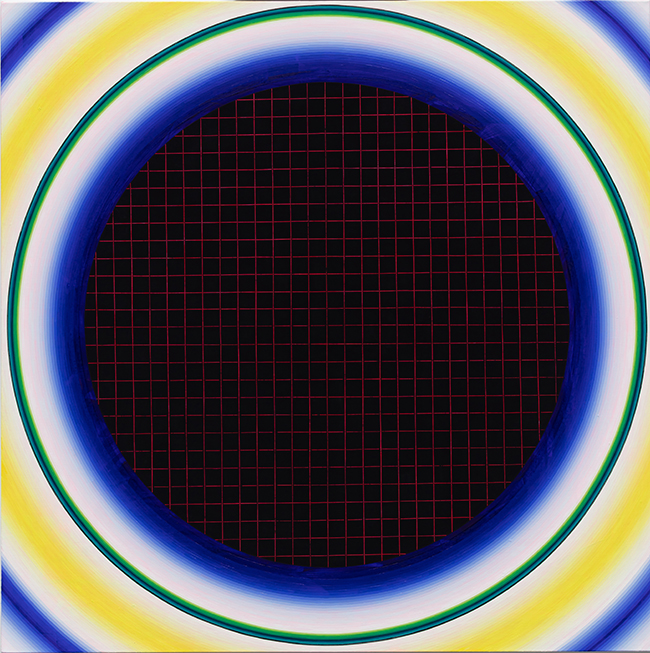
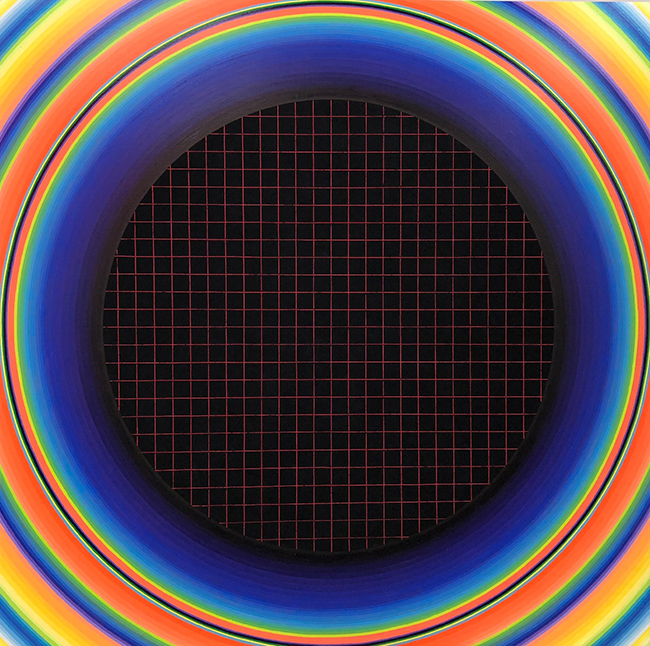
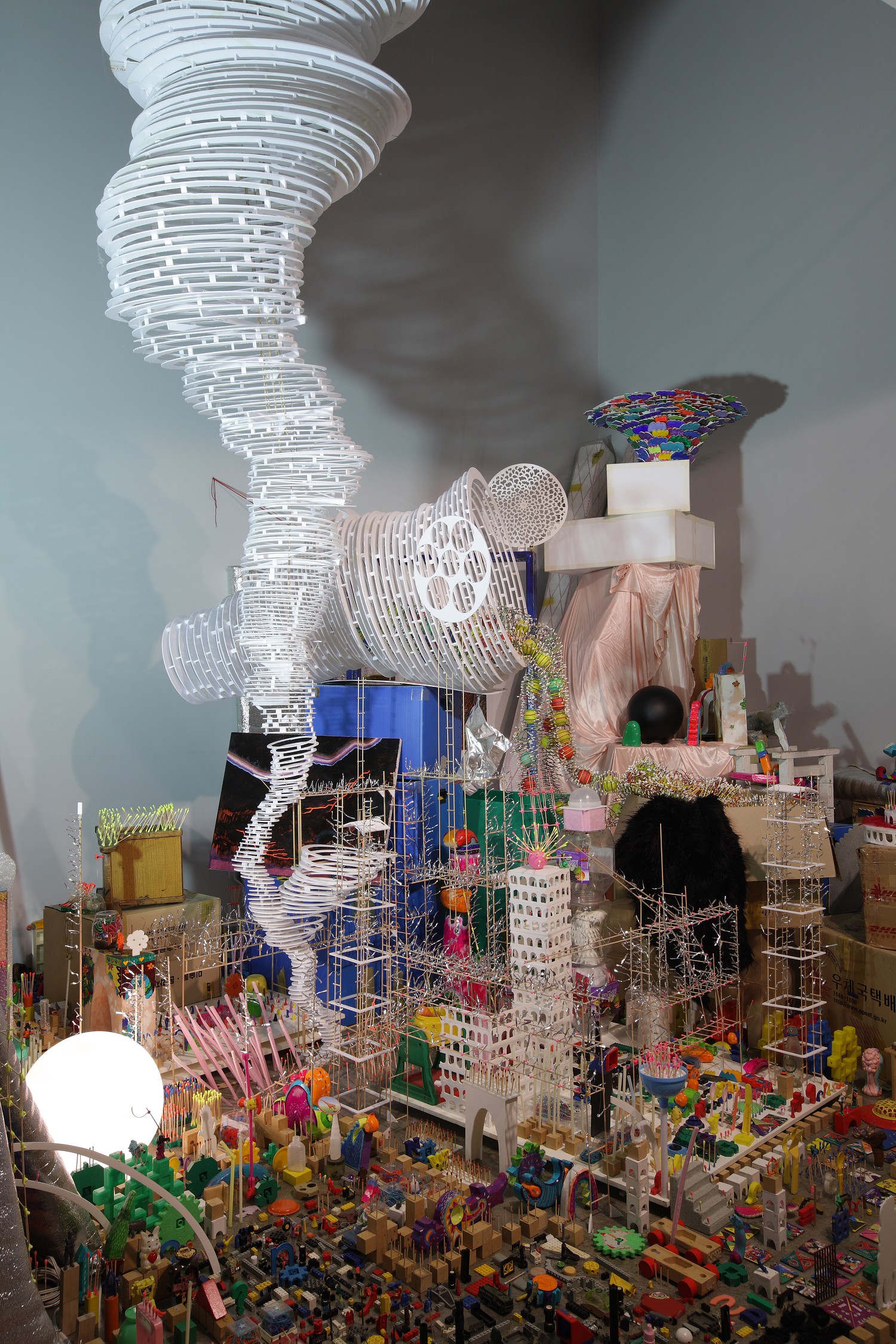
Outside the temple-like structure, the space appears dark due to the contrast in lighting and the concrete walls and floor. Within this dim residual space, the artist has installed rows of small and varied multicolored objects—either collected or handmade—which, because of the difference in scale, give viewers the sensation of looking downward from a great height. The giant circular arena painted on the wall and the densely arrayed miniature objects covering the floor do not evoke the peacefulness of a small fairytale village, but rather an inexplicable sense of tension. Through its height, size, position, and brightness, the platform turns everything surrounding it into an exterior.
Above all, the color of the platform—also the color of the sun—is enough to transform the place where the viewer stands into the center of the world. Yet physically, it is not located at the center. Taking into account varying distances from the walls and passageways connected to side alcoves, the artist deliberately positioned the platform away from the middle of the exhibition space. Through a careful study of the site, he grants a powerful context to a situation in which the individual works might otherwise disperse into fragments. Fragmentary images, prone to scattering in all directions, find their respective places through the symbolic structure of the sanctuary.
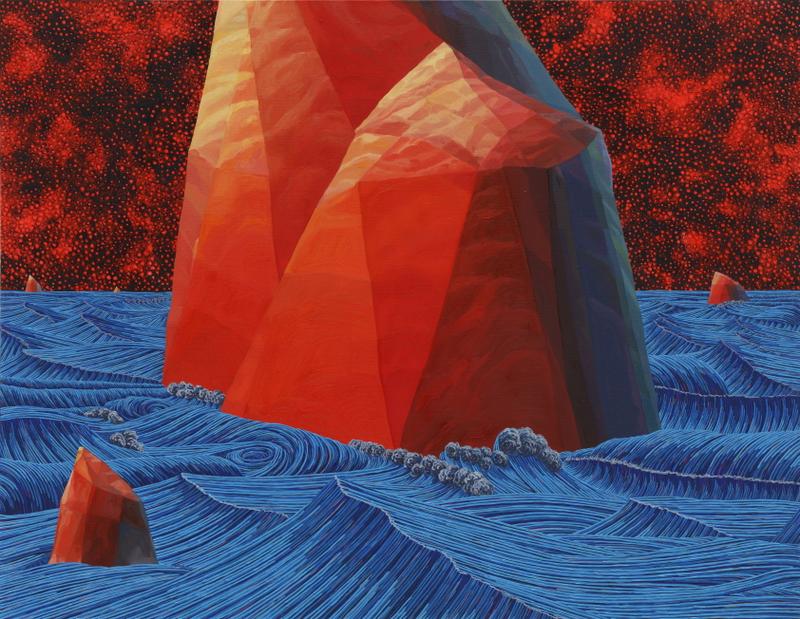
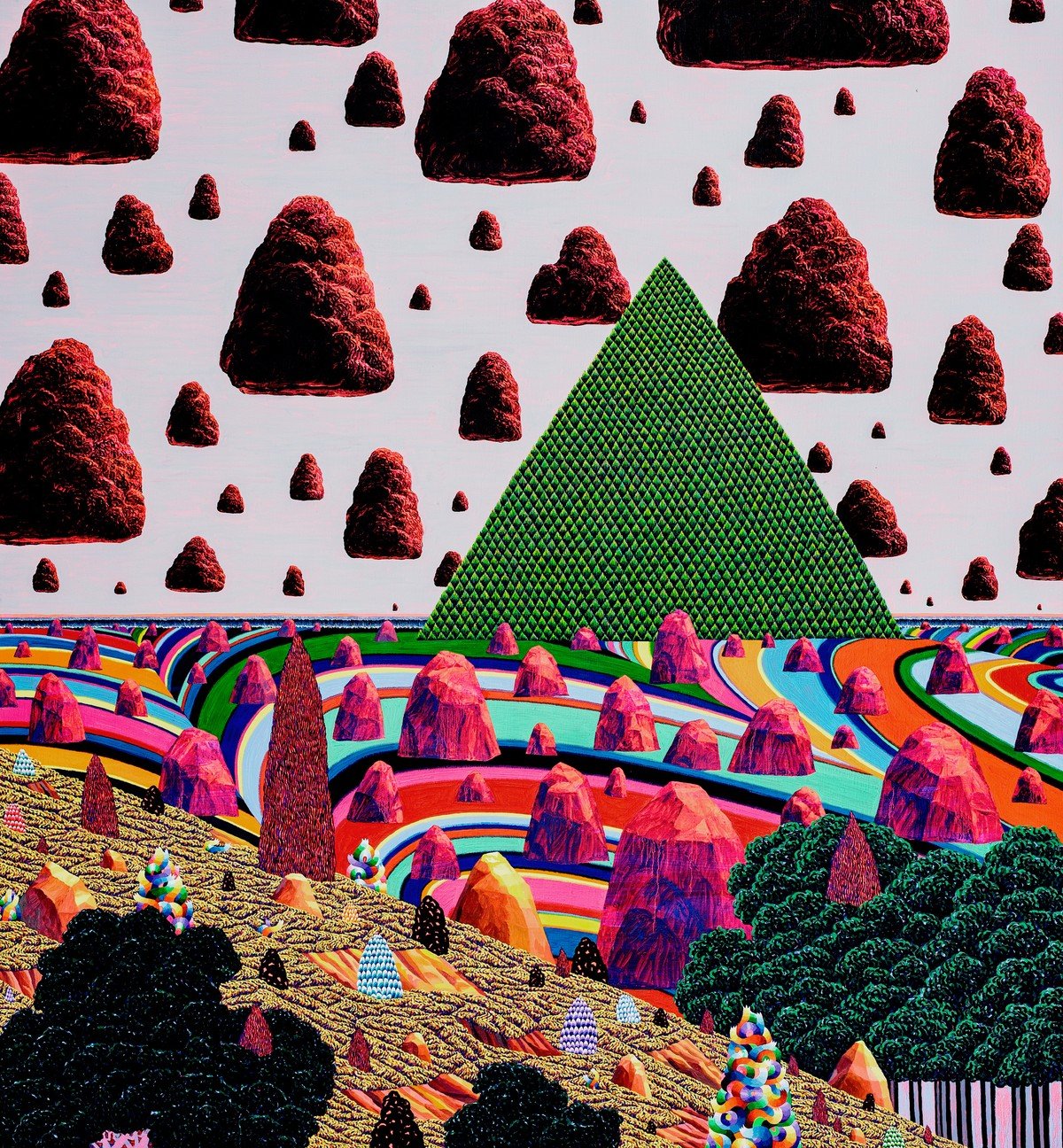
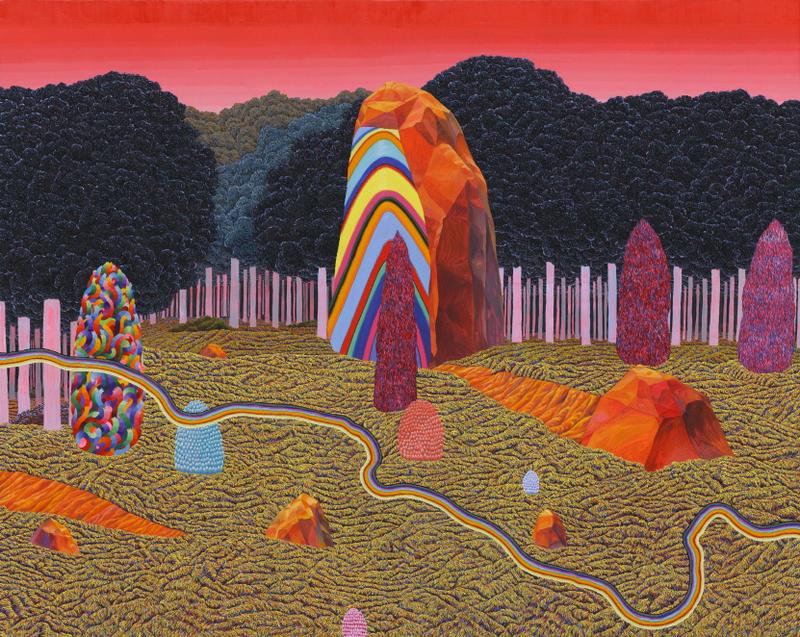
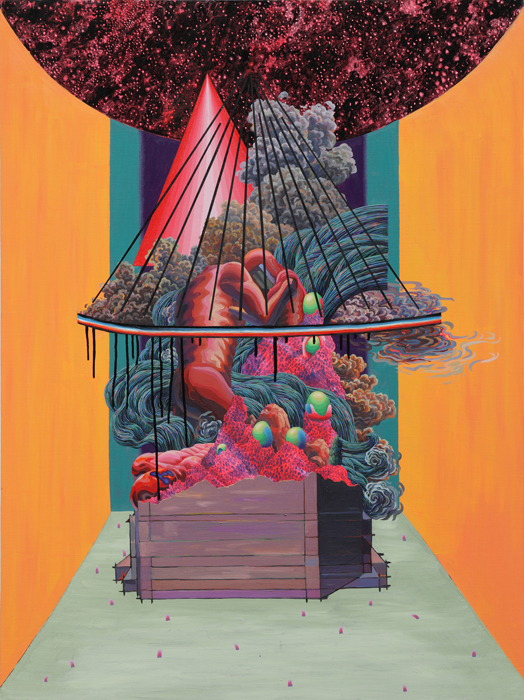
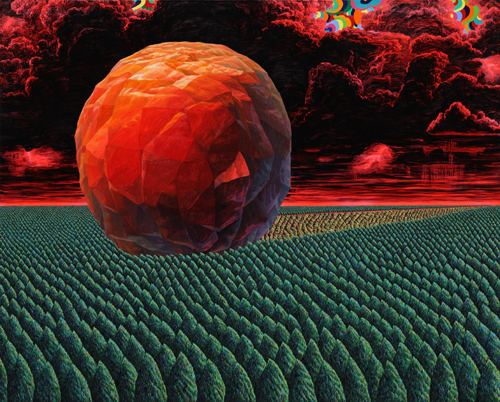
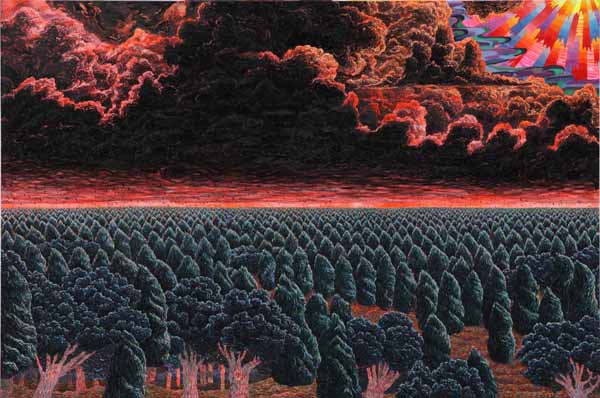
Ahn Doojin’s works are composed and dismantled through elementary particles of image. What he calls “imaquark” is a neologism combining “ima-” from “image” with “quark,” the fundamental constituent of the composite model of elementary particles; it refers to the smallest unit of image that he has created. Imaquarks become blocks or units that combine into diverse forms. In earlier works, imaquarks wandered across floors, pillars, and walls as fragmentary images, producing a powerful overall visual effect, yet their dispersal—that is, meaninglessness—remained a problem.
Faced with the possibility that they might collapse into mere decorative elements, Ahn Doojin concentrates these minimal units of image into the central structure of a sanctuary. At this stage, his work takes on a religious dimension. This is not simply because it employs motifs such as shrines or cathedrals, but because it forms a symbolic universe in which components mutually correspond while gathering into a cohesive system within a single place. The particles that disperse and regroup to form images thus begin to arrange themselves around a more fundamental ground.
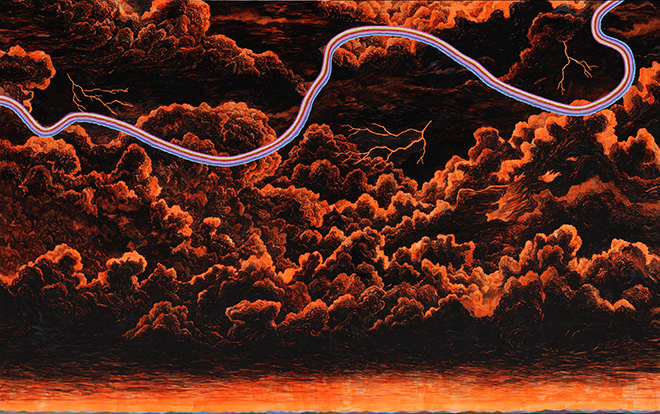
The “hysterical sublime” (Fredric Jameson), in which signifiers surge across the entirety of the wall, seeks to speak not through isolated elements but through the totality formed by a sanctified symbolic space. Of course, as a contemporary artist, Ahn Doojin could not return to the symbolism of traditional religion. In this exhibition, imagery derived from underground comics is introduced through motifs composed of only two colors. The ‘Black Series,’ inserted among the blazing colors, functions as a powerful shadow. The knight immediately visible when viewers open the door in the exhibition is rendered in precisely this manner.
The artist explains that the origins of the Black Series derive from the stark contrasts of light and darkness found in Baroque and Romantic painting, as well as the visual techniques of Frank Miller’s comic Sin City. In his work, the contrast between light and darkness merges religious symbolism with noir-inflected subculture. As popular culture has established itself as the dominant form of contemporary culture, tendencies toward the revival of religious and mythological pathos have also emerged, and Ahn Doojin’s work exists precisely at that intersection.
Of course, his work is neither religious art nor merely art that uses religion as subject matter. Rather, it focuses on the more fundamental layer where religion and art intersect. For the artist, religion is important not as a concrete doctrine or historical institution, but as a vivid human relationship to a mysterious universe. For him, the experience of encountering a sacred presence is first and foremost aesthetic, and in Ahn Doojin’s case, this experience is deeply connected to place. Religious experience is characterized by what Gerardus van der Leeuw described as “the most powerful, comprehensive, moving, and profound experience—namely intensity.”
This resembles the experience categorized by Rudolf Otto in The Idea of the Holy under the term “numinous.” According to religious studies, the original meaning of “Numinosum” refers to “that which is governed by divine will” or “that which is divine,” while the Divine is experienced through the categories of ‘mysterium tremendum’—the mysterious and terrifying—and ‘mysterium fascinosum’—the mysterious and fascinating. The feeling of the numinous, combining mystery and awe, is related to the manifestation of God as the absolute Other and to the perception of invisible forces. The experience of the numinous is dynamic and can even provoke destructive experiences.
Such experiences have historically been visualized through the aesthetics of the sublime in Romanticism. If religion—or Romanticism as religion’s modern descendant—feels too distant, then experiences such as revolution, festivals, or war may offer comparable examples. These are experiences of overwhelming totality that reduce individual existence into tiny particles, and this is precisely the emotional force operating within Ahn Doojin’s work, where stages range from small prayer chambers to vast battlefields. In this exhibition, he attempts to evoke a sense of estrangement—that is, the feeling of an absolute Other—through the total orchestration of a single place.
The orange platform, suggestive of bright light contrasting against surrounding darkness, along with the recurring imagery of light throughout the paintings on the walls, recalls intense experiences that exist somewhere between art and religion. The ceiling, heightened like that of a Gothic cathedral by the small objects spread across the floor, conveys a liberation from physical weight and gravity. In his work, the elements of objects and images are positioned within their respective places, yet they are never fixed. Like cells endlessly renewing themselves, or like trembling souls, they remain fluid within their positions. This is because Ahn Doojin’s imaquarks are living elements that sustain a symbolic universe from moment to moment through the continuous repetition of creation and destruction.