1. Two Tendencies in Painting
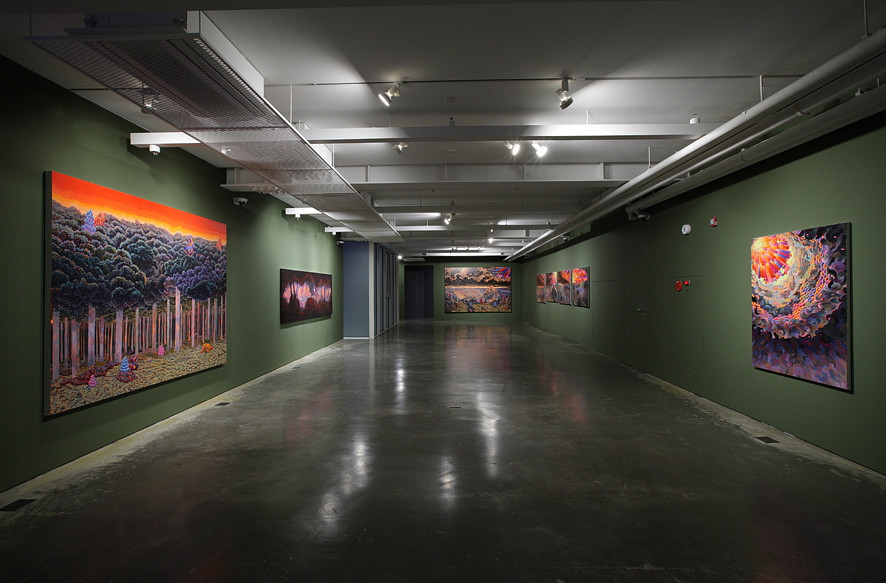
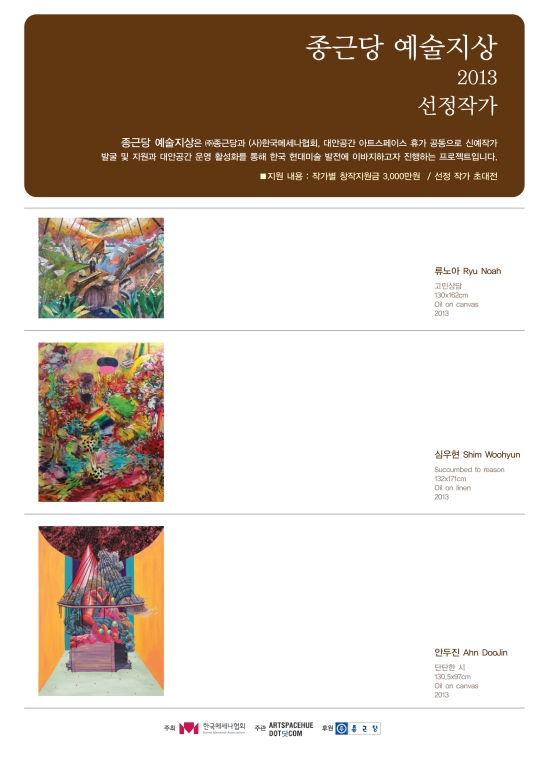
The artists invited to the 2nd Chongkundang Yesuljisang Exhibition are Ryu Noa, Shim Woohyun, and Ahn Doojin, all selected for the Chong Kun Dang Art Award in 2013. If their works are grouped into a single category, they may be understood as paintings closely related to Magical Realism or Fantastic Realism, literary tendencies (or techniques) associated with twentieth-century Latin American literature. In the field of visual art, which has already undergone the experience of Surrealism, the combination of painting and literature is neither particularly new nor unfamiliar.
Magical Realism presents landscapes that resemble reality yet are not identical to it, thereby disrupting conventions, customs, prejudices, and learned ways of seeing, and leading viewers toward unfamiliar emotions and perceptions. It may also be considered an aesthetic adaptation of social criticism. Reflecting on what traditional painted images can accomplish amid today’s highly complex web of visual information and language, one may feel that painting has long since lost its former connection to the world and to reality. Creation that rises against the gravity of existing reality is surreal. Contemporary painting naturally borrows from that power.
Excluding senior and mid-career artists, the paintings of younger artists in the contemporary Korean art scene may, despite the risk of oversimplification or mechanical categorization, be broadly divided into two tendencies in terms of form and style. One tendency is characterized by the chaotic proliferation of countless events, forms, and images across the canvas, while the other presents reality in a loose and ambiguous manner, as though the painting were left unfinished or distractedly interrupted, resulting in blurred and indistinct landscapes.
Abstract painting is excluded here because abstraction within the Korean art scene has weakened to the point that, among emerging painters today, abstract artists constitute a relatively small and less prominent group. Although growing interest in Dansaekhwa has recently brought renewed attention to abstract painting among senior and mid-career artists, abstraction among younger artists tends to unfold less through painting itself and more through conceptual art practices involving objects, installation, and media art. Therefore, this is perhaps a moment in which abstraction is more naturally understood in relation to conceptual art.
Regardless of whether such tendencies are critically judged as right or wrong, they nonetheless reflect how artists today respond to life and reality. More precisely, they reveal how our society is ceaselessly changing and moving amid an overwhelming abundance of events and narratives. At the same time, they also suggest that the dominant frameworks of art history, criticism, and interpretation inherited from the past no longer adequately correspond to the paintings produced by individual artists today.
The works of the three artists invited to this exhibition belong to the former of these two tendencies. There is no doubt that painting continues to represent reality. However, whether the reality they depict is universal—one that all people can empathize with and agree upon—will only become clear through further processes of time, relationships, and critical interpretation of meaning. Reality exists like a labyrinth, and the ways in which individuals relate to it are equally diverse: some are trapped within the maze, some hesitate at its entrance, while others contemplate it from a distance. The authenticity of painting ultimately depends on how deeply each artist’s individual world is connected to the shared reality to which they all belong.
2. Ryu Noa, Shim Woohyun, and Ahn Doojin
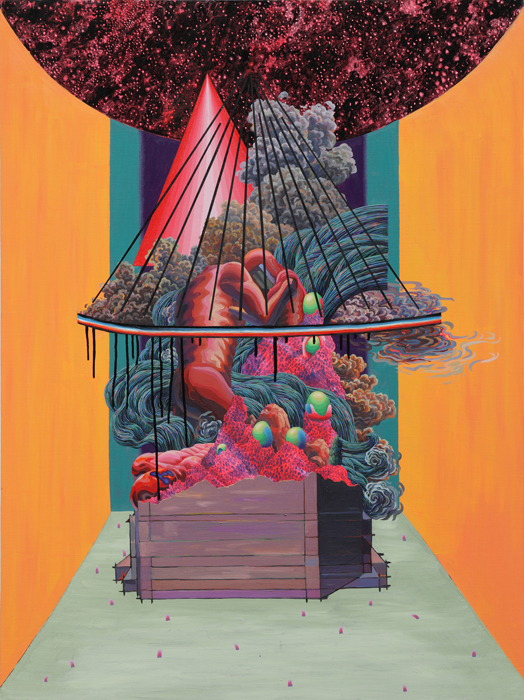
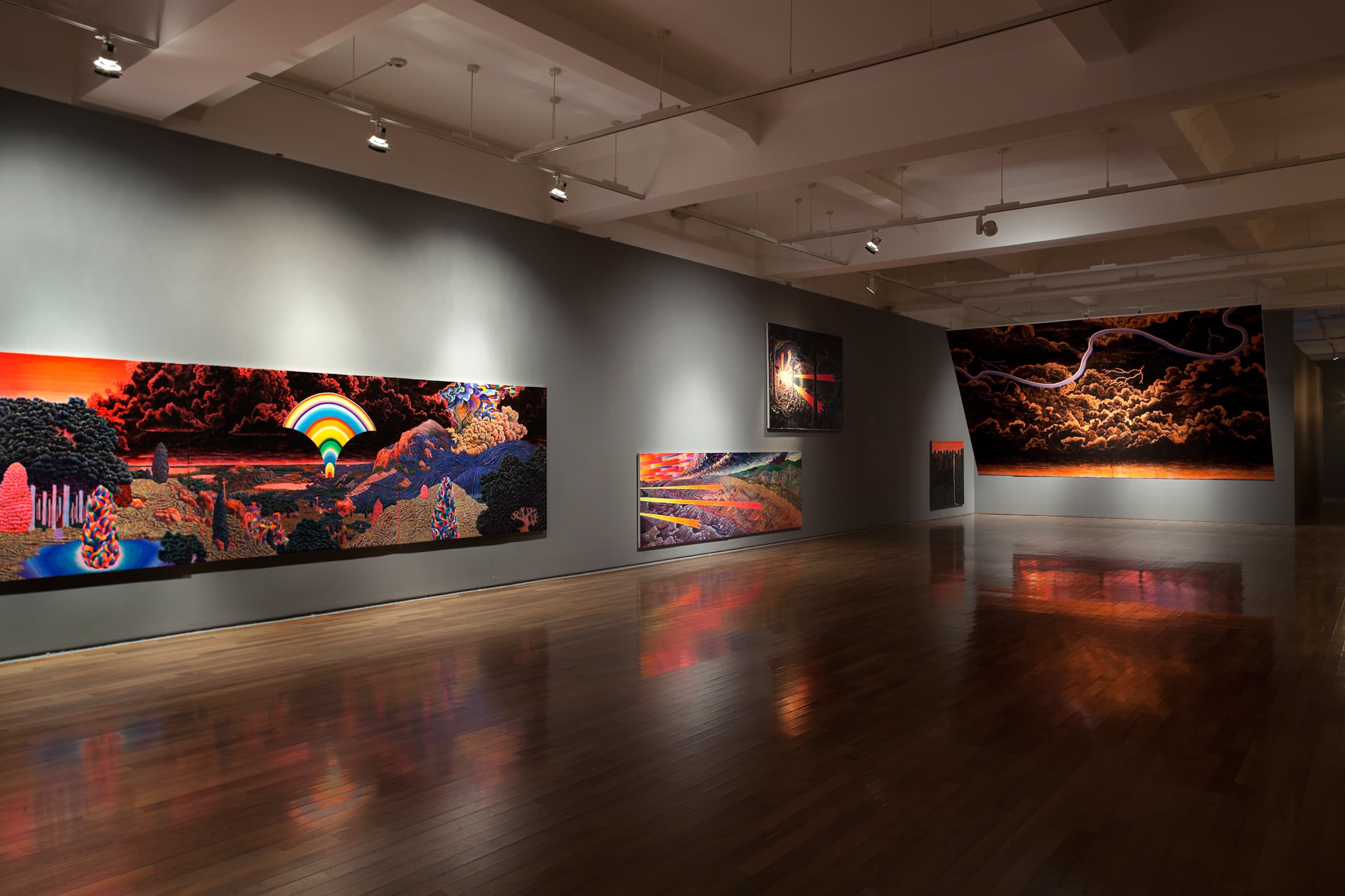
Ryu Noa’s work evokes the spirit of mural painting from around the twentieth century, presenting perspectives of political economy and social critique through images of factories, construction, violence, suffering, and collective action. His paintings resemble landscapes of a reality in which income inequality widens and society grows increasingly conservative under the guise of globalization. Formally, the works appear to inherit the tradition of Surrealism, collaging unrelated images and events into a single scene. Human figures, transformed into machine- or robot-like beings, reveal rough, uncomfortable, and anxious emotions. Looming heavily across the paintings are ominous shadows, as though immense forces of nature, society, and human desire had already swept through like typhoons or tidal waves—or were about to arrive.
His works depict lives swallowed by the shadows of reality, by pain, conflict, and violence. Human existence is cast into a world that is never safe or peaceful. The poses and expressions of the figures, as well as the places and environments they inhabit, are far from cheerful or prosperous. Ryu Noa’s world is filled with cynical realism and social critique. Within the realities governed by economics and politics, human beings become instrumentalized like mere components. Yet humans continue to exist as thinking and reflective beings, unable simply to accept such realities as they are. Humanity thus appears as a critical existence.
Ryu Noa’s visual imagery exposes the immoral aspects of political economy that unfolded throughout the nineteenth and twentieth centuries. War unfolds daily as though it were part of ordinary life. That is the reality upon which we stand. Dreams clinging to such a reality can only become shabby and miserable. The emotions of people living through an era lacking lightness, purity, warmth, and the power to transcend reality are transformed into images. Within his paintings, the contradictions and conflicts embedded in both humanity and human reality seem to be under construction, gradually taking shape.
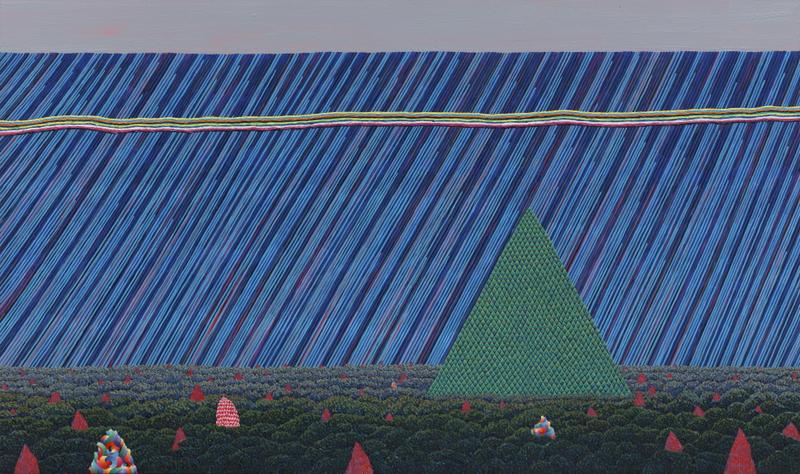
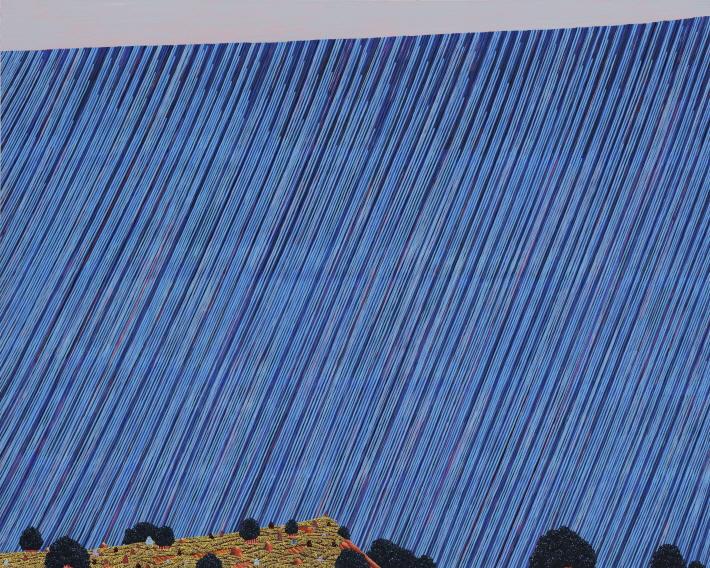
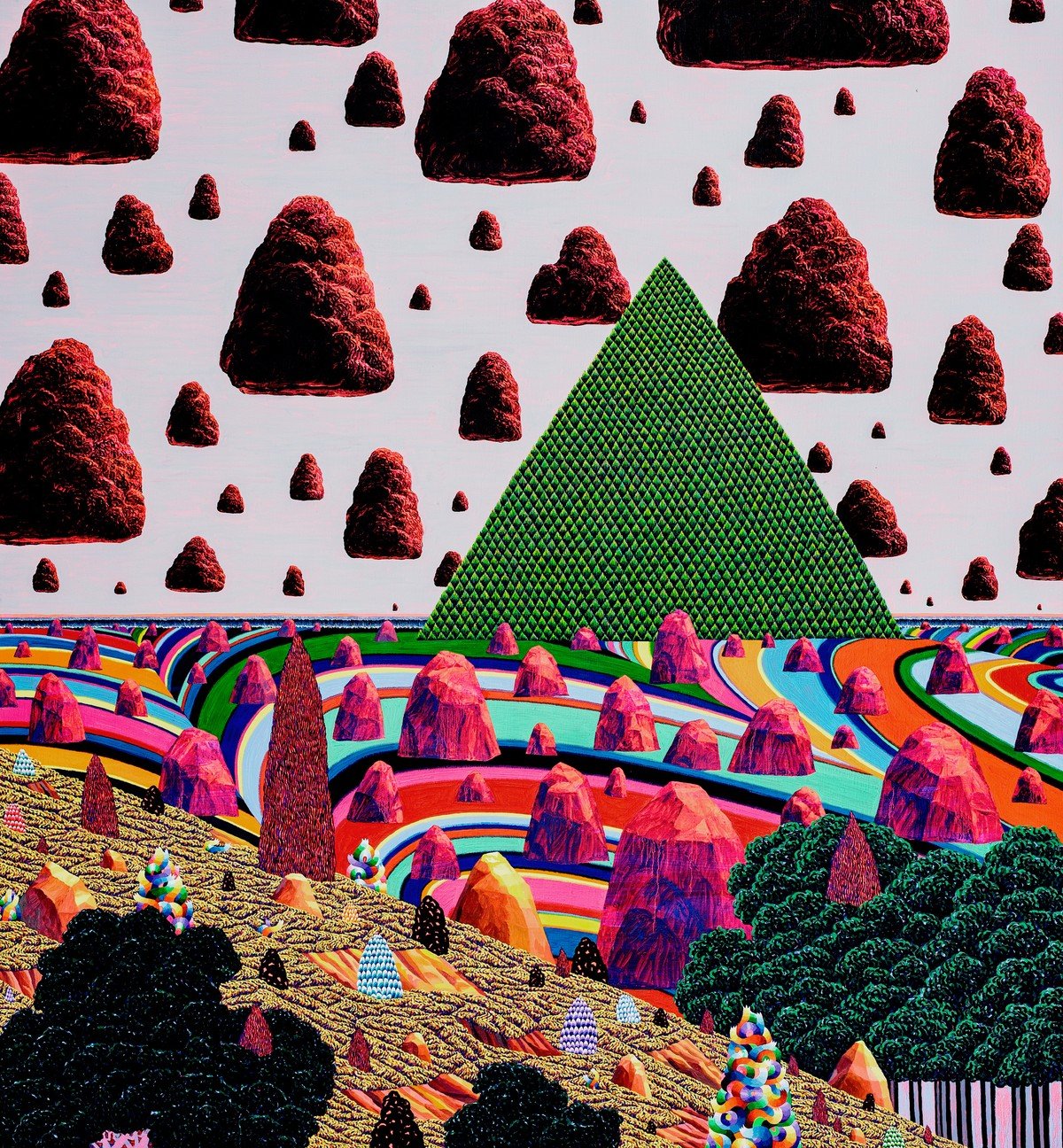
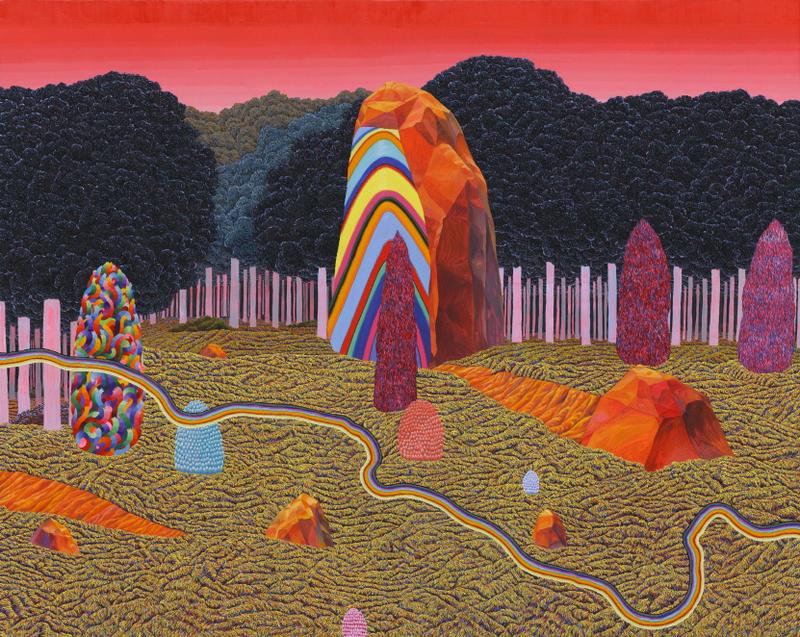
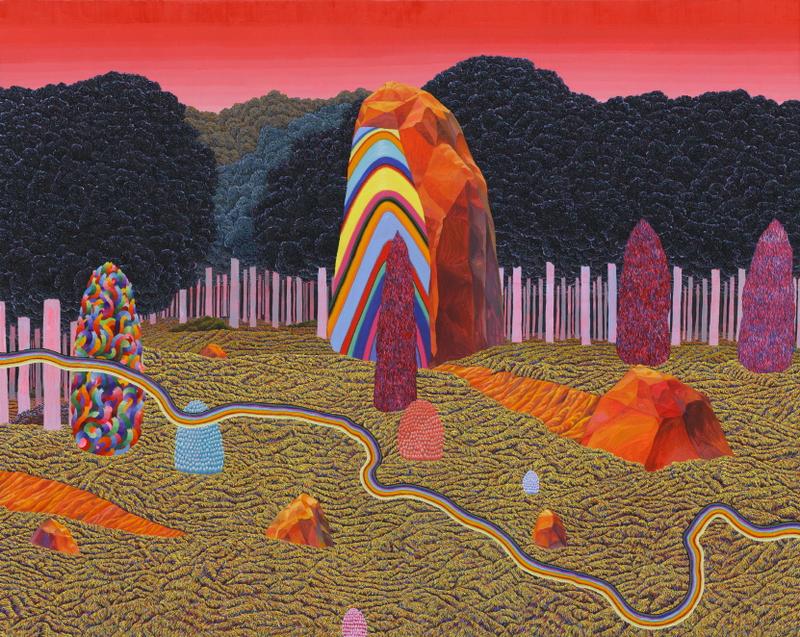
Shim Woohyun’s paintings are entangled like labyrinths composed of familiar flowers, weeds, trees, forests, and mountain ridges. Her imagery resembles natural landscapes. In a dreamlike state, hesitant and layered twofold and threefold, the plants of nature become organically interconnected. Densely filled with drawing and color, the surfaces resemble vast forests or mural-like labyrinths. The forest stretches out the hours of midday, prolonging time through reverie. To drift into reverie is to be driven toward places and moments that suddenly emerge only to be inevitably forgotten. Shim Woohyun’s drawings do not impose order upon the chaos of individual and particular experiences. Rather, they are representational movements that proceed while acknowledging the mixture of experiences as they are.
The overlaps and confusions of ambiguous and indefinable images become metaphors for the deep inner movements of the one who draws them. Drawing itself becomes a metaphor in motion. Her drawings are suggestive, like shadows or illusions of reality. They transform events and materiality into dreams and surreal states. They present fantasies structured through impossible forms and flows, as though envisioned by a lucid mind in the midst of dreaming. As a concise and lucid form, drawing functions as a method for constructing monumental murals. Whether recording and representing subtle shifts of sensation and emotion, or addressing humanity, nature, or the self, drawing becomes for her a monumental device. Through the artist’s paintings, viewers come to sense that the vitality of forests and nature still survives around the places we inhabit.
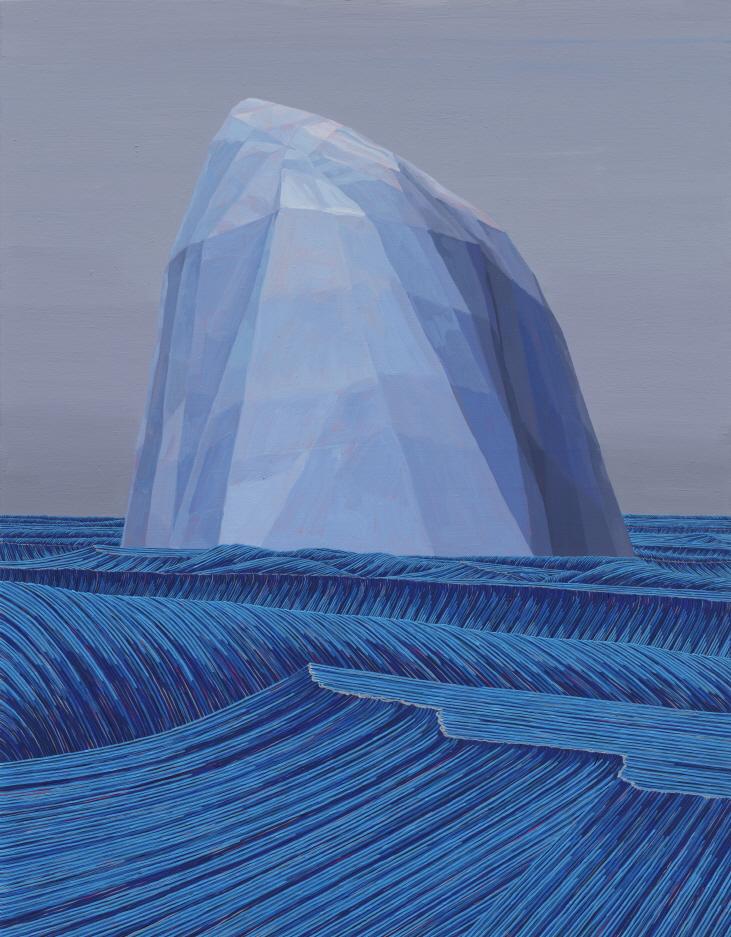
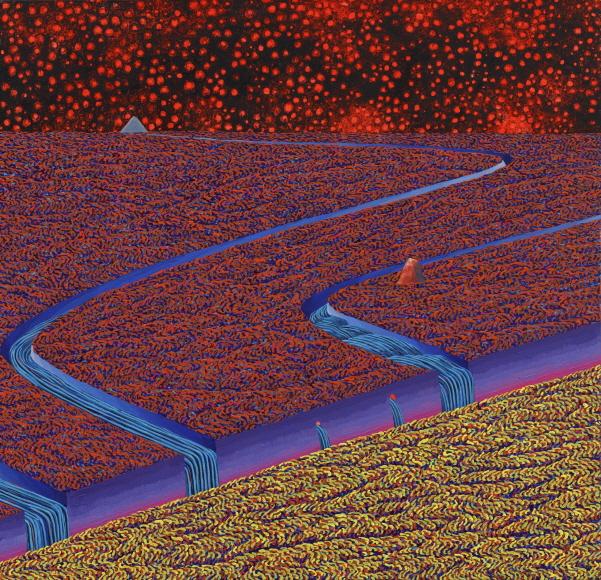
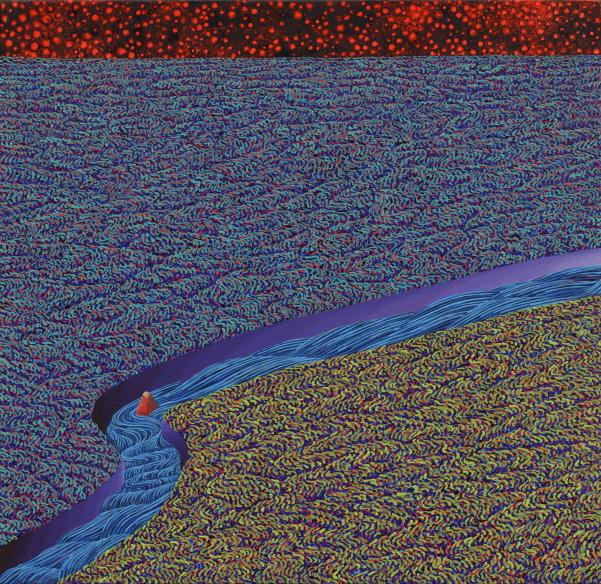
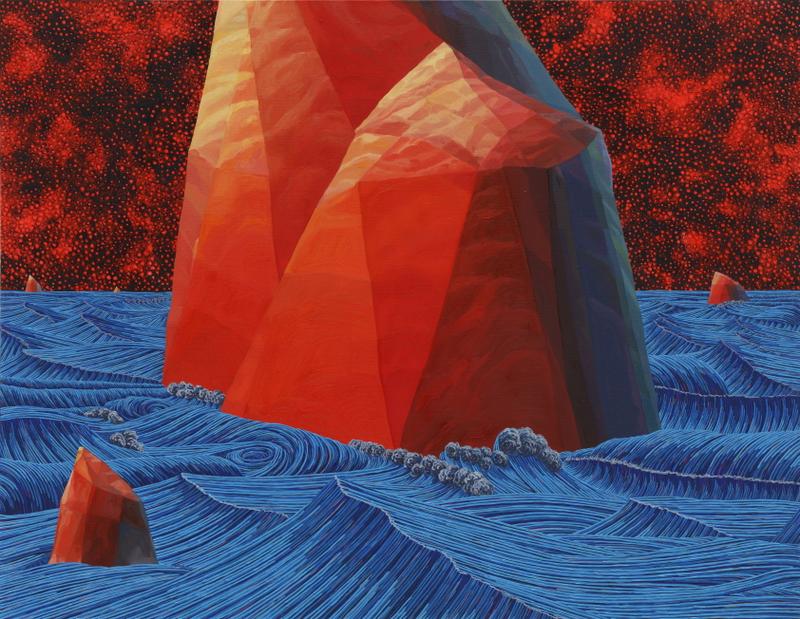
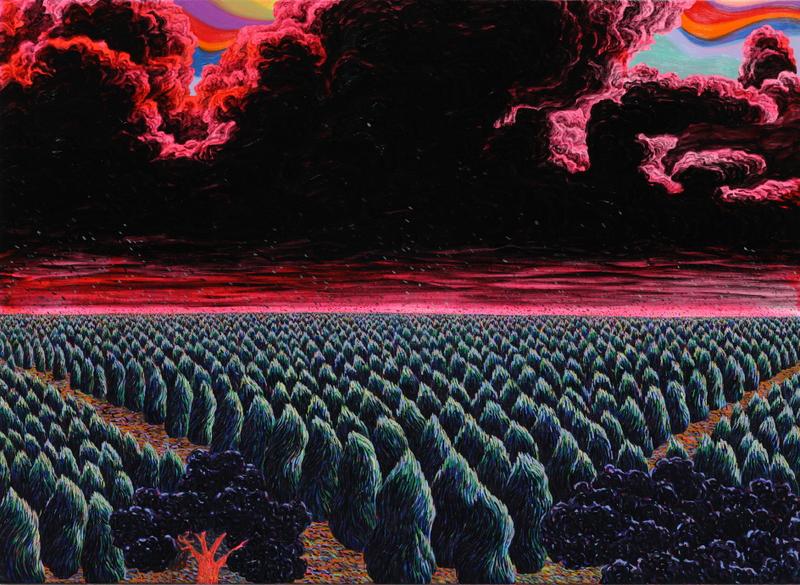
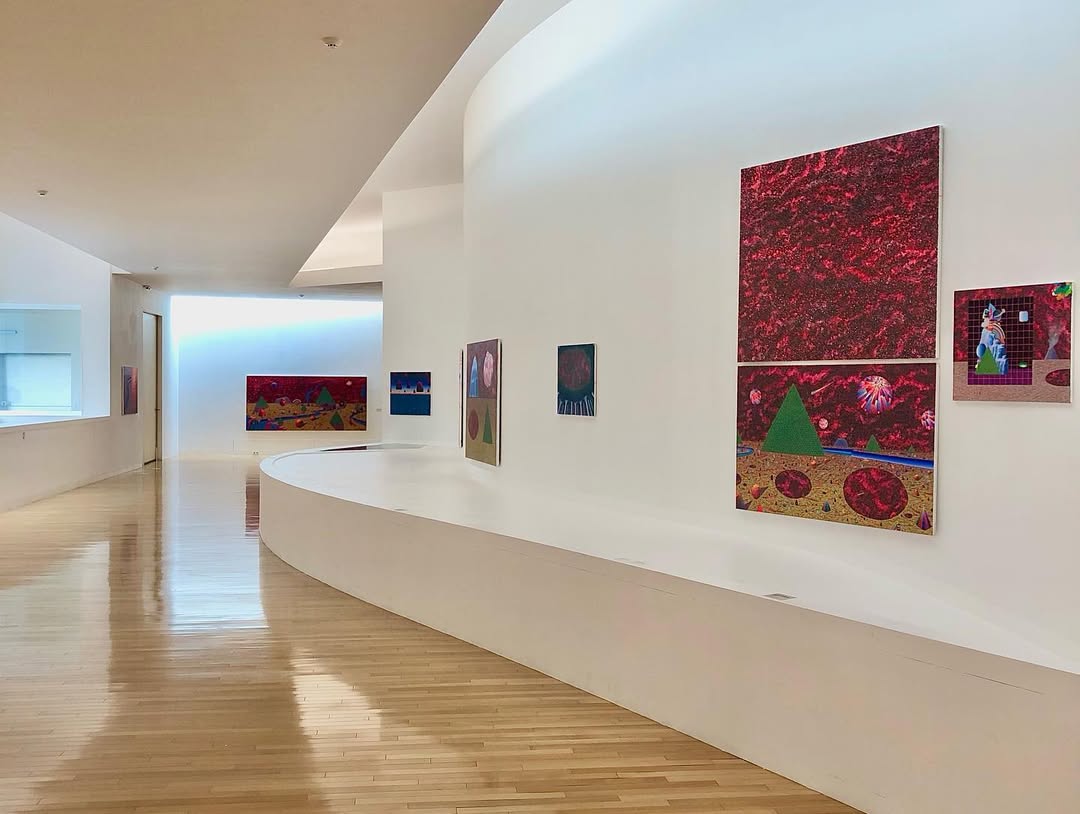
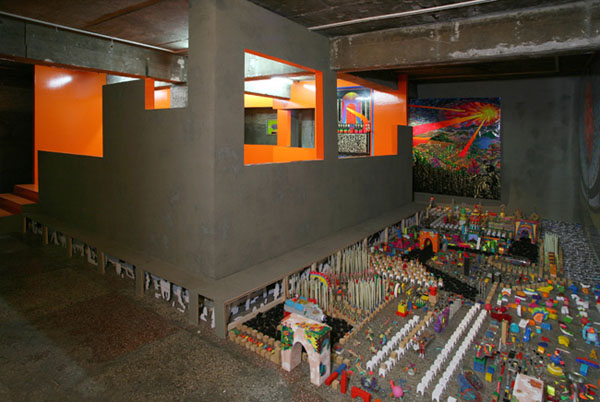
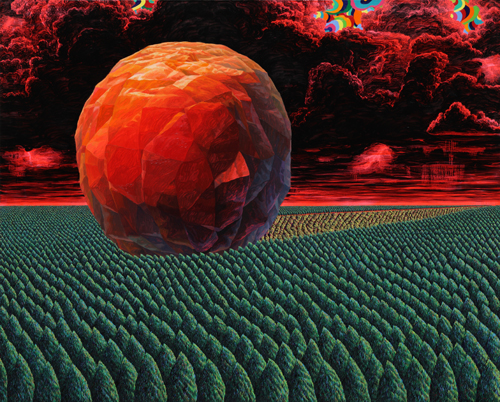
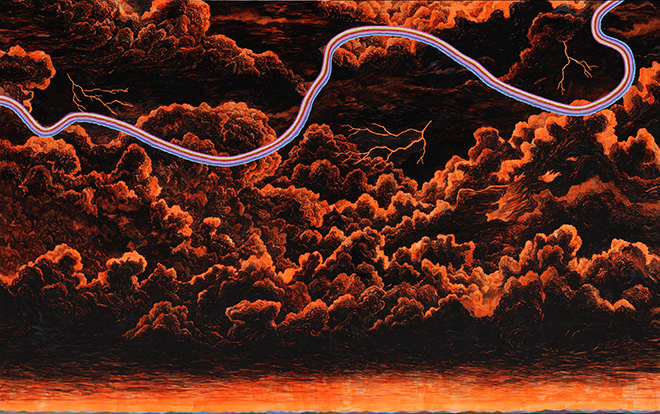
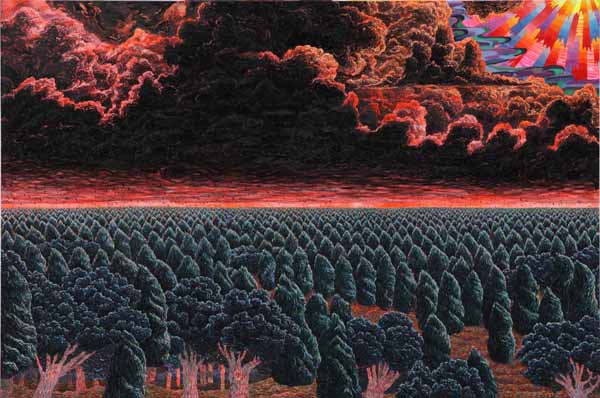
Ahn Doojin has long depicted landscapes of unreal and surreal worlds steeped in shades of red. His paintings seem to offer glimpses into another dimension shaped by an ominous worldview. Premonitions of thunder, lightning, and swirling storms envelop the entire surface, as though the moment of judgment before a final war were imminently approaching. In this exhibition, as the scale shifts gradually from monumental canvases to smaller ones, a large rock is slowly worn away until it ultimately becomes a tiny stone, rendered through the artist’s distinctive unreal landscapes.
Though the world spins chaotically amid endless commotion and disorder, the rock remains silently rooted in its place. What changes are time and the one who looks upon it. Seen not from a human perspective but from that of the rock, the world is neither ominous nor unsettling. The reality of the rock exists within eternity and permanence. It is a surreal world in which eternal time and fleeting moments coexist simultaneously. Like the surreal world dreamt by the rock, the images envisioned by the painter are fundamentally different from reality, no matter what conditions or structures of reality they may be combined with.
Even if they resemble reality almost perfectly, dreams are not reality. They transcend it. Yet this too is a kind of optical illusion. Just as a rolling stone appears continuous, the succession of images ultimately remains a series of intermittent observations and reflections upon a rock deeply embedded within reality.
3. Between Reality and Surreality
Painting pursues reality. At the same time, it dreams. And it expresses. Painting moves back and forth between dream and reality, representing the space in between. Within countless painted images, human beings, life, reality, and surreality are combined in varying proportions. Everyone dreams. You dream, and I dream as well. Yet although everyone acknowledges that dreaming while living is itself a natural part of reality, believing that those dreams actually unfold within reality is considered an entirely separate matter.
Billions of people stand upon the earth, constructing reality, sensing it, and thinking through it. At the same time, just as many people dream, comparing their dreams with reality as they live. Almost everyone, to varying degrees, enters more deeply and passionately into the reality of breathing, eating, working, loving, and sharing friendship through the experience of their own dreams.
We are so easily intoxicated by dreams because no matter how happy, complete, or vividly alive a reality may appear, it can never fully satisfy us. Perfect reality—ideal reality—can never truly be achieved within the reality we inhabit. The reality in which desire and the fulfillment of desire meet is attached to surreality, or to dreams. At that point where the boundaries touch, we become uneasy. Through the labor of the artist, painting attempts to capture both reality and surreality at once. It seeks to understand them and empathize with them. Artists enveloped in dreams and fantasy move with ease between reality and surreality.
Surreality is often regarded as delusion, unreality, or an inability to adapt to reality, and for such reasons it is frequently dismissed and excluded. Thus artists immersed in worlds beyond reality are often perceived in ordinary life as strange or eccentric beings. Yet in their presence, we are able to discover forms of reflection that inspire us.
The fact remains unchanged that mortality—the condition that all reality ultimately turns into a handful of dust and earth—is the human condition. Between immortality and mortality, reality and surreality, art continues faithfully and joyfully to seek its own path. That is the work these artists undertake, and the reason painting remains meaningful still lies in its invitation to contemplate the profound relationship between humanity and art.