There was a day when I did not look into a mirror even once. One might assume such a day could easily exist, but for a person living attached to a city, experiencing a day without any reflective surface in front of one’s eyes is nearly impossible. In terms of rarity alone, it would be quite a precious event. Mirrors—without even trying to extend their meaning—are truly everywhere.
Even within the field of vision captured by simply turning one’s head, there are as many as nine objects capable of reflecting a face. They shine so brightly. If one were to count them as though engaging in a trap game, one would be astonished by its merciless difficulty. Therefore, knowing a day in which I did not look into a mirror even once is one of the few things I can boast about.
Anyway, today, even as I boldly throw myself into a contest toward the friction of my fingertips and the resolution of my eyes, there is always that gloss that smoothly steps in as a guide. Let us talk about that thing into which a certain beauty once abandoned its breath and leapt.
Among those who participated in Anything NFT? LAB sessions 0, 1, 2, 3, and 4,
I write a review of Bunshinsama Divides a Diary into Three Parts.
Bunshin-nim, Bunshin-nim.
分身さま, 分身さま.
Published in 1987 by Grand Lucky, Bunshinsama Divides a Diary into Three Parts is a short novel intended for readers capable of reading three channels simultaneously.
The author depicts the twenty-third gathering of a secret rebellion group formed to dismantle a future city society that is wise, kind, just, and considerate. Because these rebels seek to prove values that are even more positive, wise, innovative, and just, they attempt to understand and transcend the city’s system more deeply than anyone else. Eventually, they come to excavate and experiment with an ancient and mysterious decision-making system.
The author introduces the diary of a person about to be hospitalized for childbirth on May 5, 1987. The protagonist of the diary cannot believe that they, who have never even broken a bone, are about to give birth. To shake off tension, the protagonist constantly searches for things to do. They pack extra clothes, throw away leftover tea only to boil it again, go out impulsively, and eat foods they had previously avoided.
Then suddenly, recalling the sensation in their fingertips from having once ghostwritten a nephew’s overdue homework for pocket money, they decide to write a diary. Weather, names, good deeds, regrets, things seen and heard, secrets that need not be kept, foods they could not eat or had to eat due to excessive interference from others, being told when to give birth, delaying it, reasons attributed to fate or fortune, and even strangers arbitrarily naming a child they themselves have not yet seen. Enjoying the fate of two persons at once, they consider that it might be acceptable to write as if recording someone else’s day.
The author has prepared Lucky, a cheerful guide and adorable companion. This somewhat talkative friend hops through and explains every word, combination, and connection appearing in each story. Like playing detective, it trails behind, only to suddenly run ahead and send crumpled invitations. Constantly humming and observing its surroundings, Lucky blames the insufficiency of pages.
Welcome.
おいでください.
* Like listening to a trio or a concerto, the novel invites readers capable of reading three narratives simultaneously. Unable to become such a reader, I decide to refer to the solution chosen by the characters in the novel. Thus, I invite Bunshin-nim to take a seat.
Below. Me: D, Bunshin-nim: ????
D: Bunshin-nim, Bunshin-nim.
????:
D: Bunshin-nim, Bunshin-nim. Welcome.
????:
D: Bunshin-nim, Bunshin-nim. Have you arrived?
????:
D: Bunshin-nim, Bunshin-nim. If you have arrived, please respond.
????: Yes.
D: You have arrived. Thank you for coming such a long way. Also, it is nice to meet you. We greeted each other while participating in the “Anything NFT Workshop,” but quite some time has already passed. Have you been well?
????: Yes.
D: I’ve been thinking about you a lot lately. Once, you said, “The clearer a memory is, the more I suspect its contamination. With the mindset of washing one’s face in the morning, I use a mirror of chillingly clean contamination to examine my own making.” That left a deep impression on me. I can vividly recall your tone, gaze, and gestures at that moment. Is this what you meant by a vivid memory? While the act of uttering those words remains very clear, I cannot quite remember the surrounding context. It seems that the more we wish to preserve a memory in a special place, the more we polish and refine it with great effort.
These days, I have several memories that feel suspicious precisely because they are so vivid. Regardless of whether they are good or bad, what feels suspicious is that their resolution increases the more often I recall them. Moreover, I keep discovering new scenes within them. Some memories I have revisited multiple times allow me to vividly recall even the smallest details—the texture of the carpet I stepped on, the smell of cookies, the sensation of stroking the worn edge of a table.
I feel as though I could revive those tactile sensations instantly. Here—this is the mark from when I scratched myself touching that edge. A splinter got lodged there, and since I left it alone, it became a dot. There is no room for doubt. Because it is such a clear and complete memory, you must believe me. It must have been important and special, as it remains this vivid even after decades.
It seems you do not believe me. I wrote it down in my diary. Look here. May 5, 1987, weather: clear. It was Buddha’s Birthday according to the lunar calendar. Dragging my unusually tired body, I went to Gwanghwamun. As always, there was a lantern festival, and I remember walking along an endless path of lanterns. After that day, there would be circumstances preventing me from moving freely for a while. So I thought I should do whatever I could while I still could. I had to go out somewhere.
Rather than holding onto anxiety, it felt better to keep my body busy. Also, I woke up unusually early that day. At first, I tried to fall back asleep, but it wasn’t easy. Even with my eyes closed, I could tell the sun was rising. I should have changed the curtains earlier. Eventually, I gave up, and because of that, I had to pretend to be busy all morning. I organized trivial belongings and packed more clothes and daily necessities. That was also when I found the notebook and put it in. In truth, I had already entrusted most of the necessary belongings, so there would have been no problem going empty-handed. Finding things to do became the task itself.
Laundry piled in the corner caught my eye, but someone else would probably take care of it. I wanted to do something more useless instead. So I threw away all the leftover jujube tea and brewed it again. Thanks to that, I managed to pass the time until I had to think about a late lunch. The phase of craving food recklessly had already passed, but that day I felt like eating something extremely spicy and cold. Very spicy and very, very cold. There was a good bibim naengmyeon place nearby. The owner made buckwheat noodles by hand and piled seasoned raw flounder on top like a mountain. It was famous for its sharp spiciness and had many regulars who liked spicy food. There are many expressions for “refreshing”—rich and spicy, filled with ice, generously served.
The naengmyeon there truly refreshes your entire insides. And then, yes. I went toward Gwanghwamun for dessert. There was a café I liked, and I suddenly thought of their mango sherbet. Since I had decided to move my body rather than hesitate, I went there without thinking. But when I arrived, they hadn’t started serving yet. I thought it would be around May when people start wearing short sleeves, but apparently not yet. Normally I might have had coffee, but I had already had too much caffeine. Leaving with disappointment, I decided to look around the area. The garden visible from the café could also be reached on foot. Following the connected path upward leads to a quieter alley.
As the sun was setting, I saw round lanterns hung for the Buddha’s Birthday event gradually lighting up one by one. I don’t know what connection triggered it, but suddenly I remembered that a shop selling thirty-one kinds of ice cream had opened nearby. I had wanted to go there someday, and it felt like the right moment. I even felt that my anxious mood, my random cravings, my disappointment, and the busy lantern festival were all warm-up exercises for eating those thirty-one kinds of ice cream. Then, without even needing to search for the way, my feet seemed to know exactly where to go. Pistachio almond suited my taste.
????: Yes.
D: Yes.
Yes, that’s right. I borrowed part of the content from Grand Lucky’s novel Bunshinsama Divides a Diary into Three Parts. I had recommended it to you while preparing for today’s conversation. If it caught you off guard, I apologize. I was not trying to waste time with a dull joke or check your homework. Recently, I’ve been entangled in complicated thoughts and ended up forcing a clumsy attempt. Still, it is not entirely false. Perhaps because many parts resonated with my personal tastes and experiences, simply reading it allowed me to expand very satisfying imaginations.
I felt as though I could know better than anyone the boiled jujube tea, Gwanghwamun on Buddha’s Birthday, the favorite garden, or the taste of pale green ice cream. Everything I experienced while reading the novel seemed to brush vividly across my skin. I could describe in detail how crudely the handle of the ice cream spoon was shaped, or what the texture of its edge was like.
But perhaps in a few months—or even weeks—I will forget quite a lot. Some impressive moments may remain as words or scenes. Pistachio, or the rounded gesture I mentioned earlier. Each time I recall it, I might reproduce similar hand movements and gradually attach other memories with similar gestures. Having gaps or unknown parts is frightening and quickly makes one uneasy. So I will carefully fill those gaps with things familiar, natural, and comfortable to my past self. Fortunately, I have learned how to fabricate.
Before long, it will become a smooth and thick memory. They say that when making a large snowman, rough snowflakes are better. And eventually, I will forget who originally owned the memory, and everything I can recall will become mine. I will no longer need to explain it in detail. It would be nice to imagine something like soil well-fed with compost. This is something that inevitably happens when examining one’s own capacity. I can assure you. Even this very vow will be forgotten. If, at this point, I stubbornly insist that I am accurate, trustworthy, or infallible, it would seem rather pitiful.
Still, is that a relief? Knowing one’s own insufficiency makes one want to improve, doesn’t it? Evolutionarily, they say the sweeter ones survive. Perhaps the preferences of the teachers embedded in my body remain within me—when I alternate my steps, I feel like I want to do everything better.
So recently, I acquired a few devices. In directions that feel familiar or that I wanted to improve. I tried to obtain tools that could enhance the efficiency of my existing body or help me perceive the surrounding world more richly. Most were things worn over the eyes, blocking the ears, placed on the head, worn on the wrist, carried in pockets, or kept in the room.
Some I use well as if they were part of my body, while others are already gathering dust. Regardless of success or failure, each brought some positive experience, so next time I will be able to make more beneficial choices. So rather than feeling regret, I try to look at what has safely become mine, or at least what remains near my desk. Or I consider what I wanted to become close to but could not, and why.
Well, first. The reason those things weren’t good. To put it simply, they were uncomfortable. Some were uncomfortable to look at, to wear, to carry, even to keep nearby. Some even created awkward situations. They disrupted movement, suggested negative connections, or caused harm in unexpected ways. These things naturally get pushed aside or eliminated. Of course, there were also cases where, despite discomfort, I was willing to endure it if I could redraw a desirable outline. In such cases, discomfort becomes a kind of reference point.
By tracing the boundary between what I could finally accept and what I could not allow, I can see what shape I currently have. And what kind of outline I desire. Though troublesome, colliding with uncomfortable things seems more certain than filling life only with easy and convenient ones. It’s also good for training. Perhaps like building muscle.
Have you ever had such an experience? The moving moment when, after consistent exercise, you suddenly realize you can move a muscle you didn’t even know existed. Similarly, if one fills oneself only with easy and comfortable things, one ends up becoming a shape one cannot accept at all. Perhaps because I like making things, I instinctively grab what is closest and most effective first.
Ah, there are also things that ended cleanly after exhausting their lifespan. It might be interesting to talk about them someday.
????: Yes.
D: I’m sorry. The introduction has become too long. Shall we now move on to the main topic? Today, we are here to introduce the novel Bunshinsama Divides a Diary into Three Parts together with Bunshin-nim, who participated in the workshop, and to share brief impressions. It would also be nice if we could naturally hear about what has recently captured Bunshin-nim’s interest.
[1] Grand Lucky, Bunshinsama Divides a Diary into Three Parts, Yangborisa, 1987.
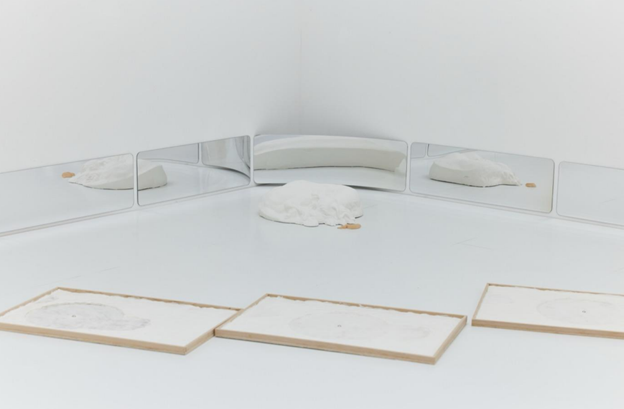
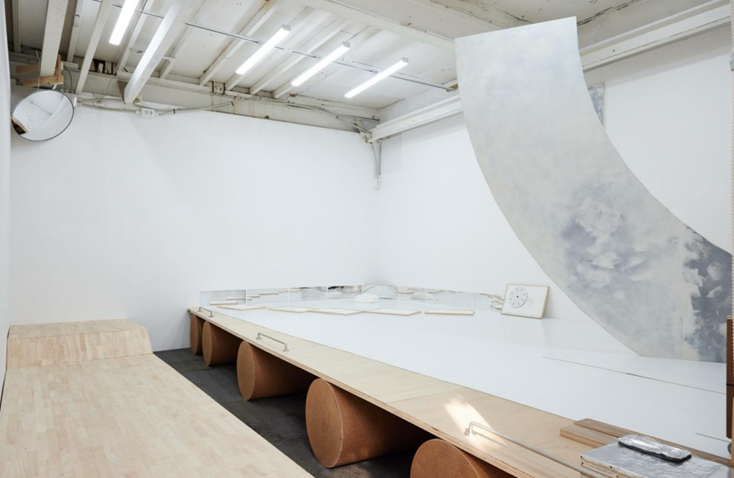
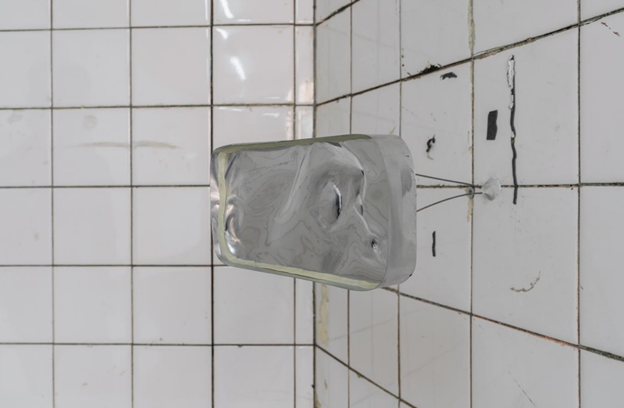
[2] If one tries to craft a mirror by hand, one realizes it requires an extremely laborious and tedious process. Differences that cannot be felt with dull fingertips must be detected through the numbers of polishing compounds. Fortunately, each stage is marked with a different color, making it easier to empty one’s mind. The goal is to deceive with smoothness. At each step up in number, one reflects their own face to judge success or failure. While both “the task” and “the doing body” each spend their own diligent time, I critique the sharpness of the outline that emerges beyond the mirror, or recite the dry love story of Australopithecus Afarensis and Anamensis. To conceal boredom, I may reexamine the shape of a dam (堤防) built by weaving together my own performance and memory, or feel the growth of some unknown part while oscillating between compromise and overcoming. Spending an entire day brushing away the dust that interferes with us, one might suddenly be surprised to realize that they themselves had been the most sensitive observer of all.
[3] A fictional novelist formed in 2023, led by Malti+Poo and Marry Yang.
[4] I live in a city. It is a new town that rose upon land that, until just over a decade ago, was known only as “rice paddies.” Tall buildings stand so densely that one might lose count trying to number them, and there are several bright streets at night even without streetlights. There are 24-hour convenience stores and school zones every few blocks. There are roads that cannot be crossed without crosswalks and signal systems, and cameras watching almost everywhere. Public transportation arrives every 15 minutes, and there is public Wi-Fi. There are rocket delivery drivers and city sanitation workers. In truth, it was only after a Starbucks opened nearby that I became aware that I was living in a city.
Postscript.
追伸.
I used to remember the days when my favorite bread arrived at the only supermarket. When kicking a ball, it would always fall into the irrigation canal. Rather than waiting for a bus that didn’t run even five times a day, I preferred walking or hitchhiking. With a stick that felt good to grip, I would give it an exaggerated nickname and spend all day stirring up the front, side, and back hills, catching a couple of stag beetles. Selling them at the stationery store would leave a few dozen won after buying Fanta and bread, and if I returned the Fanta bottle, I could add enough for one round of the lottery machine.
If I gathered ten leaflets I had carefully hidden and brought them to the guard post, they would exchange them for hardtack. While running around trying to catch pheasants, I would curse when a dog trader passed by, and scratch my head when a hearse passed. After time that could not be divided simply into good or bad has passed, many things have become smooth. Though calluses are still necessary, they must be replaced often.
When working on tasks that cause damage beyond what the body’s sensing capacity can keep up with, I make sure to take a walk in between. Since the eyes do not know the ears, the nose does not know the lungs, and the hair does not know the kneecaps, if any part complains of fatigue, I immediately leave my place. And then I take time until each part can introduce itself again with the names they prefer. I walk slowly along a familiar path. I allow every part to contribute to the movement.
If there are parts already exhausted, I seek additional help to regain balance. I continue walking slowly until reaching a satisfactory level. Because I know of the fast steps that will someday arrive, I can walk very slowly now. When the leisure gained from this becomes a table—though one never seems to tire of it—I ask whether there is a nickname one particularly likes. As we call each other by the names chosen today, we feel reassured, knowing that we are also the ones who will remember the names we called each other yesterday and tomorrow. Even if things do not follow as expected, we understand that we can always be held by difficulty, and so we continue walking slowly.
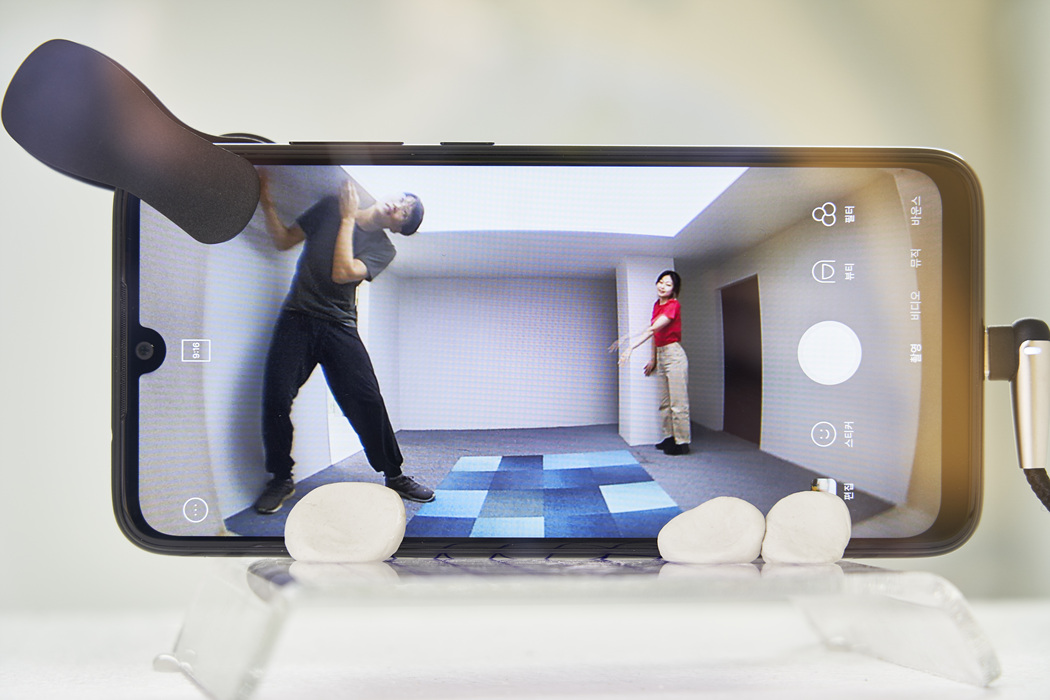
Among all the mysteries—folding the earth, stepping on the sky, breathing fire—the one that captured my heart most was the art of duplication. When one chants a spell containing their own secret method, with a “pop!” a doll identical to oneself appears. Sometimes there are only two, sometimes hundreds of millions, and their duration varies greatly. Since it is literally a secret technique, its principles cannot be known, but in terms of operation, there are many intriguing aspects.
If duplication is a technique that produces identical bodies, and all duplicates are equal entities, appearing simultaneously without the need to distinguish authenticity, then the amount of information accumulated by the duplicator would be immense. Therefore, the ability to quickly select, derive, and efficiently forget becomes essential. Perhaps the true charm of duplication is not multiplying one’s poor body to smash rocks, but rather that a single individual comes to handle the lives of hundreds of millions. A truly excellent duplicator might either be a healthy person who eats a lot of walnuts, maintains proper sleep, and receives consistent counseling—or someone irresponsibly free of lingering attachments.