1.
Nathalie Léger’s novel L’Exposition (2008 / Korean edition 2024) begins with a long sentence composed of a continuous chain of enigmatic phrases. Omitting “abandoning oneself, planning nothing in advance, desiring nothing, distinguishing nothing, not scattering, not staring intently,” I borrow the remaining words that follow and place them as the title of this text. Then I continue writing from that title.
Léger’s novel, written by an artist, curator, and archivist, begins by addressing the cliché of “looking at” a woman (her beauty), then detours briefly through sentences about a voice on the radio, a photograph, the actions of an avant-garde artist, and a torn hole in paper. It then passes through the sound of paper in a library, leading to a photo book of the beautiful woman, to collected materials layered with sentences about ghost-like people, and to the goodwill and murmurs of a librarian. The sentences of the novel interweave recollections of dusty documents with expectations felt when traversing a veiled space, suspending and nullifying both past and future tenses.
Then what responsibility does the first paragraph of the novel—written as a vow—assign to those disordered sentences of recollection and expectation? Léger quotes the voice of filmmaker Jean Renoir: “The subject devoured me entirely! A good subject always seizes you suddenly. It carries you away.” Léger draws out a narrator captivated by Renoir’s unexpected voice on the radio, describing a mysterious moment—“recognizing without knowing” a woman (her beauty), this “time of exposure (le temps de pose),” in which one becomes so absorbed in thinking about oneself that one completely forgets oneself.
The sentence used as this text’s title—“to move, to slip away, to blur, and to observe a single material that reveals itself while slowing down, in the way it appears, within that disorder, even within that order”—is a vow of postponement by the (curator/archivist/novelist) self, devoured by a suddenly imposed subject, attempting to pierce through clichés of recollection and expectation toward that moment of exposure.
2.
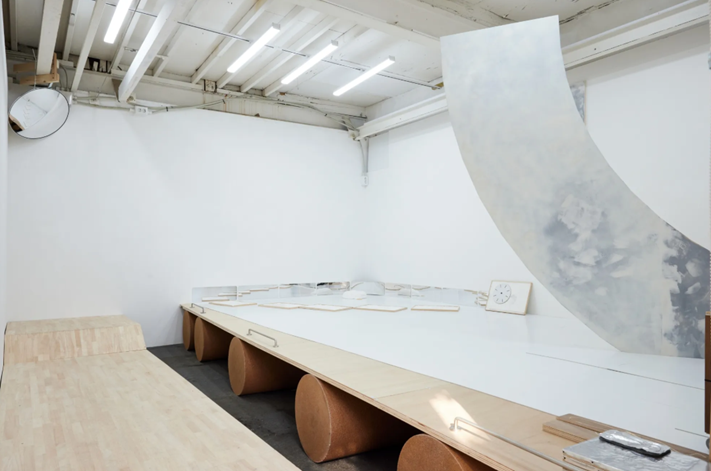
In Dahwan Ghim’s exhibition 《Prediction vs Recollection》(2024), when the (clear) illusions layered around it are peeled away one by one, the single word “exhibition” spins in the mind. This exhibition, which rudely binds “prediction” and “recollection” together without even a space, resembles Léger’s novel where various scenes are calmly arranged as words on paper. Though enigmatic, thanks to the meticulous editing technique of the exhibition text (2024), densely written from one corner of a white page to another, just as one begins to nod while imagining leaps of imagery like lightning, one can infer that it is bound to “the time of exposure,” in which we “bend our bodies futilely over papers” only to realize that “what we seek is something very, very small.”[2]
The exhibition text reads like a relay race of words [language] and imagination [images], written with “prediction” as its pivot. Ghim makes a kind of vow—what he will do, how he will act, how he will respond, what he will promise—measuring his own postponement and order. Yet the words that fill this vow reflect the anxiety of a prophet leaning on what is both “similar” and “different,” like clichés. Ultimately, by marking boundaries between paragraphs with dingbat symbols and “recollecting” (events that never happened), he unfolds the spatiotemporal structure of the exhibition as though it had already occurred.
In Ghim’s exhibition text, which even boldly quotes memories of actual events, expectations that could not foresee their outcomes overflow within recollective sentences. What is prediction and what is recollection? The tilt between the two merely delays the speed of (reading).
3.
A rolling metallic sound, Thangdeugururur(2012), situates itself within quoted past memory. “There was a class called object study during my school years, and I carried several small bells with me throughout the semester. I made various efforts to become familiar with these shiny, sounding objects, and Thangdeugururur(video, 3’29’’, 2021) is one of them.” The sentence that follows explains an unexpected event in which the bell installation placed on the classroom floor was completely cleaned away by someone. “Having nothing but an empty floor to show,” he eventually reveals himself (again) within a spatiotemporal context where the bell—already discarded in the past—once functioned as a motif, stating that he “wanted to create a floor that could be called a bell.”
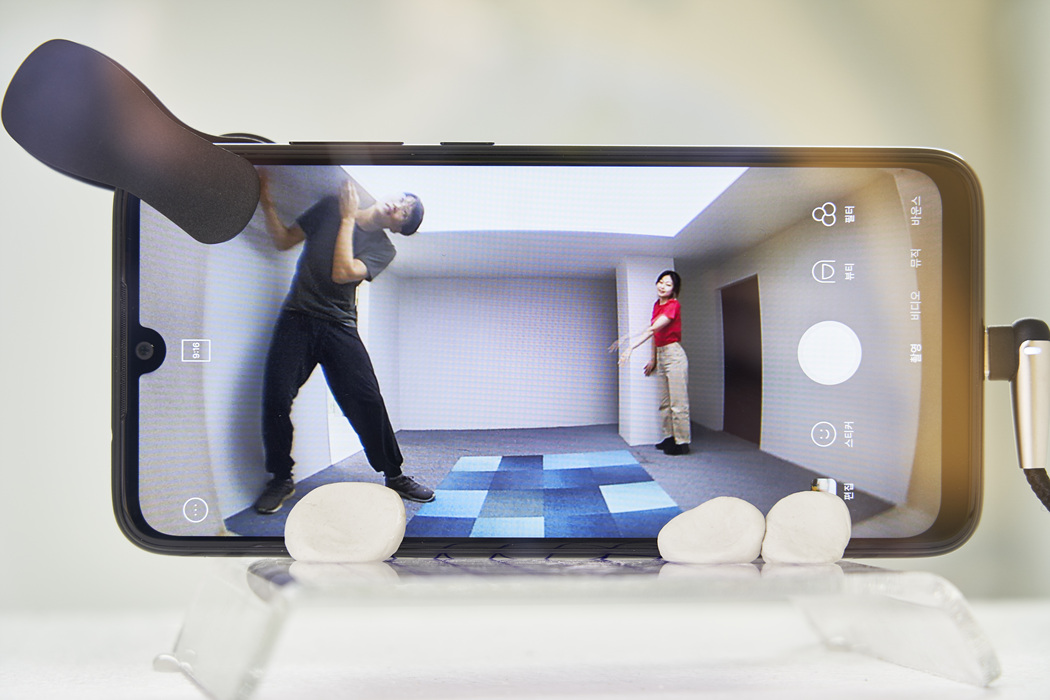
The bell is an important clue. First, as something whose original form has disappeared, it exists as memory and recollection; second, as an object whose form and sound have become blurred, it participates in illusion and suggestion while compressed into the dimension of material. The video Thangdeugururur, in which a bell is hammered flat on a dark street, contains no particular narrative event.
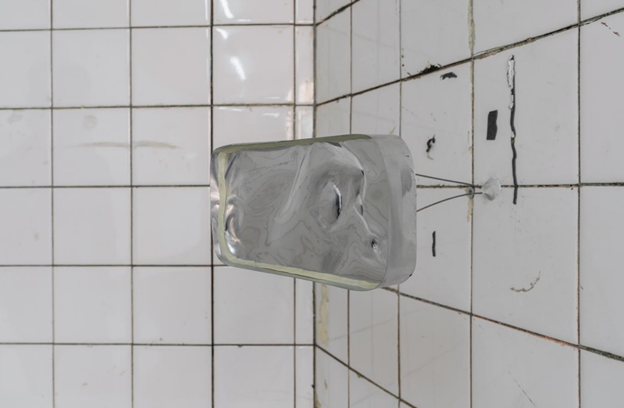
Yet as the small, round bell is gradually flattened through intense friction between stone ground and metal hammer, it no longer rolls but adheres to the ground, trembling lightly and producing a clattering metallic sound. This transformation/alteration constructs or dismantles order on the ground, prompting him to seek an image that is “pleasing to look at.” In the way it appears, within that disorder, even within that order.
4.
“To make a floor that could be called a bell”—to expose another form on the empty floor, he needed another “visual” ground. After experiencing a kind of failure[3] caused by another person long ago, he must have needed some visual boundary—like a bell hammered to the verge of losing its form—its air drained, leaving a rough and unfamiliar surface texture. The bell that once rolled around in his pocket and palm, due to its curved contour and internal vibrations, might have been perceived less as a form than as the emergence of sound and movement.
Interestingly—and this is something I can fully relate to—he seems to attempt exposing a series of events as a sculptural situation. If it is a matching that moves between recollection and prediction (with unpredictable outcomes), it is, at least for me, a sufficiently convincing development.
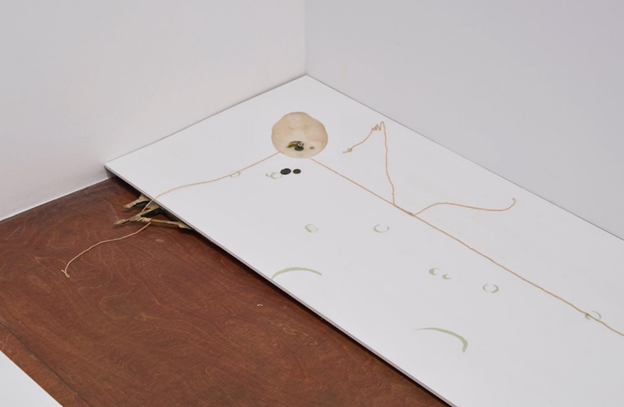
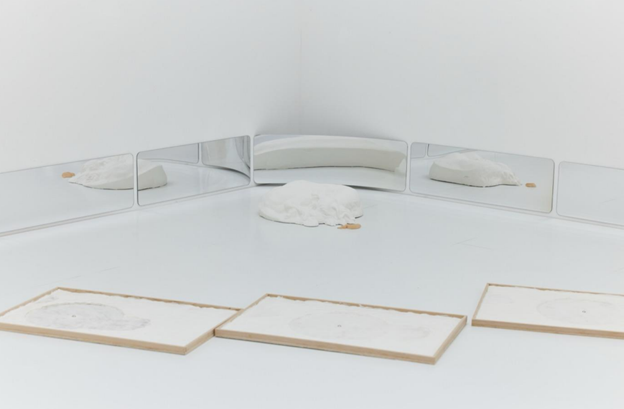
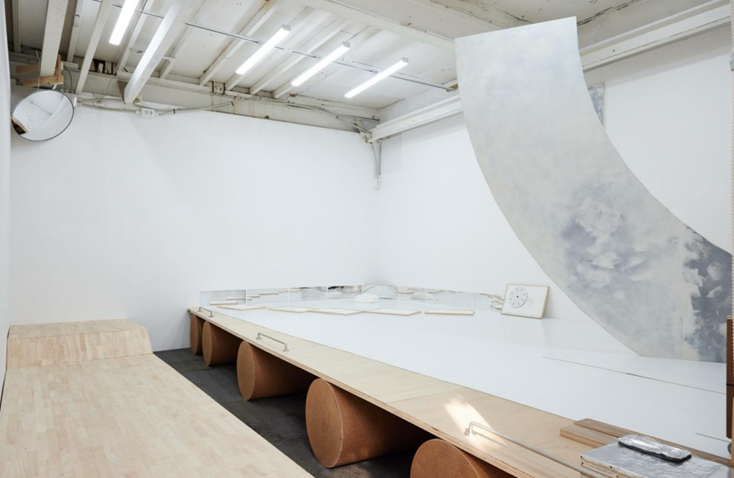
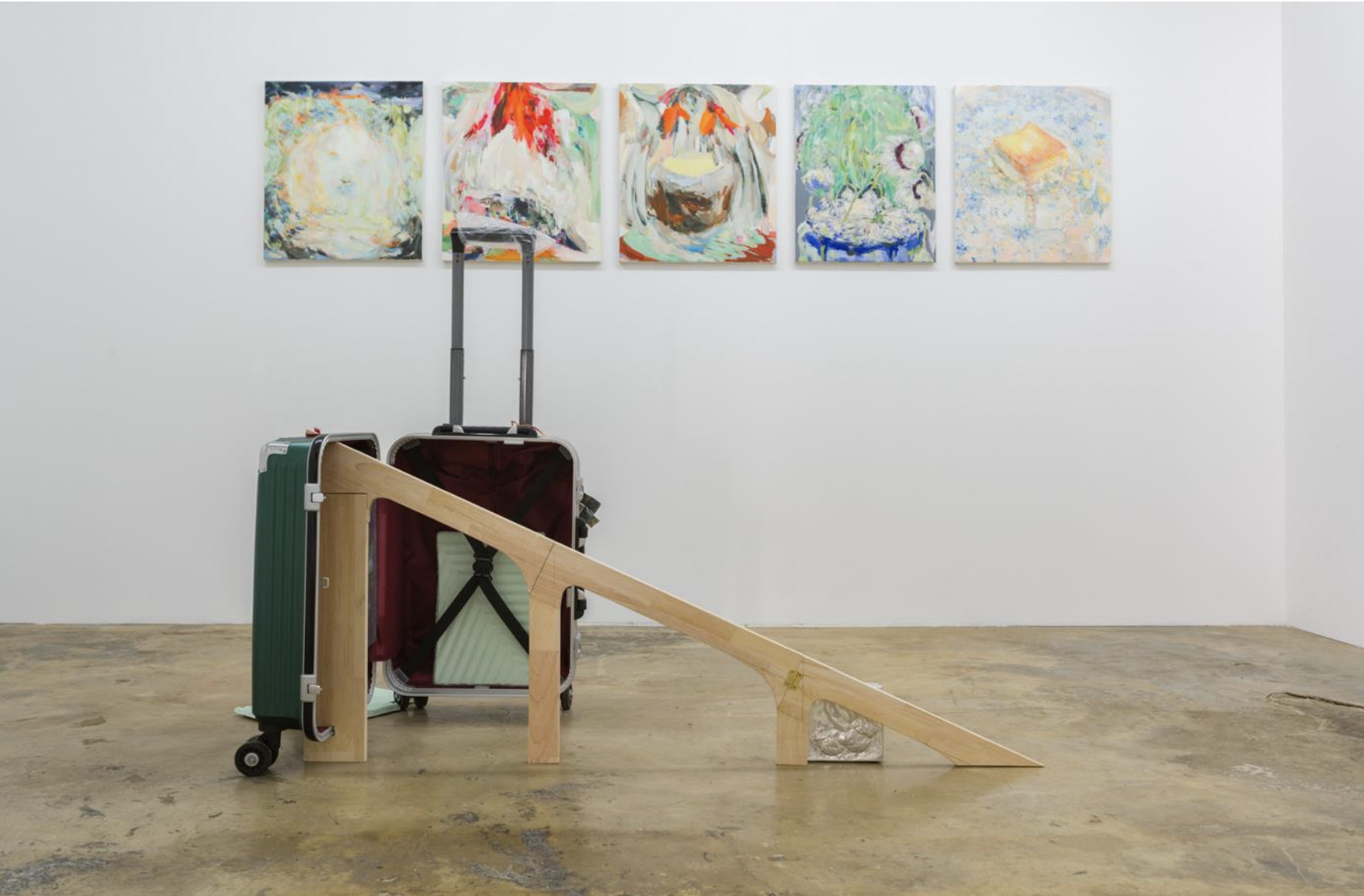
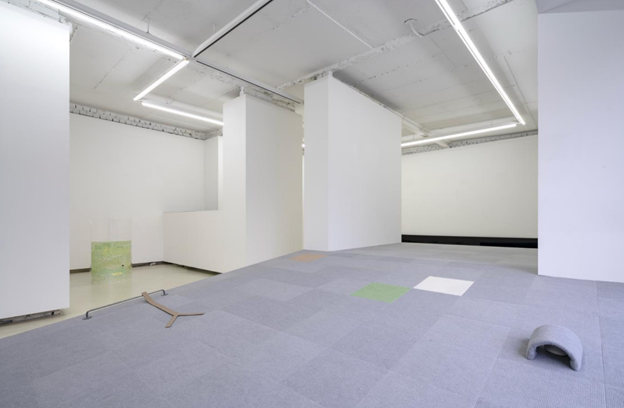
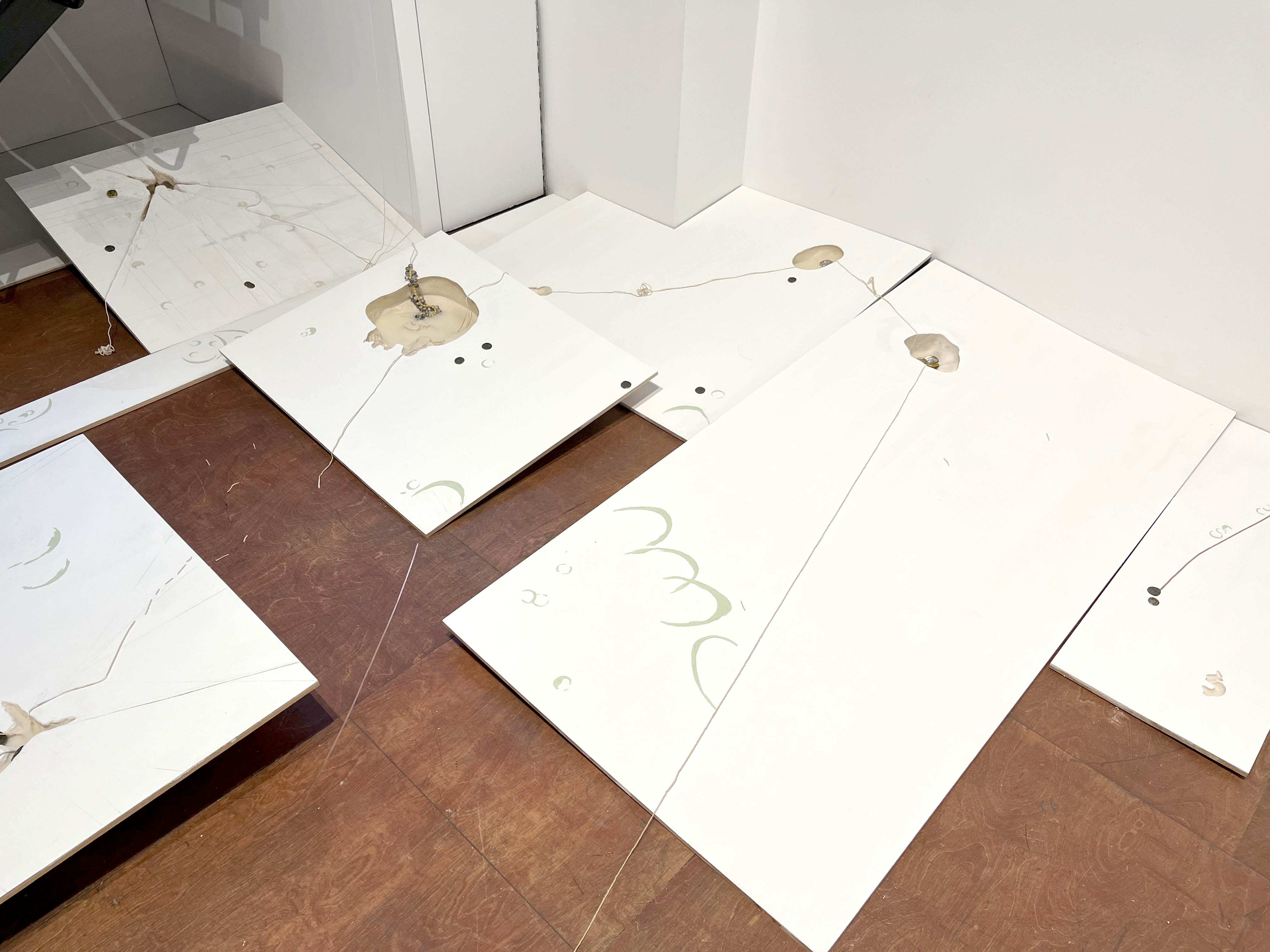
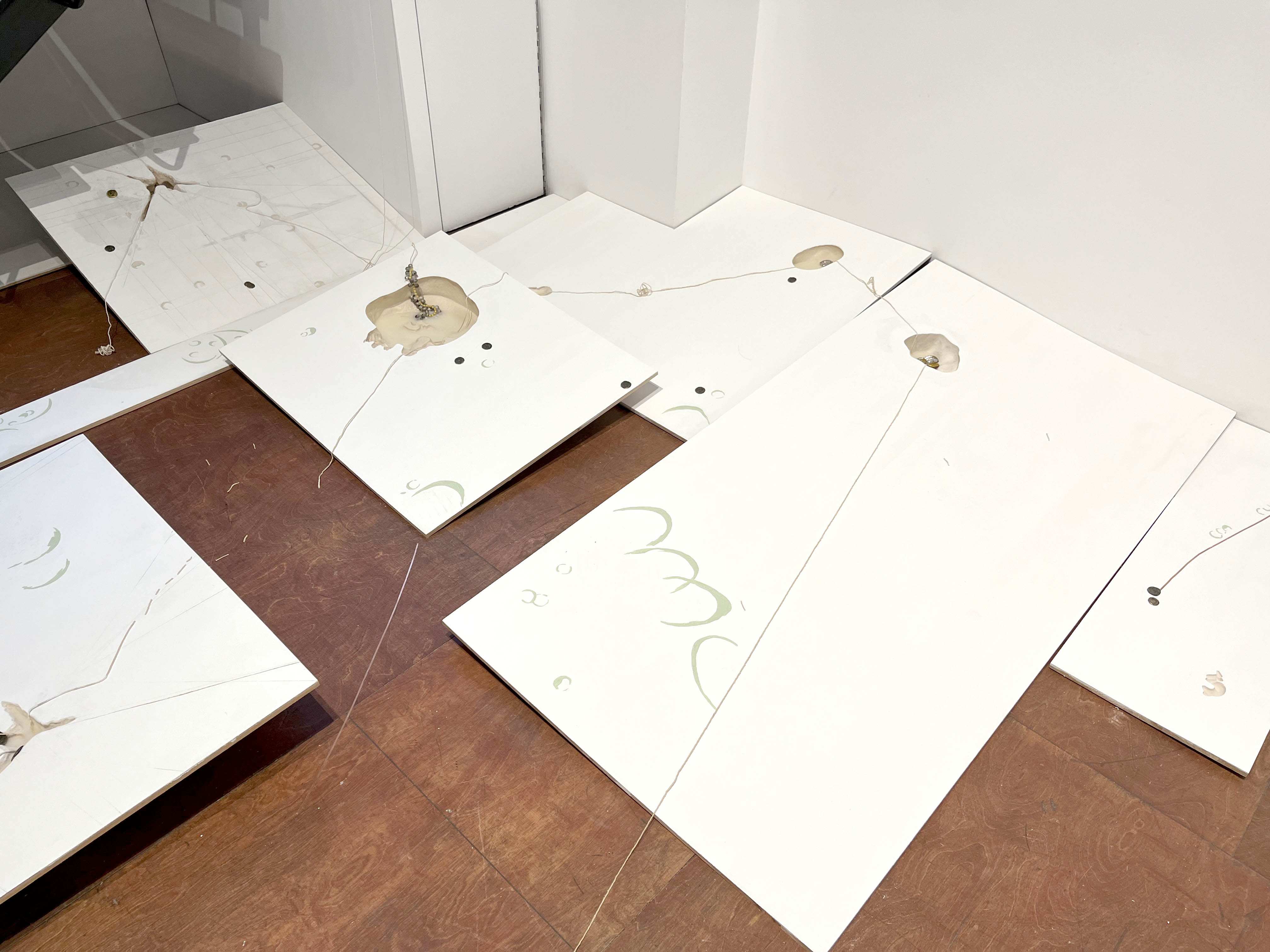
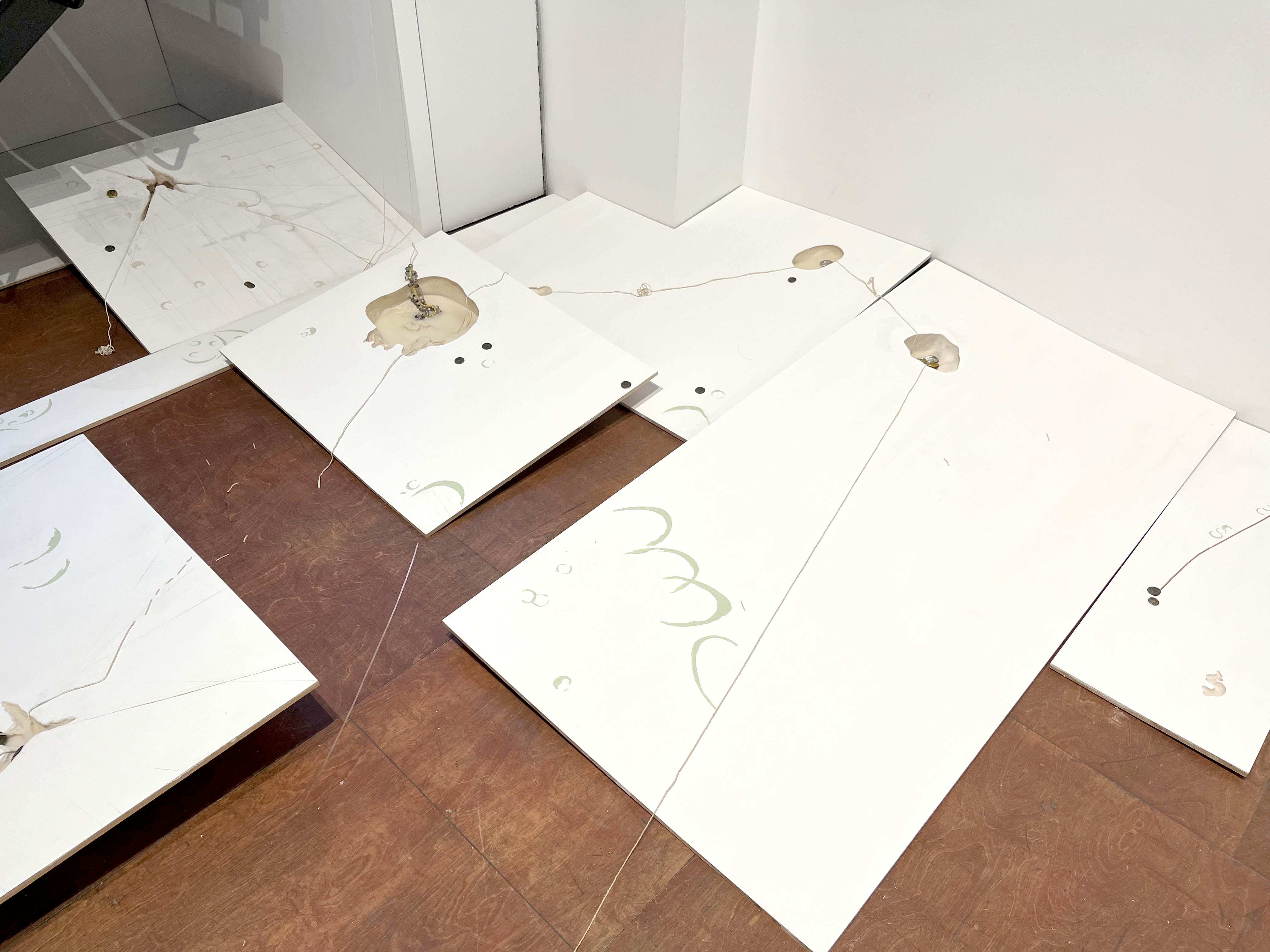
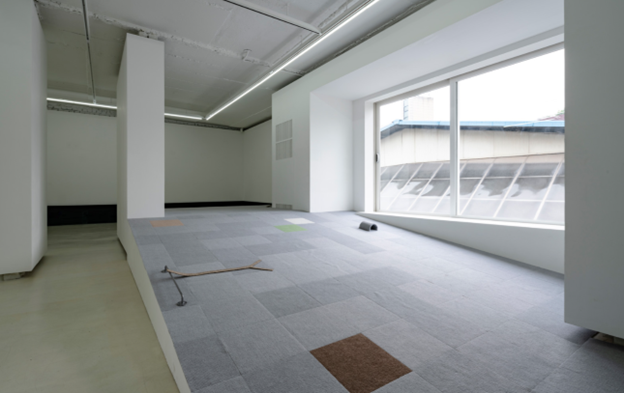
White wooden planks spread across the exhibition floor like a shipwrecked raft are loosely grouped under the title ‘Bell’s False floor.’ Each plank differs in size, tilt, and even the shape of its edges. Within them, fourteen elements—each with different names, pending or resembling traces—form blurred shapes. Because of this, those vague forms influence the inclination of the floor. In areas hollowed out like puddles, fragmented objects and materials intersect and overlap, destabilizing the three-dimensional order of the ground plane.
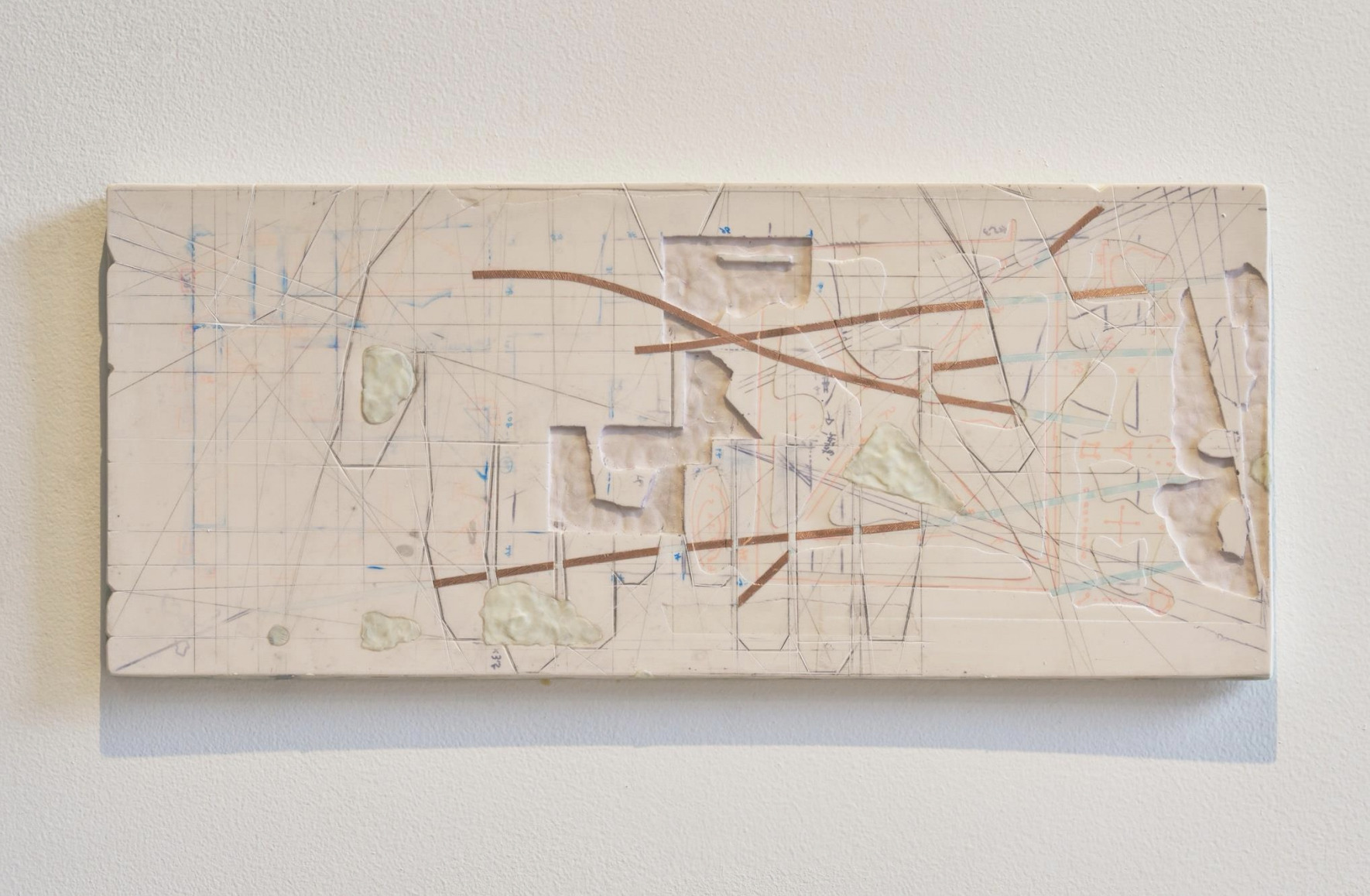
The fourteen individual elements composing ‘Bell’s False floor’ encode concealment like a riddle. Passing through Thumb of ___(2024), Afarensis A of ___(2024), Friend of Afarensis of ___(2024), and sliding into Afarensis B of ___(2024), One Note of ___(2024), Two Notes of ___(2024), and Three Throwing Hands and a Friend’s Ear of ___(2024), these titles weave together fragmented and ambiguous signs, leaving the “owner” as a silent blank. The (non-)appearance of existence derived from this relation of ownership, and the imaginative act of observing it, form the script prefigured by 《Prediction vs Recollection》.
In this sense, the title ‘Bell’s False floor’ reveals the cognitive contradiction of resemblance and difference implied by “a floor that could be called a bell.”
At this point, Ghim unravels the relationship of ownership—suggesting cognitive contradiction—as a metaphor for a sculptural situation. He has already hinted at similar conditions in past exhibitions. For instance, in his 2023 solo exhibition 《Easy Way》, his companion dog “Yangmal” is mentioned. In the exhibition text, he writes that he “likes things that are not visible as much as those that are visible,” hinting at the visual riddle of the “easy way.”
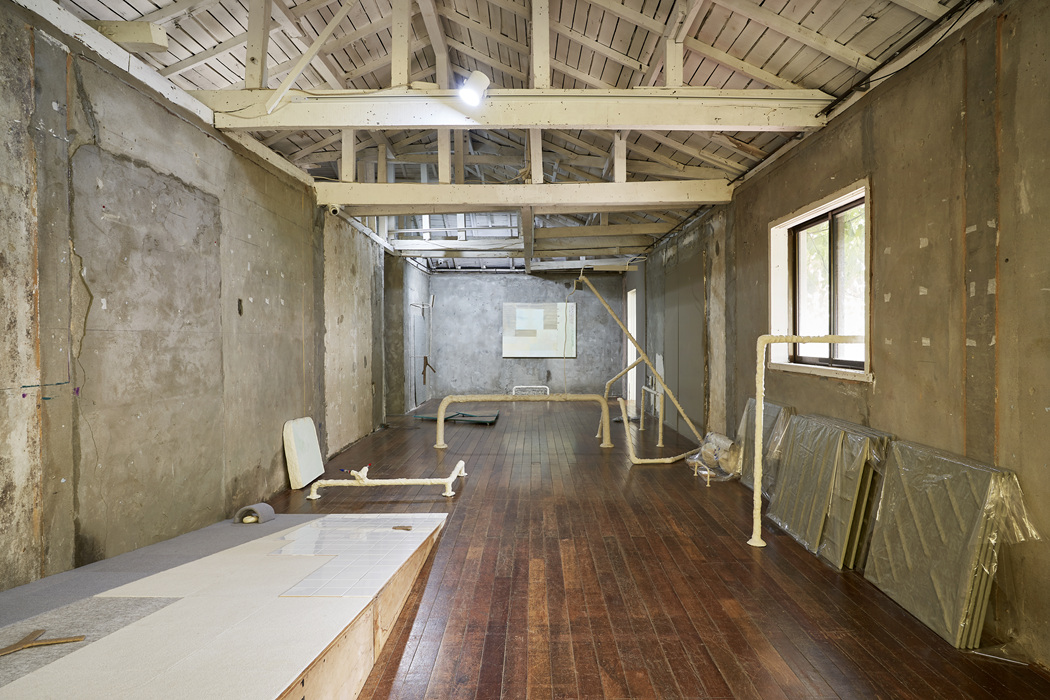
There too, he constructed an arbitrary ground evoked by the idea of a path, raising it one level above the actual floor and covering the exhibition space with another layer of thickness and inclination. Such spatial transformation was also treated as a crucial condition in establishing the exhibition as a site of exposure in his first solo exhibition 《Yang-Mal-E-P-T》(2018).
He imagines a body that will confront this moment of exposure. Creating a spatiotemporal passage between his own past [recollection] and others’ future [prediction], he calls it a kind of stage-like ground. Regarding the forms that have appeared/will appear upon this passage, he holds an expectation that they will be “pleasing to look at.” It recalls the biblical account of creation, where, on the final day, a human is made in God’s image and placed in the garden, and “it was good.” Ghim often mentioned the phrase “a pleasing form” in conversations with me. Within our conversations, I understood it as a visual implication of “things that are not visible”—a relationship that possesses the duality of resemblance and difference, like “a floor that could be called a bell.”
5.
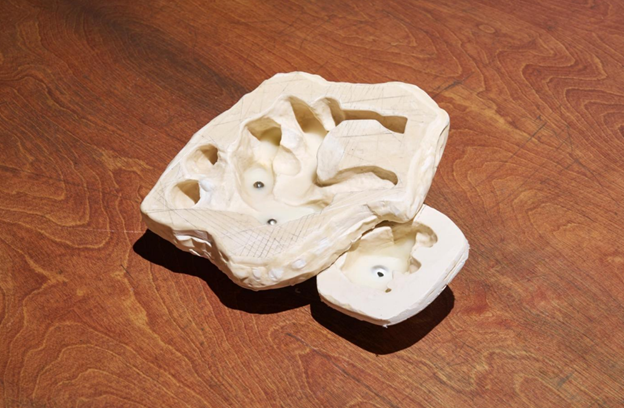
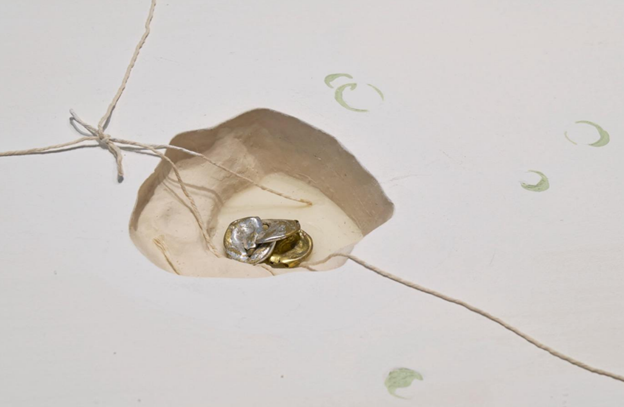
Again, we return to the exhibition floor, where white wooden planks lie spread like a shipwrecked raft. Hollowed areas resembling puddles are faintly connected to the surface through threads and bells, while circular outlines stamped like footprints on the floor strangely form a dual correspondence between puddles and bells. If we imagine further, the flattened metal bell resembles a dissolving body just before returning to dust. Observing the perceptual and sensory conditions at play, the ‘Bell’s False floor’ series essentially contains the concept of a mold.
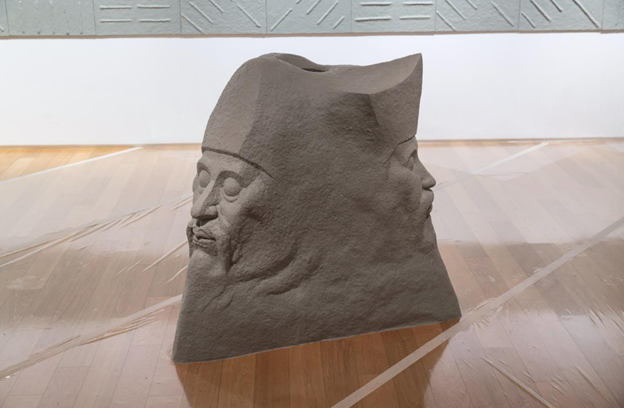
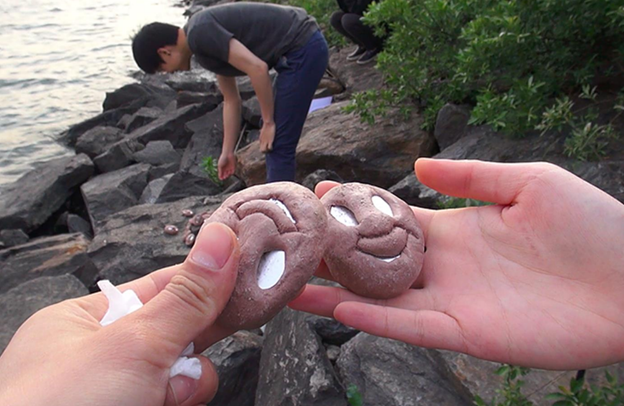
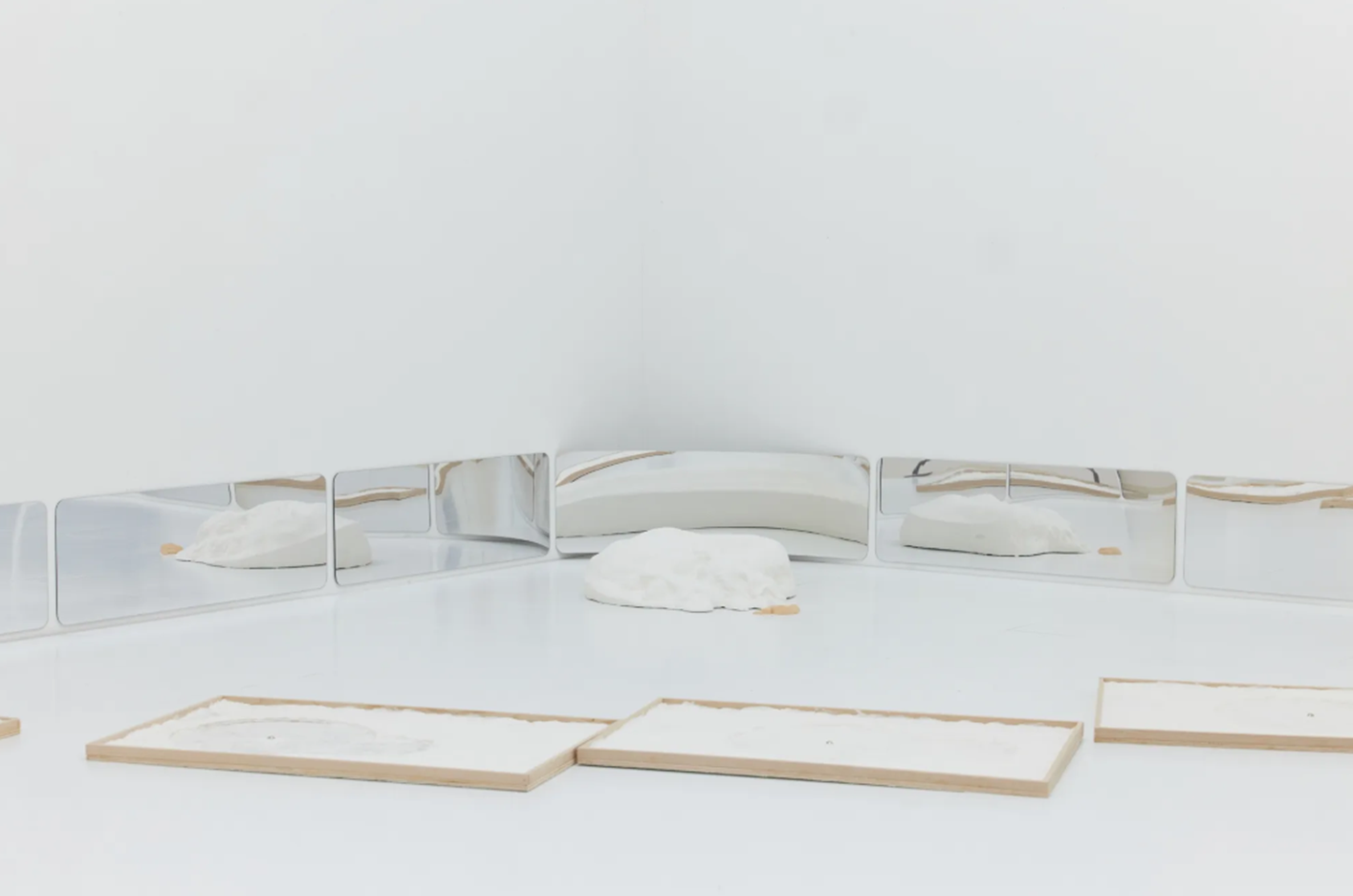
The faint chain of hollowed areas reveals, in the classification “3-lower” on the exhibition plan, that Three Throwing Hands and a Friend’s Ear of ___ is an independent mold not attached to the white wooden plank.[4] Just as the titles of the individual elements evoke concealed ownership, the mold functions as a formal metaphor for that relation. The ambiguous ownership, whose subject remains unknown, resembles the concept of a mold that remembers only the trace of an original form (as a negative).
[1] The title of this text is quoted from Nathalie Léger’s L’Exposition (Seoul: Bomnal Books, 2024), and the italicized phrases in the main text are also excerpted from the same book.
[2] Léger’s book title L’Exposition is translated as “exhibition” in the Korean edition, but in photography it also means “exposure,” allowing for a layered interpretation that encompasses the book’s theme. With this in mind, this text attempts to project the relationship between photography and exhibition-recording explored in Léger’s novel onto Dahwan Ghim’s sculptural, drawing, and video works, as well as his approach to exhibition as a spatiotemporal framework. The aforementioned “exhibition text” is a one-page text written by the artist himself for the exhibition 《Prediction vs Recollection》.
[3] This experience of failure is described in detail in a quoted passage inserted into the “exhibition text”: “Once, I installed various works in a corner of the classroom for a presentation. While waiting for my turn, the cleaning staff cleared everything away. When it was finally my turn, I had nothing to show but an empty floor, so I could only fill the space with hollow words lacking friction.”
[4] In the exhibition plan for 《Prediction vs Recollection》, three artwork titles are presented. Among them, 3. the ‘Bell’s False floor’ series is classified into a total of fourteen individual works, labeled from (a) to (h).