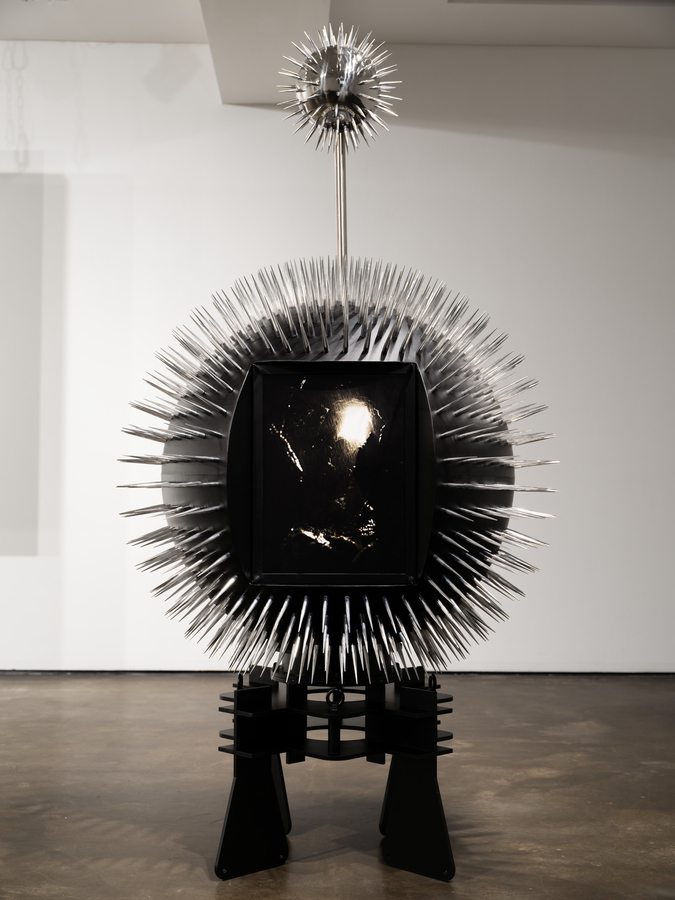
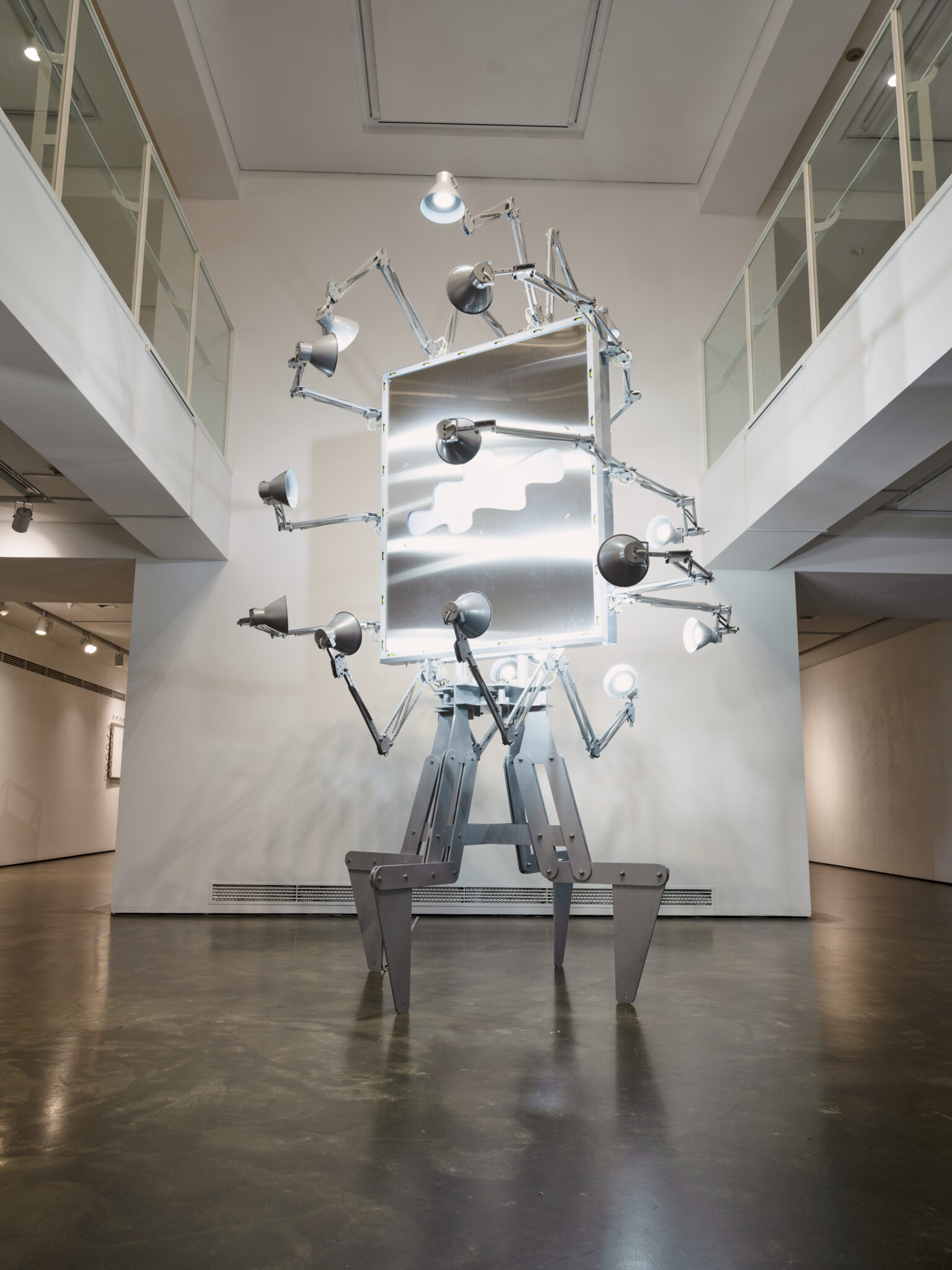
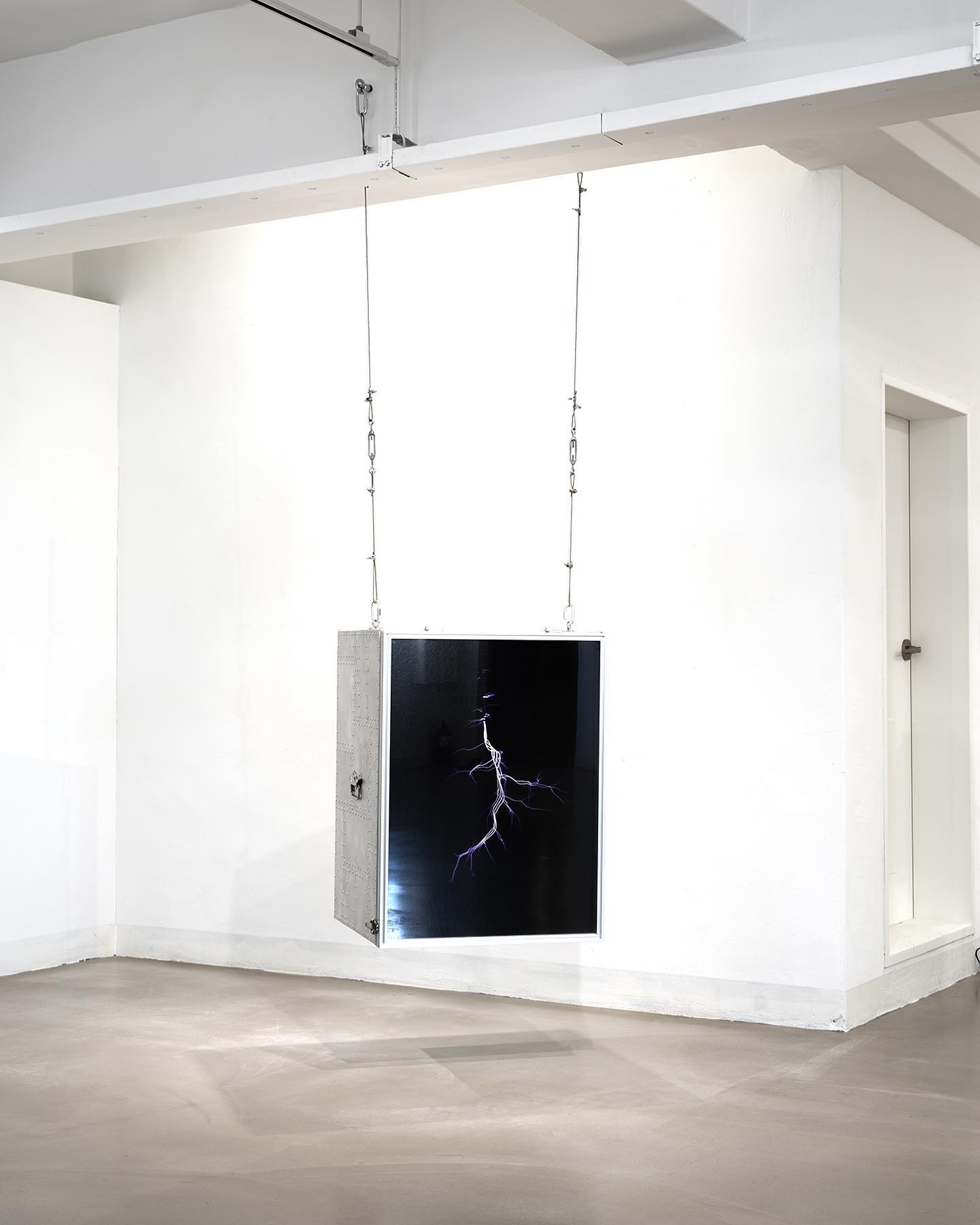
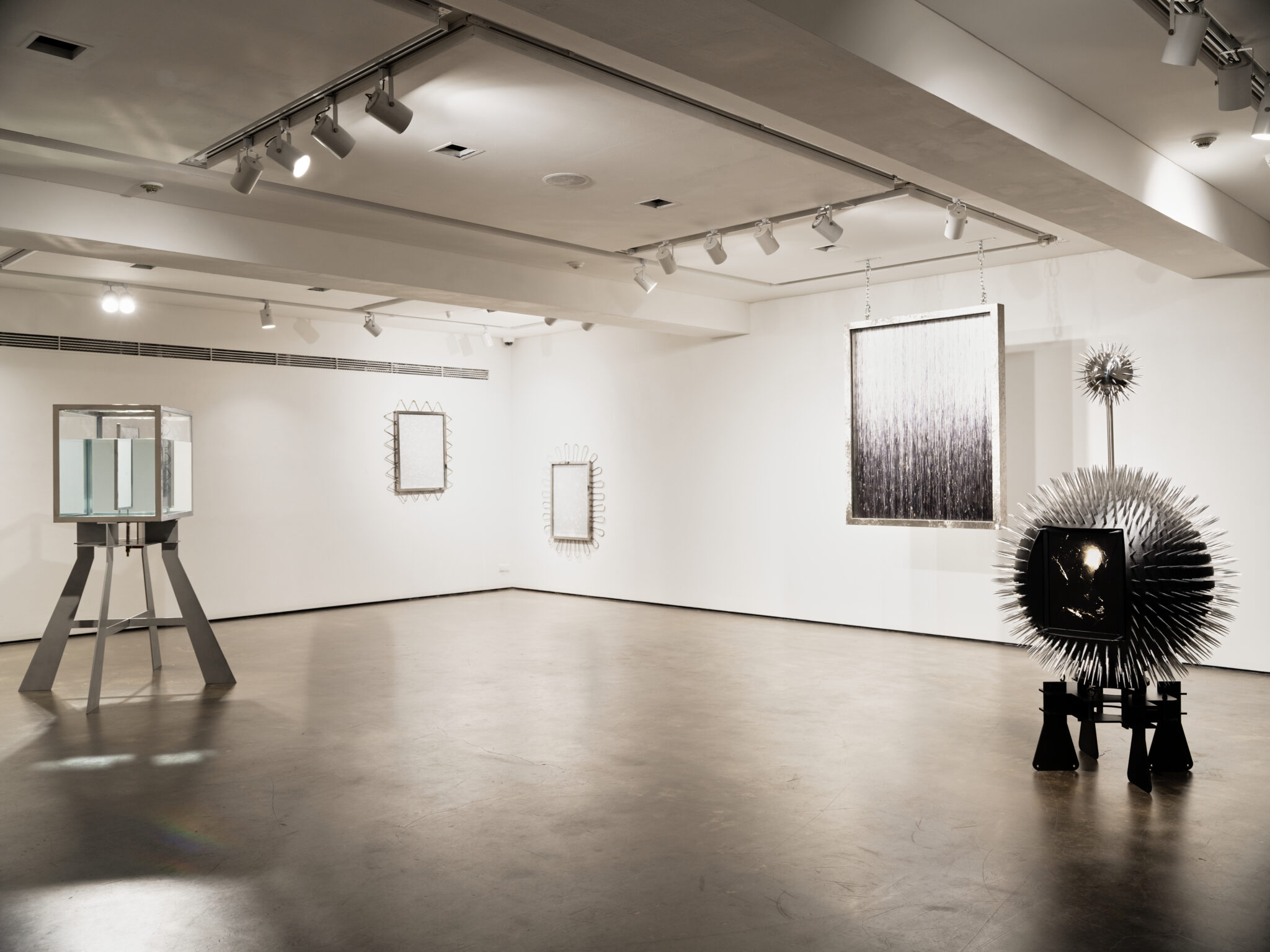
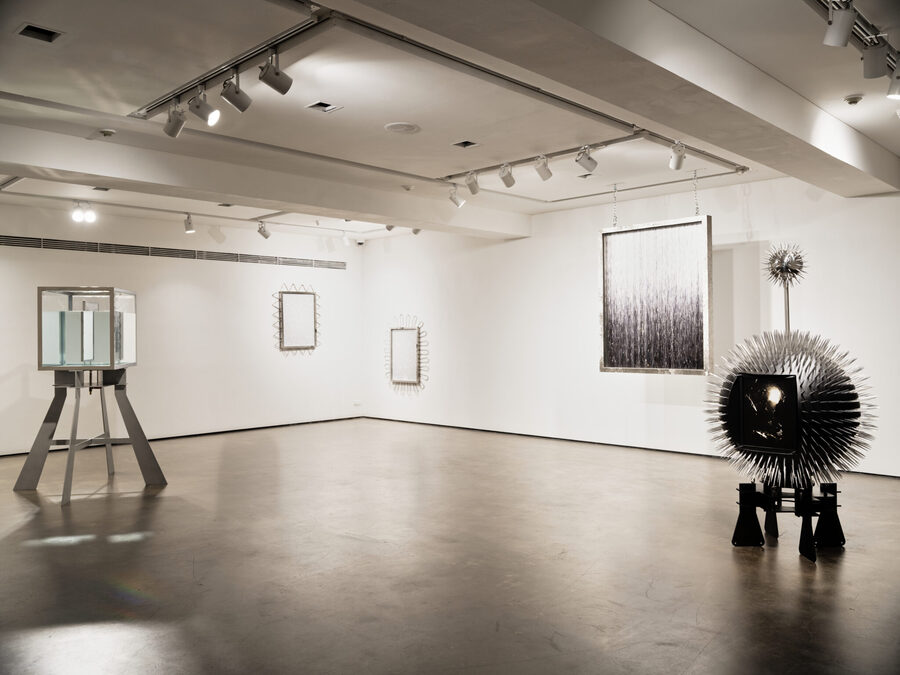
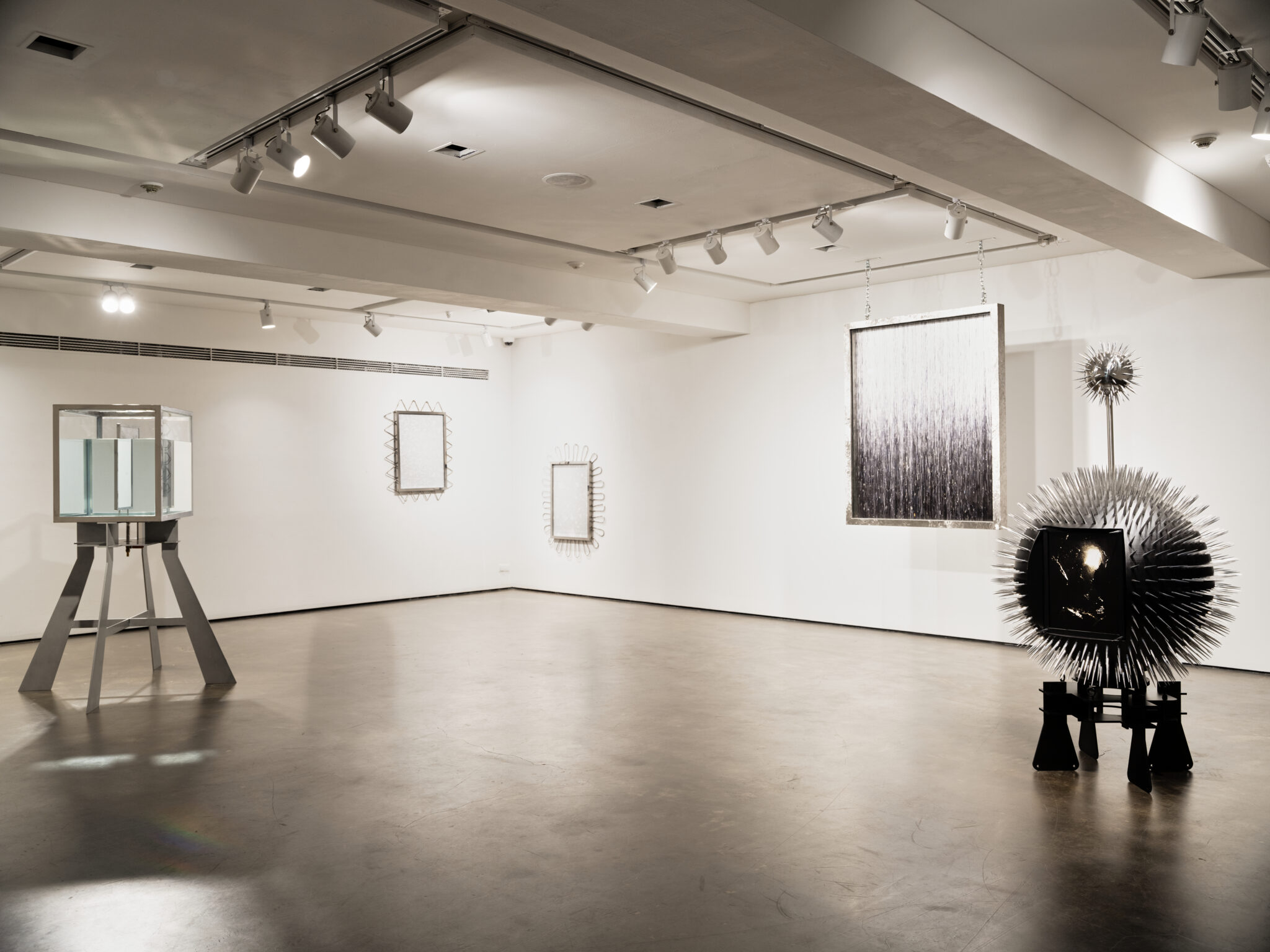
A spherical form made of steel is covered with sharp iron cones protruding like spikes, and on one side of it sits a rectangular image. Careful not to let one’s gaze be captured by the threatening cones jutting out as if they might pierce, one cautiously looks into the image and encounters a ray of light that appears to be an exit, seen within a cave or the ruins of a collapsed building. Supporting this rather heavy object—too massive to be simply called a frame—is a pedestal made of assembled steel plates, equipped with rings for easy movement or fixation, and adopting a functional form reminiscent of industrial sites with minimal decorative elements.
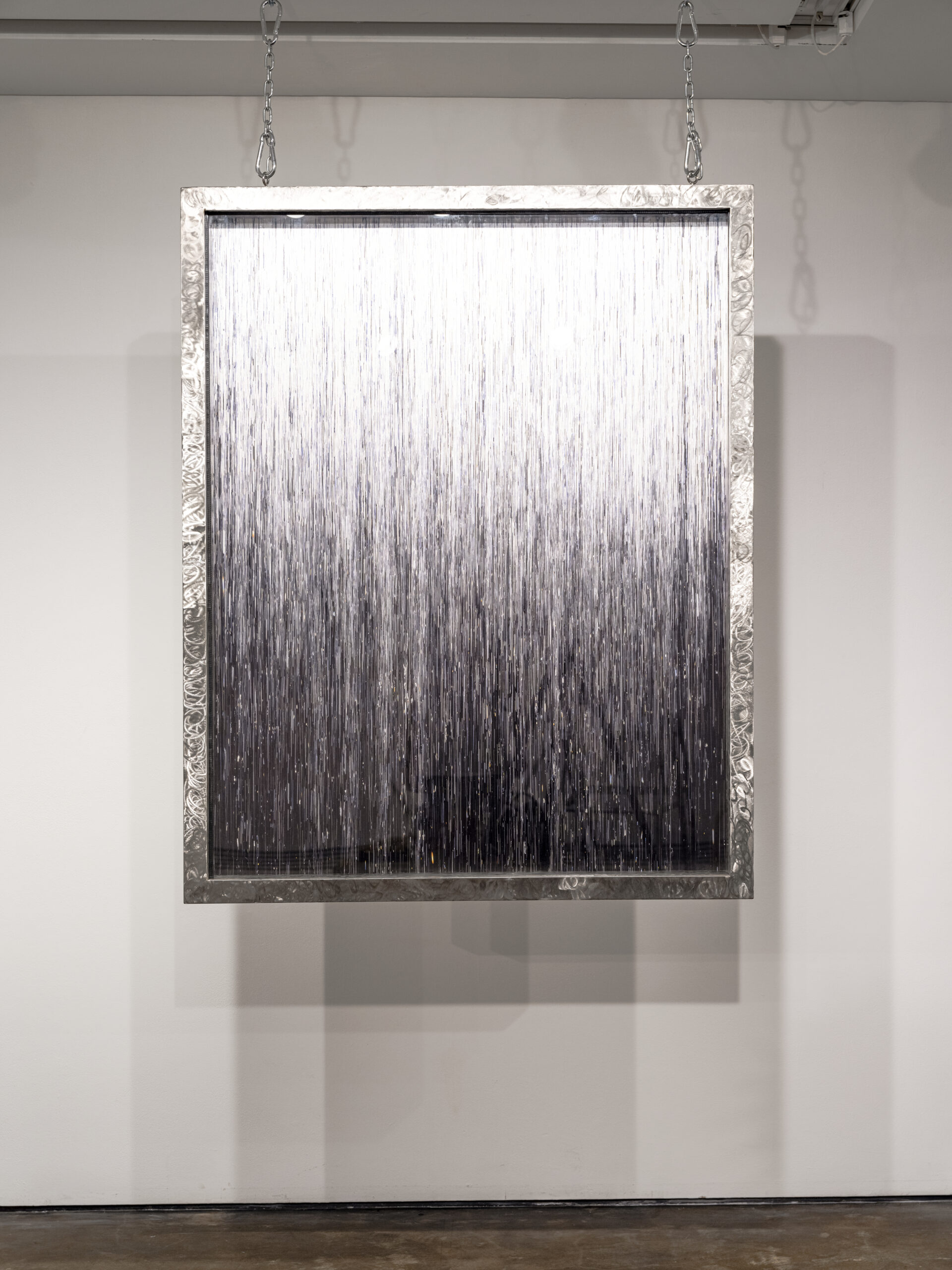
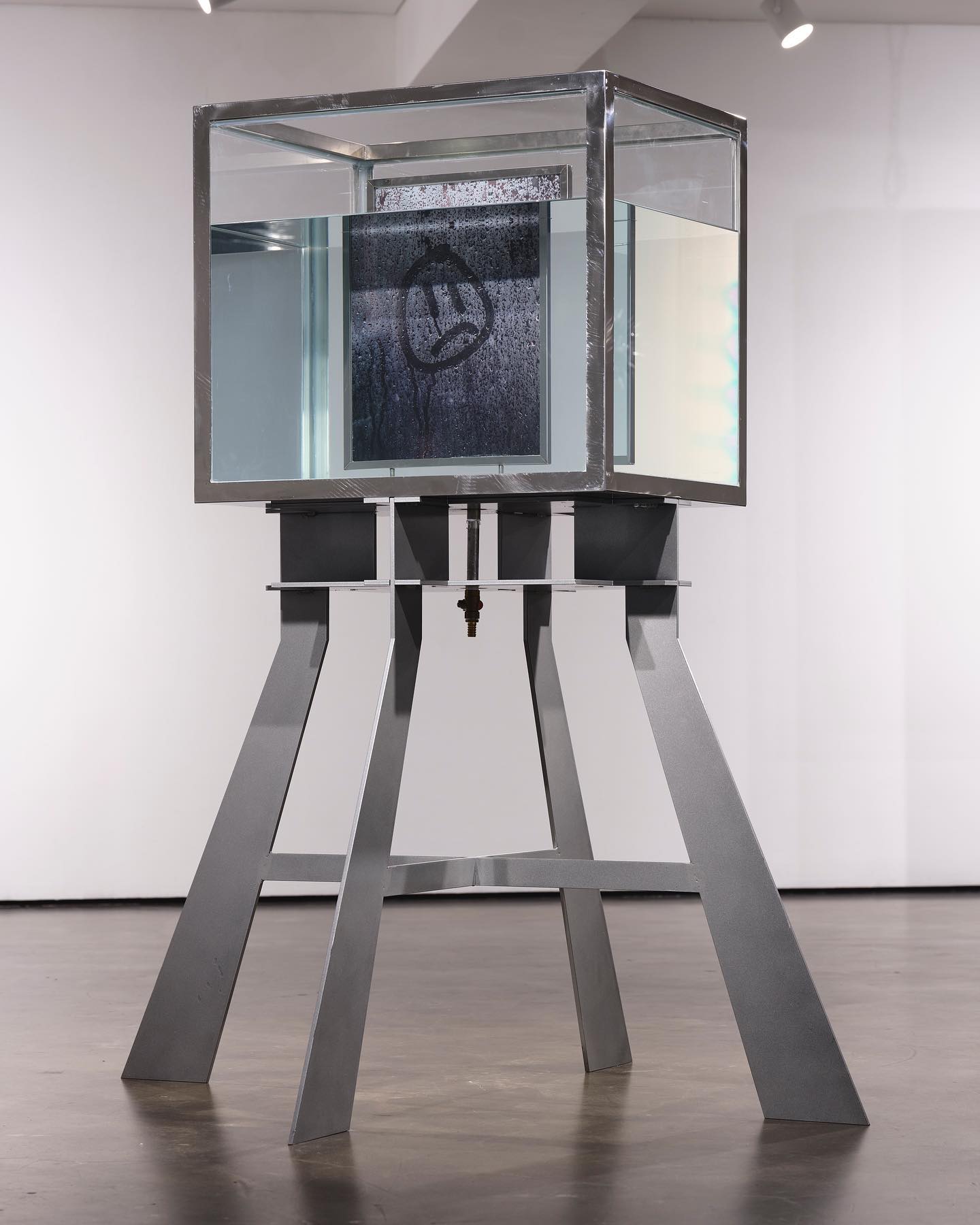
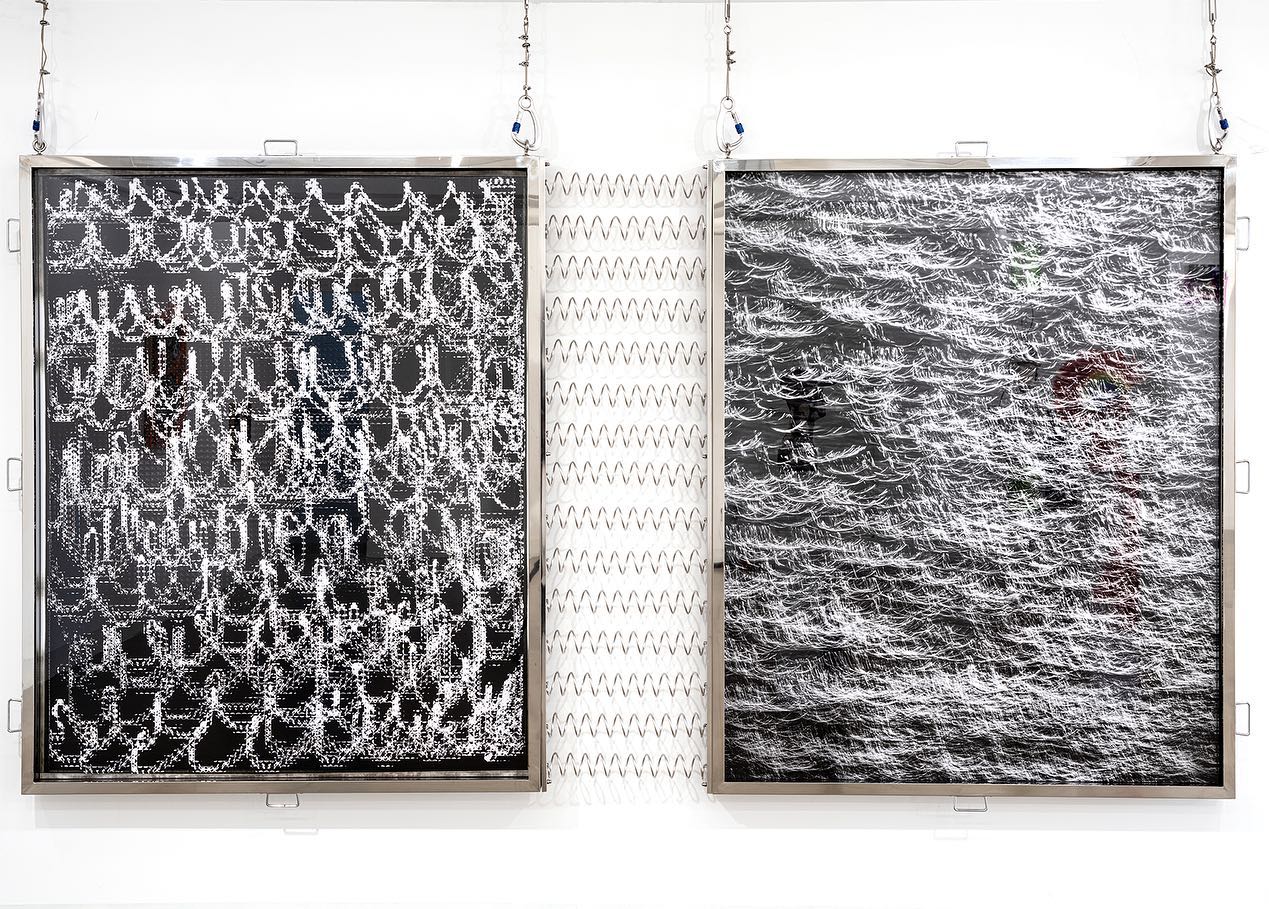
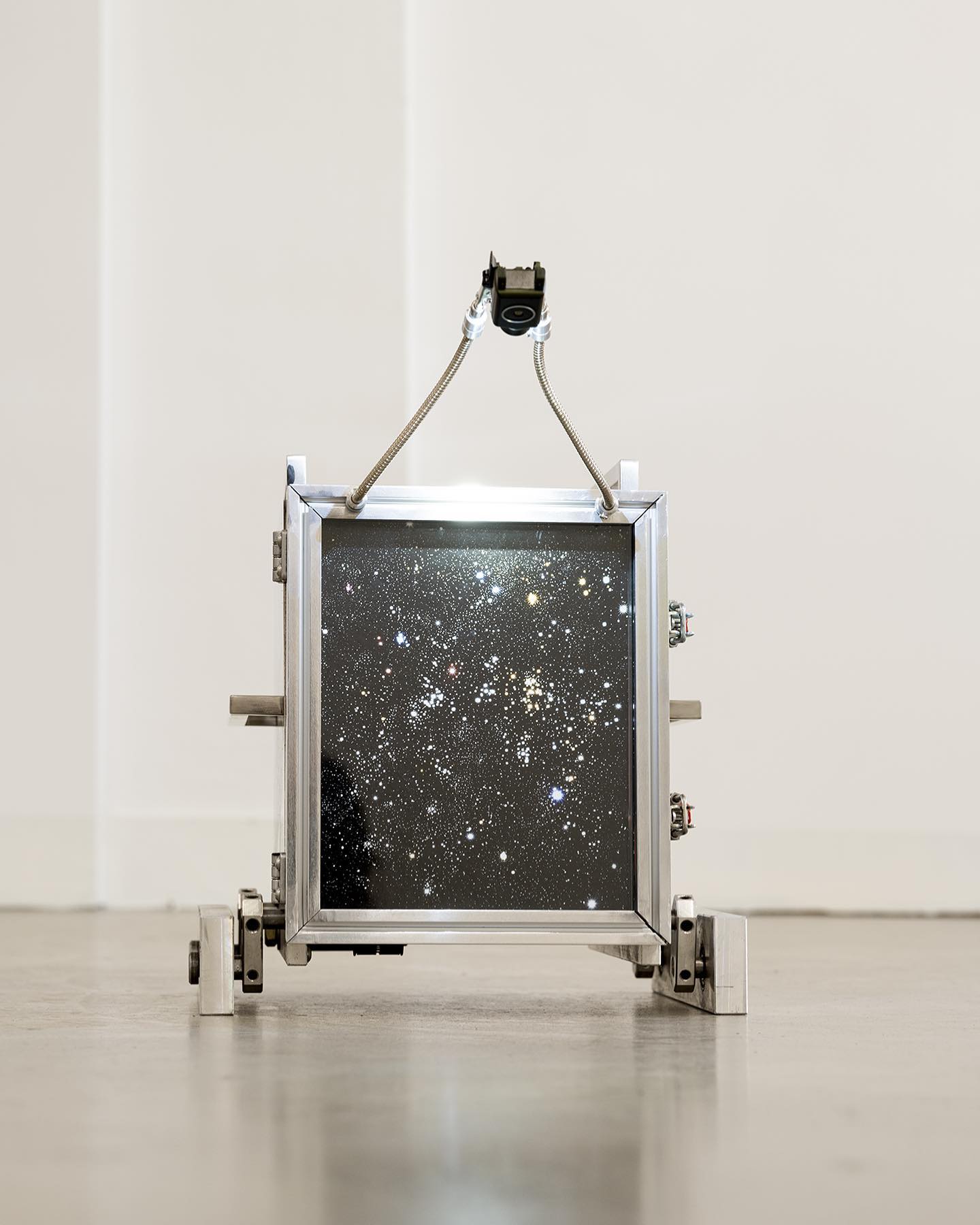
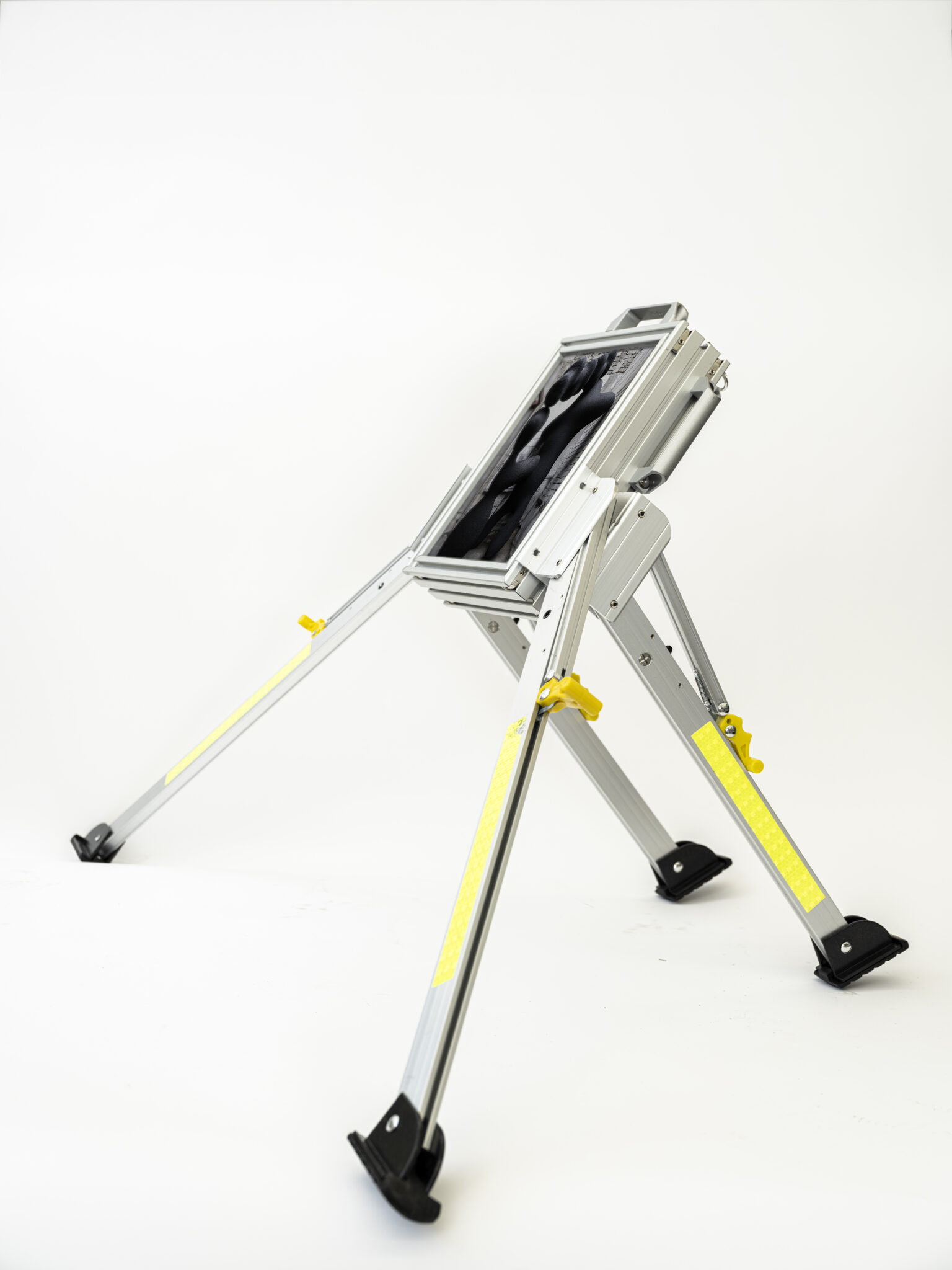
Shifting the gaze to another scene, there is an image inside a rectangular steel frame that visualizes motion through thin vertical lines, evoking rainfall. While the flat image reveals texture through vertical strokes, the surrounding steel frame bears spiral scars created by the rotation of a grinder, forming a visual contrast. In addition, there are works in which three sculptures lean against each other to create a balanced composition, photographed and then placed within a frame with four steel legs that can be leaned against a wall or the floor; or images of finger-drawn marks on water droplets gathered on glass, enclosed within an aquarium-like frame.
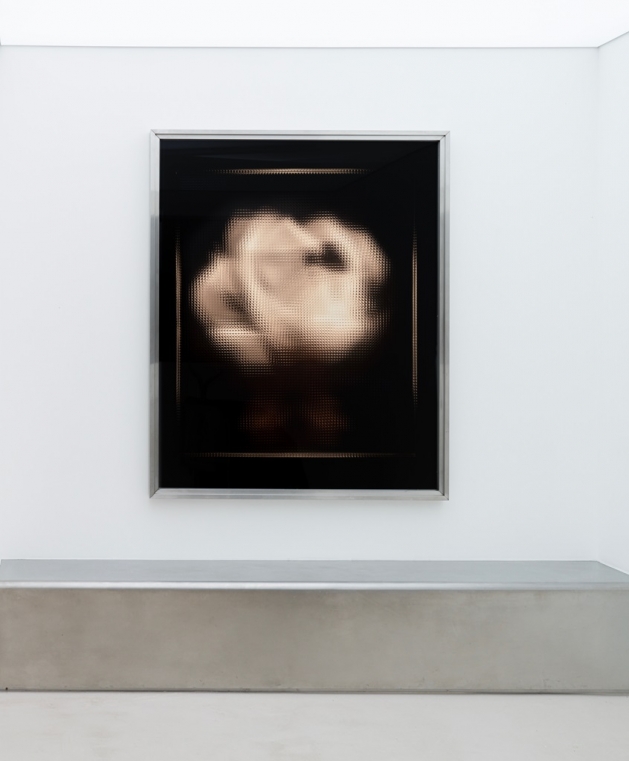
In such works, photographs of ambiguous subjects and situations are placed within diverse types of frames, forming relationships while simultaneously pushing their meanings away from one another.
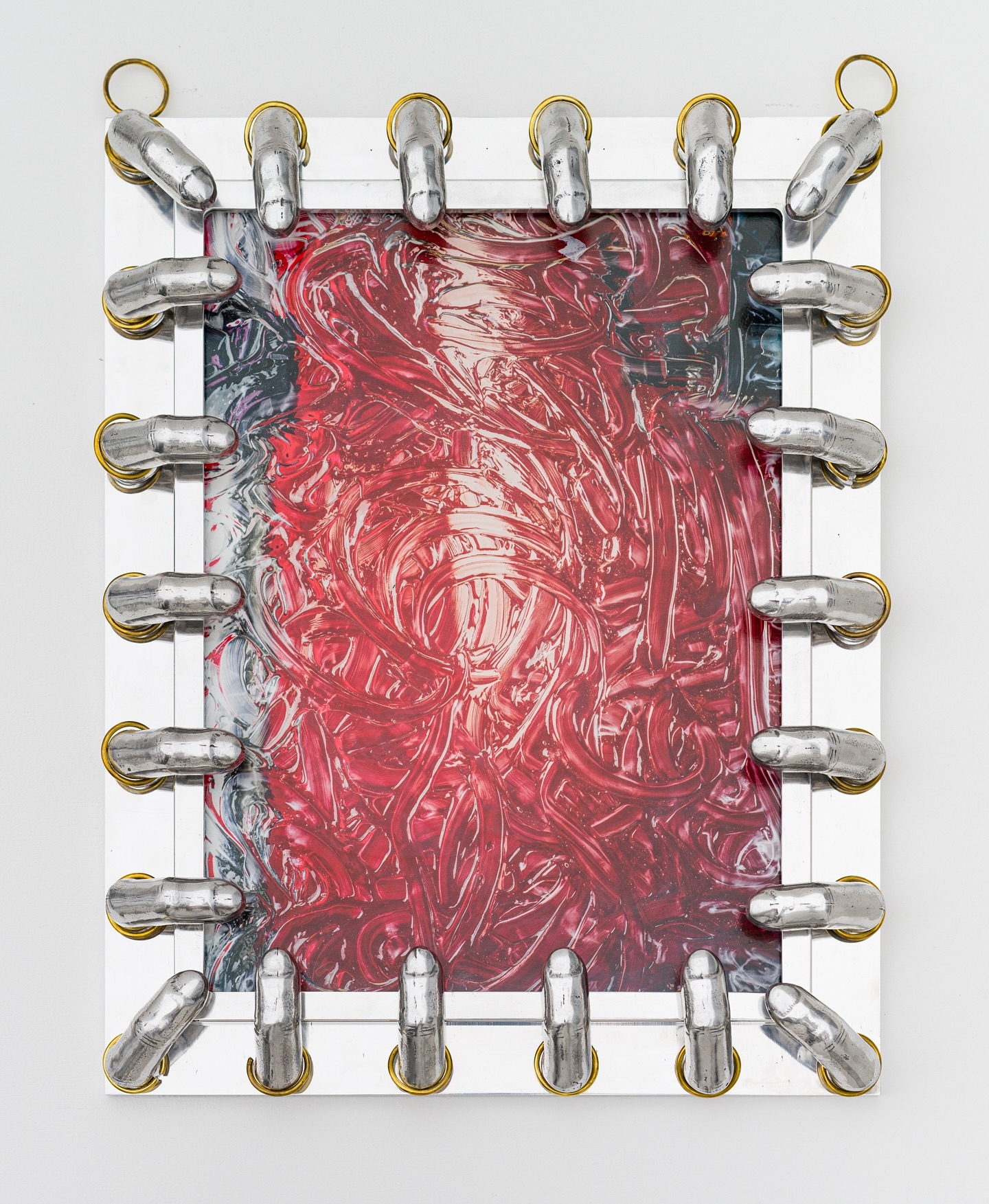
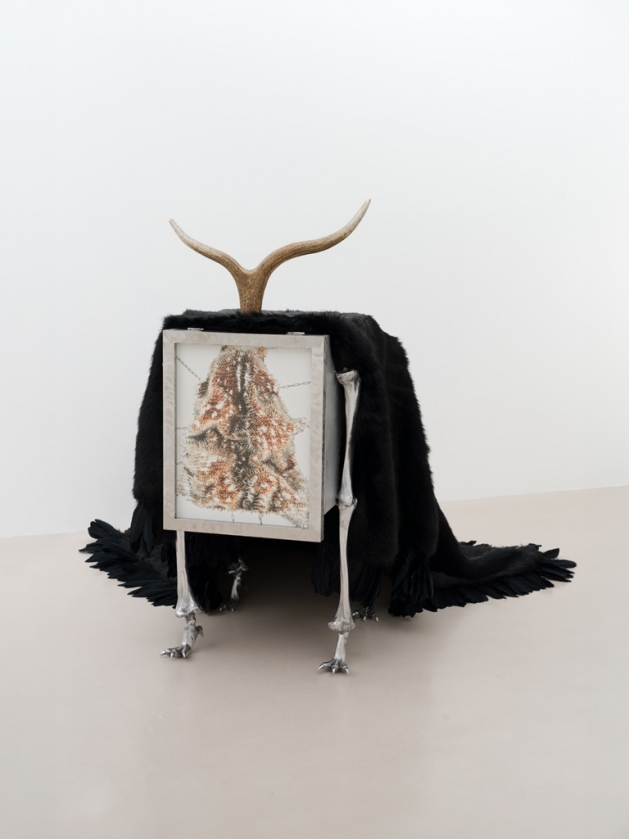
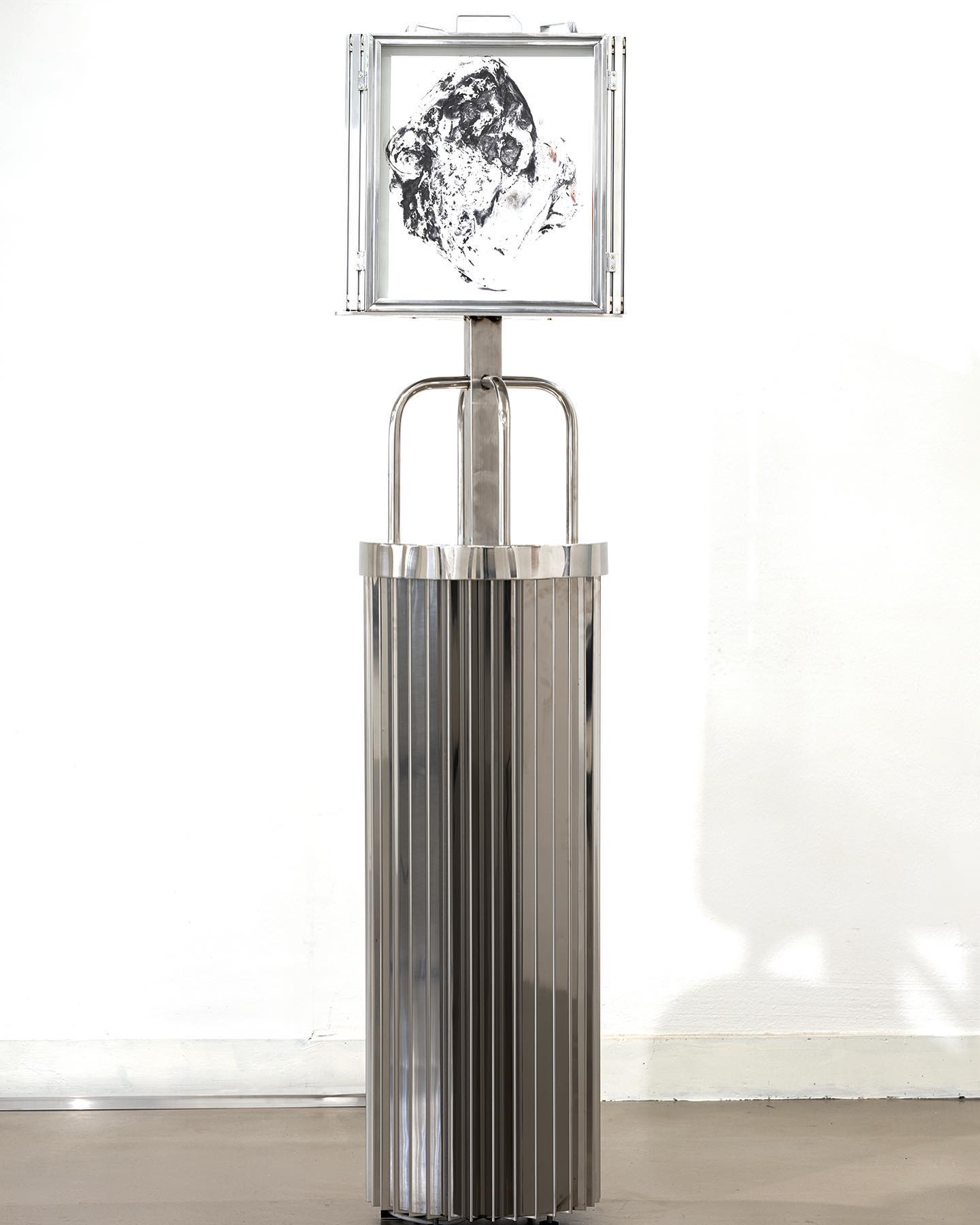
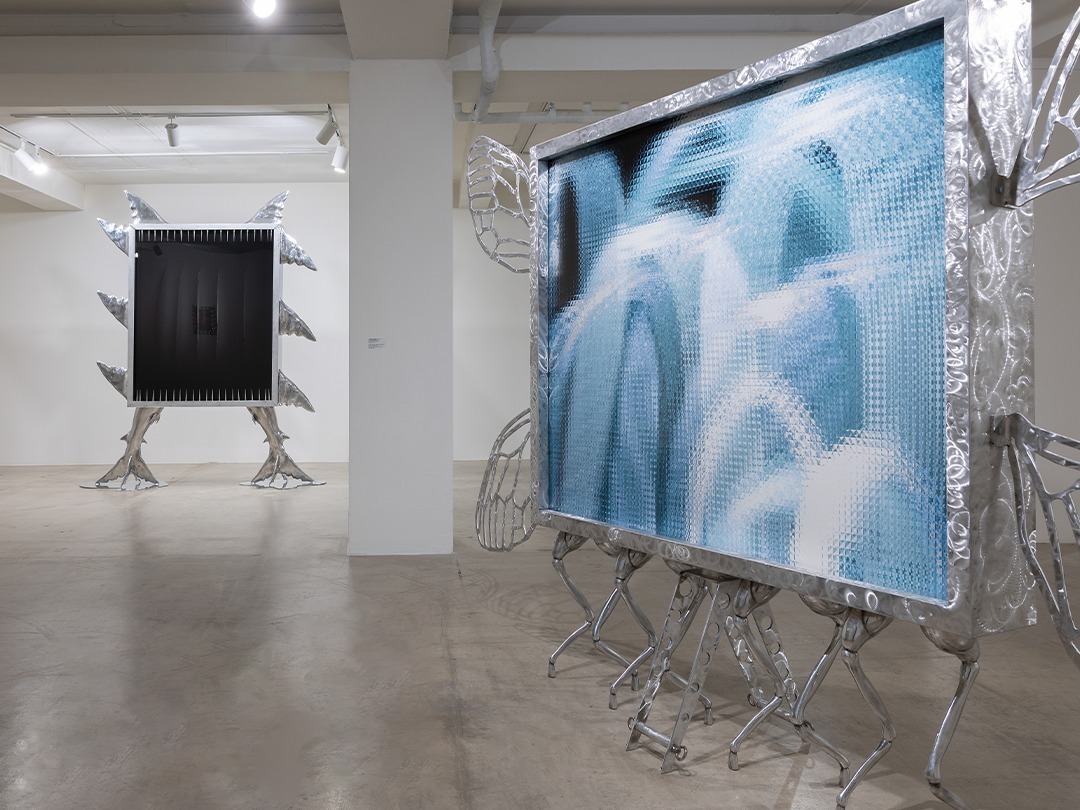
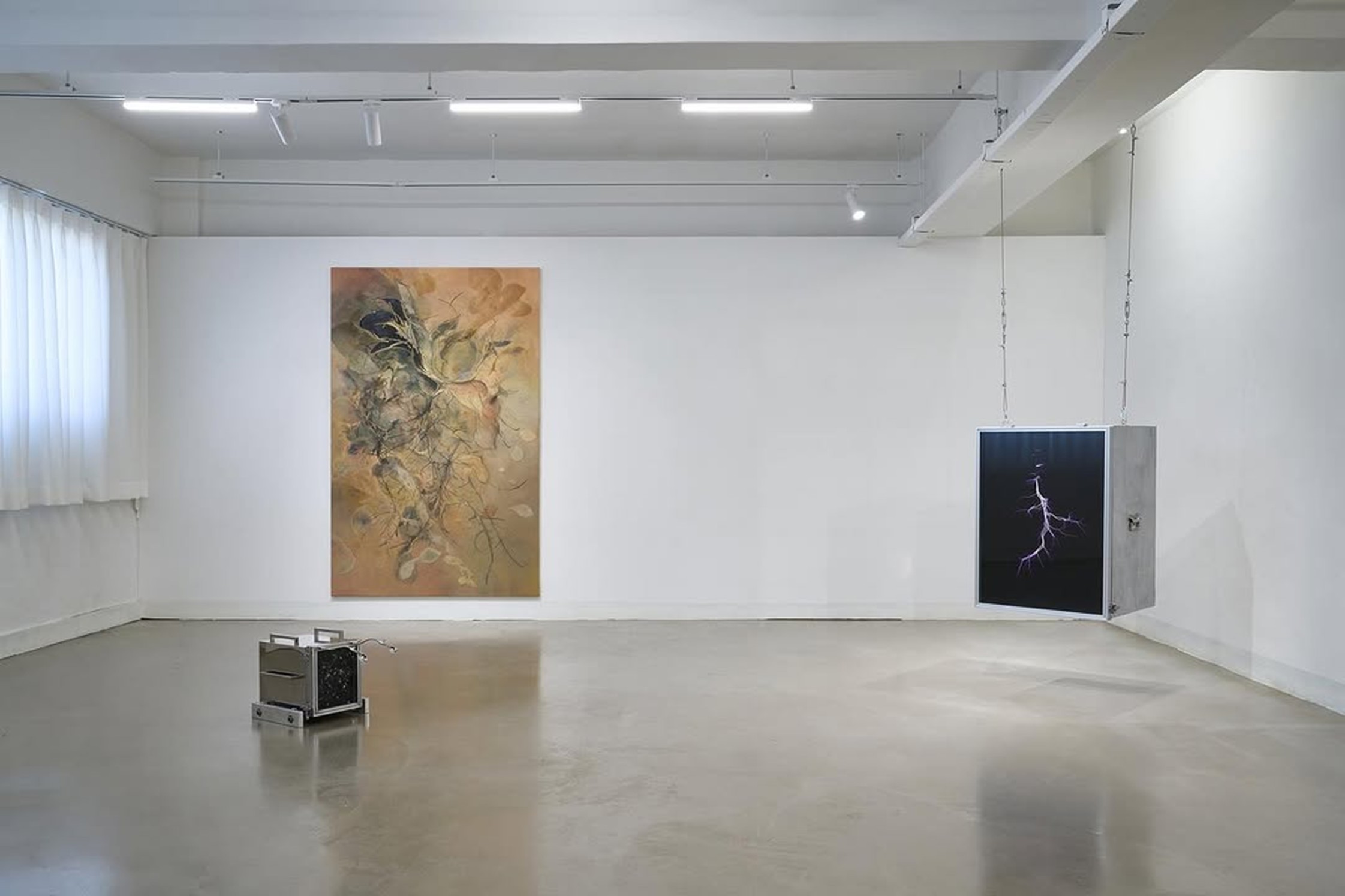
The works introduced in Jeongkeun Lee’s solo exhibition 《SUPERNATURAL》 continue his earlier practice of expanding frames—originally functioning to protect two-dimensional works—into various industrial and functional forms, as seen in works from 2022. The works generally take the form of steel sculptural frames containing still images.
The reason Lee’s photographic works, installed in space as sculptural forms, have taken on their current form lies in an incident in which his studio was flooded, damaging works that had been protected by wooden frames, leading him to recognize the material fragility of flat images. Through this event, the artist developed an obsession with robust protective devices and began to focus on the outer shell surrounding the image.
After this incident, the frames that protect the images became obsessively enlarged and bloated, yet Lee’s work continues to retain the medium-specific qualities of photography that record time and light. However, he has moved away from methods that involved searching for sites to capture invisible flows of air or temporality through light, or using objects that indirectly visualize them.
Instead, he now constructs steel frames and produces moving images through mechanical devices. While he continues to work primarily with photography and actively utilizes its capacity to visualize the transparent or invisible, in his recent works the frame itself becomes more prominent than the image.
Within the tradition of visual art, frames have served not only to protect artworks but also to provide ornamentation and facilitate mobility. However, the mobility of the frame paradoxically results in separating the work from the spatial context—such as walls or architecture—in which it was originally situated and inseparable. Jeongkeun Lee focuses not on site-specific context but on the functional aesthetics of self-supporting frames, their decorative qualities, and the ambiguous relationship between interior and exterior.
He refers to his work as “frames exaggerated through the gleam and angularity of metal, paired with photographs made by selecting only the most striking parts,” likening them to “supernormal stimuli”—exaggerated stimuli that surpass real sensations. Works from 2023 presented in the exhibition most clearly reveal this intention. Ironically, while the works gain a strong presence through materiality and form that exceed functionality, one must be careful not to have one’s senses overtaken by these stimuli in order to properly view the images within the frames. The frame can be defined as the surface or shell, and the photograph as the interior; works such as those from 2023 and 2021 reveal this relationship between form and image.
At one point, one begins to question whether contemporary photography is truly so fragile that it requires protection by such bloated materiality. While some artists focus on the medium-specific characteristic of photography as capturing subjects, traditionally photography has functioned by conveying the artist’s intent through images fixed on thin surfaces such as photographic paper. Photographic paper is produced by dissolving wooden fibers such as bark and grass in water, then reassembling them into a flat surface and applying a photosensitive emulsion to create a chemical reaction.
Artists working with photography have traditionally maintained an approach that involves the deconstruction and recomposition of materiality, as well as capturing invisible elements such as light and time into a single moment. However, in the present, capturing moments of light and subjects through digital cameras and smartphone optical sensors has become routine, while images are explosively produced and consumed through various platforms that project desire. In terms of production and consumption, photography remains a powerful medium, yet it too easily yields its agency to the materiality of external environments or exaggerated stimuli.
For days, the monsoon rain has poured heavily outside the window, and droplets form on the glass due to the cool air from a rattling air conditioner. Much like the temperature difference between inside and outside the space, Jeongkeun Lee’s image strategy does not allow materiality and image to align in parallel or converge in a single direction, as they are separated by the transparent surface of the window. Although the artist began producing frames in steel after the incident in which the wooden frames he trusted to protect his works were rendered useless by flooding, he neither affirms nor denies the irony that the viewer’s attention is captured by exaggerated stimuli rather than the actual subject he intends to present.
This may be because he continues to adopt, to some extent, the modes of image consumption of the present, while maintaining his existing artistic approach—his interest in “things that are transparent or visible yet unseen,” and his attempt to “visualize ungraspable time and belief.” It is hoped that in this exhibition, rather than being captivated by the bloated exterior or the fragile image, viewers will focus on the artist’s image strategies and his approach to the photographic medium.