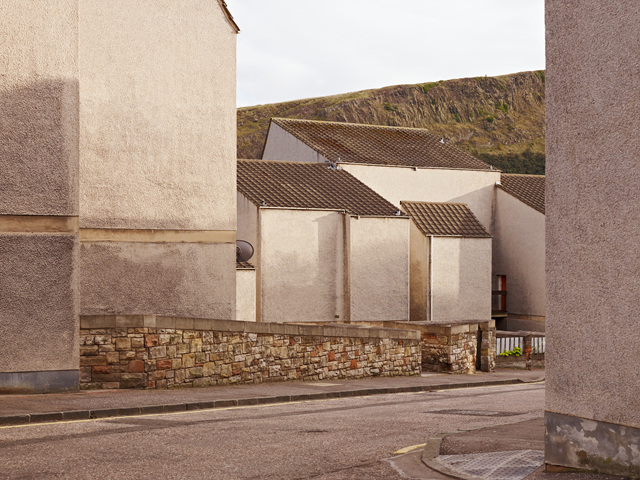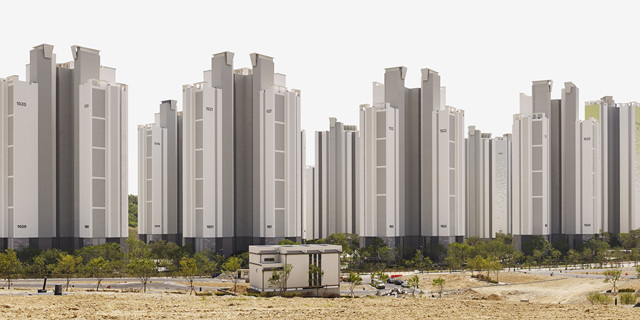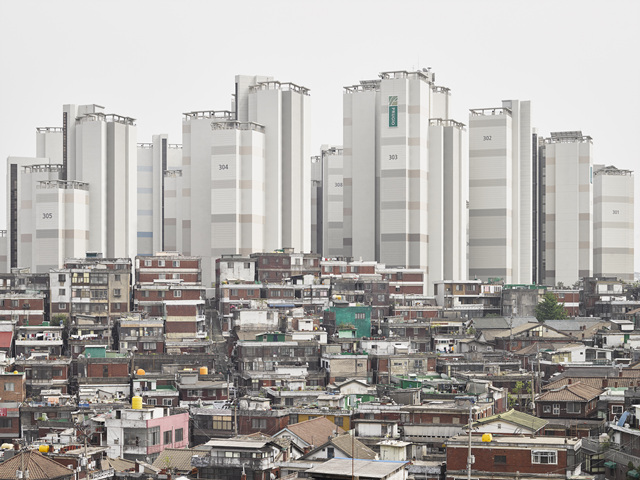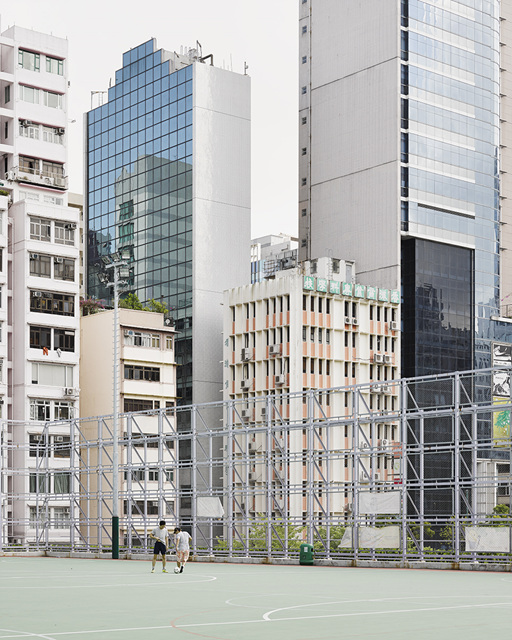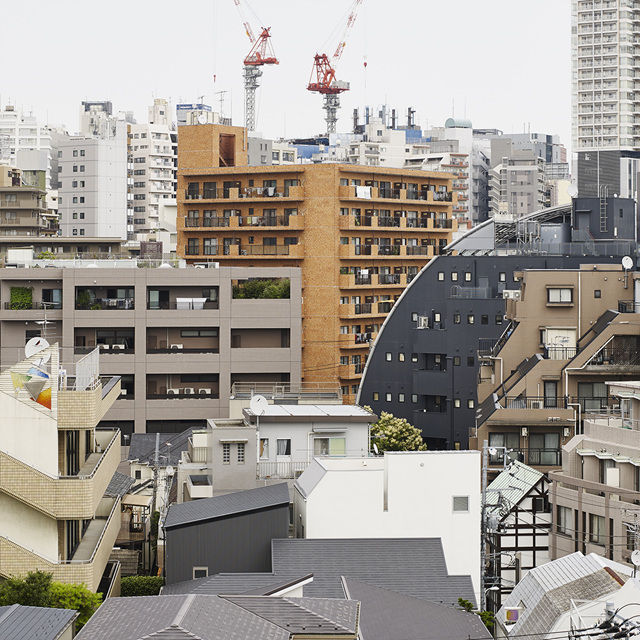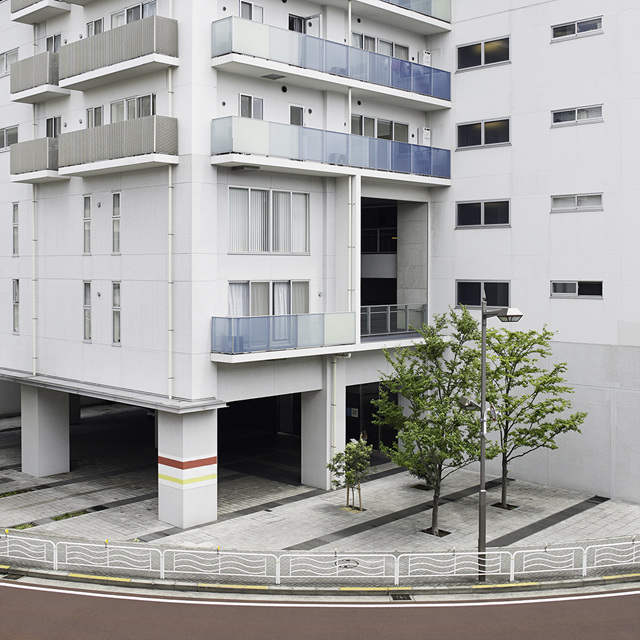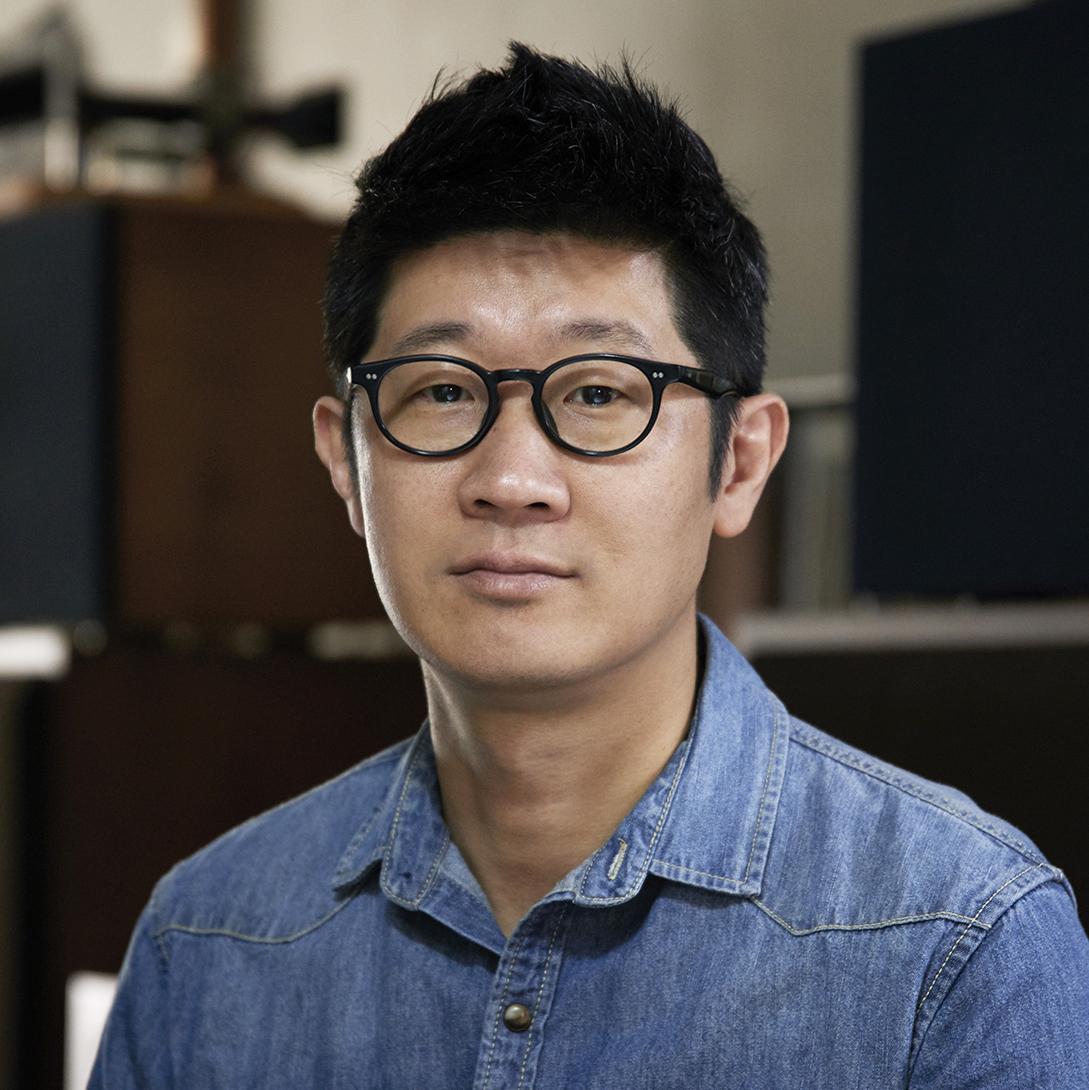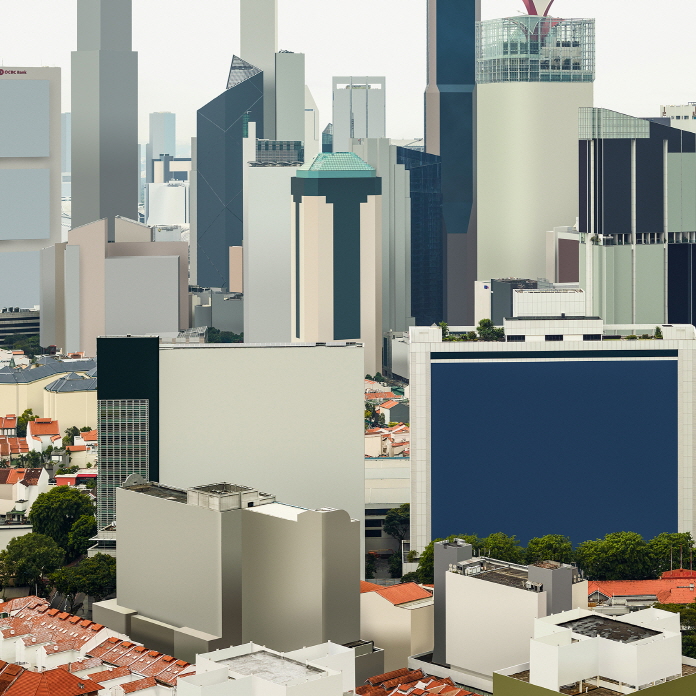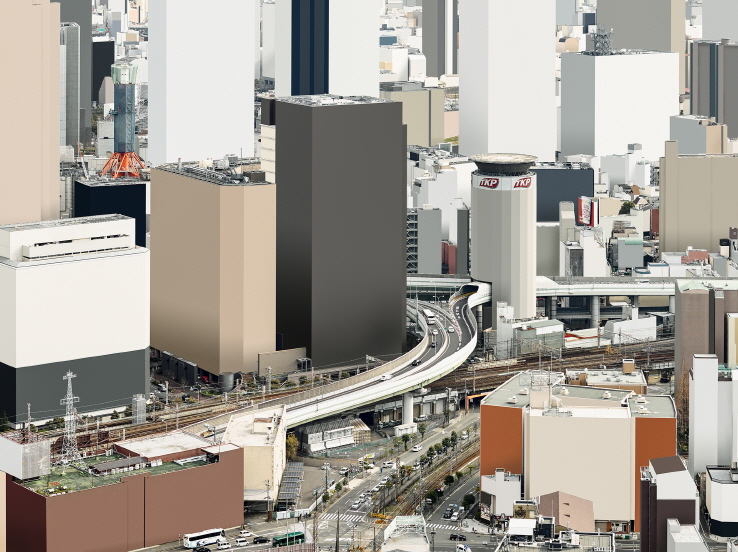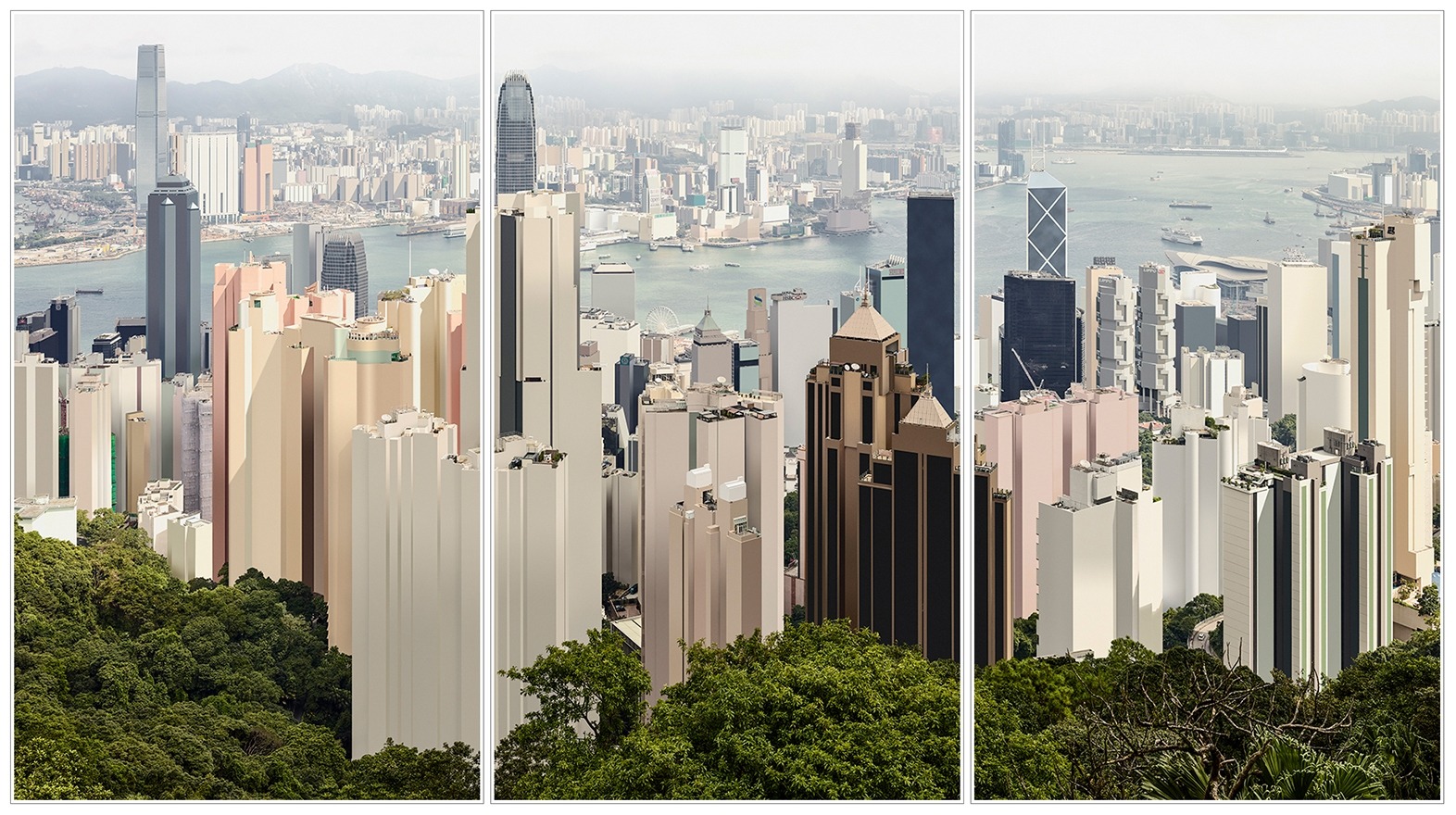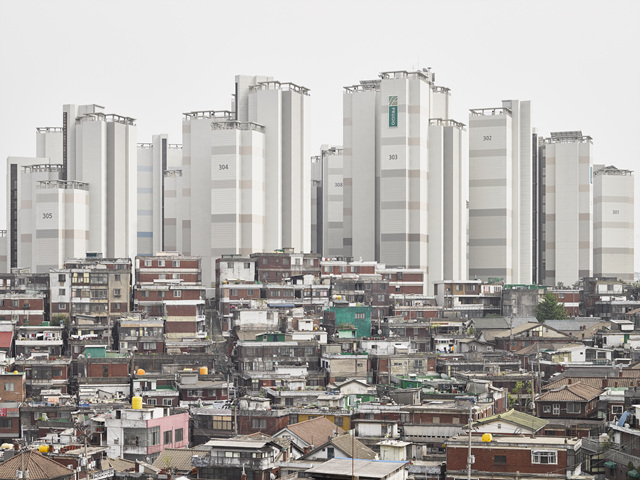


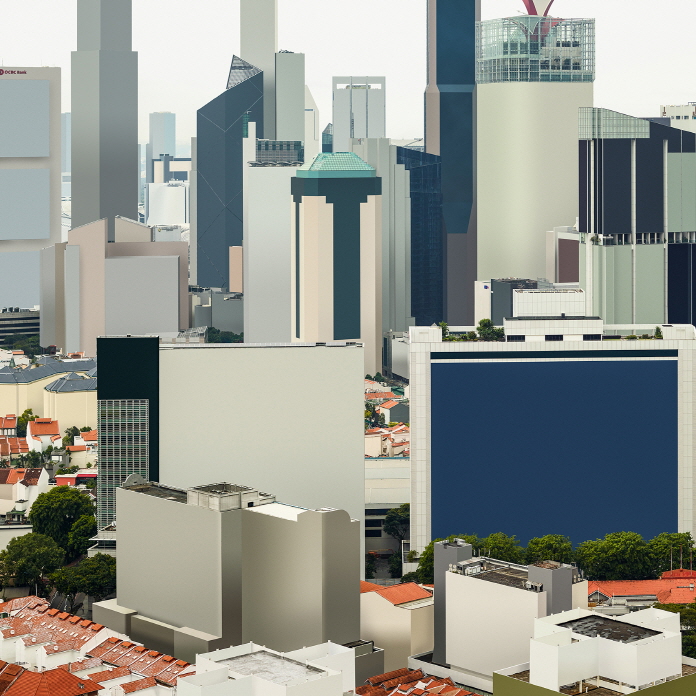
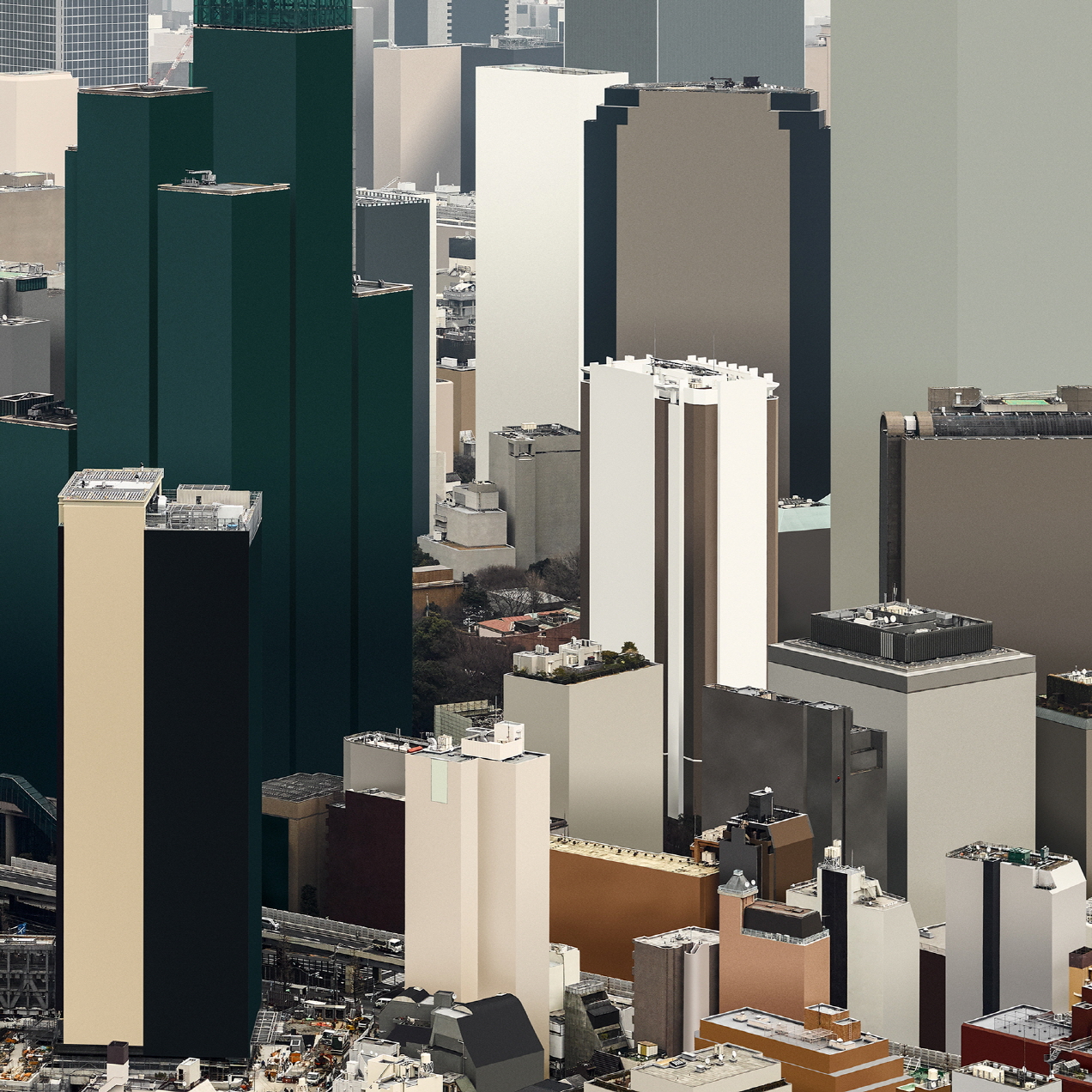
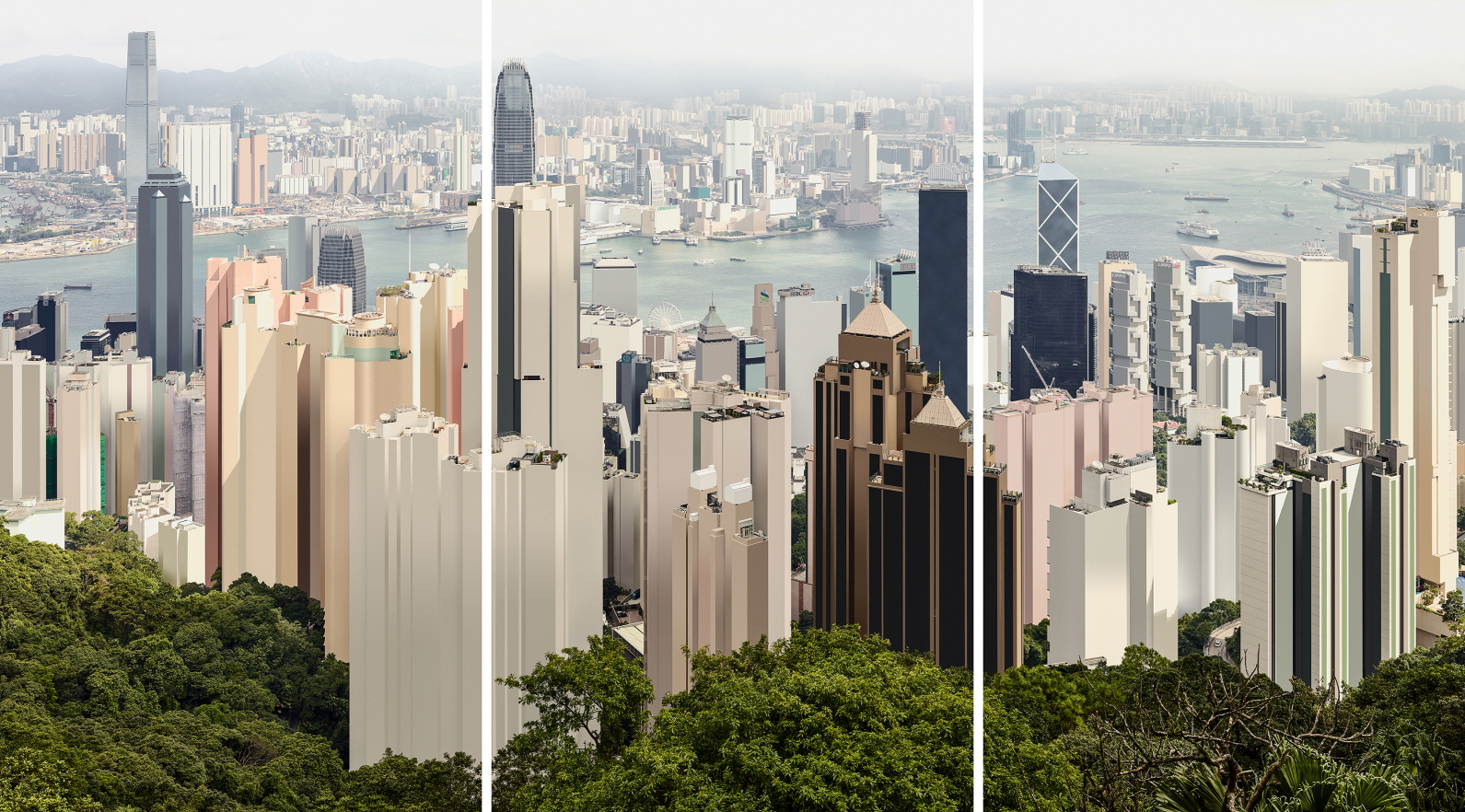
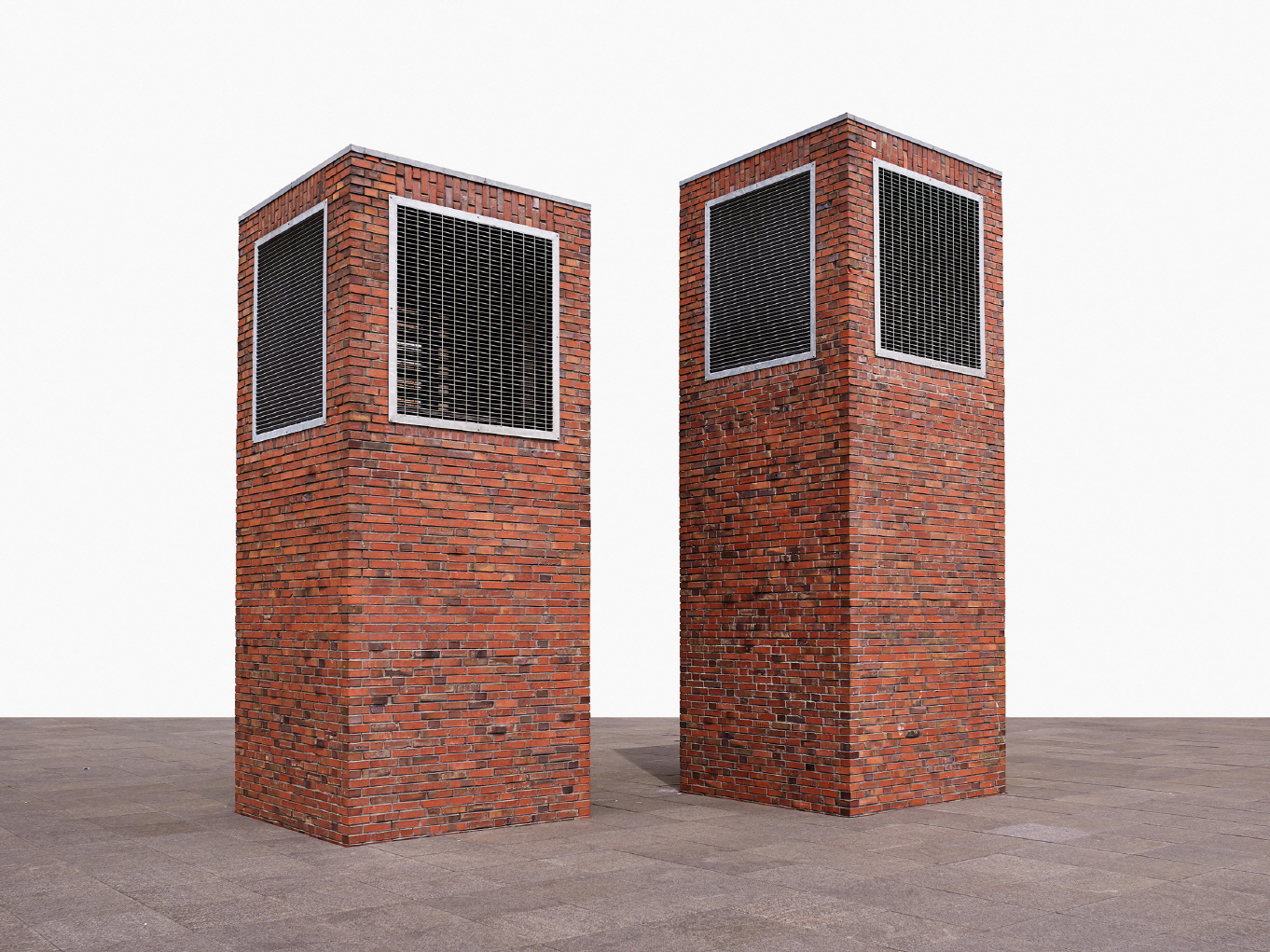
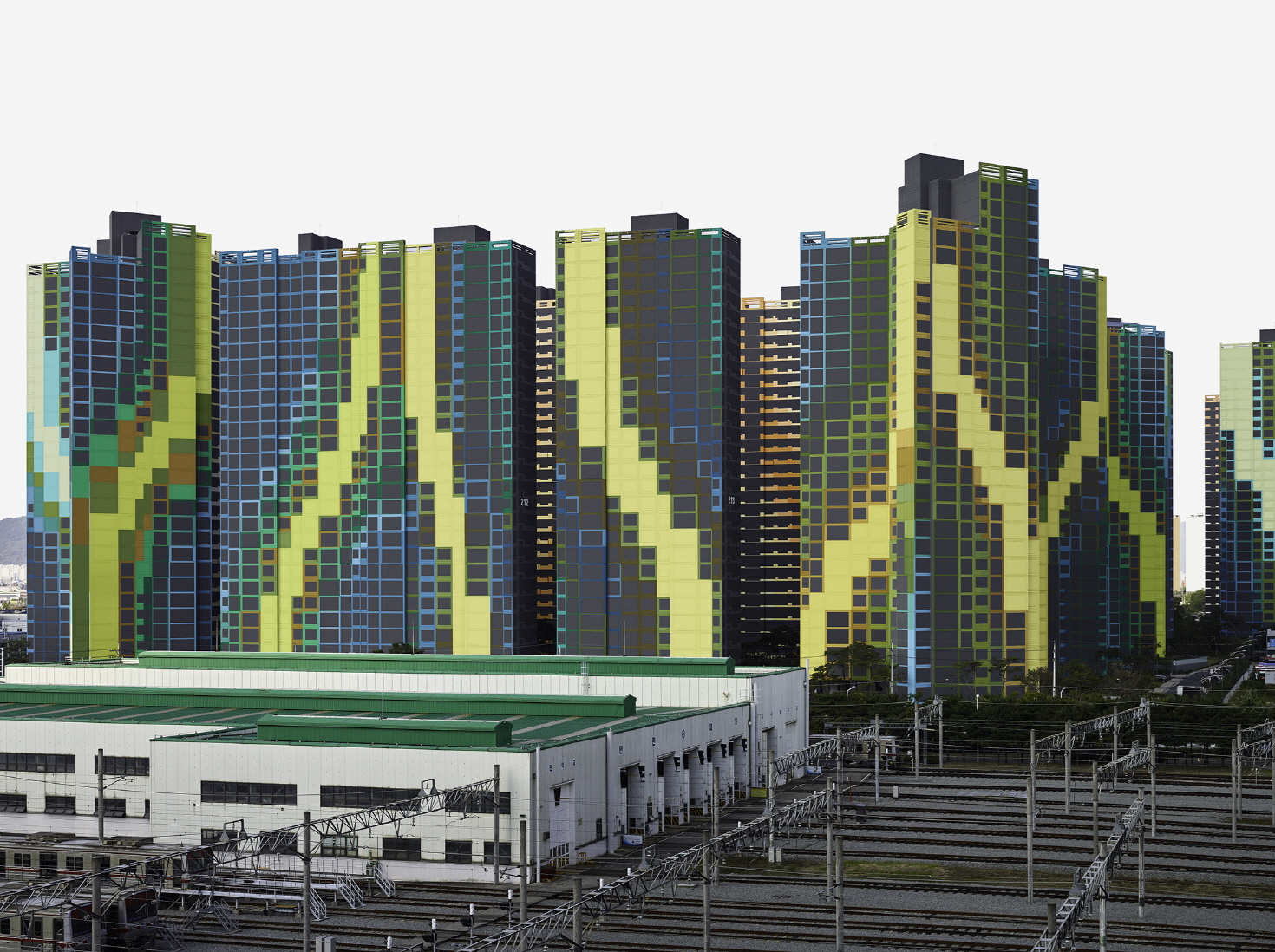
Park Chanmin’s exhibition 《Surrounded by Space》 presents an urban landscape in which spaces overlap and appear to enclose one another. It may well be described as a geometric jungle. Layers upon layers of buildings envelop the land and sky, erasing even the traces of human presence. These urban scenes, which can only be described as a monstrous ecosystem, provoke a sense of doubt—are these truly places where we live?
 
In a world that feels as though it has been compressed into a vacuum pack, devoid of any sense of air, one begins to wonder whether human beings can even breathe and exist there. In such a flattened world, are humans themselves not reduced to flat, microorganism-like entities? A flat creature experiences its flattened world as an infinite expanse. In such a compressed environment, how might one reach the buildings visible in the distance?

As is often the case, rapid horizontal and vertical movement—via automobiles and elevators—would be required. Anything that obstructs such speed is eliminated. Unnecessary contact with nature, with other people, and with the environment must be excluded. Yet, if everyone relies on the same means and participates in this race for speed, the velocity itself is bound to diminish.


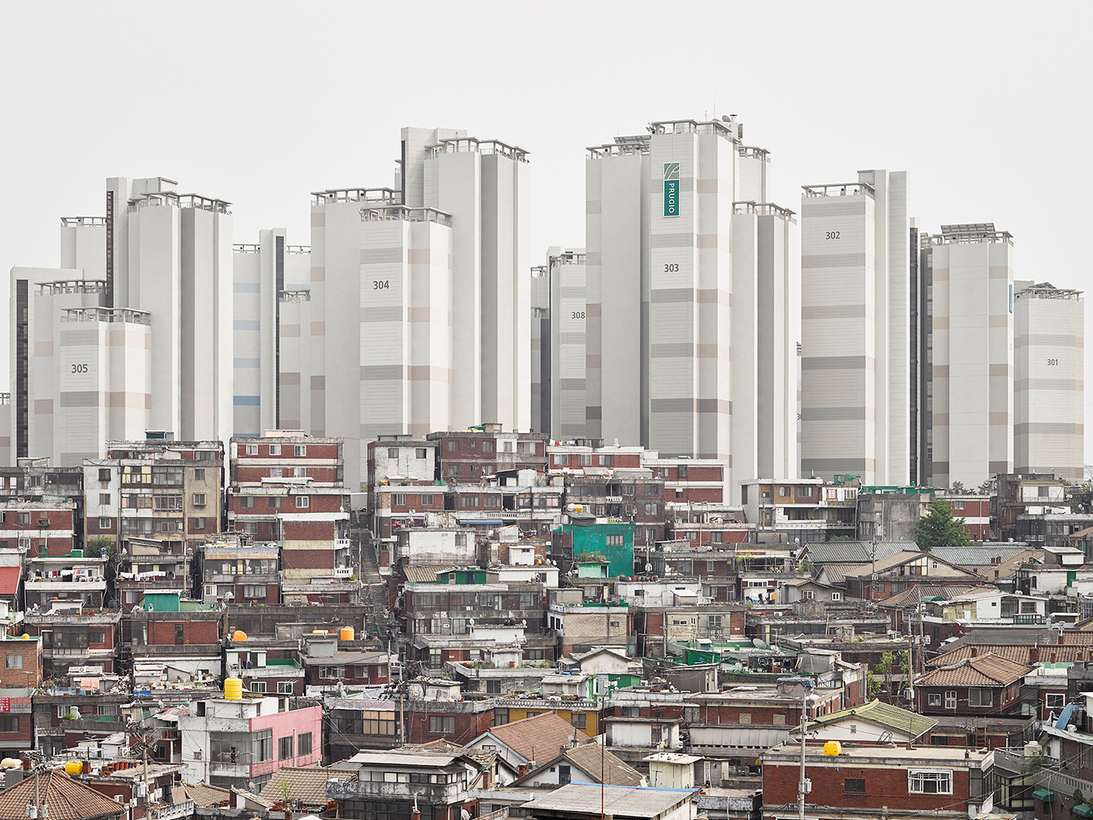
Park Chanmin, BL1055571303103015, 2010, Digital Pigment Print, 100 x 129 cm © Park Chanmin

The moment arrested by the photograph reveals a cross-section of an apocalyptic process. Park Chanmin’s urban landscapes are so excessively realistic that they appear almost surreal. While they offer a critical perspective on the very reality we inhabit, they also produce an aesthetic pleasure that arises from confronting an unvarnished truth laid bare. His images, though seemingly altered in appearance, still point to a reality grounded in the real; precisely because they retain a clear referent, they sustain their critical force. Yet there is a paradox in his method of distancing us from familiar urban life: it results in the loss of distance itself.

This loss of distance is precisely what calls for critique, for it traps us within a single given dimension, leaving no room for surplus or alternative perspectives. If reality were wholly agreeable, such immersion might not matter—but since it rarely is, this condition signals a form of existential suffocation. However, as seen in Park Chanmin’s work, when distance is pushed to an extreme and seemingly disappears, it paradoxically re-emerges. The world we perceive as homogeneous returns to us as something heterogeneous and estranged. The artist reveals contradictions that modern individuals, already conditioned and desensitized, can no longer perceive—doing so through the most familiar of subjects.
 
In this exhibition, Park Chanmin focuses on several series, yet what he ultimately engages is not a particular motif but a system. Considering the significance of dwelling within the symbolic universe of human life, housing becomes a fragment that encapsulates a portion of contemporary society—yet a decisive one. At the same time, each fragment is not self-sufficient, lacking fullness in itself. The artist gathers countless fragments within the single fragment of the photograph. These fragments, devoid of organic totality, collide against one another, producing a sense of friction and dissonance.

This discomfort and strangeness are all the more pronounced precisely because the elements themselves are so familiar. And yet, this uncanny urban landscape is not the result of heavy manipulation; it is not an imagined construct but reality itself. His work remains faithful to the photographic viewpoint, which differs from that of the human eye. Like painting, photography translates three-dimensional space into a two-dimensional surface; it is ultimately flat. Park overlays this inherent flatness of photography with a world that is itself becoming increasingly flattened. A world drawn ever closer for immediate consumption, where mutual interference is maximized, becomes flat. An era in which everything can be aligned in a single row—as commodity or as code—is, inevitably, a flat one.


Park Chanmin, BL214365198127251931, 2014, Digital Pigment Print, 120 x 220 cm © Park Chanmin

Flatness is the result of the compression of time and space. Compression, in turn, brings about implosion. Through globalization, a contraction of space has occurred, wherein diverse communities across the globe are placed into conditions of infinite competition. The time that fills this space likewise becomes homogenized. In The Condition of Postmodernity, geographer David Harvey argues that the postmodern condition emerges through the accelerating process of time–space compression. Park Chanmin’s urban landscapes, shaped by this compression, appear almost like collages.

Yet rather than a collage that produces dialectical transformation, they resemble a mosaic-like collage that penetrates every gap without leaving even the smallest void. In this flattened world, abstract visuality prevails. Buildings, emphasized in their two-dimensionality, underscore that these are not so much places to live as they are places to be seen. Here, everything must be grasped at a glance rather than gradually understood. Interaction in the city is visual, and vision is immediate. A reality dominated by anonymous gazes fixed only on surfaces excludes contact and participation. The world that appears flattened feels profoundly unfamiliar. Yet in Park Chanmin’s estranged urban landscapes, the underlying structure itself is never altered.
 
The interventions are minimal—such as erasing letters or windows. What pervades his work is a vertical and horizontal structure designed to accommodate as many commodities, pieces of information, and individuals as possible. These structures expand and form grids, allowing the position (and value) of each element to be determined through a clear system of coordinates. The grid proliferates by overlaying and extending existing structures.

This exhibition, which focuses on “the general and universal tendencies of urban space,” observes “scenes in which lines intersect, planes overlap, and lines and planes intermingle—the fundamental elements that compose space and structure—through a simplified and diagrammatic gaze.” Through photography, Park Chanmin not only reproduces these structures but also rearranges them. This rearrangement is not intended to produce a more beautiful or more grotesque landscape, but rather serves as a formal device to make the structure itself more perceptible and real. As David Harvey notes, “if space is a vessel that contains social power, then the reorganization of space is always a reorganization of the framework through which social power is expressed.”


Park Chanmin, BL215375573126950232, 2015, Digital Pigment Print, 121 x 156 cm © Park Chanmin

For Park Chanmin, arrangement is not a matter of physical displacement but is grounded in the precise selection of viewpoint. His limited use of Photoshop stems from an intention to emphasize reality rather than fiction. At a certain vantage point discovered within the tangled, complex silhouettes of the urban jungle, the city reveals its true face.

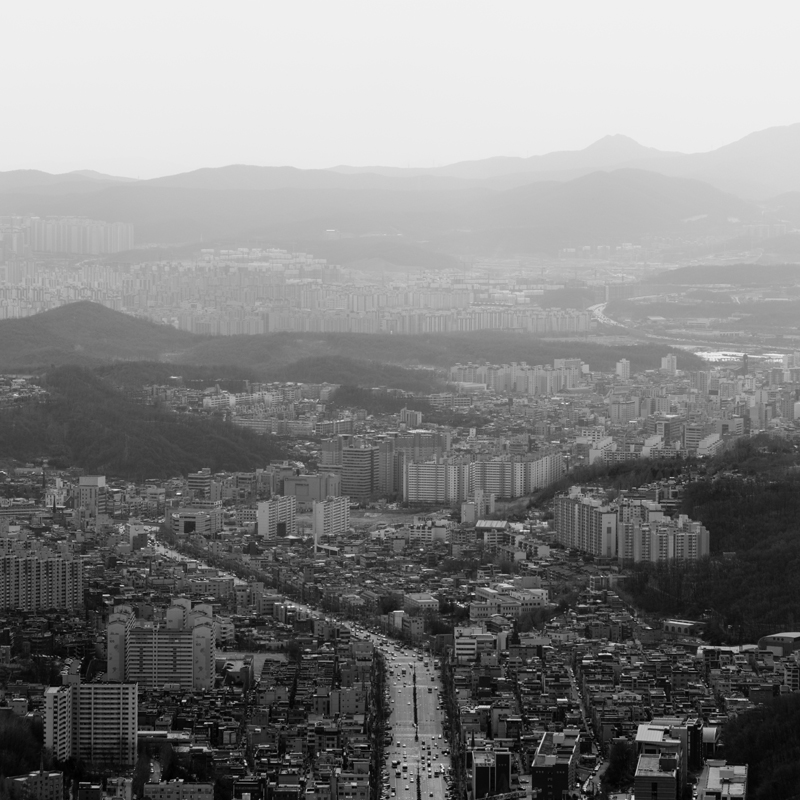
According to Park’s photographic interpretation, the spatial condition of the contemporary city is one of extreme compression. If one considers the interrelation between space and time, the same applies to time as well. In order to enable rapid communication—or more precisely, circulation—the present expands infinitely, making it increasingly difficult to discern temporal sequences or causal relations. Cities were not always like this. When buildings first rose vertically from the ground, they must have possessed a heroic and monumental presence.

Yet soon, driven by the logic of capital, they proliferated infinitely in both vertical and horizontal directions, becoming a universal grammar found across the globe. While traces of local specificity remain, this condition is particularly extreme in Korea. According to the artist, in Europe, apartment housing is often regarded as a failed modernist project—referred to as “general hospitals” or “prisons”—and when such buildings become obsolete, they are not simply replaced with more apartments.
 
In contrast, in Korea, it has become an almost unquestioned norm to demolish even five- or six-story apartment buildings and rebuild them as high-rise towers of several dozen floors. The windowless—thus eyeless—structures in Park Chanmin’s work seem to symbolize this form of blindness. Within a cyclical system in which systems generate desire and desire in turn accelerates the system, a monstrous ecosystem—an “apartment republic”—has emerged. Is the difference in perception of apartment housing between continents merely a functional response to Asia’s high population density?

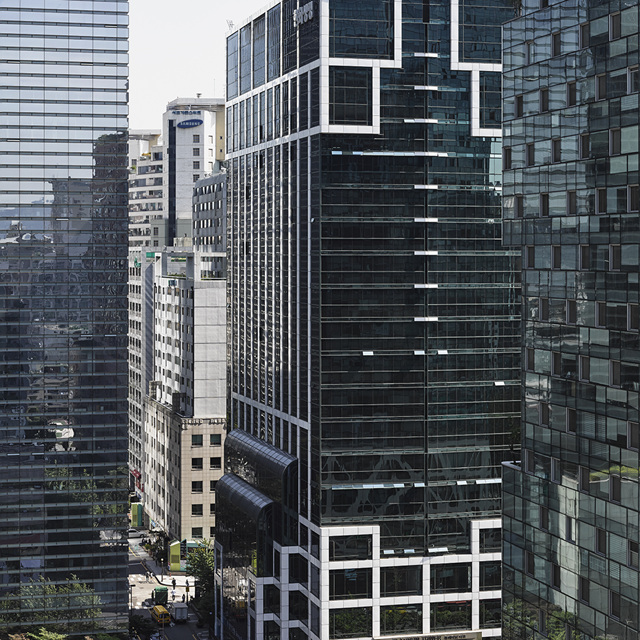
Or is it a “newness complex” born from a history that began in ruins? Time–space compression has accelerated to the point of oversaturation, where there is no longer any room left to insert more. Beyond horizontal saturation, vertical saturation is also evident. In some of his works, artificial structures are so densely layered that not even a sliver of sky remains visible. The skyline itself appears rigid. In urbanscape 71, where glass buildings reflect and refract one another, further flattening the image, even the sky becomes part of a geometric system. The ground, too, seems suspended. In [1], the empty space beneath the densely packed forest of buildings—where children are playing soccer—feels less like a natural environment and more like a space derived from abstraction.


Park Chanmin, urbanscape_001, 2014, Digital Pigment Print, 100 x 122 cm © Park Chanmin

For a building to possess a sense of material presence, it should stand as if rooted in nature, growing from the ground. However, the artist significantly reduces the density of the foundation—so much so that it appears almost empty. In [101], the building seems to be precariously suspended above a gray fence below. This unstable and uncanny layering is pushed to an extreme in [3], where water is placed atop a building rooftop, a small rocky island rests upon the water, and another building stands upon the island. Once proliferation exceeds a certain threshold, no governing principle can be discerned.

What remains perceptible is only the fierce, unrestrained surge of a force penetrating and occupying empty time and space. In [13], buildings continue to rise higher behind an already oversaturated landscape, while in [48], old structures and newly constructed ones are chaotically intermingled. Compared to the aggressive proliferation of artificial structures, nature appears almost like a plastic model.

In [17], a frail tree wedged between buildings is weakly planted, surrounded by masses of concrete. High-rise buildings that encroach upon space render their surroundings desert-like. They are isolated islands, severed from their context. In [56], the sky is entirely absent, while in [72], space is only suggested through reflections on the surfaces of opposing buildings.
 
In [37], where commodities are visible through the windows of brick-built structures, the image hints at what is contained within these densely packed rectangular forms. It reveals the city itself as a site of mass production and consumption. Within such urban spaces, human presence is scarcely detectable.

As seen in [42], where a window cleaner hangs between buildings, such figures—found almost like hidden images—exist with only a faint, shadow-like presence. Regarding these near-uninhabited landscapes, the artist notes that he does not intentionally erase people. Rather, the locations from which he photographs are places where people are rarely visible; even when present, they are difficult to perceive. He suggests that in the city, humans are simply that small.

This indicates that the artist’s concern lies not with individuals but with (urban) structures. The city exists for its own survival, not for human beings. Humans are merely components that serve the city itself. Through his photographs, Park Chanmin uncovers an abstract matrix-like space within our everyday environment.


Park Chanmin, urbanscape_048, 2012, Digital Pigment Print, 100 x 100 cm © Park Chanmin

In [86], the balcony captured at the center of a dense forest of buildings suggests that what is called “private space” is merely a small point from which one can look out over a desert-like city. For human beings inhabiting such overlapped spaces—where the gaze can no longer penetrate—the only remaining possibility is to immerse themselves in more plausible illusions.

The city is gradually becoming a screen, and those who face it are reduced to viewers or spectators—the endpoints at which various messages are received. As Guy Debord writes in The Society of the Spectacle, the consciousness of the spectator is imprisoned within a flattened universe and bound to the screen of the spectacle, where one’s own life is exiled behind its surface. In Park Chanmin’s work, screens of various scales endlessly compete with one another.

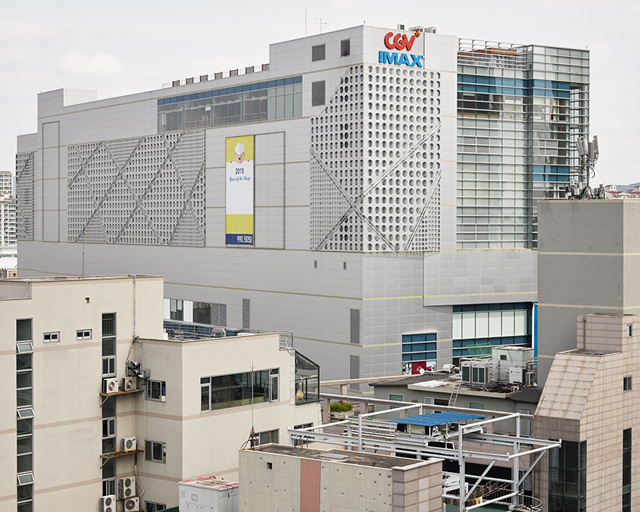
In [68], where an imposing “CGV IMAX” sign looms over a cluster of smaller buildings, the city is revealed as a site of spectacle. The urban landscape, like film itself, is composed of fragments that are separated yet conjoined. As Debord suggests, so too are social relations mediated by images. The spectacle—another facet of capital—is a historical condition in which we are already captured, an expression of separation and alienation between individuals.
 
In the layered landscapes of [73], where the gaze can no longer traverse space, the importance of surface texture comes to the fore. In a space where distance has been lost, difference is perceived through a kind of visual tactility. Although Park Chanmin photographs the façade or surface of the city, it simultaneously reveals its reverse side and interior. In [82], where scenes not usually visible emerge, the city appears far more chaotic and unstructured than it seems.

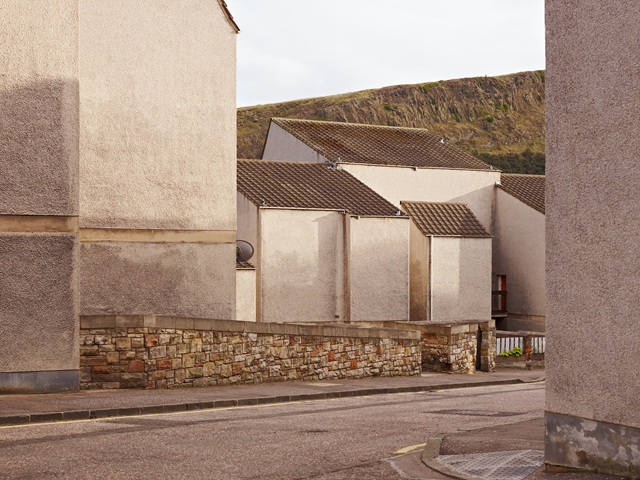
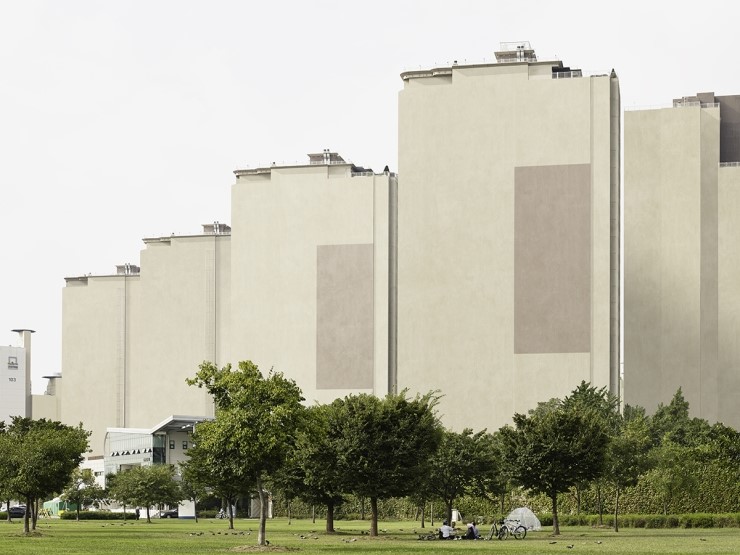
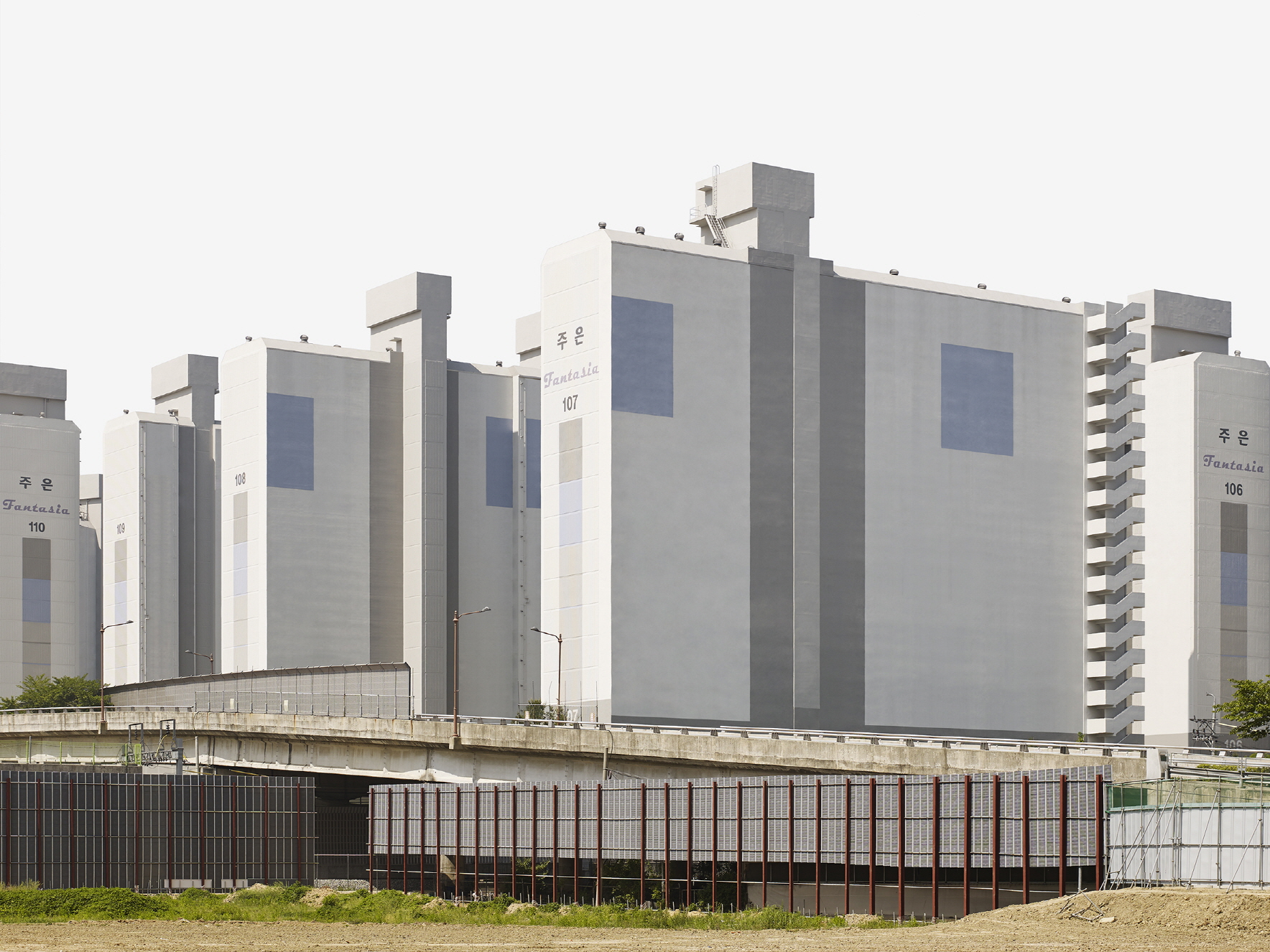
The elements composing Park’s urban landscapes are buildings that can be compressed into blocks. In the ‘urbanscape’ series, these blocks are further compacted and flattened. In the ‘Blocks’ series—where windows are removed from apartment buildings or collective housing structures—houses become nearly indistinguishable from warehouses, containers, or factories. Projects aimed at overcoming nature often rest upon barren terrain, in effect accelerating desertification. In Block 1, where a white building cuts vertically through a gray sky above a grassy field, the vertical artificial structure appears so flat that it resembles a sheet of white paper against its surroundings.


Park Chanmin, urbanscape_017, 2012, Digital Pigment Print, 100 x 100 cm © Park Chanmin

Photographs of European villages, where small cubes are clustered together, still appear relatively humane and proportionate when compared to images of Korea’s high-rise apartment complexes. Windows function as passages connecting inside and outside—akin to a kind of eye. The removal of windows implies a severing of communication between interior and exterior, a condition that may give rise to a kind of madness akin to editing or fragmentation.

In the ‘Blocks’ series, while windows are removed, brand names are not. This is because the essential quality of residential space, represented by the apartment, lies in its commodity value. The elongated vertical structures, marked only by building numbers or brand names, resemble barcodes that instantly generate a price when scanned.

They reveal the standardized nature of products produced within a regulated system. Buildings without windows also evoke images of apartments left dark due to oversupply caused by miscalculated demand. Korea, dominated by apartments, can be likened to a pathological ecosystem ruled by a single species.
 
Apartments, as products of a system of mass production and consumption, foreground convenience and function. However, large-scale high-rise residential complexes, like nuclear power plants, require long-term (over)consumption and maintenance for short-term economic efficiency. In this sense, they are by no means a sustainable form of housing. While capital has driven people toward concentrated urban living, the system continually sheds those who gather within it.

Concentration inevitably produces excessive competition, while simultaneously generating greater surplus. In the city, there is little to do other than consume. Ultimately, consumption becomes the only possible activity, and the moment one can no longer consume marks the point at which utopia turns into dystopia. In Park Chanmin’s work, utopia and dystopia are not far apart—they are separated by only a fine line.

The collective residential structures visualized through high-rise buildings can be understood as outposts of such a consumption mechanism. In Block 30, which depicts windowless apartments seen from a rooftop, the foundation of the buildings is weakened, much like in the ‘urbanscape’ series. At the same time, it suggests that the view from here toward there, and from there toward here, would ultimately be no different.


Park Chanmin, urbanscape_068, 2015, Digital Pigment Print, 100 x 122 cm © Park Chanmin

The city is a place that produces banality—one that can only be escaped through consumption, and even then, only as a fleeting form of diversion. Collective housing, too, operates according to the logic of commodities, inscribed with a short lifespan from the very moment of their production. Within this logic, not consumption itself but the reduction of consumption is regarded as a form of disaster.

Modern society, having developed solely toward the enhancement of productivity, seems to carry within it something akin to a ticking time bomb. In Block 32, tightly packed multi-family houses are seen with another layer of densely clustered apartment buildings rising behind them. It is a scene in which what might be called the “before” and “after” of development coexist simultaneously. What this juxtaposition of two spatial conditions suggests is a developmentalist illusion: that the future exists in that space, while the past resides in this one.

Here, time becomes spatialized. While blocks may evoke partition walls that atomize individuals, Park Chanmin’s work does not merely speak of alienation in the city. Alienation, which posits human and environment as opposing terms, is itself a product of modernity. His work captures the moment when modernity shifts beyond quantitative excess into a qualitative transformation. Development operates according to the interests of capital, yet such structures are also the result of desire.
 
Structure and desire move beyond interaction to a point where they become difficult to distinguish. We must speak of the structure of desire and the desire of structure. What is required for the maintenance of capitalist hegemony is standardization and the production of subjects suited to it; modern high-rise buildings, including apartments, are the condensation of such desires.

These structures, mutually exclusive yet interlocking, resemble vast prisons that reflect one another, prompting the question of whether it is possible to escape them. The artist brings these structures into proximity to reveal their similarities, and identifies arrangements in which they collide and nullify one another. In doing so, he relativizes a mode of life dependent on closed and abstract structures. This suggests a relativization of the dominant grammar that governs the present. Félix Guattari, in The Machinic Unconscious, argues that there is no universal language; what is considered a dominant language is merely the phenomenon of a particular social group seizing semiotic power.

Park Chanmin, while employing the dominant grammar that governs the present, simultaneously accelerates it to the point of nullification. For instance, while each building in his work may appear consistent in itself, by emphasizing the points at which they entangle, he disrupts their continuous codification.


Park Chanmin, urbanscape_094, 2015, Digital Pigment Print, 100 x 100 cm © Park Chanmin

Park Chanmin’s work demonstrates that “the existence of the universal depends on the contingent relations between heterogeneous strata” (Guattari). According to The Machinic Unconscious, which shares the same objective of escaping the structures and systems that dominate modern society, the structure of language arises from “a kind of barn composed of borrowing, mixing, adhesion, and misunderstanding that has fossilized.”

Coherence, then, lies in discovering “a system of arrangement that can draw from all directions, or a system of rules that can be interpreted in every possible way.” The artist visualizes the structures that frame contemporary life, while simultaneously revealing that such structures in fact operate through the assembly of diverse components. Insofar as structures are assembled, they can be transformed—and ultimately dismantled. The artist thus considers alternative social arrangements and different machinic assemblages.

An assemblage, as defined by Deleuze and Guattari, is “a framework that includes heterogeneous elements and is not fixed by codes or territorialities, but continuously produces new flows.” The emphasis on assemblage rather than structure is not intended to produce meaning or facilitate communication. Rather, for the artist, to construct an assemblage is to grasp the singularities of a given situation.

References