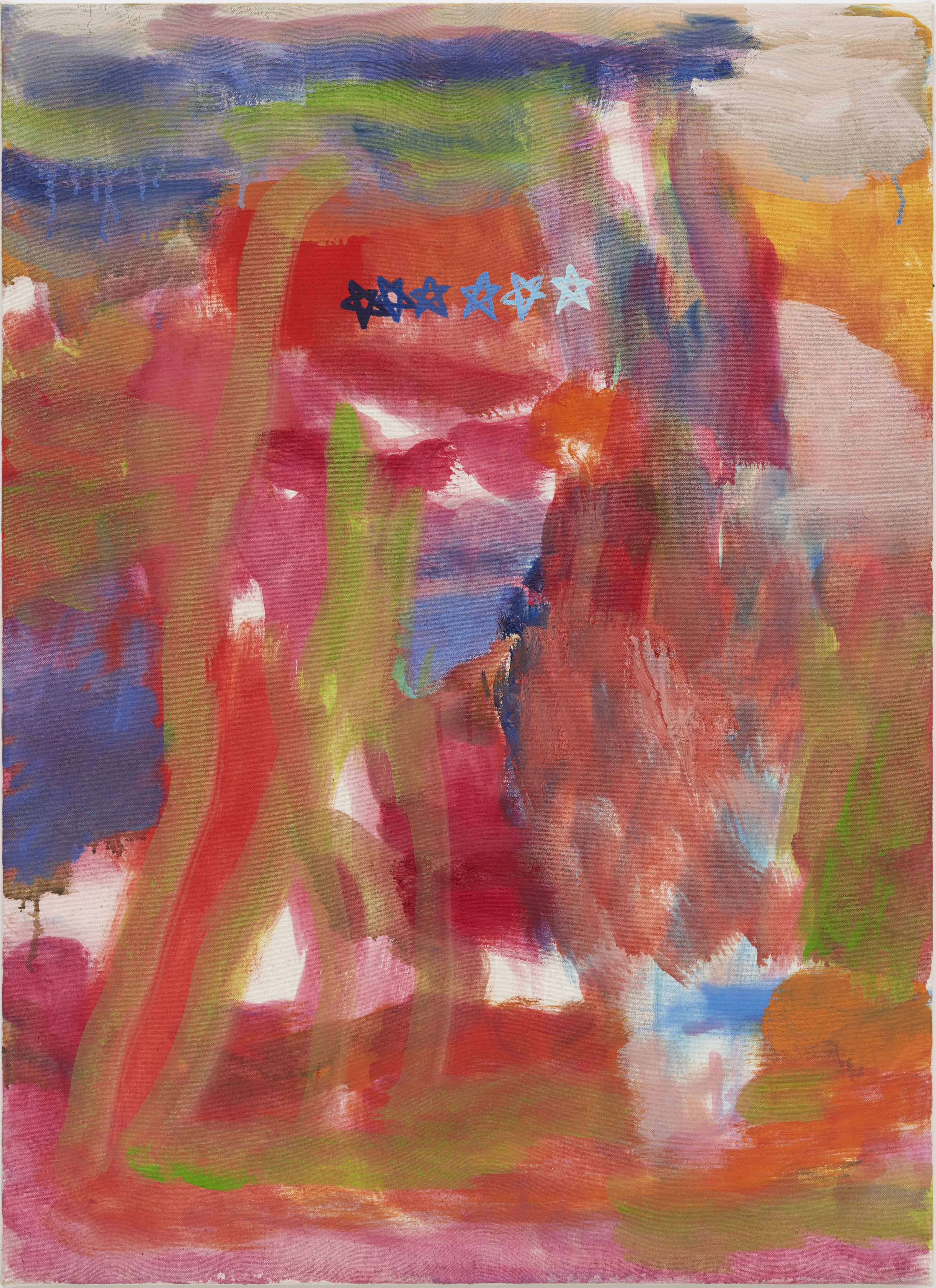
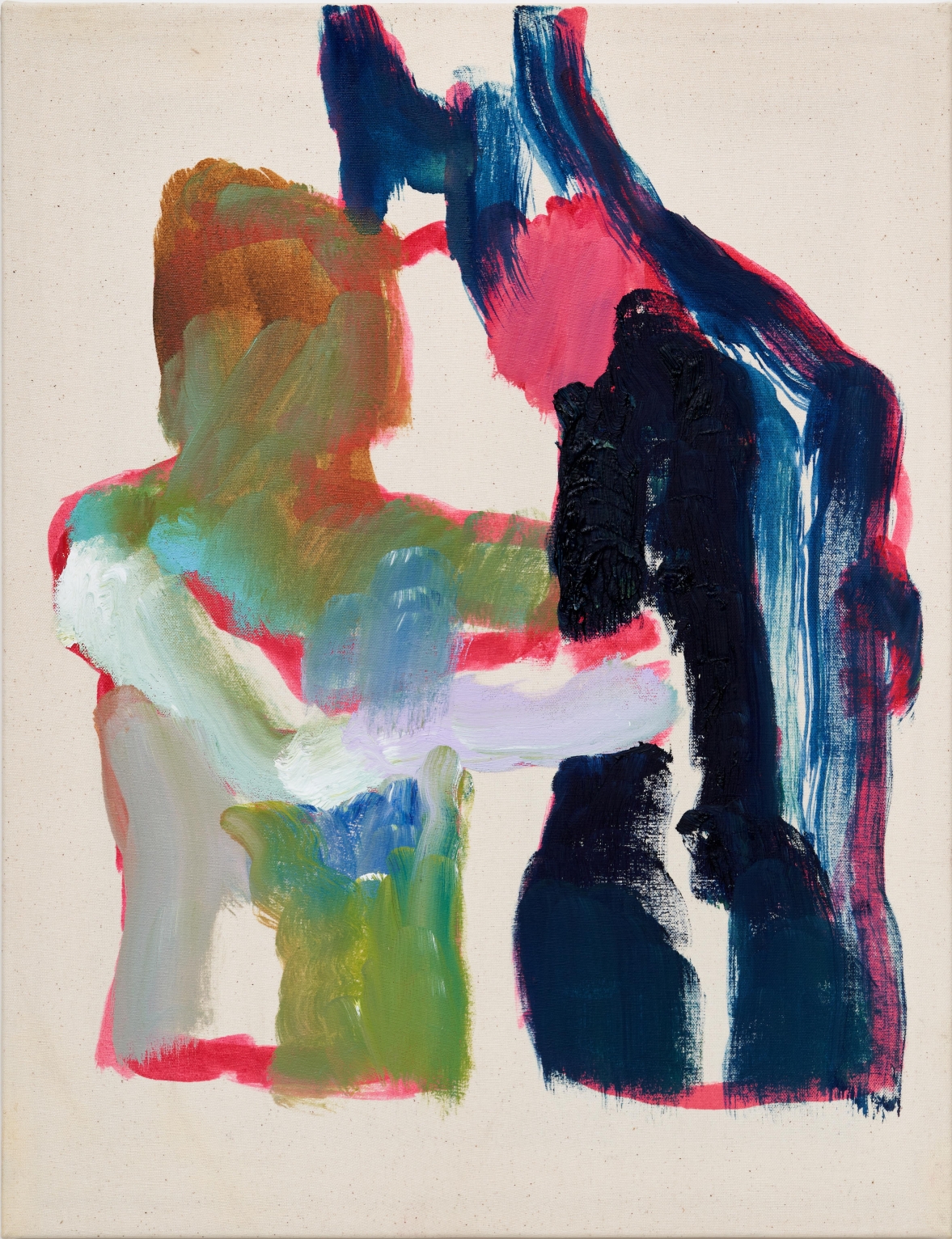
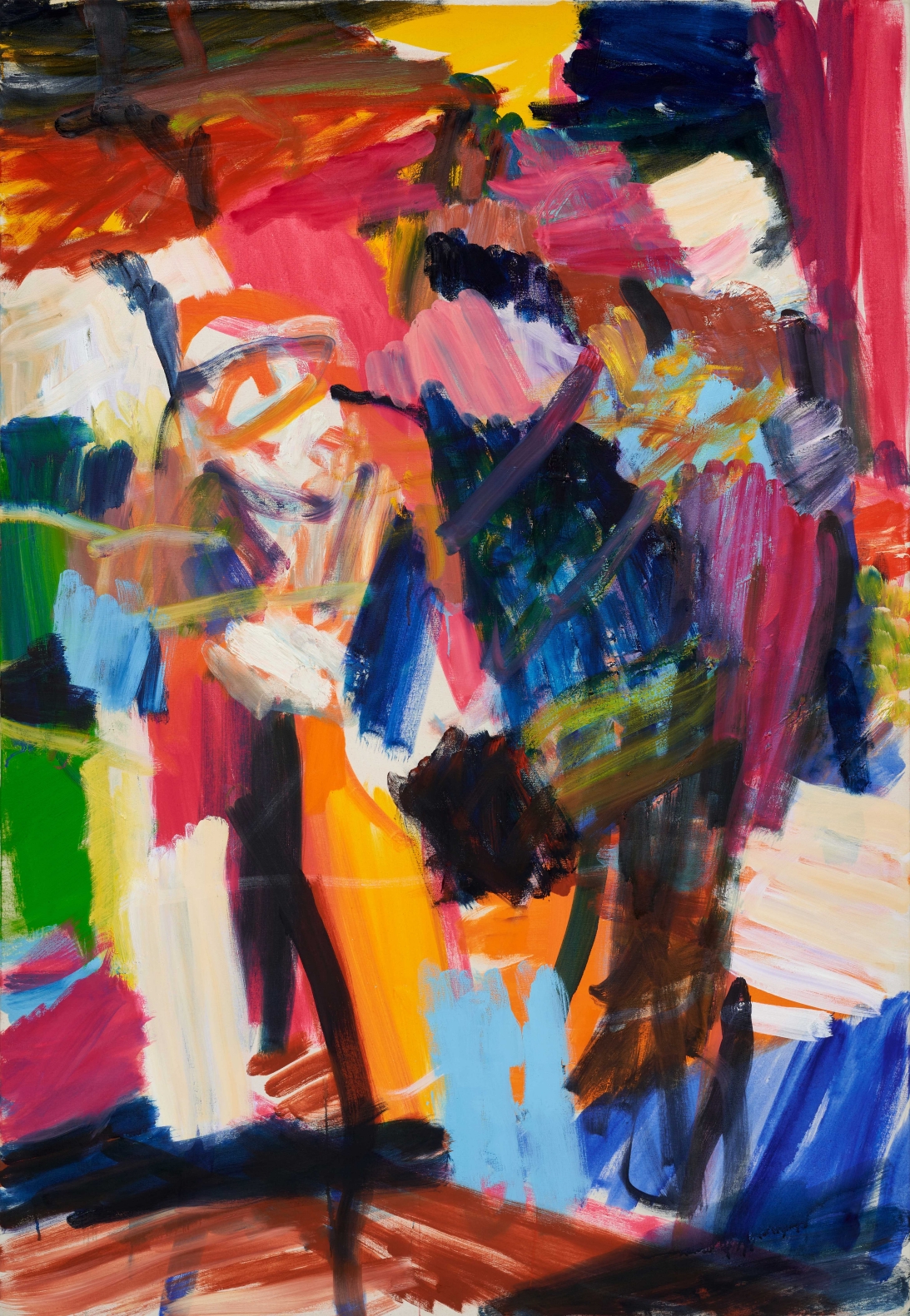
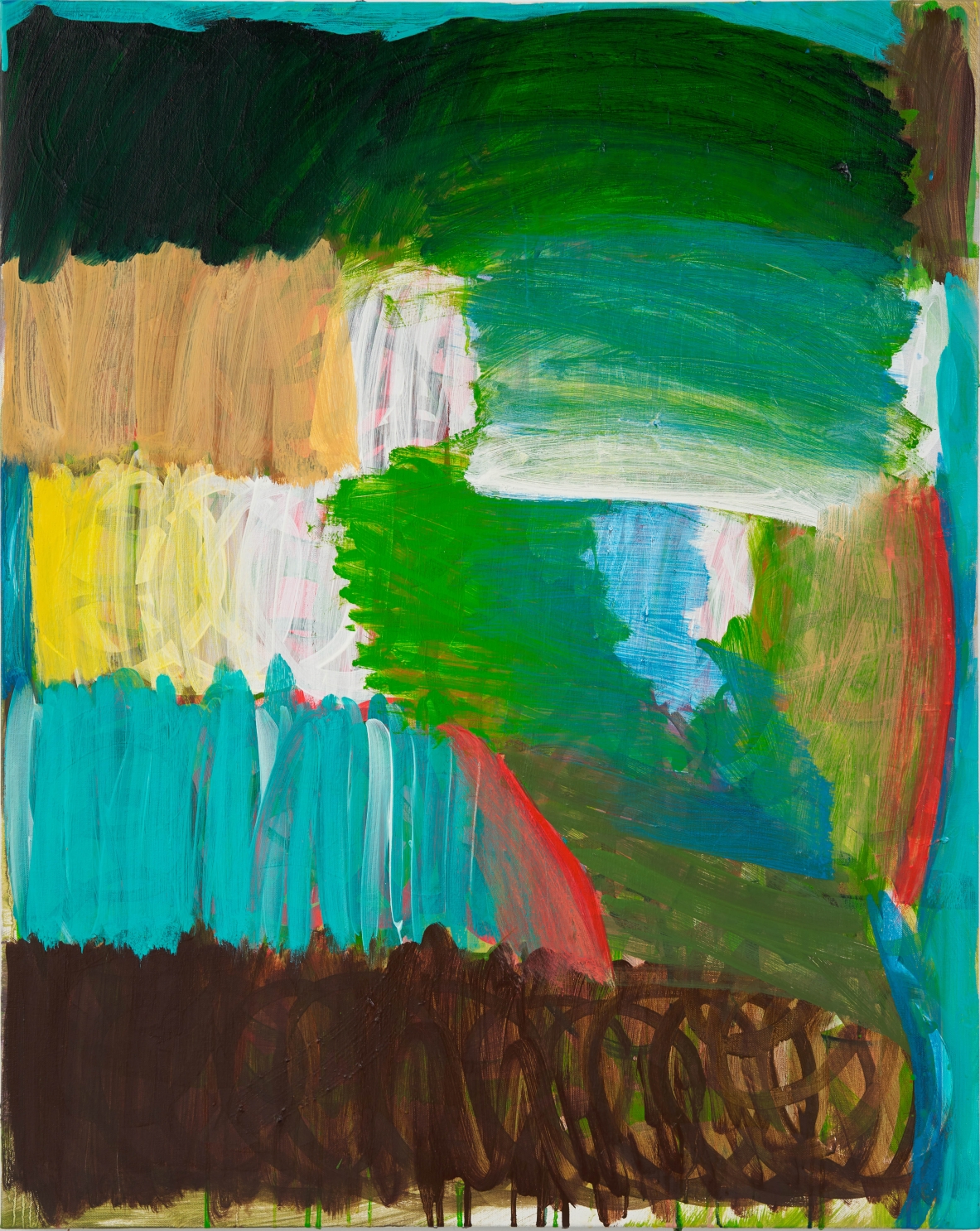
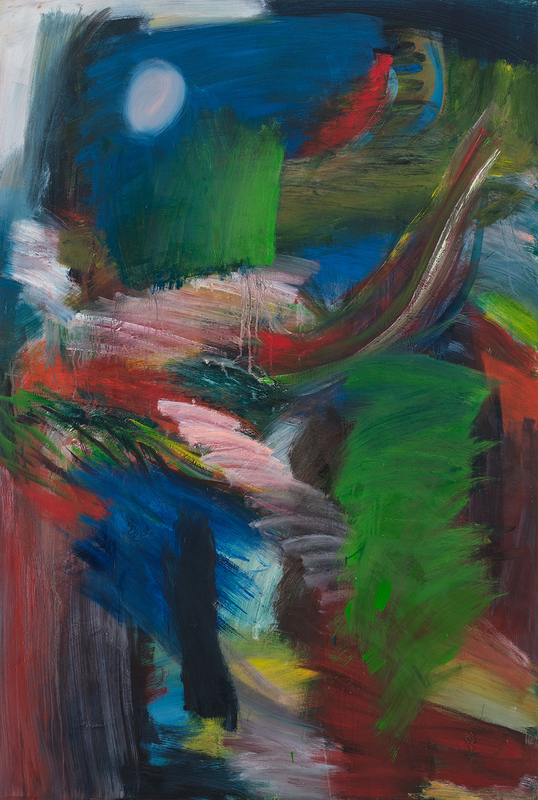
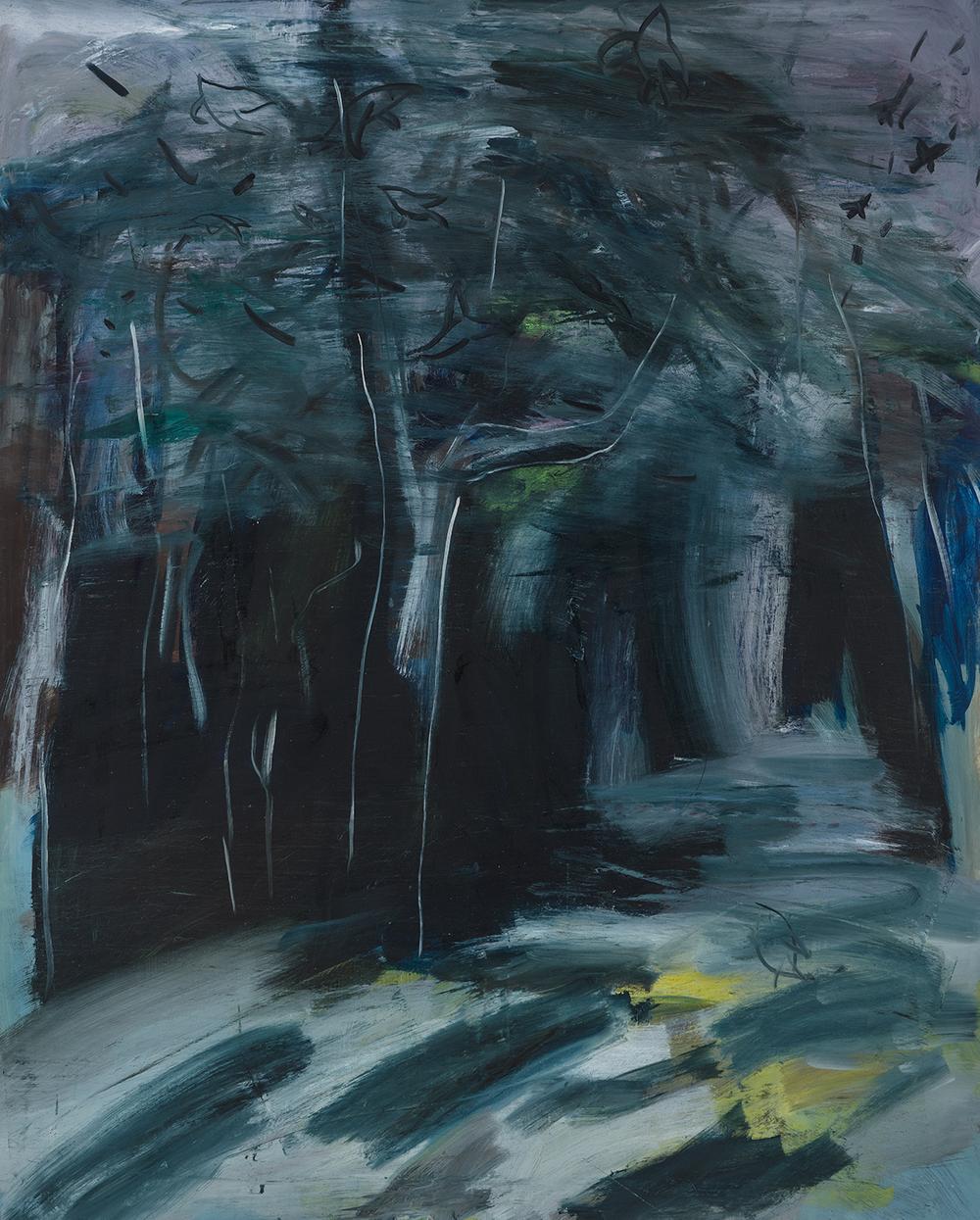
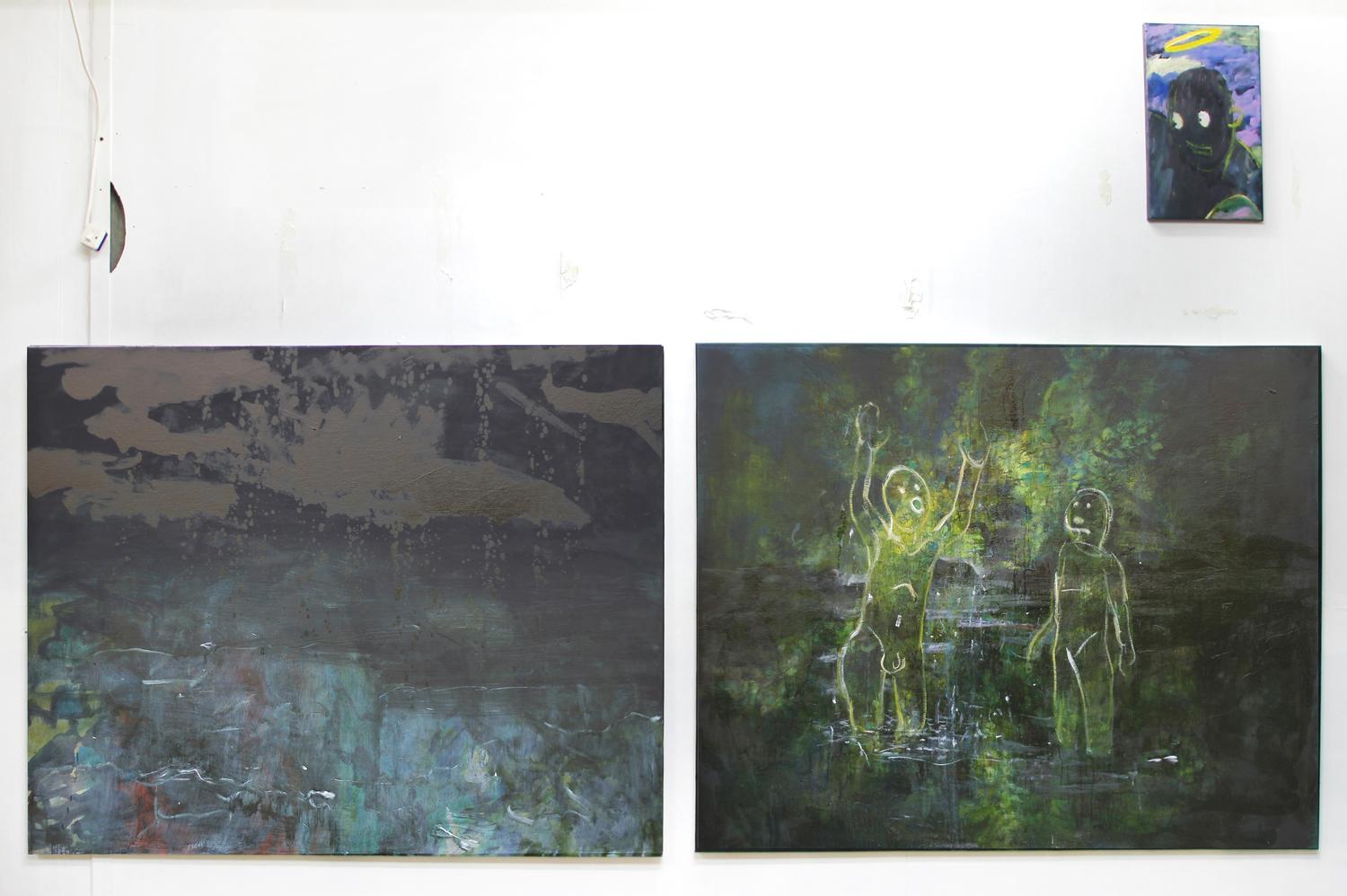
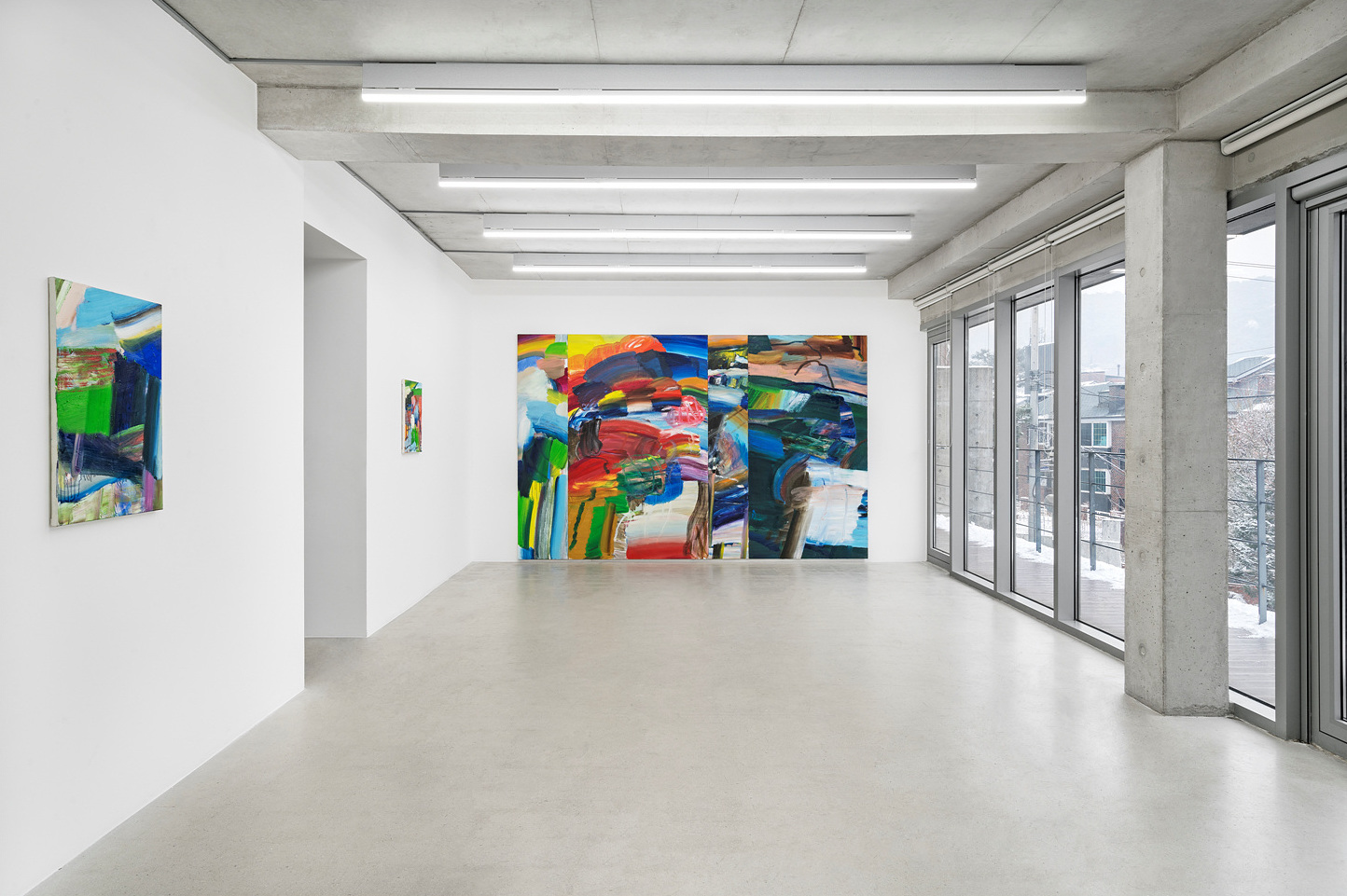
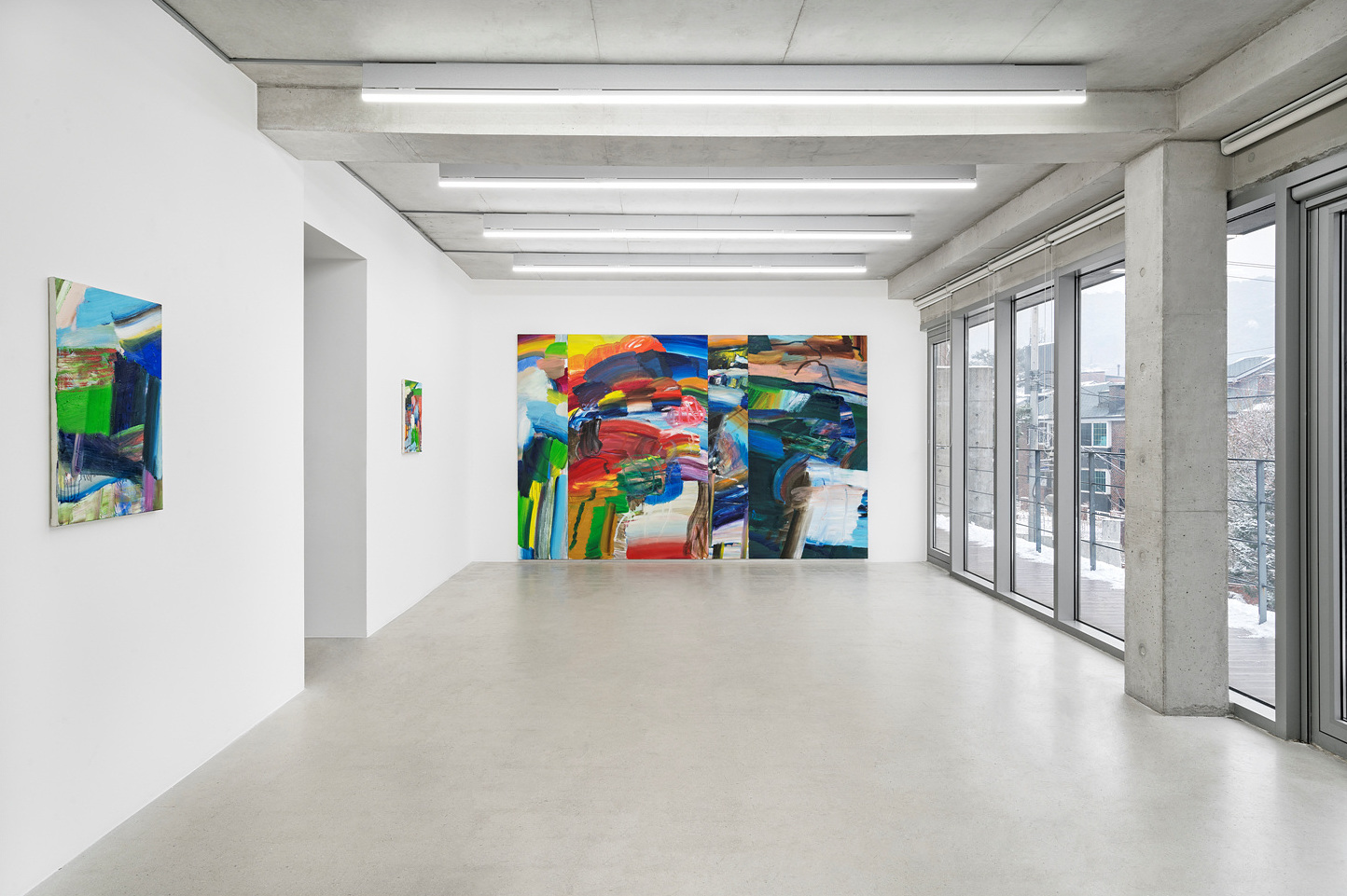
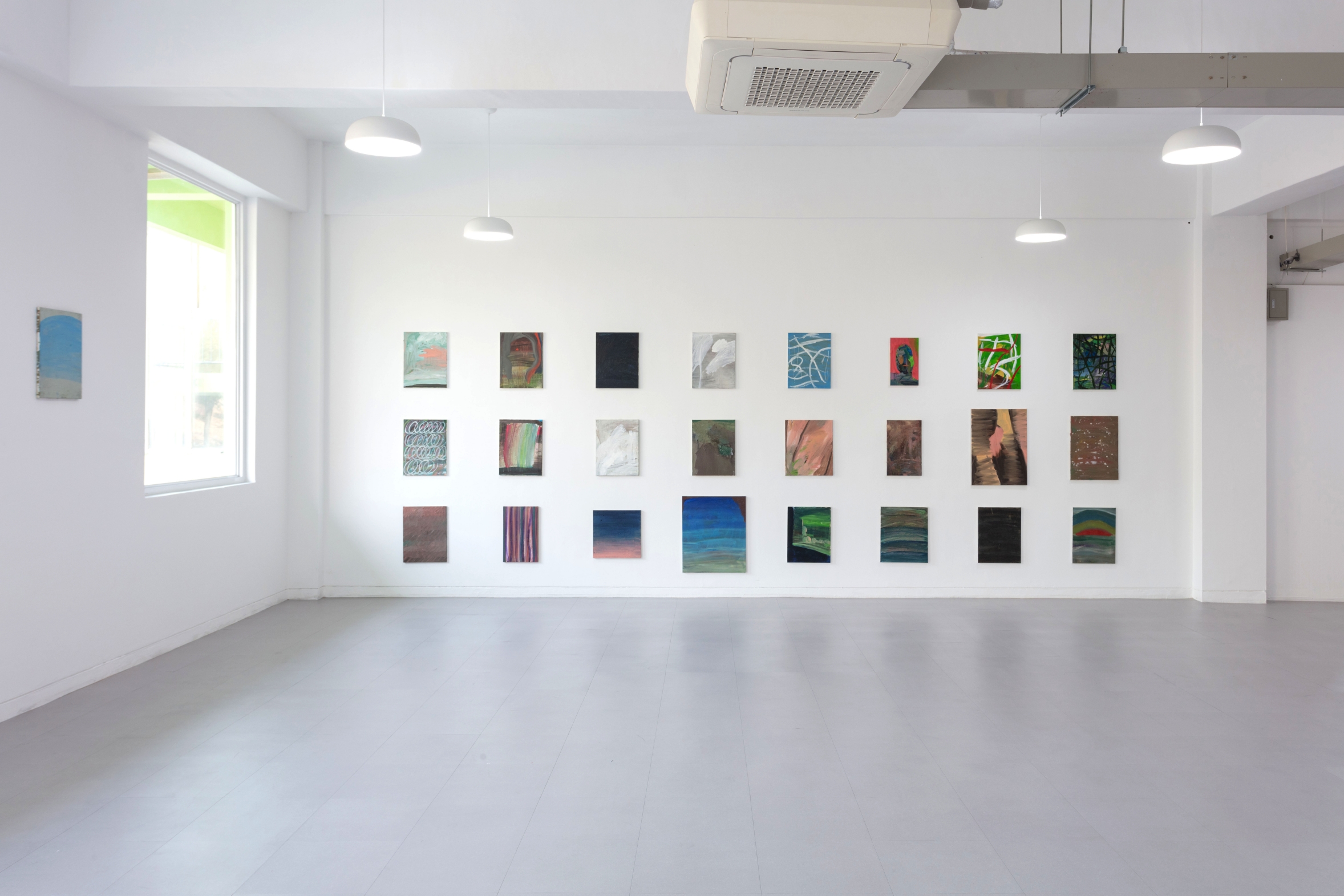
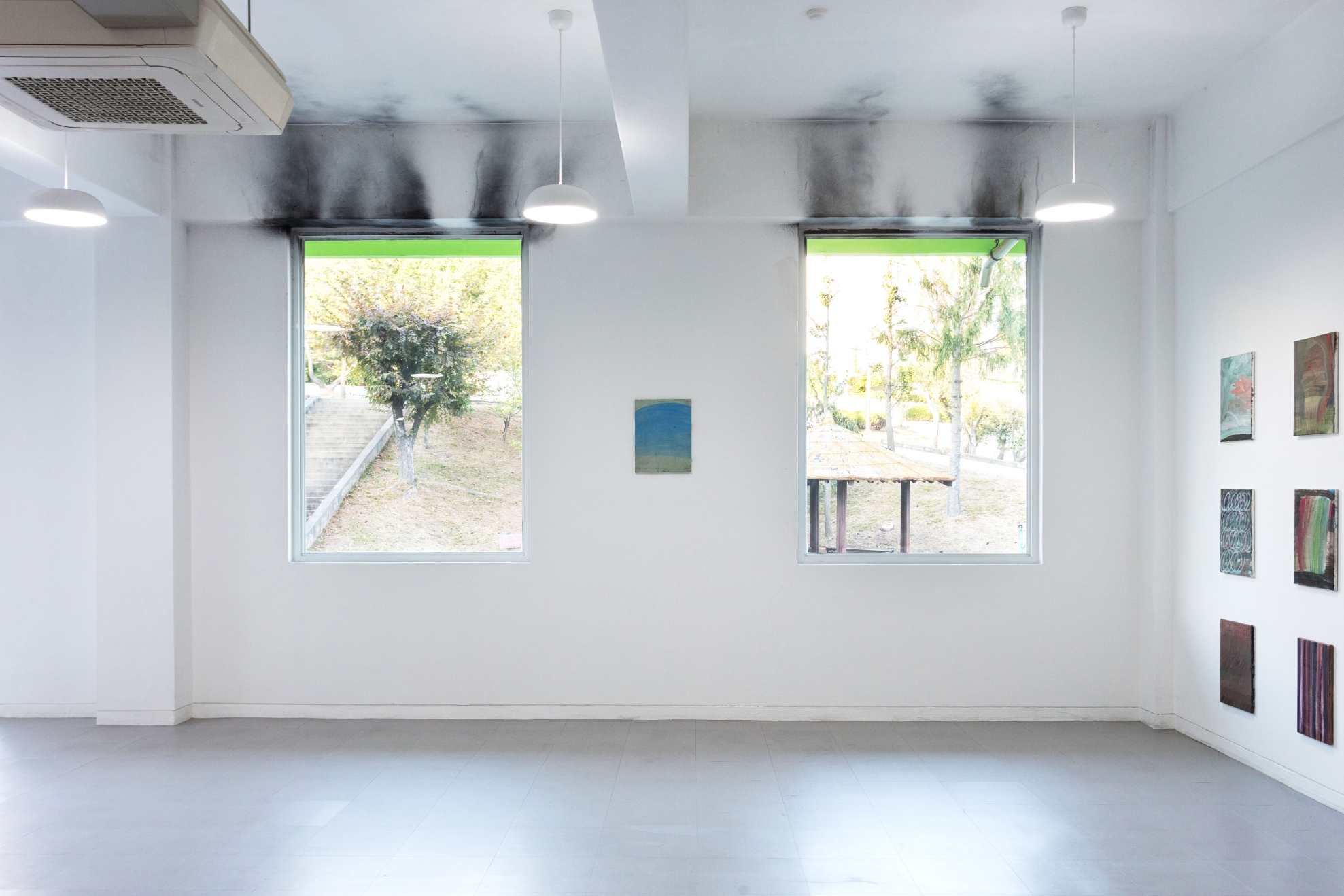
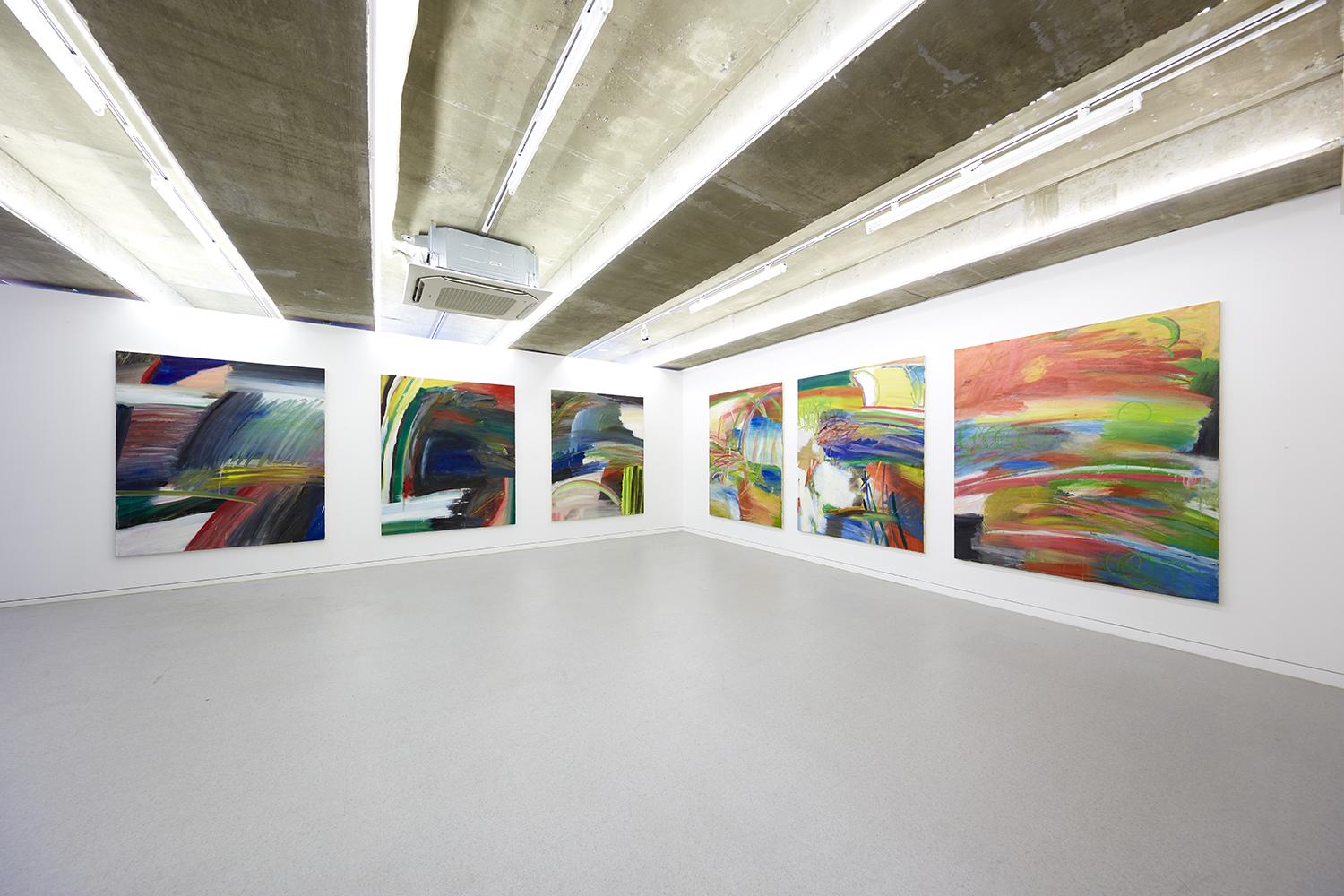
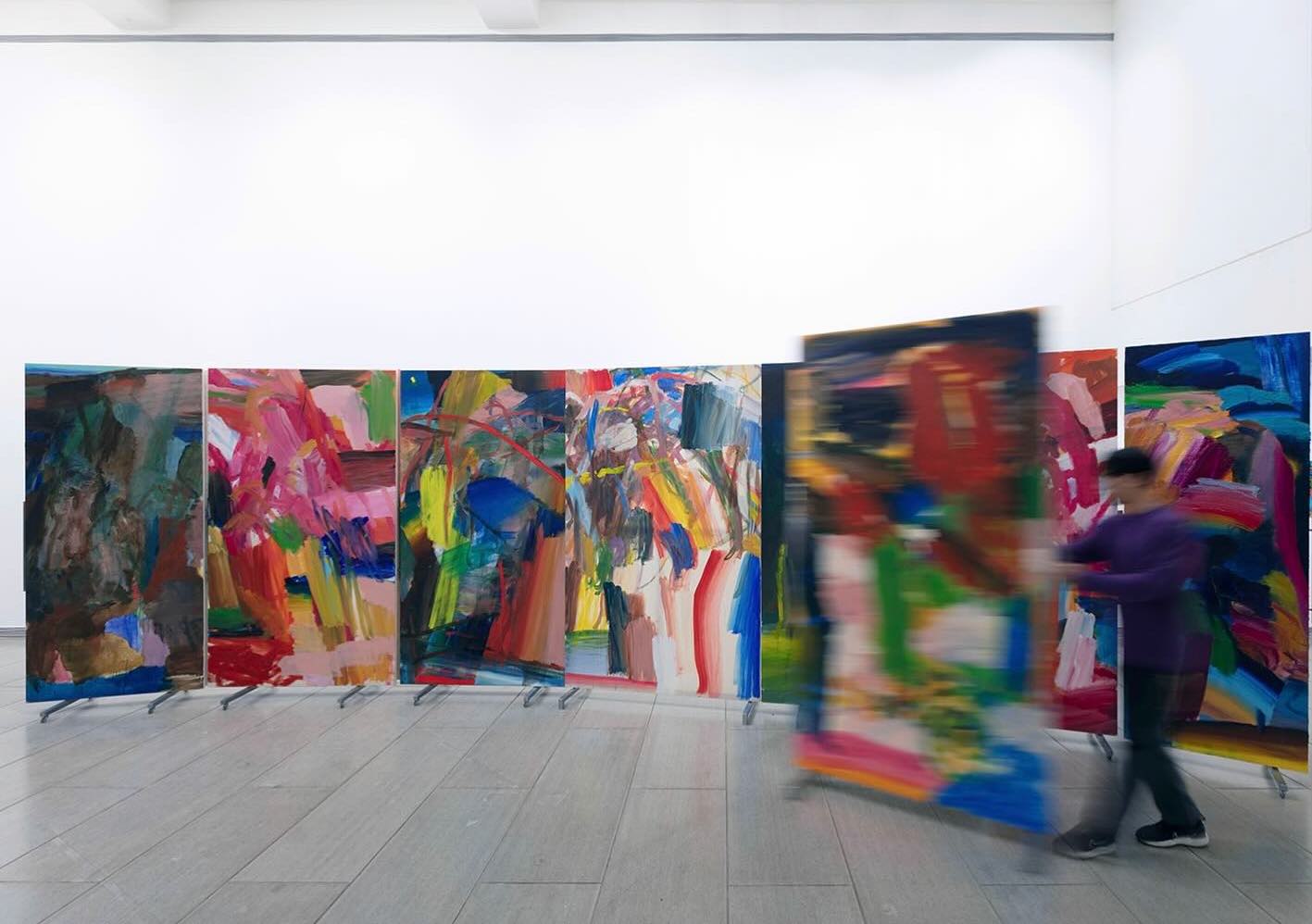
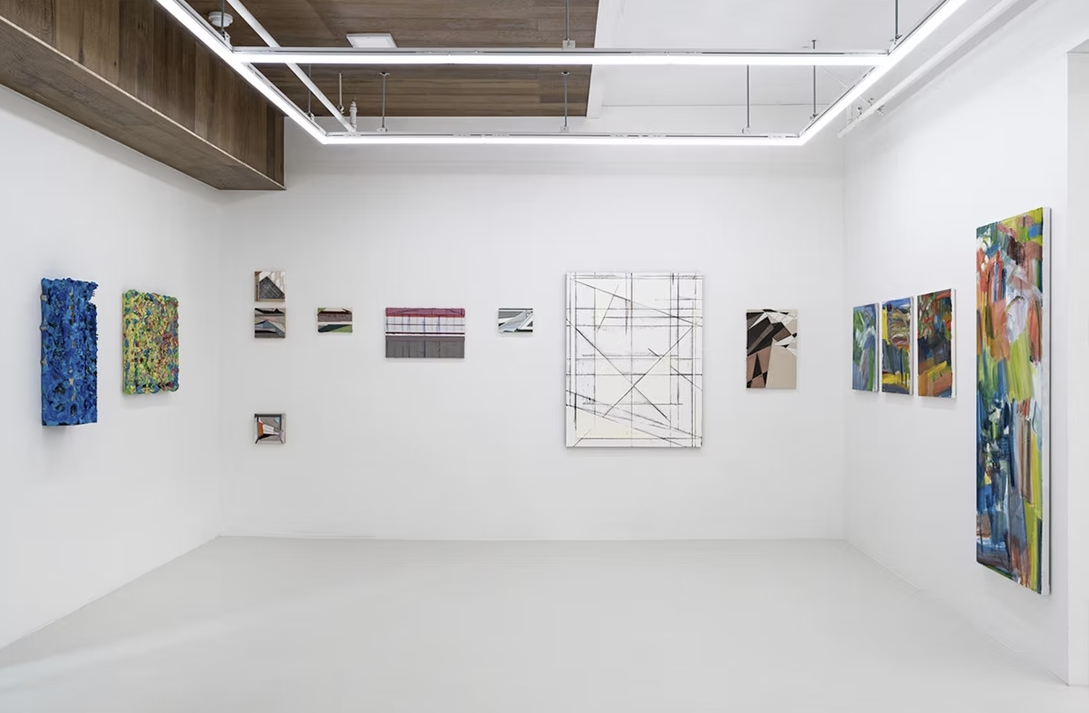
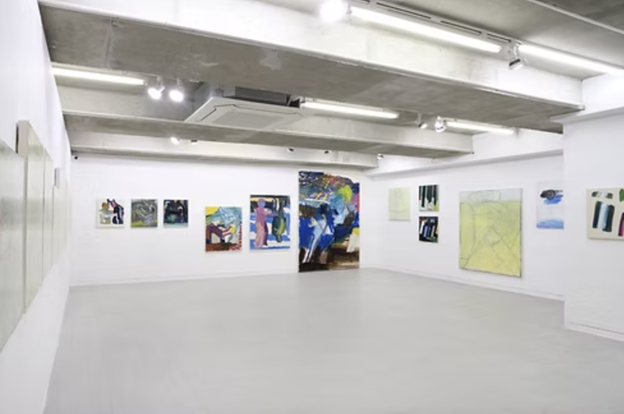
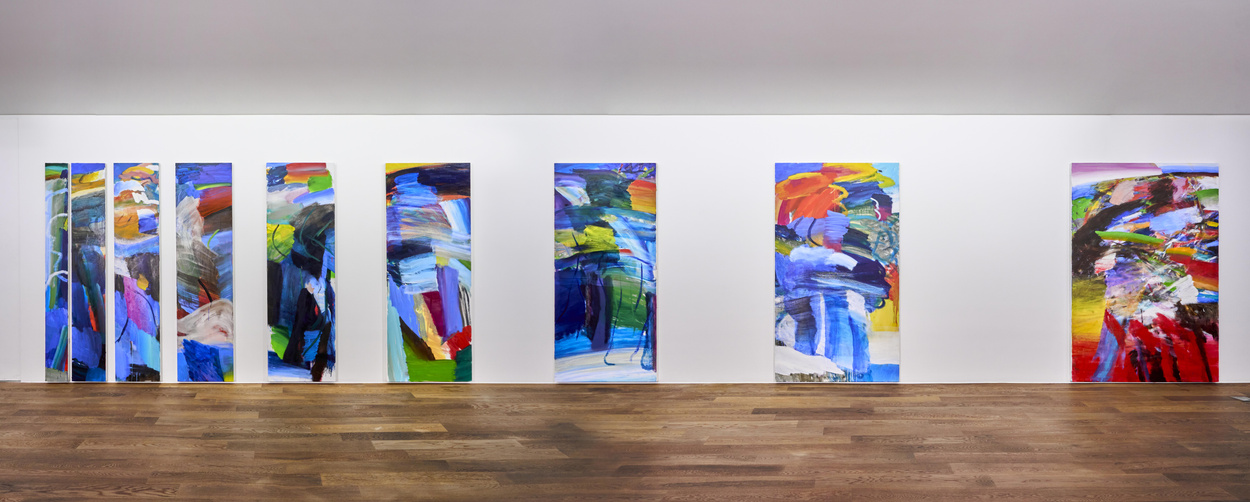
《Gradually, Shadow Legs Hidden》(A-Lounge Contemporary, 2024) is Hyundoo Jung’s fourth solo
exhibition, reflecting his recent situation that seems to attempt to prove the
latent possibilities of certain images through the distance/gap between
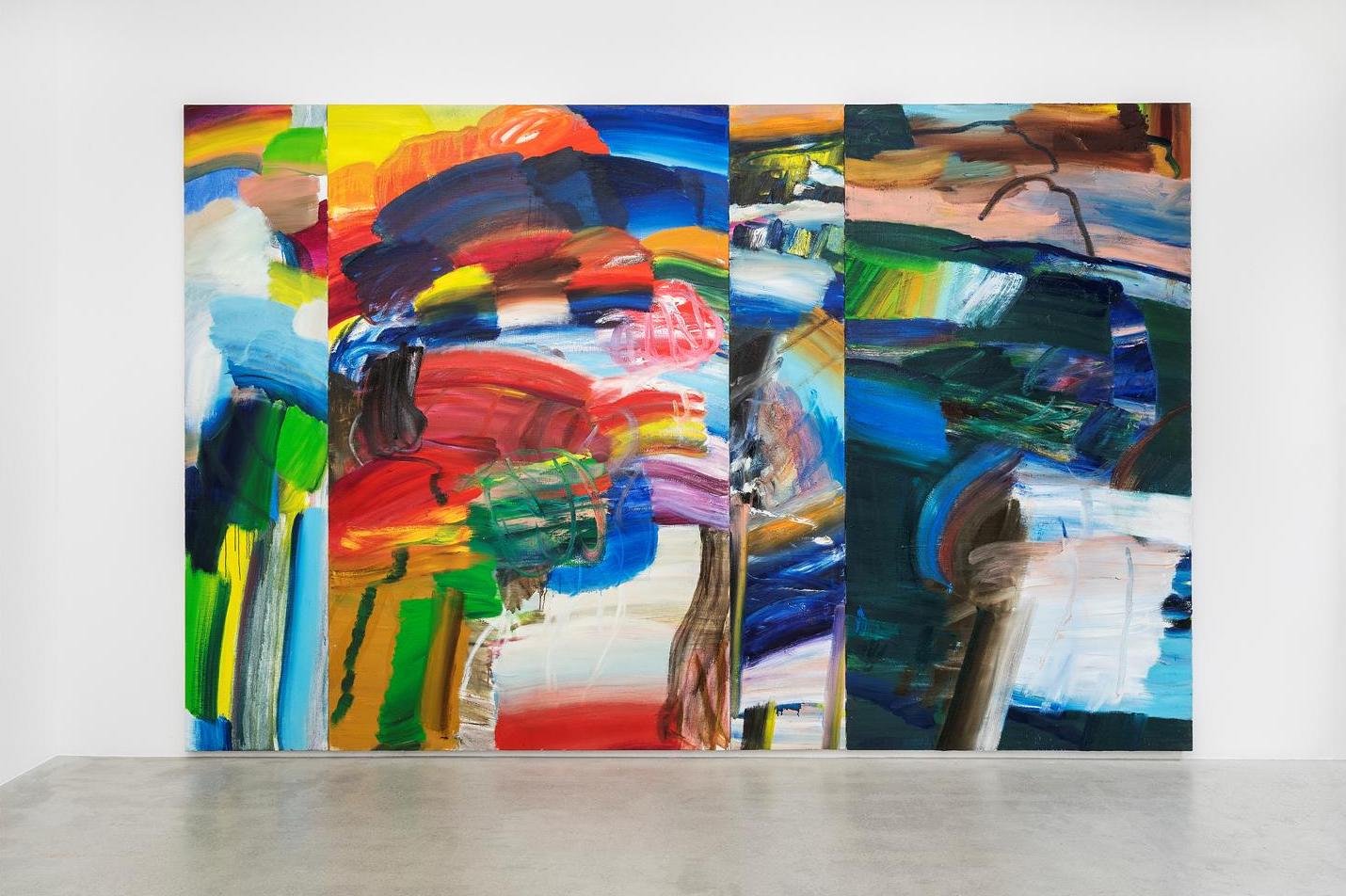
painting and painting, surface and surface. Gradually, Becoming
a Cloud, Our Bodies and the Body, and Where
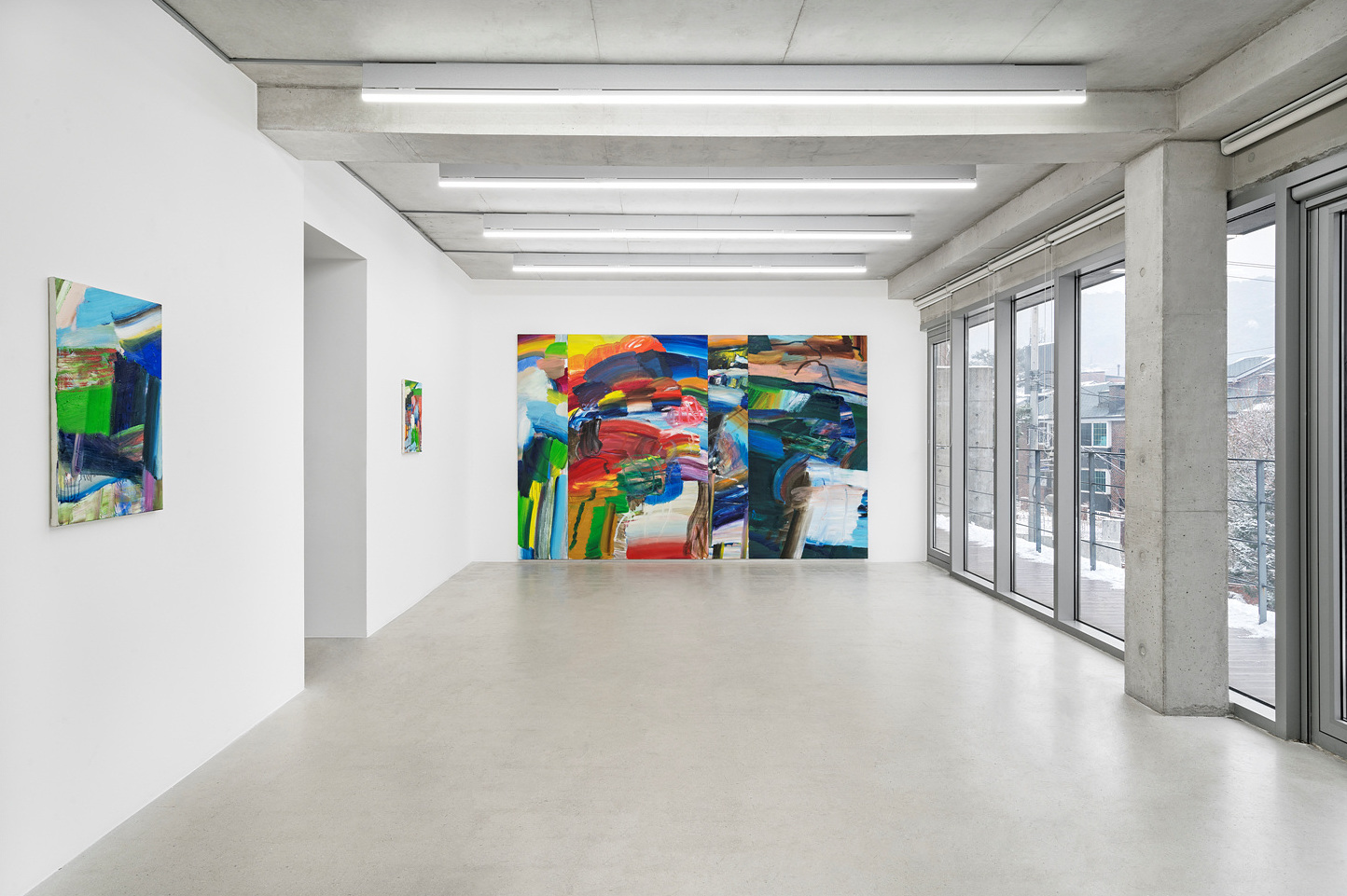
the Shadow Hidden stand side by side without interval, forming a
single large surface. Four paintings, each with a different name and different
dimensions, arbitrarily joined at a certain moment, stand against the wall as
if they were one. This temporary union of segmented surfaces, by connecting
brushstrokes executed at different times, chains together unrelated events
within a single “delayed narrative,” proposing a mode of viewing (seeing/being
seen) that blurs the clear time lag between them.
Moreover, those abruptly cut, severed boundaries assume the role
of frames that measure time, yet within the continuous whole, they resemble
inexplicable folds, inviting imagination about the (infinite) space opened
between word and word, time and time. Over a long period, he must have painted
these four consecutive works discontinuously, aligning the movement of his body
(freely) with the width and length of each expanded plane rather than
organizing the limits of each individually given edge.
Look there, at the
movements of brushstrokes seemingly unrelated to order, the overlapping of
colors, the entanglement or interruption of lines. More interestingly, although
the differently sized surfaces are precisely aligned to a height of 225 cm,
they do not appear as a smoothly continuous panorama; rather, what is
painted/expressed intensifies yet another boundary or segmentation, bringing us
to a moment where the time lag between paintings imposes even greater “delay”
and “suspension” through the (similar/different) elements of each individual
surface.
Jung unfolds the impossible sentence “Gradually–Becoming a
Cloud–Our Bodies and the Body–Where the Shadow Hidden,” stretching the time of
a doubting person before this impossibility like a night extended without end.
Seeing is endlessly hesitant, yet through the arbitrary act of showing the
impossible, one finally comes to see; borrowing Rancière’s words that “an image
is visible because it is shown,” it becomes the work accomplished by the pupil
of the night before the capacity to see. Jung’s paintings seem to have long
accepted this “delay” arising from such a relationship, and in this exhibition,
he pays even closer attention to those concealed times within the continuous
arrangement of forms.
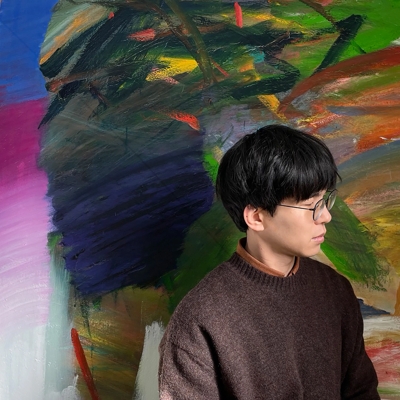
Jung’s painting may appear to pursue spontaneous gestures, but as
he himself has said, his brushstrokes relate to images that arise in the mind.
This does not mean that he directly transfers the mental image; rather, if we
allow for a slight time lag, before the (already) left brushstrokes, another
mental image arises again—repeating like a kind of loop, continuing like the
tedious parallel of certain images. At this point, he constructs a series of
flat surfaces by drastically colliding speed and stillness, sharp contours and
blurred planes, highly saturated paint and tangled material. For this reason,
within this overwhelming plane, microscopic and macroscopic viewpoints coexist
without hesitation: rapid brushstrokes crossing the diagonal of the surface and
traces of brushstrokes that pause at a single point, pressing down the
thickness of hesitation, all occupying their place together.
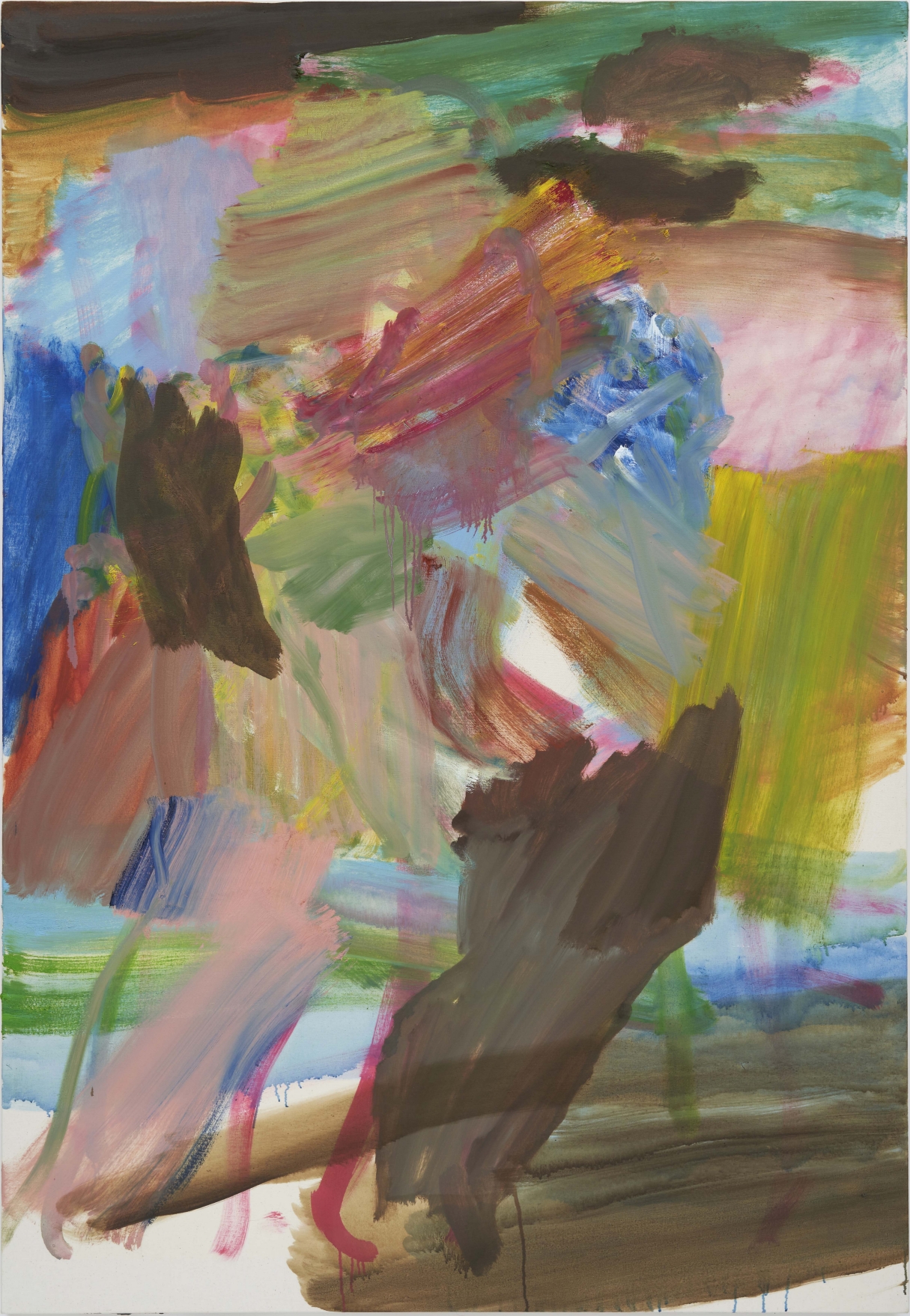
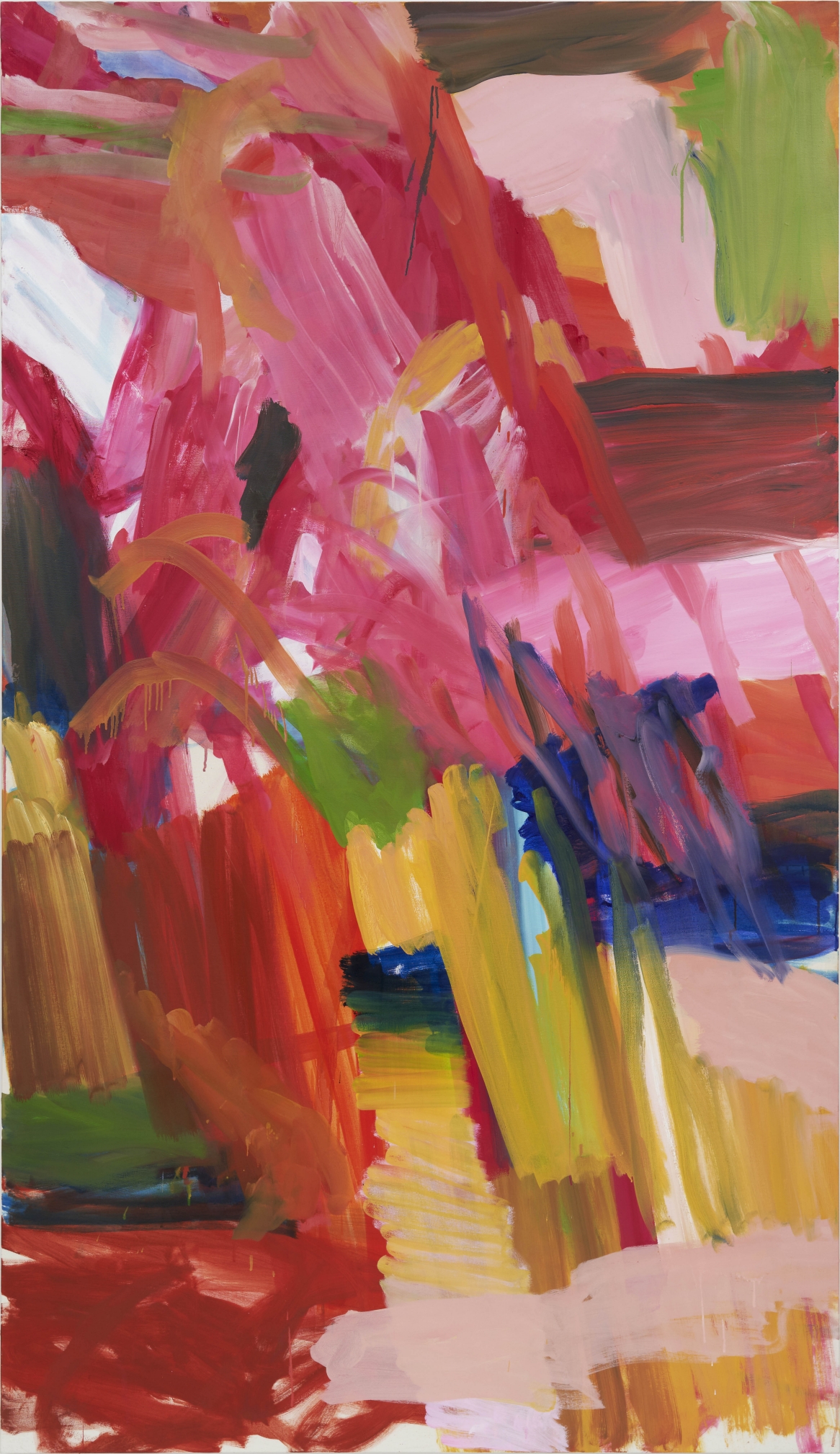
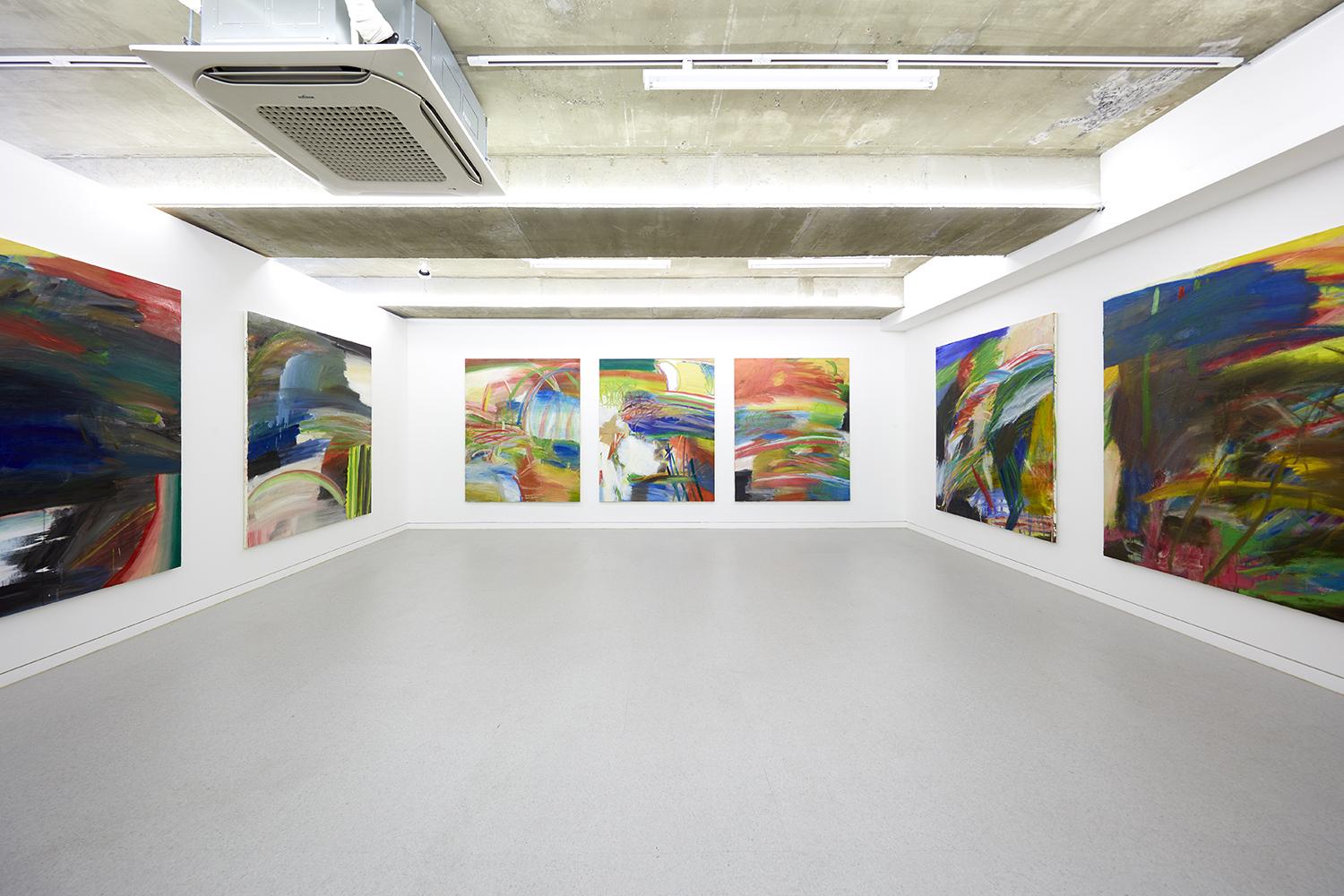
Not Pretending, It Became This Way(2023) seems
filled with the impulse to make something visible. Forms that resemble a
person, the sky, rocks, trees, arms assume a posture “to be seen.” What Jung
calls this “flesh,” realized on the surface as material, forms a mass and is
finally “expressed” as something that can be sensed (far from representation).
Like an image that (again) arises in the mind of the body confronting this
painting, this “approach” and “emergence” repeats continuously.
He had long ago
problematized the sense of distance between himself and his painting. If
brushstrokes mediate this, the image that arises in the mind and the trace left
on the surface hold an immeasurable “distance.” As one philosopher suggests
that an image must necessarily maintain a distance from its archetype, Jung is
conscious of the gap/void between his body (which holds a certain archetypal
image) and painting (which pursues certain archetypal traces).
The inner workings of his painting, formed by the combination of
the words “Gradually, Shadow Legs Hidden,” stem from this inevitable
distance/gap/void. Does not the phrase “throwing a face” also imply an
invisible distance within its sentence? Perhaps for this reason, in his recent
works, he seems to examine the folded gaps between surface and surface, face
and face, between such sensations. Furthermore, when the sentence “Gradually,
Shadow Legs Hidden” is dismantled and examined word by word, one can witness
within the entirety of his paintings not only horizontal connections but also
the time lag, gaps, and overlaps between materials and forms built upon the
plane.
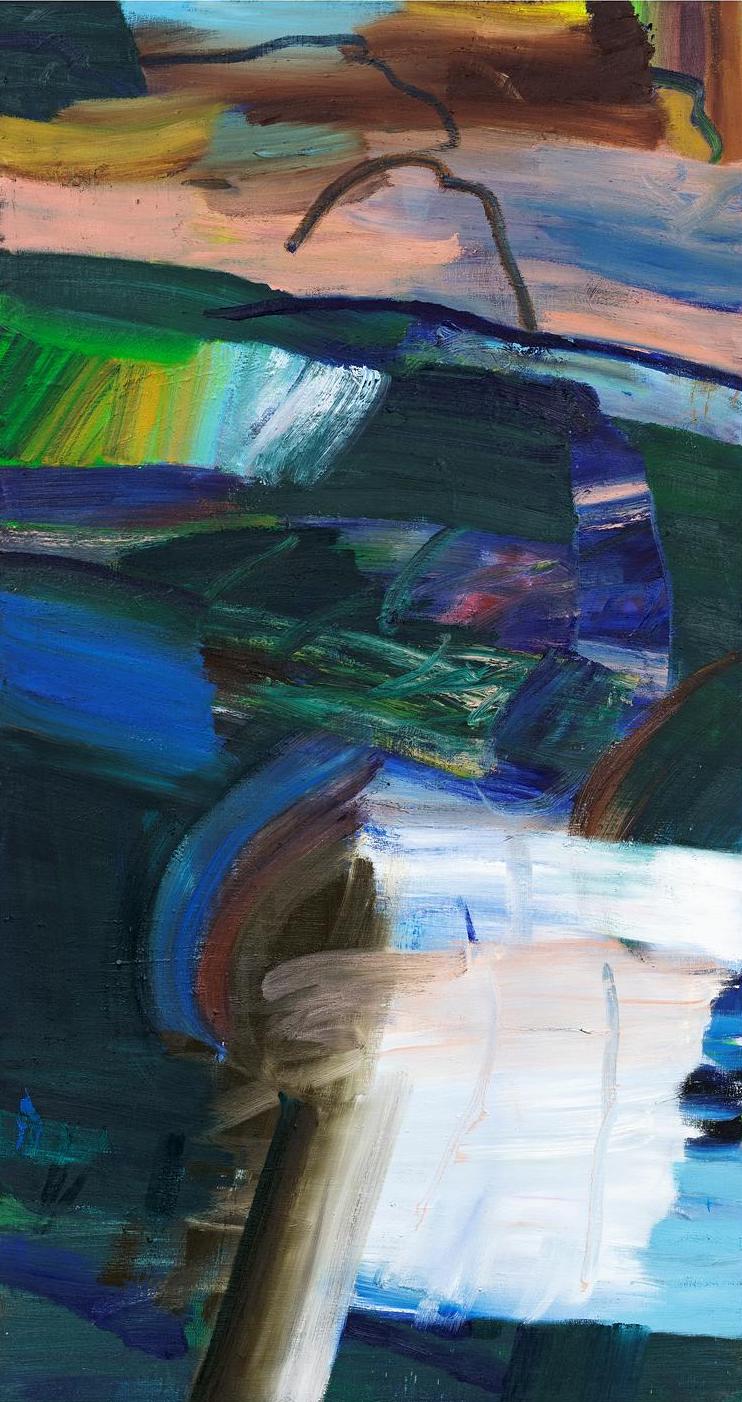
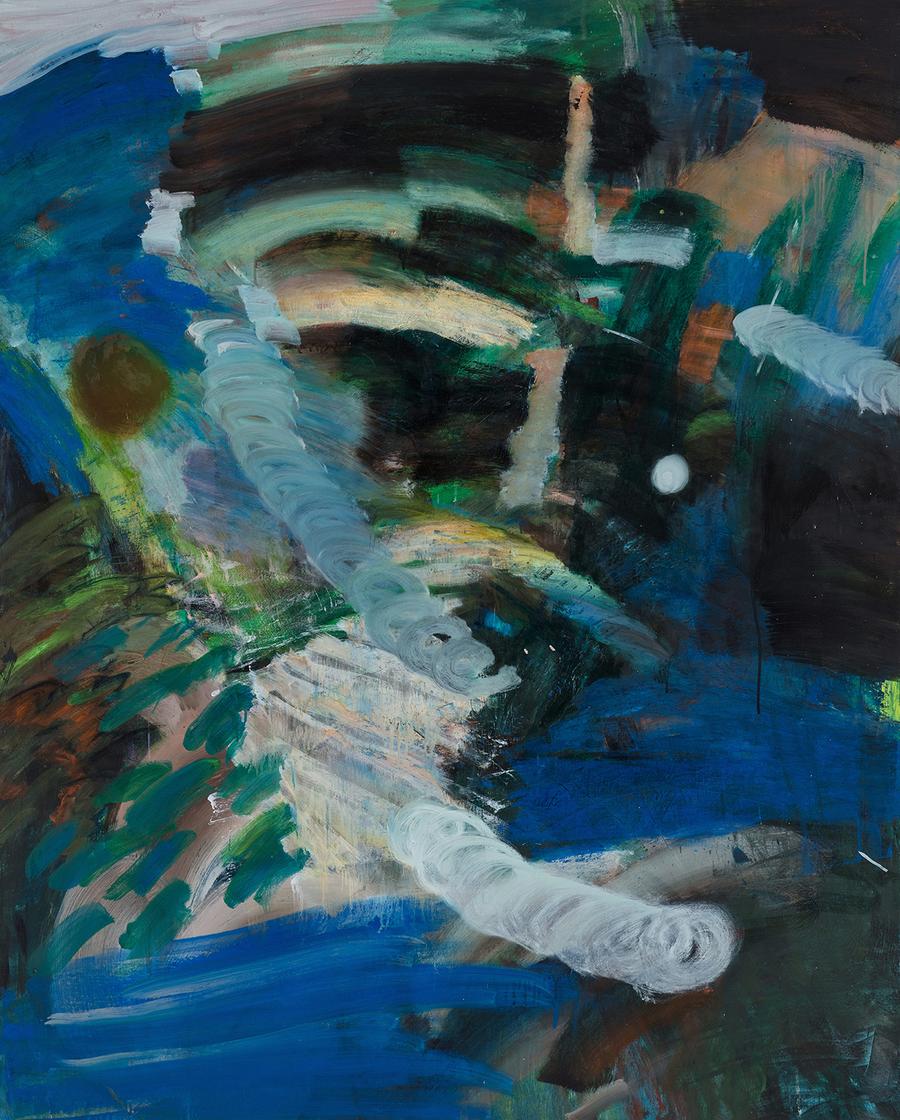
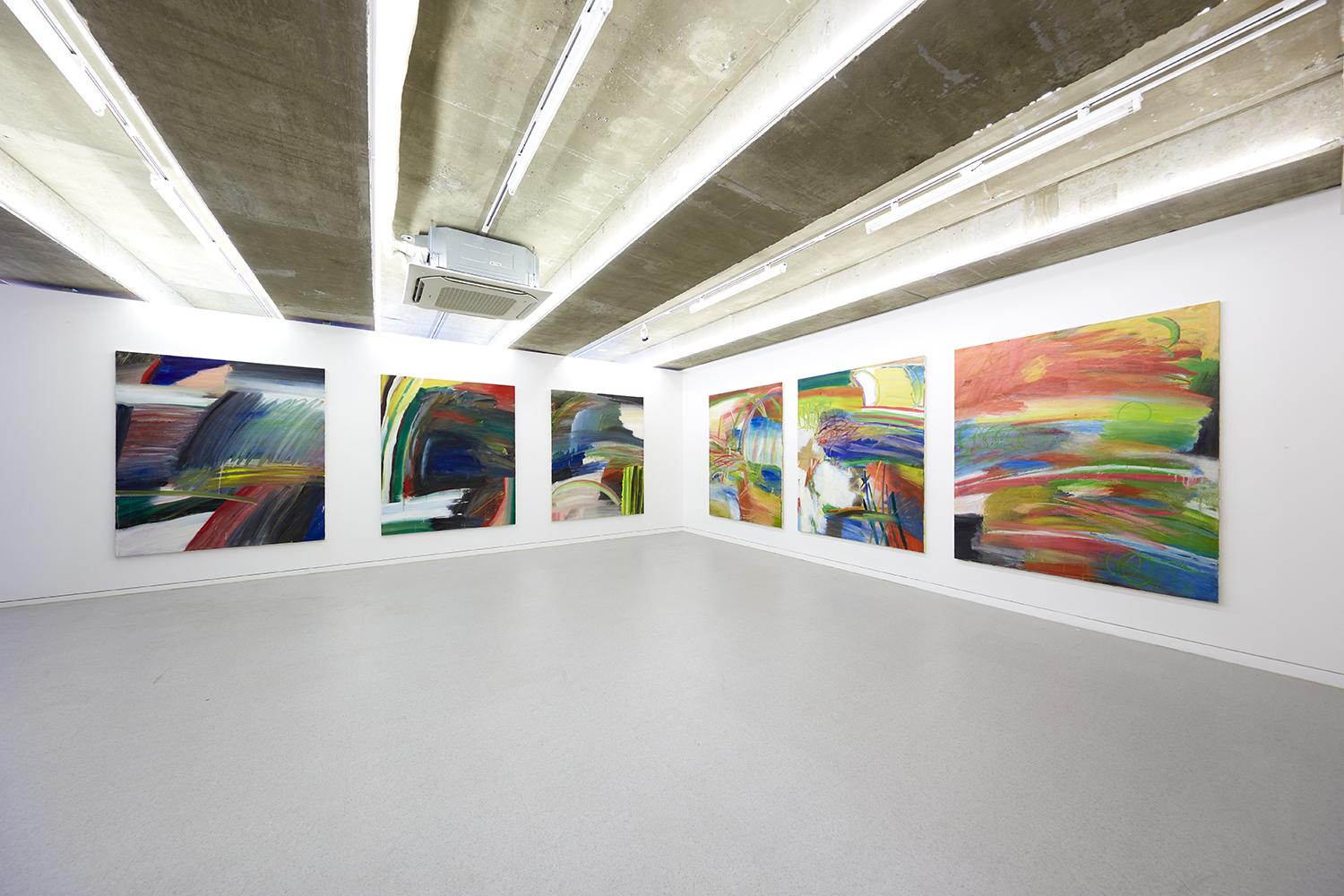
Not Pretending, It Became This Way and Storm
Cloud in the Fist(2023), hung vertically on the adjacent wall, seem
poised to trigger an anonymous event within some circumstance—perhaps in the
[future], or perhaps its failure [past]. Setting aside the complex emotions I
experienced between these two paintings, I step closer to Storm
Cloud in the Fist, confronting it within a single gaze to concentrate
further. He generally does not finish his works quickly; within a suspension of
time, he often generates time lags. And thus, time known only to himself, that
anonymous time, often becomes the title of a painting.
At this moment, the
traces of time he leaves on the flat canvas are abstracted as “material” and
“gesture.” The movement of a large, flat brush passing diagonally across the
surface, the migration of lines resembling the contour of a certain form or
appearing as incomplete images, the strange overlaps and concealments generated
by repeated stopping and turning, even the dynamic light and shadow created
between the subtle ridges formed by the interaction of material and force—all
of this becomes entangled, evoking an enigmatic plane/surface like a fossil
formed through the repeated dismantling and construction of bones and flesh.
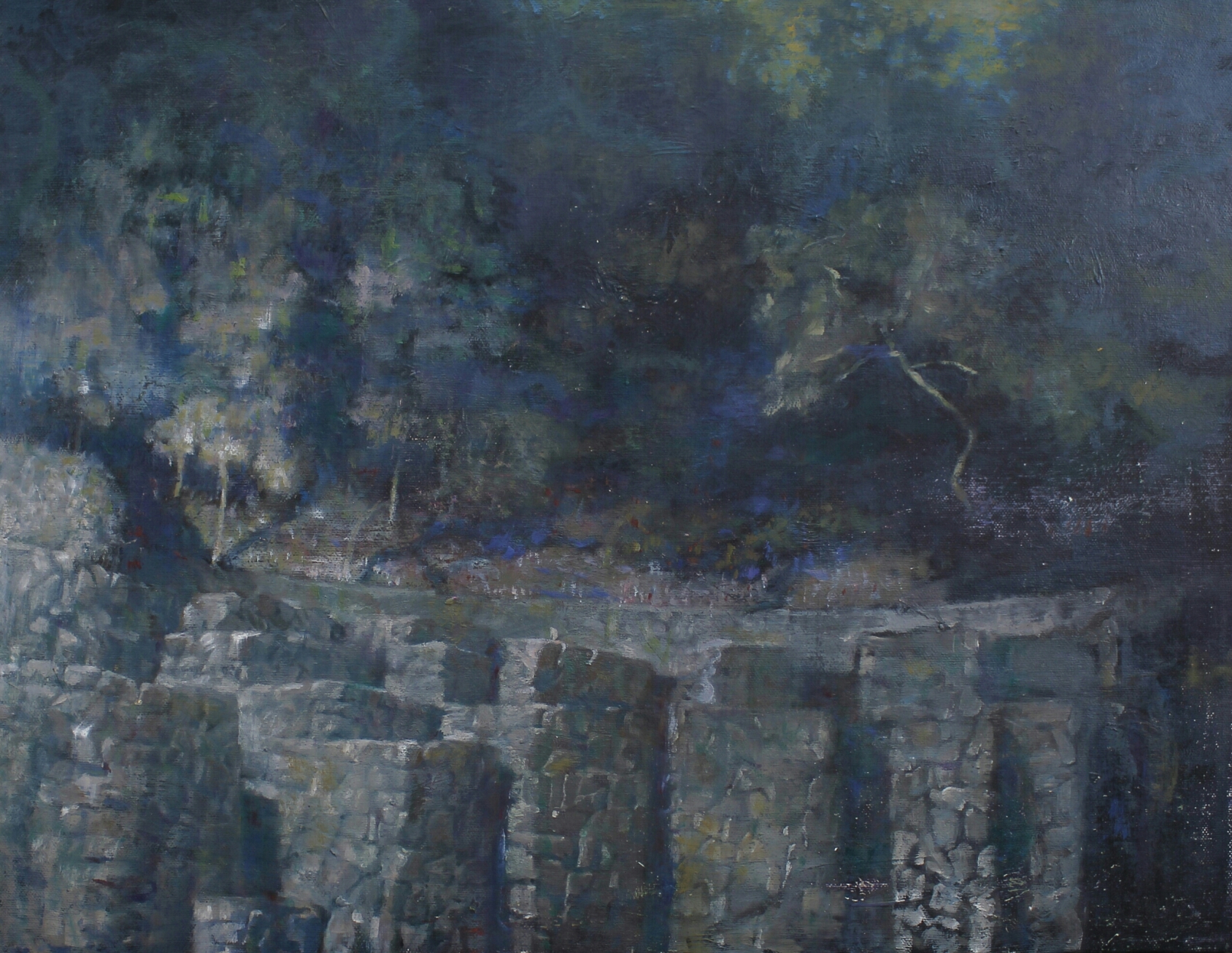
The same is true for Wooden Bridge Body and Mind(2023)
and Pretending to Seek Hope(2023), hung side by side at
a certain distance on one wall. Jung seems to examine the painterly conditions
that allow the bodily act mediated by brushstrokes (as if transferred like a
photograph) to acquire new material and bring forth (identical) images on the
plane. In doing so, he arranges (here and there) automatic words that enable
the painter’s act and the abstract image on the painting to share/remember a
common form.