This text aims to examine the meaning of
Hong Sungchul’s recent works, to be presented in his 2011 solo exhibition,
through as detailed an analysis as possible. To do so, a review of his earlier
works is inevitable. This is because the recent works of 2011 can be
understood, in terms of production attitude, form, and meaning, as an extension
of his previous works, particularly those from 2007.
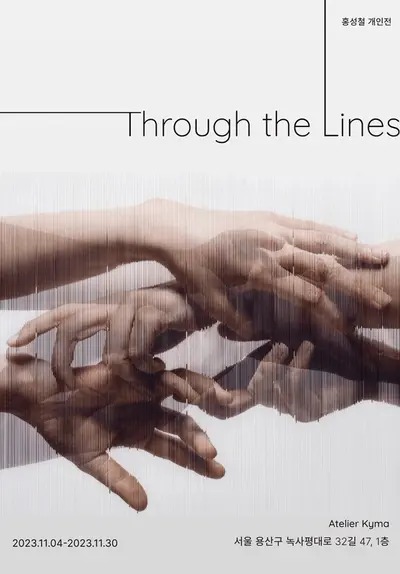
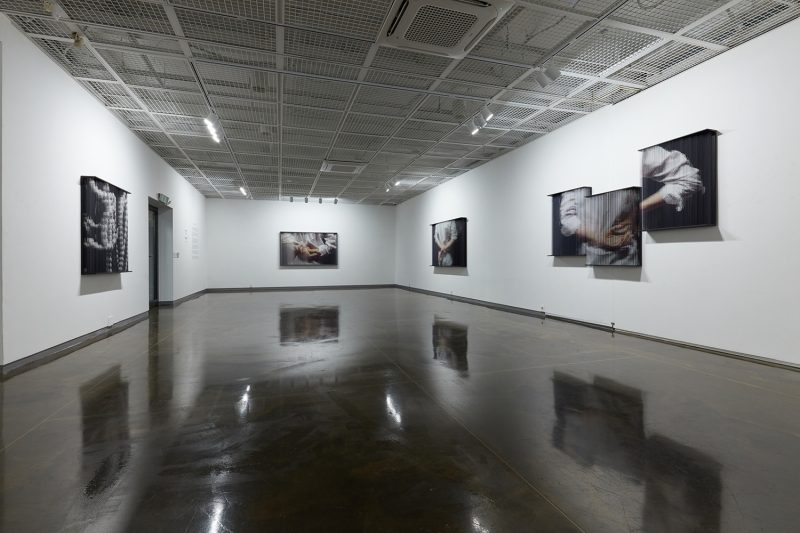
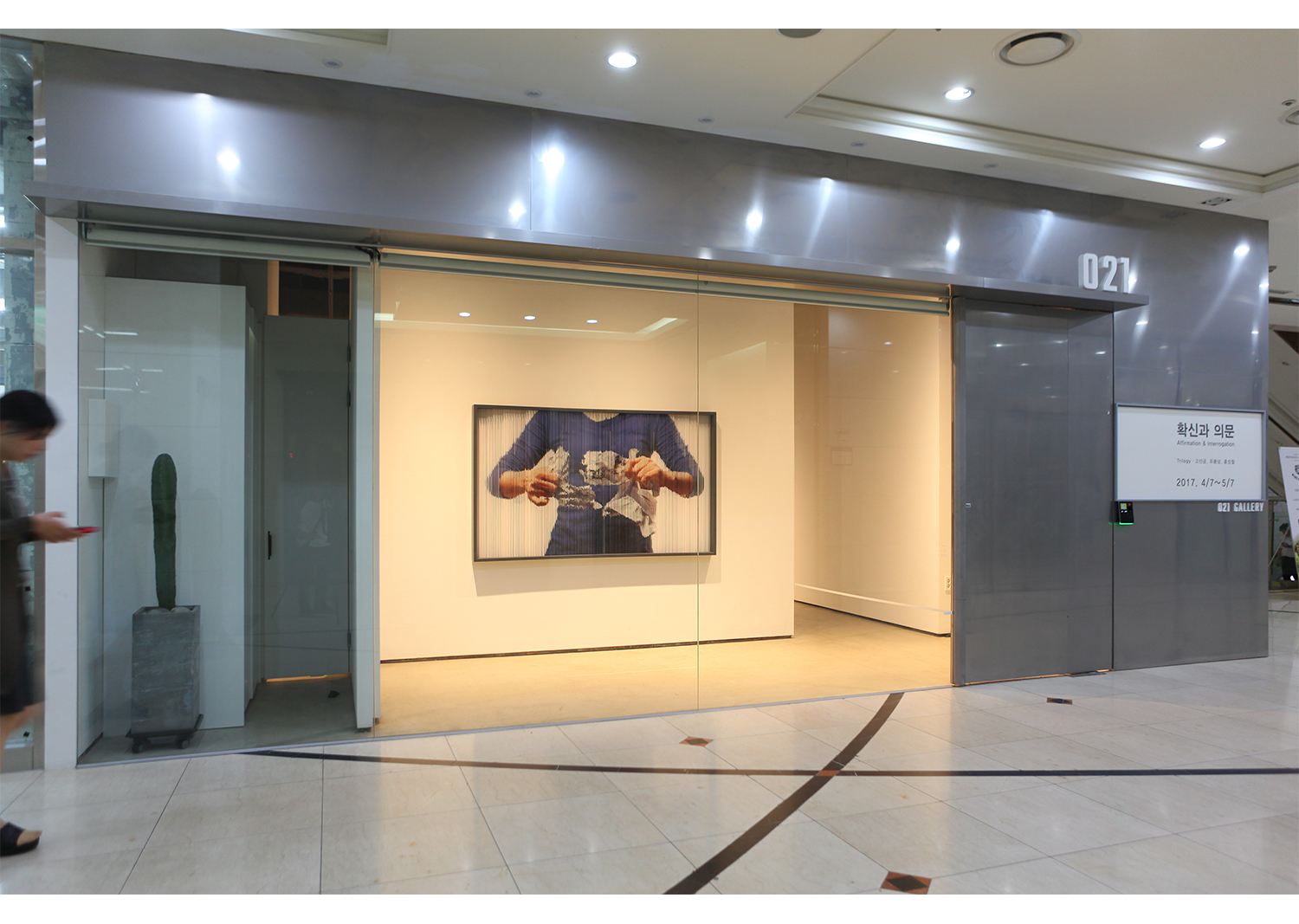
Let us first note that Hong Sungchul’s
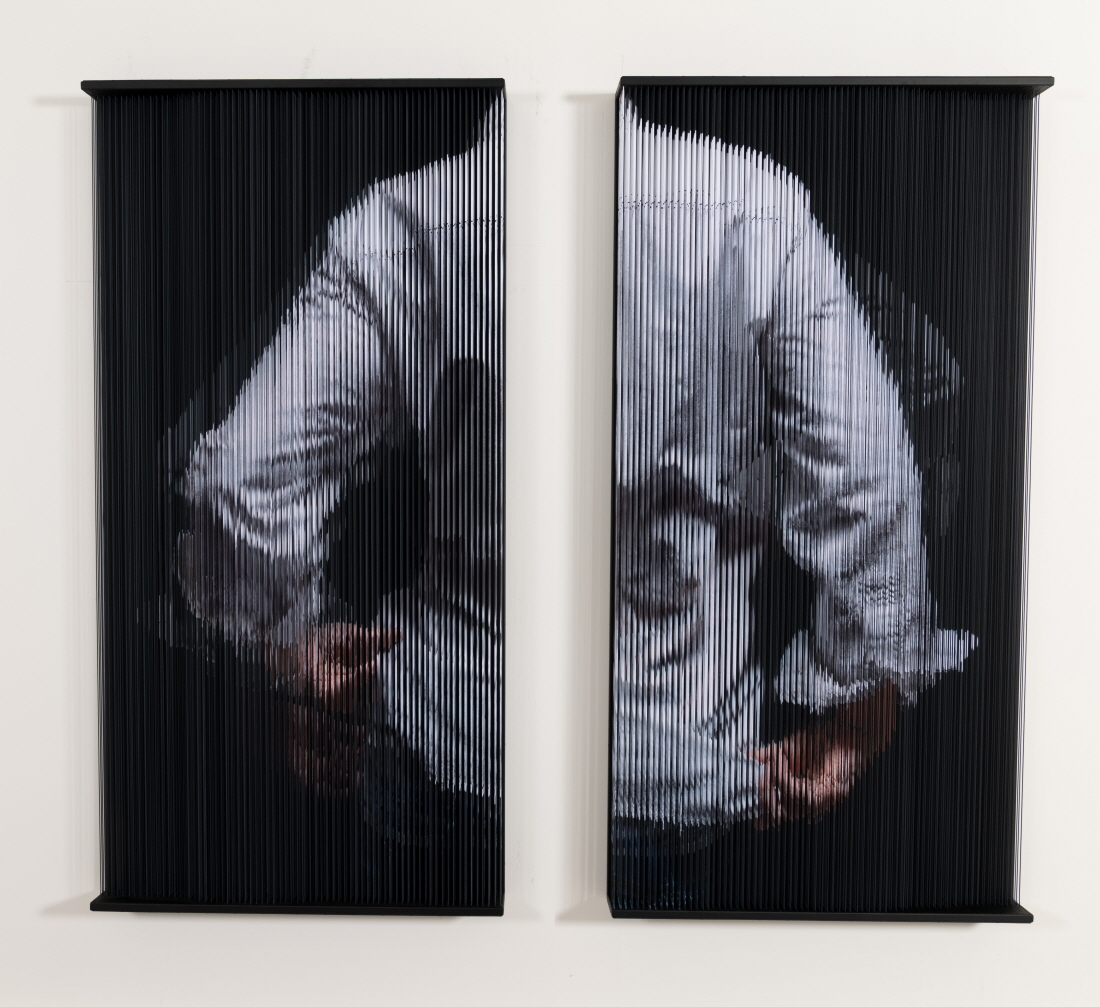
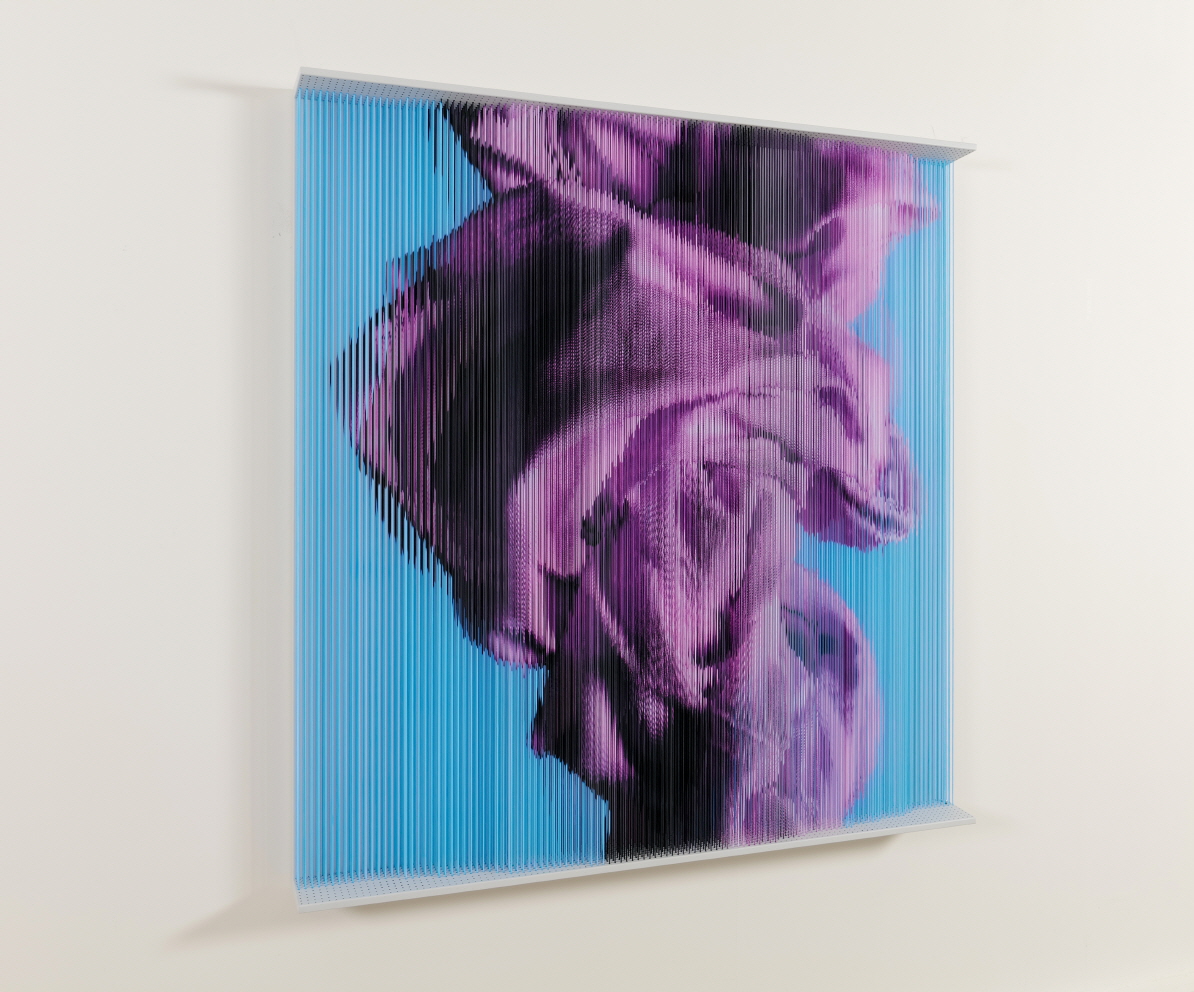
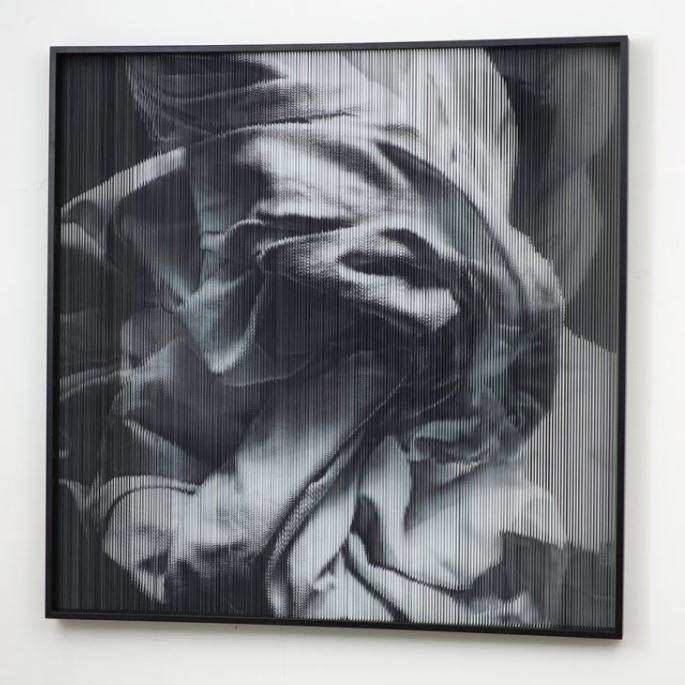
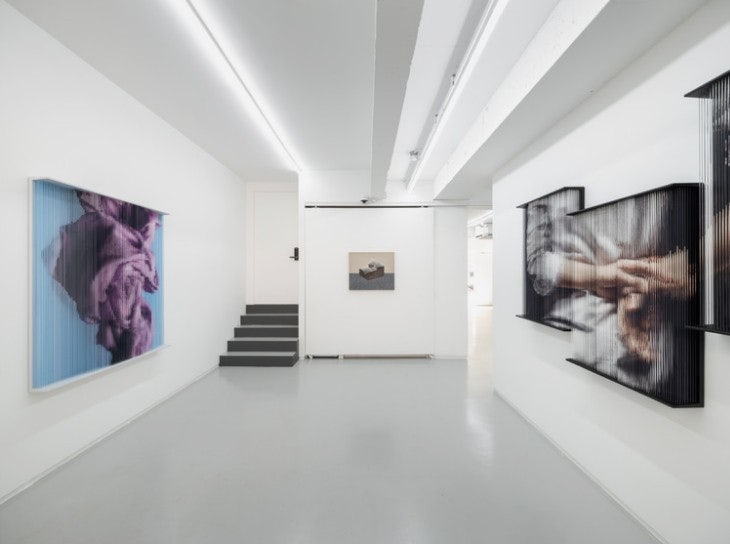
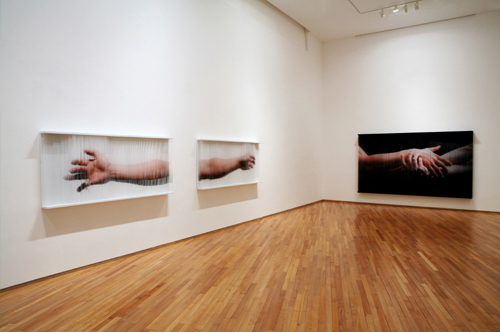
recent works are constructed by connecting thin, linear strands (threads) in
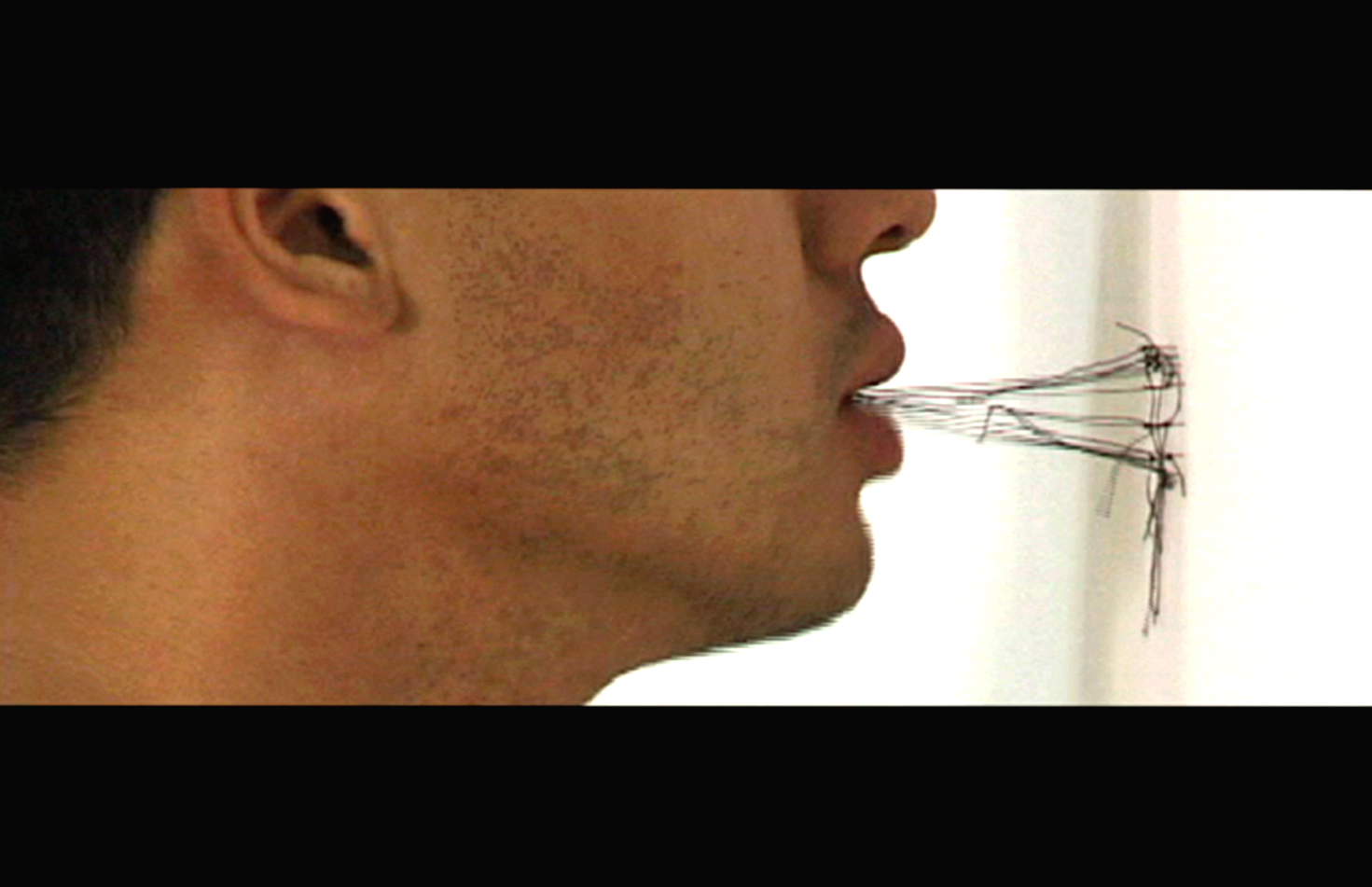
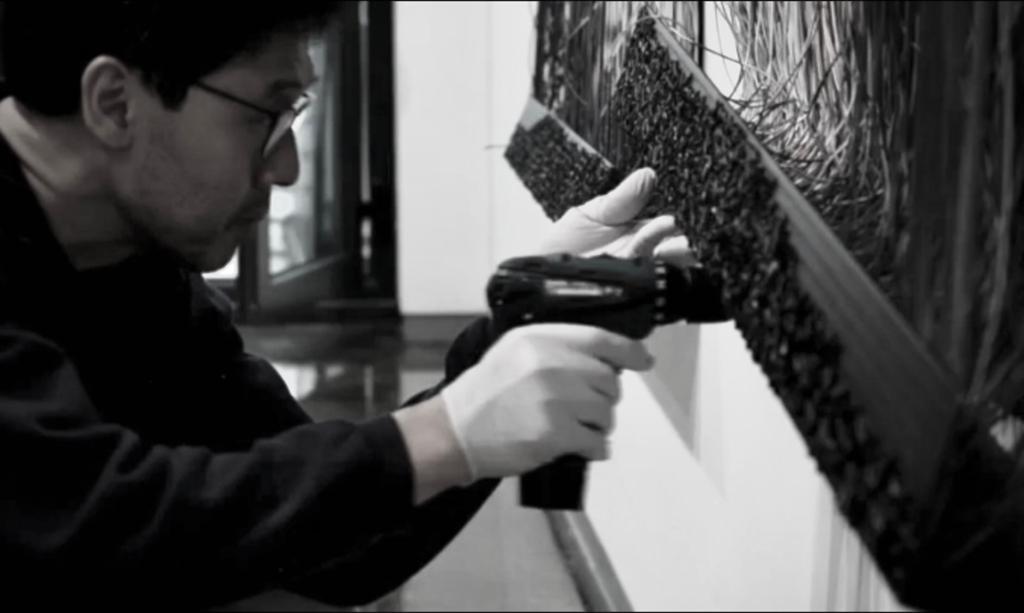
parallel, vertically aligned. The artist drills holes into the upper and lower
parts of a metal frame and connects thin strings between them. This act is
repeated countless times, resulting in the connection of hundreds, even
thousands, of strands. In this sense, the form of these works resembles that of
a string instrument—such as the appearance of a harp. These fine lines come
together to form a single whole.
Arranging basic units repeatedly according
to a certain system or rule to construct a whole is a fundamental method that
runs throughout Hong Sungchul’s practice. For example, the artist has layered
newspapers to create a mass—as seen in Heavy Bag (1994) and
Red Wash (1995); presented numerous threads descending from
the ceiling to the floor in the form of a cube—as in White
Cube (2000) and Green Cube (2002); and arranged
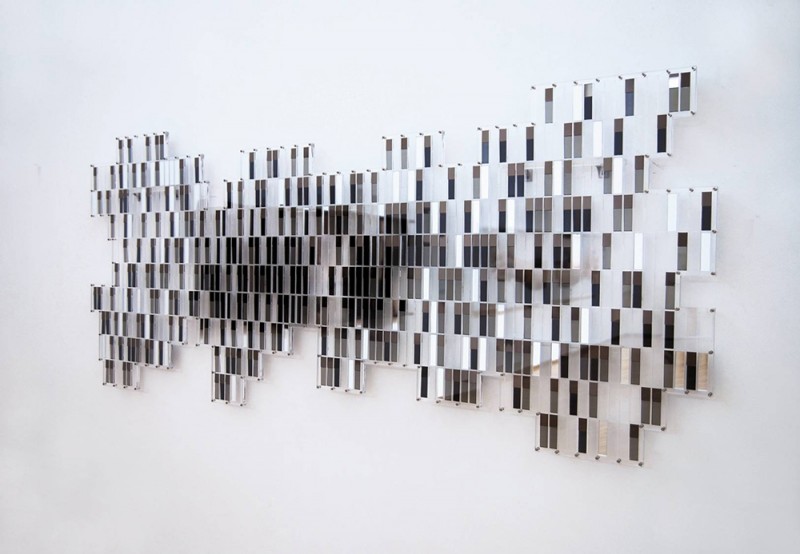
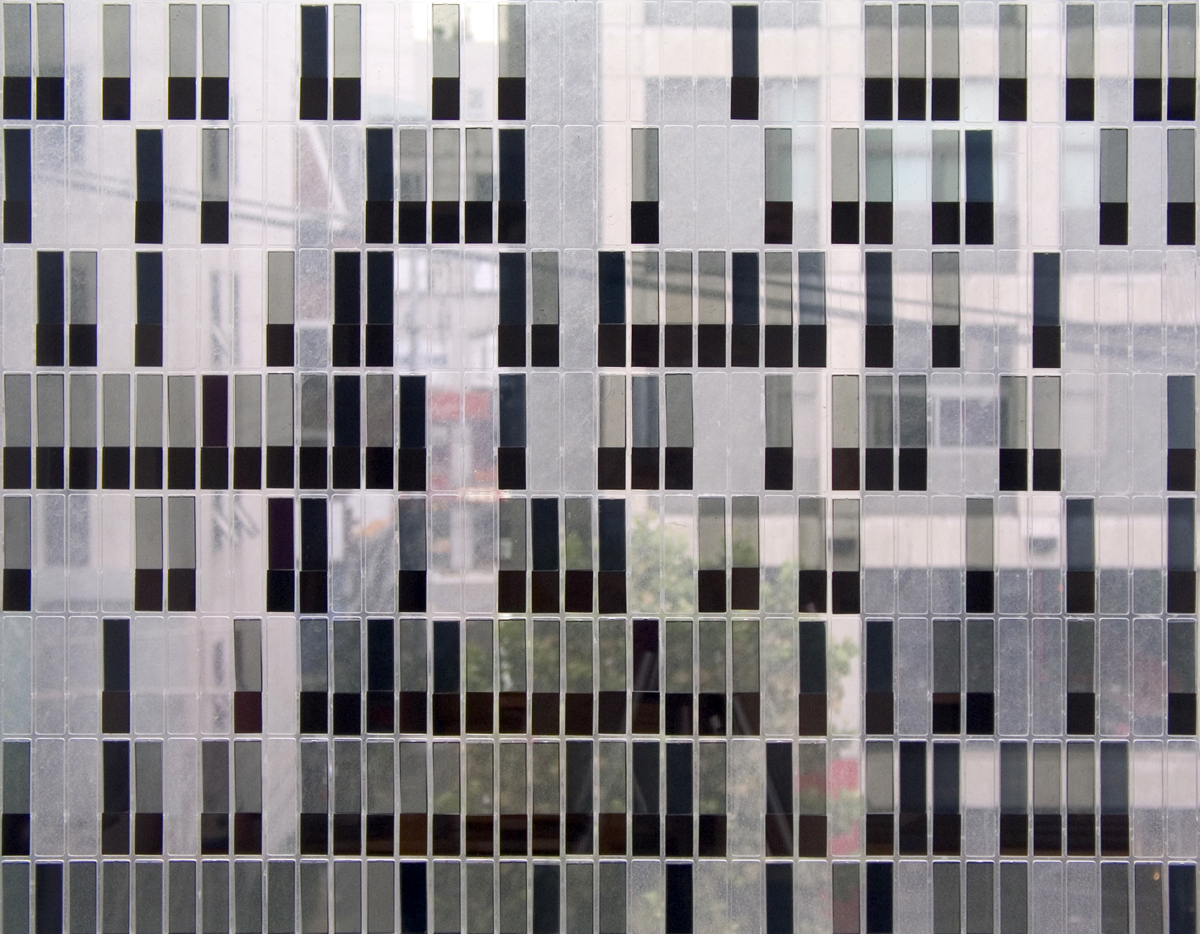
small rectangular cells (solar cells) that light up on a wall in geometric
formations—as in Perceptual Mirror Blinker (2007).
What is
noteworthy is that in most cases (especially after 2000), the parts (basic
units) do not disappear into the overall form but instead retain their
individuality and reveal themselves. In other words, while the whole is
visible, the parts (units) are also visible. Put differently, Hong Sungchul’s
work asks the viewer to see both the whole and the parts. When observing the
parts up close, the viewer feels the urge to step back and see the whole; when
viewing the whole, the viewer is drawn closer to examine the parts.
There is yet another variable at play
here: the subtle movement or trembling of the parts. The parts (units), or the
combinations of parts, generate a certain movement (effect). For instance, in
White Cube, the basic unit is a thin, lightweight thread
descending from the ceiling to the floor. Because it is thin and light, it
responds to even minor environmental changes and moves (trembles). More
precisely, since this movement/trembling is not singular but multiple, it
should be described as movements/tremblings.
In Perceptual Mirror
Blinker, these tremblings take the form of the flickering of small
cells. In addition, one must also consider the optical illusions generated at
the level of perception through the repetition of small units. Such
illusionistic effects are particularly prominent in the recent works
collectively referred to as String Mirror. In any case, the
movement (effect) produced by the parts and their combinations renders the
previously mentioned back-and-forth movement between part and whole more
dynamic and rhythmic.
Rather than identifying the parts, viewing the whole, and
then intellectually relating the two, what becomes emphasized is riding a
certain rhythm generated through the interaction between part and whole. As
Yoon Du-hyun once pointed out, “anyone standing before the work ends up moving
as if dancing.”
To reiterate, this act of riding the
rhythm (moving as if dancing) is far removed from identifying and recognizing
each fixed entity one by one. What matters is not the recognition of individual
parts, but responding to the indeterminate and momentary relationships
(effects) between them. From this perspective, experiencing Hong Sungchul’s
work is akin to listening to music. It is about following the beat and rhythm
generated by the combination of sounds.
In his recent works, this corresponds
to following the rhythmic atmosphere and flow generated by the relationships
between the strands. Or, just as one perceives sounds in music that disappear
in the next moment, one perceives in Hong Sungchul’s work the forms unfolding
before the eyes that are about to vanish. And upon closer inspection, the
arrangement of these strands closely resembles that of a musical score.
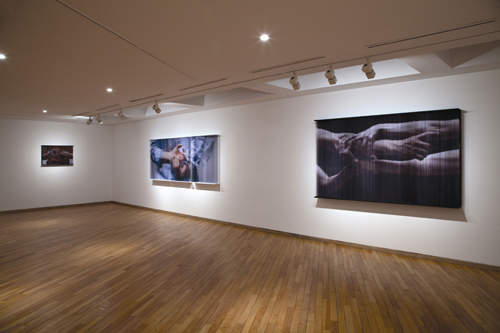
Now let us turn our attention to the level
of images/pictures. What kinds of images are present there? Let us first
revisit the works presented in the 2007 solo exhibition at In Gallery, which
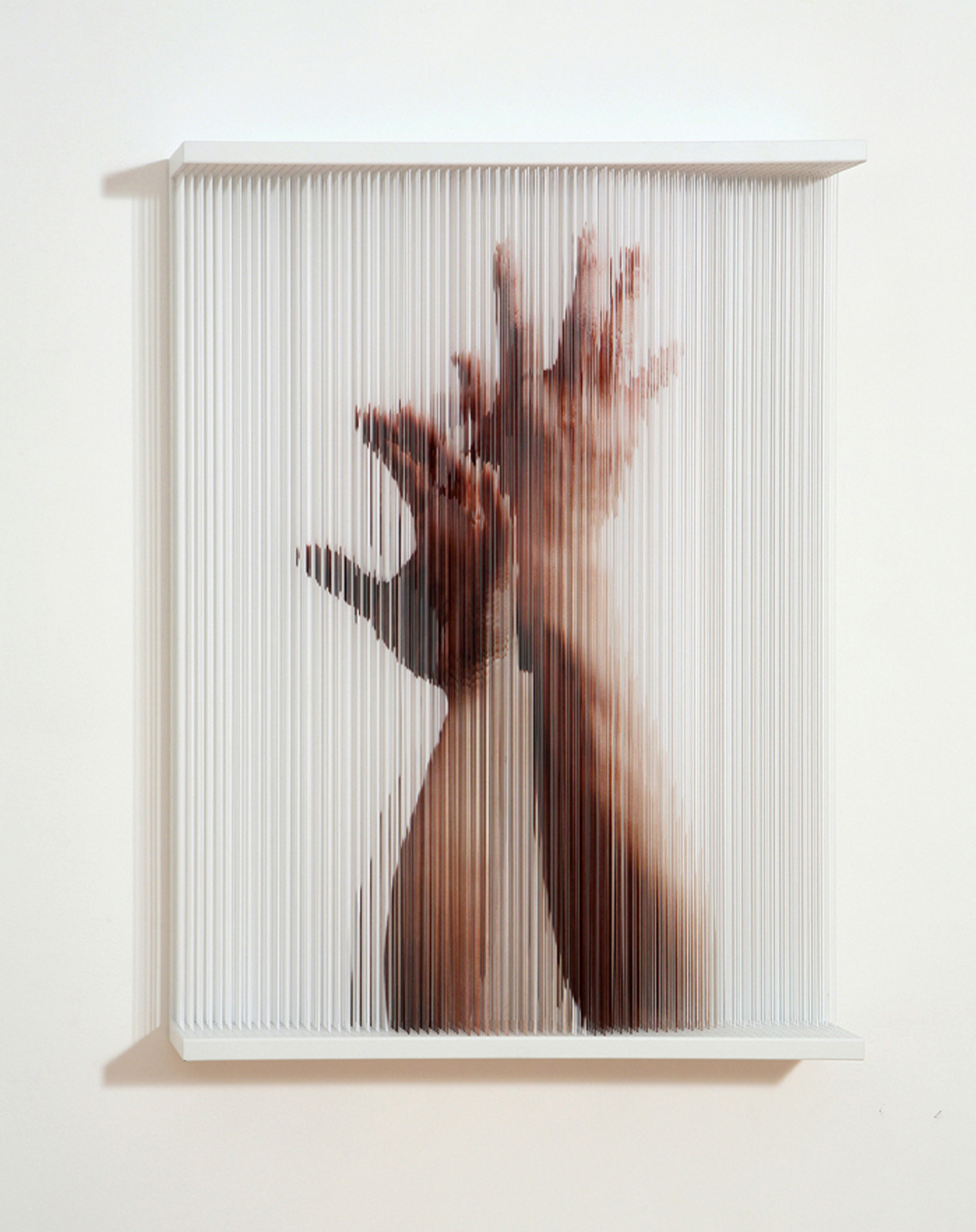
can be considered direct precedents of the recent works. The most prominent
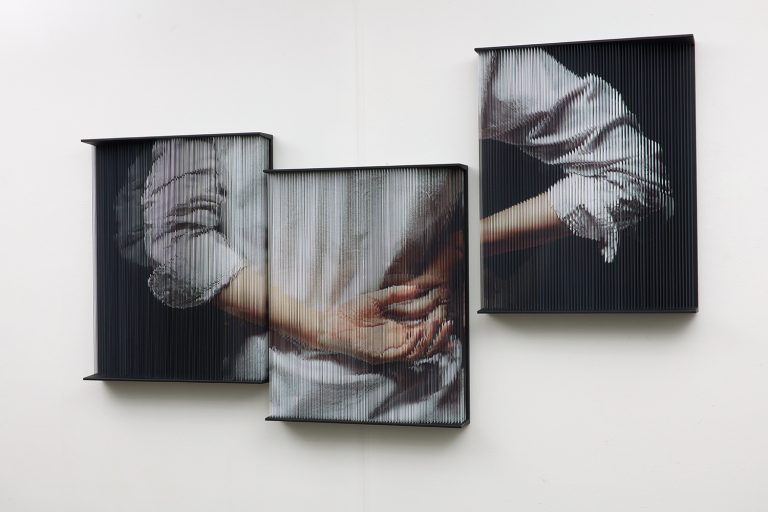
image in these works is that of the “hand” (printed on the strings). What kind
of hand is it? To me, it appears as a “playing hand.” More specifically, it
resembles the hand of a performer moving across the strings of a harp.
At the
same time, the (rubber) strings that constitute the material of the work
indicate, on the level of image or illusion, the strings of a string
instrument—namely, the harp. With this in mind, if we look again at the hand
images presented in the 2007 works, we find that there is not just one. There
is another hand behind it. This is the hand image printed on the second layer.
While it resembles the hand in the first layer, it takes a different position.
Upon closer inspection, there is yet another layer behind it, containing yet
another hand image.
In some cases, more than ten layers of hand images are
superimposed. Thus, even at the level of the image, Hong Sungchul’s
characteristic compositional method—“constructing a whole by repeatedly
arranging basic units (here, hand images) according to a certain system or
rule”—is consistently applied. What kind of effect does this compositional
method produce at the level of the image?
One might first recall the “playing
hand” images of the Futurist artist Giacomo Balla. In other words, the
overlapping of layers through superimposition can serve as a striking method
for representing variable movement (or the passage of time) on a static
surface. From this perspective, what matters is not identifying each individual
hand image, but responding to the movement (effect) generated by their
overlapping.
In short, Hong Sungchul’s 2007 “hand
image” works aim toward a musical dimension in both form and content. That is,
these works are concerned with the transformation of the visual into the
auditory. As Wolfgang Welsch has pointed out, while the visual relates to what
is enduring and continuous, the auditory relates to what is ephemeral,
fleeting, and event-like.
Thus, to become auditory is not to “investigate,
control, or verify,” but to pursue “sensitive concentration on the momentary,
perception of the singular, and openness to events.” Conversely, to become
visual is to step back (to create distance) in order to objectify a given
situation. This exchange between vision and hearing, and the immersion in
event-based situations, is a prominent characteristic throughout Hong
Sungchul’s work, as seen in Open Me (2001) and
Please Call Me (2002). Open Me is an
interactive installation featuring a hand image that moves and opens in
response to the viewer’s sound, while Please Call Me is an
interactive installation in which a figure, initially turned away, turns back,
approaches, and disappears in response to the viewer’s voice.
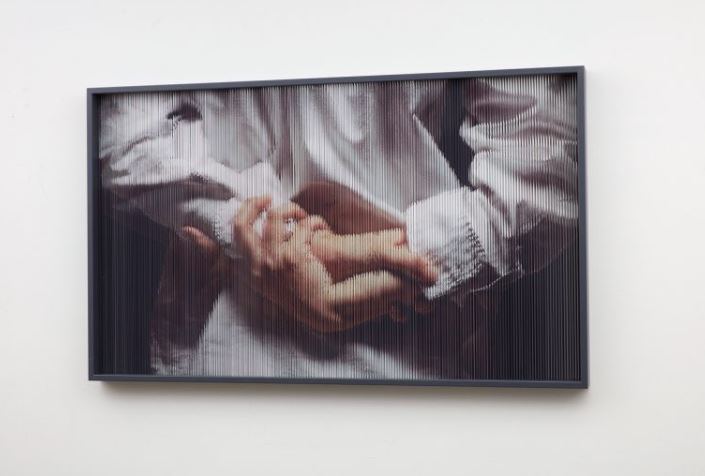
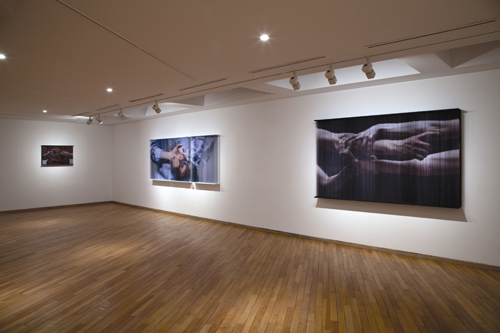
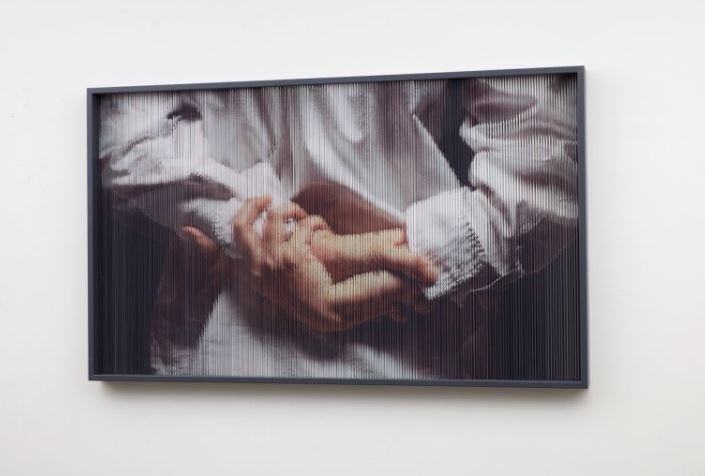
However, there are still works that have
not yet been addressed. These are works that present hands firmly grasping one
another. Here, the hands have ceased playing. In this case, our gaze naturally
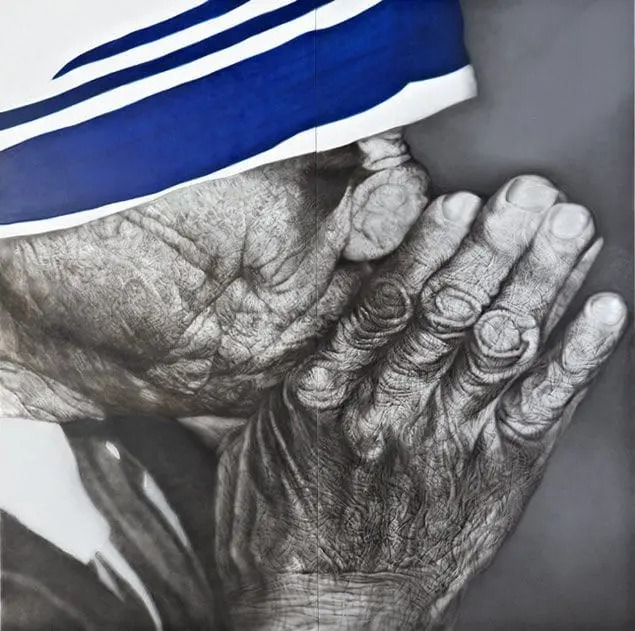
turns toward the “hand itself.” Since Hong Sungchul’s works are generally large
in scale and the “hand image” is presented in close-up, what becomes prominent
when focusing on the hand itself are its “wrinkles.” These wrinkles are strata
in which the time and experiences of the hand’s owner have accumulated layer by
layer.
In this sense, the wrinkled hand image corresponds as an equivalent
image to the previously mentioned multilayered overlap of hand images. These
wrinkles/layered overlaps simultaneously unfold temporal development (history)
within space. In such a situation, we cannot isolate and observe any single
wrinkle or layer independently. In other words, it is extremely difficult to
define the overall condition with a single term or form. In a sense, it is like
an inseparably entangled skein that is difficult to unravel. Hong Sungchul
himself compares this condition to the existential situation of human beings:
“The meaning of the entity called ‘I’ cannot be closed in itself; it is
endlessly deferred and postponed, and the ultimate entity and meaning can never
be grasped.” — Artist’s note
Now it is time to mention the works that
we will encounter in the 2011 exhibition. These works follow a trajectory
similar to that of the 2007 works in terms of orientation, production method,
and basic composition. In other words, they continue to emphasize the
ambivalent attitude that does not side with either part or whole, the effect of
movement generated by the trembling of parts (or a musical/auditory
orientation), and the engagement with movement and temporality revealed through
the multilayered overlapping of images.
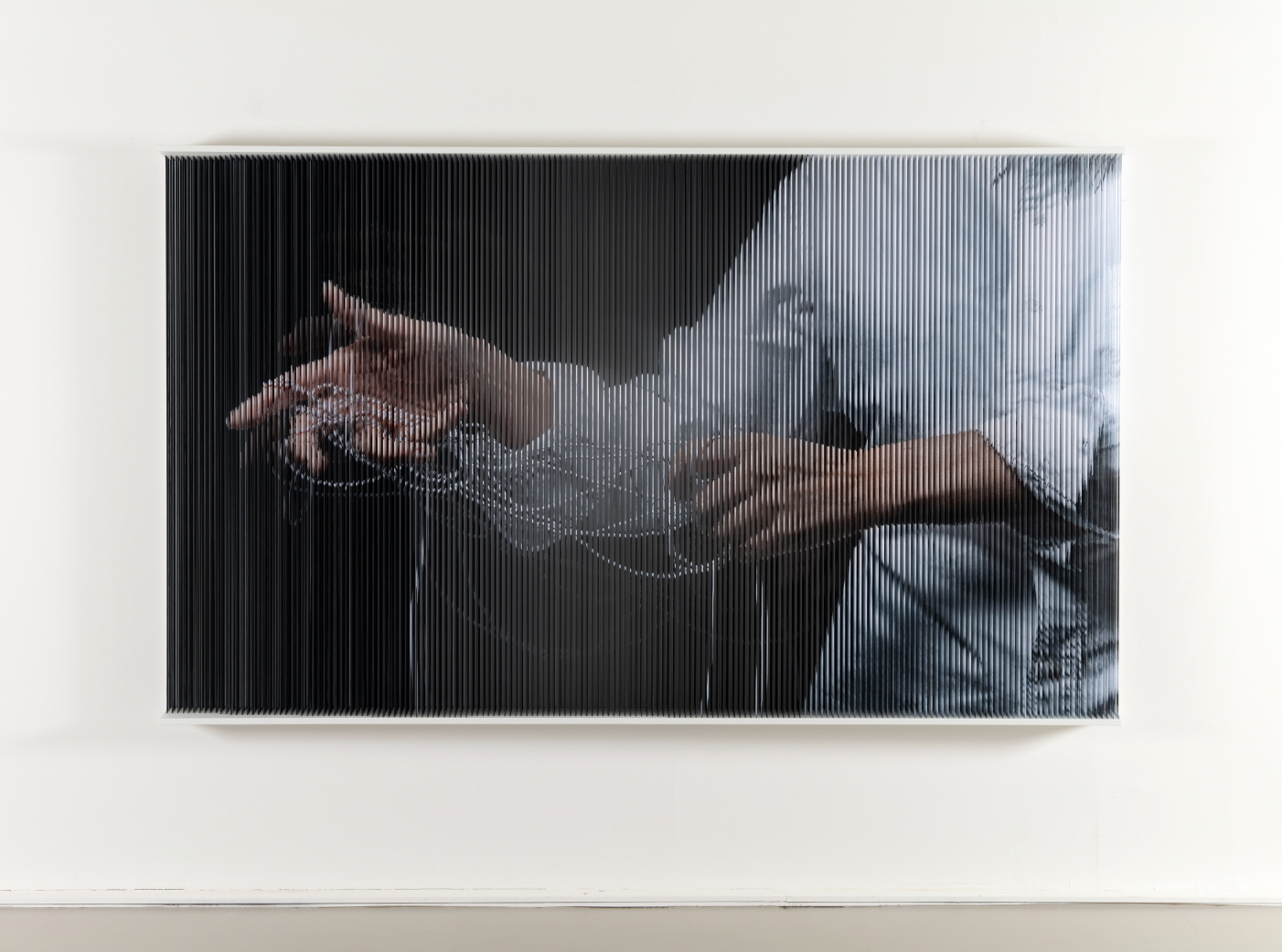
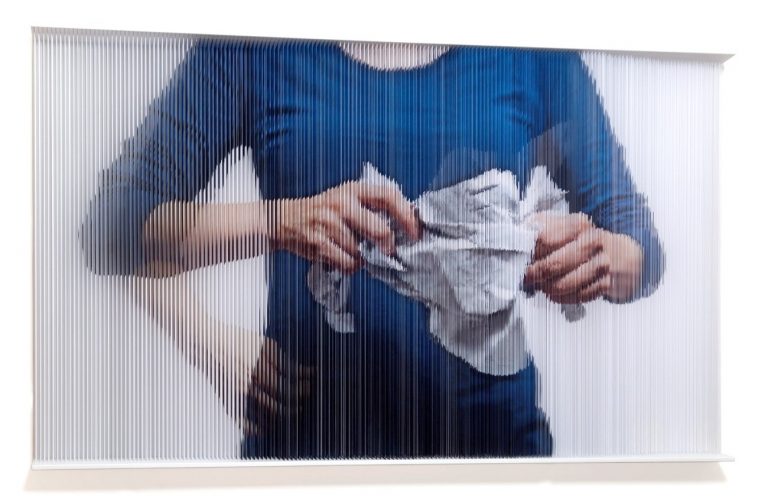
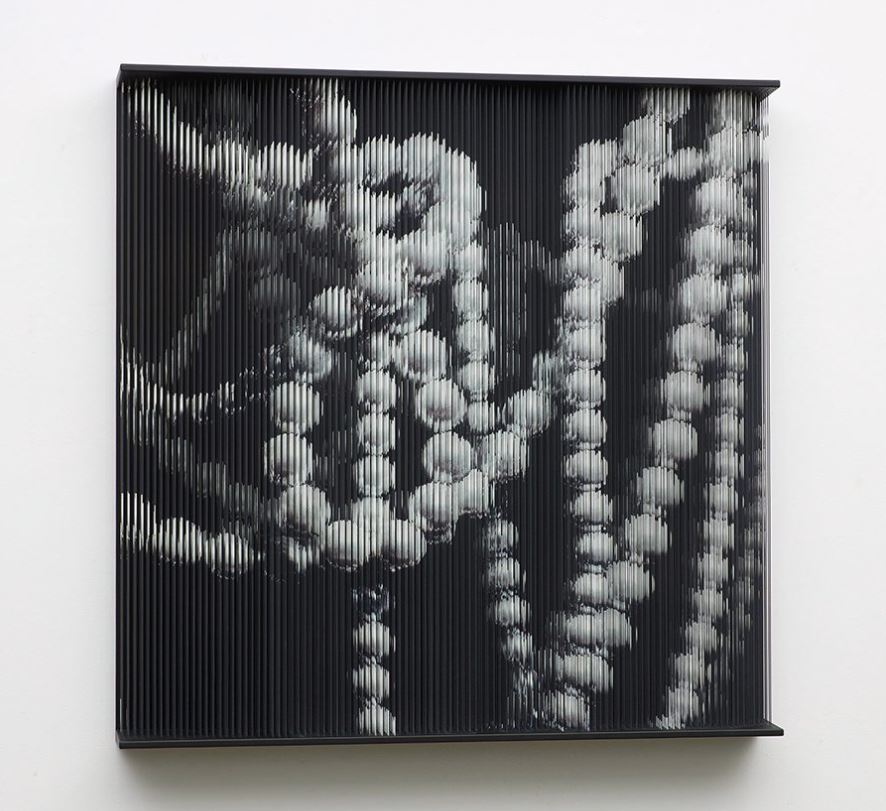
Above all, the “hand” image remains
important here as well. However, there is a significant difference. The most
notable change is that the hand now grasps strings of beads. These strings of
beads may resemble a necklace or a rosary. The hands appear to untangle, pull,
intertwine, and count the beads. In this case, the strings that previously
appeared as harp strings in earlier works lose their mimetic (iconic) quality
and are perceived simply as strings themselves. If one were to push the
interpretation further, these strings might be seen as indicating the staff
lines of a musical score.
Then could the bead images be considered signifiers
of musical notes placed upon that staff? In any case, the movement associated
with beads/strings is less noisy than that of string instrument performance.
This remains true even if one interprets them as a score and notes. In this
way, Hong Sungchul’s 2011 works somewhat reduce the auditory atmosphere that
dominated the 2007 exhibition. How should this be understood?
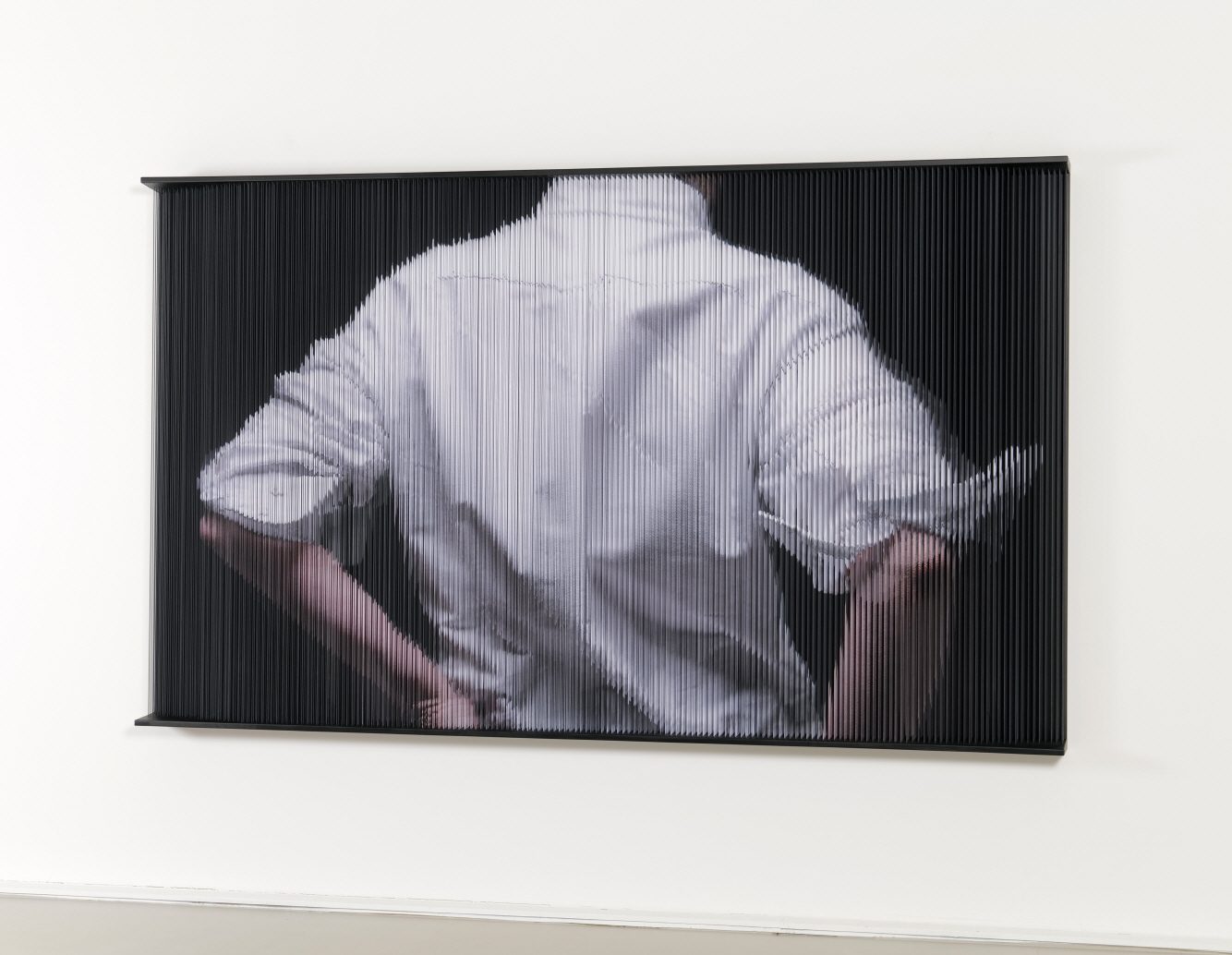
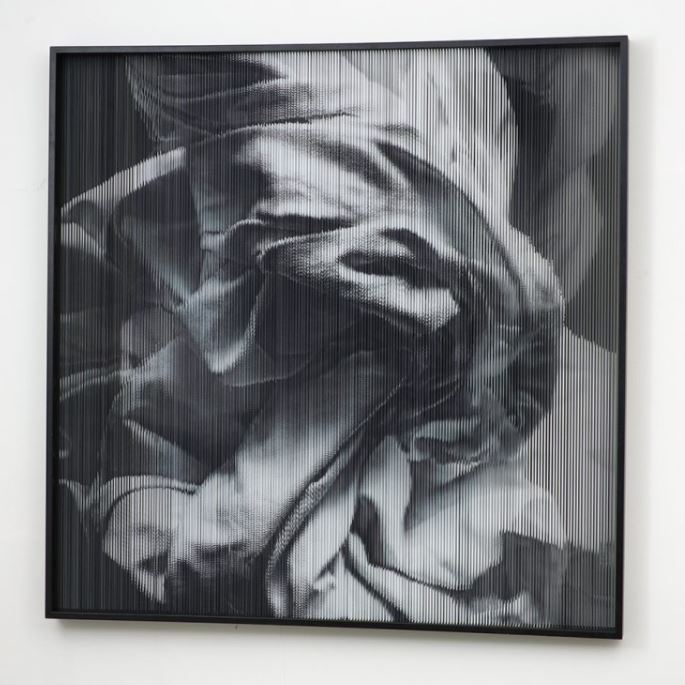
Another change brought about by the
addition of beads to the hands can also be noted. In order to capture the
beads, the camera (the artist’s body holding it) moves backward, revealing a
different kind of wrinkle from those previously discussed. These are “wrinkles
in clothing.” As the (model) grasps the beads and engages in movement, folds
naturally form in the clothing. What is notable is that these wrinkles are
qualitatively different from the wrinkles of the hand (body) mentioned earlier.
Unlike the latter, which reveal accumulated time and memory, these are
temporary and contingent wrinkles. Such transient and accidental wrinkles were
not present in the 2007 works, which focused on the hand and body. Here,
however, the artist assigns vivid colors to the clothing (or at least permits
its coloration) and uses special lighting to emphasize the folds. Through this,
the artist counterbalances the excessive attribution of meaning to wrinkles
that was present in the 2007 works.
To summarize, Hong Sungchul fundamentally
seeks balance between opposing values. It is akin to walking a tightrope.
However, as is always the case with tightrope walking (as a game), maintaining
balance ultimately fails, and we inevitably lean toward one side. Then he
climbs back onto the rope again. In this sense, a seesaw may be a more
appropriate metaphor: one rises and falls, and then rises again. What if we
compare it to a whack-a-mole game? One strikes what protrudes (and thereby
demands exclusive attention), forcing it back down—only for something else to
pop up again.
Borrowing the artist’s own words, this could be described as a
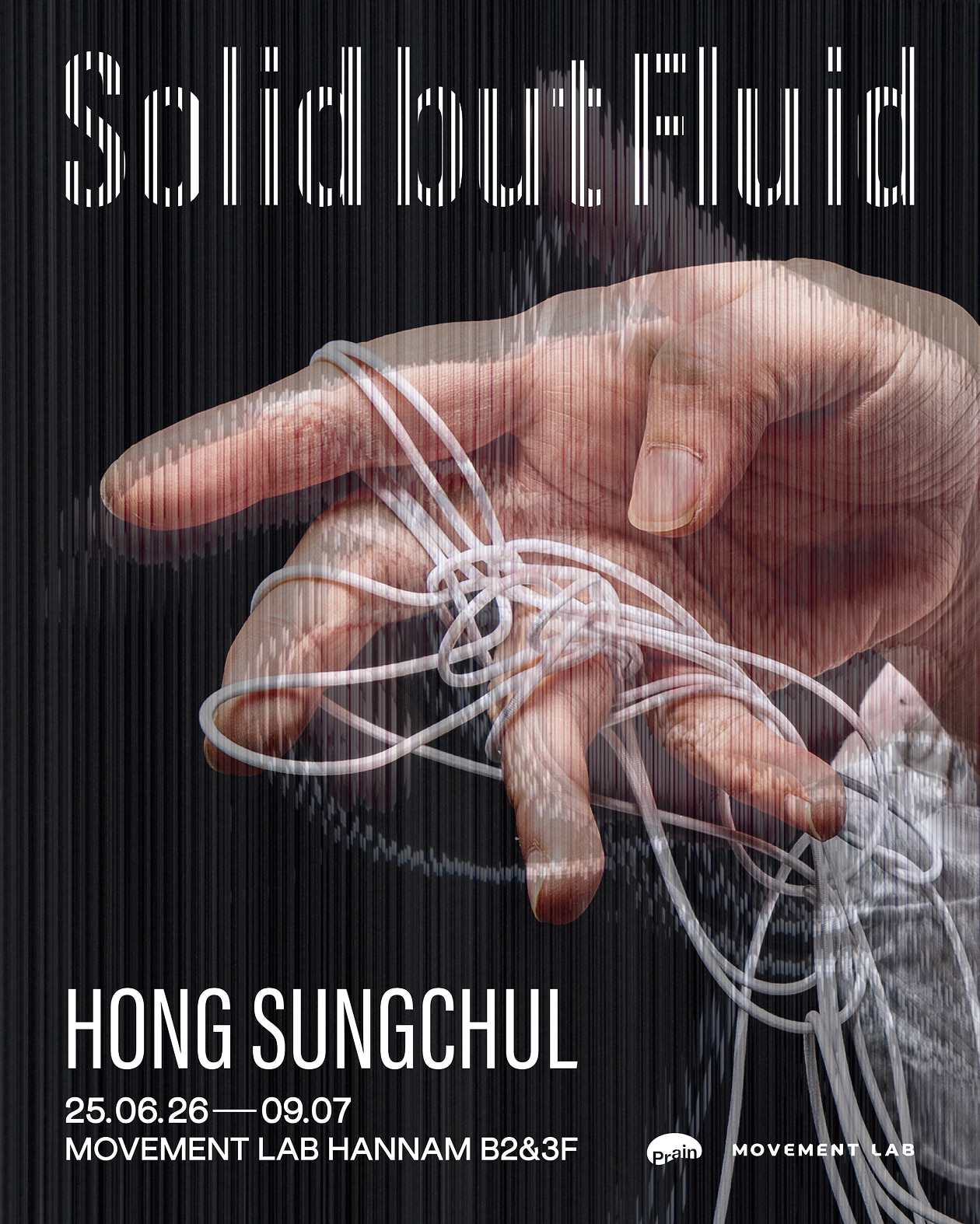
“game of grasping the meaning of entity and subject.” Hong Sungchul has termed
this ‘Solid but Fluid,’ but it could just as well be described as ‘static but
dynamic’ or ‘good but bad’ without much discrepancy. For this artist, what
ultimately matters is not ‘solid’ or ‘fluid,’ but rather the ‘but.’