This
exhibition is about “darkness.” 《Oh, Night and I’ll Come to You》—the title
itself makes that clear. The sentence is a promise made to someone. It calls
out to the one who is in the dark, extending a hand to someone crouched within
it—a tender promise. This promise may sound firm and trustworthy, or it may
sound hollow and sorrowful. Either way, what matters is that it is a promise.
Yet to promise a journey toward someone, this darkness, this night, is a truly
trembling and desolate time. The gaze that pushes through that trembling, fear,
helplessness, and loneliness toward somewhere else—this is likely the shared
point of view of Yuja and Jungyeon¹, and the point of departure for this
exhibition.
The
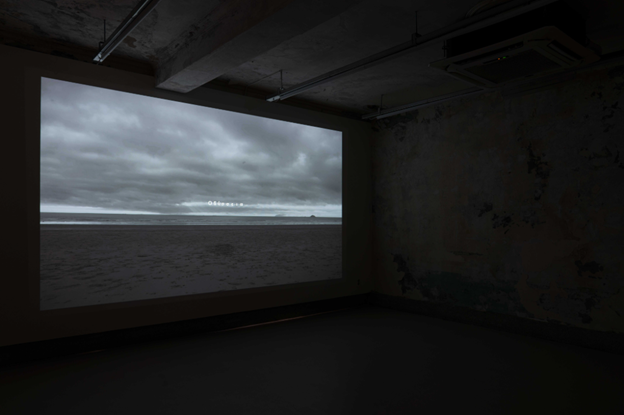
emotional register of night runs through both the title of Yuja’s photograph (Night
Writing) and Jungyeon’s two-channel video (Night Piece).
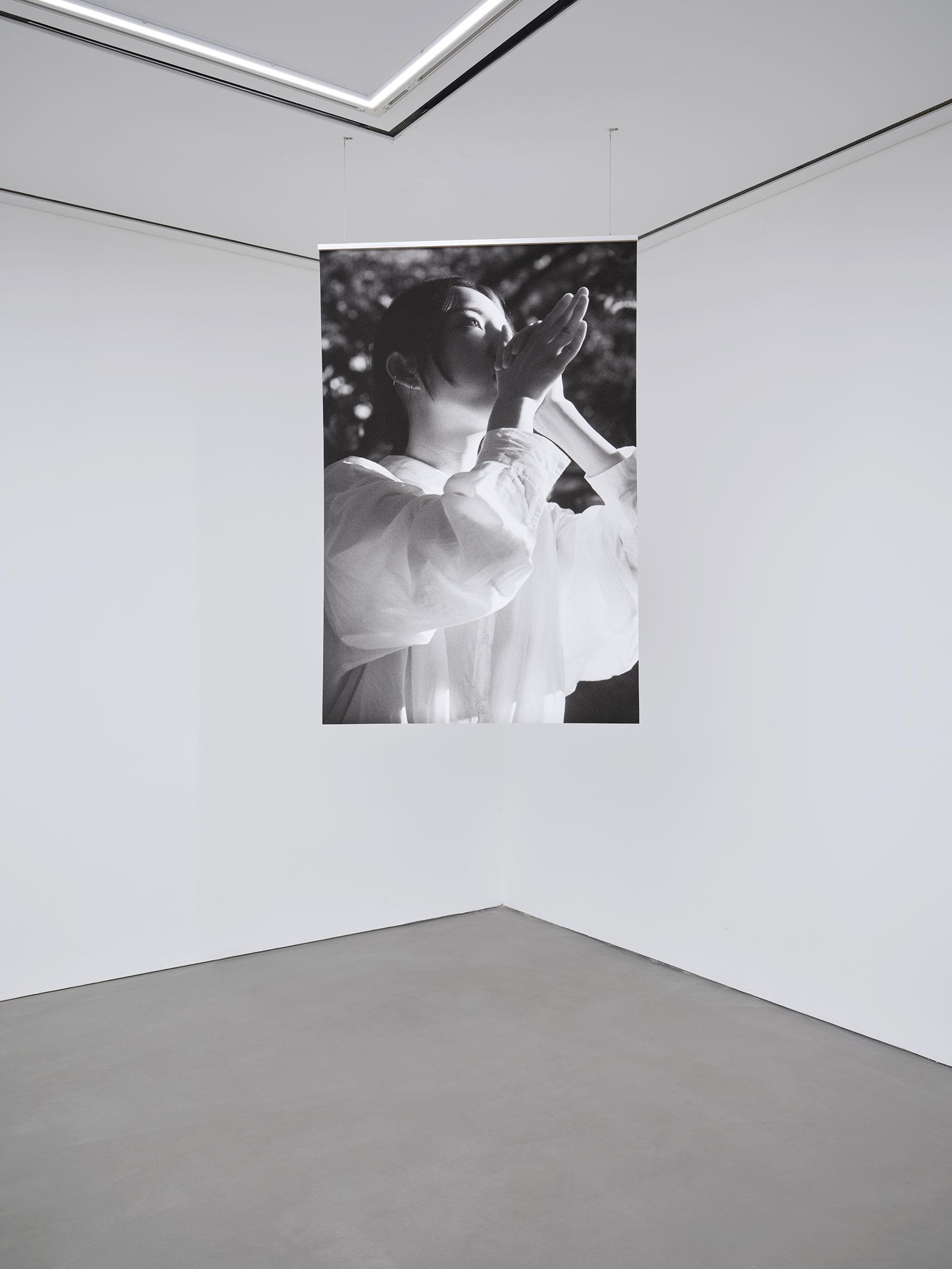
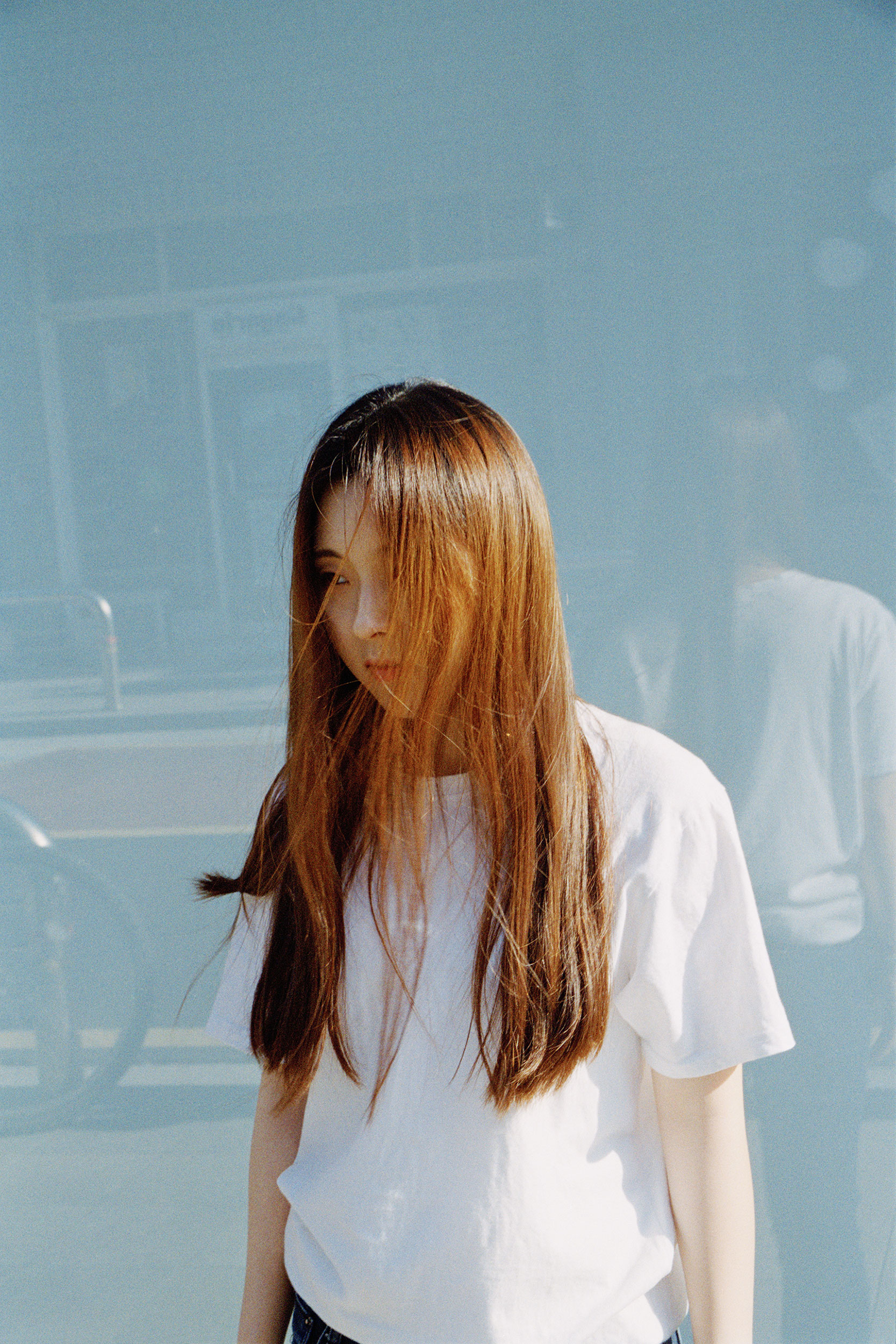
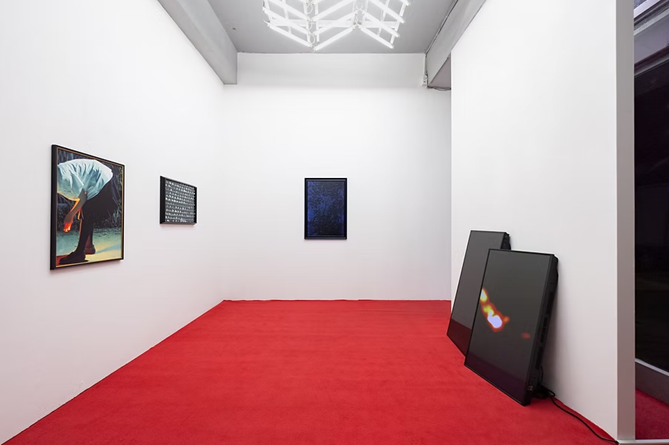
In the large photograph Night Writing(2024), hung
prominently on the window, a girl is captured whistling with her fingers.
“Night writing” refers to a coded system devised by Charles Barbier for
military operations, a system that later contributed to the invention of
Braille.
Composed of twelve dots, this writing enabled silent communication on
dark battlefields, and Braille for the visually impaired was born from this
very possibility of connection in darkness. “Night piece,” meanwhile, refers to
a literary genre in medieval literature that deals with accidental and uncanny
events. Often classified as “Gothic” or “Gothic fiction,” night pieces center
on mysterious incidents and unknown fears that occur at night, invariably
accompanied by solitary figures seized by anxiety and hallucinations summoned
by darkness.²
Sending a message to someone in the dark, or staring into the darkness while
waiting for someone to appear, is an old melancholic figure—waiting for a
distant lover, a comrade lying in ambush, or someone who has departed.
According
to Yuja and Jungyeon, “darkness” here serves as a metaphor for a sense of the
end of the world. Images that convey “the end as a finely spreading vibration,
an apocalyptic sensation that is fatal yet at the same time fragile, enveloping
us through delicate gestures”³ form a particular landscape. To state it
hastily, this landscape is a dim scene of girls living amid loss and wounds. In
fact, night or darkness is not an independent or positive entity in itself.
Ontologically speaking, darkness does not exist as a substance; it is merely
the absence of light. Darkness is not simply dimness, but the loss of light;
the end is not merely an ending, but the loss of the future. The apocalyptic
sensation that seeps out tremblingly from a negated future—a future faded more
into memory than dream—is nothing other than a sensation of loss.
Meanwhile,
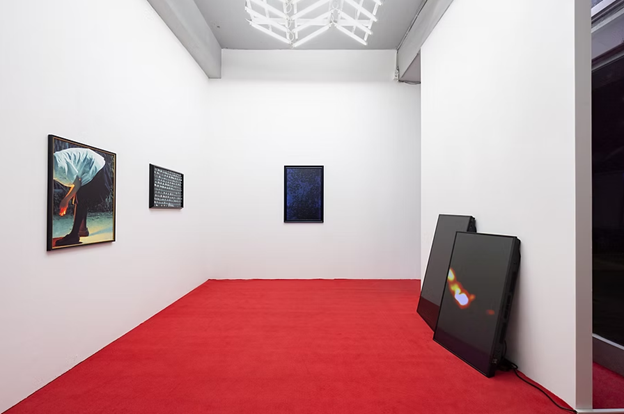
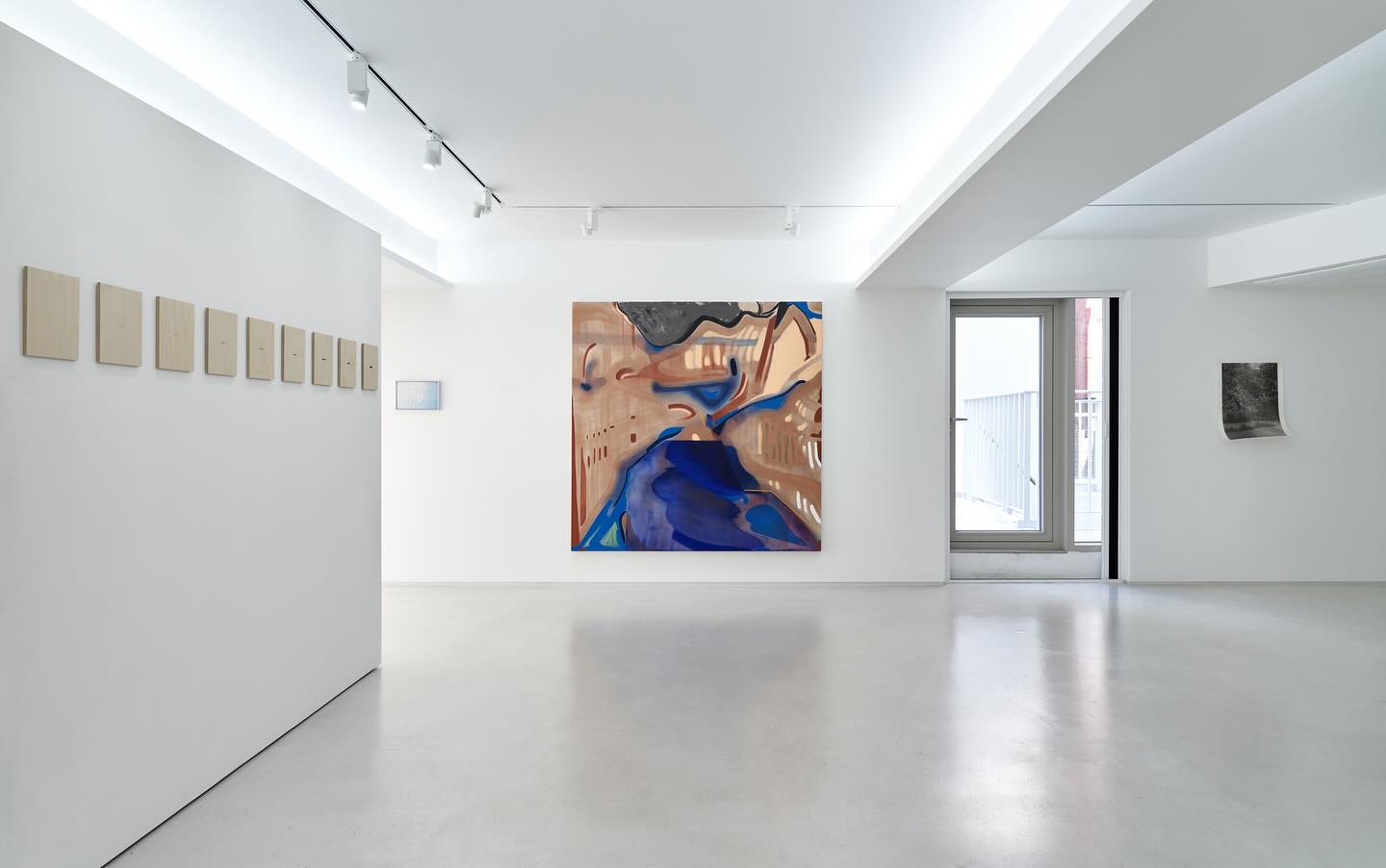
this exhibition composed of Yuja’s photographs and Jungyeon’s videos appears as
though two fragments—day and night—have been stitched together. Though captured
at different times of day and featuring different subjects, both attempt to
grasp the invisibility beyond what is seen, resembling “light-images” that seek
what lies beyond. It hardly needs to be reiterated that the word “photograph”
itself means “drawing with light (phos + graphê).”
Jungyeon’s videos also
consciously evoke optical gazes that emit light in darkness, such as
surveillance CCTV cameras or night-vision imagery. Yuja’s photographs are
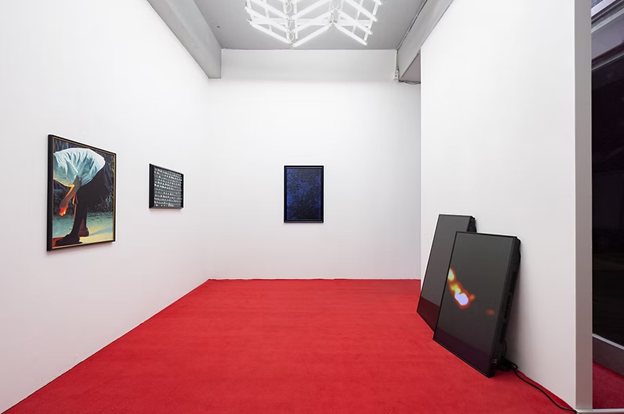
mostly placed on the first floor near the storefront windows, while Jungyeon’s
videos—except for Night Piece—are screened underground.
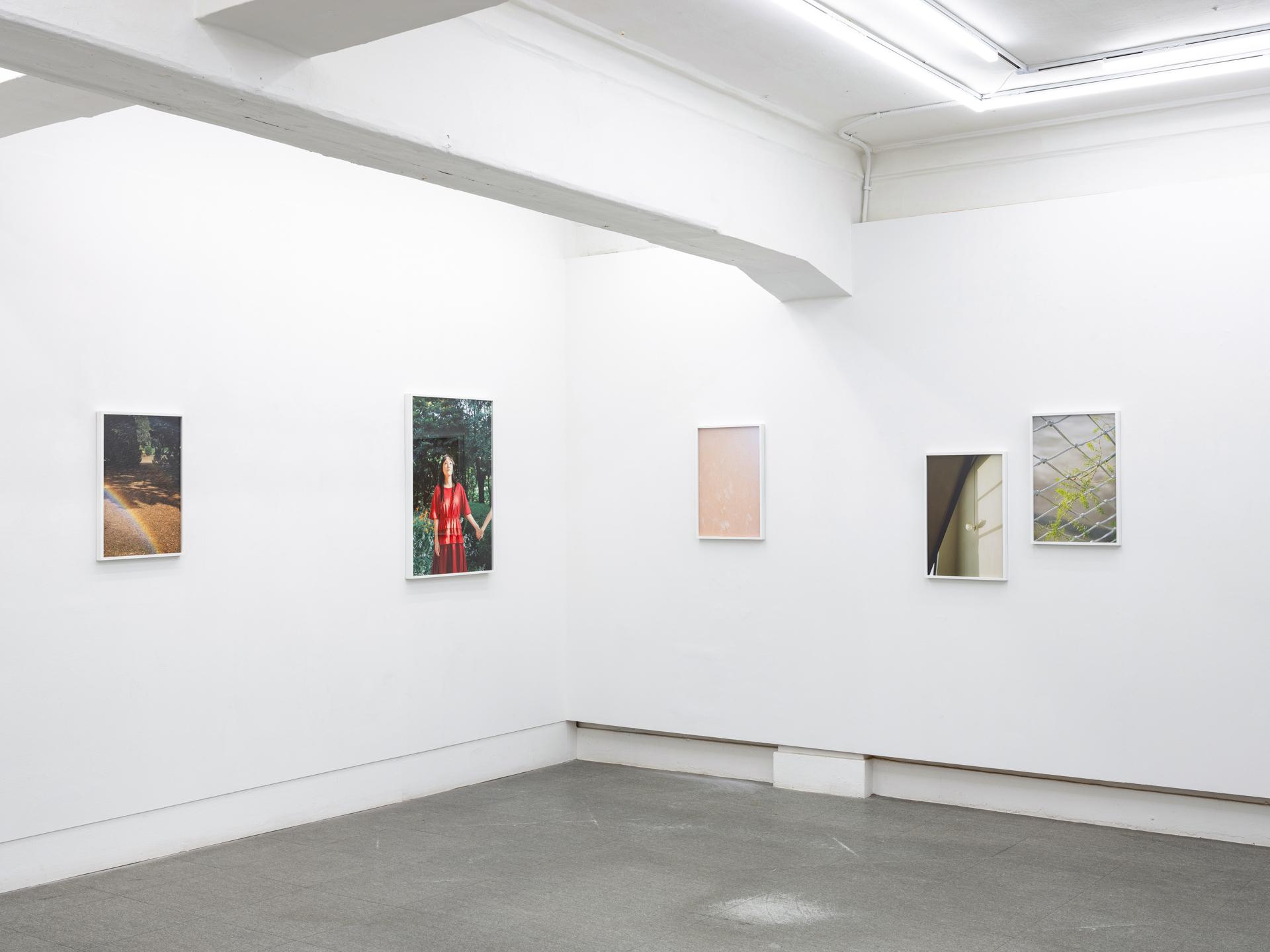
Yuja’s camera fixes scenes that scatter like foam in the dazzling brightness of
broad daylight, while Jungyeon’s camera captures the gazes and movements of
“animal-like” girls crouched in caves or wandering through the dark night
outside. Yet the two practices do not appear contrived or oppositional, perhaps
because both evoke a desire to glimpse “light” within “darkness.”
It
is difficult to read desire from photographs. More broadly, one cannot expect
to extract emotion from photographs—except in cases where viewers react
reflexively or empathetically to subjects such as a crying person or a smiling
child. Even photographs that depict clear misery do not emit emotion in and of
themselves. I dislike invoking Roland Barthes’s concept of the punctum in
relation to photographs. While not entirely unfounded, it is not something
objectively or interpretively discoverable on the smooth surface of a
photograph for everyone, regardless of details.
Still, if one were to defend
the punctum, it would be a rupture of memory or a piercing of emotion arising
precisely at the point where interpretation fails. And yet—paradoxical as it
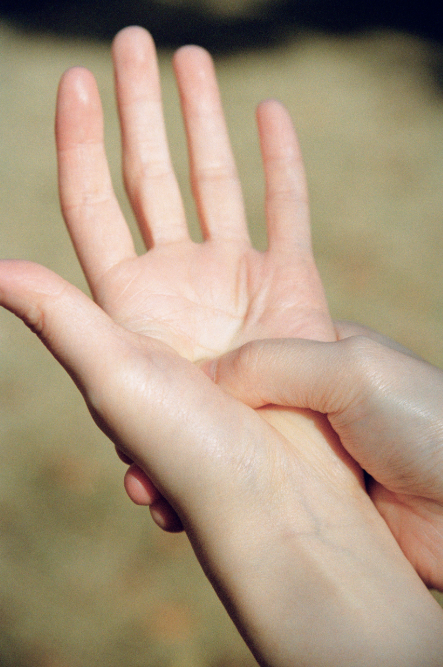
may sound—I believe photographs do contain emotion. By emotion, I mean not
sentimentality, but a “structure of feeling” shared by certain groups of
people, a numb desire. In the context of photography, this is akin to a quiet
disturbance caused by the light of the moment the photograph captures. This
disturbance is not the light itself, but the subtle vibration inscribed in the
eyes, forehead, fingertips, or nape upon which the light settles. There are
moments when we cannot tear our eyes away from such vibrations in a photograph.
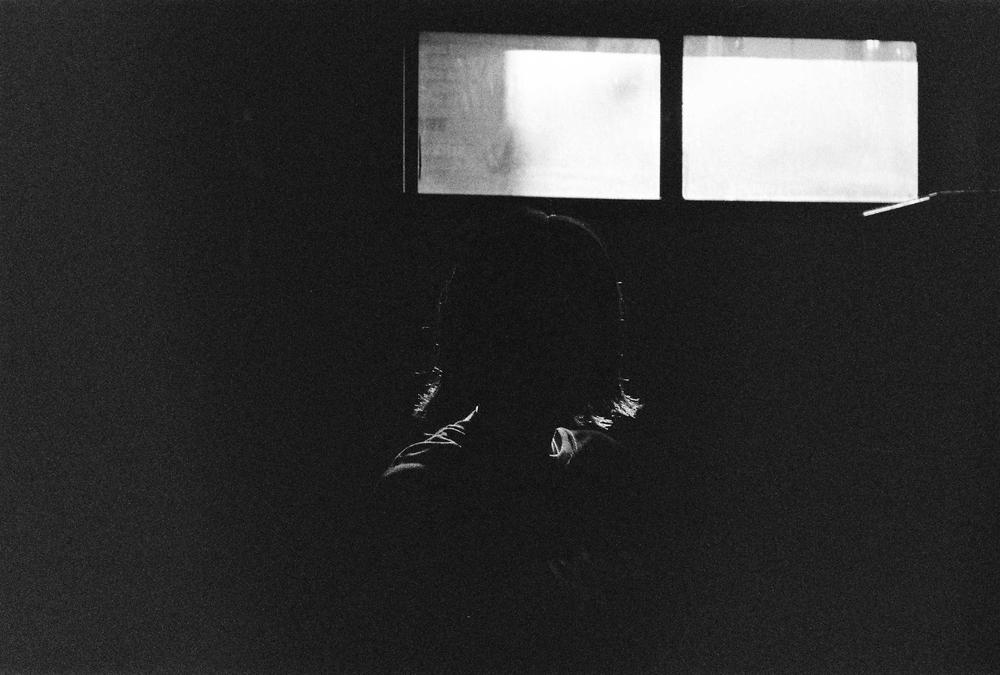
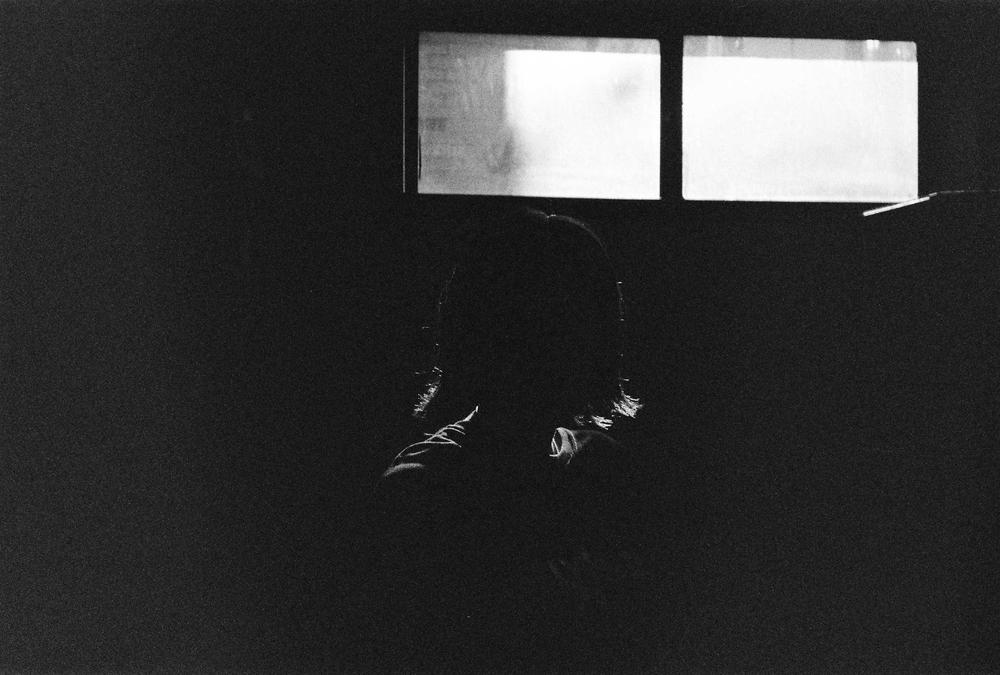
In Will
o’the wisp(2023), hung on the side window of the exhibition space,
rows of empty desks are reflected beyond a hazy pane of glass. In Oh,
Night and I’ll Come to You(2024), which shares its title with the
exhibition, light floats like fine down, forming white outlines as if washing
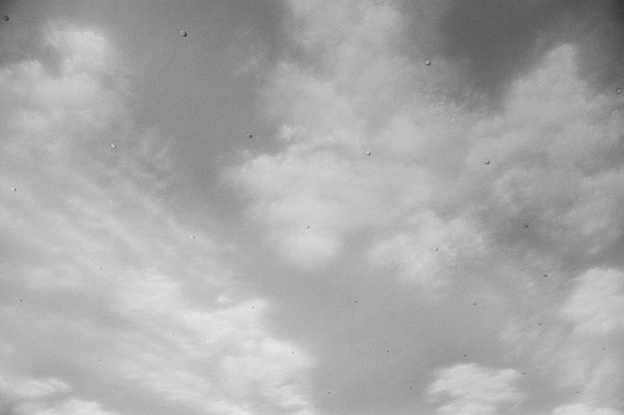
away darkness. In We Ring the Bell and Walk(2022), a
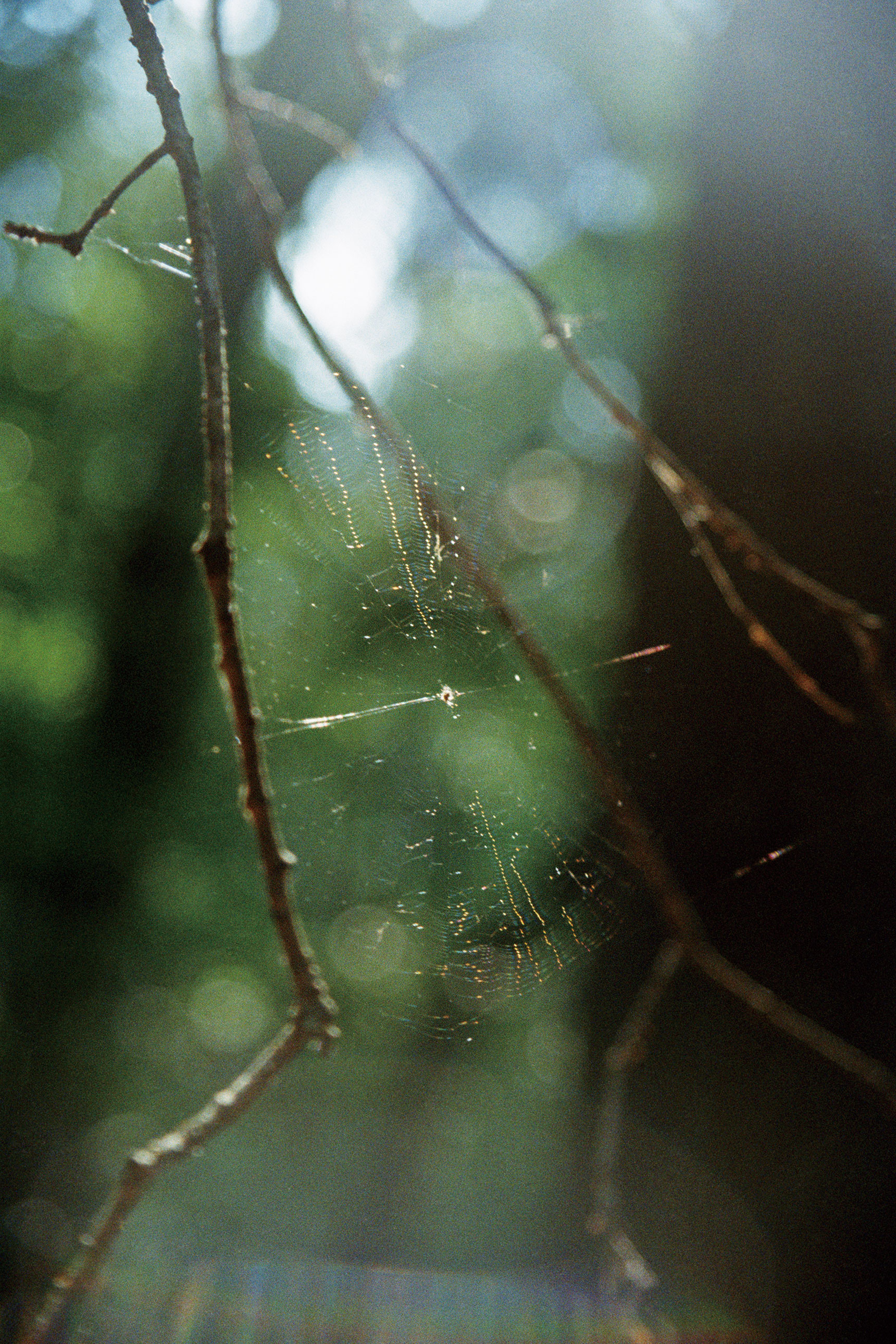
photograph developed from accidentally burned film, autumn leaves and fireflies
scatter like a tomb of light across a deep, abyssal blue sky.
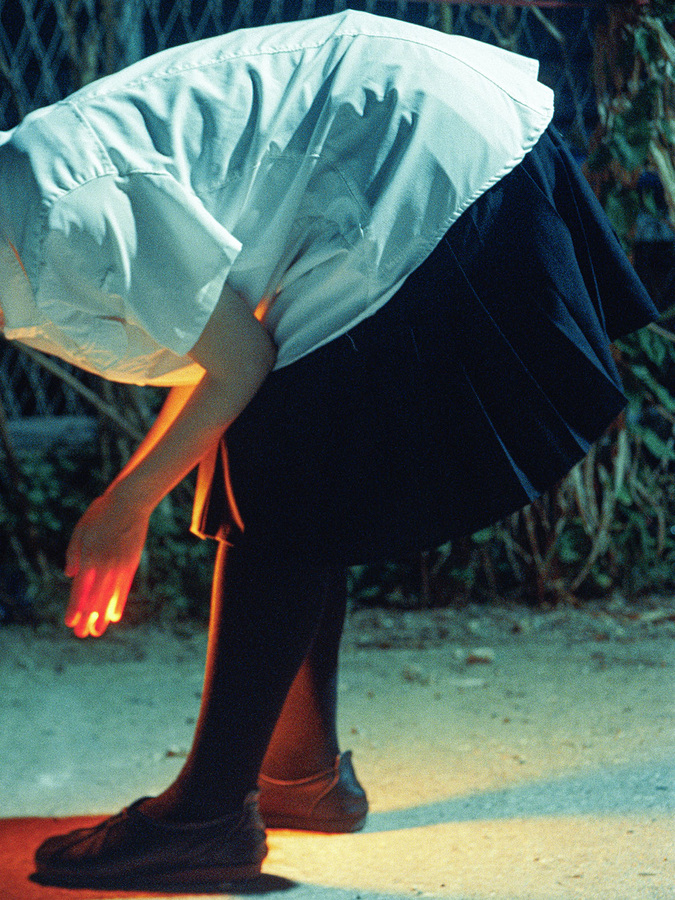
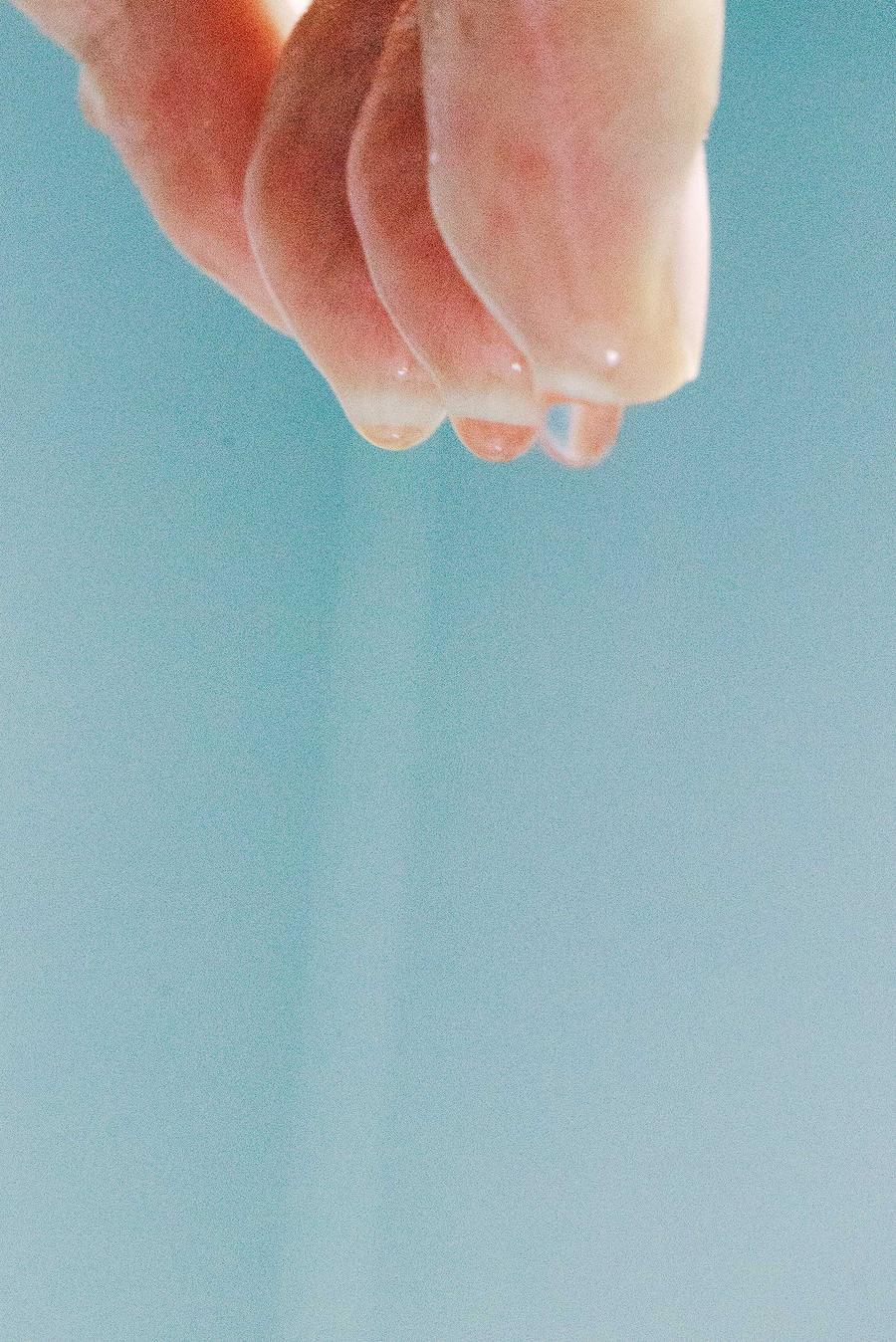
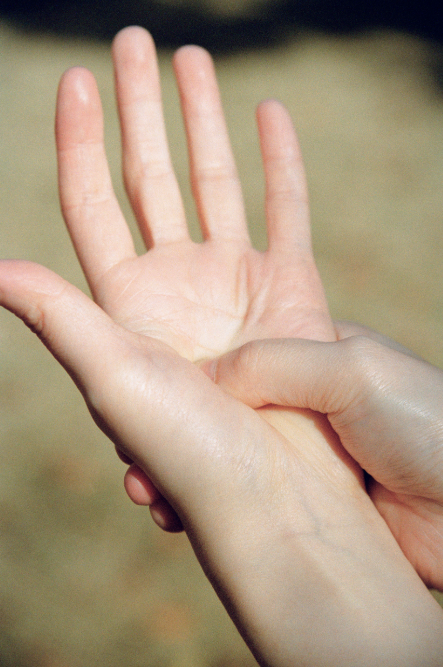
Yuja’s
photographs bear traces of things that undoubtedly existed but could not be
fully recorded. These traces—submerged in light or darkness—are powerless and
sorrowful, yet piercingly radiant. Though I hesitate to cite Barthes, his
expression is too precise to omit: a photograph is “a treasury of rays emitted
on that very day” by a being now vanished, and the vitality of a photograph
reaches us “not through added light, but through its own rays.”⁴
In
scenes captured by Yuja and Jungyeon, white clothing—and girls dressed in
white—appear with striking frequency. One might question the need to assign
meaning to the color of clothing, yet the white light captured by the camera
evokes, on one hand, the solemn and pure child acolytes of Catholic Mass, and
on the other, cold and unreal ghosts. In particular, Jungyeon’s video The
Minotaur Was the First Child to Fall into the Labyrinth features
a girl with large eyes and an expressionless face.
As we follow her wandering
through underground roads, karaoke rooms, and city streets, our attention
shifts less to curiosity about her origins than to her small body contrasted
against vast spaces. Whether filled with noise or echoing only with solitary
footsteps, every space becomes a hollow “labyrinth” to her. A numb, drifting
expression; a slow, animal-like gait that continues despite sensing the absence
of an exit. The video follows her slowly through CCTV-like perspectives and
night-vision imagery. When her eyes meet the camera, the flashing red light is
at once animalistic and distinctly ghostly.
The
dead float as light, while the living crouch like decaying corpses. 《Semele’s Light》 compresses the suspense of
Gothic fiction into the narrow, dark confines of urban studio apartments,
vividly revealing the sense of enclosure and isolation left to the living. The
myth of Semele—who was burned to ashes the moment she beheld Zeus’s light—is
translated into the figure of a contemporary girl suffering from PTSD, confined
to her bed and addicted to the glow of screens.
The death of others exists
outside us as an object of voyeurism, yet also as an unbearable trauma and pain
that cannot be confronted head-on. At the same time, it sinks deep within us.
Yet when the flickering light of the screen spreads across the face of the girl
lying sideways in the dark, we discover not curiosity but resolve in her
expression. “At the very center of burning pain, Semele does not close her eyes
for a single moment.”⁵
I
may be forcing a connection between their works and the emotion of loss. I may
even be insisting that Yuja’s photographs and Jungyeon’s videos emit a certain
emotional light—that of a nocturne in which darkness is arriving, rays of
trembling twilight. Perhaps this insistence stems from the line by T.S. Eliot
cited in the exhibition preface: “This is the way the world ends / Not with a
bang but a whimper.”
Rather than a spectacular apocalypse of asteroid impacts
or grand catastrophes, we are led to imagine an ending that rots, decays, and
festers—an ending that progresses without a bang, but with anxious noise and
intermittent vibrations, like air leaking out or ice melting. For us (whoever
this “we” may be), grand declarations such as “the end is coming” or “the world
has ended” are no longer necessary. What do I mean? Let me mimic Nietzsche’s
tone: “That old saint in the forest has not yet heard the news that God is
dead!”⁶
The
world has already ended, and we live on in its aftermath as if in an appendix.
This sensation rings in our ears like tinnitus. The apocalypse has become
everyday life. How might we name this? “Our” world sank once eleven years ago,
and suffocated again three years ago. In between, smaller worlds we assumed to
be safely beside us collapsed and disappeared without sound. We all carry the
anniversary of a friend’s death. The repetition of life and death is no longer
an aporia of famous philosophers, but something like the tolling of a bell that
sounds whenever we begin to forget—like an announcement for a delayed train.
And yet, we watch this decaying end. In the darkness where bells ring, we
stubbornly open our eyes once more. We count the dates. As Barthes said, dates
belong to photographs because they “raise their heads and make us reckon with
life and death, the ruthless disappearance of generations.”⁷
¹
The artists are Yuja Kim and Jungyeon Kim. Having followed their work for some
time, I have largely lost the distance typically maintained between critic and
artist; in this text, that loss of distance is not incidental, and thus I refer
to them by their first names.
² Jungyeon, who dresses in a “Gothic lolita” style, is an avid reader of Gothic
novels.
³ From Jungyeon Kim’s exhibition preface for 《Oh, Night and I’ll Come to You》.
⁴ All quotations from Roland Barthes, Camera Lucida: Reflections on
Photography, trans. Kim Woong-kwon, Dongmunseon, 2006, p. 104.
⁵
From text appearing in Jungyeon Kim’s Semele’s Light.
⁶
Original text: “That
old saint in the forest has not yet heard the news that God is dead!” Friedrich Nietzsche, Thus Spoke Zarathustra, trans. Jung Dong-ho, Chaegsesang, 2000, p.
16.
⁷
Barthes, Camera Lucida, p. 107.