In
his previous solo exhibition 《EarTrain
Reverse》 (2021), Seo Minwoo presented works that
produced virtual spatial perception by adjusting geographical positioning and
modulating material properties to construct auditory experiences. At that time,
he installed what he termed “sound-sculptures,” forming sculptural spaces
designed to emphasize specific frequency ranges. By situating sound within
diverse environments, these works guided listeners toward particular modes of
experience.
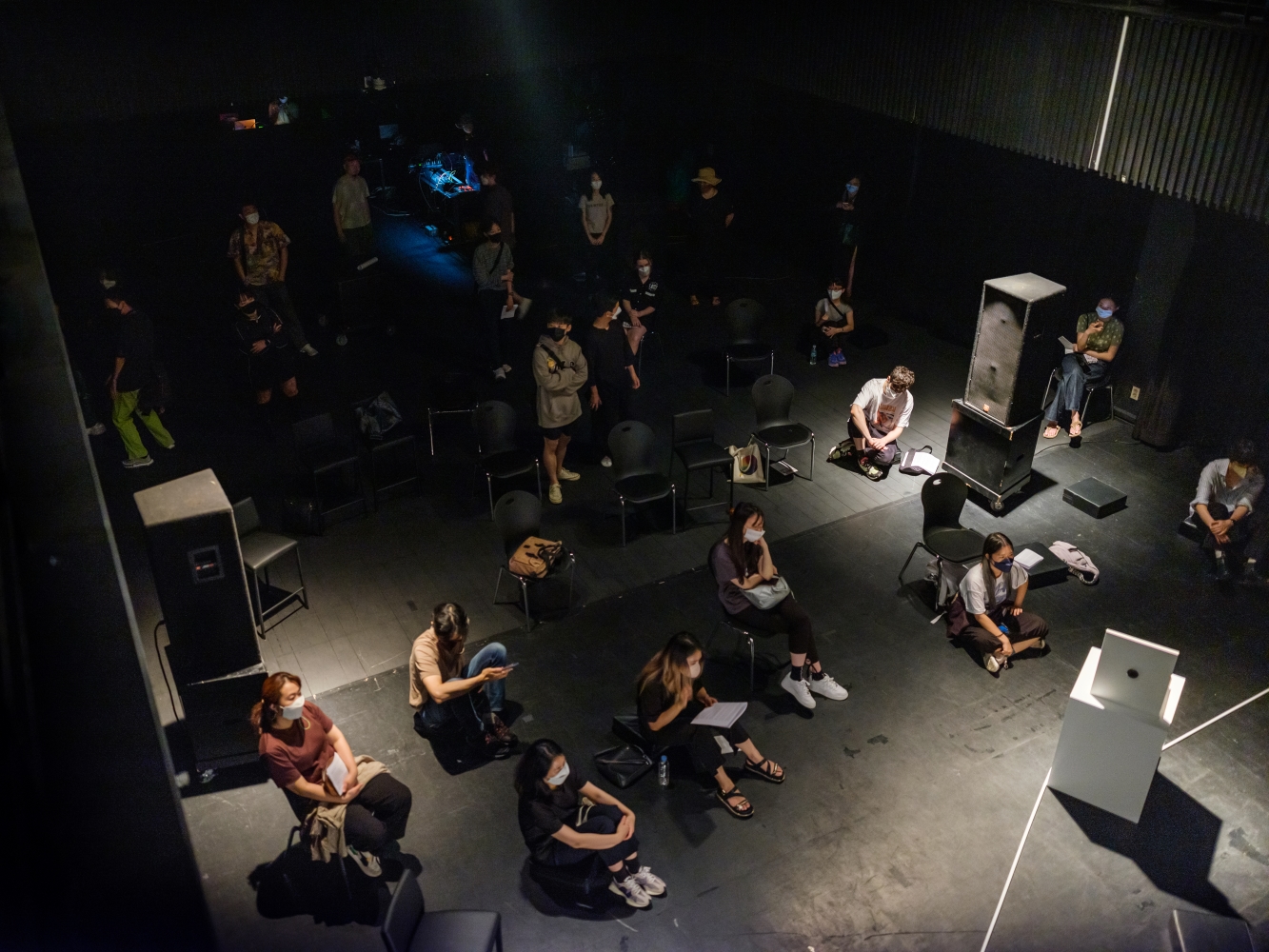
The
showcase performance earcabinet, presented at Black Box
in 2022, did not offer sound as a complete or enclosed spatial experience.
Instead, the space was designed so that sound would be fragmented, deliberately
inducing sonic loss while simultaneously dismantling the illusion of sound
itself. Through such works, Seo has experimented with the performative nature
of auditory response by spatially and sculpturally shaping the countless
frequency ranges inherent to sound as a medium, producing texture through
listening.
Anyone
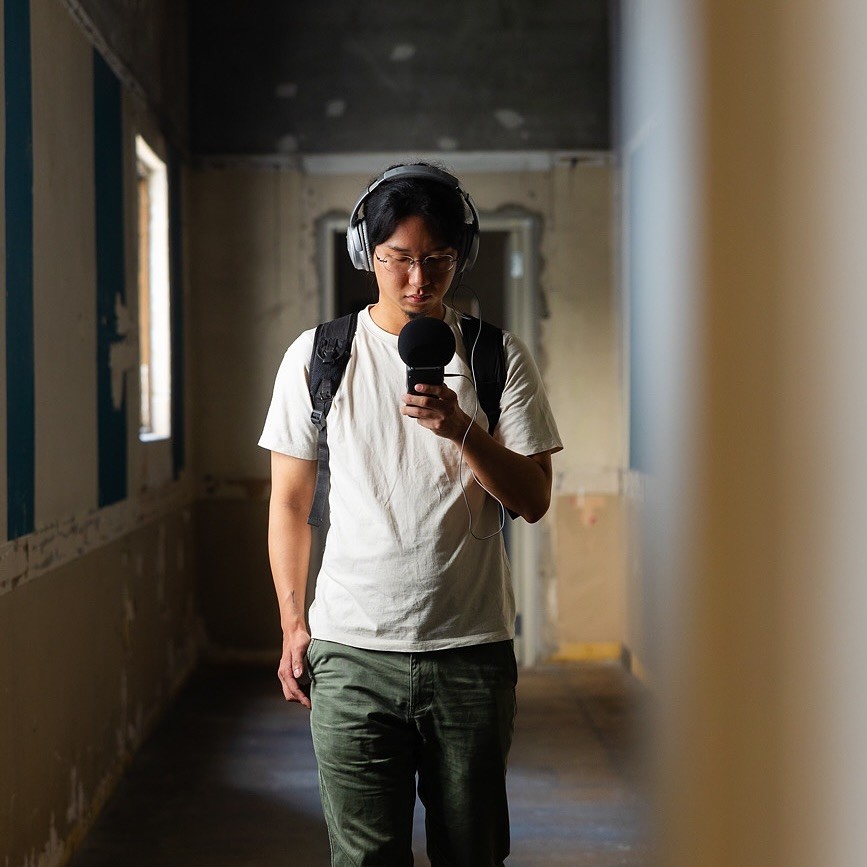
who has visited Hall 1 even once would intuitively sense that Seo exercised
great care from the very stage of selecting the space, given his focus on
spatial and architectural experimentation. From the outside, it is difficult to
infer that the site functions as an exhibition space at all. Hall 1 stands
alongside industrial factories—between a dry ice plant and a logistics
warehouse, directly facing the entrance to the parking lot of a large
office-style residential complex. Even before entering, one hears the ambient
noise of the surrounding factories.
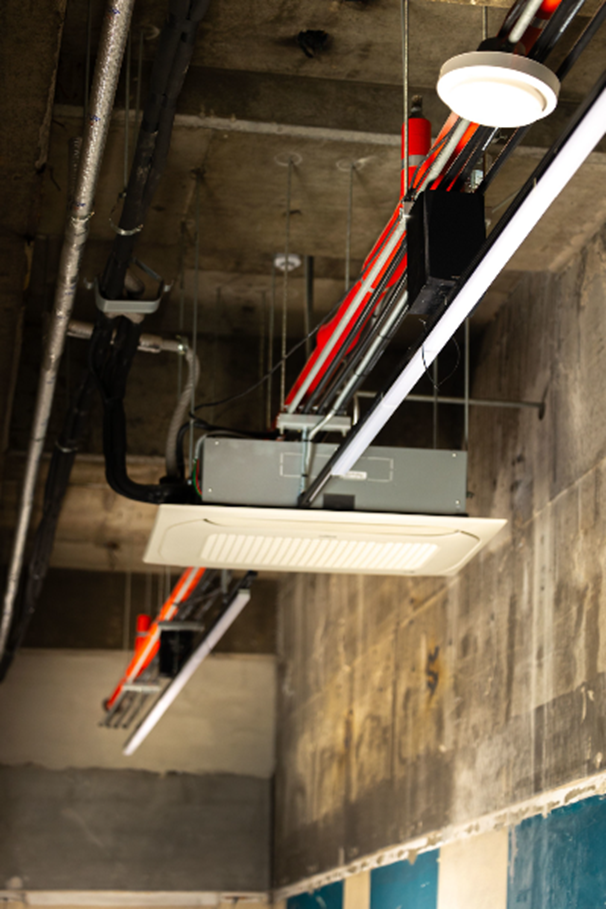
Formerly
used as a cotton warehouse, the building reflects traces of its past through
its architecture. A wide entrance allows materials to be supplied directly from
inside and outside; the high ceiling and expansive hall, a small rectangular
second-floor area, aged gray cement bricks, a slate roof, and rusted beams
supporting the structure collectively define Hall 1 as a symbolic architectural
entity.
The
structural conditions, surrounding landscape, visual scale, and layered
temporality of this space all correspond to the ten works presented in 《Sections》. Along the exhibition route,
visitors first encounter Hall Ambience, followed
by Section 1: Blurry
Walk and Section 2: Blurry Walk. As its
title suggests, Hall Ambience consists of sounds
collected from Hall 1 itself and replayed through an existing partition wall.
Using vibration speakers without diaphragms, the entire wall vibrates as it
emits sound.
By
contrast, Section 1: Blurry
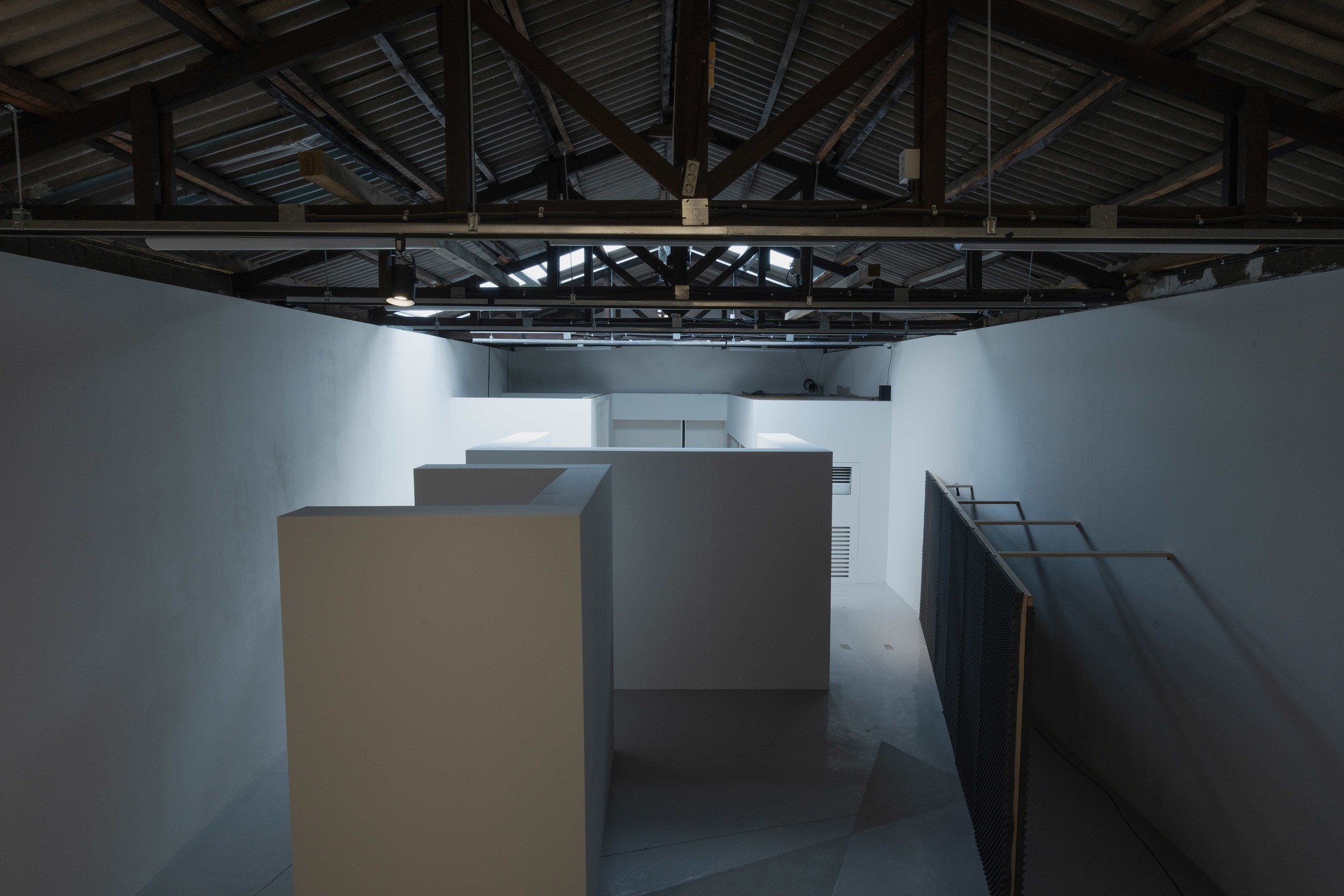
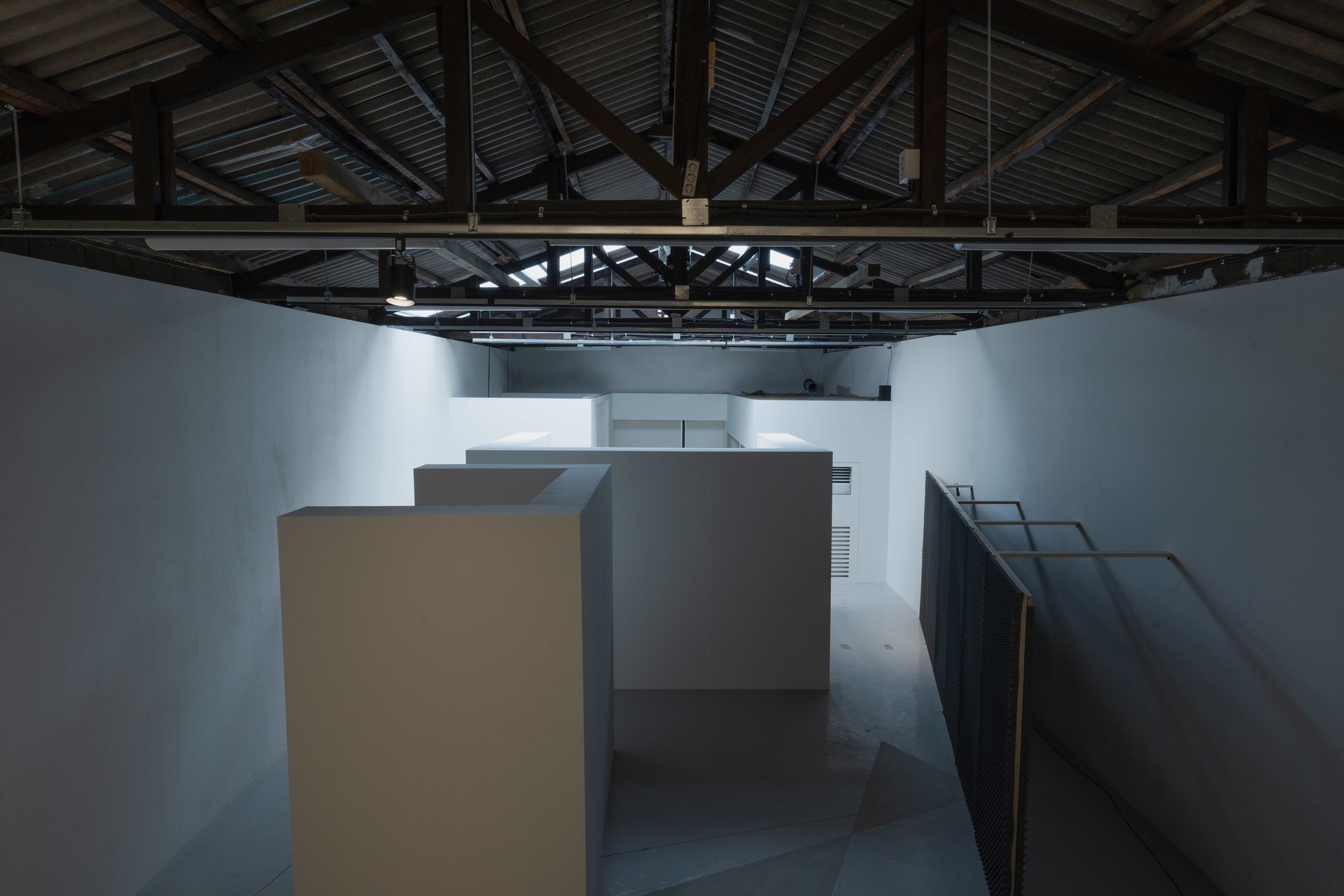
Walk and Section 2: Blurry Walk, located
immediately beside it, reproduce spatial sound through conventional speakers
that require internal resonance chambers. These are installed as partition
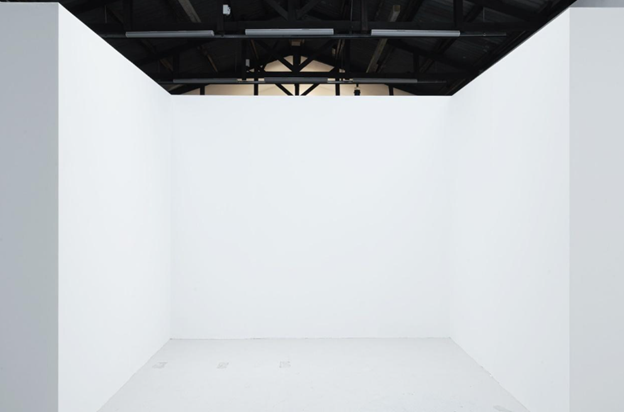
walls: Section 1: Blurry Walk stands at
approximately 2.4 meters, while Section 2: Blurry
Walk is half that scale. These two partition walls function as
supports for sound, presenting spatial sensation through differences in scale.
In this configuration, viewers are not simply listening to sound; rather, they
are positioned within a continuous situation in which a perceptual environment
is sustained.
This
partitioned structure readily recalls works in art history that experimented
with bodily perception and architectural form.¹ While earlier works—often
constructed from plywood and panels to create singular walls or corridor-like
structures—combined performance and sculptural situations to activate bodily
movement and a sense of scale, Seo’s work differs in that it intentionally
evokes similar environments while allowing them to function primarily as signs.
By placing structures at 1:1 and 1:2 scales side by side, he enables viewers to
gauge relative spatial dimensions, while the partition walls design not only
spatial division but also restriction, dynamism, and relationships between
interior and exterior environments.
At
the periphery of this space, Traces—a faint sound
resembling subtle footsteps—emerges as the most alien sound within the
exhibition, while also serving as a concrete device that implies motion. The
listening experience proposed here, in which sound is treated as a sculptural
mass, passes through the historical lineage of artistic media, yet deliberately
avoids any sense of completion.
Before
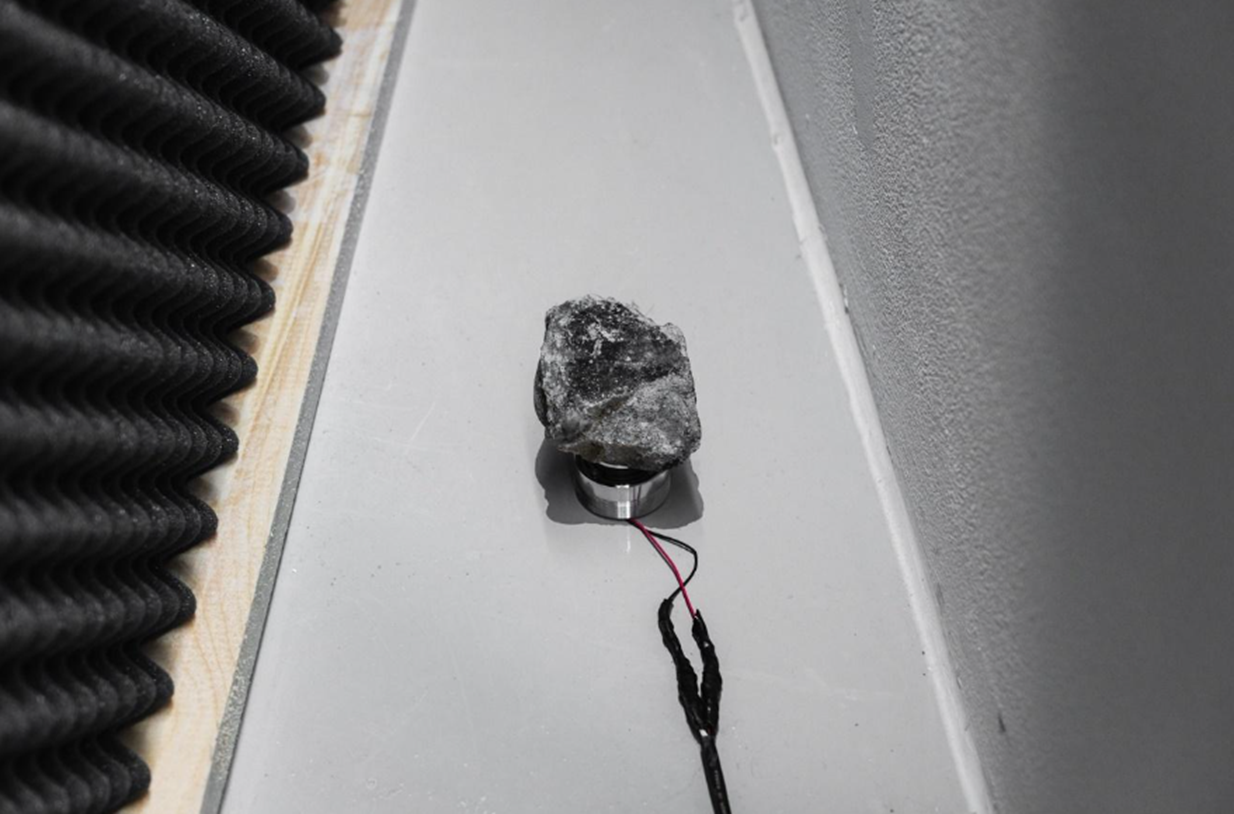
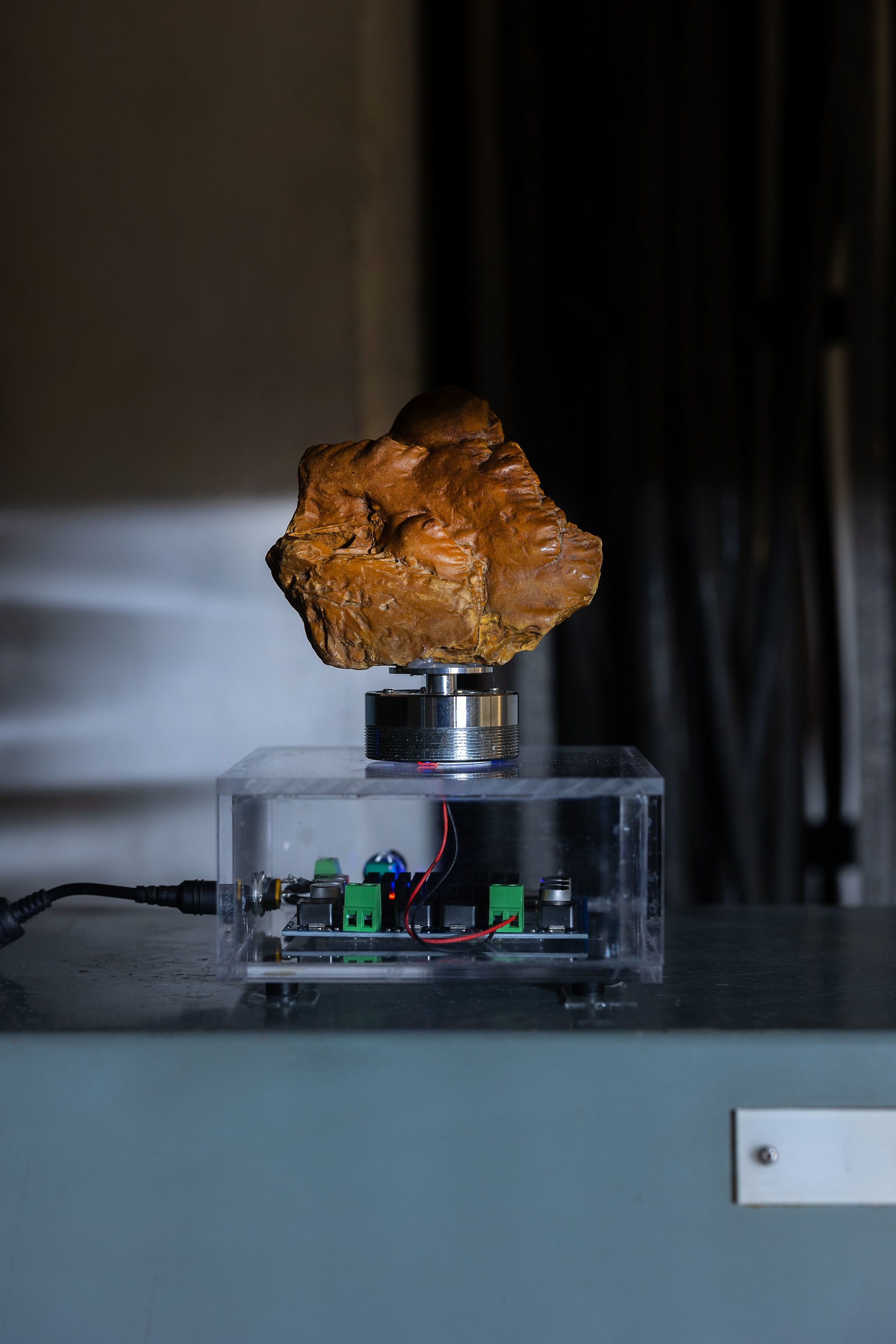
entering the second-floor space of Hall 1, visitors encounter the stone
objects Saw Generator and Drill
Generator. Each consists of a stone fitted with a vibration speaker,
installed on the floor beside the staircase where traces of a previous
exhibition² remain clearly visible. During the preparation period for the
earlier exhibition, Seo stayed in the space to collect sound. At that time,
when viewed from the second floor, the floor below had been cut open in a
geometric triangular shape, exposing raw concrete.
In
《Sections》, the exposed
concrete has been filled in, leaving behind a triangular scar that functions as
an index of the site’s past exhibition context. Saw
Generator attaches the recorded sound of a circular saw from the
earlier construction site to stone. As the vibrating sound collides with the
material, it acquires distinct waveforms. The sharp saw sound—repeated twice
over approximately ninety seconds—connects the former exhibition to the “event”
of construction, granting narrative depth to the space.
Drill
Generator, which repeats at five- to six-second intervals over one
minute, similarly derives from sounds collected on-site and introduces
variation by applying friction to the original sound. However, it differs in
that it physically engages the ground itself—literally drilling into it—thereby
emphasizing materiality and texture revealed through a sense of depth.
Located
opposite the staircase, Crowbar Generator likewise
attaches the sound of a metal crowbar to stone, revealing texture through
vibration. Commonly used to pry apart or dismantle solid materials, the crowbar
embodies bodily action, intervals, and temporal gaps. The stones visible
through gaps, and the sound that catches abruptly after prolonged digging into
a single point, articulate bodily process, movement, spacing, and delay.
Although
fabricated in the same manner as the previous stone
works, Crowbar Generator adopts a distinct
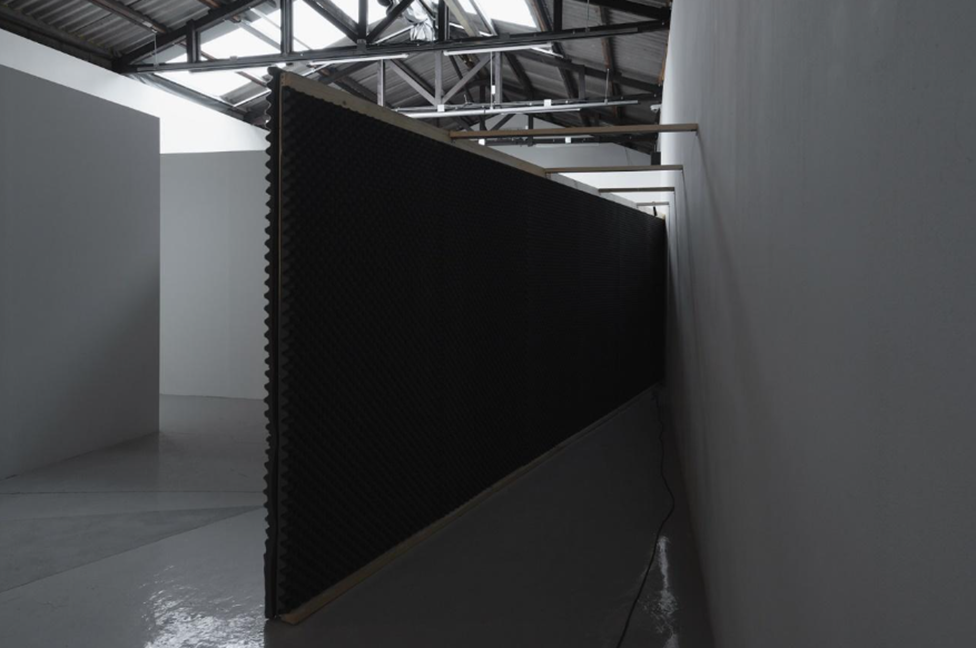
installation condition. To reach it, visitors must pass through the soundproof
installation Cover by Walk. This work consists of six
one-meter egg-crate soundproof panels connected and supported by a wooden
frame, forming a long corridor set at a diagonal angle. Walking
through Cover by Walk, visitors experience the convergence
of sound, as vibrations from surrounding works are gradually absorbed. Within
this acoustically partitioned space, sounds from adjacent works slowly adhere
to the environment.
In
this site where multiple vibrating sounds gather, the viewer uniquely senses
sonic loss, while the diagonal circulation path enables the experience of sonic
traversal. The layered relationship between Crowbar
Generator and Cover by
Walk produces a mutually responsive presence.
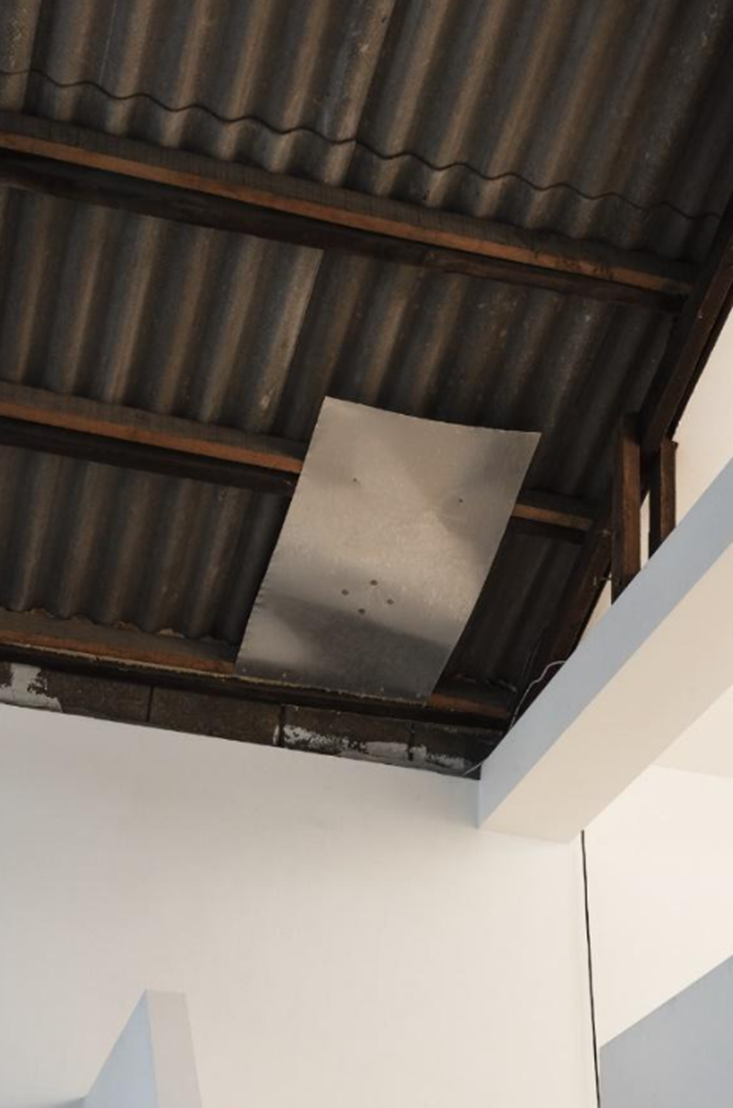
Upon
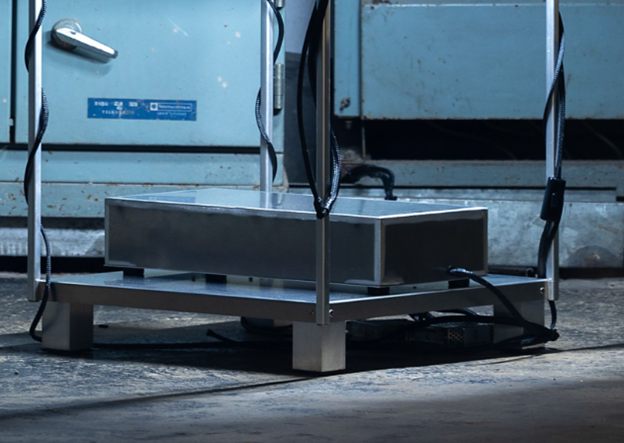
reaching the second floor, Distortion
Floor appears installed at eye level on the wall. This
rectangular aluminum plate, connected to vibration speakers, matches the
proportions of the second-floor space. Over the course of the exhibition, sound
vibrations gradually cause the aluminum to bend. Demonstrating how sound is
transformed according to the variable properties of material, this work
simultaneously shows how material itself is deformed over time, with sound and
matter distorting one another.
The
speakers emit frictional sounds generated by walking—sounds of bodily movement,
contact, and surface interaction—revealing the materiality of motion. At the
same time, access to the second floor is only possible by climbing the stairs.
Positioned between the first and second floors, the staircase marks a spatial
boundary, while aluminum plates articulate the edges between wall, ceiling, and
ground.
Legs
are the bodily organs through which we sense our relationship to the ground,
and sensing the ground becomes possible through bodily movement. While Seo
suggests motion through frictional walking sounds, to interpret this merely as
an invitation to bodily performance would be a shallow reading. Although our
cognition of ground and ground plane is firmly established, this partition
continues to present the ground only as a sign.
Through
this, the work invites reflection on fixed spatial experience, shifts in ground
level, orientation, and how we might re-perceive space today. It is telling
that the sound of the final work, Hall Moment, can be
detected from the second floor, yet is more appropriately heard from below, at
the boundary between the first and second floors.
Hall
Moment, which demands listening from the opposite side of a boundary,
operates in conjunction with Hall Ambience, encountered
at the entrance. Whereas Hall Ambience consists of
interior sounds, Hall Moment is composed of
external noise: sounds from the neighboring dry ice factory, cars entering the
parking lot, and rustling grass. These external events are recorded as sound
tracks tied to specific moments.
Sunlight
entering through the slate roof and these external noises penetrate the
interior, intermingling once again with internal sounds, partition walls,
soundproof panels, and aluminum plates.
《Sections》 is, in the most literal sense, a
spatial-architectural situation designed under the conditions of partition.
Existing sonic textures are overlaid with specific forms of friction, forming
quasi-material entities that viewers perceive as sculptural signs. Through
deliberately structured—and at times constrained—experiences, viewers encounter
the materiality of waves and spatial sensation.
For
art audiences, this inevitably recalls historical attempts to transform the
coherence of artworks by altering the viewer’s position—resisting the
absoluteness and illusionism of art objects defined by white walls, rectangular
frames, authorship, and lighting. The temporary situations that emerged from
such attempts sought to preserve the singularity of the moment and resist
permanence, aligning closely with the contemporaneity of “planned
obsolescence,” a strategy that accelerated production and consumption in the
1960s.³
Site-specific
art likewise disrupted the long-standing conventions of the white cube,
bringing art into confrontation with social and historical dimensions.
Still,
《Sections》 does not seek
to attach itself to definitive assertions. By engaging raw industrial materials
that signify the present, liminal sites, and the presence of sound as
vibration—or perhaps as matter—it positions itself toward eventual disposal or
disappearance. We know that attempts to either completely dismantle or rigidly
fix categories were only possible in earlier contexts and hold limited meaning
today. Instead, the work operates as a representation layered onto the specific
site of Hall 1 in Seoul.
Yet
this does not mean it claims the lightness of non-attachment. In a contemporary
art field where words and images endlessly flutter and expand laterally, Seo
Minwoo instead attempts to seriously reconsider and accumulate marks worth
leaving behind.
Art,
sound, and sound art have existed in distinct ways.⁵ Sound, in particular, exists
unmistakably as waves. For this reason, sound art has often followed the
operational logic of media art, weaving code to visualize sound as image—resulting in relatively concrete
image-scapes. In 《Sections》, however, sound does not congeal into fixed forms. Instead, it
remains a floating mass of vibrating medium—resonant sound waves that occupy
the entire volume of air.
These
sound-masses, vibrating with three-dimensional density, perform as sculpture
and are sculpturally enclosed, passing through the minor histories of Seoul.
Pressing between past and present, they pose their questions once more—leaving
traces at the boundaries of partitions.
Notes
1.
One may recall installation–performance works such as Green Light
Corridor (1970), experimented with by Bruce Nauman in the 1970s.
Approximately thirty years later, Nauman presented Raw
Materials (2005–2006), an audio work that filled the Turbine
Hall of Tate Modern in London with non-verbal sound.
2.
This refers to the exhibition 《Hall2》 by artist Kim Donghee, held from April 27 to May 23, 2023. During
the preparation period for this exhibition, Seo Minwoo frequently stayed in
Hall 1, collecting various sounds generated by the space. 《Hall2》 was an exhibition that materialized
the many contexts embedded in the site through both tangible and intangible
structures.
3.
Robert Haywood, “Critique of Instrumental Labor: Meyer Schapiro’s and Allan
Kaprow’s Theory of Avant-Garde Art,” in Benjamin H. D. Buchloh and Judith
Rodenbeck, Experiments in the Everyday: Allan Kaprow and Robert Watts, New
York: Columbia University Press, 1999.
4.
From the preface to the exhibition 《Hall2》: “Initially functioning primarily as
a studio for artwork production and filming, Hall 1 has increasingly been used
as an exhibition space through word of mouth. (…) By treating Hall 1’s
relatively clean, expansive floors and walls as an extension of the white cube,
exhibition time repeatedly opened and closed under a tacit, peculiar consensus
between artist (or artwork) and viewer.” This passage offers insight into the
complex layers embedded in the space of Hall 1.
5.
David Toop, “The Art of Noise,” TATE ETC, 2005, https://www.tate.org.uk/tate-etc/issue-3-spring-2005/art-noise