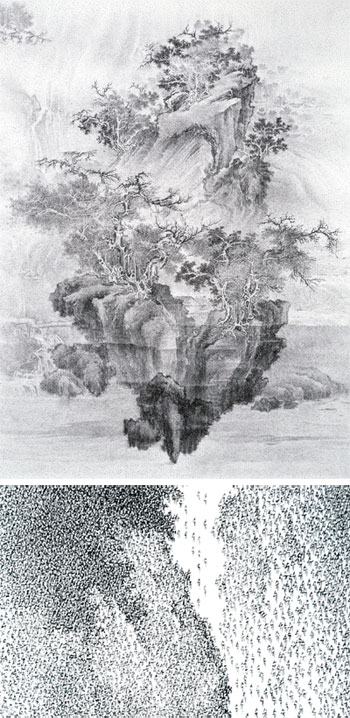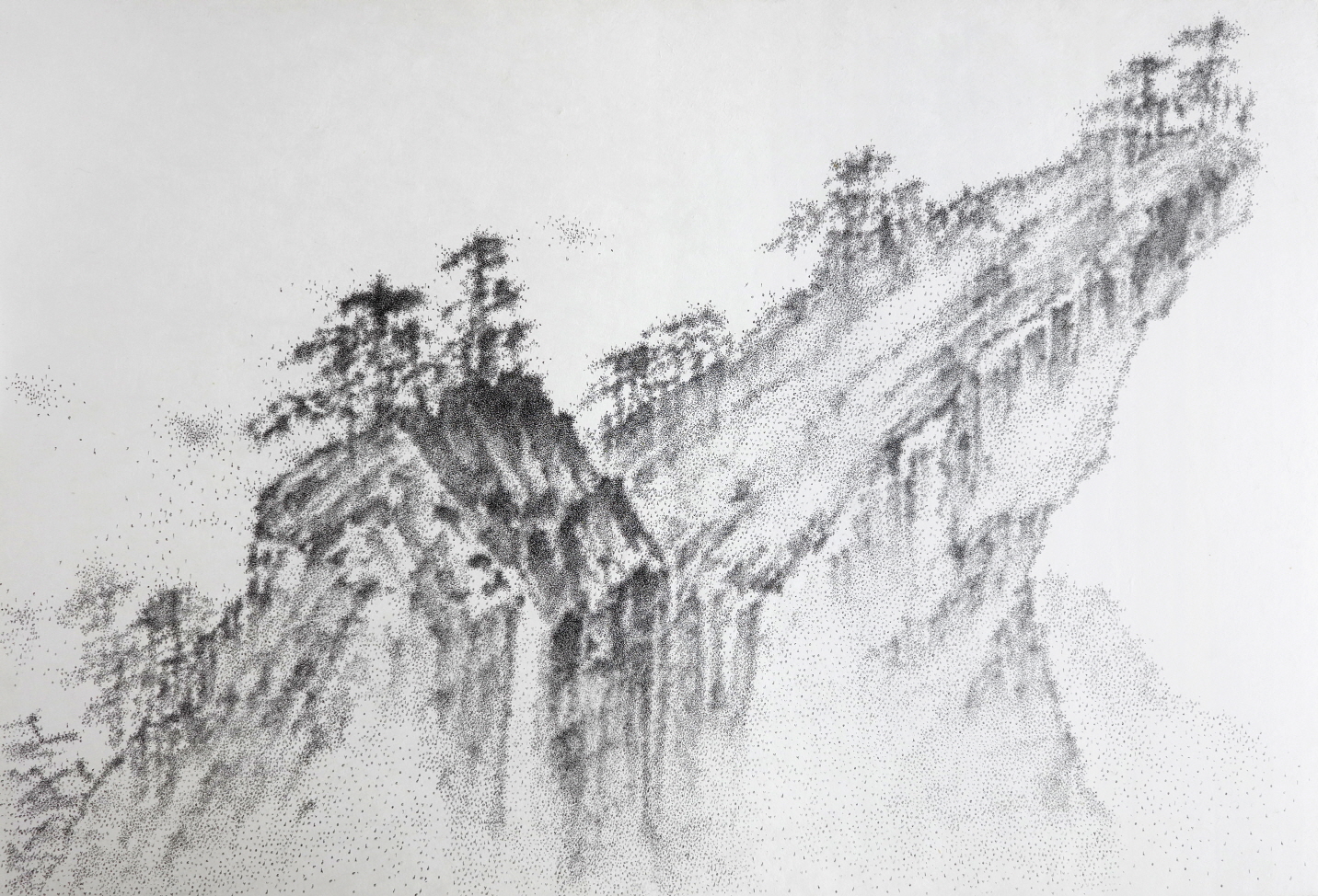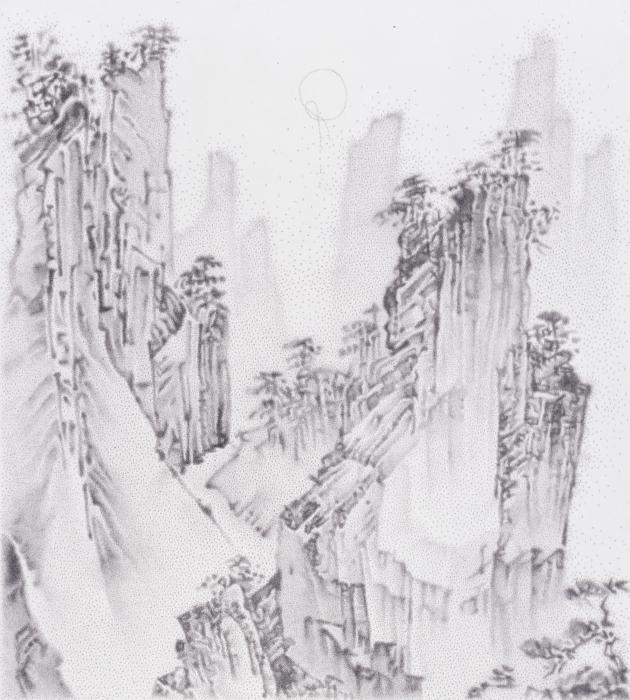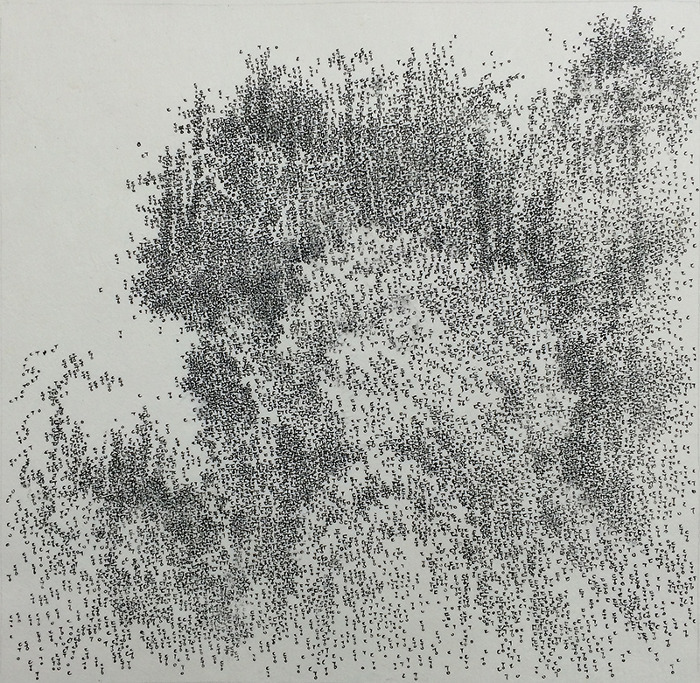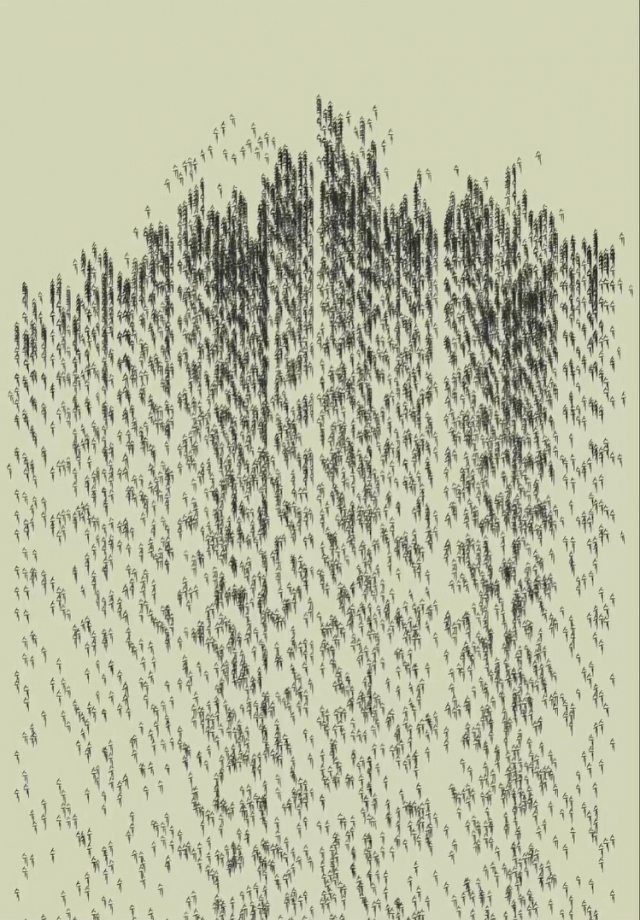

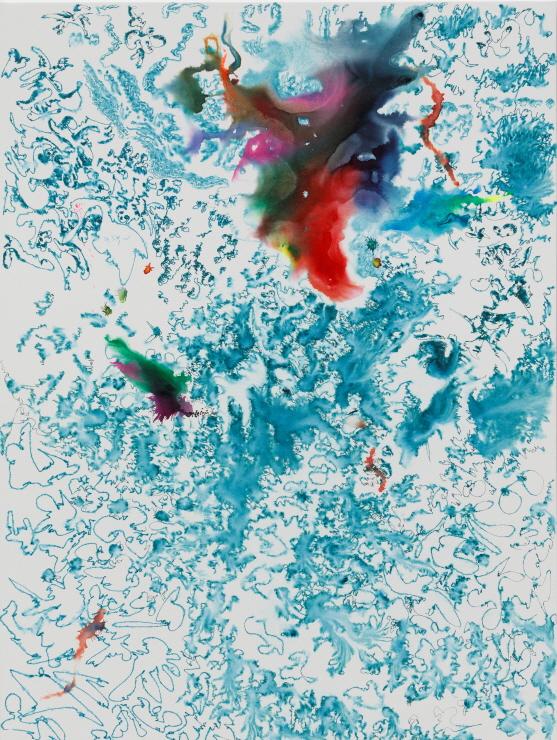
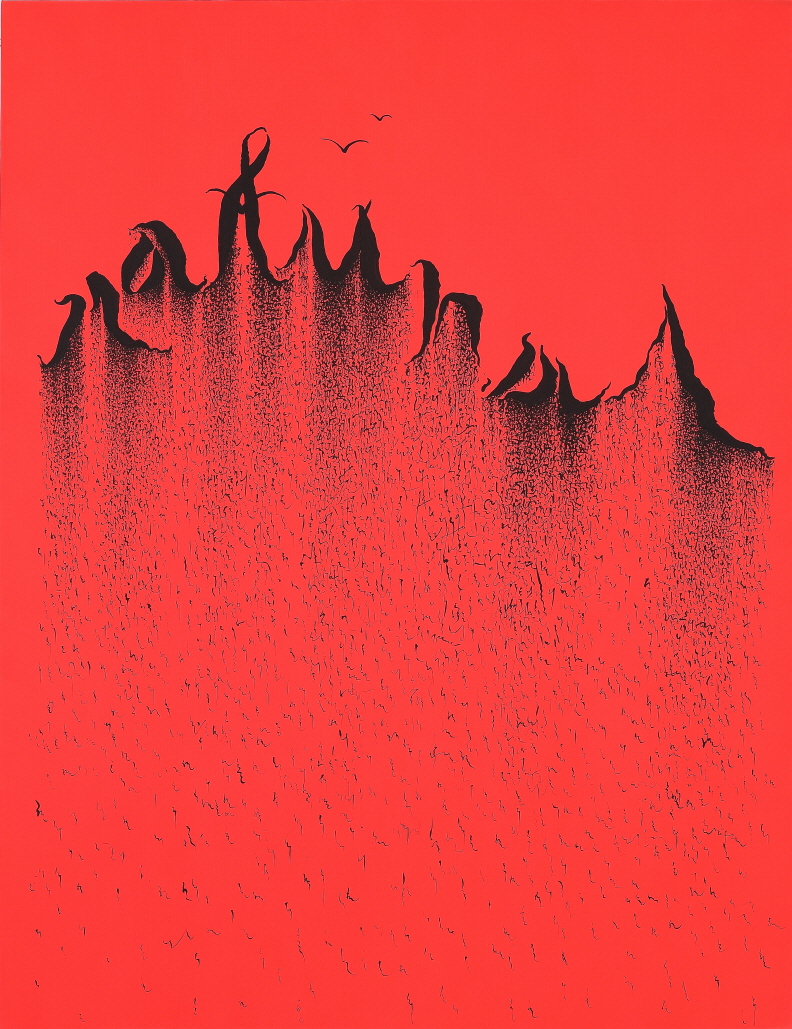
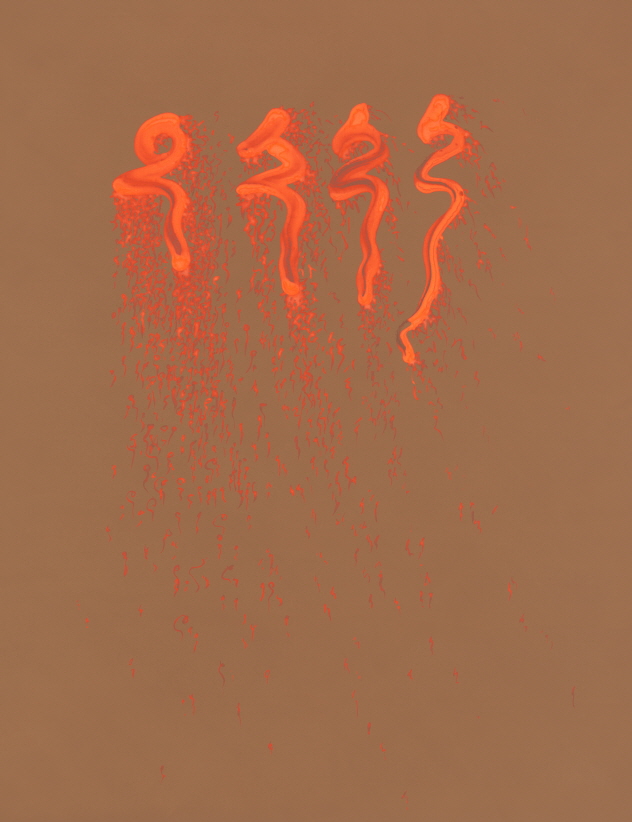
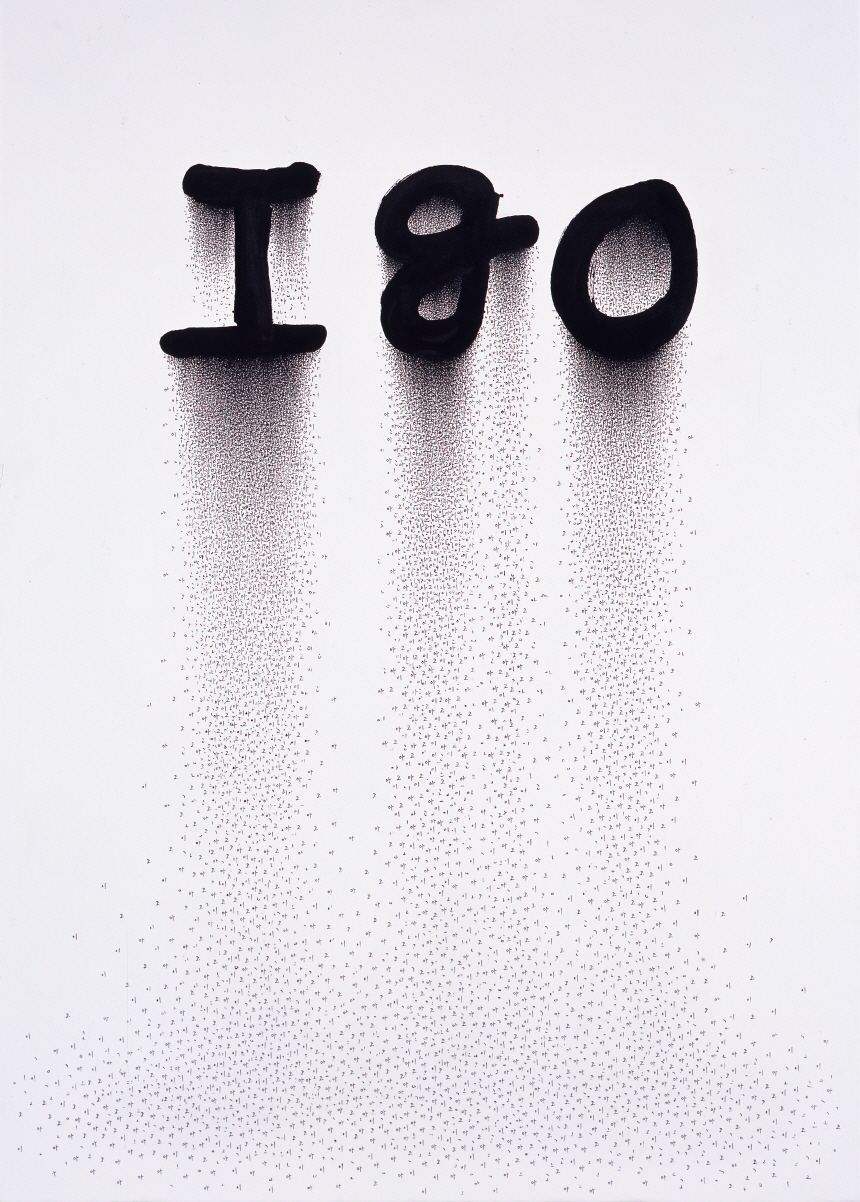
Yoo Seungho, bzzz, 2007, Ink on paper, 200 x 157 cm © Yoo Seungho

Rustle, rustle, rustle…. The wind blows, and fallen leaves scatter endlessly, dispersing into countless points. It is a moment when the world before our eyes becomes a pointillist painting. When we encounter a scene that stirs the heart, we search for the right adjectives to describe that moment. Yoo Seungho’s work captures precisely such a moment through pointillism. He draws by continuously writing tiny letters. What kind of man would create such works? What kind of novels does he like? As I looked at his work, I grew curious about the person himself.

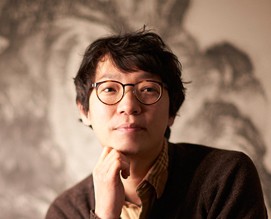
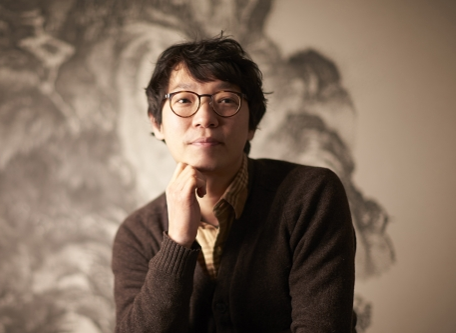
And so, driving along a dusty, winding national road, I made my way to Jangheung in Gyeonggi Province, where he is based. Judging from his work, he must be someone who knows how to laugh freely. Yet he also seems like someone who can quietly inhabit the spaces between silences, and who knows how to shed tears in loneliness. Perhaps, in contrast to the chatter within his paintings, he may be a man of few words in person. With sensitive fingers, his knuckles slightly pronounced…. Lost in such flights of imagination, I eventually arrived at my destination, the Gana Art Center Residency.
 
It was a summer day when the monsoon had briefly subsided. Around lunchtime, under the blazing sunlight that seemed to compensate for the previous dampness, a black, box-like building revealed itself. Why do studios always feel so cool and cold? I instinctively found myself hunching my shoulders. As I reached the corridor, the familiar smell of paint rushed into my nose.
 
I opened the door to Room 507. Instead of a greeting, I was met by the loud sound of a toilet flushing. At the same moment, he emerged from the bathroom holding a dustpan, and we came face to face.


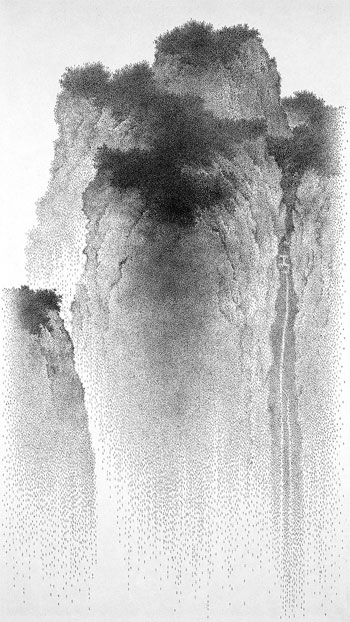
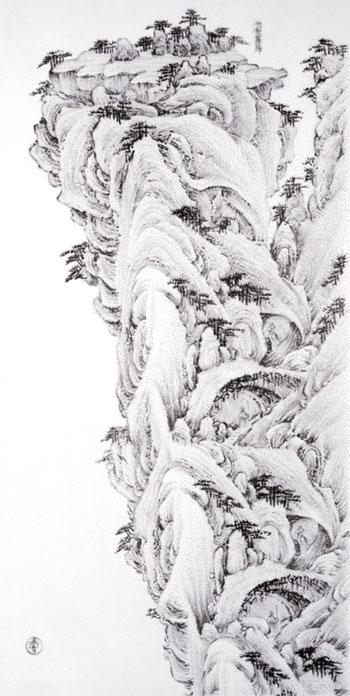
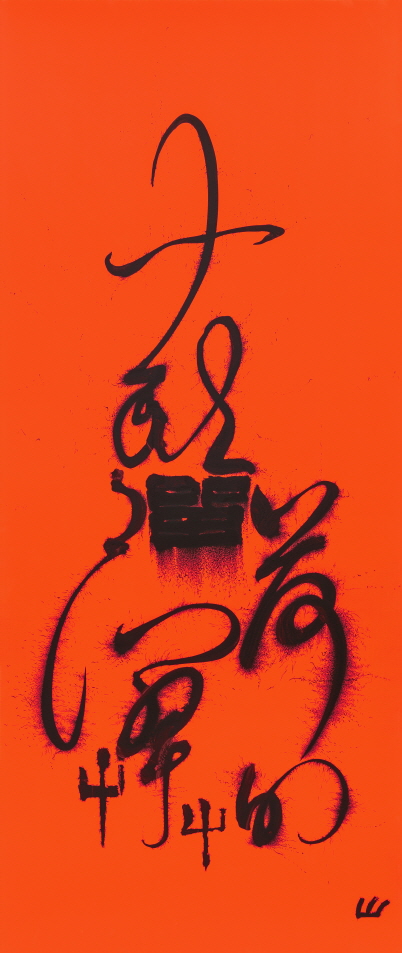
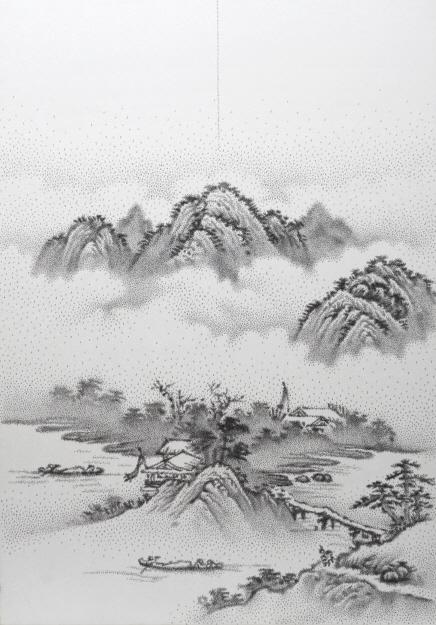
Yoo Seungho, shooo, 1999-2000, India ink on paper, 129.6 x 72.3 cm © Yoo Seungho

“Because there are a lot of bugs here in front of the mountain.” I can’t help but laugh when I see the artist say this, slightly embarrassed. Somehow, he is exactly as I had imagined. On the upper inside wall of the studio door hangs a nameplate reading “Yoo Seungho.” The character “Yoo” is drawn like a human figure with loosely dangling limbs, and combined with associations such as “gentle,” “flowing,” and “flexible,” it matches the artist almost perfectly—100 percent in sync.
 
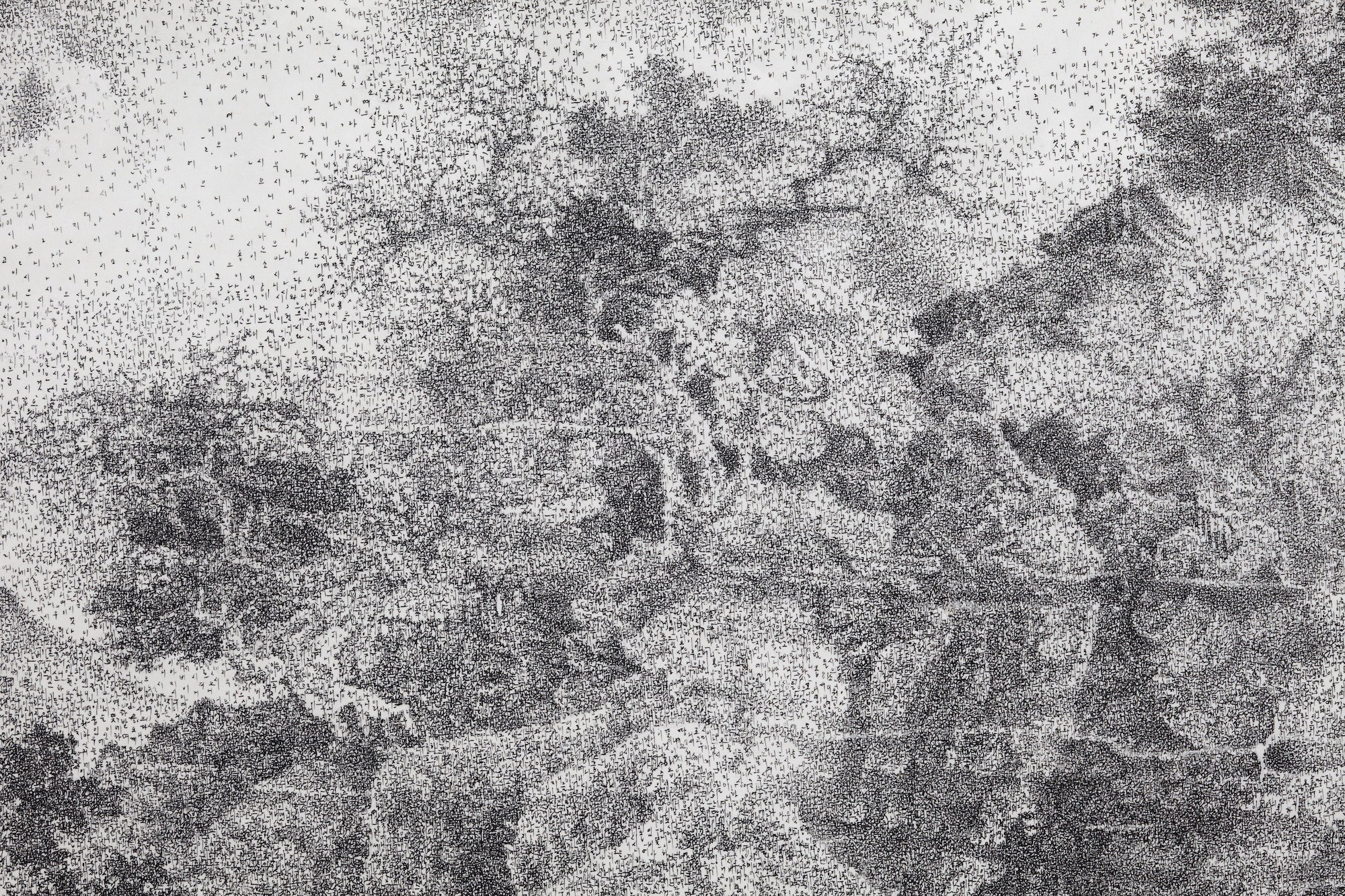
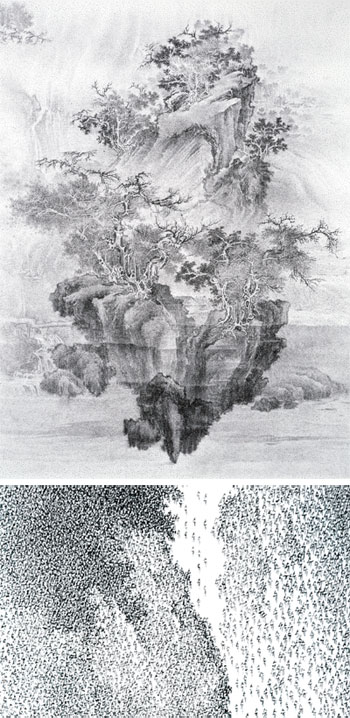
Ten years ago, when I first saw Yoo Seungho’s work, I thought: he must be someone who understands the taste of words. If you keep writing “guruk-guruk” over and over in a notebook, it really starts to feel like the letters themselves are gurgling—it’s amusing, as if the letters are alive. When you quietly look at Yoo Seungho’s work, you begin to experience something strange: the images on the flat surface seem to subtly move, then suddenly fill your ears with a lively buzz.

From afar, it looks like an ordinary landscape painting, but up close, it is an illusory landscape made up of “yaho~ yaho~ ya~ho~.” The joy and exhilaration of tiny handwritten letters joining hands at the artist’s fingertips to generate new meanings—this playful act is his work. That is why it makes you chuckle. Come to think of it, even the word “kik-kik-kik”—doesn’t it really sound like laughter? Kik-kik….
 
As you listen to the sounds of the letters, you become enveloped in a sweet and delightful sensation. It is a paradoxical multisensory experience, like a silence filled with chatter. We become intoxicated by the fresh air, the droning sounds of summer, the echoes that Yoo Seungho offers us. It is the moment when seeing transforms into hearing. Historically, artists who have expressed such synesthetic experiences have often been regarded as highly creative. For instance, the painter Paul Klee translated Bach’s polyphonic music into images.
 
When we read text, we follow it from left to right, in temporal sequence. But when it becomes an image, the letters begin to murmur within space. It gains an immediacy beyond time—we are no longer simply reading, but rather able to “hear or see” it.
 

A Faint Sadness Composing a Joyful World

If the first impression upon seeing the tiny, grain-like letters in the work is an exclamation of awe, the next feeling is an inexplicable, faint sadness. Is it because of the thin and light quality of the lettering? The letters seem as if they might come alive and then vanish at any moment. Letters—they are expressions, not substance. They are not real mountains, not real trees, not real water…. They are substitutes made of language that reflects our thoughts. Perhaps the world as he perceives it is just that—light, sorrowful, immediate, fleeting, and ephemeral.
 
From a distance, the landscape painting appears serious, but up close, it is composed of whimsical letters, making you laugh—yet at the same time, you detect a subtle, sharp hint of black comedy that makes you pause.
 
Perhaps Yoo Seungho’s work is not simply cheerful because the process of meticulously rendering countless characters is closer to pain than to pleasure. When you look at the work, there is a considerable weight that achieves a kind of balance.
 
Standing before the work, no one can ignore the sheer magnitude of labor it entails. Moreover, being a painter means working alone in a studio, staking one’s life on time that no one can guarantee. Unless you experience it yourself, it is hard to imagine the weight of that struggle. The common assumption that artists live freely, doing whatever they please in carefree delight, is a misunderstanding held by those who have never experienced it. How do you endure the pain during your work? He answers:
 
“I listen to music that’s so loud it’s almost noisy. Electronic or lounge music. I guess I can’t stand being in a blank state.”
 
“Blankness.” The gap between one minute and the next. The space between one thought and another. The void between anxiety and emptiness.
 
Yet perhaps this “blankness” that the artist describes as painful is, in fact, inseparable from him. Yoo Seungho’s letters possess a lightness as if they could drift away at any moment; though they appear clustered together, each character is inherently a complete entity with its own meaning.
 
In works shown since last year’s exhibition, following his text-based landscapes, dots appear instead of the familiar ink lettering. These round dots connect with one another to form enigmatic shapes or letters. Looking closely, familiar, clichéd images sometimes become visible at once, while at other times they remain hidden, only to suddenly pop out with a playful “surprised, aren’t you?”
 
A dot is lonelier than a line. Circles drawn as closed forms possess their own independent completeness. In fact, they feel more solid in presence than letters. The spaces between dots are either evenly arranged or deliberately slightly separated. The “spaces” between dots and between letters create an appealing tension—like the melody that exists between the notes of a piano.

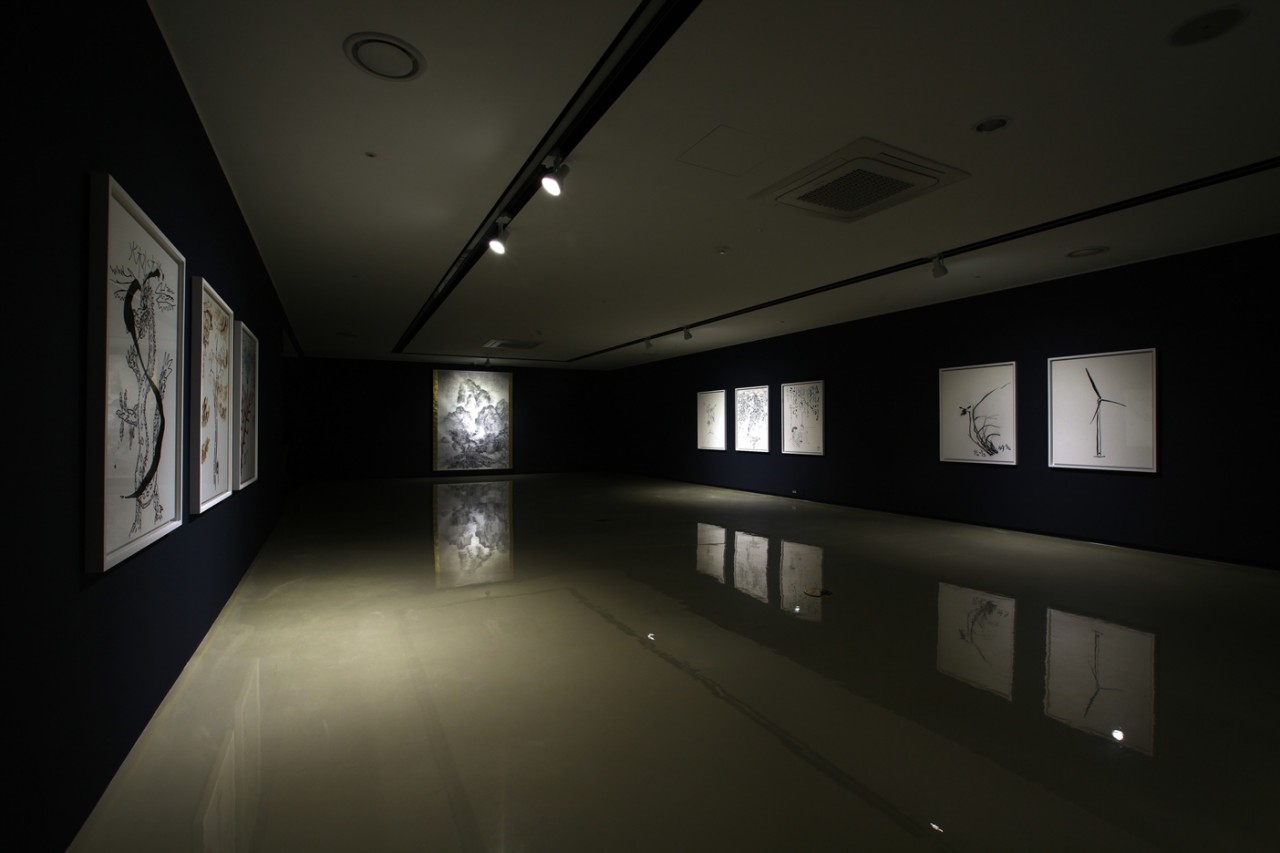
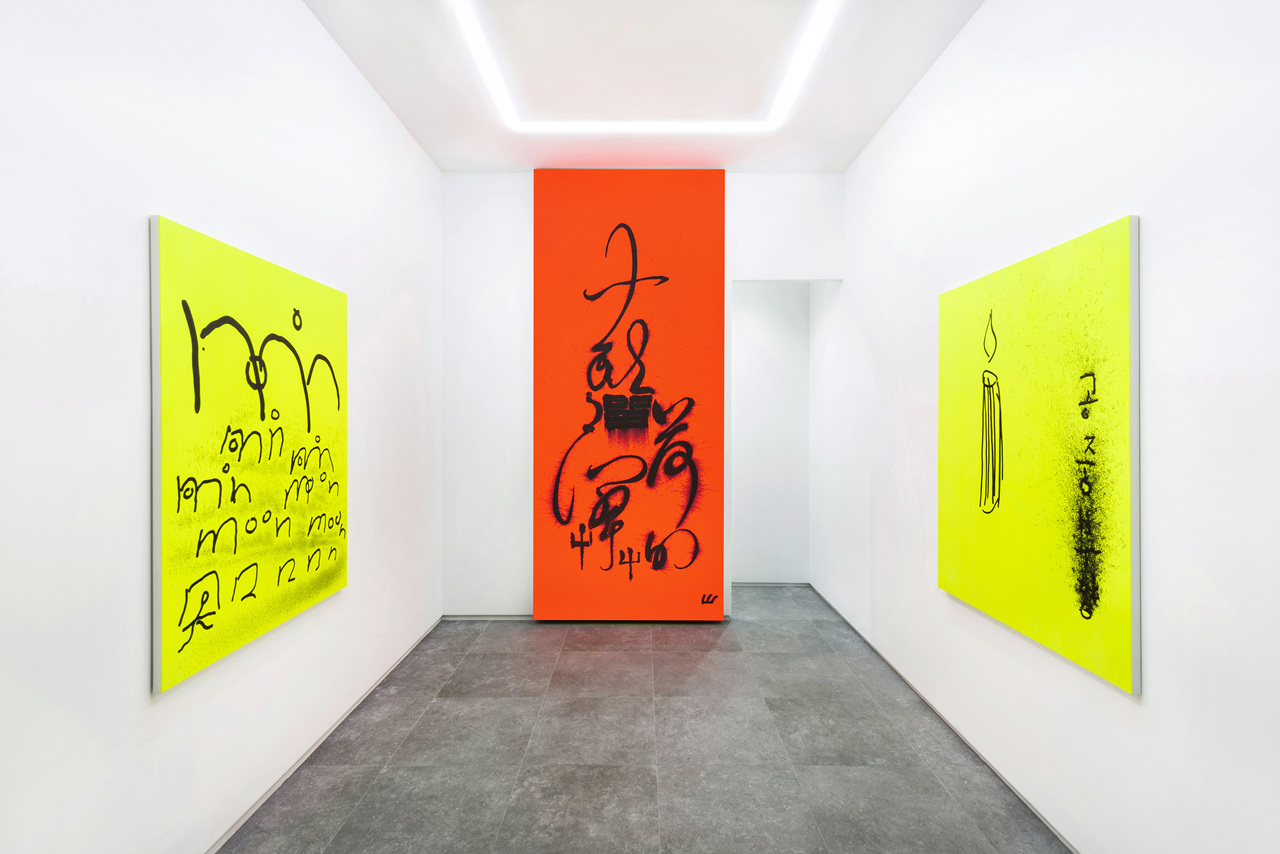
This is why the letters and dots the artist uses as materials sometimes extend beyond the canvas and appear on gallery walls or in other spaces. For instance, crying letters are drawn on a shabby wall, which makes them feel even sadder. A fly, rendered in the form of the word “ae-ae-ae-ae-aeng~,” is shown falling dead mid-flight, displayed alongside a flyswatter.


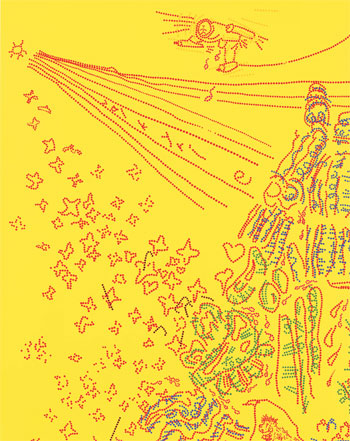
Yoo Seungho, We Should Just Flash Together, 2010, Acrylic on aluminum, 122 x 122 cm © Yoo Seungho

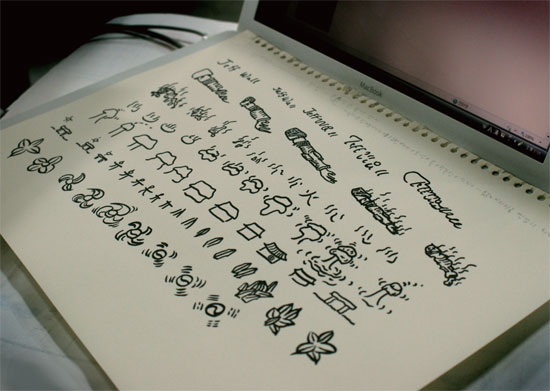
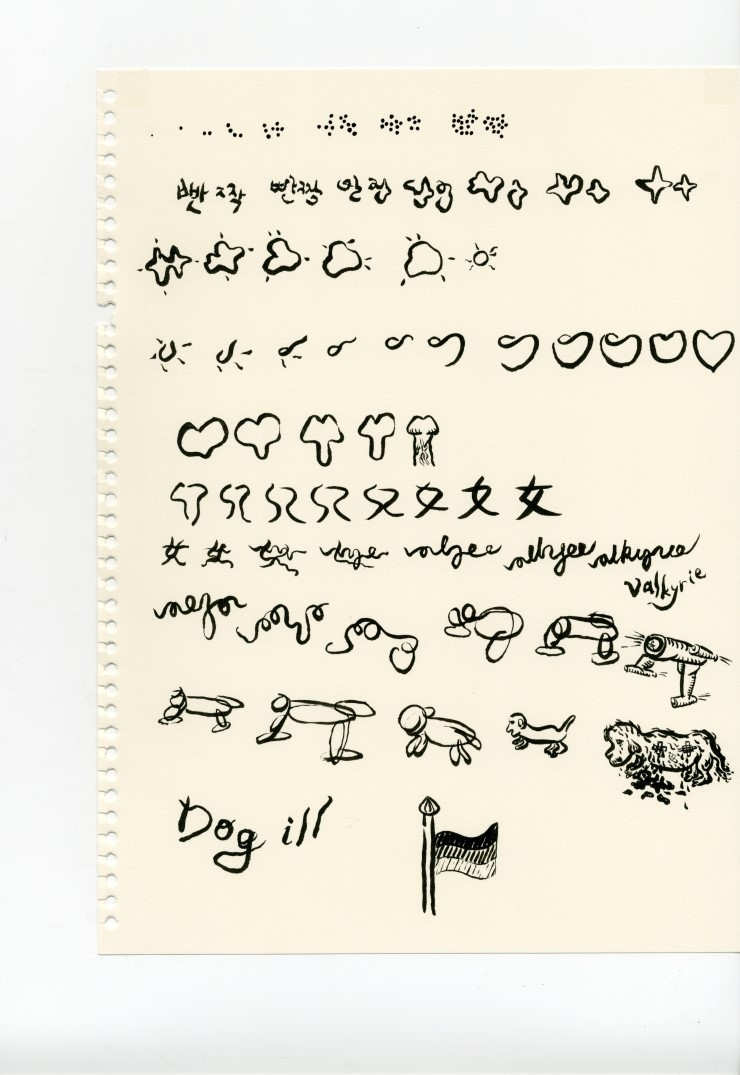
In the work titled We Should Just Flash Together, one can faintly glimpse images resembling male and female genitalia. There are also stars and hearts. Compared to his landscape works, this piece feels slightly more enigmatic. What do these seemingly unrelated images mean? Instead of answering, the artist says, “Let me show you something interesting,” and rummages through a box. Inside are his idea sketches. Like an answer sheet secretly kept by a teacher, these sketches contain clues to deciphering the puzzle-like works. They show how letters transform into images, and how those images, through chains of association, turn back into letters. For example, one begins with the name “Jeff Wall,” a German photographer.


Part of an idea sketch (concept sheet) © Yoo Seungho

“This lettering turns into a robot arm, then evaporates, becomes the character 火 (fire), turns into Operation Valkyrie, then into a dog, then into Germany, then into the German flag. And then the dog gets sick. Why would the dog get sick? Hehe. That’s what I turned into an image.” In this way, the images of male and female genitalia eventually transform into a heart shape, and after passing through several more stages, the work We Should Just Flash Together is born.

Looking at it again, the works that maintain balance in every aspect resemble Yoo Seungho himself. The lyricism and innocence of a boy from the mountains, and the loose humor and playfulness, are counterbalanced by a process of logical thinking and meticulous calculation, like a perfectly balanced scale. A sense of restraint is essential in creating the work. The lively flamboyance of fluorescent backgrounds contrasts with the suffocatingly obsessive working process; the lightness and honesty that resemble bathroom graffiti coexist within it.

This is made possible by the ability to reveal what should be shown and conceal what should be hidden. A sense of balance that allows one to come close, yet never cling to the point of fatigue. One might think—this man would be good at relationships, too. As he turns away with a loose, easy smile, almost laughing, the solid strength of the artist stands firmly in his composed shoulders.

References