0.
There
are moments when states we believe we know well—through frequent encounter or
familiarity—begin to slip away. The field of art sometimes transforms what we
call the “obvious” into a question imbued with doubt and fear. Particularly
amid the turbulence of digital technologies, our sensory understanding of the
physical and the immaterial readily falters, and hybrid subjects and situations
emerge with increasing prominence through layers of overlap.
As our bodies
strive to keep pace with the speed of change, they simultaneously expand and
sever the range of sensation. Moreover, the body as a condition that once
defined the individual through an independently recognized completeness
gradually relinquishes that absolute closure, coming instead to acquire meaning
through self-verification as a being entangled in relations.
Here,
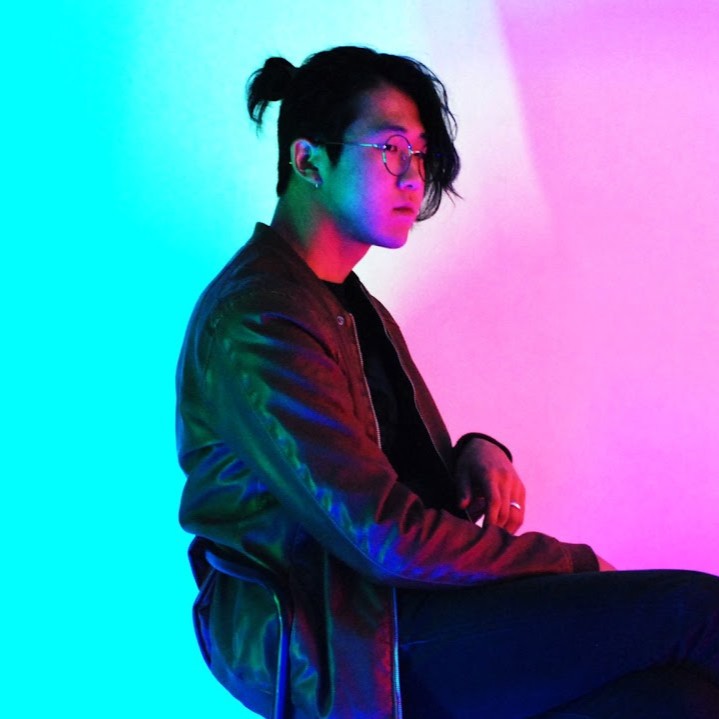
Daewon Yun’s solo exhibition 《Circle, Chase,
Contact》 suspends sensory judgments between the real
and the virtual, layers bodies, and replaces the obvious with questions,
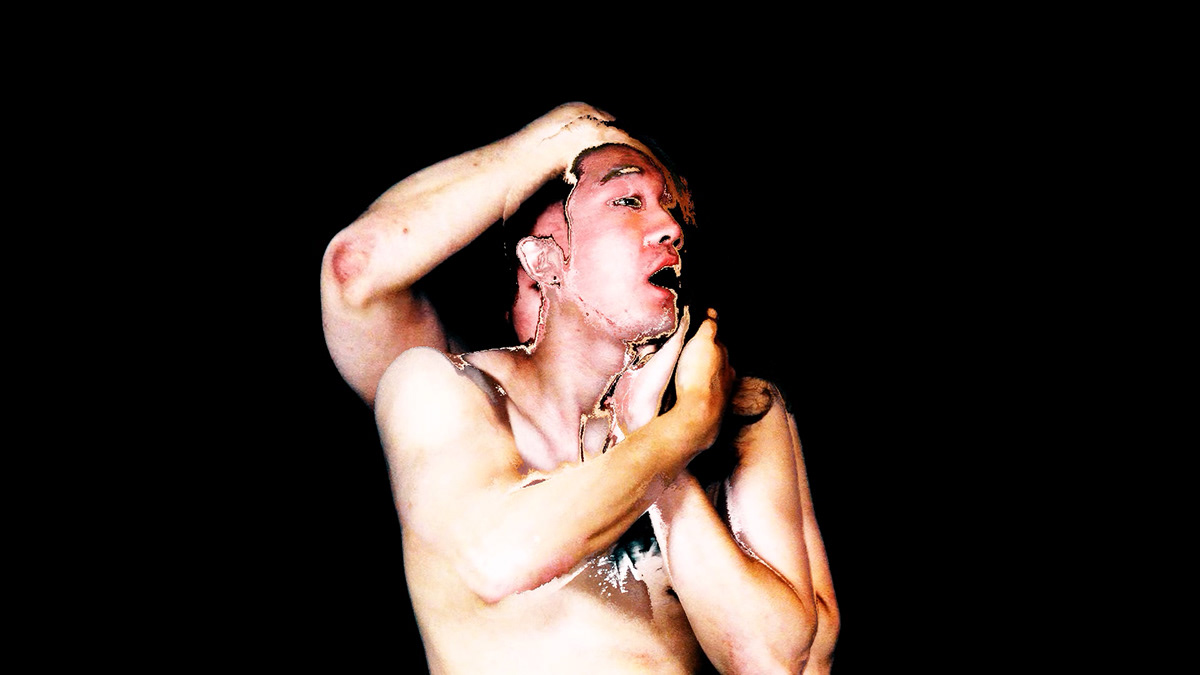
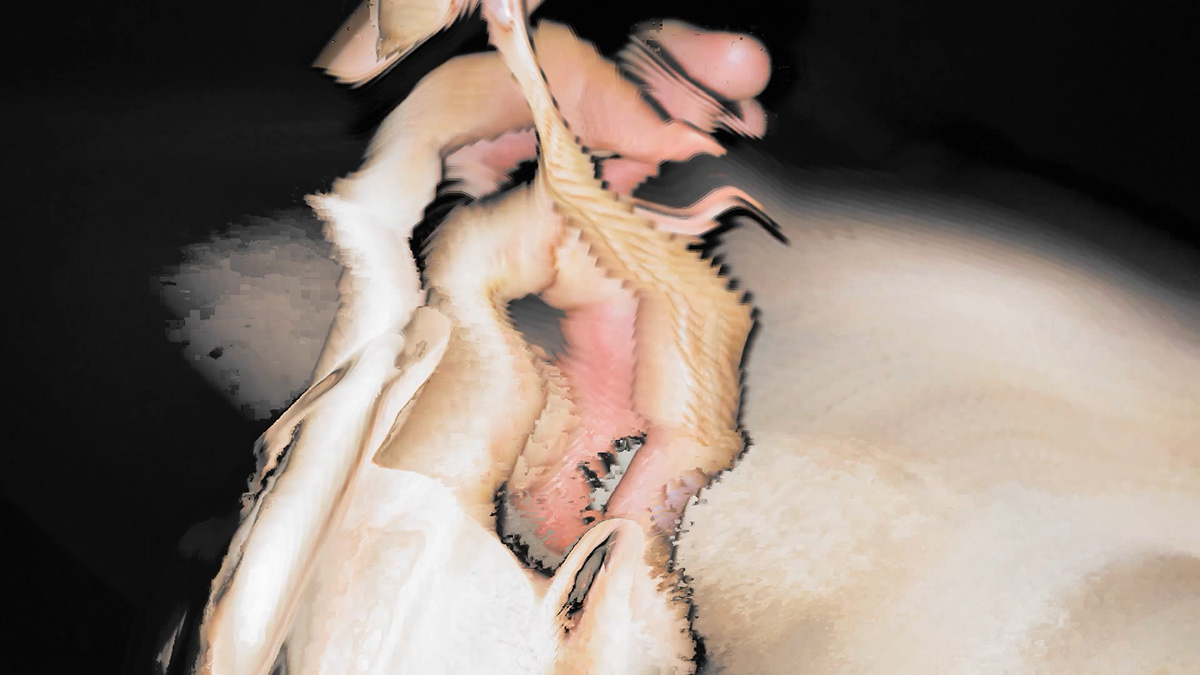
inviting us into an art space filled with apparitions. Indeed, the space was
full of apparitions. Layer upon layer of bodies and shadows, apparitions within
screens and mirrors, and between their contacts flowed our welcome to
connection.*
1.
Mediated
by the corporeal and technological conditions of “contact” and “connection,”
Daewon Yun reconstructs the sensory and perceptual conditions that surround our
bodies today. Here, “contact” and “connection” extend beyond concepts that
merely distinguish physical or technological relations between body and body,
human and human, or human and machine. Yun observes a state in which the
tactile sensations of actual skin-to-skin contact and encounters within digital
sensory realms are not clearly separated but instead coexist in hybrid form.
In
the unfamiliar world he unfolds, bodies are placed within a mixture of physical
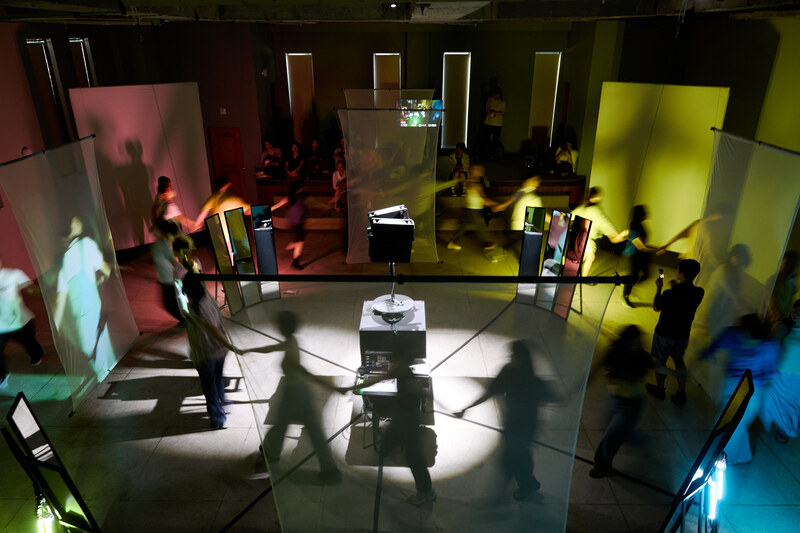
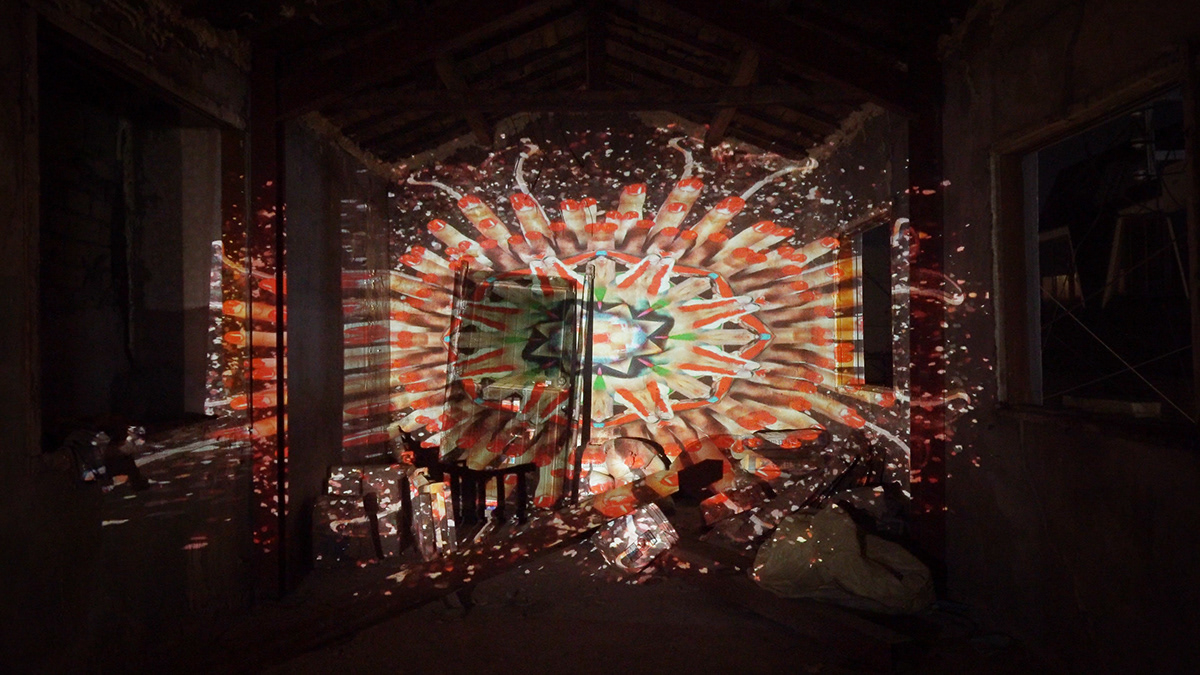
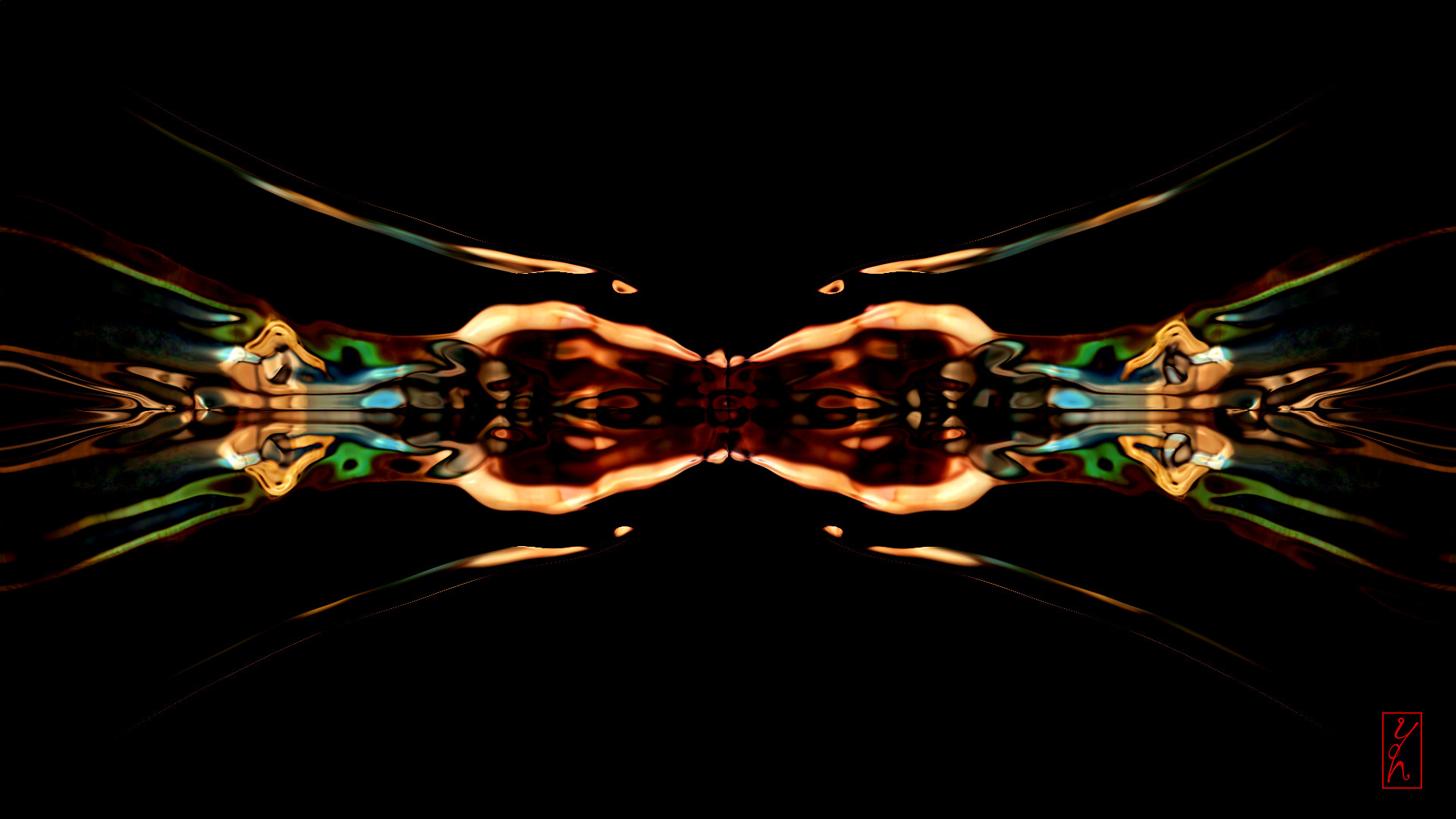
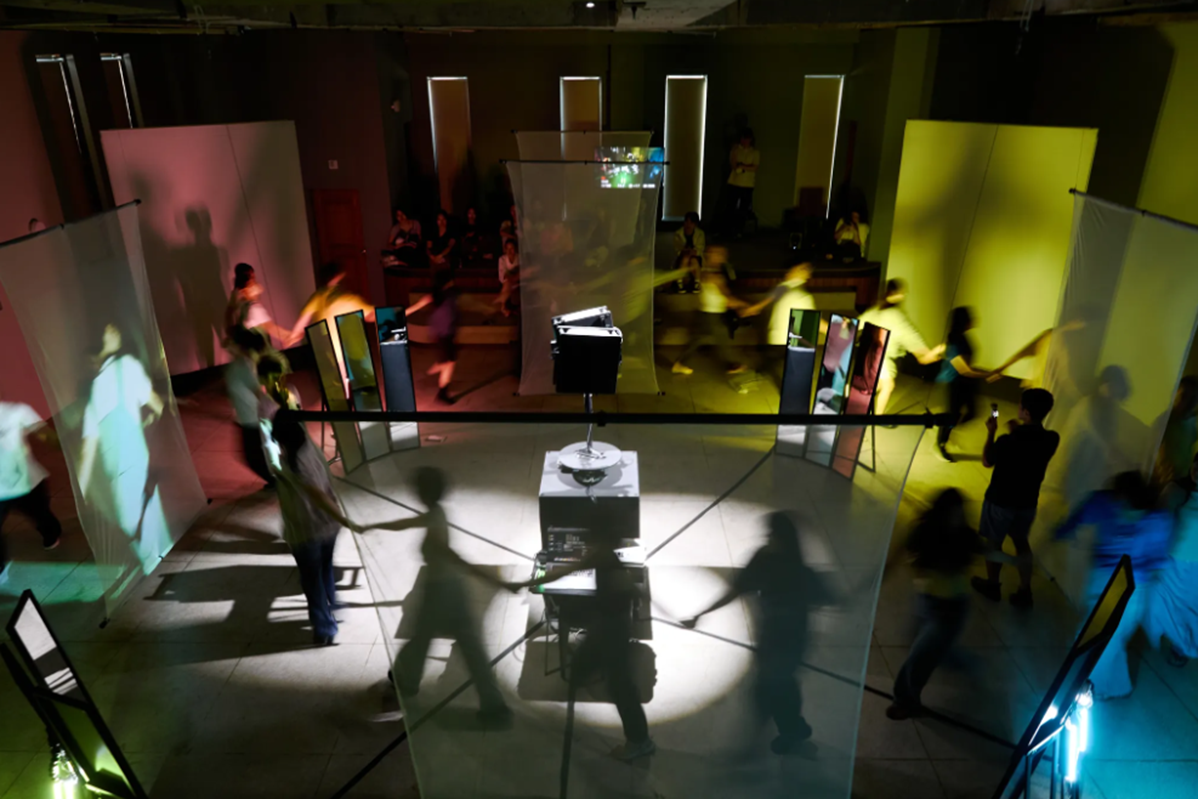
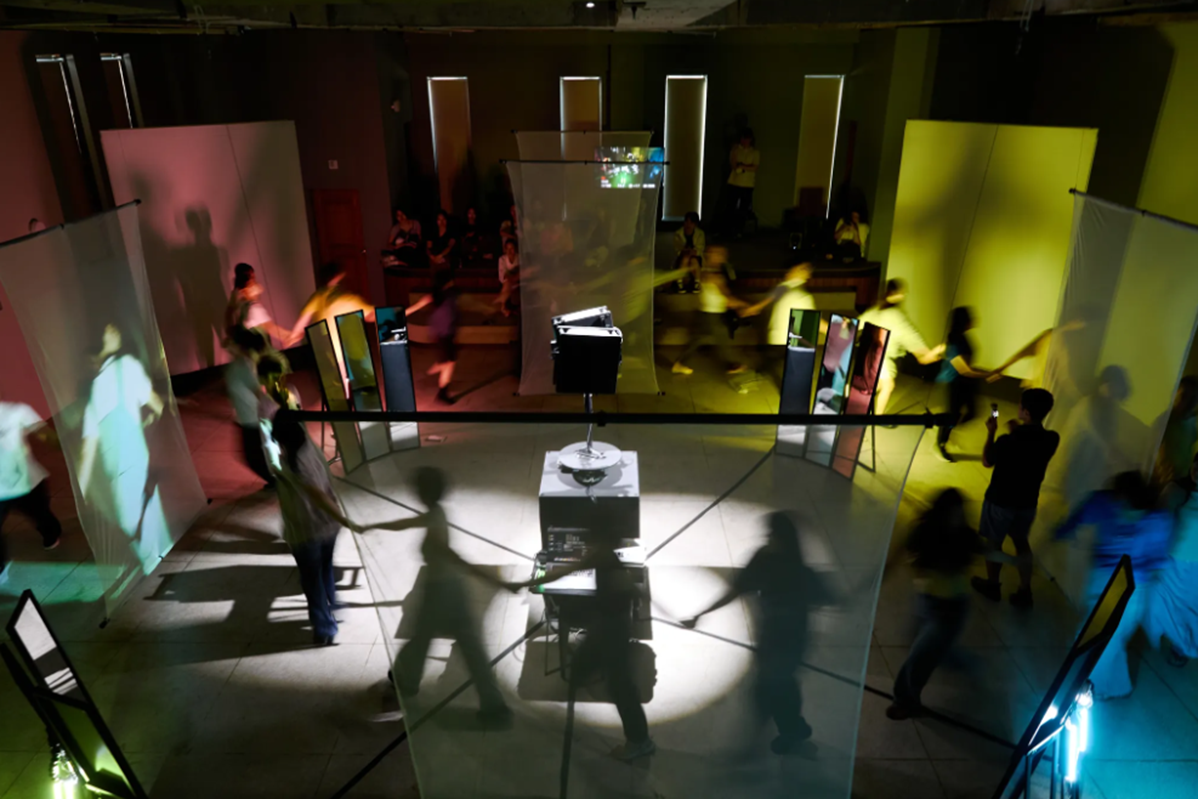
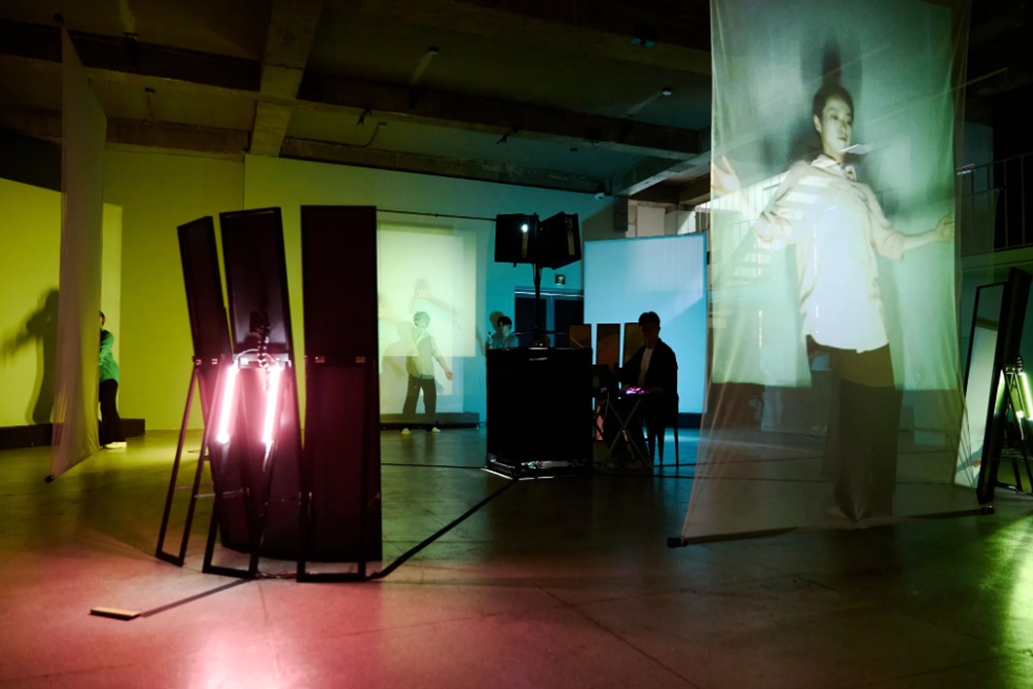
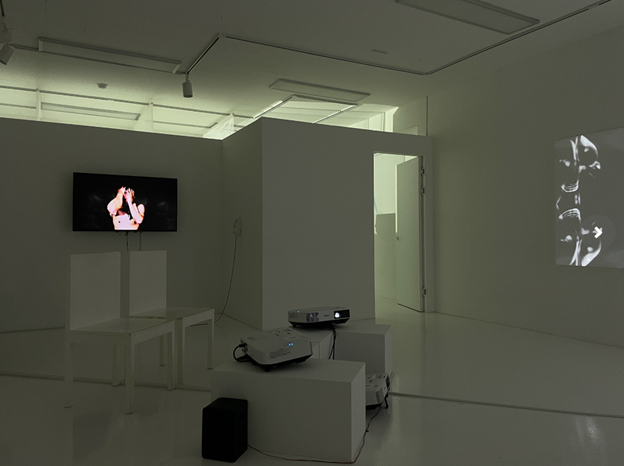
contact and immaterial connection. At the center stands a towering projector,
rotating as it converts recorded bodies into light and disperses them.
Surrounding it are transparent fabrics, screens, and mirrors arranged in
reference to the bagua formation, along with lights in the five
cardinal colors, all holding their positions as structural symbols.
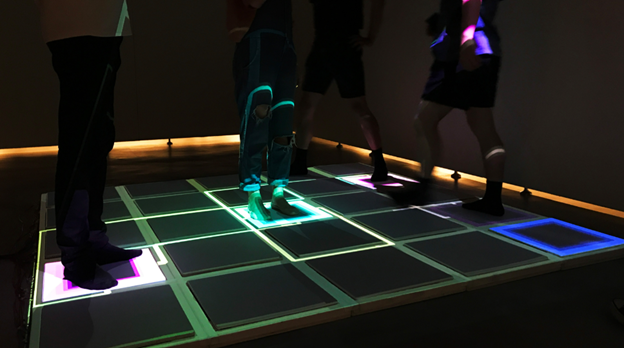
We enter a
space that is simultaneously artwork and stage. After passing through a
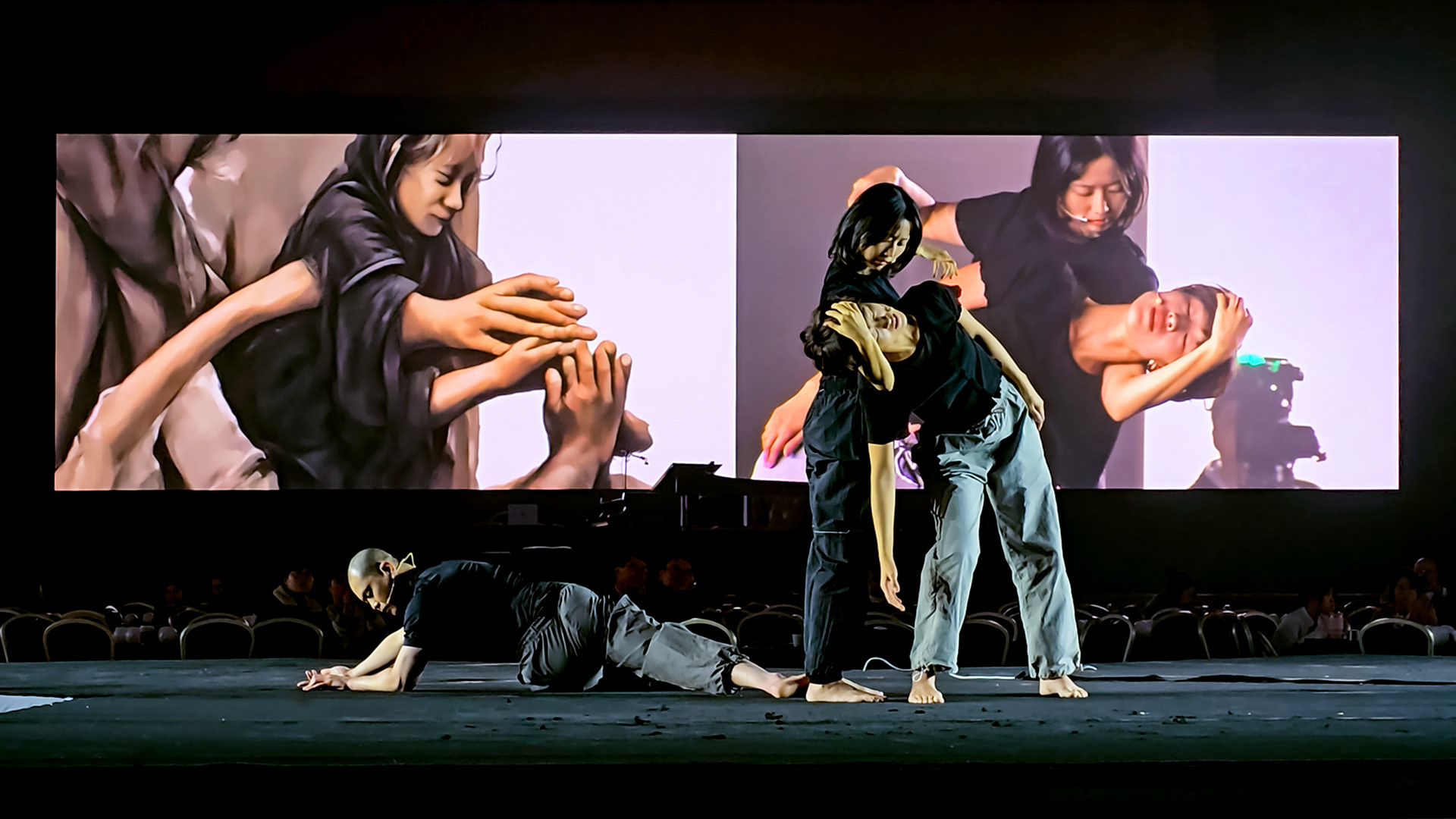
suspended time, we encounter four performers. The performers’ bodies and our
own continually interact with the world, searching for objects of contact or
connection; at times, contact and connection metaphorically substitute for or
transform into one another.
At
this moment, bodies are prepared as the most fundamental physical elements of
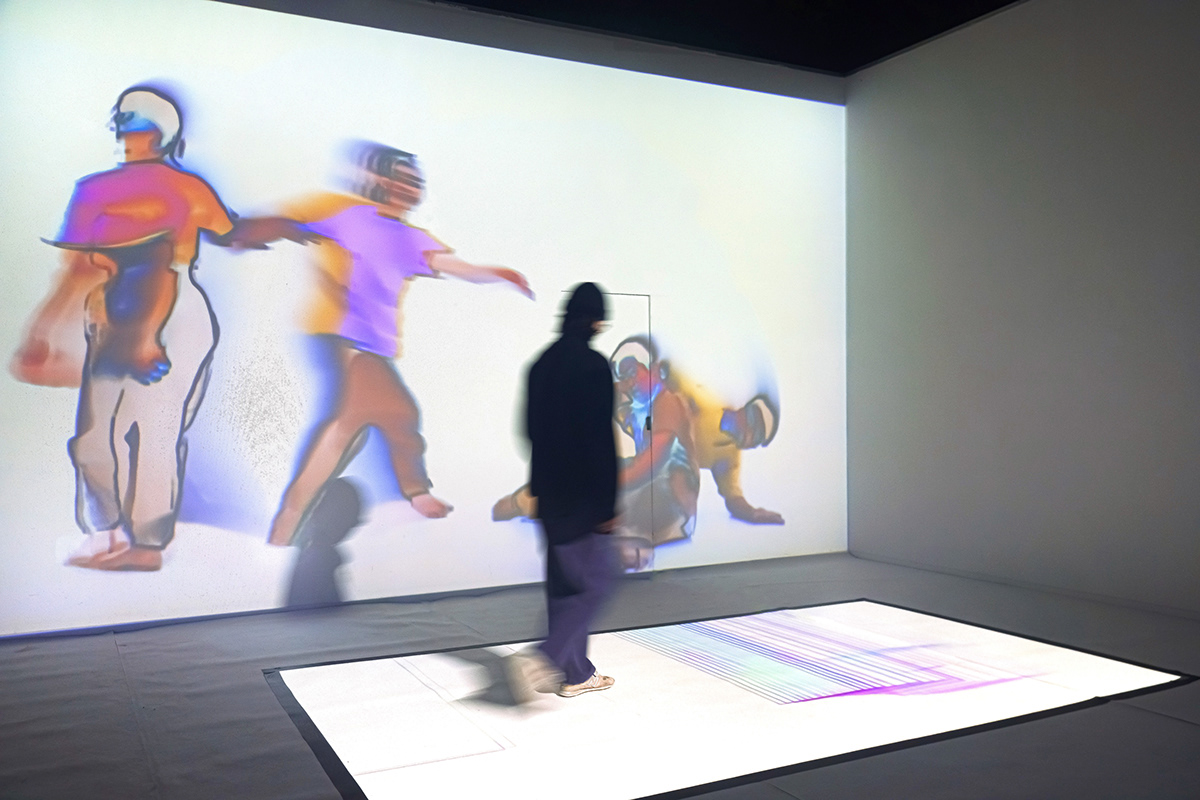
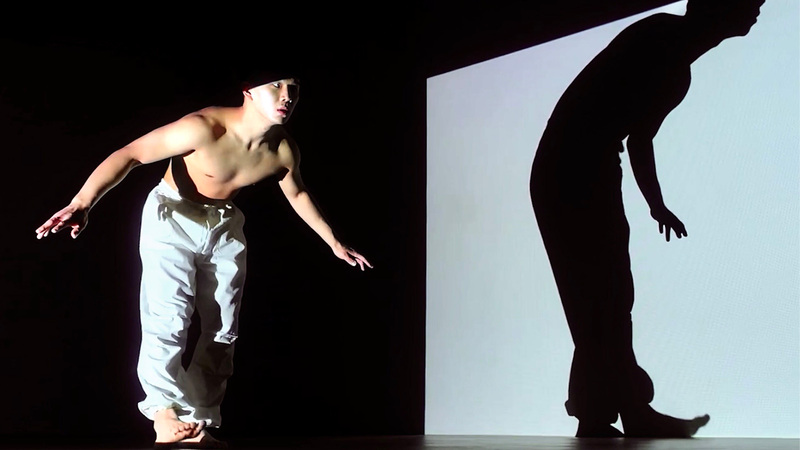
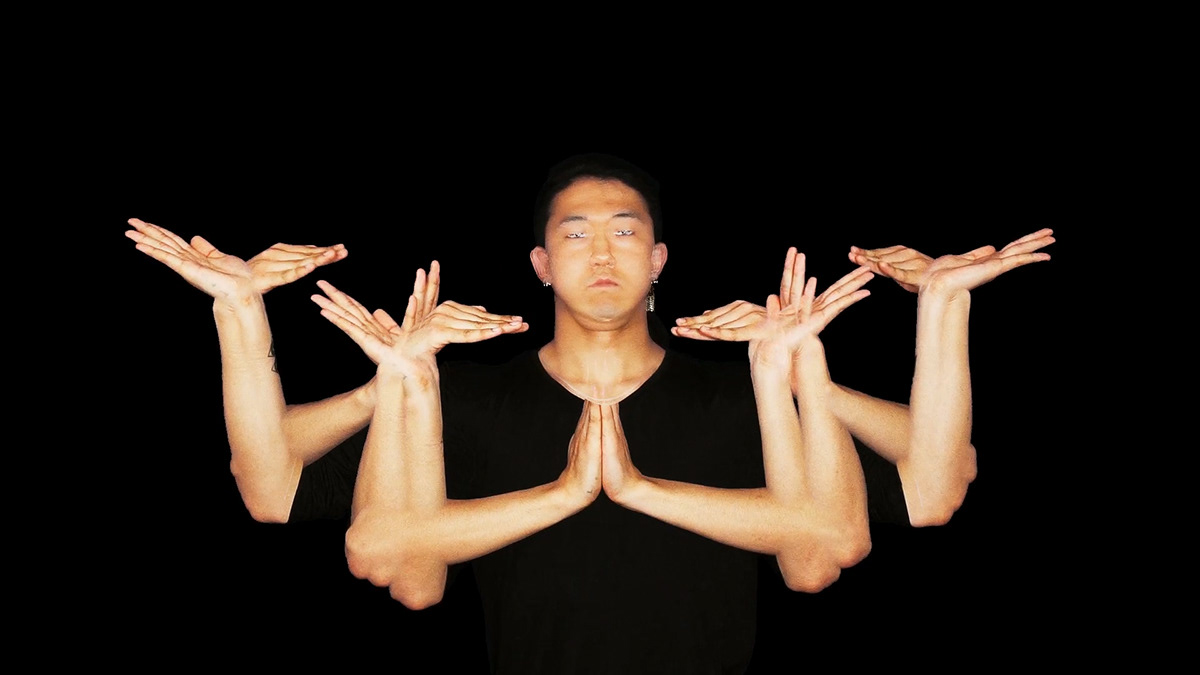
subjectivity. Depending on the direction of the rotating projector, recorded
bodies accumulate upon fabric and screens, performing chance encounters with
physical bodies. Shadows repeatedly disappear and reappear, while bodies
reflected in mirrors disperse and spread throughout the space. In this way,
bodies there repeatedly sense, contact, and connect.**
Contact
without contact, improvised contact, the gaze exchanged between eyes and the
projector, the radiating heat of dispersed beings, and our synchronized
connection. As performers repeatedly connect and disconnect, contact and drop
out, our bodies, faced with their challenges and initiations, break away from
possessed finitude and open toward the world. The frameworks surrounding our
bodies are reconfigured, giving rise to a slight sense of unfamiliarity and
discomfort.
This may stem from anxieties and isolation accompanying the
development of digital network technologies; or from the process by which
socially and culturally contact-oriented bodies are re-recognized as digital
bodies of connection in response to the expansion of new sensory apparatuses;
or from the perplexity of bodies that have slipped away from physical
environments into the blurred boundary between the real and the virtual.
Within
Yun’s invitation, which refuses to confine the body to a purely biological
frame, a chain of complex thoughts continues to unfold. Yun confronts as a
sensory reality of our time the very transformation of the body—fragmented by
digital technologies, dematerialized, and rendered connectable. Through his
work, we gradually come to accept that the body is not a fixed entity but a
state within relations, a mode of existence as connection. As our bodies become
open bodies, we encounter the subsequent scenes, momentarily setting aside
tangled reflections and beginning to grope toward the possibility of overcoming
individualistic alienation and restoring a sense of community.
2.
At
the core of Daewon Yun’s solo exhibition 《Circle, Chase, Contact》 lies “play.” As the
title suggests, it is composed through the contact (and connection) of two
long-standing communal games: ganggangsullae and tag. The movements
Yun devises are not limited to play as a device for evoking childhood sensory
memories. His approach to bodily movement does not merely realize an aesthetic
of formal motion. As he states, “dance is an act of liberation from primordial
anxiety,” and within his practice, the ritualistic potential of socially
constructed and perceived movements is expanded.
Whereas
his earlier works focused on patterning and imaging mechanically derived
movements of the body—extending and exhausting the body in the process—《Circle, Chase, Contact》 shifts its focus
toward movements that vocalize ritual gestures and collective emotions. It
expands emotional rhythmic synchronization of bodies into a ritual performance
aimed at the liberation of sensation.
The
method Yun proposes—“to experience contact in a way that is unfamiliar yet as
familiar as possible, and to feel oneself as part of a community”—is realized
through the formats of ganggangsullae and tag. Within the framework
of play, movement is not predetermined but decided through improvisation and
responsiveness. The movements of performers and participants overlap and
intermingle, rearranged within immaterial imagery through the rules of these
games, and enter the orbit of repeatedly shared emotional attitudes.
Movements
reminiscent of fern-breaking, hand-clapping and foot-stamping, roof-treading,
or gatekeeper games go beyond expressions of mere excitement or pleasure. They
become ways of constructing relationships—calling someone, catching, touching,
fleeing, and gazing—on the opposite side of solitary play. As roles shift and
the game transforms, we follow the performers and become subjects who hold
hands and run together. In these relational movements, contact becomes the most
primal medium of sensation, and brief encounters and eliminations leave behind
a desire for new connections.
Ultimately,
the communal worldview of Korean tradition unfolded by 《Circle, Chase, Contact》 proves neither grand
nor distant. The worldview of community encountered through Yun resembles
childhood—meeting friends without firm plans, inventing games on the spot,
running and playing until dusk settles, and heading home at a parent’s call,
leaving behind an open-ended “See you tomorrow!” Without calculating right and
wrong, gain and loss, or relational accounting, we find ourselves liberated to
become friends even with those we meet for the first time.
Within
that liberation, the rhythmic overlap of the real and the virtual—realized
through the coupling of projector movement and digital technology—recedes into
a sensory backdrop, while the center of time and space gradually shifts from
thematic structures to our bodies. Through 《Circle, Chase, Contact》, Yun reveals the
concern that “digital culture unsettles the body and generates unstable
sensations,” yet he simultaneously accepts the state of technological media we
face as a natural transformation of the sensory environment, exposing the
questions that drift along with it.
The art space he constructs presents our
bodies not as fixed entities but as variable, relational states. There, we
simply run and play, anticipate encounters and tomorrows, and hope. And those
invited gradually become the protagonists of play, and the owners of the space.
In this way, Yun’s field becomes a sensory laboratory that moves beyond
nostalgic aims derived from body and community, toward re-sensing the body and
rethinking togetherness under contemporary conditions. It is filled not with
critique but with reflection, not with regression but with recovery.
3.
Daewon
Yun’s solo exhibition 《Circle, Chase,
Contact》 consisted of 19 performance sessions over
seven days, along with one artist talk. According to the artist, the project
aimed “to expand the boundaries between traditional performance and media art
through the characteristics of multidisciplinary art that combines diverse
genres and media.”
In this sense, it may be more accurately described as
multidisciplinary art, performance, or live art rather than an exhibition.
Notably, however, official promotional materials continued to refer to the
project as an “exhibition,” producing a subtle tension by deviating from the
conventional grammar of solo shows that typically presume single authorship and
gallery-centered modes of viewing.
Yun
thus assumes multiple roles: artist, planner of a multidisciplinary art
project, and designer of the exhibition-viewing experience. Particularly
noteworthy is his strategy of designing the conditions for viewers’ sensory
immersion through the structure of performance, positioning our bodies and
attitudes as interfaces. This constitutes a central strategy and methodology of
the project.
In
contemporary commercial technologies, the configuration of an interface
radically shapes narratives of function and structures of sensation. An
interface extends beyond a mere control panel; it is a device that opens
possibilities for connection and sustains environments of contact. Yun
transposes the concept of the interface into an artistic methodology. In other
words, he proposes a new “interface of perception” at the intersection of
technology and sensation.
This interface is concretized through performers’
bodies and completed through the audience’s senses. Not only physical bodies,
but also the will to sense, the attitude toward immersion, and the state of
blending into space—all become interfaces.
While,
in technological history, an interface mediates functions between user and
system, in Yun’s work it becomes a device and attitudinal frame that induces
tension and collaboration between body and sensation, media and perception.
Consequently, audiences are placed in multiple states: they may simply watch,
participate, gaze, or immerse themselves, operating as beings that tune sensory
frequencies. This structure exceeds participatory art, demanding a
transformation of sensory attitude itself.
Before
the performance begins, a twenty-minute period of suspended time symbolically
reveals the preparatory structure of this attitude. Before performers’ bodies
appear, the central projector, transparent fabrics and screens arranged
in bagua formation, mirrors, and five-colored lights occupy the
status of the artwork itself, prior to becoming a stage.
These material objects
function as omens of the scene to come, as sensory warm-ups, and as intervals
between pre-connection sensation and imminent contact. Here, Yun’s work expands
beyond media performance into the design of a sensory environment. Audiences
prepare themselves as a potential community, readying their attitudes for
immersion. This silence becomes a key to understanding the structural rhythm and
spatial sense of the ensuing performance.
The
performance unfolds in two parts. In Part I, the movements of four performers
appear fragmented among images and shadows projected onto fabric, screens, and
mirrors. Amid excessive visual information and heterogeneous temporalities,
audiences abandon single-point perception, turning their heads, moving between
scenes, adjusting flows, and reconstructing coordinates of sensation. Sensation
here is no longer natural but an effort that must be continually perceived and
tuned. While this information-rich structure may at times induce unstable
immersion or stalled movement, its intent becomes clear as Part II begins.
In
Part II, audience movement is incorporated into the stage, revealing
retrospectively that the earlier stillness and gaps were conditions of sensory
preparation. No longer peripheral others, audiences become subjects of
sensation within the structure, experiencing how their bodies generate meaning
through processes of contact and elimination. The forms
of ganggangsullae and tag symbolically realize this structure of
sensory connection. Holding performers’ hands, running together, searching, gazing,
and fleeing, audiences retrain patterns of sensation.
In
tag, subjects exchange positions through contact,
while ganggangsullae invokes collective emotion through repetition.
Toward the end, all participants—who had been playing both separately and
together—join hands, forming a single rotating circle. The four performers,
once challengers and initiators, quietly exit one by one. There is no longer
any need to read cues or follow others. The communal play now sustains itself
autonomously through the audience’s bodies.
This
scene is not a simple reenactment of play, but a strategy that reverses the
immaterial interactions emphasized by technological media into bodily affect.
The performance thus becomes not a question of “how to represent community,”
but an experiment in attitude asking “how community can be sensed.”
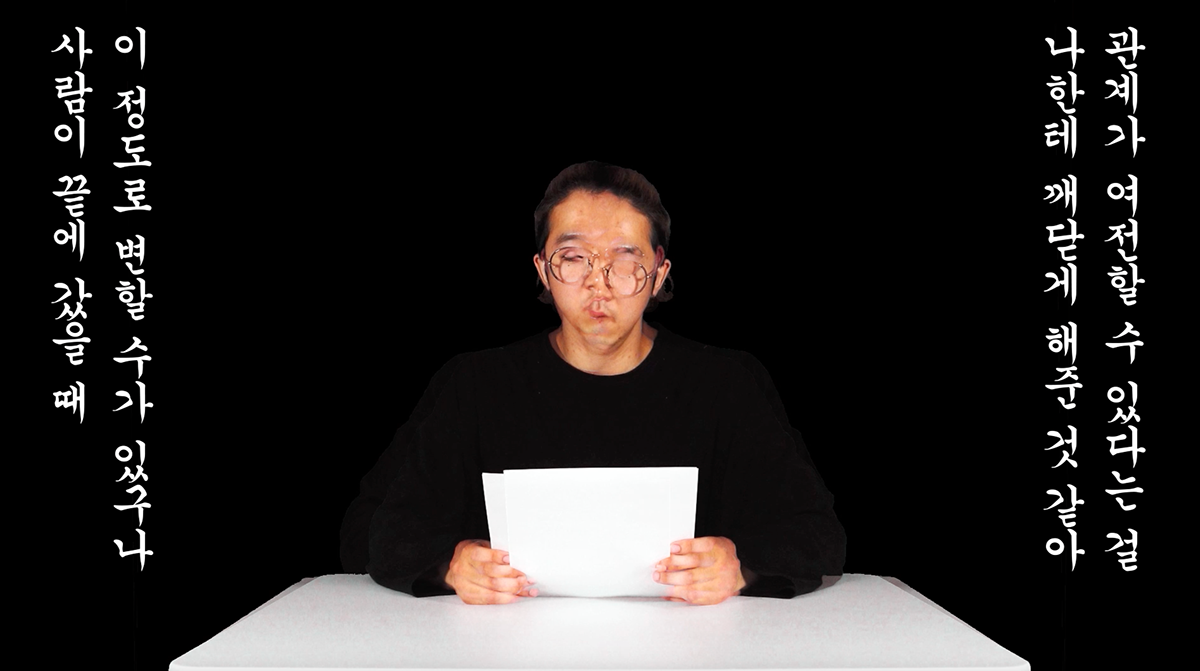
This
experiment extends into the collaborative process itself. The movement
designer, sound designer, and four performers are not merely collaborators;
they participate in the artist talk alongside Yun as equal contributors.
Notably, the sound designer collected non-contact sounds generated by the
resonance of a gayageum with wind, and after each rehearsal and
meeting, participants shared their sensations and progress through a
collaborative web page. This functioned not as simple online connection but as
a structure of contact without contact, synchronizing attitudes and rendering
each performance a unique sensory event through improvisation and repetition.
Within
a ritual structure that repeats yet never remains identical, Yun explores the
rhythms of sensation generated by multidisciplinary art, seeking to invent new
modes of connection between body and technology, community and attitude. The
sensory structure he designs lingers with us even after the viewing ends—not
merely as an afterimage or memory, but as a question of how we might continue
to keep our bodies open in everyday life. Thus, art sometimes quietly activates
an attitude no one demanded, gently inclining our bodies toward others.
*
The ambivalent term “apparition/welcome” (환영) is borrowed from the introduction of the exhibition preface
written by Jihee Yun.
** Maurice Merleau-Ponty considers sensation to be a moment-by-moment
“re-creation and re-composition of the world.” The art space Yun unfolds
reveals the expressive capacity of the body, and his conception of art may be
understood as the encounter between subject and world, and the process of
recreating and recomposing the world beyond that encounter. Merleau-Ponty’s
assertion that “artistic expression gives what it expresses an existence in
itself, arranging such self-existing entities within nature as objects
accessible to all of us” also comes to mind. Yun translates contemporary
conditions of perception and existence derived from corporeal and technological
circumstances into the keywords of contact and connection, arranging even
himself—following Merleau-Ponty—as an object accessible to all within nature.
Through this, we are positioned to grasp ourselves as one aspect of existence
within the field of encounter between subject and world, and within the process
of recreating and recomposing the world. See Nam-In Lee, Husserl and
Merleau-Ponty: Phenomenology of Perception (Paju: Hangilsa, 2013).