What
is the meaning of gravity in a painting? It can appear as an imaginary force
which organizes the order of the three-dimensional space within the painting,
or it can appear as a real force acting upon the physical body of the painter
and the canvas covered in paint. In both cases, however, gravity is not a force
contained on the optical flat surface of the painting. If a painting is
approached innocently as a flat space for the paint, there will be no space for
gravity to function.
Therefore, if gravity can be felt within the painting, for
whatever reason, it is because the painter either felt the need for gravity and
intentionally inserted it there, or simply tolerated its accidental presence.
Looking at the past works of Soojung Jung, it seems as though up until now she
has not felt the distinct need to introduce gravity into her paintings. Her
works are not realistic portrayals of three-dimensional worlds, but rather are
closer to an attempt to conjure up a world she wants on a two-dimensional surface.
So, rather naturally, her paintings have been filled with a sense of
weightlessness.
In
her two previous solo exhibitions, 《Sweet Siren》 (Rainbow Cube Gallery,
2018) and 《A Homing Fish》 (Gallery
Meme, 2019), Soojung Jung increasingly used an intentionally disjointed
arrangement of exterior lines and blocks of solid color forming differentiated
objects, or omitted sections in the painting, revealing them to be solely the
result of brushwork. Nevertheless, the paintings did not disintegrate into
tatters but rather remained firmly stitched together—and created a liberated
world where plump bodies run and play.
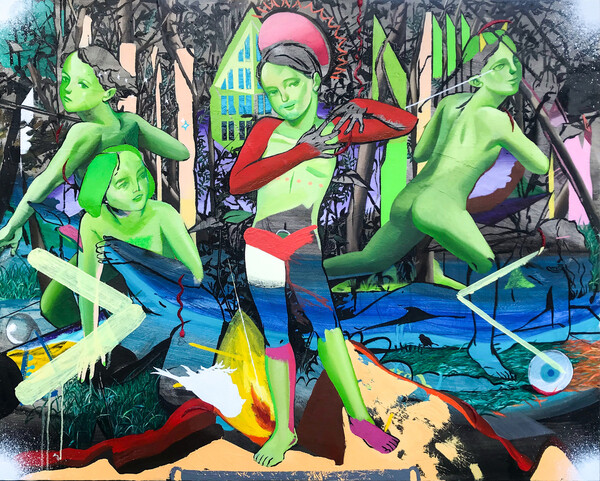
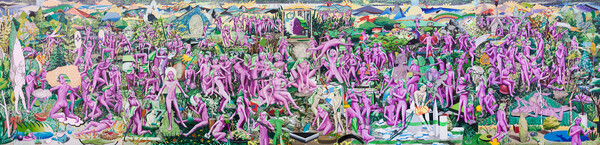
The human bodies, which appeared to be
in female form, conveyed a three-dimensional feeling and a sense of emotion
which contrasted sharply with the thin surface of the painting. These beings
were not arranged on land as dictated by perspective, but rather welled up as
lumps and bumps across the entire surface of the painting. These soft and
malleable beings—these animals, plants, landscapes, and panoramic views which
come and go freely within the fluidity of the paint—lie comfortably on the
support structure of the canvas. While displaying a sense of mass innate to
objects that cannot be pushed or pulled by an outside force, their arms, legs,
heads, and butts moved at will, or remained obstinately still. However,
although the paintings capture a sense of up and down through their postures, a
sense of gravity is largely absent.
However,
this exhibition, 《The Star of
Villains》, is overflowing with images of things soaring
upwards against the forces of gravity. That is, it appears that Soojung Jung
wanted to draw something different from her previous works. How should we
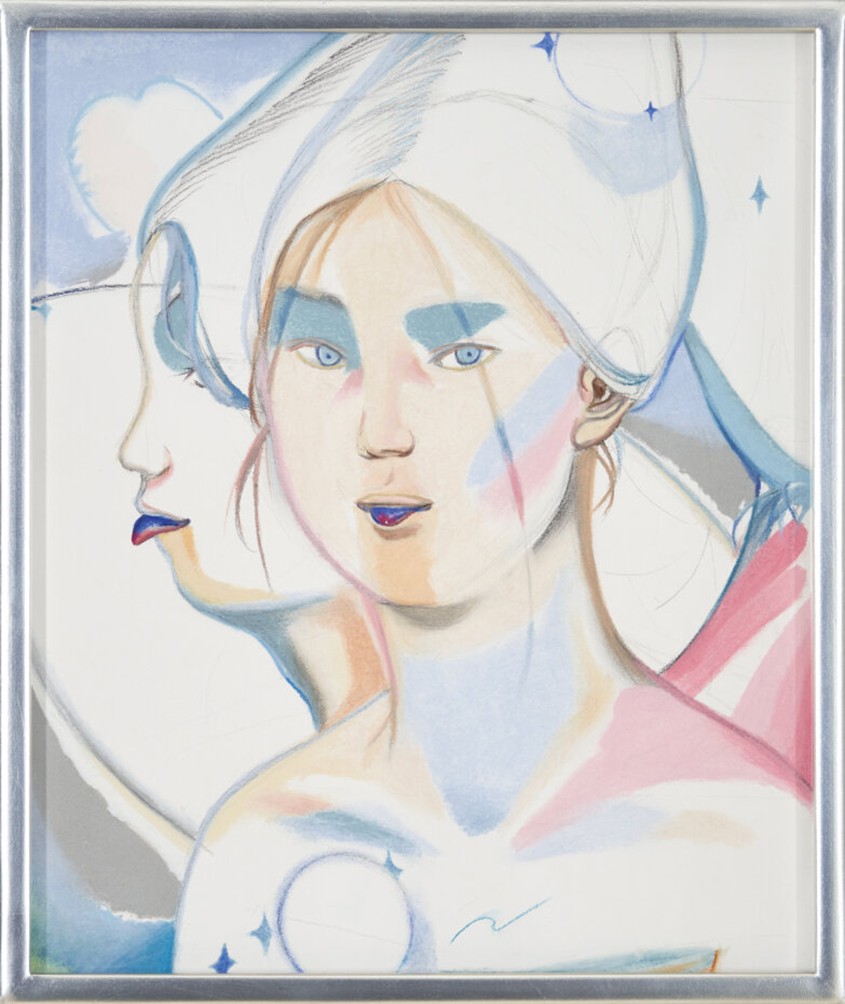
understand this? Looking at her drawings, we see rockets and flying machines,
and one can glimpse a clearly drawn image of mars based on the science fiction
genre. However, this work has not been completed as a graphic novel or a
narrative type of painting. Indeed, as if the order of time and space has been
shattered, each painting—both existing on its own while also overlapping with
the next—shakes and vibrates.
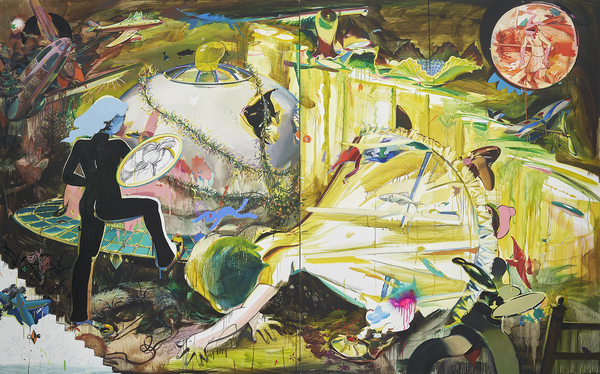
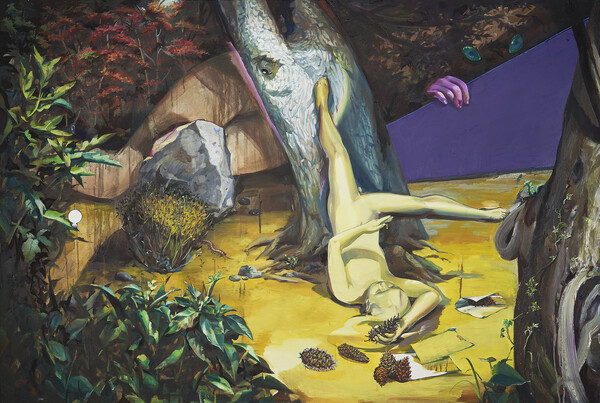
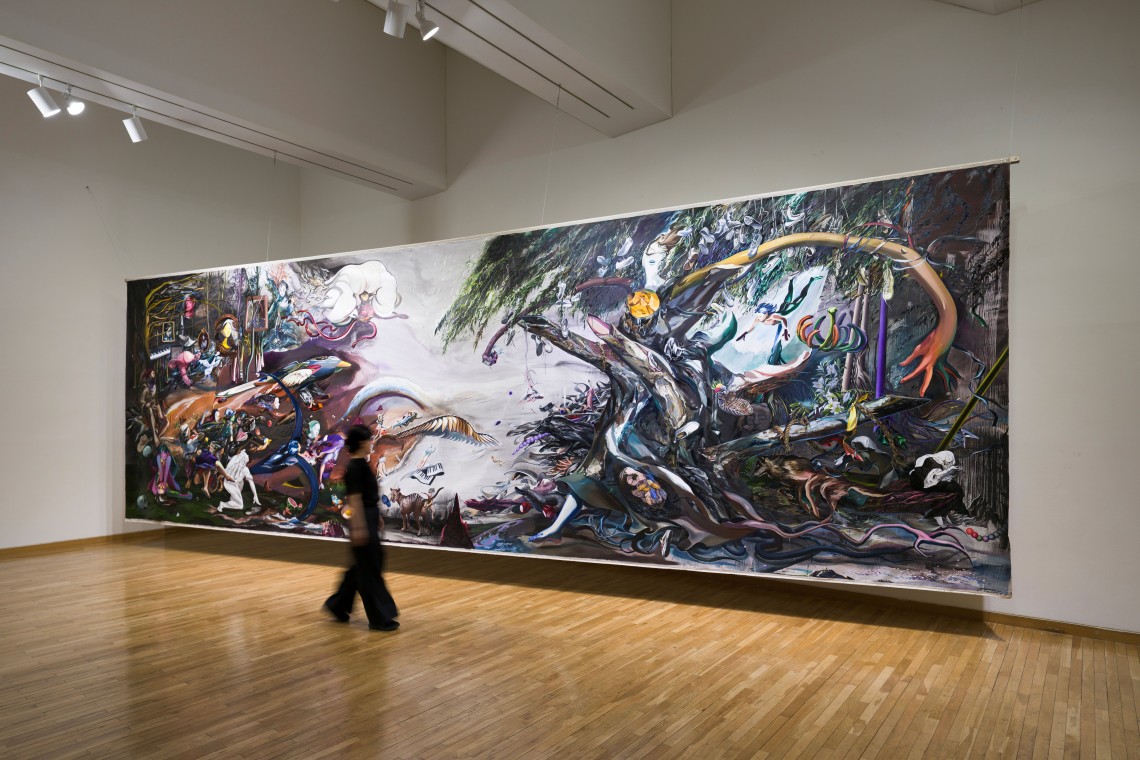
Take the painting No graffiti here,
for example. Above the flying saucer that is either landing or crashing, there
is a person who is painting, and at their feet is another person who has
collapsed. They are surrounded by all types of flying machines and painting
tools. Here it is easy to imagine a destroyer-artist painting wherever they
like. However, because the people within the painting are themselves holding
brushes, it is difficult for the person outside the painting to decide on one
story for all of them.
Are the people with brushes drawing graffiti on the
flying saucer after having captured it? Or, have they drawn the image of flying
machines into the world of the painting, where they previously did not exist,
destroying the originally pastoral imagery in the process? According to what
criterion can we distinguish between that which has been drawn with the brush
of the artist, and that which has been destroyed?
Among
the multiple stories that can be told, here is one of them. The
artist—attempting to break away from the world they have constructed in their
paintings and escape the gravity of their constructed world—dreams up images of
painters coming and going across the canvas and flying machines freely
traversing the painting. However, the things flying up from the painting are
revealed to be the act of colliding with the flat surface of the canvas and
destroying it, or the destructive process of being destroyed on its own.
The
painter is split; the flying machine breaks into two parts; the skeleton
shatters into four pieces; the painting breaks apart into shards. In the end,
what dominates the surface of the painting is not the science fiction flying
machine, but rather a kind of ball—a moving object which has been quickly cast
out, struck, exploded, destroyed, and has crashed—it’s the image of a cluster
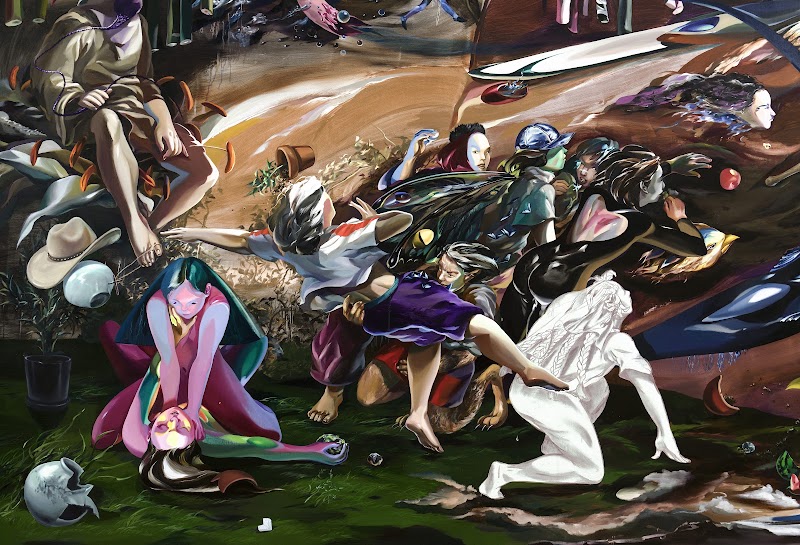
of energy. For example, in Fly, which unites two canvases as
one painting, there is a white, round thing which has been cast into the middle
of the painting.
Although it clearly looks like the focal point of a forceful
impact, it is difficult to know exactly what it is. What is clear is that the
force of it being thrown into the painting has caused the remaining elements to
move. In fact, all of the elements appearing in the painting, as moving
objects, are homologous with the ball-like thing. A tumbling mandarin and a
watermelon split in half, a seed covered in dandelion fluff, pieces of paper
with butterflies and dragonflies drawn on them, and the people plummeting
towards the earth all have bodies that are imperfect flying machines. However,
they float temporarily by riding the shockwave.
The
ball- and disc-like shape appears repeatedly in other paintings. While it does
look like the flash of an explosion, a sparkling eye, or a screen, you could
also say it is a “hole” if you don’t think too hard about it. It is both the
focal point where the force that has made a hole is concentrated, and also the
point marking the expanding epicenter of the destructive force emanating from
the hole.
Different than a vanishing point or the center point of gravity, this
dynamic point—which creates an uneven field of power on the flat surface of the
painting—is in a way simply a large blotch of paint made by the painter’s brush
being pressed to the canvas. The painter, who is both a creator within the
world of the painting and an outsider to that world, uses a brush to poke their
way into the world they created. In this world, the brush is a powerful and
absolute weapon; however, as the objects made by the brush are not simply
passive blotches of paint, a collision of forces is inevitable.
The result is
something like an action painting. The painter does not only wrestle with the
canvas on a physical level with a brush and paint, they also enter and fight on
the imaginary surface they have created. Considering that each painting makes
manifest a designed and directed scene, they look like a historical painting
that ideally represents heroic battle of the painter. However, that battle—as
an optical and physical process taking place in real time through the eyes and
brush of the painter—leaves clear traces within the painting.
The
speckled and trickling of paint and layered paint freed from the constraints of
the rough sketch reveal the unique amorphousness of the painting, which does
not point towards a- distinct form by nature. Unlike past works, in these new
works the translucent traces of watery, trickling paint leave literal stains on
the scenes which are structured like a comic. However, these paint stains do
not nullify linear composition, but instead function as an element which imbues
the story of the painting—that is, the story of the painter fighting with the
world they have created—with a sense of movement and vitality.
If there is a
consistent hypothesis presented in the paintings of Soojung Jung, it would be
that the power of the pictorial thing can be amplified not through its purity,
but rather through its hybrid nature. Within the bounds of the painting it is
not just to leave over the most painterly to concentrate it, rather, there is
also the ambition of the painter to create a third world that is not limited to
either side of the binary of real or imaginary, flat or three-dimensional, or
momentary or continuous—and creating such a third world is achieved by
expanding the painting and inserting all types of things which were originally
not there.
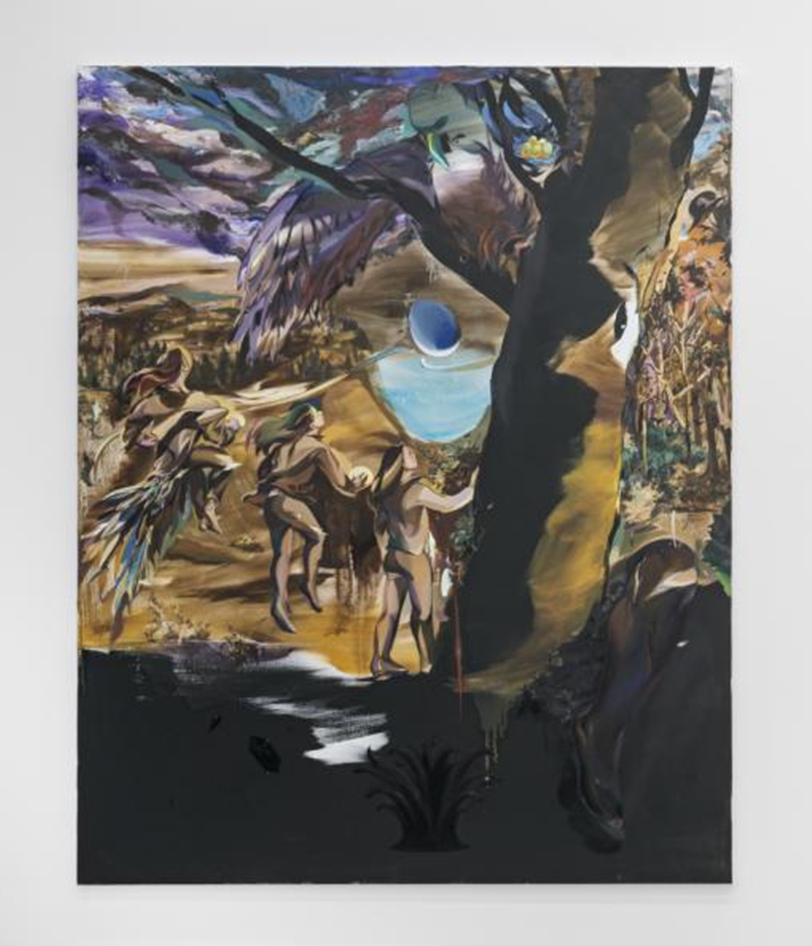
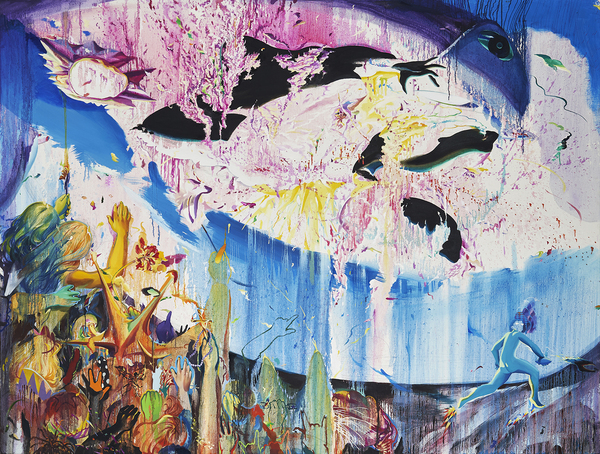
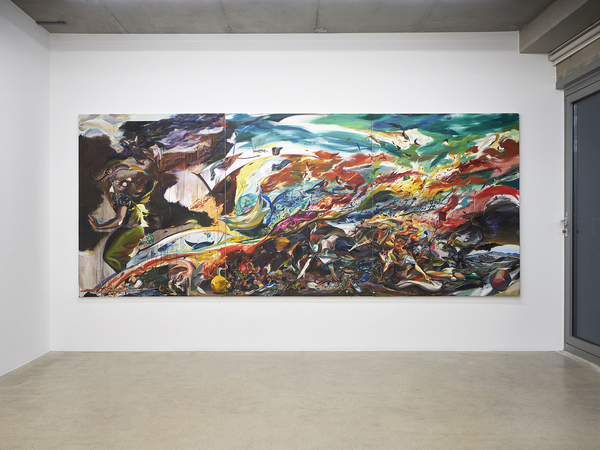
Our
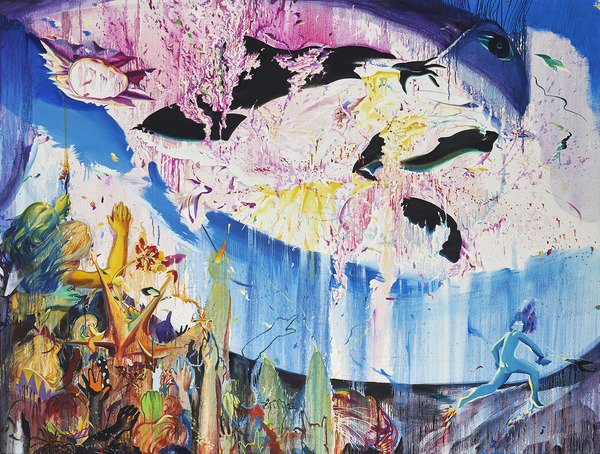
Starman, which is both the climax of this exhibition and the last
piece to be created, offers a glimpse of the new horizon towards which Soojung
Jung now sets out for after finishing these works. The painter’s self (which is
created through the collusion of the painter and the world they create), the
fragments of that world, and the incarnation of the force that appears
alongside the destruction of that world are all concentrated in this single
painting. Here the circular disc shape appears as a contorted and twisted
horizon which exceeds the painting and expands in size.
The blotches of paint
splatter in all directions, spilling and running both up and down—and this
abundant energy strangely gives rise to a crooked sense of space. It is both an
unknowable entrance to a new world and the potential territory of a pictorial
dream as transformed space. In principle, a painter can paint anything, and
therefore they become the king of the world they draw. If that is the case, how
can this king draw a map of a territory for an unknown place that they have not
yet drawn? While destroying the world she has made and then recreating it
again, Soojung Jung finds opportunities to expand that world. Indeed, like a
silkworm ripping through its cocoon, this is the journey of a painter
repeatedly being born again.