Magic,
fantasy, gods, and heroes have vanished. In the past, people invented mythic
figures and lived under their control, carrying out predetermined tasks. Today,
fate rests in our hands; the future is a time realized through relentless
effort. With life’s joystick handed to us, we seemed destined for freedom and
passion. Yet amid reels and shorts that mass-produce stimuli and dopamine,
those who chase ever greater pleasures are left with inertia.
For our parents’
generation, labor and leisure were separate domains. After work, office workers
could pursue hobbies or play games; it wasn’t strange to set routines and order
in life. In this climate, a politician’s slogan about “evenings with family”
now rings hollow—an industrial-era echo—because in a capitalism that compels
labor and production, safeguarding our capacity for leisure and play grows ever
harder.
This
essay looks at the ecology of people who have forgotten how to rest in an age
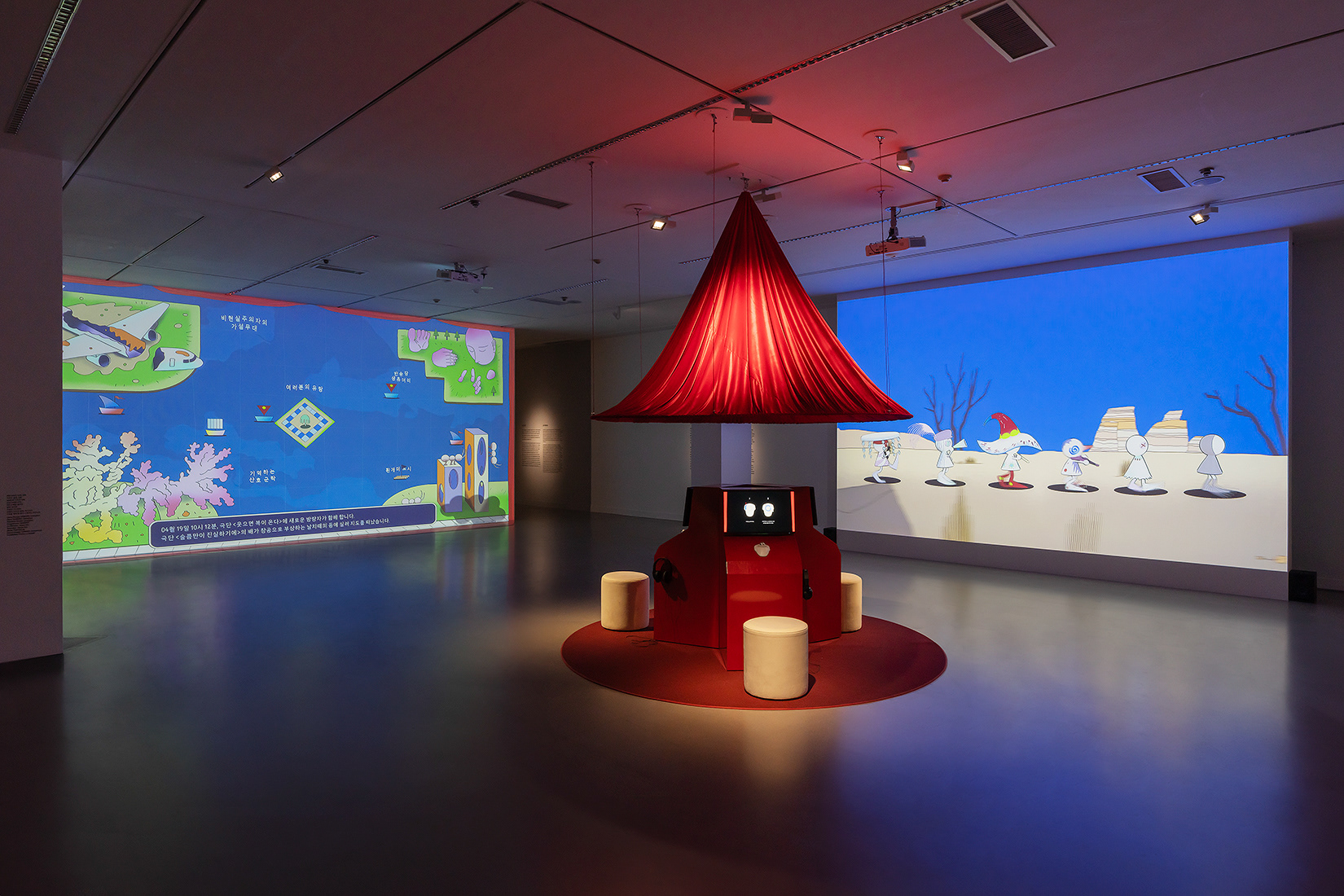
when “burnout” has gone viral. Focusing on SANGHEE’s solo exhibition 《Worlding…》 (Audio Visual Pavilion Lab,
2023.12.10–12.31), it explores labor and the feeling of ennui as existential
reflection. Titled after the exhibition, Worlding··· (2023)
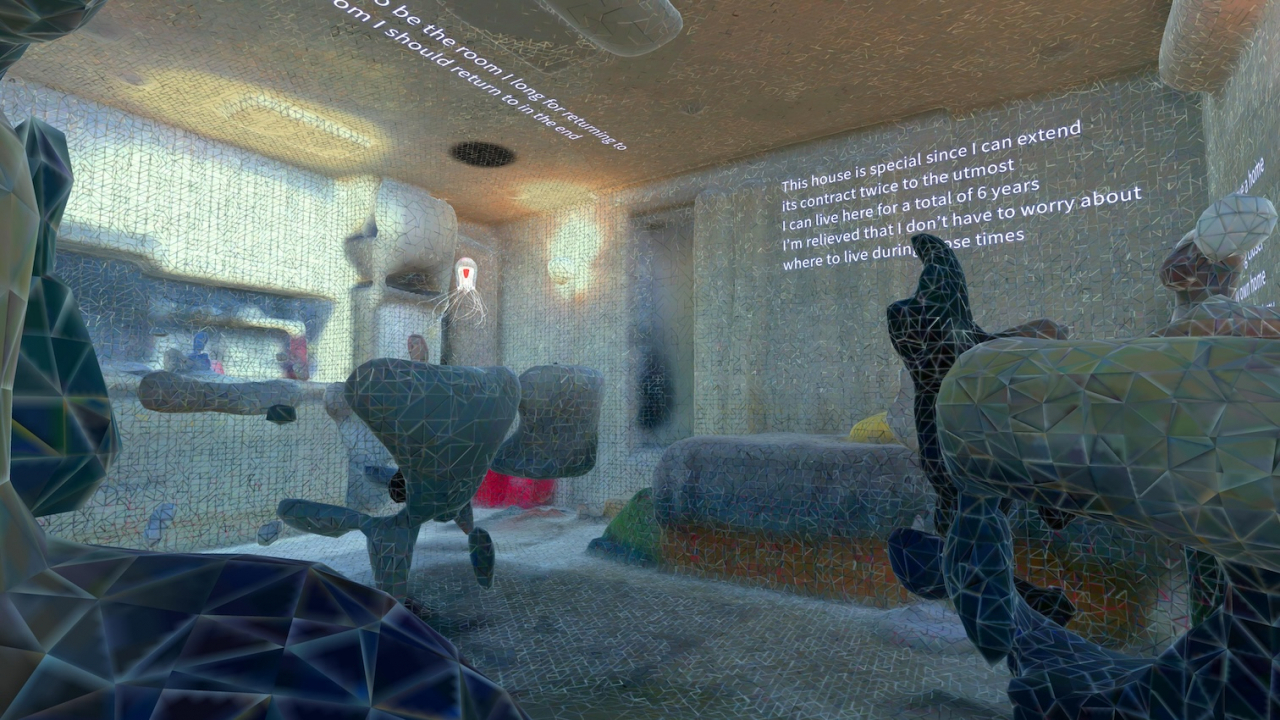
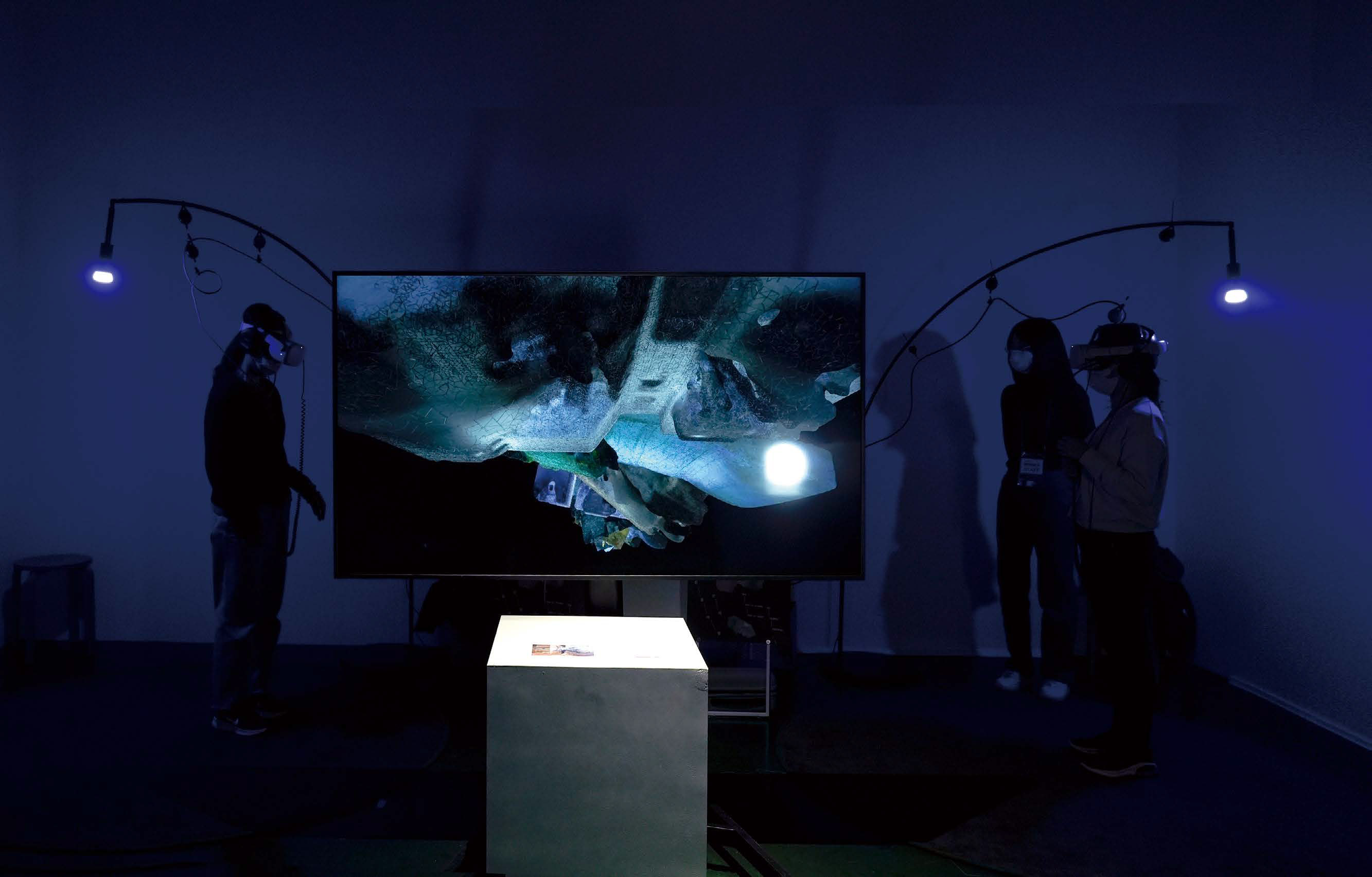
is a participatory VR work that adopts the form of an asynchronous online game:
unlike real-time games, it compels solitary play without user-to-user
interaction.
As “asynchronous” suggests, each player’s actions are linked not
in real time but as traces with a time lag. Borrowing gaming’s image of fun and
enjoyment, SANGHEE speaks to the sensations of bodies laboring in the digital
industrial era and, against the backdrop of instant gratification and fully
individualized worlds, reconsiders the affect of “ennui” as an inner mode of
thought.
Game Stages and the Labor of Play
Worlding··· begins
from a concrete narrative. The viewer/player receives a handover from a
predecessor and starts work. The task: bury a giant who has emerged in a swamp.
Appointed as the swamp’s watch, the viewer shovels soil over the immense corpse
by day and returns to quarters by night to read the predecessor’s log. Most of
the playtime is consumed by burying the giant. And then tomorrow comes. As if
yesterday’s labor never occurred, the body you covered lies exposed again. Like
Sisyphus, the punishment of labor repeats anew.
As
noted, SANGHEE borrows the grammar of games—evident in how the work “stages”
its narrative. Typically, game space expands meaning as a vehicle for concrete
player experience; narratives unfold via stage-building, structuring the
beginning-middle-end of gameplay, with players completing quests stage by
stage. In Worlding···, whose day-by-day stages are
separated into units, there are no quests. More precisely: each day, a prompt
appears—“Fill today’s labor quota”—but there is no reward for doing so. Rather
than advancing the story through stage progression, the work sets a stage of
the same scene—yesterday and today alike—and offers a quest without
compensation.
The only sign that time passes is the on-screen image of a
controller: represented as two hands that age with each stage, turning
progressively dark and shell-like. The two hands ceaselessly shovel soil to
meet “today’s labor quota” demanded by the burial. Controlled by two hands yet
touching nothing, grasping nothing—the image conveys a hollow sensation. This
powerless, repetitive motion piles earth again upon the giant whose body will
be unearthed tomorrow. The endless burial recalls laboring bodies bound
insubstantially to digital infrastructures.
Waiting for a Game to End
Crowdworking,
platform labor, even AI labor—utopian visions trumpet that technology lets us
work “anytime, anywhere” with “freedom.” Cloaked in the logic that future
technologies will reduce drudgery and liberate our lives, this appealing
program claims legitimacy. But are workers truly liberated from labor? As
technology and society accelerate, we too must process more, faster. Even when
we leave the office physically, we do not escape work. As with the collapsing
boundary between virtual and real, the border between workplace and everyday
life has eroded.
Depending on the social use of technology, companies outsource
non-core departments through in-house subcontracting, dispatch, and
externalization, tethering workers in non-worker guises to the network of work.
Being “online” and connected in real time—always and everywhere—means bodies
are constantly placed in a state of labor, with no clear border between labor
and leisure. In a hyper-accelerated world, slow bodies are ruthlessly culled.
The more quickly automation and autonomy advance, the more rapidly individual
disempowerment proceeds.
Within
these conditions, SANGHEE engages with the performative nature of labor through
gaming’s terms. If execution is obeying commands and performance is generating
events through repeated bodily training, then the laboring body in this work—an
image executing tasks—offers a critical meditation on the performativity of
contemporary labor. This emerges in the work’s principal affect: tedium and
“ennui.” While games are often discussed in terms of pleasure, fun, immersion,
or addiction, the artist adopts gaming’s form to speak about ennui—proposing
that viewers shape the ground they will tread through the game’s staged
narrative.
No one sets “today’s labor quota,” and the game’s timeline has no
guaranteed end. The physical body gripping the controller syncs with movements
in VR and repeatedly re-enacts tedious labor. Viewers map their bodies onto the
bodily image in the VR game: at first focusing on a mismatch of sensations,
then, as identical daily stages pass, feeling sore arms and shoulders as their
bodies attune to the one on screen. Play becomes painfully monotonous.
Rediscovering Ennui in a World Perpetually Loading
Those
who feel ennui dwell in emptied spaces. In vacant lots where communal order and
life’s direction vanish, one is easily exposed to ennui. In today’s society of
doing, working, and eating alone, we become subjects of narcissistic enjoyment,
choosing isolation while being captivated by virtual scenery. SANGHEE
transposes this contemporary vista into virtual space: solitary labor,
movements with no end in sight, a world without others. When one viewer removes
the headset and leaves, another—the swamp’s next watch—arrives.
They do not
meet. The gallery viewer inherits the predecessor’s task and repeats it.
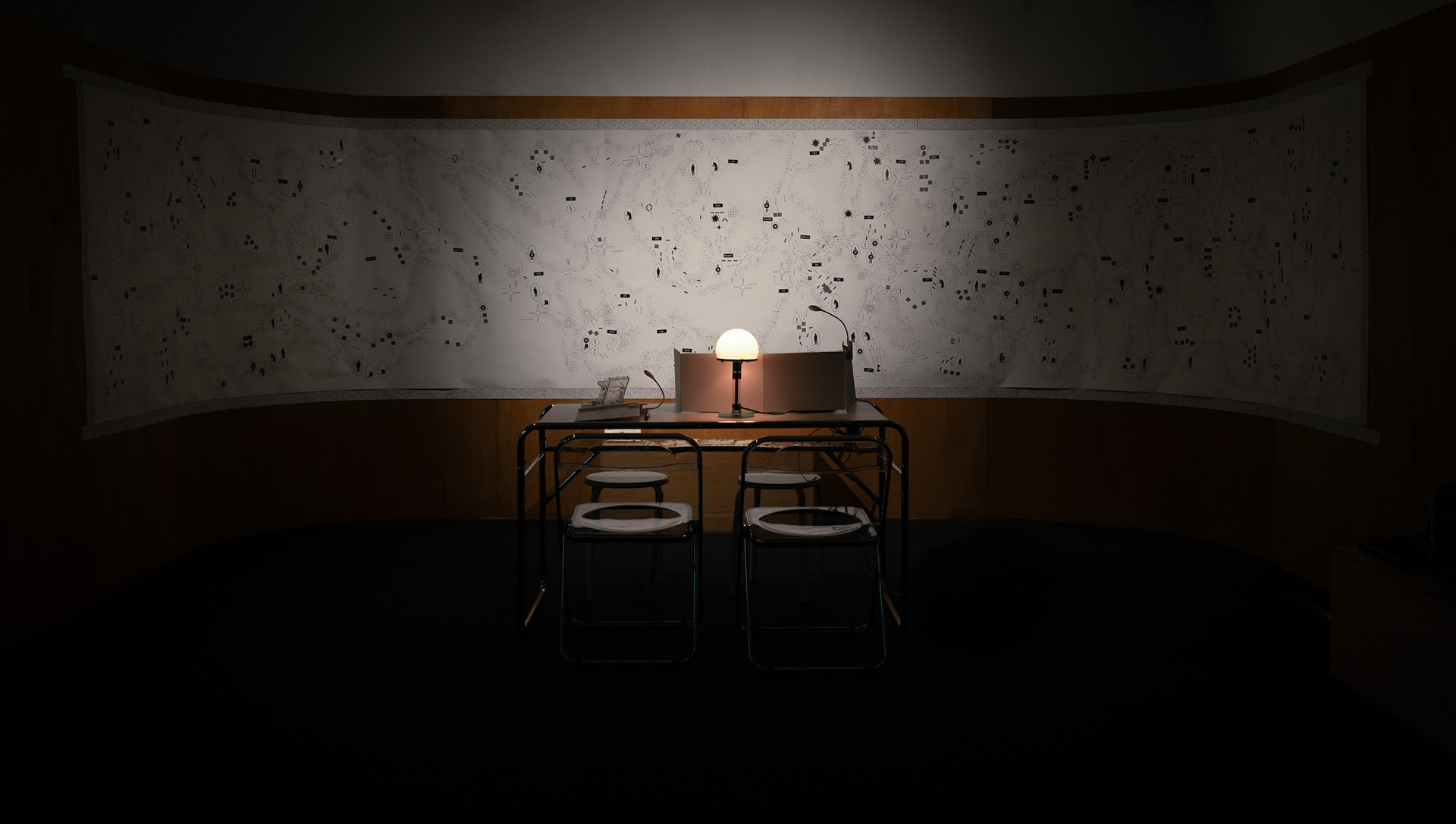
Notably, what happens after the player removes the HMD is crucial: freed from
the long playtime, the viewer slips off the headset—head throbbing, shoulders
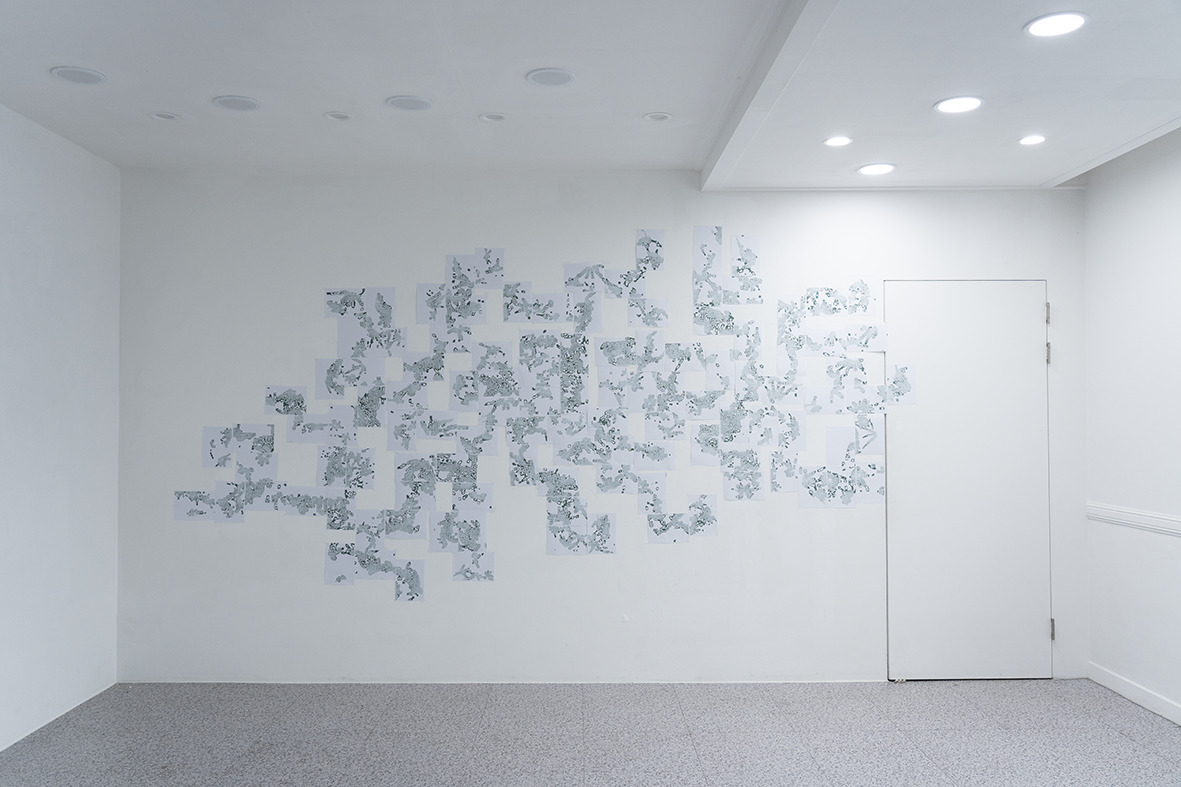
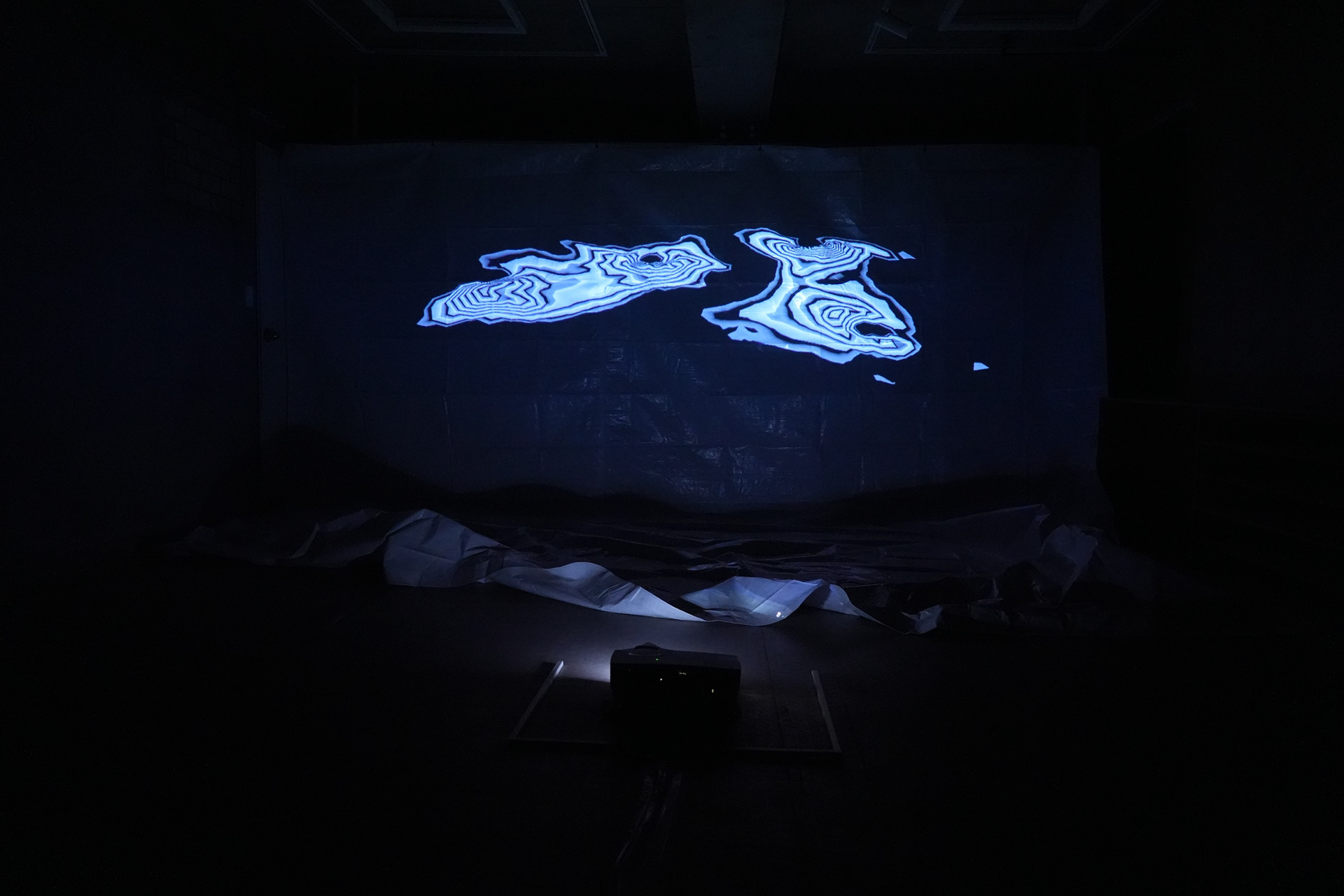
heavy—and sees their accumulated VR data printing onto paper. Depending on how
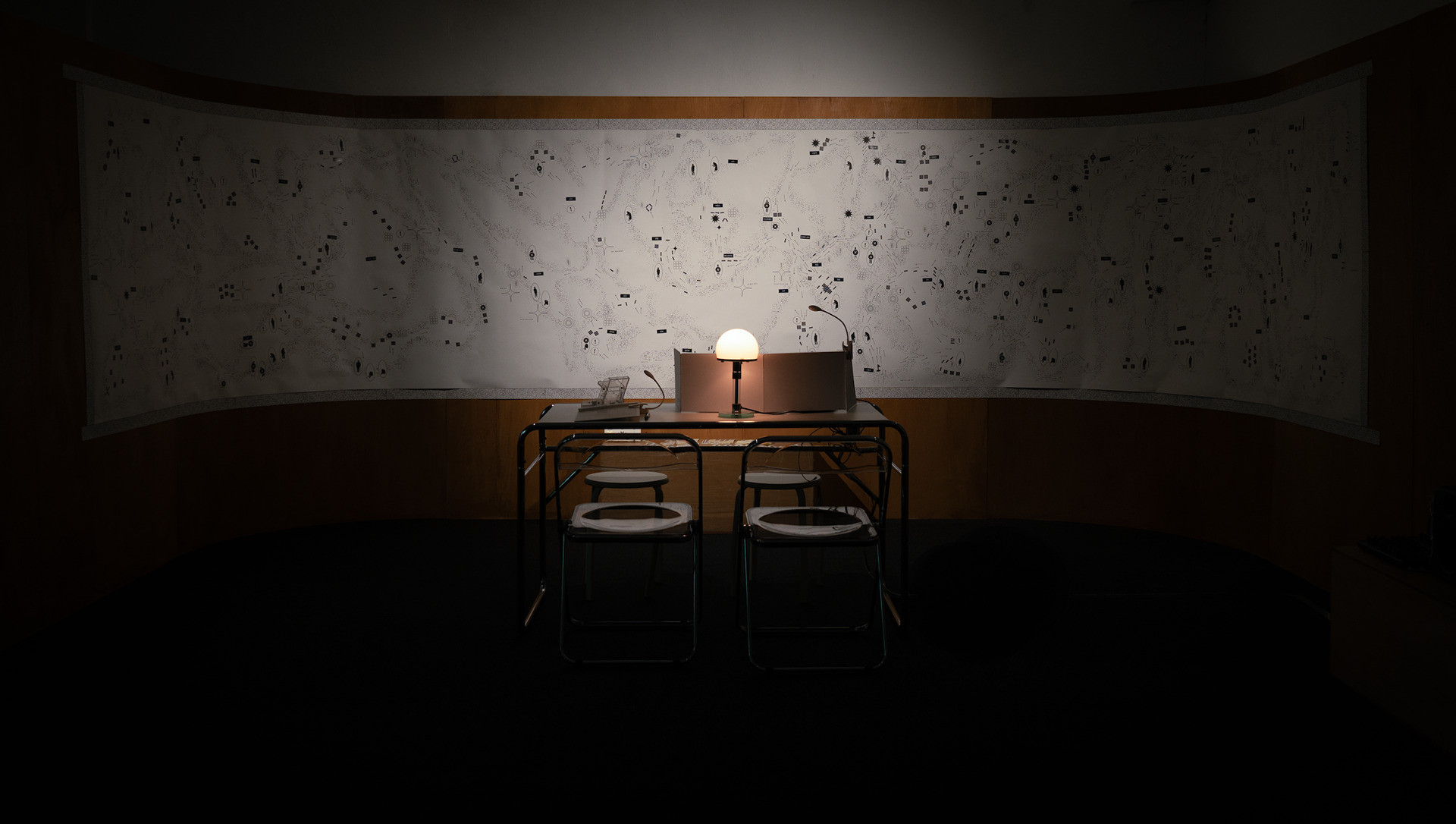
the giant’s body was covered, the data draws a terrain map. The high-spec VR
ground becomes a 2-D dataset stacked in space; meanwhile, in the basement, a
screen projects a combined map formed by aggregating all participants’
execution data. Viewers discover another trace of labor through a coupling of
physical and virtual spaces. In short, Worlding··· constructs
a world where “nothing happens,” yet makes palpable a community linked purely
by traces.
The
chief symptom of ennui is perceiving time as time itself. The subject of ennui
estranges themself—sensing time as if observing an object—and this proposes the
distance that partitions “you and I,” or the common terrain that binds us. In a
society whose time is packed to the seams—bodies “online” and synchronized
24/7—there seems no room to feel ennui. Here, SANGHEE attempts to
“desynchronize” bodies bound too tightly. From the unburied giant’s death—an
entity whose origin and very nature remain unknown—come stories of ennui and
solitude. Put differently, in the kingdom of fun, where world events are
consumed as images or shells, the artist slows the pace by weighting today’s
time, stretching the world in “loading,” and making a place for ennui—summoning
a solitary, existential confrontation with the self.