The history of art that grapples with
invisibility has a long lineage and trajectory. The Dadaists exposed hidden
social contradictions and absurdities through anti-art attitudes,
anti-nationalism, multinational identities, chance, and the irrational; Surrealism
revealed the unconscious and psyche repressed by reason. Martin Heidegger
argued that art shapes how humans understand the world and disclose Being,
framing it as a process of truth’s self-unconcealment (Selbstoffenbarung).
Discussing the shared origin of art and technology, he links their creative
modes of bringing forth things and world within art’s process of unconcealment.
Walter Benjamin introduced art’s Enlightenment function alongside
technology—its role in newly illuminating the world—while Marshall McLuhan
disclosed the essential meaning-making of media that had been assumed
transparent.
As technology increasingly shapes life and
the world—and as its rate of development accelerates—the weight and lethality
of the unseen both intensify and become further obscured. Media art, which
deals with technology as a central axis, responds closely to this condition. It
now goes beyond mere enlightenment, proposition of possibilities, or critical
stance to embrace a more comprehensive view—adding a new narrative of
“survival” to probe relations between technology and humans.
Artist Inhwa Yeom
explores a complex web of interwoven meanings and proposes a three-dimensional
XR-based interactive system—a 3D Performative Apparatus-Environment—where
visitors can directly access and intervene. On this basis she unfolds a
distinctive narrative, offering points of contact with a constellation of
meanings.
Yeom identifies two contemporary
manifestations of invisibility: the “climate crisis” and the “omnipresent
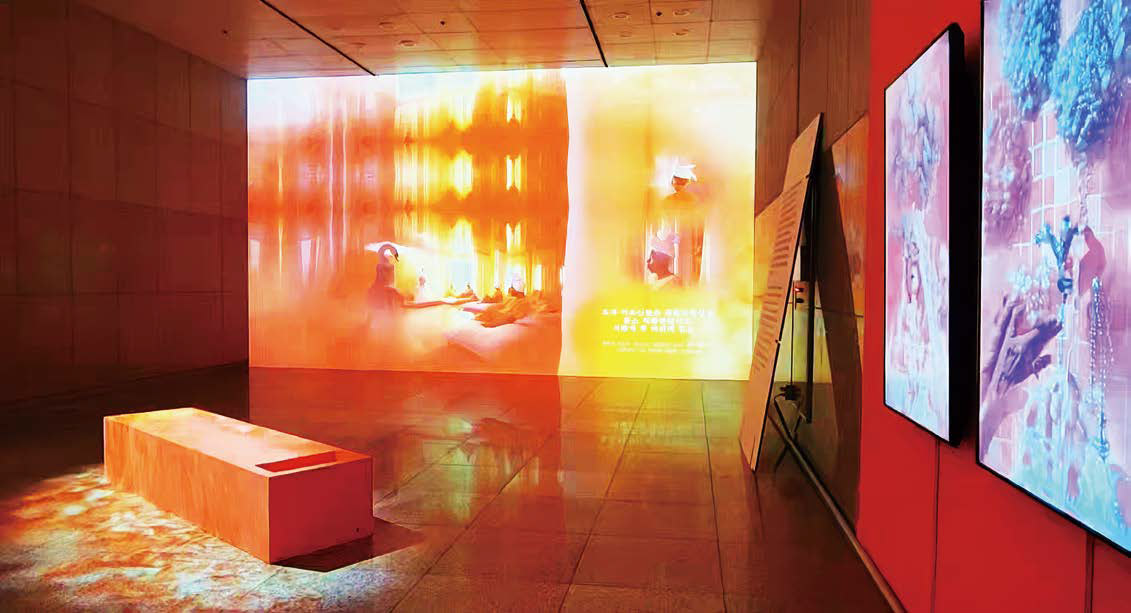
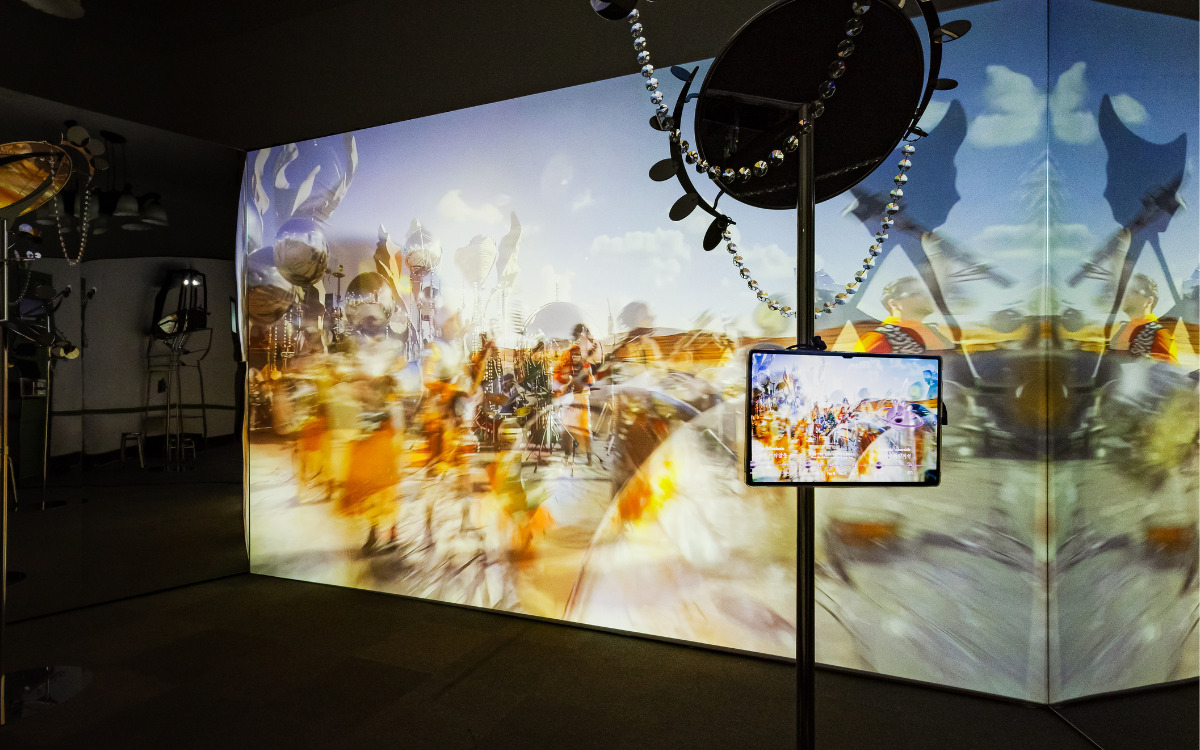
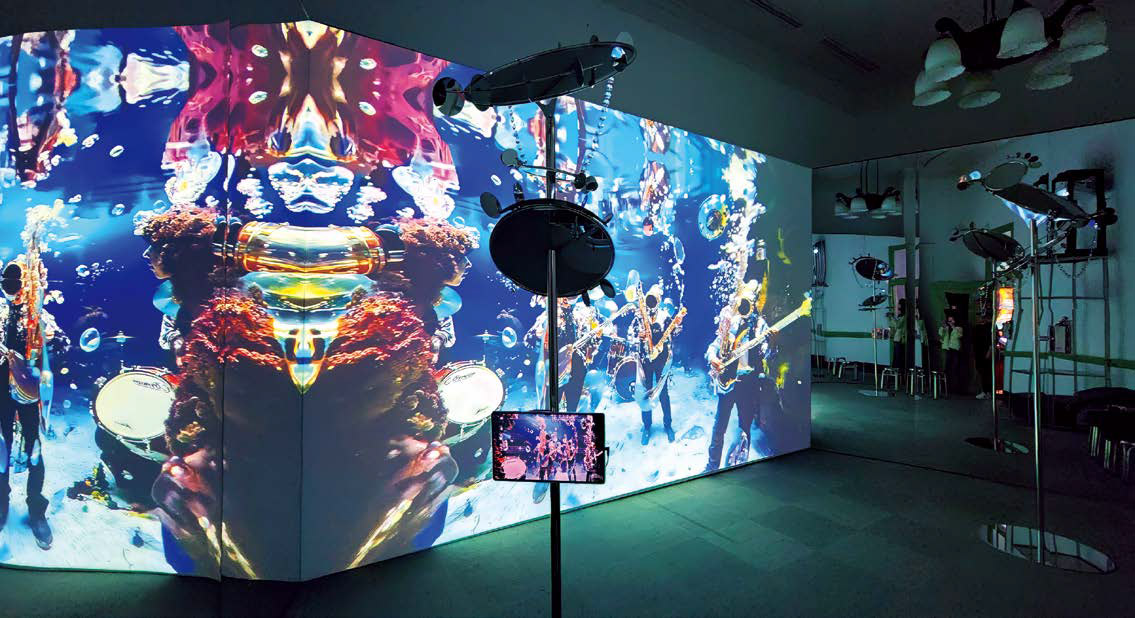
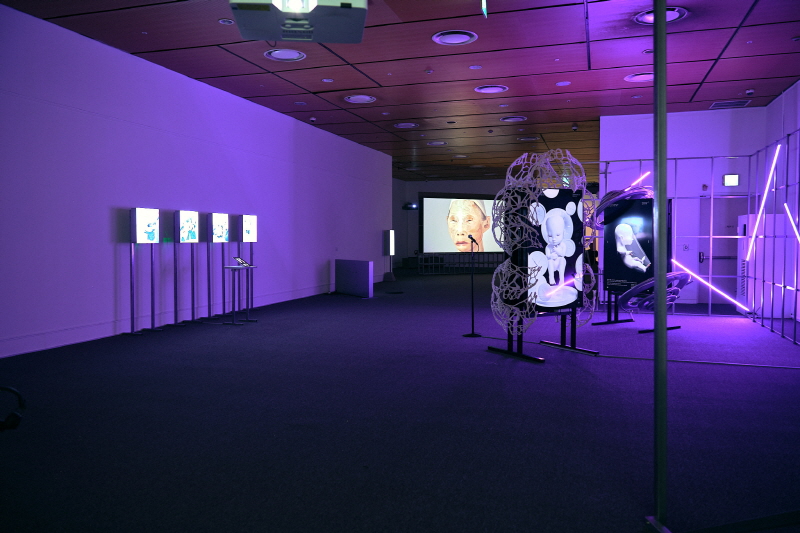
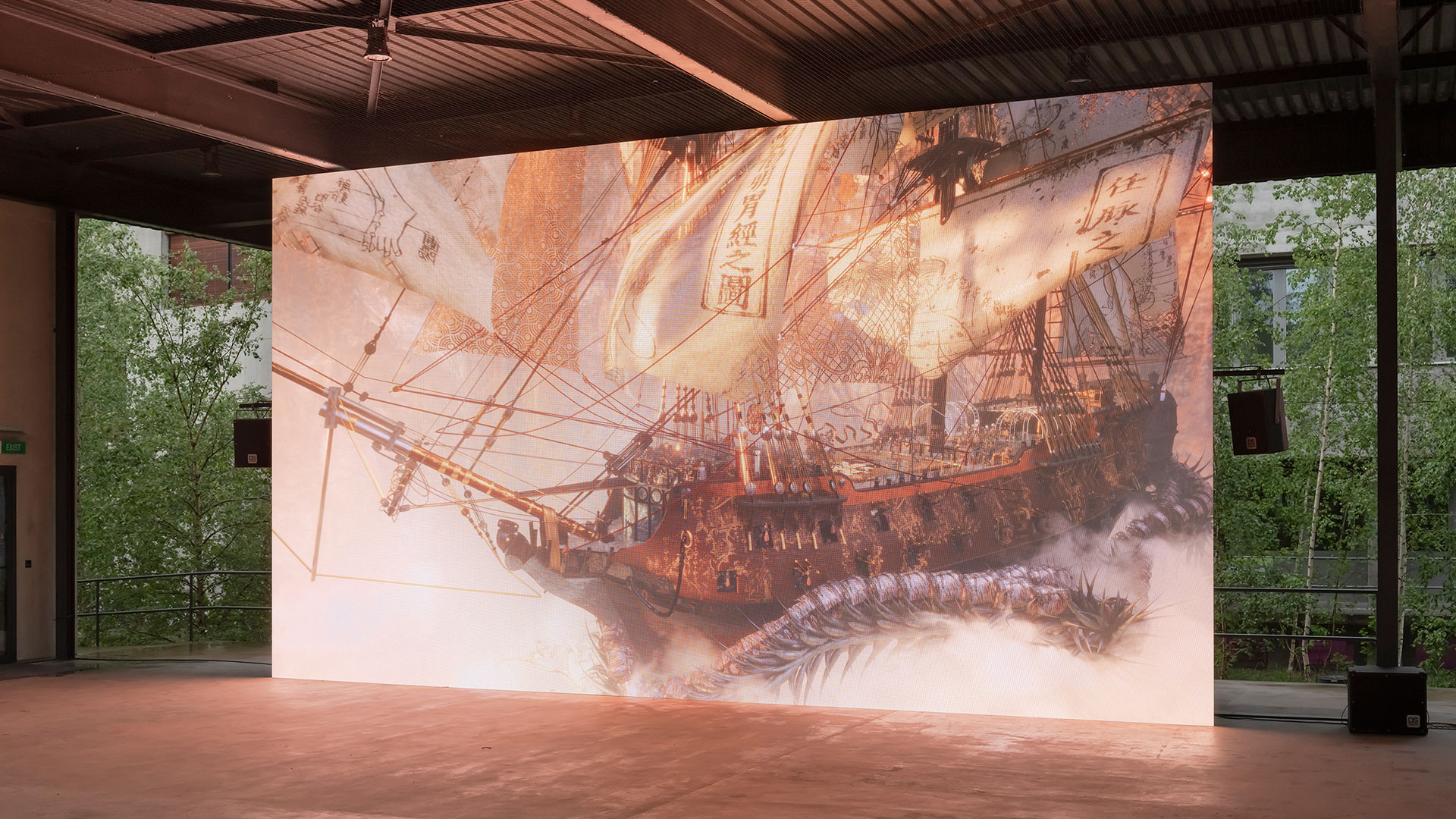
penetration of AI.” Her work Solarsonic Band (2024),
presented at Unfold X 2024, brings these two vast invisibles into co-presence
through a theatrical situation of performance and an unfolding narrative within
it. The piece does not stop at audiovisual delivery; it is structured in an
extended-reality environment so visitors can directly participate and
intervene. It invites us to sense, perceive, and think through conditions that
are invisible—hence vague—and thus merely watched, ignored, or even
unrecognized. In the pragmatic context of Korea’s climate-change performance
ranking 64th out of 67 countries, the work situates itself as an attempt that
goes beyond problem-posing to a participatory experience leading toward
practical alternatives.
In Solarsonic Band,
the concept of “performance” operates on three simultaneous planes. First, as
artistic performance, the work reinterprets Edvard Hagerup Grieg’s Peer
Gynt Suite using climate data, translating the reality of the
climate crisis into musical language. The prodigal Peer Gynt’s journey overlaps
with that of contemporary individuals living through climate crisis; music
functions not as mere background but as a core device structuring the
narrative. This exceeds a simple audio-visualization of data and delivers the
gravity of the crisis on a sensorial level. Second, as performance in the sense
of climate-response indicators, concrete data for each climate sphere exposes
the severity of reality.
The artist distills this into “Quantitative Narratives
of Climate Change: 50 Data Poems” embedded within the work. Phrases such as “By
2050, landslide-prone areas will increase by 30% compared to today. Scars
etched by reckless mountain development await torrential rain,” and “By 2100, the
growing season of plants will lengthen by 70 days. As seasonal boundaries blur,
nature descends into chaos,” appear in the space and user interface; visitors
interact with a system designed so they can adjust and reflect these directly.
Third, performance as it pertains to AI systems—their “performance”—both
critically illuminates technology’s environmental impact and seeks creative
ways to employ it. As Yeom noted during the Dialogue X symposium, the fact that
“a single use of ChatGPT is equivalent to running a light bulb for 20 minutes”
starkly shows the environmental effect of technological performance. Here, AI
performance seeks balance between environmental cost and creative potential,
urging us to rethink the fusion of technology and art.
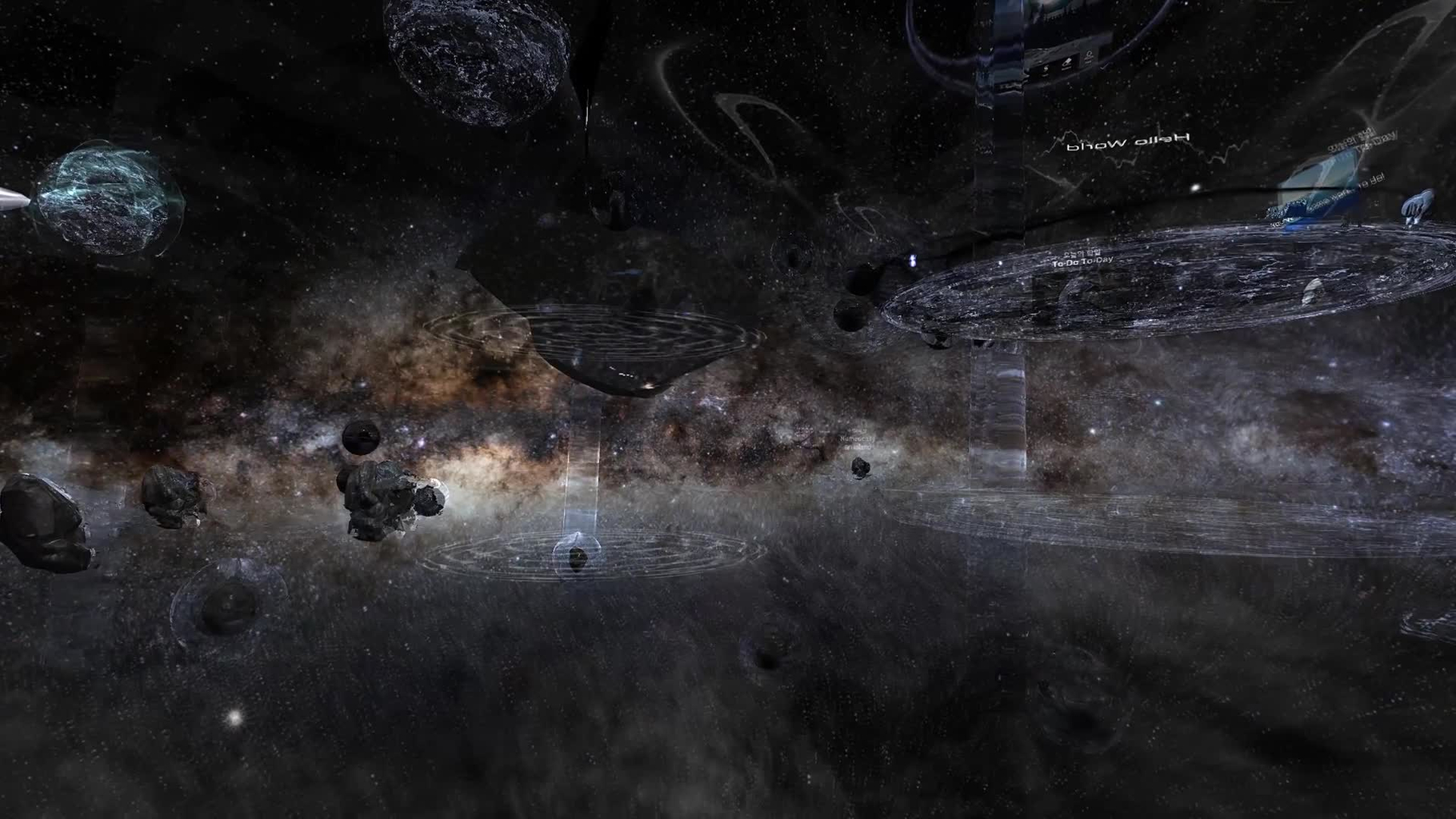
A key feature of the work is that, while
grounded in reality, it realizes a networked world capable of drawing out
latent meanings. In each VR scene, ten statements—“data poems” of quantitative
climate narratives—are not speculative musings but projections grounded in
fact. Thus the story does not remain a hypothetical fiction; it creates a
simulation in contact with reality. Particularly notable is the presence of AI
band members and crew. Dialogues among bandmates and staff—impossible in live
performance—are enabled here by AI, allowing the work to explore new phases and
zones of possibility beyond reality’s constraints.
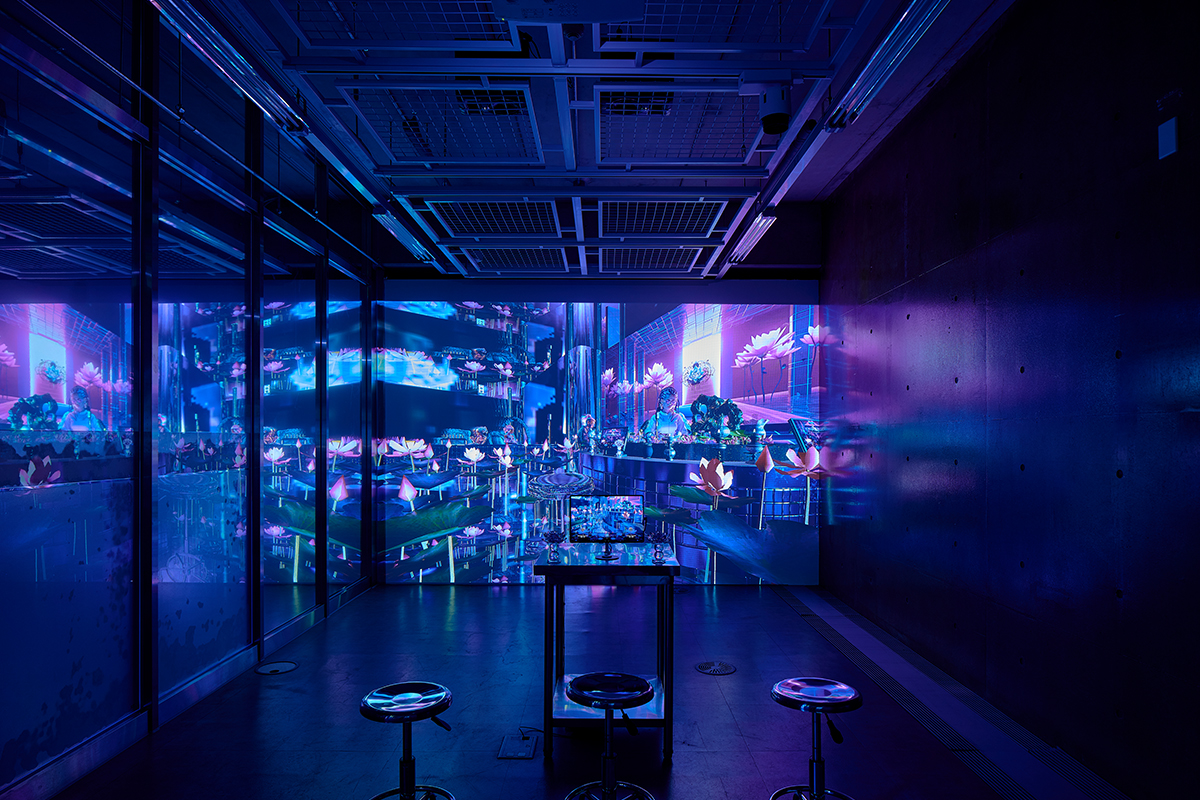
The work’s physical and virtual spaces are
meticulously structured. The VR stage tours the five spheres of the climate
system defined by the Intergovernmental Panel on Climate Change (IPCC)—the
atmosphere, hydrosphere, lithosphere, cryosphere, and biosphere—expressing each
sphere’s crisis from multiple angles. Here visitors are assigned a distinctive
position: through an AR-based on-site device called the “Band Stand,” they
participate as the “band lead.”
Reading text/graphic scores generated from
climate data on the tablet and adjusting parameters in real time, visitors
directly participate in modulating climate-crisis scenarios. Manipulating
tablet icons to intervene in the scenarios extends beyond simple interaction;
it positions visitors as responsible agents who must act in response to climate
crisis. This AR device germinates a performative interactivity of
meaning-production—beyond technical interaction as mere functional exchange
with the on-screen virtual stage. Participants become not only viewers or users
executing given roles but also key contributors composing the work’s meaning,
taking the position of the interface’s dramaturg.
Another intriguing turn arises in the
conversations within the work between the audience-concertmaster and band
members, as well as project collaborators. The AI stage manager overseeing the
show, together with the lighting, sound, apparatus-environment, and development
teams that shape the performance environment, converse incessantly about the
performance itself, its environment, and surrounding information—even while the
music is underway. Band members join this small talk mid-performance.
Because
AI runs the whole show, this situation—seemingly nonsensical to us
today—becomes possible, and the content of their chatter further amplifies it,
drilling into the ears of the audience-concertmaster who is performing
alongside them. Generational teasing, gossip about instrumentation and the
artist-director, and an onrush of slang and in-group lingo spill out. Amid the
smirks elicited by the familiar or the strange, the dizzying spectacle of
language carries weighty themes—critiques of the digital/analog binary, the
ethics of AI use, perceptions of and responses to the climate crisis—filling
the space. The dissonance between flippant language and an inescapably heavy
topic pierces the audience-concertmaster more sharply than a temperate harmony.
It is a moment of shedding—of slipping free from an insensitivity that results
from technologies and crises positioned too fast and too near, numbing and
concealing themselves.
We are situated within the technological
sublime. The complexity and scale of today’s technologies exceed our capacities
for understanding and perception. If the original discourse of the sublime
concerned the modern subject overwhelmed before the grandeur of nature—and the
philosophical awakening to the power of reason to transcend it—the
technological sublime takes on a different aspect. It can function as a kind of
adaptation mechanism beyond paralysis or Benjamin’s “anesthetization of
perception”: confronted with an overwhelming technological reality, our
cognition, senses, and even ethical judgment attempt adaptation not by response
but by blocking.
Concerning this extreme possibility, the artist
adopts a playful yet weighty approach through everyday narratives, community
slang and vocabulary, and the techniques of dialogue—proposing a process that
re-starts our perception and action. Here, a 3D Performative
Apparatus-Environment connects devices that visitors can operate and music they
can perform with space, story, and act. The artistic intervention that unfolds
secures the possibility of re-activating benumbed senses and judgment.
The new sensory field Solarsonic
Band opens for visitors unfolds on three major planes. First, it
translates the abstract concept of climate crisis into a concrete audiovisual
experience. Changes across the climate spheres are conveyed through specific
expressions and a musical narrative linked to the Peer Gynt Suite,
delivering a direct sensory impact. Second, it makes visible the omnipresent
penetration of AI technologies. Conversations among AI staff reveal how deeply
technology has already permeated daily life, recalling the irrevocable
inevitability of these entities and relationships. Third, it sensorially
presents the possibility of collective praxis. Collaborative performance
with band members lets audiences experience the collective effort demanded by
climate-crisis response.
The work also tackles head-on the ethical
dilemmas of AI use. In response to the question, “Isn’t it contradictory for a
work about climate crisis to use AI?”, the artist counters with “Who uses AI,
when, and how?” As Google’s 2024 sustainability report shows, AI’s carbon
emissions are surging; the work neither dodges this reality nor glosses over it
but actively takes it as an object of discussion. Of note is Yeom’s notion
of strategic use: rather than rejecting AI outright, she seeks practical
ways to employ it more efficiently and meaningfully within current conditions.
She reduces pre-/post-processing steps to cut computer time, streamlines
working hours, frequency, and staffing via AI, and leverages AI strategically
in shaping climate-crisis discourse. This approach recognizes the inevitability
of using technology while making visible a realistic effort to minimize its
negative impacts.
Given that technology now structures
all-encompassing domains of our lives, there is a growing need to continually
explore its social and aesthetic potentials and to concretize their diverse
modalities—while also recalling the presence of technologies that “hide in
plain sight.” In this context, the practice-oriented stance of Solarsonic
Band—beginning from curiosity, inviting contact and
interpretation—intersects with currents of media artivism. A performative
practice that organically links artistic grammar, digital technology, and
critical action renders visible our contemporary attitudes toward
technology—its invisibility and insensitivity—so that we can actively revisit
and perceive them. This does not stop at encouraging critical awareness of
black-boxed technology or the technological sublime; it moves further toward a
new politics of possibility through a subversive, interpretive use of
media technologies.
The work also transforms the vast challenge
of climate crisis into the realm of concrete, personal action and experience
through the concept of rehearsal. It is an attempt to explore the
possibilities of real change beyond simple warnings or enlightenment. More
crucially, the work proposes a role for art: not merely to represent or
critique reality but to intervene and effect change as a practical tool. Solarsonic
Band demonstrates this possibility concretely, offering a model
of artistic practice at the intersection of technology, art, and environmental
discourse.
As a hybrid performance that couples art’s creative vitality with
social praxis, it reveals the complex strata of meaning in contemporary
technological society while seeking alternative possibilities. It raises
fundamental questions about the social role of contemporary art and serves as a
kind of milestone pointing to where art in our time might go. For those of us
who cannot perceive or respond because the issues are too vast, too fast, and
too near, participation in the work’s polyphonic performance brings about
a resonance across its network of meaning—and casts light on
possibilities for our next steps.
* This article was written with support from
the Seoul Foundation for Arts and Culture’s Seoul Convergence Arts Festival,
Unfold X 2024.