Painting is a slow medium. But it wasn’t
slow to begin with. It has simply maintained its own steady rhythm and pace.
What has truly accelerated is the dizzying speed of modern civilization, driven
by the relentless progress of technology and industry. These developments have
swiftly transformed the means of artistic expression.
With the invention of
photography came a way to represent reality far more quickly and accurately
than painting could. The advent of cinema enabled the depiction not only of space
but also of time, and video technology introduced the real-time production and
transmission of moving images. Today, digital media offers an environment where
every kind of audiovisual information can be instantly encoded, integrated, and
transmitted.
This unfolding evolution of media technologies has accelerated
time itself. In the digital environment especially, time becomes atomized. As
philosopher Byung-Chul Han writes, “This is also what causes the feeling that
time is going by much faster than it used to. Because of the temporal
dissipation, experiencing duration is impossible. Nothing holds time. Life is
no longer embedded in the ordering structures or coordinates that grant
duration.”
Fragmented time gives rise to a certain
illusion. When the experience of duration is no longer possible, we are led to
mistakenly believe that the present is made up solely of moments that pass by
with increasing speed. Time is now defined by ultrahigh-resolution images that
stream instantaneously, by news that is responded to across the globe in
real-time, by the fantasy that life over there is no different from life here,
and by a fully synchronized world where things are constantly outdated and
updated.
Yet with just a moment’s reflection, we realize that surprisingly few
things are actually governed by the pace of accelerated technological progress.
Since ancient times, the Earth has completed its yearly orbit around the sun,
and in that cycle, the moon has waxed and waned twelve times. Pregnant women
still carry their children for roughly ten months before giving birth. Most
human hearts continue to beat at much the same tempo as they always have.
The
curious rock formations of Korea’s storied mountains endure in their own
mineral time, indifferent to shifts in climate or the rise and fall of
geopolitical regimes. The half-life of radioactive substances has remained
unchanged since the birth of the universe. Just as there are countless things
that have been accelerated by technology, so too are there many that continue
in unhurried, steady rhythms of their own. Together, they form our
contemporaneity. Slowness, after all, is only ever relative. And painting is
one such thing.
To be precise, painting is not inherently
a slow medium; it has become one in our time. And within atomized time, it has
come to bear the suspicion of having fallen behind the flow of contemporaneity.
Among painting traditions, Dongyanghwa (Eastern painting) faces a double
indictment. Because the Industrial Revolution was driven by the West, Eastern
painting was already regarded not only as part of an outmoded medium, but as
something doubly obsolete, an outdated form from an allegedly backward East.
Suddenly
branded with this stigma, Eastern painting withdrew into what was perceived as
the opposite of the contemporary: “tradition,” while simultaneously struggling
to leap into the present. Under the banner of “modernizing tradition,” it
sought to reinvent itself in order to catch up with the rapid pace of
contemporary life. Treated as doubly behind, Eastern painting came to be
likened to a turtle moving at its deliberate pace.
Yet contrary to Zeno’s
paradox, this slow creature placed upon itself the impossible burden of
accelerating fast enough to catch up with the far-ahead Achilles. This
overdetermined role stems from the optical illusion created by dispersed time.
The deceptive binary between “fast modernity” and “slow tradition,” born of our
infatuation with speed, absurdly urged Eastern painting to become a turtle
dreaming of outrunning itself.
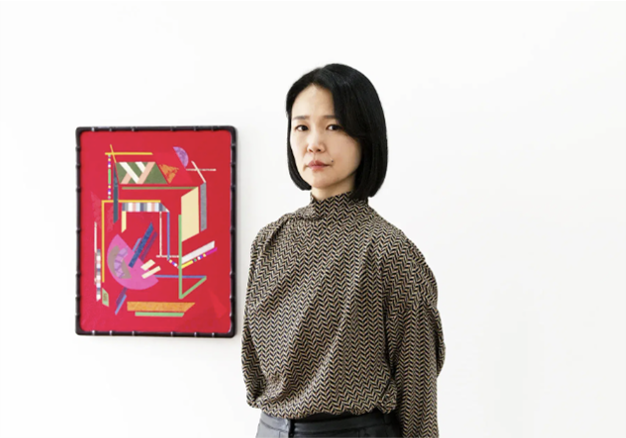
Kim Jipyeong pursues painting as a slow
medium without being trapped in nostalgia for the past. While she holds a
special interest in the Eastern, she does not regard it as a distant tradition
that needs reviving. This is because the contemporaneity she inhabits is a time
in which slowness exists alongside speed, and the East she engages with is not
necessarily identical to a tradition confined to the past.
She maintains a
thoroughly contemporary stance, contemplating and practicing Eastern painting
as it emerges from within that framework. In this sense, Park Chan-kyong has
noted that Kim’s work “does not exist solely ‘within’ traditional painting or
contemporary art, but rather ‘speaks about traditional painting and
contemporary art.’” For Kim, the question of tradition versus modernity is not
a matter of either/or, but rather two distinct temporal rhythms that together
comprise her contemporaneity.
To her, Eastern painting is as modern as it is
traditional, and the slowness of Eastern painting defines the character of her
contemporary moment just as much as the speed of modern civilization does.
Therefore, when she “speaks about traditional painting and contemporary art”
without privileging one over the other, she is ultimately engaging with the
complex and relative speeds that define contemporaneity as she experiences it.
The unhurried tempo of things that cannot
be subsumed by accelerated media, and the persistent duration of history that
cannot be dismantled by atomized time—these are embedded in the distinctive
form of “contemporary art” that Kim Jipyeong’s work brings forth. Park
Chan-kyong calls this tendency “rewinding,” suggesting that “when the
‘modernization’ of vernacular traditions intersects with the ‘rewinding of
modernity (the West),’ it can escape from the rigid, goal-driven language of
‘modernizing tradition.’”
If modernity is equated with the West and defined by
the fast-forwarding of time, then Kim rewinds this simplified notion of
modernity to reveal a more complex and dialectical reality of our time. Whereas
modernizing tradition reflects a “rigid pursuit” born of blind desire for
speed, “rewinding modernity (the West)” attempts to make visible what lies
hidden beneath this narrow understanding of the contemporary.
The “modernizing
tradition” must always be thought together with the “traditionalizing modern.”
Only through such a dialectical perspective can we fully grasp contemporaneity.
Achilles is not the present of the turtle, nor is the turtle the past of
Achilles. They are beings moving at different speeds within the same space and
time. In this sense, the contemporaneity of art is understood through the
dialectic of fast-forwarding and rewinding.
Eastern painting, imagined as a turtle, is
not a laggard left behind by the times. This illusion holds only within the
narrow vision created by the optical illusion of atomized time. We must broaden
our perspective as much as possible—not merely in spatial terms, but above all
in temporal ones. Put differently, we need not a narrow vision fixated on
fleeting moments of the present, but an expansive view that can perceive the
thickness of duration.
Through such a perspective, Eastern painting reveals itself
as a slow turtle, yet one that lives within a dense present. In this dense
present dwell both the slow turtle and the swift Achilles. This is the
temporality that shapes Kim Jipyeong’s Eastern painting and its
contemporaneity. When she conceives works using so-called “traditional” formats
such as folding screens or hanging scrolls, she does not regard herself as
working with antique art.
She buys these screens and scrolls on Karrot Market,
a secondhand trading app. Because many people still require folding screens and
scrolls for rituals or decoration, they continue to be produced and circulated
today. When they become burdensome surplus, they are resold on Karrot Market.
These inexpensive contemporary ready-mades—often featuring printed
reproductions rather than original ink paintings, sometimes backed with
newspaper—are the very materials she takes as sources for her work: modern,
mass-produced objects traded on the same digital marketplace as the latest
smartphones.
If we were to fully expand our sense of
the thickness of duration, we might acquire a cosmic perspective. The countless
stars scattered across tonight’s sky can be seen as a comprehensive map
encompassing the full depth of duration that constitutes our contemporaneity.
Each light we see comes from a star born at a different moment in time—some
even from stars that have long since perished.
There are also stars receding
from Earth faster than the speed of light, whose signals can never reach us,
yet they, too, exist somewhere in the night sky. The constellation of stars
stretched before us, from time immemorial to the present, is like a flat
tableau depicting the maximum span of duration that contemporaneity can
contain. In this context, Giorgio Agamben writes: “To perceive, in the darkness
of the present, this light that strives to reach us but cannot—this is what it
means to be contemporary.
This is why contemporaries are rare. And this is why
being contemporary is, above all, a matter of courage.” Not everyone born in
the same period or living in the same era is a contemporary. A contemporary is
one who perceives not only the visible present but also other, invisible
temporalities that coexist alongside it. True contemporaneity includes not only
the speed of modernity but also the slowness of tradition, not only the present
of tradition but also the tradition of modernity, not only the fast-forwarding
of time but also the vector of rewinding.
“Contemporaneity is thus a singular
relationship with one’s own time, which adheres to it and, at the same time,
keeps a distance from it through dislocation and anachronism.” The courage to
affirm the phase shifts between temporal acceleration and deceleration, and to
embrace the anachronisms that traverse chronological order. This is what
ultimately makes us contemporaries.
The reason for likening Eastern painting
to a turtle is primarily because both carry the image of slowness and being
left behind. But there is another reason: Kim Jipyeong’s current exhibition is
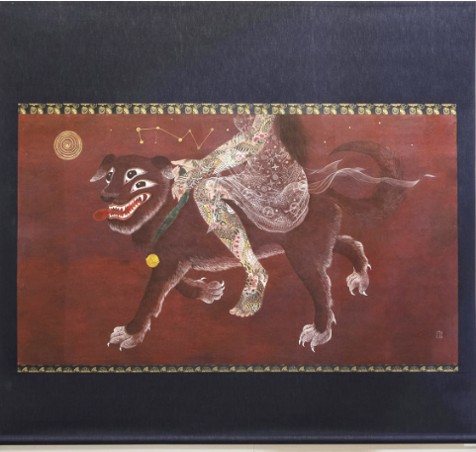
itself about the turtle. She presents Cosmic Turtle (2025)
as its title. This “turtle of cosmos” suggests that Kim may well be one of
those rare contemporaries—or at the very least, someone who deeply understands
what it means to be one. The turtle of our time she evokes in this exhibition
encompasses the entire duration of the cosmos.
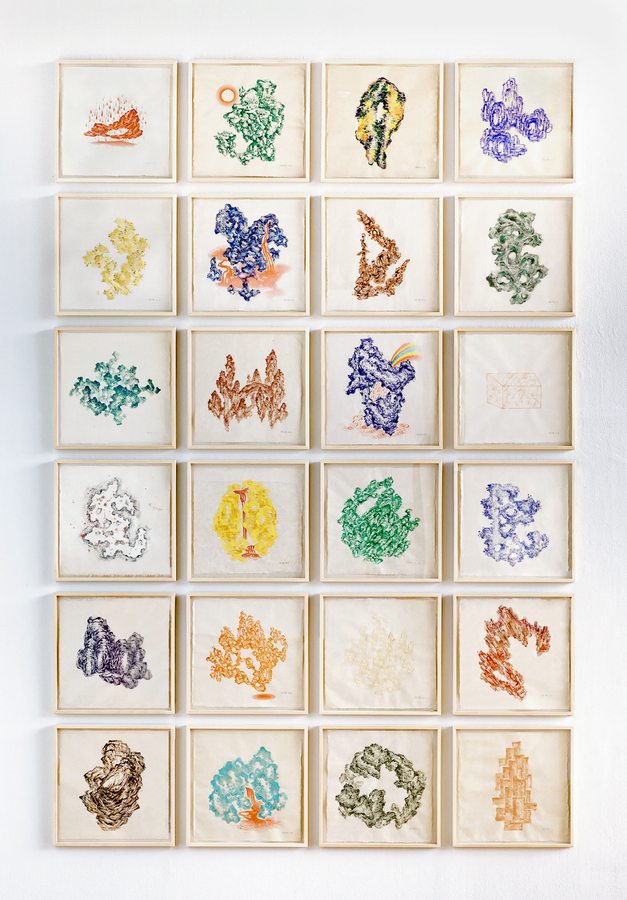
According to ancient Chinese mythology,
the turtle is closely linked to the origin of the cosmos. Consider, for
instance, the myths of Hado 河圖 and Nakseo 洛書. Hado is a diagram of fifty-five dots said to have been borne from the
Yellow River by a dragon-horse during the time of Fu Xi. Hado, composed of nine
patterns formed by forty-five dots, is said to have appeared on the back of a
turtle that surfaced from the Luo River when Yu the Great was working to
control the great floods.
Regarded as precursors to the Taiji and the Eight
Trigrams, and foundational to the principles of the I Ching, these two diagrams
have also been interpreted as cosmological maps oriented around the North
Star.8 In these myths, the dragon-horse delivers the image 圖, while the turtle brings forth the written word 書.
This act is said to mark the beginning of human civilization. In another
Chinese myth, the turtle forms the very foundation of the world: its domed
carapace is the sky, and its flat plastron is the earth.
In this way, the turtle
in Chinese mythological tradition represents both the basis of the cosmos and
the origin of civilization. This is precisely where Kim Jipyeong’s Eastern
painting, her turtle, takes its point of departure. The visual chronicle of
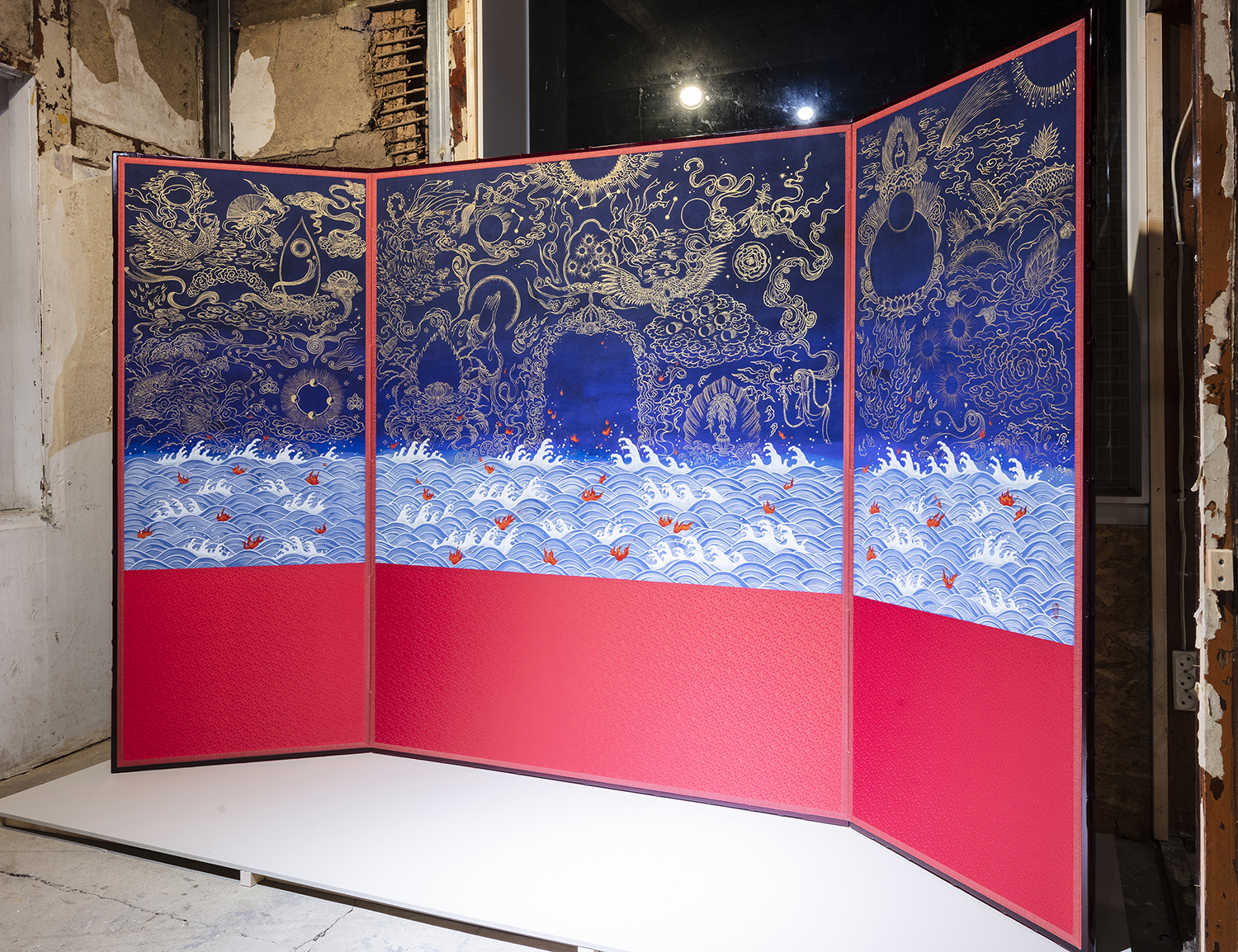
Cosmic Turtle, rendered as a sequential narrative akin to the Buddhist
Oxherding Pictures 尋牛圖, unfolds through images of
constellations embroidered across the sky, a turtle bearing the Nakseo on its
shell, and figures dancing within the turtle’s belly.
Yet in Kim Jipyeong’s work, this sluggish
turtle of myth is not confined to the fleeting past as a relic overtaken and
left behind by the nimble currents of modern civilization. The chronicle of
Cosmic Turtle unfolds beyond its mythological origins, moving into scenes of
modern technological prosperity and the destruction that follows in its wake.
Some years ago, a dead sea turtle washed ashore on Korea’s eastern coast, its
entrails containing a piece of plastic.
When the foreign matter was rinsed
clean, it revealed tiny letters densely printed on its surface: propaganda
leaflets, symbols of ideological struggle and psychological warfare in a
divided nation. The ancient turtle that once gifted humanity with written word
had perished after swallowing a plastic scrap inscribed with that very gift. In
Kim’s paintings, the ecological devastation wrought by hyper-industrial
civilization is montaged together with the symbolic origins of that very system
into the chronicle of Cosmic Turtle.
This is the thickness of enduring time
that she perceives—a temporality made legible—and the contemporary stance she
claims through anachronism. From such a cosmic perspective, Eastern painting
rewinds the present, forging contemporaneity not by matching the tempo of other
contemporary art, but by asserting a slower rhythm all its own.
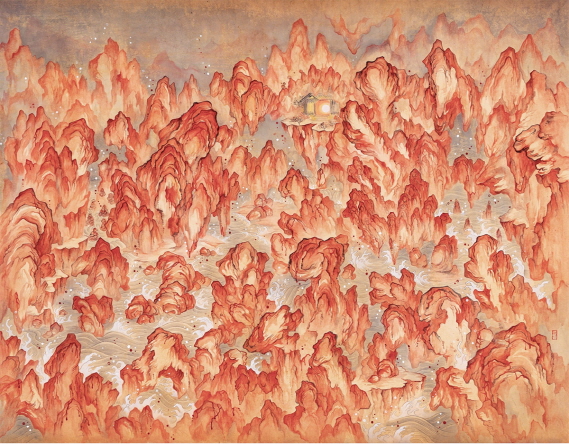
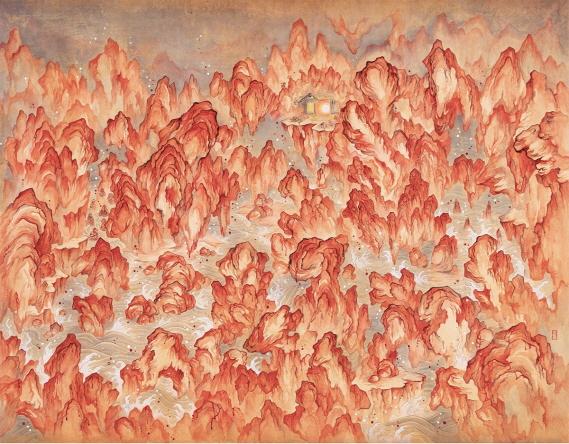
Kim Jipyeong’s stance toward Sansuhwa
(landscape painting), or traditional landscape painting within Eastern
painting, follows the same logic. For her, Sansuhwa remains a vital means of
expression even today—unsurprisingly so, since mountains and rivers still cover
most of the Korean peninsula, each maintaining its own temporal rhythm.
These
features of the land reflect a contemporaneity shaped by natural slowness, a
pace that falls far short of modern civilization’s accelerating change. In
Michae Sansu (Camouflaged Landscape) (2009), Kim depicts
mountains, waterfalls, and rivers alongside military facilities camouflaged
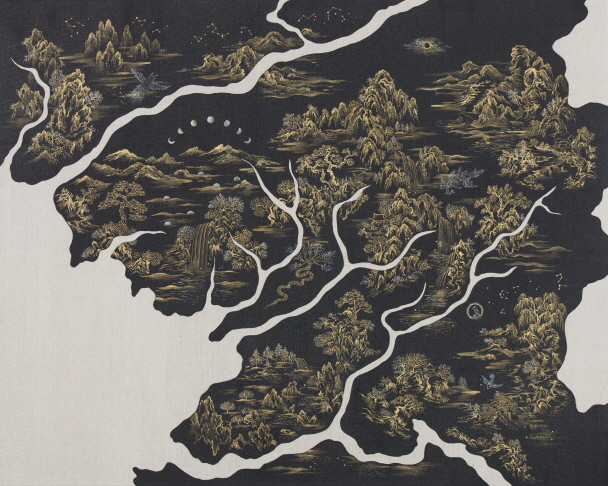
with paint, evoking the condition of national division. In
Pyeongando (2014), she combines the styles of landscape
painting and cartography, drawing from historical texts and using ink and gold
pigment on canvas to represent the Gwanseo region—her maternal ancestral home,
now inaccessible.
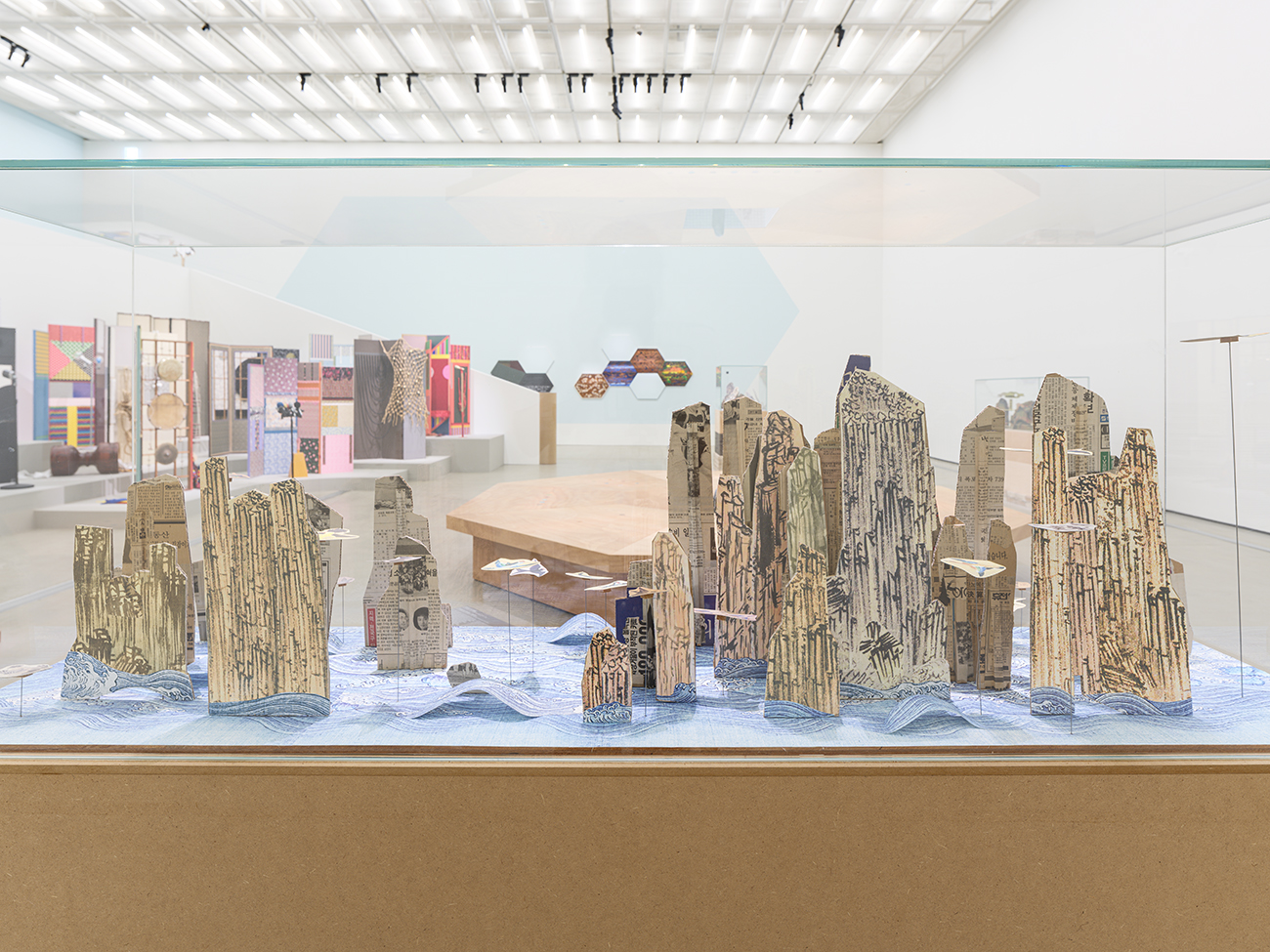
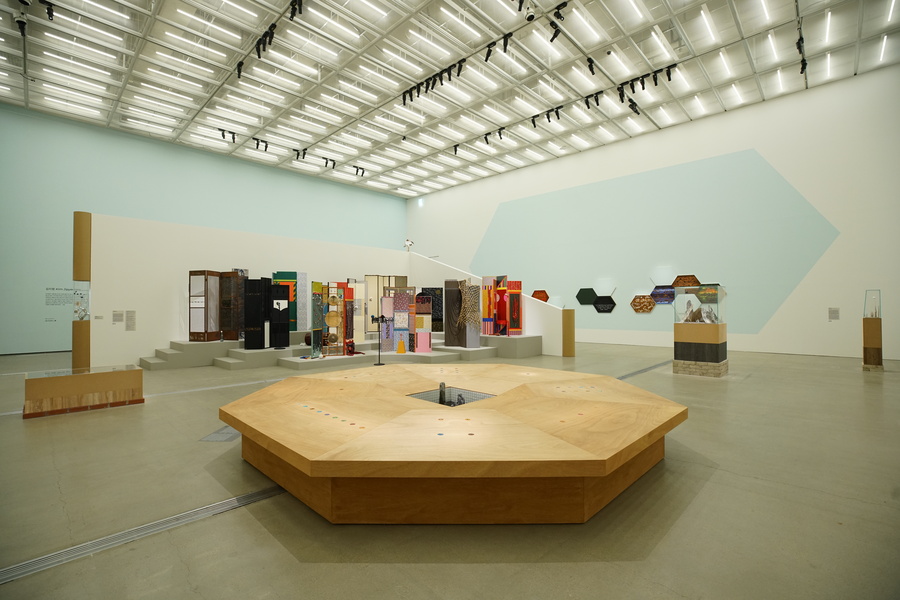
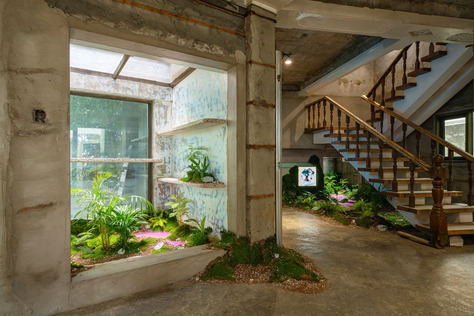
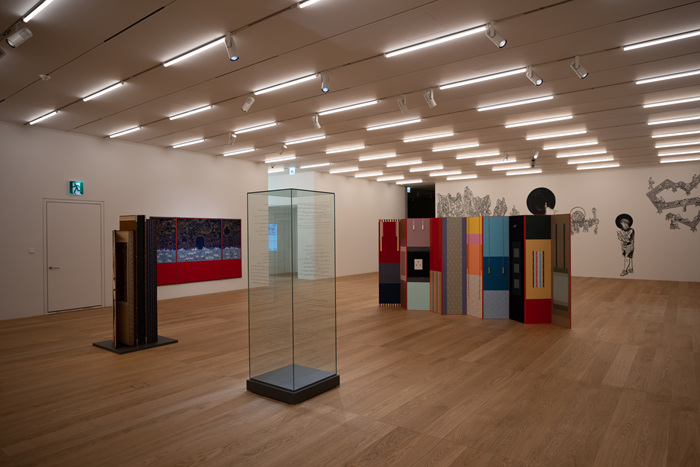
In her current exhibition, Kim transforms the gallery itself
into the space of a landscape painting. She installs an octagonal pavilion made
of wooden panels, a structure typically found in traditional landscapes, and
places artificial rocks and water at its center, employing Chagyeong 借景 (borrowed scenery) to three-dimensionally realize the compositional
logic of Sansuhwa within the exhibition space.
Viewers may sit in the pavilion,
rest, and engage with the works. Clearly, this is not an installation designed
as a time machine to simulate a bygone tradition. The landscape visible from
within the pavilion is instead a scene in which past and present, tradition and
modernity, Eastern painting and contemporary art are interwoven through the
entangled tempos of speed and slowness that define Kim Jipyeong’s
contemporaneity.
Within an artistic perspective where
“modernizing tradition” and “traditionalizing modern” form a dialectical
relationship, the very distinction between Western and Eastern art may well
lose much of its significance. Once we move beyond the deceptive opposition of
“fast modernity” versus “slow tradition,” the relationship between Western and
Eastern art can be understood not as a conflict between the modern and the
traditional, but as a difference in intensity and vector within the field of
comprehensive contemporaneity.
Within this interplay of fast-forwarding and
rewinding, moments of anachronistic encounter between the respective histories
of Western and Eastern art become particularly compelling. Consider, for
instance, the fusion of image and text. In Western art history, major examples
include Guillaume Apollinaire’s Calligrammes and Pablo Picasso’s Synthetic
Cubism in the early twentieth century. Apollinaire gave visual form to the
subject of his poems through their typographic arrangement, while Picasso
collaged heterogeneous objects onto the canvas and incorporated suggestive
lettering.
In the East, by contrast, image and text have shared a common origin
from the very beginning. As noted earlier in the myths of Hado and Nakseo, both
Do 圖 (image) and Seo 書 (written
word) emerged from the constellations. In ancient Chinese Oracle bone script 甲骨文, character and image were never separate.
Moreover, Jebal 題跋 (the inclusion of colophons) in Eastern painting was hardly unusual.
In the tradition of Muninhwa (literati painting), Siseohwa 詩書畵 (the trio of poetry, calligraphy, and painting) held equal and
inseparable value. Even in the realm of Minhwa (folk painting), Korean Munjado
(character paintings) show that text and image were not fundamentally distinct.
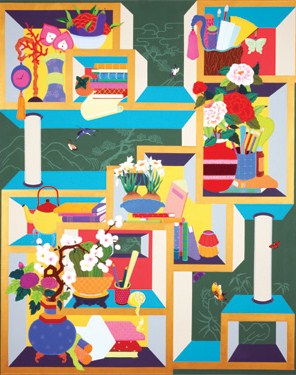
Within these leapfrogging “archives” of
East and West, Kim Jipyeong discovers materials and forms suited to revealing
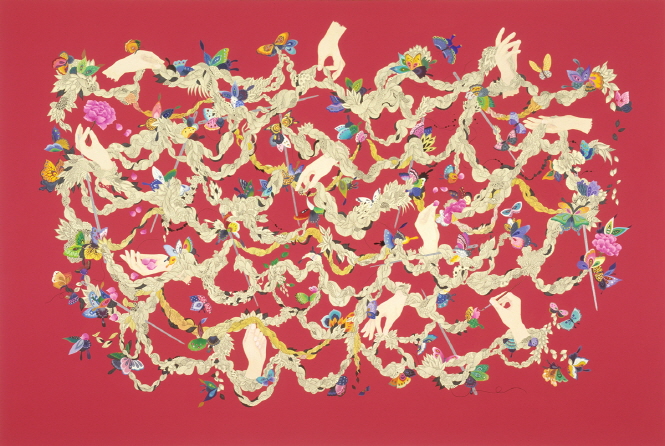
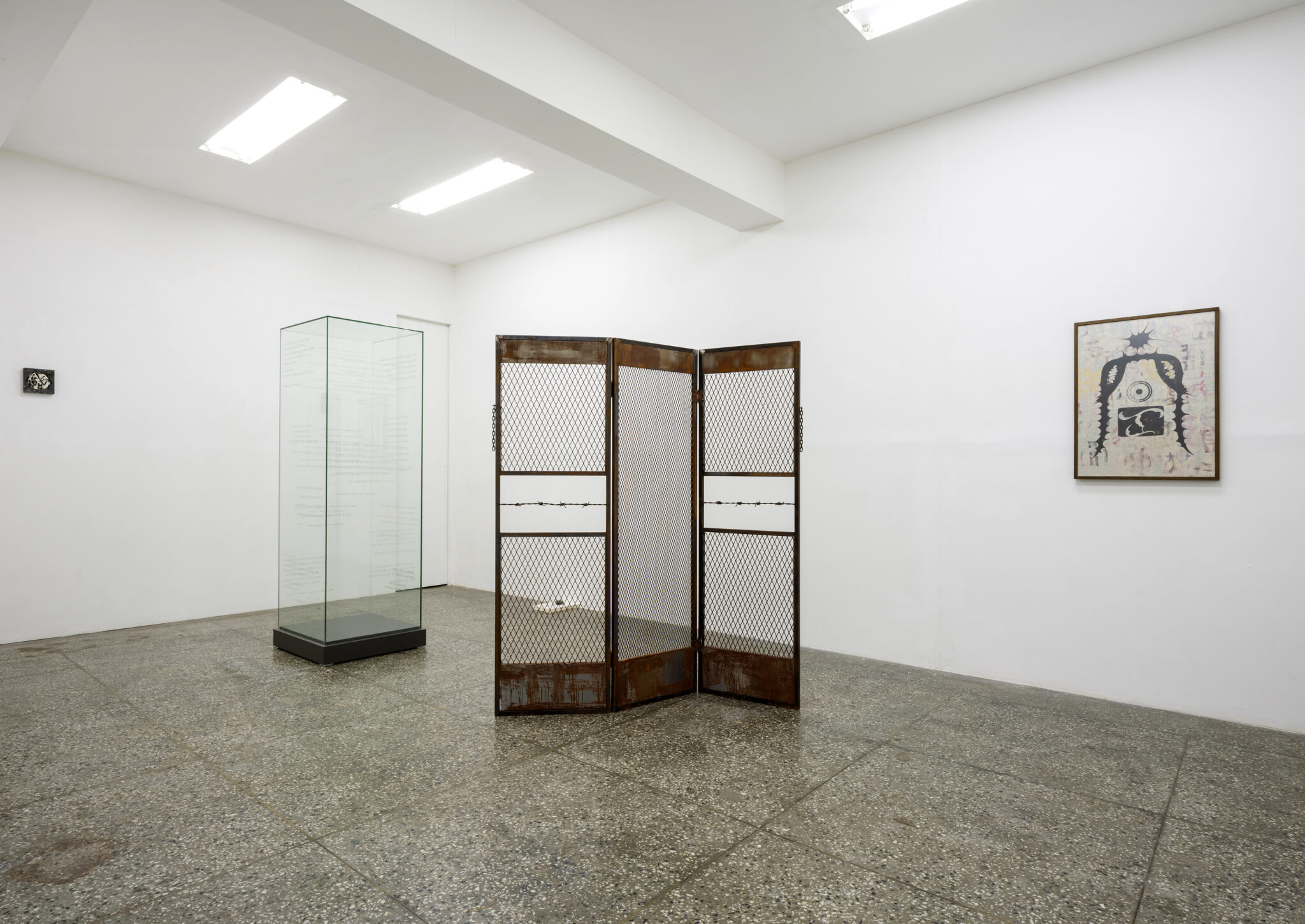
contemporaneity. Her ‘Munjado’ series, begun in 2017, borrows the formats and
materials of Joseon folk Munjado to embody her perception of contemporaneity.
In Confucian Joseon society, Munjado typically depicted virtues such as Hyoje
chungsin 孝悌忠信 (filial piety, fraternal love, loyalty, and
faithfulness).
Kim, however, selects characters that carried negative
connotations in Confucian culture—such as those containing the female radical
Gyejipnyeo 女 or characters like Eum 淫
(licentiousness)—to address contemporary themes of gender and sexuality. In
Untitled: Emulated ‘Yang Yanping’ and ‘Bahc Yiso’ (2017),
she adopts an Eastern painting format with colophon included, printing an image
on hanji paper and then adding pencil marks—a hybrid method that
anachronistically intersects the Eastern tradition of Bang 倣 (emulation) with the Western concept of appropriation.
Kim’s
engagement with Munjado extends beyond traditional Chinese characters to
include hangeul. In rururururu (2025), for instance, the
Chinese character for “tears” 淚 is modified: its dog
radical 犬 is replaced by various animals—ox 牛, cat 猫, turtle 龜, bird 鳥—to form variant characters. Alongside these, the character’s Korean
pronunciation ru is written repeatedly in vertical rows of black ink, flowing
like tears. Various animals, including turtles suffering from the rapid
development of modern technological civilization, weep silently with muffled
cries of “rururururu.”
Meanwhile, Kim Jipyeong applies to Eastern
painting the discourse on media—a primary concern in visual culture studies
that began in earnest in German-speaking and Anglophone contexts after the
1990s. She approaches Eastern painting’s Janghwang 粧䌙/裝潢 from a media perspective.
Janghwang refers to
the decorative mounting that transforms paintings and calligraphy into formats
such as hanging scrolls, folding screens, handscrolls, books, and albums—in
other words, it constitutes Eastern painting’s material support. Traditionally
considered secondary decoration relative to the image itself, Janghwang was
often likened to clothing for paintings and calligraphy. Intriguingly, this
“clothing” was specifically imagined as women’s attire. Each panel of a scroll
or screen has designated names: the bottom is the “skirt,” the top the
“jacket,” and the sides the “sleeves.”
The attribution of femininity to
decorative elements rather than the work itself likely stemmed from the
parallel between women’s subordinate position in patriarchal society and the
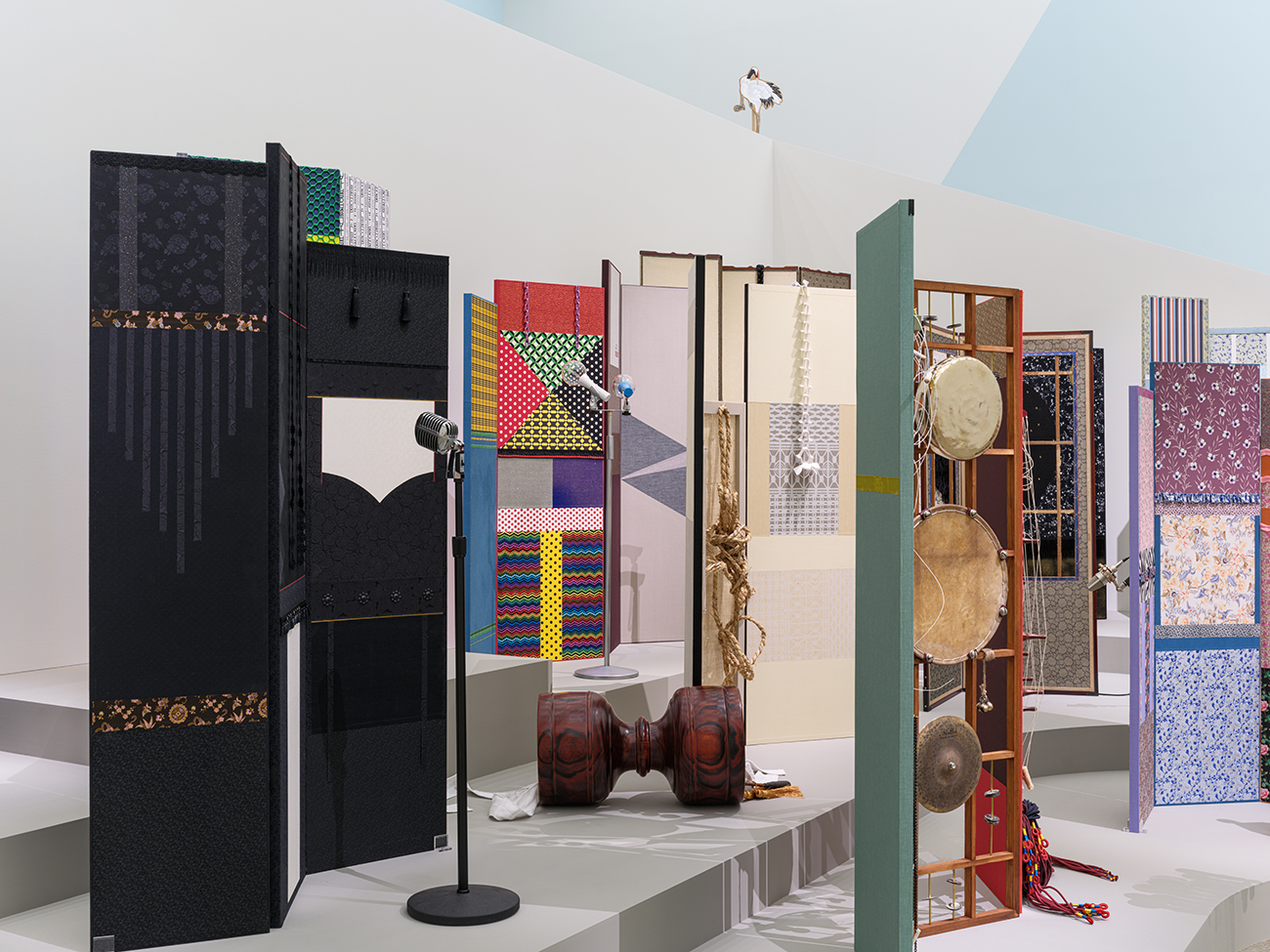
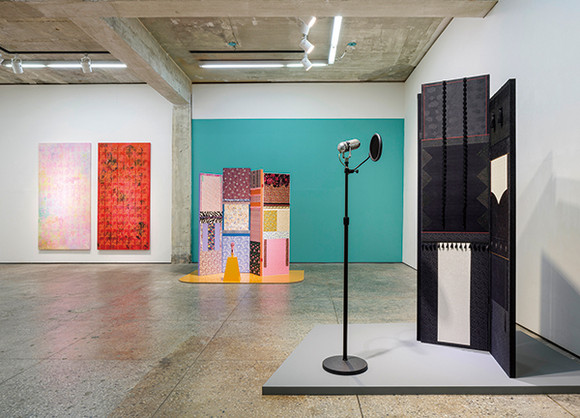
marginal role of ornament in relation to the artwork. Kim removes the paintings
from secondhand scrolls and screens, leaves their supports intact, and creates
anthropomorphized works by attaching materials such as silk, lace, tassels, and
straw to them.
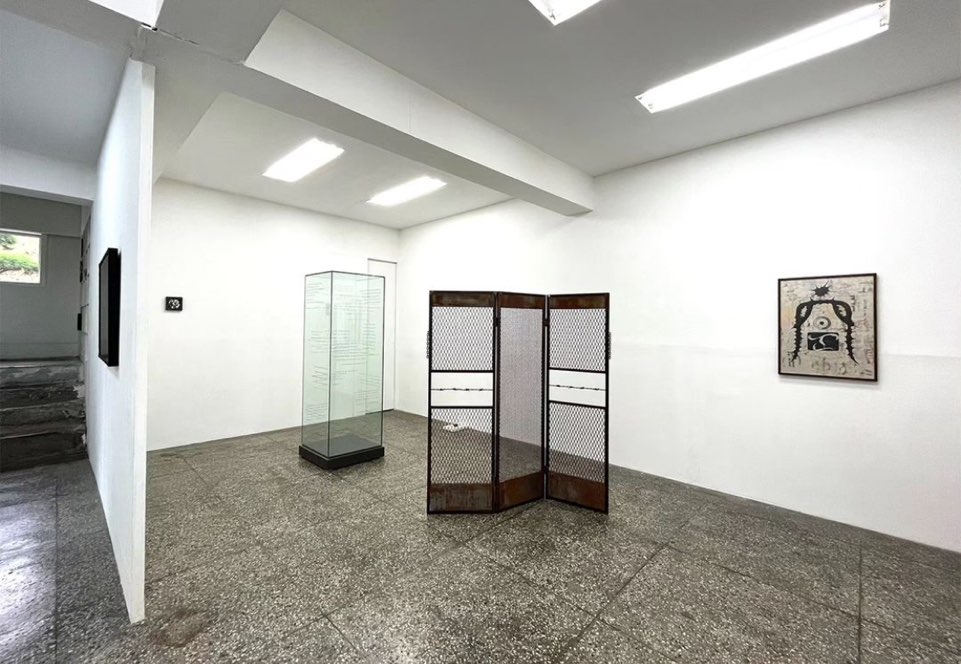
In the current exhibition, her installation ‘Polyphonic Chorus’
(2023–2025) adds new pieces to her ongoing screen series and places audio
microphones in front, staging a scene in which multiple figures appear to sing
in chorus. The act of imagining their silent harmonies is not unlike the effort
to perceive invisible starlight in the night sky.
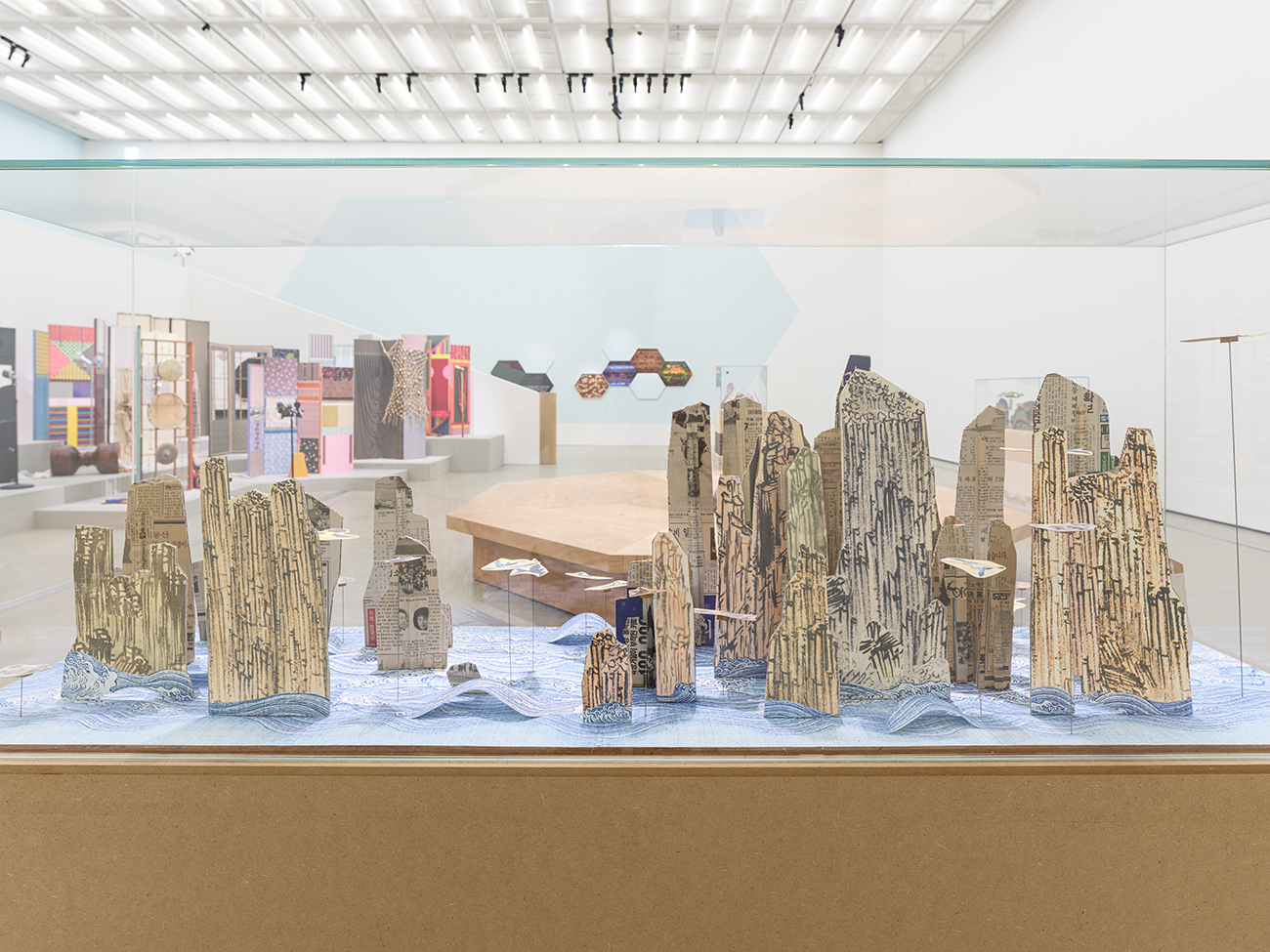
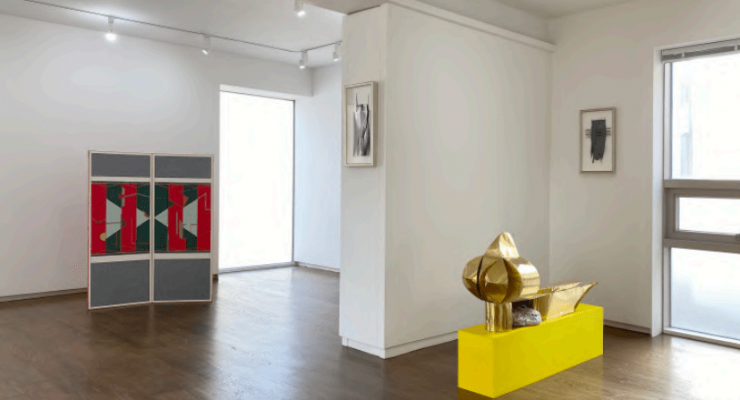
The ready-made screens Kim Jipyeong
purchases secondhand, fragile in construction and made from cheap materials,
feature not genuine paintings but printed reproductions. ‘Pop-up Sansu’
(2023–2025) is a three-dimensional montage work that recycles these images
(reproductions) removed from screens, arranging them like a pop-up book.
As
traditional rituals such as ancestral rites become increasingly simplified or
omitted altogether, these images from now-obsolete screens stand upright on
pedestals. This is not an attempt at sweet nostalgia for Eastern painting
traditions or their glamorous revival. Rather, it should be seen as an effort
to raise onto the surface of visibility the mode of existence of Eastern
painting as it truly is—which, though collapsing one by one like the sea turtle
that died after swallowing propaganda leaflets, still constitutes part of
contemporaneity.
Eastern painting, fallen with a thud in accelerated time, has
not vanished; instead, it persists in its fallen state and will gradually rise
again at its own slow tempo.
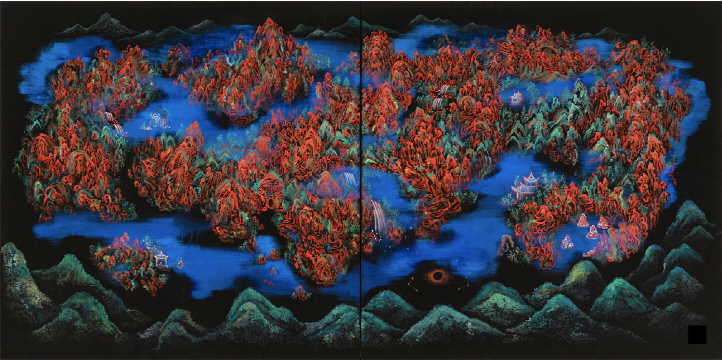
Let us return to Kim Jipyeong’s narrative
paintings. Where does the chronicle of ‘Cosmic Turtle’ ultimately lead? The
turtle wandering through the universe’s duration passes through the sea turtle
that died after swallowing propaganda leaflets and arrives at a black screen
conceived as a Heukgyeong 黑鏡 (obsidian mirror). As if
fallen into an abyss of complete oblivion, not even a trace of the turtle
remains, nor any visible form.
But is this truly the end? Must all things
invisible to our vision—beguiled as we are by time’s rapid pace—remain forever
imprisoned in the darkness of the past? Let us look at another of Kim’s black
paintings. This scroll painting, despite its deep darkness, offers up
constellations faintly glowing like an unexpected gift. A gift signals a new
beginning.
We must remember that the chronicle of Cosmic Turtle began with
constellations. Light from countless stars in the expanding universe reaches us
at different speeds. The resolute courage to perceive signals of light creeping
toward us like a turtle through darkness that seems empty—that is what makes
Kim Jipyeong a contemporary Eastern painter. And that is the virtue of slowness
inherent in the contemporaneity of Eastern painting.