Data
Ordinarily, the opening of an art exhibition
indicates the completion of an artist’s work in preparation for the exhibition.
The time leading up to the opening is time in which the artist creates the
artwork, and the opening is regarded as the end of this creative activity. In
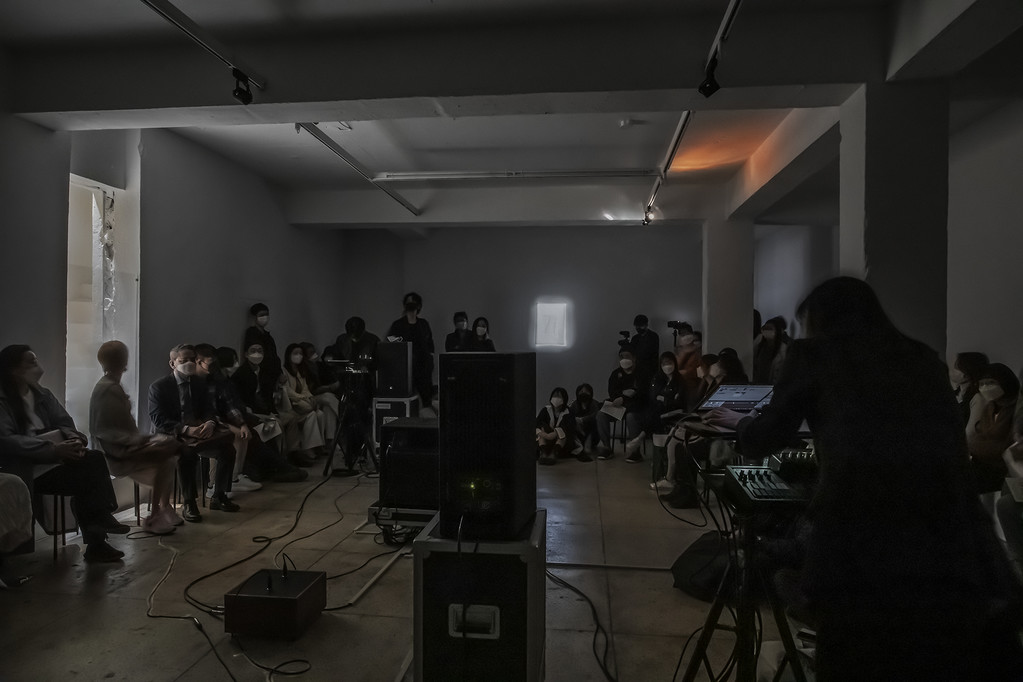
the 2020 exhibition 《Time in Ignorance》, however, GRAYCODE and
jiiiiin instead used the opening to mark the starting point of their work,
arranging the frequency of the sound that was created at the opening concert to
gradually diminish until it finally vanishes from the human spectrum of
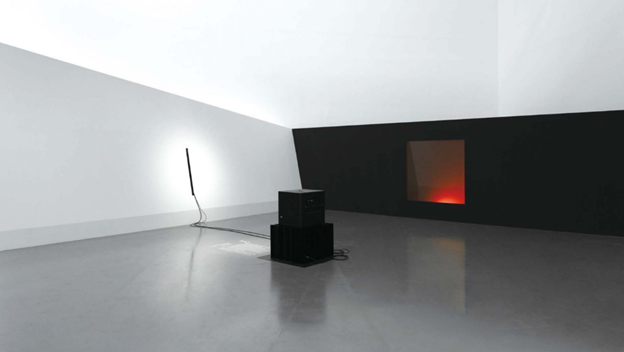
hearing. Similarly, in their latest exhibition, the opening of the exhibition
is not the end but the start of their work, as evident in the exhibition guide
placed at the entrance that divides their project into three sections of A, B,
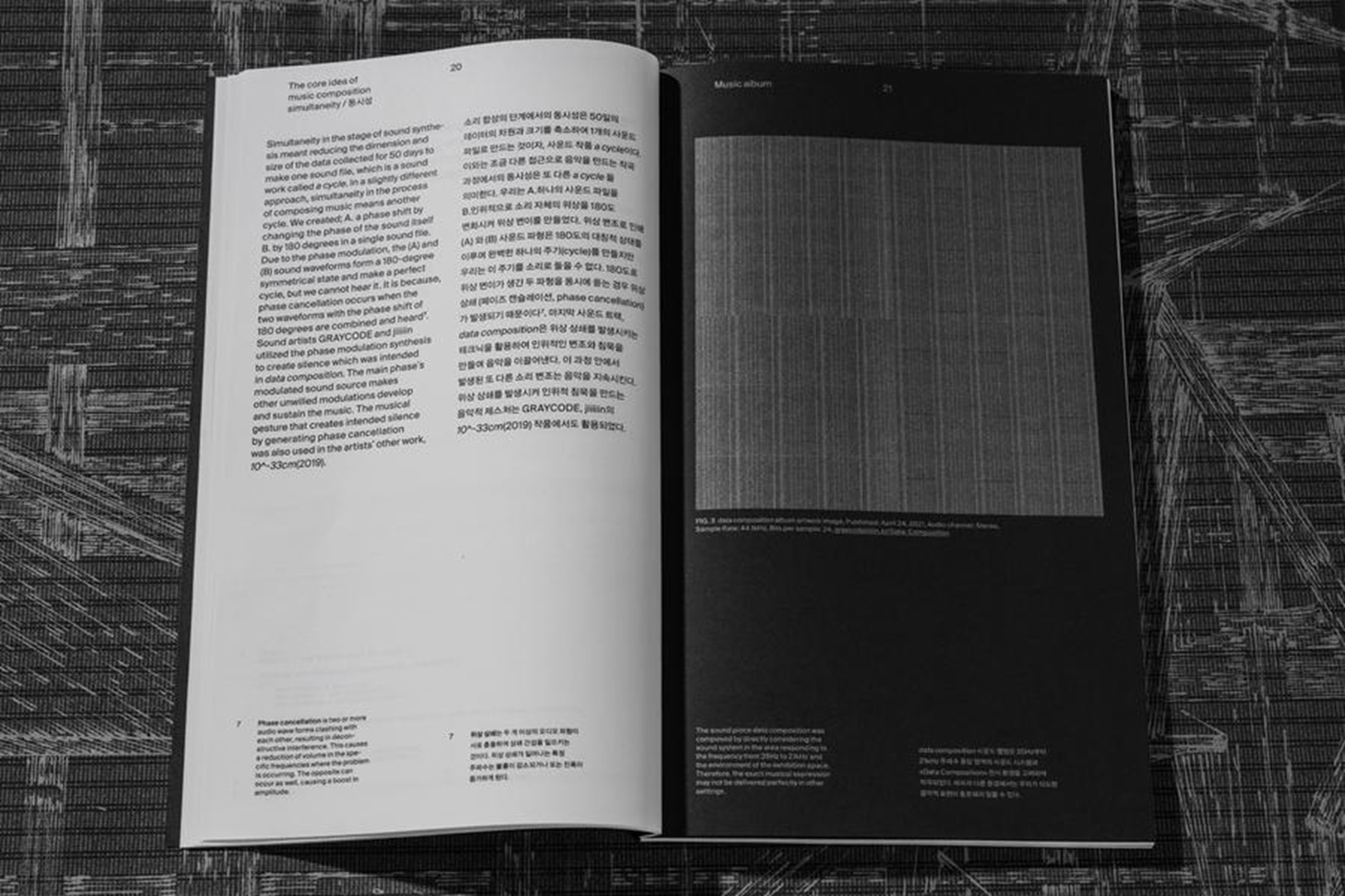
C. While Sections A and B are titled “Data Composition -1” and “50 Days
Exhibition,” the title of the exhibition, “Data Composition,” is actually
assigned to Section C. Why was this single exhibition divided into three sections?
The answer is related to data, the core keyword of 《Data
Composition》.
In The Mathematical Theory of
Communication (MTC), a founding work for today’s information theory,
Claude Shannon proposed a method to quantitatively express information through
the extent of the reduction of the “data deficit.” For example, one might
decide whether to receive a medical check-up this year by flipping a coin,
assigning “Yes” to the head and “No” to the tail. Until the person who chose
this decision system actually flips a coin, there is a deficit of data required
for the decision, which can only be completed with the data collected from the
flip of the coin. As such, the “-1” in “Data Composition -1” implies that the
system for the exhibition is prepared, but the key data is lacking, wherein “50
Days Exhibition” is dedicated to the collection of the said absent data. As
such, the exhibition 《Data Composition》 is designed to be
completed upon inputting the data collected over the course of 50 days.
Therefore, the exhibition that opened on January 15, 2021 at Sejong Museum of
Art 2 comprises only one-third of the entire Data Composition
project. Visitors to the exhibition are placed in Section B and become
providers of data required for the completion of the exhibition. Poetically
expressed in the exhibition leaflet as “The time spent here by each of you will
be a stitch in the piece of musical embroidery by GREYCODE and jiiiiin,” the
process of completing the exhibition is extremely mathematical. Accessing the
website (dc.seoul.kr) given by the docent at the exhibition allows the website
to quantify your IP address as well as how much time you spent in which
section. Ultimately, the data collected during the course of the exhibition is
used to fill the data deficit of “Data Composition -1” in order to ultimately
complete Data Composition.
Is this a form of “participation art?”
Absolutely not. In this exhibition, viewers do not participate in the artwork semantically. In information theory, what matters is not the semantics
of data or information; no matter what
you decide on―whether to receive a medical check-up, whom to marry,
or which smartphone model to buy―everything is converted into a certain
quantity of information. Here, the important matter is not the meaning or value
that you derive from the information, but the reduction of probability or
possibility that can be numerically calculated. While participation art
provides viewers with the experience of engaging in artwork and attribute the
creation of artwork not to a single individual but collectively to numerous
viewers, Data Composition does not incorporate viewers’
feelings and experiences of the exhibition as data required for the
completion of the exhibition.
What meaning does it hold then to create art using
only the data generated and collected from the time spent by viewers to access
the website? Answering this question calls for contemplation on the status of
data and information in today’s world. Searching for information on web search
engines, purchasing goods on online malls, and ordering food on online
platforms using a credit card have naturally become a part of our daily lives,
as well as “liking” or “sharing” posts or leaving comments on Facebook,
Twitter, or Instagram, scanning QR codes with smartphones to check-in somewhere,
visiting gourmet restaurants based on web search results,
subscribing to Netflix or YouTube channels, and watching YouTube videos
on autoplay mode.
Indeed, we are connected to various networks for nearly half
of the 24 hours in a day. Every little thing
that we do online while we are connected to a
network, whether we recognize it or not, constantly generates data. Devices
such as smartwatches even record our physical activities such as daily steps
and sleeping hours as well as physiological indicators such as blood pressure
or heart rates and turn them into data. We are aware that this collection of
data is “changing the meaning of
labor, boundaries, and social structures at this very moment and
creating its own reality.” This excerpt from the artists’ notes for Data
Composition is by no means an exaggeration. Derived from our daily
lives and activities, this data becomes the basis for governments to promote
their policies, political parties to customize their campaigns according to the
characteristics of each voter group, and companies to develop their marketing
strategies and release advertisements tailored for
consumption trends.
Luciano Floridi pointed out that today’s
world has turned into an “infosphere,1” where we consider the
space of information to be synonymous with reality. The world we live in is
composed of data produced from our lives and activities, and the feedback loop
where such data is conversely used to regulate our lives and activities. Converting
visits to an art exhibition into data and feeding them back as a sound piece
does not represent a particularly significant act in itself to us, as we
already live in the infosphere. Rather, 《Data Composition》 is merely modelling our present situation itself in the form of an
exhibition.
Modelling instead of representation
At this point, the distinctive aspect of GRAYCODE and jiiiiin’s creative method becomes apparent; to these
artists, art is not representation. Through their exhibition, they model a
certain process with which we are associated
but nonetheless are not able to detect While
《Time in Ignorance》 presented the 720-hour compressed version of the process of
the transition towards the thermodynamic equilibrium that is constantly happening in the physical world
yet out of our perception, Data Composition focuses on the
process through which the time that
we live in is converted into data and fed back to us. What is the definitive
nature of this form of art? The concept of “representation,” which has long
defined art, is premised on a firm boundary that separates art from the actual
world. The idea that what we find in artwork is not the reality but its copy or representation has historically been the
fundamental condition for the creation and appreciation of art.
Contemporary
art has made various attempts to escape from this frame of representation, such
as happenings that actively create or stimulate an event instead of merely representing it, and durational art that demonstrates
the actual time in which the event occurs rather than representing it in a
compressed form. Nonetheless, not even happenings or durational art can
capture an event or process at a scale that far exceeds the human lifespan,
such as the birth of the universe through the Big Bang about 14 billion years
ago or the dissipation of the
order of energy in the physical world―events that transcend the scope of human experience and thereby dubbed
the “absolute reality” by Quentin Meillassoux. We demonstrate these events
using representations such as symbols or artificial signs. For example, science documentaries
represent the Big Bang, neurons exchanging electrical signals, or the curvature
of space-time in the universe through computer graphics. Strictly speaking,
however, what they convey is not the actual process
i t self but
merely i t s “virtual representation.”
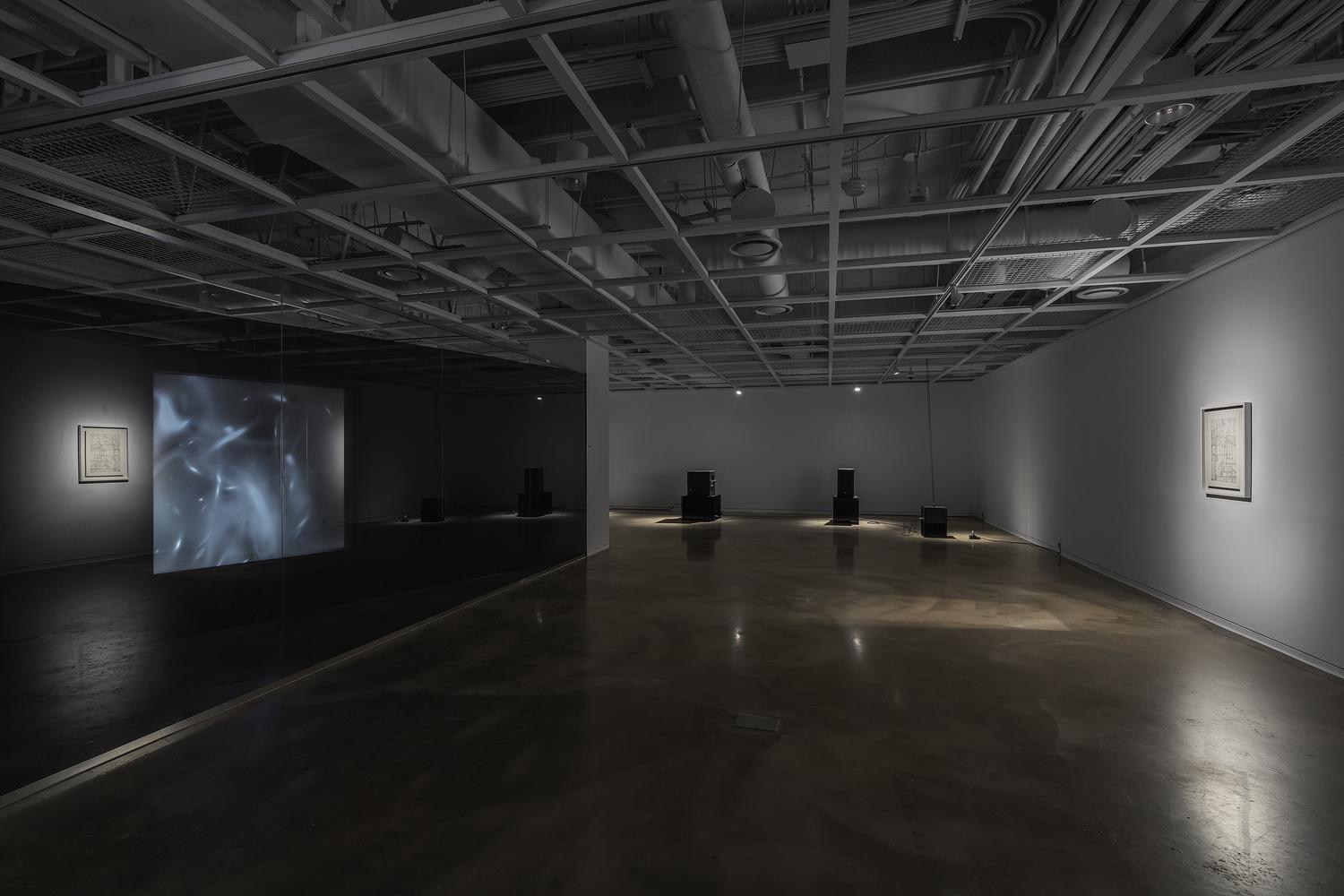
No stranger to computers and programming,
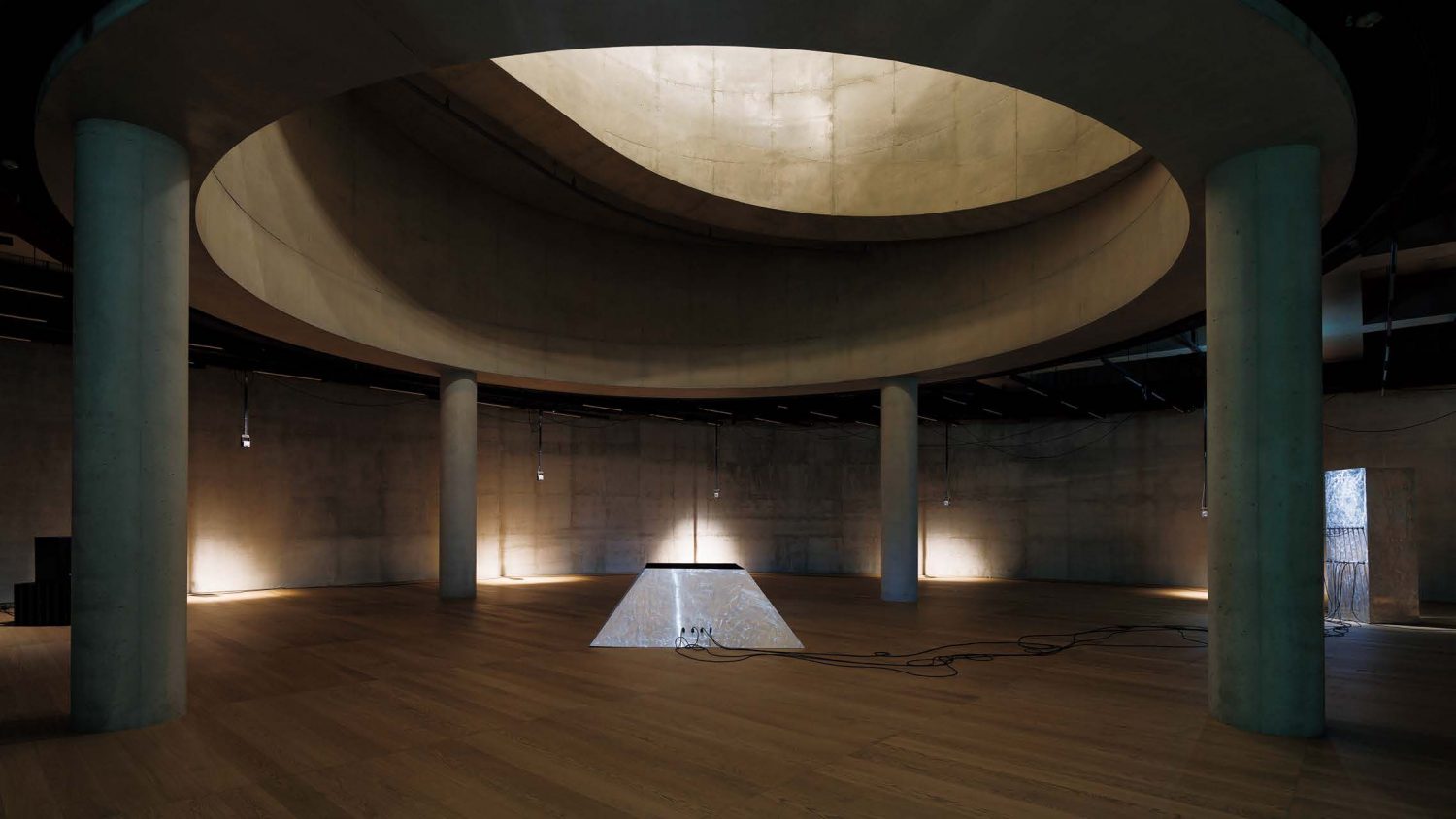
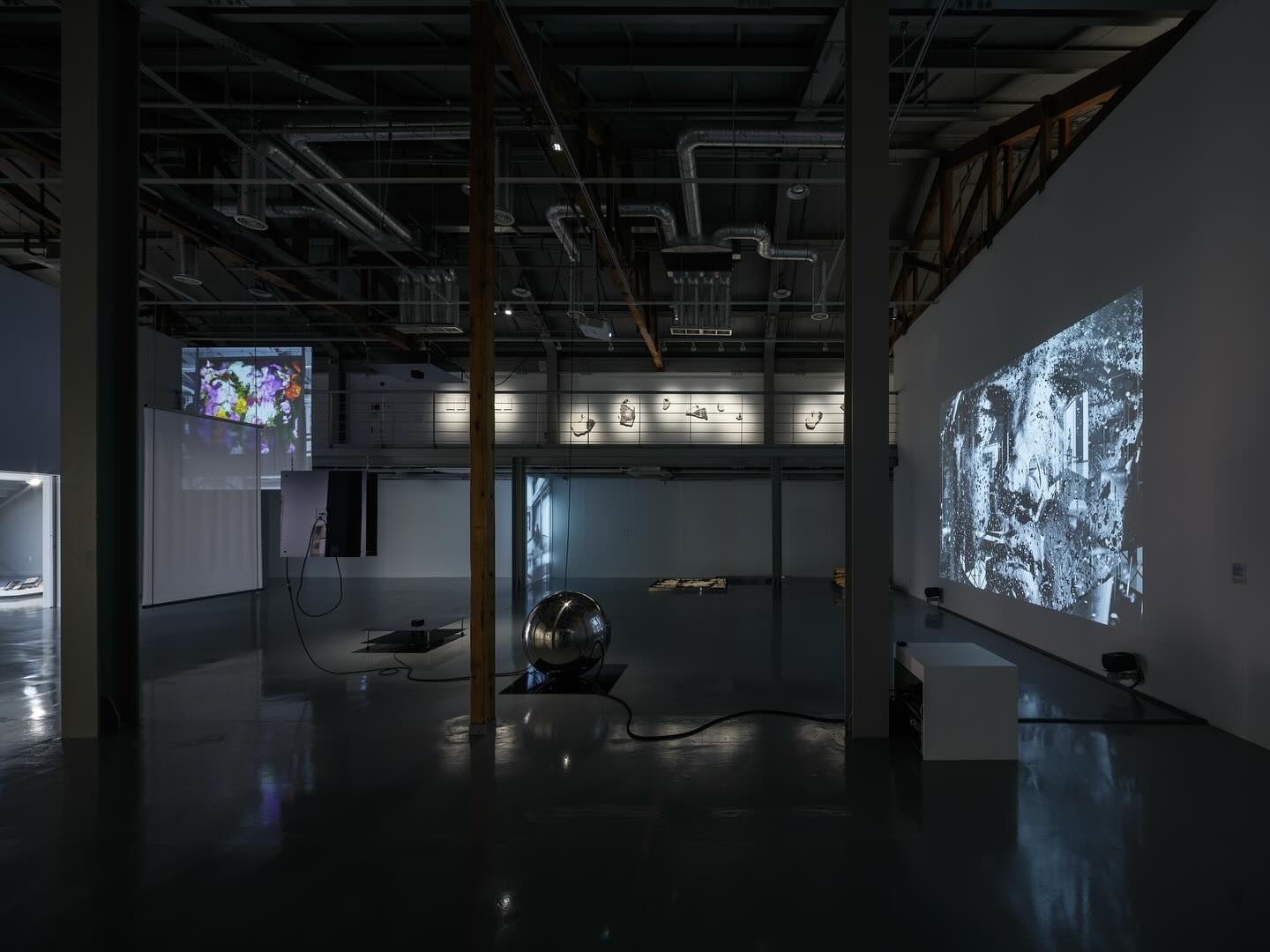
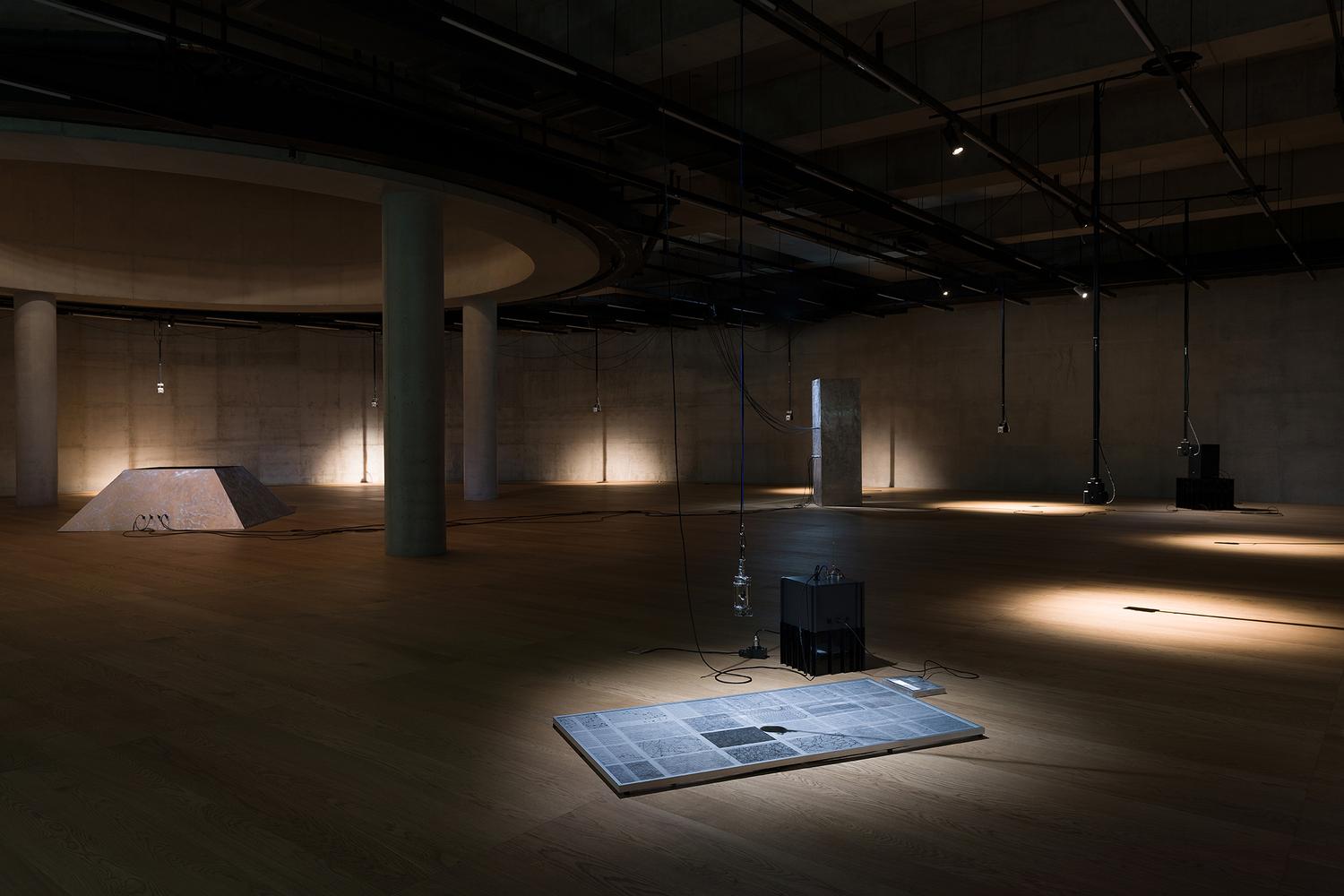
GRAYCODE and jiiiiin refrain from using digital devices for the mere “virtual representation” of an event. Upon
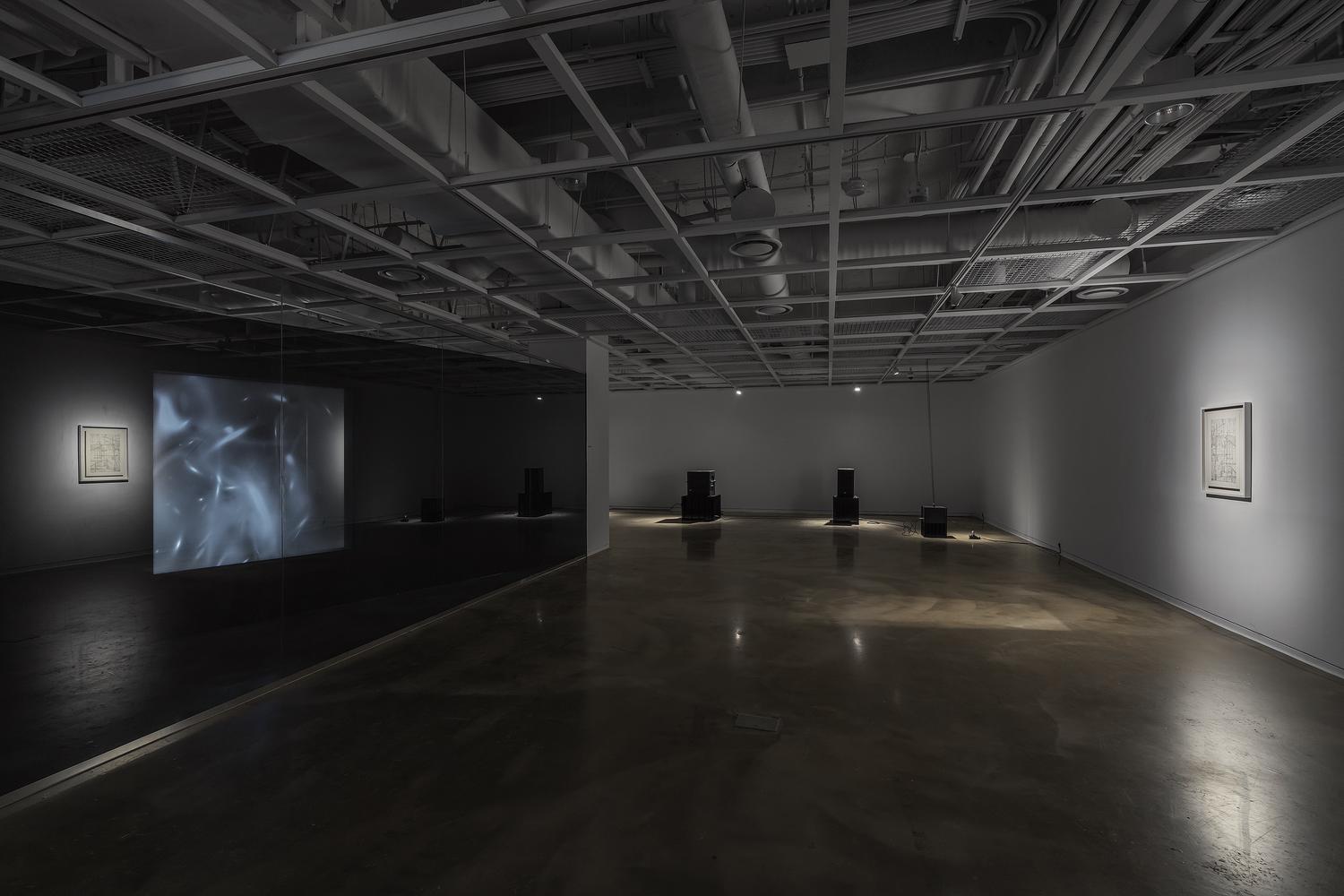
entering through the curtains at the entrance
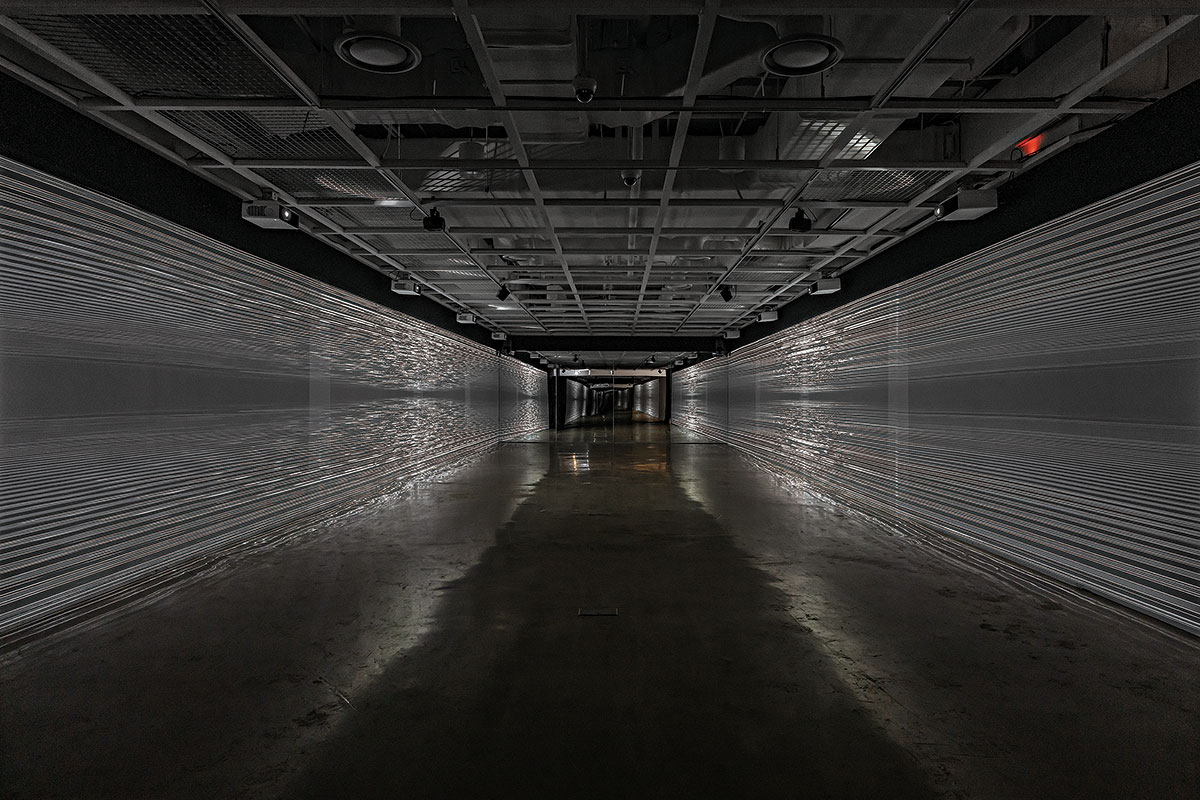
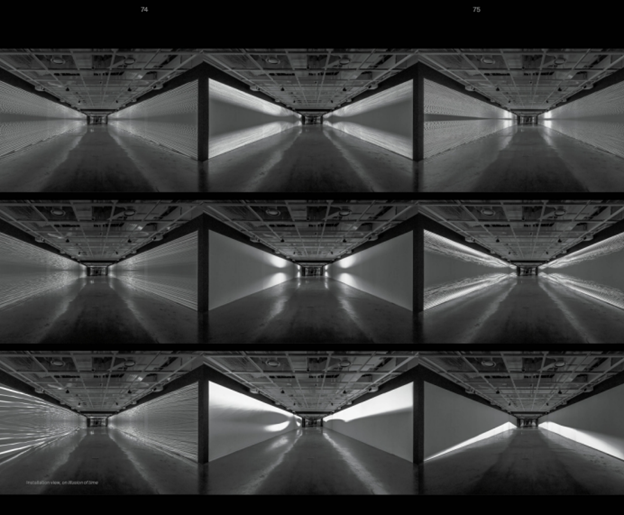
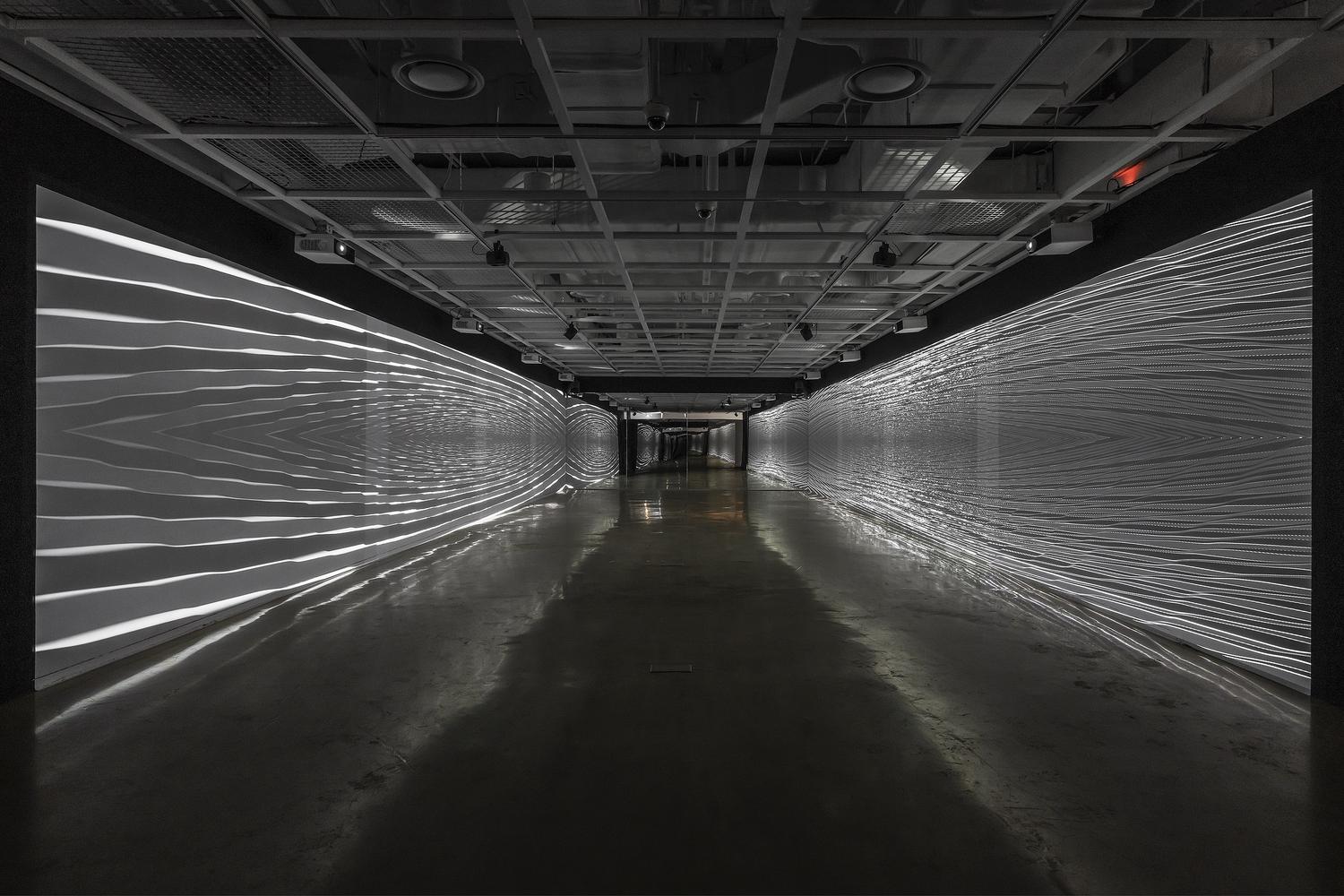
of on illusion of time, one is surrounded
by the massive bundle of light rays generated by eight DLP projectors
within a space 2.4 meters high and 16 meters wide. Three speakers each
installed on both the left and right sides of the space emit sounds at two different frequencies, 39.4 and 61.0 Hz, which means
that the signal from the left is repeated 39.4 times a second, while the signal
from the right repeats 61 times per second. At the spot where the visitor
stands, these different frequencies clash against each other and modulate
through mutual interference. The Moiré patterns projected on the walls on both
sides are also the product of the interference between the lights emanating
from each side. Here, what the viewers see and hear is not the symbolic or virtual representation of
the interference between lights and
sounds, but the actual phenomenon of interference occurring at that very
moment. As the body of the viewer moves in the midst of the interference, the
sounds and lights undergo subtle changes.
It is incorrect to describe on illusion
of time as an “interactive” artwork, simply because movements of the
viewers can cause change in the piece. Interactive works generally utilize
movement sensors and audiovisual elements that change with much clearer causation by such movements, aiming to
directly intrigue the viewers. In contrast,
on illusion of time does not use any sensor that confirms to
the viewers that their movements are contributing to changes in the work,
because its intent is not to convey a certain audiovisual effect generated
through the viewers’ movements. Interactive media works that capture movements
using sensors and change accordingly tend to incur a certain loss, and on
illusion of time focuses on this loss. For example, the sound of
someone sweeping snow outside my window passes through the media of the window
glass and air to resonate with my eardrums and interferes with the sound of my
fingers typing on the keyboard. This event is not expressed in a concrete and perceivable form since there is no sensor or amplifier, but it is clearly
happening in the actual physical time and space around us. The fact that the
presence of viewers affects the sound interference in the space of On
Illusion of Time is subtly perceptible only by the modulation caused
when viewers speak. This is not the virtual representation of the sound or
light interference, but proof that the field of such interference is being
created.
Time
Of all the events that are hard for us to
detect but are nonetheless constantly happening, could anything be subtler and
more difficult to capture than time itself? The artists have been interested in
time as the theme of their works since their
first exhibition, 《Time in Ignorance 》. In their latest
exhibition, time is once again the core subject of their work. In the title of the piece, on illusion
of time, and the
Einstein quote written on the wall at the exhibition venue, which reads “People
like us who believe in physics know that the distinction between past, present
and future is only a stubbornly persistent illusion,” the word “time” appears
alongside the word “illusion.” The Einstein quote is criticizing Newton’s
notion of “absolute time” that still rules over the general concept of time
today. To Einstein, who theorized
that time can bend or expand depending on the existence of matter in the
universe and changes in such matter, and that the disappearance of matter would
also mean the disappearance of time, the Newtonian concept of absolute
time―time that flows equably and at the same speed in every part in the
universe, regardless of matter or material changes, and follows the clear
causal order between the before and the after, and the past and the future2―represents nothing but
an “illusion.”
In 《Data Composition》, however, the word “illusion” is not only juxtaposed against Newton’s
concept of time. Einstein also remarked on time: “When you sit with a nice girl
for two hours, you think it's only a minute. But when you sit on a hot stove
for a minute, you think it's two hours. That's
relativity.3”
Through this remark, Einstein seems to claim that time is similar to a
subjective feeling towards each situation. Is it valid to understand time in
this way, even if the concept of absolute time is an illusion? The answer might
be found in Kant, whose works were enjoyed by Einstein. In Critique of
Pure Reason, Kant provided a truly intricate answer to the question:
Is time objective or subjective? According to Kant, time is an a priori form of
inner sense. Time is like a filter that one must penetrate
through to experience, a pair of a priori
sunglasses only through which one can see and experience the world. In the sense that one cannot experience anything
at all without passing through time, time is the absolute condition of our
every experience. This does not mean, however, that time “objectively” exists
beyond our experience. The point is that, though we cannot experience time
itself, our every experience occurs within (the a priori form of) time. Despite
the differences between their views on time4,
Kant and Einstein both certainly considered time as not independent from
objects and matter or our experience5 of them.
When we say we “experience time,” we do not
actually experience time itself, but changes in things such as the moving hands
of a clock, changing display of numbers on a digital clock, or growing
fingernails or hair. Still, we perceive time
as an inner sensation created as we imbue a sense of continuity to the changes
or movements of things we experience. To stretch this notion, we could even call it an “illusion.”
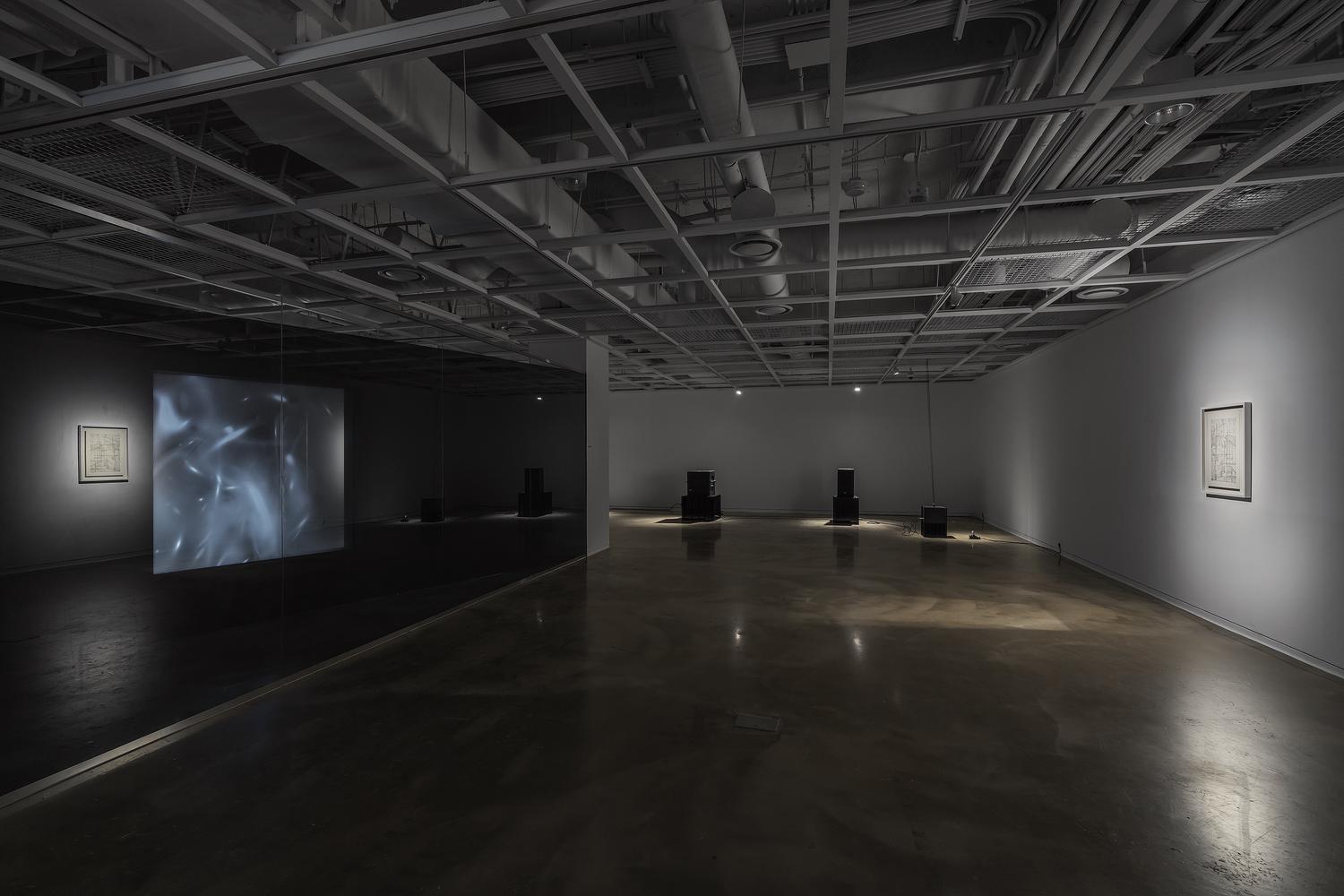
GRAYCODE and jiiiiin’s now slice demonstrates this aspect of time. In the piece, a display with a
diameter of over a meter shows luminescent particles seemingly floating in a
disorderly array in space or the deep sea. The video image is presented at the
speed of one frame per second in a disjointed way, like video footages sent
from a Mars rover back to Earth. Watching such videos, we think that each frame
that we are watching “now” is a “slice” cut from the continuity of time,
presuming that a certain change or movement is continuing to happen “between” each frame and the
next, though we cannot actually see it.
In this manner, the continuity
that we attach to the invisible gaps “between”
the changes of matter and objects creates an inner sensation that we consider
to be time. Strictly speaking, we cannot perceive the change or movement in
matter and objects within the frame of such continuity. When we glance at a bonfire once every five minutes, the
fire that we are seeing now is different from the fire that we will see after
five minutes has passed. Whether the flame
has become bigger
or smaller, we assign
continuity to what occurred “between” those changes and say that “time has
passed.” What if, instead, we continue
to look at the bonfire
without looking away? We may be able to trace changes that can be perceived, but we cannot capture all of
the microscopic changes that happen in the blink of an eye or during the
oxidation of matter. What we see, instead, is the series of discontinuous
images that represent the changes
of the bonfire. Time is what
we construct to make such images appear to be continuous6.
Data as anti-entropy
The exhibition presents another saying
related to time: “Time was, is, and will be.” It is quite different from the
Einstein quote in its context. When it is already understood that time is an
illusion, what does it mean to say that time was, is, and will be? Does it
indicate that, like those who believe the earth is flat, the illusion of
absolute time exists now, existed before, and will continue to exist?
Personally, it seems that this saying is related to the concept of entropy, on
which the artists’ previous exhibition was centered. Since the birth of the
universe, the only direction―if there is any―that has led the system
of the universe is the constant increase
of entropy.
The unequal
distribution of thermal
energy caused by the creation
of the universe as an orderly system inevitably pushes the world towards
thermodynamic equilibrium, as with hot water left at room temperature becoming cold
without additional heat and ice cubes dissolving in water. In What is
Life, Schrödinger explains this phenomenon as follows:
When a system that is not alive is isolated
or placed in a uniform environment, all motion usually comes to a standstill
very soon as a result of various kinds of friction; differences of electric or
chemical potential are equalized, substances which tend to form a chemical
compound do so, temperature becomes uniform by heat
conduction. After that, the whole system fades away into a dead, inert lump of
matter. A permanent
state is reached, in which
no observable events occur. The p h y s i c i s t c a l l s t h i s t h e s t a t e o f thermodynamic equilibrium, or of "maximum entropy.7”
Unlike ordinary matter,
however, living organisms can, despite existing within the process of reaching
maximum entropy, “maintain itself on a
stationary and fairly low entropy level,” according to Schrödinger. How can
living organisms, which are ultimately composed of matter, maintain their life
(order) against the natural law of entropy that continues to expand and dominates the entire material world? Schrödinger discover the answer in genetic
materials that enable living organisms to sustain themselves with enough
strength to “evade the tendency to disorder.8” Information theorist Floridi describes this notion as
follows:
Biological life is a constant struggle
against thermodynamic entropy. A living system
is any anti-entropic
informational entity, i.e., an informational object capable of instantiating procedural interactions (it embodies
information-processing operations) in order to maintain its existence
and/or reproduce itself (metabolism)9.
Every form of life, including human beings,
is an anti-entropic informational agent in that it extracts and
responds to information
from the environment in order to survive. What we do to sustain
life―eating, sleeping, avoiding being hurt,
striving to be healthy, obtaining information needed for our survival and life
from the environment, and responding properly to such information, or in other words, the entirety of our life itself―is a constant struggle
against the increase of entropy.
In this regard, today’s information society,
where all of our actions and physiological signs are converted into data,
embodies a kind of duality; it entails the possibility
for a dystopian future where everything in our life is tightly
controlled under information networks, while it is simultaneously resisting the
increase of entropy by “organizing” our actions and lives as information that
might otherwise have simply
become lost to thermodynamic equilibrium. Information technology such as big data or artificial
intelligence might be able to convert carbon emissions and plastic waste
that are recklessly discharged by human beings into systemized information. For
example, the international carbon
credit system, which was devised to reduce
greenhouse gas emissions across the world,
is based on data technology that can measure and calculate the amount of CO2
discharged by each country. Could it be that the trend
of converting human life into data presents at least a minute clue for a world
that is currently facing an ecological crisis?
1 Luciano Floridi, Information: A Very Short Introduction, Oxford
University Press, 2010.
2 “Absolute, true, and mathematical time, of itself, and
from its own nature, flows equably without relation to anything external, and
by another name is called duration: relative, apparent, and common time, is some sensible
and external (whether
accurate or unequable) measure of duration
by the means of motion,
which is commonly
used instead of true time; such as an hour, a day, a month, a year,”
https://plato.stanford.edu/entries/newton-stm/scholium.html.
3 https://www.br.de/fernsehen/ard-alpha/programmkalender/sendung-1315134.html.
4 According to Einstein, time disappears along with matter;
Kant sees time as in its a priori form that exists without matter
that can be experienced. See https://www.menscheinstein.de/biografie/ biografie_jsp/key=2414.html.
5 The
space of matter in the universe,
as explained by Einstein, is not something we can experience
in person.
6 On the aforementioned perception and construction of time, see Römer, Inga & Bernet,
Rudolf & Taminiaux, J. & IJsseling, S. & Leonardy, H. & Lories,
D. & Melle,
Ullrich & Bernasconi, R. & Carr, D. & Casey, E.S. & Cobb-Stevens, R. & Courtine,
J.F. & Dastur,
F. & Düsing,
K. & Hart, J. & Held, K. & Kaehler,
K.E. & Lohmar,
D. & McKenna,
W.R. & Waldenfels, B. (2010). Husserl
– Zeitbewusstsein und
Zeitkonstitution. 10.1007/978-90-481-8590-0_2.
7 Schrödinger, What is Life?, Cambridge University Press, 1944, p70.
8 chrödinger, What is Life?, Cambridge University Press, 1944, p70.
9 Luciano Floridi, Information: A Very Short Introduction, Oxford
University Press, 2010.