We
often find ourselves wanting to visit a brand’s showroom—especially a flagship
store—instead of shopping online (even when the internet price might be
slightly cheaper) or going to a department store just to buy a certain outfit.
Likewise, there are times we want to visit a café whose coffee isn’t
particularly good but whose spatial design or ambience is stylish. Such
impulses are less about acquiring a type of clothing or a cup’s worth of
caffeine than about consuming an atmosphere that can only be felt by being
there. It’s an activity geared less toward practical purpose than toward
switching one’s mood.
Neologisms
popular among young office workers these days—“sibal-costs” (shi-bal-biyong)¹
or “squander-fun” (tang-jin-jaem)²—are connected to these “mood-lifting
activities.” The category spans everything from long overseas trips to a
few-second moments staring at cute animal GIFs or luscious dessert photos on
one’s timeline.
Though
it varies by person, the common denominator of “mood-lifting activities” can be
summarized as the consumption of something “cute,” “pretty,” or “sweet.” Like a
healing potion in an RPG, they function as the quickest, easiest tools for
shifting one’s vibe or mood. What’s interesting is that most of these
activities are coupled with photography. As the “cute / pretty / sweet” thing
passes through the camera, much of the object’s material / real qualities
evaporate. The object remains as an image that not only is modified by “cute /
pretty / sweet” but comes to represent “cuteness / prettiness / sweetness”
itself. Scattered across social-media timelines, such images are consumed as
images per se. In that light, we can’t dismiss people who diligently take
photos in cafés as mere selfie- or SNS-addicts. Perhaps they are those who most
actively enjoy the “ambience” they want.
In
this way, browsing a carefully designed offline store—without buying the
clothes—can be more effective for lifting one’s mood than ordering garments
online to be delivered. If we think along these lines, when indulging a feeling
or enjoying a particular atmosphere, the process of purchasing or eating some
physical thing may not be that important. From this perspective, there are
cases on the timeline in which the number of people who see something only as a
photo far exceeds those who have actually owned or eaten it. Like a “rice cake
in a painting,” Serious Hunger—a dessert brand that exists only in photos and
videos on timelines—falls squarely into this case. Occasionally someone appears
claiming to have tasted it, but no one knows where to go to buy it. The brand
“Serious Hunger” and its SNS accounts are visible, but there is no physical
shop that sells desserts. As a result, many wonder whether it really exists,
and if so, how they might try it. Others, regardless of whether it can be
eaten, simply focus on the ecstasy of looking at the images that Serious Hunger
releases.
“Serious
Hunger” is one of the various SNS accounts run by artist Song Min Jung, who has
primarily presented video works; it is simultaneously a fictional dessert shop
and an artwork in a mixed form of video and installation. In that it offers a
mood through images rather than the taste of desserts themselves, it connects
to the “mood-lifting activities” mentioned above. Is it then a fictional
dessert shop? To be sure, it seems “virtual” in that it does not exist
physically and you cannot purchase cakes or cookies through its SNS accounts;
but it is also hard to say it resides purely in the realm of the virtual.
Desserts operate as auxiliary elements that create a certain mood, and anyone
can feel the mood proposed by the artist through this account.
Thus, although
“Serious Hunger” is a dessert brand within a world the artist has created, it
does not stay only in the virtual. It functions most effectively with one foot
in both reality and virtuality—through the SNS timeline.
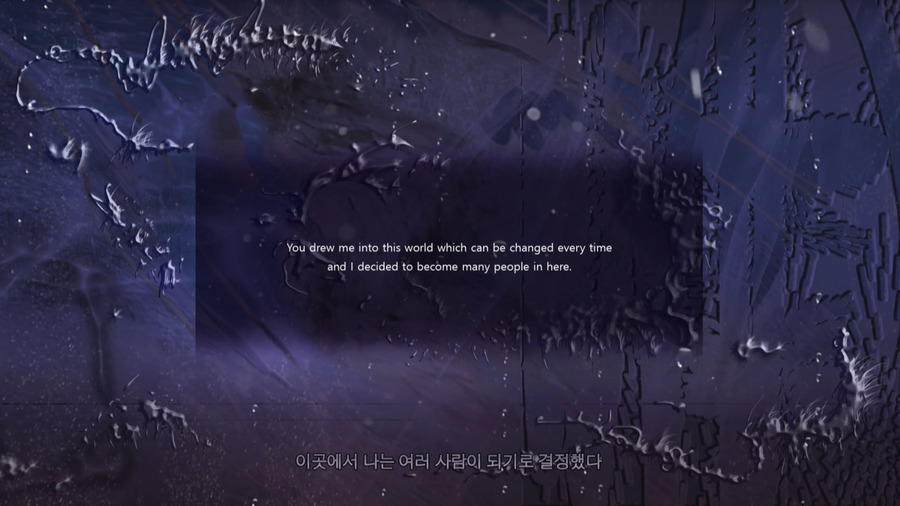
The
video works of “Serious Hunger,” which are often in the form of commercials,
state or imply through on-screen captions / narration that they will switch
your “mood”:
“It's
a joke or a fictional persona; there, we are not hungry at all. We just look
cool.”
— Serious Hunger x Zeewooman, 2016
“From
now on, we will transmit the mood we propose. We’ll suggest the most accurate
mood possible.”
— Double Deep Hot Sugar: the Romance of Story, 2016
“Intuitive
cream improves your mood immediately.”
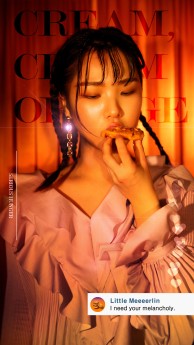
— Cream Cream Orange, 2017
These
“mood-switching elements” stem less from the videos themselves than from the
dessert-table settings presented at exhibitions and events in which “Serious
Hunger” has participated, and from the images that document them. As noted,
whether visitors actually get to taste the cakes and desserts on the table is
not very important here. Where “Serious Hunger” truly functions as an artwork
is in asking how the atmosphere of that place is constructed, and what moods
and experiences viewers feel and consume within it.
Recently,
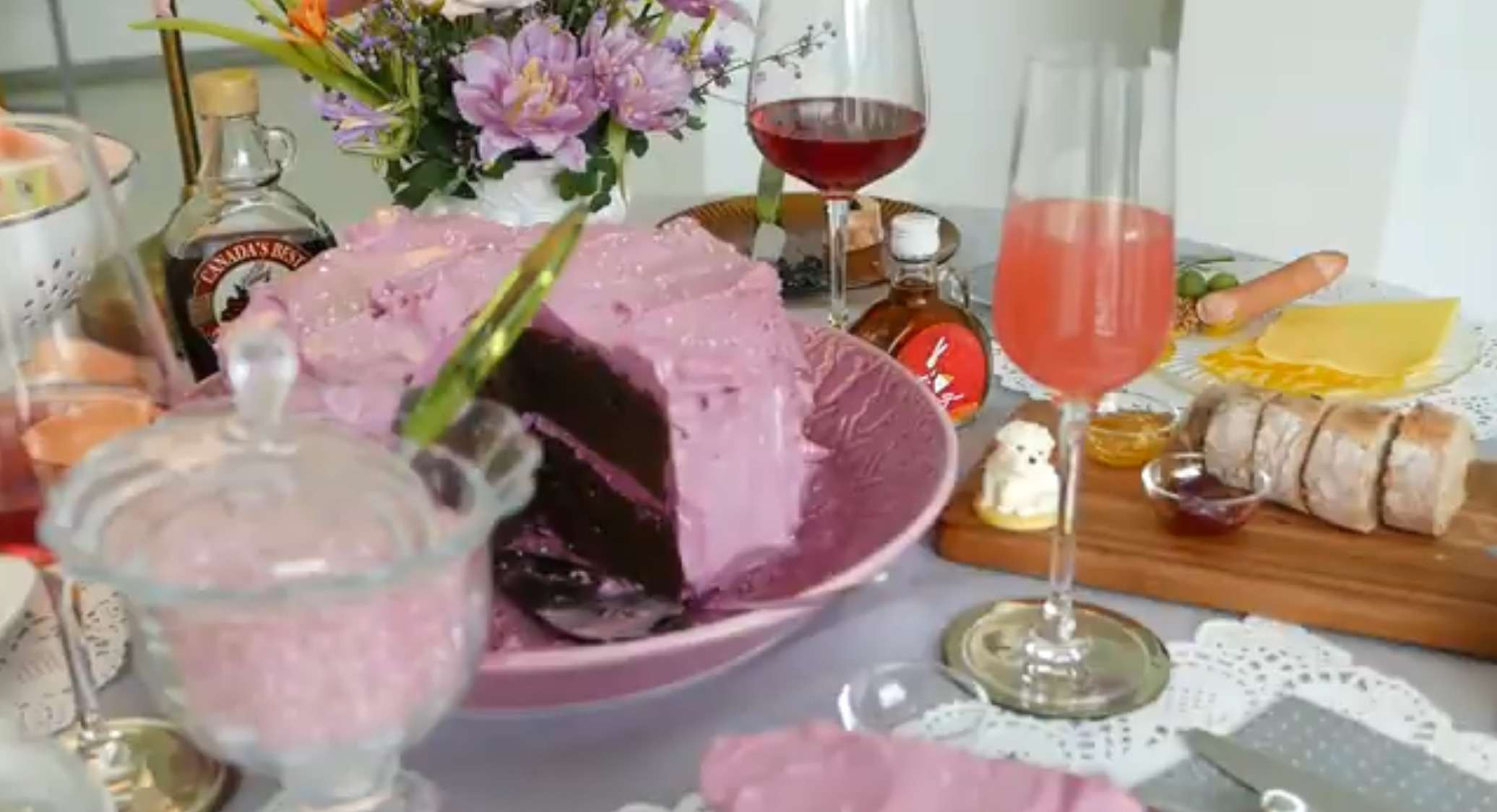
“Serious Hunger” staged a “ceremony” for the opening of the second-floor
exhibition space at Tastehouse. Visitors finally faced a table on which cakes
they had seen on timelines were harmoniously arranged with flowers and plants
in collaboration with a plant shop; yet, again, they could not taste the cakes.
Instead, they could enjoy the atmosphere “Serious Hunger” proposed and examine
the elements on the table in their own ways while taking photographs. This
logic also held in earlier exhibitions and events such as 《Otaku Project》 (Buk-Seoul Museum of Art,
2017), 《Dessert Exhibition》
(COEX, 2017), and 《Artist’s Lunchbox》 (Seoul Museum of Art, 2017).
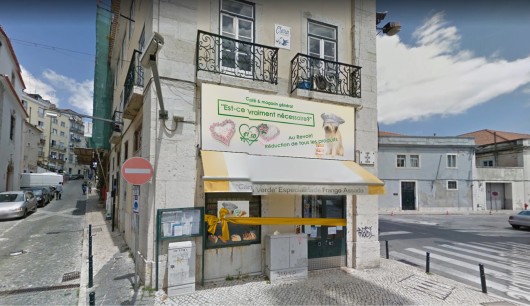
In October of that year, in 《Taste Pavilion》 (Tastehouse, 2017), Song Min
Jung also presented another account, “Jacqueline,” set as the proprietor of
“Est-ce vraiment nécessaire?” (“Is that really necessary?”), a café-cum-general
store in Juvisy, France. Accompanied by an instructional video, the “Jacqueline”
corner—staged as a small refrigerator—allowed only those who paid an “opening
fee” of 2,000 KRW to open the fridge and peruse and purchase items such as
cookies and chocolates. Here, the “opening fee” became the price paid to gain
the opportunity to experience and purchase the atmosphere created through
“Jacqueline.” This setup makes the artist’s intent in “Serious Hunger” or
“Jacqueline” crystal clear. It also leads participating viewers to recognize
more explicitly what it is they are consuming.
The
mood that “Serious Hunger” creates may seem dominated by a cute and pretty
vibe—like cakes and table settings. Yet, at the same time, something hollow can
be sensed; from a corner of the thoroughly staged image, a tinge of melancholy
and loneliness leaks out. Across the body of video works as well, “Serious
Hunger” does not merely evoke a mood of cuteness / prettiness / sweetness. The
act of consuming “cute / pretty / sweet” things³ as “mood-lifters” reflects
that much reality’s melancholy and stress, and the way “Serious Hunger”
“transmits an accurate mood / improves your mood immediately” likely operates
in a similar context.
Consider timelines in which a tweet about wanting to die
is followed by retweeted cat or dog photos: what Song Min Jung intends through
“Serious Hunger” is closer to showing the very mode by which (mostly cute)
photogenic things trend and are consumed in the SNS world. Thanks to this, what
viewers can consume / enjoy as an “artwork” in “Serious Hunger” is not confined
to the visibly presented cakes or video pieces. For the artist, the timeline,
like a canvas that bears a painterly image, becomes the support that sends out
Serious Hunger (as image) as a “virtual dessert shop.” In this sense, the
timeline’s reactions to the cake images function not as merely mistaken
audience feedback but as another axis constituting the work.
Song Min Jung
Working with “current states (current moods)” as material, the artist provides
a mood she has set or becomes a fictional account that links herself onto the
timeline. “Serious Hunger” is one such account constituting the work, a
fictional dessert brand that borrows the form of advertising to link to
viewers—or consumers.
¹
A portmanteau of the Korean profanity sibal and “cost,” meaning “an
expense that would not have occurred had one not been stressed.” For example,
splurging on a perm at an upscale salon in a fit of anger, or taking a taxi on
a route one normally travels by bus or subway. (Parkmungak, Dictionary of
Current Affairs, 2017)
² A neologism combining tangjin (to squander one’s wealth)
and jaem (fun), meaning the “fun of small squanderings.” As economic
recession and job shortages persist, younger generations with modest incomes
spend all available money to extract maximum satisfaction—an approach to stress
relief that indulges in small, unnecessary purchases.
(Parkmungak, Dictionary of Current Affairs, 2017)
³ This can include cute animals and babies; character goods; appetizing food;
sleek interior design; and even “photogenic artworks / exhibitions.”