In
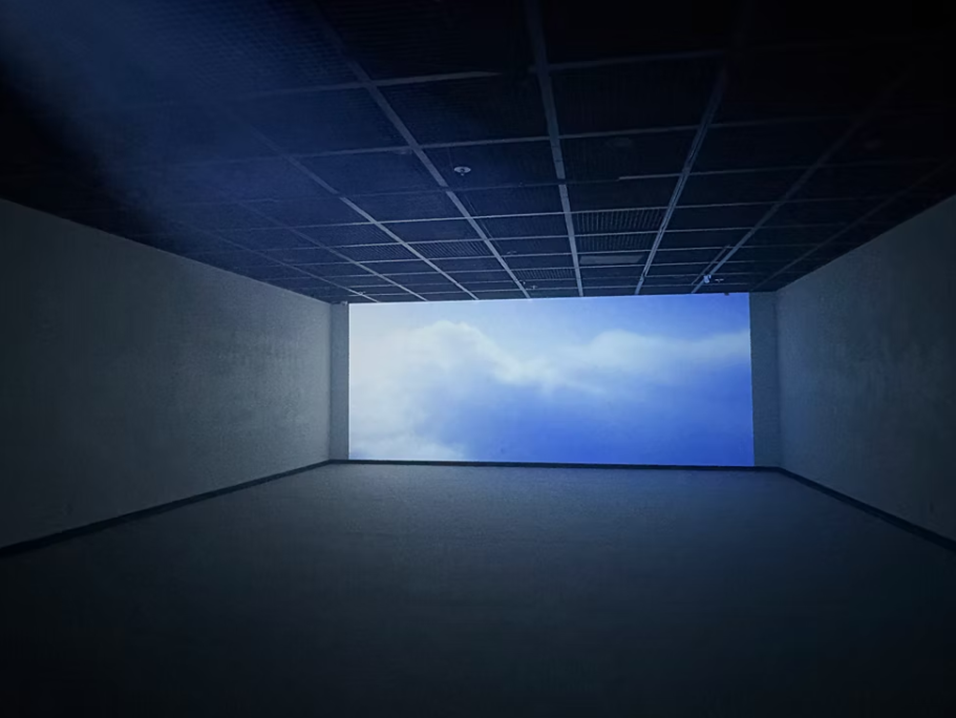
the center of a rectangular space partitioned by temporary walls, a video plays
on the middle wall showing the upper body of a man in a trance—rapturous yet
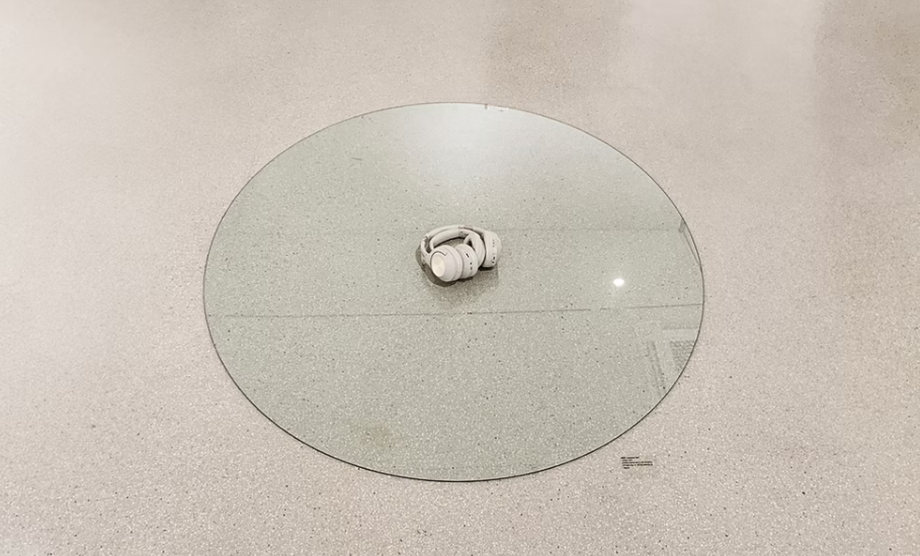
strained. Wearing wireless earphones piping in music, he sways as if possessed
and dances to the rhythm. In the space before the screen, which is filled with
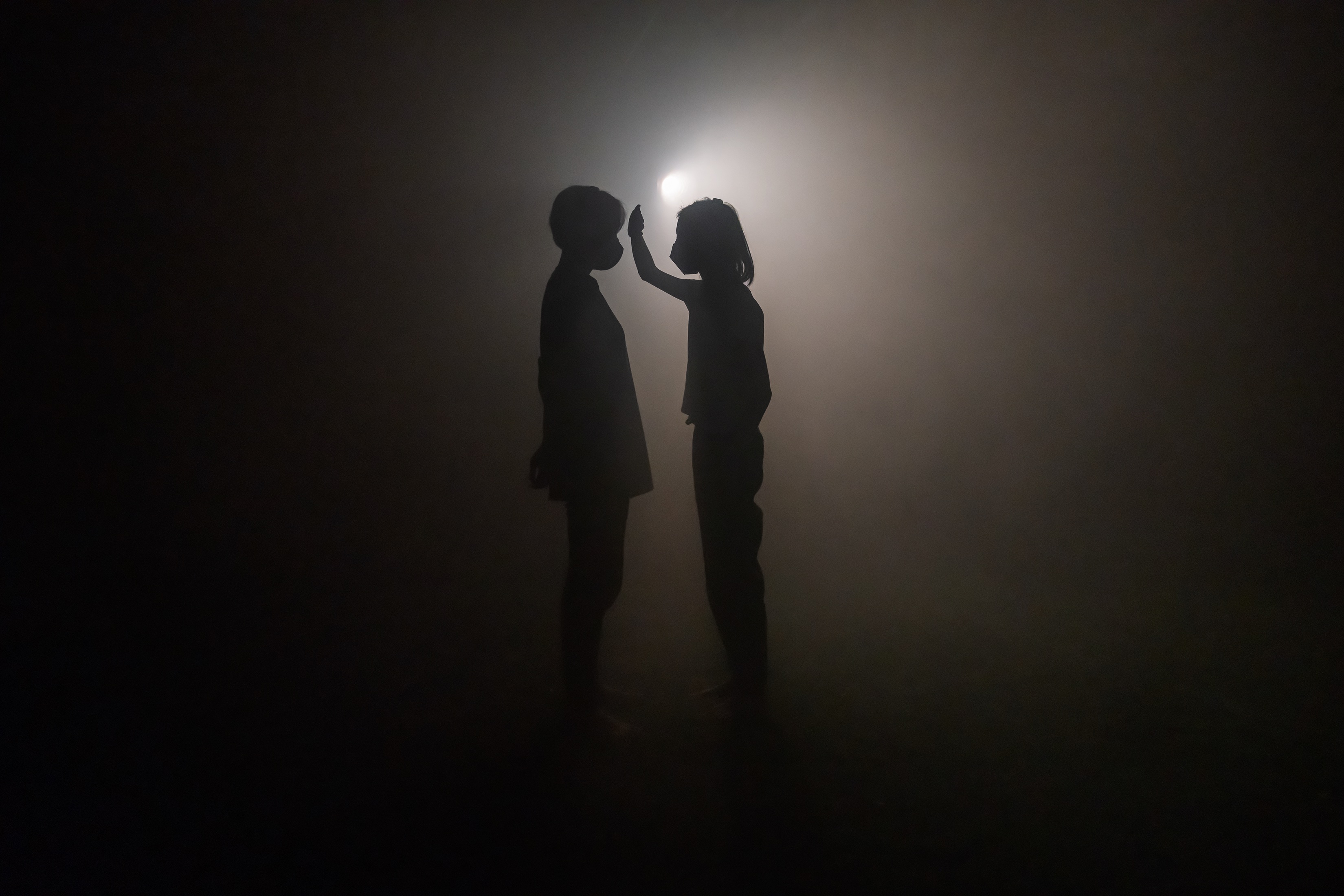
fog and made dreamlike, many people, like the man on screen, give themselves
over to the EDM sound and dance. Then, at some point, one person after another
suddenly freezes in place as if their batteries have run out. The number of
frozen figures grows, then slips away from the scene entirely. Nearby viewers,
bewildered, either awkwardly leave with them or murmur to companions as they
try to grasp what’s happening.
My
first point of contact with Park’s work was Do Androids ‘feel’
like dancing? (2019), a performance space, a video, and the
scenes unfolding within it all woven together. The immersive video of a man
dancing in utter abandon draws people’s gaze, the music fills the room, and
performers—assigned the role of androids indistinguishable in appearance from
humans—join the space and freely enjoy dancing, thus proclaiming it a place for
everyone’s participation. Drawn in, visitors melt into the mood and join the
dance—until they startle and peel away from it as, one by one, the performers
reveal their “machineness” by freezing in place. This spatiotemporal separation
leads viewers to questions: about the situation, about the frozen performers’
very existence, about the present relations—and about myself who is feeling all
of this. To borrow an oft-seen online catchphrase, their inner thoughts might
be summed up as: “Where am I? Who am I?”
Park
is producing work that motivates an inquiry into “me” and proposes a sustained
repetition toward that end. What he focuses on is the question of human
self-consciousness—the subject who asks and repeats questions—and of our
external and internal perception of the self. For him, despite scientific
advances that offer directions and frameworks for understanding and employing
it, the “world” remains a fundamentally unknowable inevitable, one we still do
not understand and perhaps never will. He says that the world we encounter only
reaches as far as the range that can touch my current point of reference—i.e.,
a kind of low-resolution rendering. Worlds constructed in that way must all be
different. This converges into grinding friction on all fronts—from the
instability of individual communication to harm done to the surrounding
environment. The “problem of me” is thus linked to the “problem of the world.”
This connects to many issues today: we in networks that are connected yet
fragmentarily biased; we as perpetrators within ecosystems; we as those harmed
by environmental and climate change.
How,
then, does he act to express this problem consciousness? He makes works that
function as access interfaces reaching toward the question. At first glance,
his works appear to have a stable, even perpetual, cyclical structure. Yet this
is the staging of an unstable state—the kind with high potential energy
disguised as stability. It entails foresight that things will eventually reach
an end and either settle or collapse, an awareness of fissure points that
enable such foresight, a search for the meaning of the outcome, and an
affirmation and awakening of the subject “I” who undertakes this series of
acts. In other words, to proceed with a play experience, taking the artwork as
a framework/controller of perception and development—this is the perceptual and
cognitive game he proposes.
Park
divides this game into three broad currents: “the problem of self/other,”
“dimensions beyond understanding,” and “blurred boundaries.”
First, Tomorrow (2014), Stranger (2018),
and Tell me that I’m here 1, Tell me that
I’m here 2 (2019) pose questions about self and other through
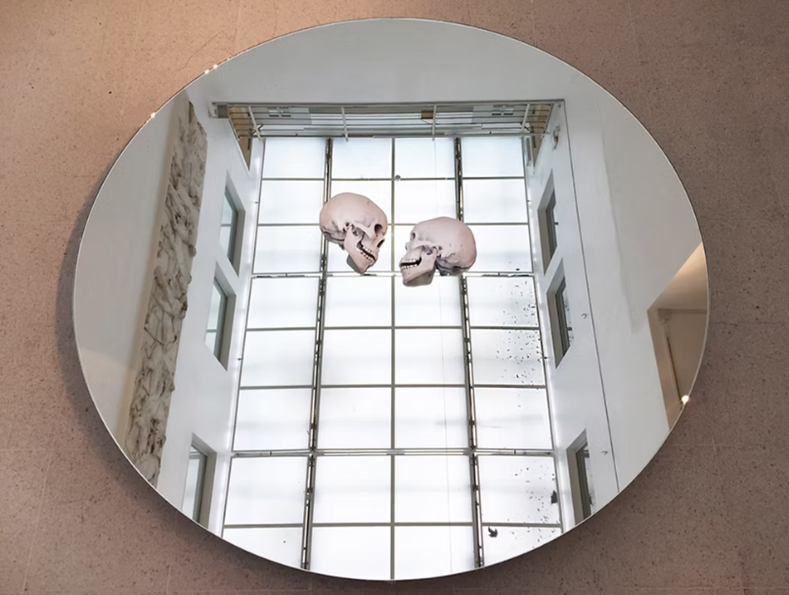
cyclic structures of image and sound. In Tomorrow, when
you stand before a mirror-shaped screen, the scene from that location exactly
24 hours earlier is replayed; Stranger is a
periscope-like structure placed on both sides—when you look through one
eyepiece, you see the back of your own head. Tell me that I’m
here 2 has two performers wearing head-mounted displays (HMDs)
positioned like parallel bars, moving toward each other. On the front of each
HMD, a 180-degree VR camera is installed, and each camera relays the situation
to the other’s HMD. In other words, the two performers cross-own each other’s
field of view. Sharing the other’s viewpoint, they draw closer, and in the end,
they perceive one another via touch, resolving the visual disjunction. These
works are structured so you can see “me” as seen from the other’s perspective.
Across the works, a spatiotemporal dislocation occurs that is not the vista one
expects from the act of looking. Ultimately, what the viewer confronts is a
question about my sight, perception, and understanding. In all the pieces,
visual sequences repeat; the repetition reaches an end as the viewer becomes
aware of fissures, encounters structural limits or their counter-terms.
The
art critic Ahn Jinkook’s book title Burning Utopia emblemizes
today’s world. A world spun from resources within our field of view and our
understandings—yet today’s reality and ideal are ablaze: set alight by the gap
in our understanding of the real, and by the automatism acquired by the
“digital network,” the new nature birthed by our hands yet now beyond them. Our
society seethes with clashes among fragmented generations and groups. The Earth
physically burns as a result of our longstanding failure to understand
ecological perspectives. Park’s gaze is an act and a question that can be
effective here. Logging into his game and, within the confusion and disjunction
there, repeating a cycle of perception–recognition–cognition–questioning, we
can pull loose the tangled threads of areas we had ignored, dulled to, or
misread, and repeatedly feel out answers. This recursive process is not simply
vague and painful. The fissures he intends arrive like clues in a
game—stimulating, like adventure games of the 2000s or the recent fad of escape
rooms. And the instant of comprehension is as pure-white as clearing a quest.
Drawn into the exploratory perception game, viewers actively identify with the
work, and what they reach is a succession of discoveries. As players, they
search out and fill in the blanks and misalignments the artist has arranged,
gaining perceptual satisfaction and cognitive accomplishment. Through this,
they obtain a possible perspective for narrowing fractures in relations and
misunderstandings.
This
should be seen as a tactical victory set by the artist. Within his designed
system, the viewer bridges surface fissures through their own
“question–answer,” orienting toward the inner aim the artist envisions. This
emotional inference game can be a gladly suffered win. The problem he poses is
connected to contemporary reality, and the interface for accessing it is
polished. Once you recognize the structure and the gaps of the piece, it
becomes a controller for playing the system, and the viewer immerses as a
player in a perceptual game within a system whose balance has been broken.
Satisfied with their individual achievements, they retain within them threads
of inquiry about existence and the world. It is a scene that leaves one eager
for the work to come.