The
first time we encountered the word “barrier-conscious” was in a research
project we participated in during 2018. It was a project titled “Research on
the Direction of Disability Culture and Arts Education and Development of
Teaching Materials,” carried out by the creative group Bigija with support from
the Korea Disability Arts and Culture Center, in which Kim Ji-young, Shin
Won-jung, Shin Jae, Yousun, Choi Sun-young, and Oh Hana participated. The
result came out as a small booklet titled Meeting Through
Expression Without Expectation (Note 1), but the word or concept
of “barrier-conscious” was not included in it. It was only a passing term in
the materials we used as reference, and it was not a commonly used word or
concept.
Takayuki
Mitsushima, who spoke of barrier-consciousness, is a totally blind person with
a visual disability, an acupuncturist, and an artist who continues to work
creatively. Since 1992 he has been making sculptures using clay, and since 1995
he has been producing what he calls “constructed paintings” using drafting line
tape and cutting sheets. His works, which employ rings, wood, pins, and other
materials, can be seen, touched, heard, and experienced. Since 2020, he has
been running a gallery and atelier called “Atelier Mitsushima.” He began to
think about “barrier” while preparing a solo exhibition at Sendai Mediatheque
in 2010. At the time, after attending a lecture by the aesthetician Hiroshi
Yoshioka, he told him that he felt resistance to the word “barrier-free.”
“(…) Was it 2010? That year, there was an exhibition at Sendai
Mediatheque, and when I said that I felt resistance to barrier-free, he said,
‘Then how about barrier-conscious?’ Now that I think of it, maybe it was around
that time that I opened my eyes to installation.” (Takayuki Mitsushima) (Note
2)
Yoshioka
also described the situation at the time in this way:
“What I suggested to Mitsushima back then was ‘barrier-consciousness.’ For
example, removing a threshold is called barrier-free, but even in places where
visible barriers are gone, barriers still exist. Rather than saying they do not
exist when they do, wouldn’t it be healthier to ‘be conscious of the barrier
and to acknowledge its presence together’?” (Hiroshi Yoshioka) (Note 3)
Mitsushima
later developed his thoughts on barrier-consciousness, and in the preface to a
solo exhibition, he said that what he meant by barrier-consciousness was “a
wall that is made conscious, and that can be enjoyed.”
“(…) Somehow, the shops I like never have Braille blocks at the
entrance. There are countless barriers: hard-to-find entrances, steep stairs,
places marked with signs like ‘Watch your head!’ The food is delicious, but
there are no Braille menus. But a space where all barriers are removed and
everything is neat is boring. Everywhere looks the same. If I could only go to
places that are barrier-free, life’s joys would be reduced to one-tenth. So I
squeeze myself into difficult places to enter. By involving the shop staff or
people around me in the effort to get in, change happens.” (Note 4)
We
liked the term “barrier-conscious.” But we were not impressed by the fact that
Yoshioka had come up with it spontaneously or that Mitsushima had developed it
on his own. What drew us was wanting to understand why Mitsushima used the word
and with what feelings—because we ourselves were so attracted to it. A stance
of being conscious of barriers sounded to us like a declaration to remain
conscious of all barriers in the world.
The
way we think about barrier-consciousness is probably quite different from
Mitsushima’s. What feels like huge barriers to us might not feel like barriers
at all to him. There are enormous differences between us in age, generation,
educational background, gender, sexual identity, nationality, and so on, and we
know it is somewhat naïve to believe that he would think the same as us just
because we use the same term. It is like the phrase on a poster we once made:
“we welcome all.” The scope of “all” that can be welcomed varies greatly for
each person. For one person, “all” might include wheelchair users but not
LGBTQ+. For another, people with developmental disabilities and L and G are
fine, but T is excluded. And yet another may never have once thought that their
words or actions could themselves be barriers to someone else.
Mitsushima
wanted to create something that would cross barriers rather than eliminate
them. But for us, barriers are things that constantly pierce our bodies in
every moment. They are too large, too varied, too complex, and they form and
dissolve. A fleeting sneer, a contemptuous or desirous gaze, the looks we
receive when standing in the middle of a crosswalk during the morning commute
with wheelchair users, demanding the right to mobility and the right to live
outside institutions—these are just a few examples. The moment you point out
the problem of a physical barrier, thousands of invisible barriers appear.
Violence that comes from the fact that you and I are different. Violence that
many people, including ourselves, sometimes commit. Violence that many people
sometimes inflict upon themselves. How can we regain joy from the sensation of
being penetrated at once by hundreds of invisible barriers?
The
idea that barriers could be something to enjoy may be something only art can
express. It must be treated subtly and delicately. At least within the category
of art, it is absolutely not an expression that affirms a nondisabled-centered
society. We understand it as an expression that affirms differences between
individuals—differences that cannot and should not be eliminated. That is how
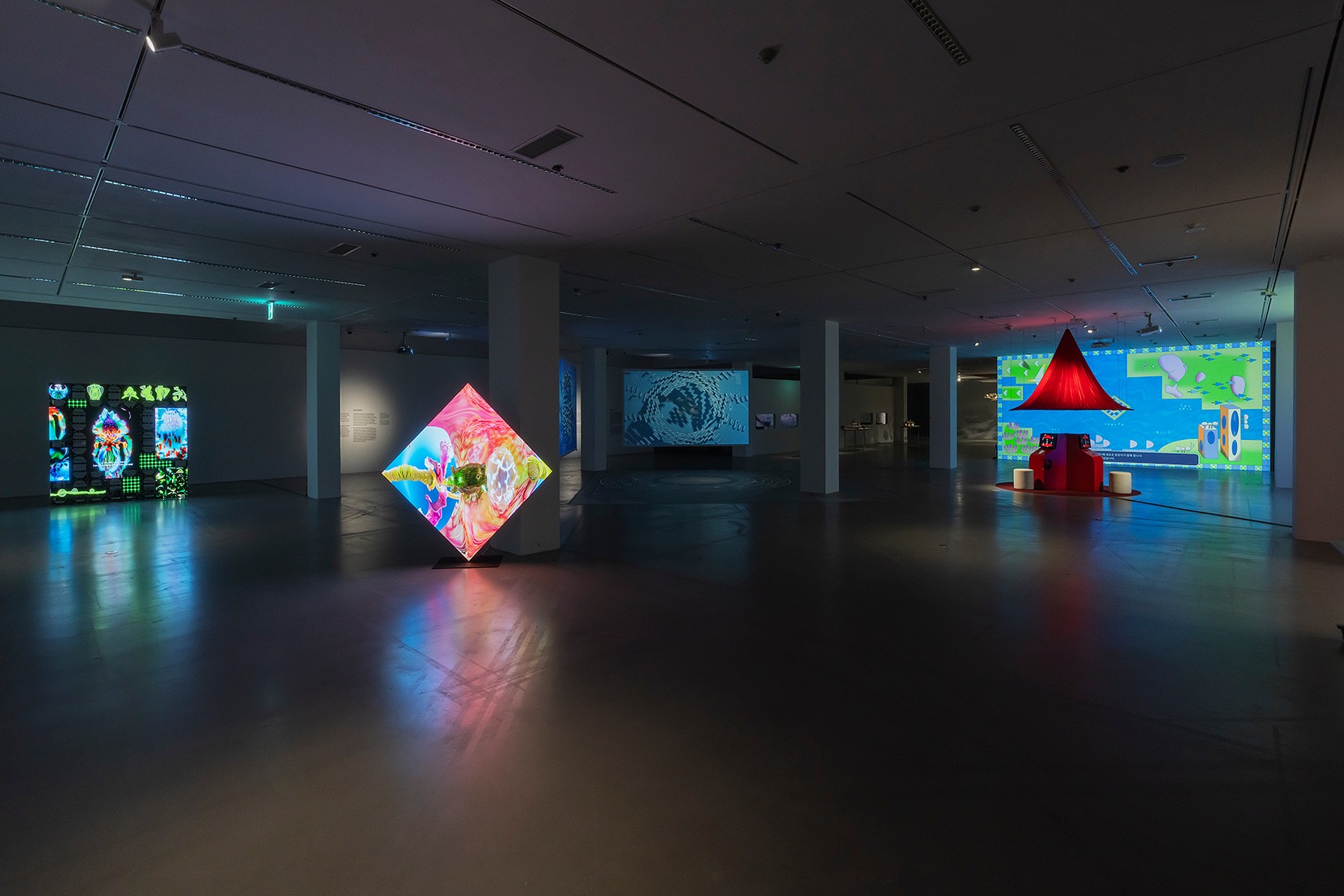
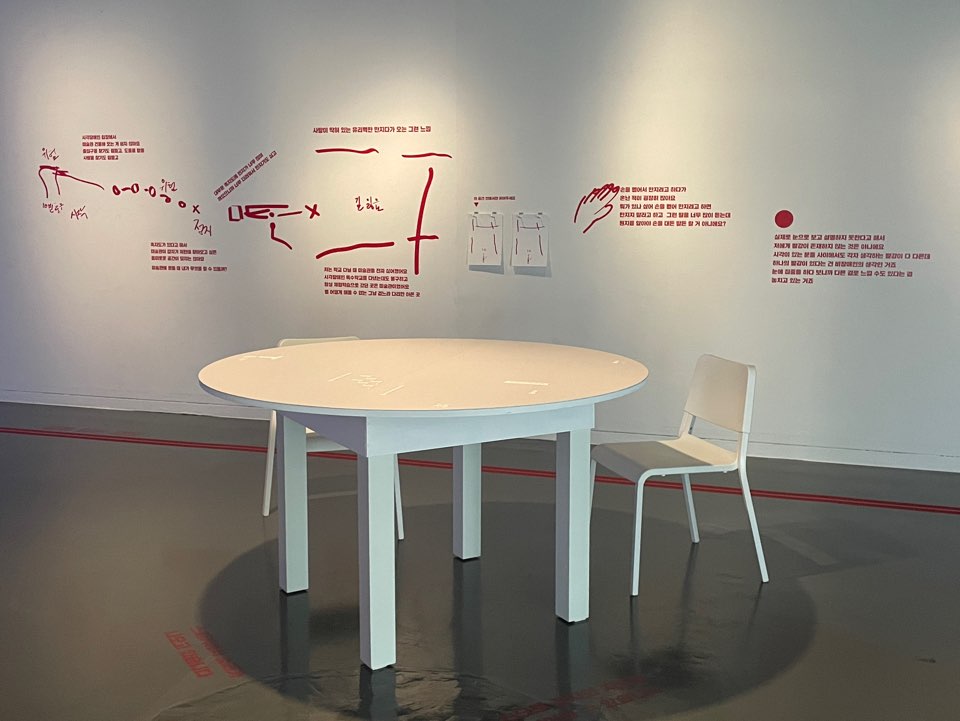
we interpret the works of dianalab and our friends, which have been explained
with the word “barrier-conscious.”
What
dianalab does may look like art brut, but it has never been art brut. It may
look like able art or outsider art, but it is not that either. It is not
barrier-free art. Although we use the word “barrier-conscious,” we are not the
same as the people who first spoke it. What we want is an art in which our
queer, disabled, women, animals, and those we have not yet thought of are all
both audience and artists expressing themselves. People say, “There is no such
thing. Just pick one. Make it simple. If it’s that complicated, it cannot be
realized in reality.” But as the poet Audre Lorde said, “There is no hierarchy
of oppression.” We have no intention of saying to one another, “Let us pause
our thoughts about other barriers for now, in order to eliminate a big
barrier.” And perhaps what was thought to be impossible, we have in fact
already been doing little by little for a long time.