Each
individual word used within the title of Sang A Han’s solo exhibition holds
multiple meanings. The word ‘sharp’ normally refers to the thin, pointed end of
an object and can therefore give a sense of intimidation. However, at the same
time, it also signals such thoughts or tricks, which then infer the possibility
of breaking through a problem that presents itself. ‘Courage’ refers to a
steadfast energy or a righteous attitude held towards the world, but the word
in Korean can also denote a container that holds objects. The artist may well
have been trying to point out the ambivalent nature of human beings by choosing
such words with dual meanings. The scope of perception given to people in
differing magnitudes, and the varied shapes of people’s hearts within that
boundary, are expressed through unfamiliar, as well as familiar states in the
real world. Han’s previous works focused on depicting, in a more definitive
language, the events she had experienced or the environments she encountered in
her social roles as a woman, mother and wife. In contrast, the phrases she
presents in this exhibition are implicit and metaphorical, with 《Sharp Courage》 also being a title that
speaks to that narrative.
Rather
than developing a piece around a specific time or event, as she had done in the
past, the artist now looks to contemplate all aspects of everyday life that
continuously unfold and visualize a fragment of the emotions felt within them.
During a conversation with the present writer, Han explained that she wanted
her voice to be hers alone, but at the same time not linger as a solitary
monologue. There will be certain emotions that everyone shares as fellow human
beings. Anxiety about the future, a sense of security arising from the
collective body that we call family, a desire to be recognized by society, an
internal conflict surfacing amidst contradictory values. All these emotions are
internal waves that each appear before us at different points in time in
diverse shapes and colors, and are realized as images of various weights and
sizes within this exhibition. Han wants to actively and widely share the
genuine worries and insights she feels as a person wanting to live the present
day in equilibrium despite being a fluctuating principal.
With
the shift in conversation topic, the realistic expressions that once stood out
in Han’s work have now been replaced with much more unfamiliar shapes.
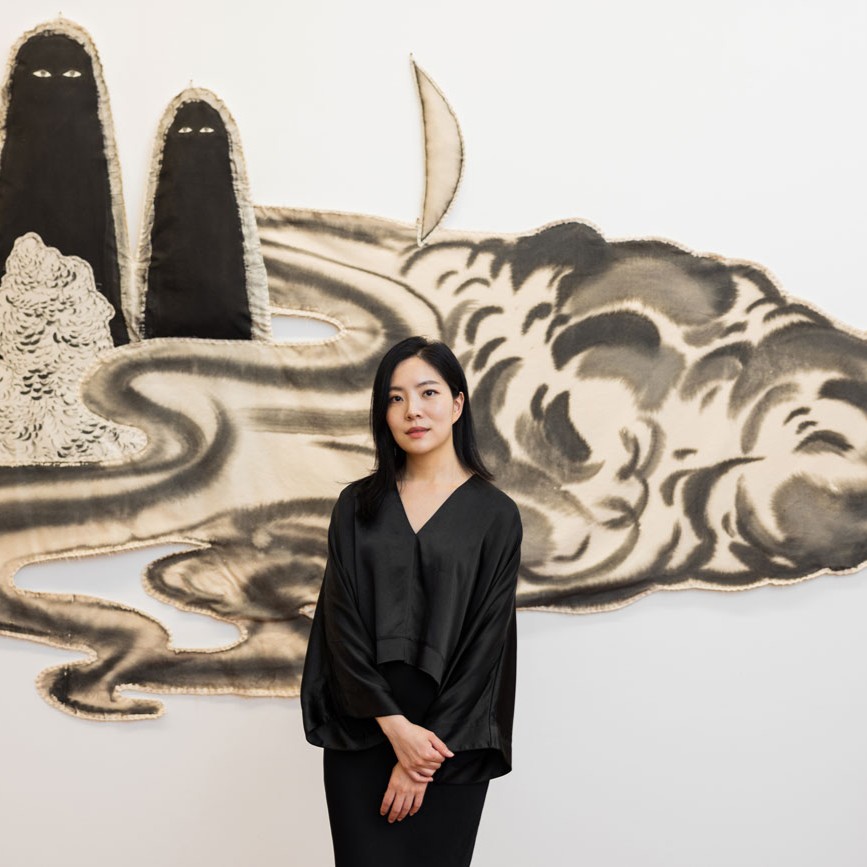
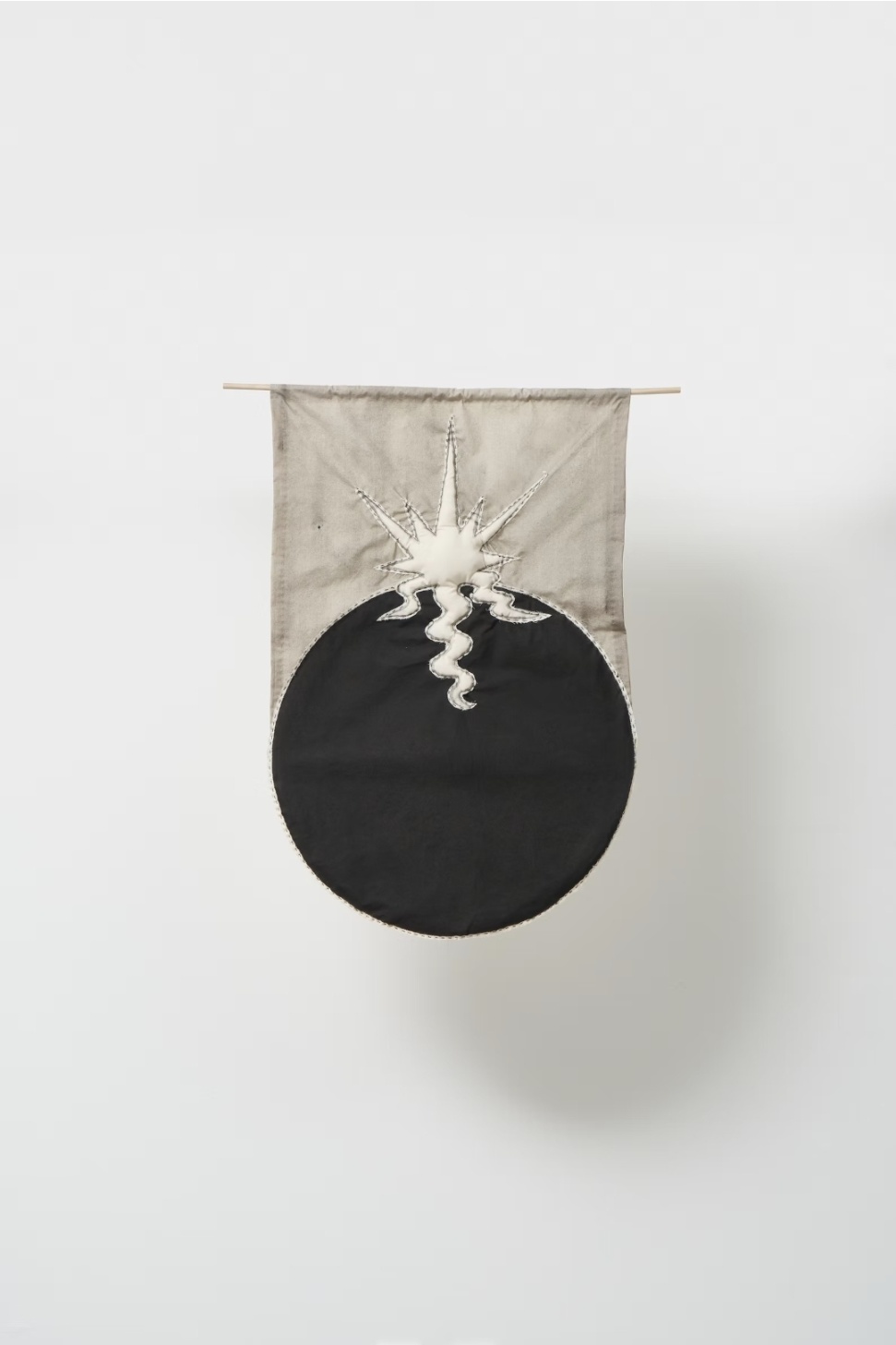
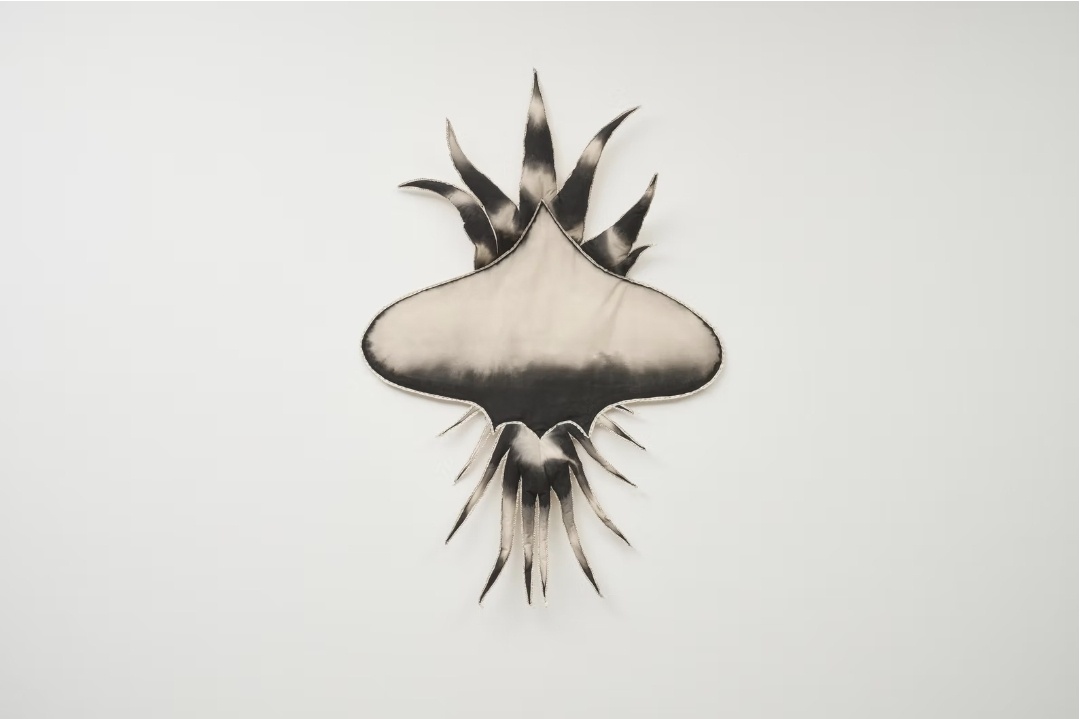
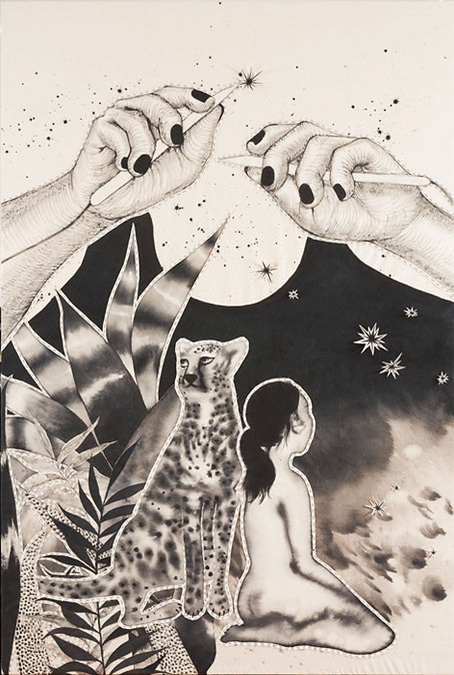
Configurations of rows of sharp-pointed bumps, circles with black-filled
centers, crooked waterdrops, round or pointed pillars, vast expanses of empty
space. Han’s drawing style, which had previously been tightly bound in a
subject-and-predicate structure, transforms into ambiguous and slack symbols.
In addition, the figures appearing amidst the geometric shapes are drawn in a
state where their entirety cannot be clearly determined. Rather than specific
characters, they are closer to a visual substitute for the notion of a human
being. If you look a little closer, what you see filing the frame isn’t a simple
shape, but rather an abstraction of reality and actualities that closely meet
one another, such as the sky and sea, the sun and moon, the stars and clouds,
fire and water. Bizarre scenes that began from natural motifs remind us of the
universal logic of life. The sense of awe you feel before nature makes you
think of the weight of life and death, and the starry night sky reminds you of
the network of relationships between people that’s as expansive as the
universe. In addition, the geometric shapes, symbols, symmetrical composition
or ascending structure that appear in the pieces act as a mechanism to draw in
transcendental narratives into the work. In general, the scenery captured in
religious paintings refers to an unknown force beyond our actual dimension,
triggering psychological states such as awe, fear, healing, faith, belief and
hope. However, rather than mentioning the object of transcendental worship by
drawing in the code of mythology or religion, the artist means to focus on the
actions of extremely secular beings. In short, for the artist, the journey to
form relationships with people, establish a small society and find her place
within it is considered to be the most noble and honorable, above any other
task.
Meanwhile,
the materials used by Han have the physical properties that she feels most
comfortable with and, equally, were chosen according to need. For Han, the life
of an artist is not achieved metaphysically in another place separated from
here in this moment. Rather, it continues within a place that’s in extreme
close contact with everyday life, in an incredibly difficult and intense
manner. Traditional Korean ink ‘meok’ and fabric were most definitely a medium
that supported Han to continue her artistic experiments, not in well-equipped
studios, but even in the most restrictive of environments. Furthermore, these
materials possess multi-layered properties, and are very similar to the
messages her most recent works strive toward. By nature, ‘meok’ penetrates deep
into any gaps and stays there for a long time rather than floating across over
the top of a given surface. In addition, the pigments that may only seem black
actually have the potential to express countless shades of light and dark
depending on their background and concentration. The fabric may be weak in
front of the sharp protrusions, but it is a tough material tightly woven with
the warp and weft. Han continues her work based on these warm but robust
physical properties. The shapes of an impenetrable heart from within her mind
become images with outlines, and these soon become thin pieces overlapping each
other upon another frame. The artist then repeats the labor-intensive process
of packing cotton between the black and white fragments and sewing them with
thread, steadily weaving a world between reality and non-reality.
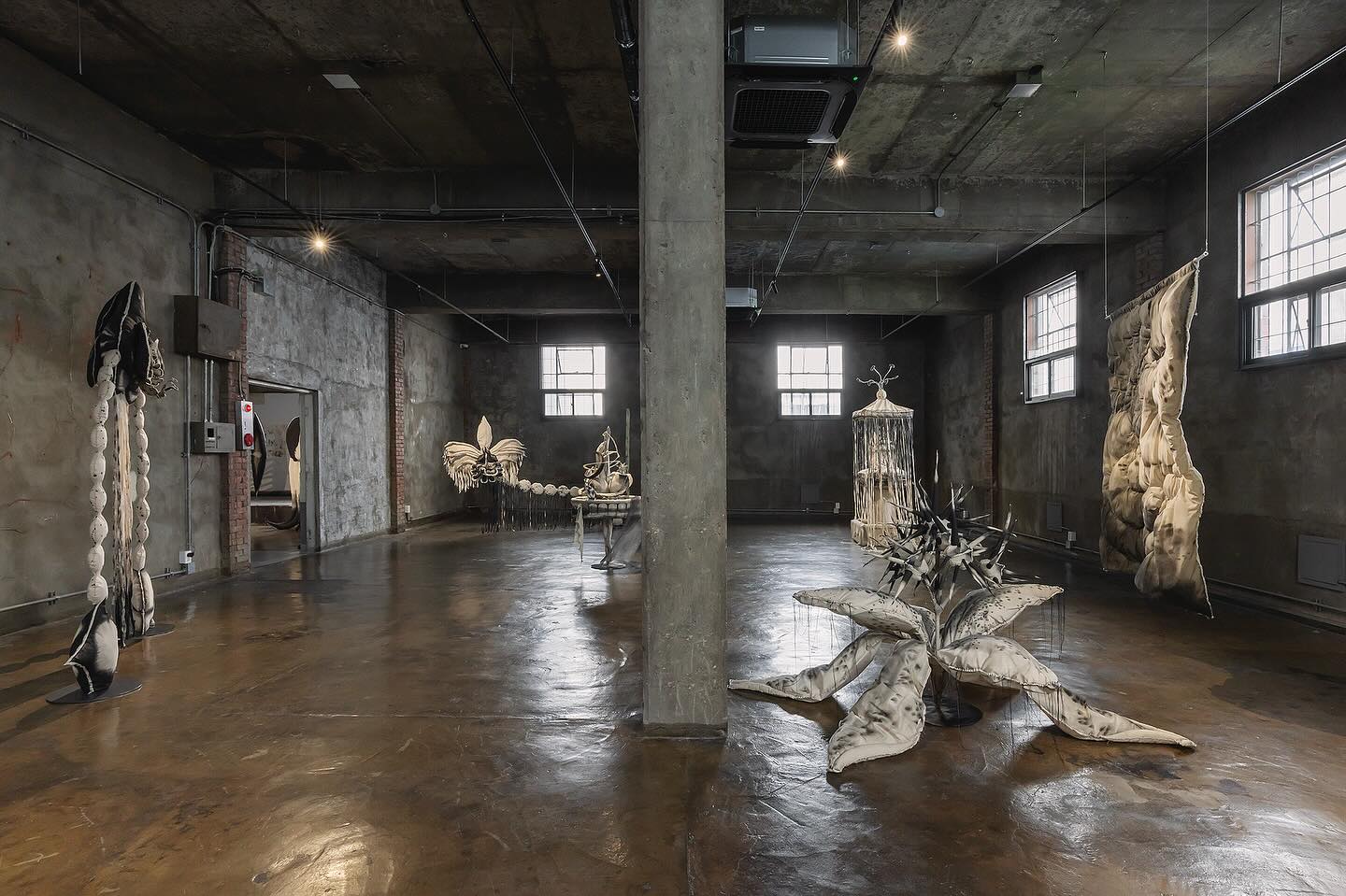
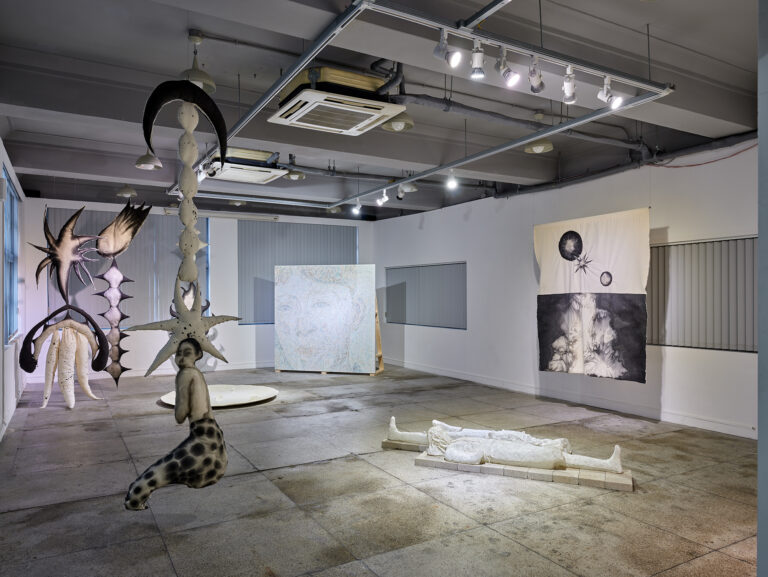
The
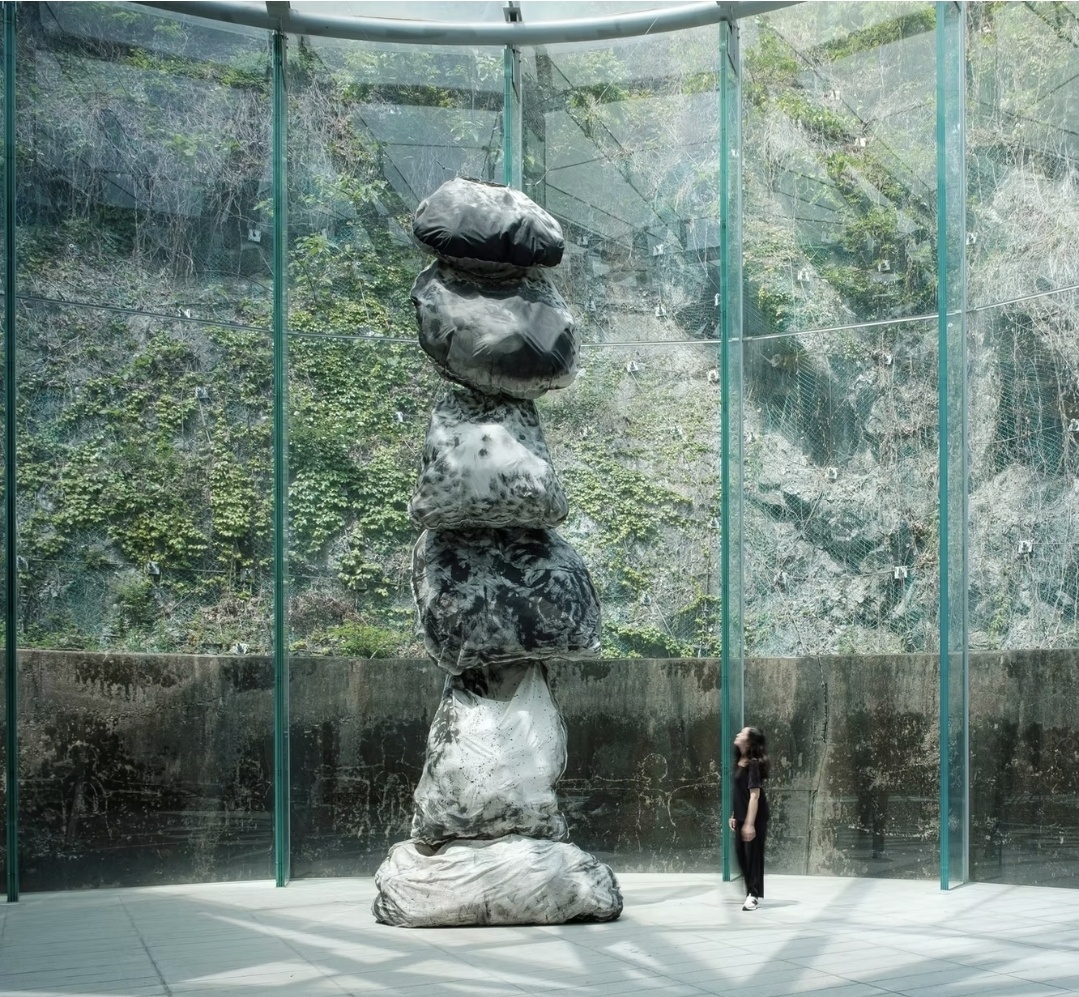
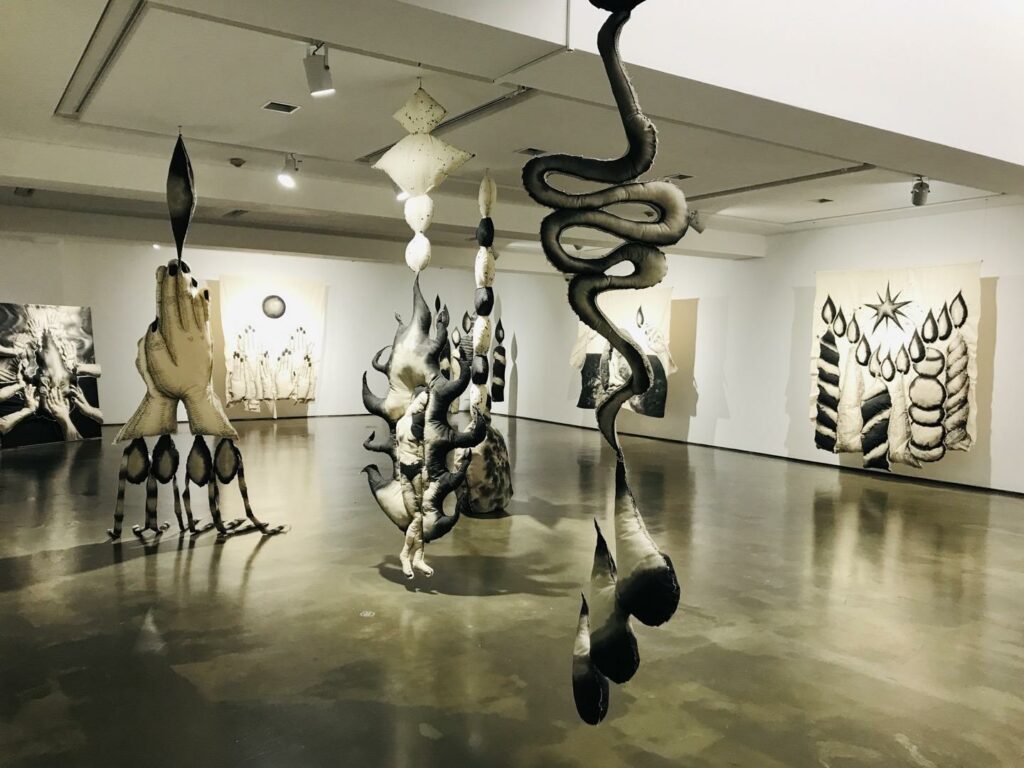
active practice of sculptural techniques such as dangling, stacking and
hanging, using the objects made from ‘meok’ and fabric, is particularly notable
within this exhibition. The high ceiling and lengthy walls that stretch out
extensively become the backdrop upon where compositions of varying sizes and
weights find their place. The exhibition space, which embraces installation
methods that reflect the principles of mobiles, hanging scrolls and towers,
opens out in front of the audience almost like a stage for a play. Han may well
have recognized in the first instance that what she was creating would not
remain as an afterimage on a flat plane, but rather, that these objects had the
volume to occupy a three-dimensional space, or even a dimension beyond that.
The dark and pale scenes extending out along the horizontal and vertical axes
of the exhibition space become the bounds that embrace the vast skies, the
moon’s halo amidst darkness, the stars scattered across the heavens and the
lives of myriad small existences.
The
profound senses engraved upon the artist’s body as she passed through various
hurdles in life become authentic existences wearing a harder outer shell and
blend into the landscape. In fact, what Sang A Han set out to say from the very
beginning sits close in line with a perpetual theme that has inspired and
intrigued numerous artists for a long time. That is, the fundamental forms
found underlying the psychological reactions that circulate within a human
being’s lifetime. We recall how emotions such as anxiety, joy, sadness,
compassion and love have taken on different forms and moved through styles of
art depending on the times. Additionally, the more surrealistic allegory that
Sang A Han has adopted further extends the breadth of meaning her work is able
to achieve. Han’s voice has now amassed the speed and scope to also embrace the
experiences of strangers with the words spread out through her canvas. Her
voice no longer lingers just with herself. Han is stepping out from her own
domain and cautiously striking a conversation with this world of yours and
mine; it is now time to welcome her courage and open up our own stories.