Wherever
it may have been, there was a time when I could play for hours with anything
within reach as if it were a toy. At home, I would often build caves out of
chairs and blankets, or make dollhouses with unused household objects. Every
toy had its own personality, and with its tiny moving mouth, I would exchange
lines back and forth alone, weaving narratives of a doll’s world. Occasionally,
when I followed my parents to visit their acquaintances’ homes, I would find
myself surrounded by new objects and environments that stimulated my curiosity
and imagination, and I would spend time crossing back and forth through
different times and places. I would embark on adventures in the ancient world,
travel to countries on the other side of the globe, or stay within a particular
moment in Korea’s past. This “play,” where new narratives and imaginations were
drawn, was the beginning of all creation.
Here
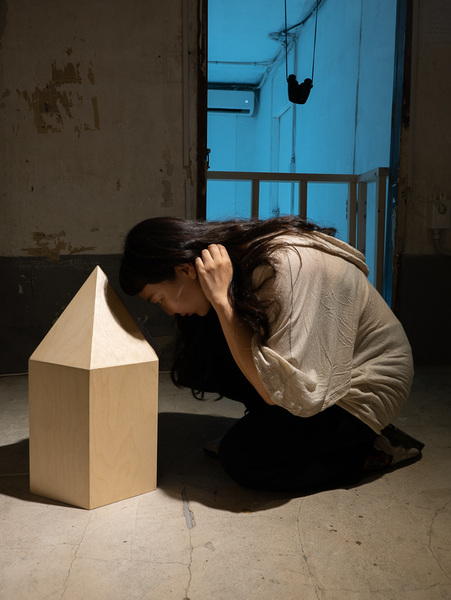
is one person who shows us her own play. Following a winding staircase up to
the rooftop of a building, as if climbing into someone’s secret attic, three
wooden doors appear, each opening into a different world. With a pounding
heart, I open the cherry-colored door. Inside, there are two small cube-shaped
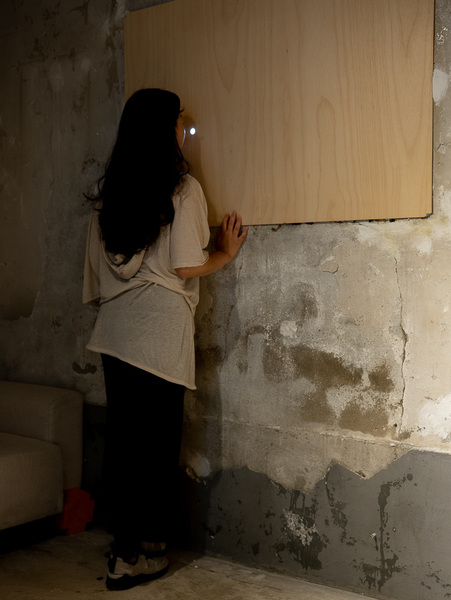
pillars and two holes in the wall, which reveal Hong’s work Peepject:
Two Holes for Eyes x 2. In the adjoining small room to the
right, blocked from entry, a telescope allows a glimpse of Hong’s piece 12
Mountains 9 Stones 6 Liters of Water. Looking through the two
holes, one sees fragments of the outside scenery, objects seemingly detached
from somewhere else, and images of the world collected by the artist, displayed
on a small monitor.
Tilting my head back to peer through a hole placed higher
on the cube, or bending my body low to see through one closer to the ground, I
find myself in somewhat uncomfortable positions. Yet through this act of
peering into holes, among the countless sights of the world, I am able to
experience “looking differently” from a shifted point of view. Through the
aperture, I sometimes discover new things, or imagine unknown objects and
worlds. Hong creates these acts of “peeping” within a world saturated with images,
making small holes in the system of familiar vision to construct new ways of
looking. This play of peeping is accompanied by discomfort, but it is through
this discomfort that we come to see something else.
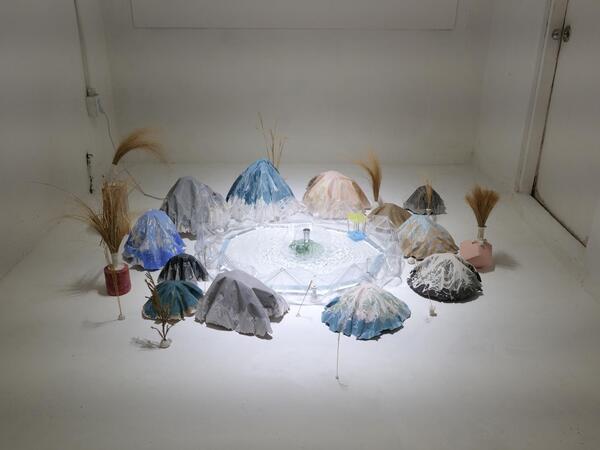
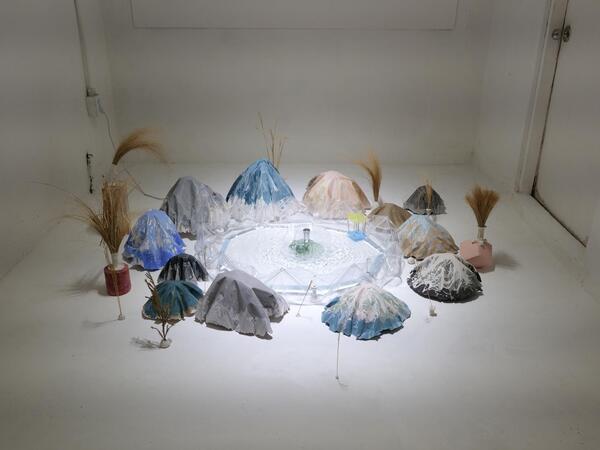
In
the small room to the right, there are fake rocks covered in layers of plastic
sheeting and bearing traces of weight, their surfaces spattered with layers of
colors. These artificial stones are arranged in a circle with dried grass, and
in the center floats a tiny toy sailboat in a small fountain. This little pond,
barely reaching knee height, is a miniature world created by Hong. Gathering
things from around her, she builds a landscape of her own and invites people
into her play. Yet, just as with the earlier holes, she leads us to view this
landscape through a telescope. Even when the entire scene is right before our
eyes, she directs us to use the telescope, through which our vision flickers
with the tremor of our hands as we examine the details. Through this other act
of “looking closely,” we expand and explore the world before us, discovering
aspects that cannot be seen with the naked eye.
Hong
says that her play is grounded in an attitude of “whether you look or not, it’s
up to you,” but through the holes and telescopes, our curiosity and desire to
actively participate in her play are stimulated. What might be beyond this
hole? What might be seen differently through the telescope? The artist seems to
play a game of peeking into the world, observing it from uncomfortable
positions and carefully examining it through devices.
In
the small room to the right, there are fake rocks covered in layers of plastic
sheeting and bearing traces of weight, their surfaces spattered with layers of
colors. These artificial stones are arranged in a circle with dried grass, and
in the center floats a tiny toy sailboat in a small fountain. This little pond,
barely reaching knee height, is a miniature world created by Hong. Gathering
things from around her, she builds a landscape of her own and invites people
into her play. Yet, just as with the earlier holes, she leads us to view this
landscape through a telescope. Even when the entire scene is right before our
eyes, she directs us to use the telescope, through which our vision flickers
with the tremor of our hands as we examine the details. Through this other act
of “looking closely,” we expand and explore the world before us, discovering
aspects that cannot be seen with the naked eye.
Hong
says that her play is grounded in an attitude of “whether you look or not, it’s
up to you,” but through the holes and telescopes, our curiosity and desire to
actively participate in her play are stimulated. What might be beyond this
hole? What might be seen differently through the telescope? The artist seems to
play a game of peeking into the world, observing it from uncomfortable
positions and carefully examining it through devices.