The
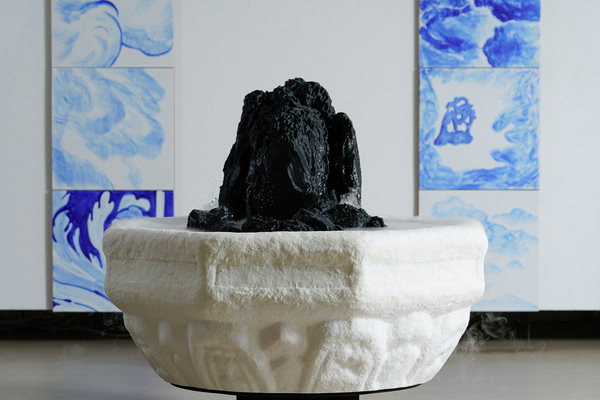
new work Sansu Sculpture(2023), presented in this
exhibition, transposes Fan Kuan’s Travelers Among Mountains and
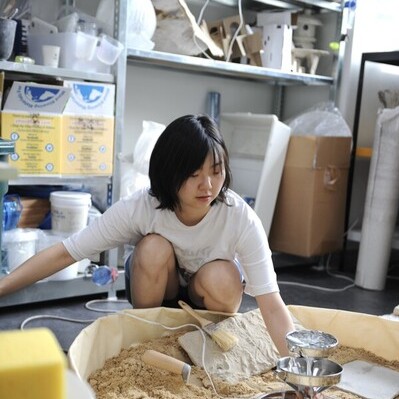
Streams into three-dimensional form. Hong first sculpted the
large rock mountains of the painting in sand, then 3D scanned and printed them.
She explained that her inspiration came from the East Asian concept
of wayu (“wandering while lying down”), which underlies traditional
landscape painting: though the body lies still, the mind roams freely in the
spiritual space evoked by the painting.
The
elongated landscapes of East Asian scroll painting are not composed from a
single point perspective; rather, they gather multiple scenic impressions
chosen by the artist into one view. In these hanging or handscrolls, viewers
wander through the depicted mountains with their eyes, as if traveling through
real terrain. Because the movement of the painter’s body is recorded in the
process, the landscapes naturally encompass shifts in perspective that follow
the path of the gaze. Unlike Western landscape painting, which often relied on
linear perspective to converge upon a single viewpoint, East Asian landscapes
contain multiple perspectives layered together, demanding both active visual
mobility and mental engagement from the viewer. Travelers Among
Mountains and Streams in particular is celebrated for its
masterful integration of near, middle, and far views, each rendered with
distinct vantage and subject.
Hong
adopts this worldview to uncover new potentials in vision. Here, both the
painter’s gaze—which selected and assembled the scenic fragments—and the
viewer’s gaze—which wanders through them to form an individual journey—are
present. In Sansu Sculpture, the two-dimensional
painting becomes three-dimensional, and details that never existed in the
original—its unseen sides, back surfaces, or the interiors of rocks—are
imagined by the artist. Filling in these gaps, Hong reconstructs the landscape
through careful looking, which is then retraced again by the eyes of the
audience. Viewers scan the sculptural mountain’s surfaces, feeling with their
eyes the smooth planes and dense ridges as if touching them—an embodied,
tactile vision foreign to the Western ocularcentric tradition.
Water
also plays a recurring role in Hong’s practice. Its flows embed time within her
works while presenting provisional, ever-shifting landscapes. For instance,
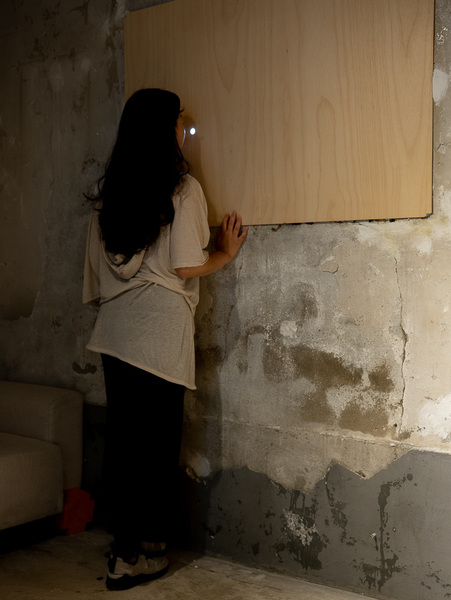
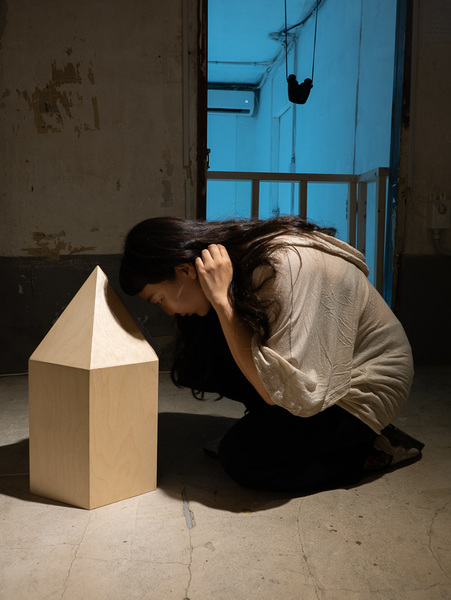
though A Piece of Ceiling(2022) may simply be described
as birch plywood coated with wax, the work’s true material also includes the
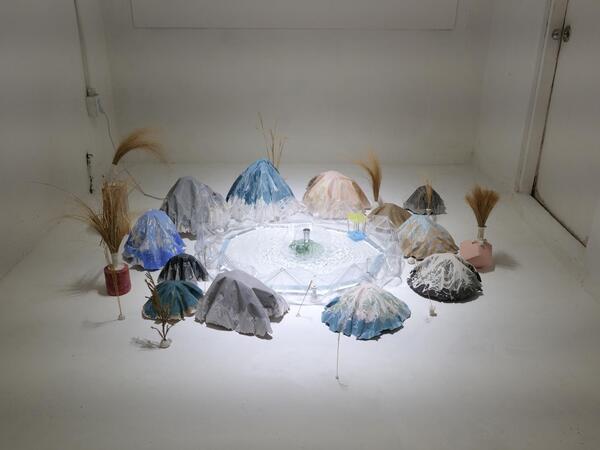
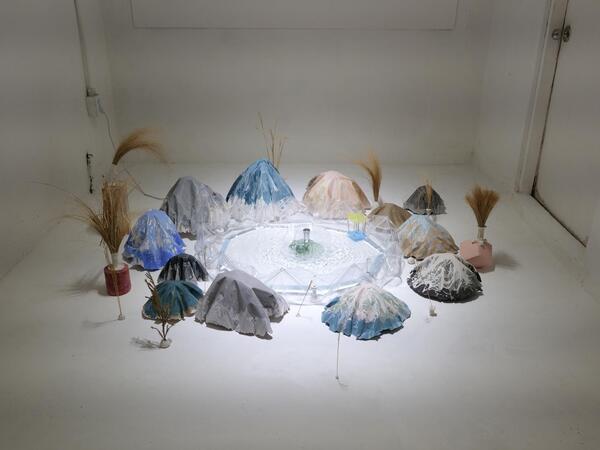
shimmering light reflected from the water in 12 Mountains 9
Stones 6 Liters of Water (8 Mountains and 6 Liters of Water)(2020/2022),
installed on the floor below. The rippling reflection flickers across the
ceiling piece, compelling the viewer to raise their gaze and trace the elusive,
unreachable image with their eyes.
More
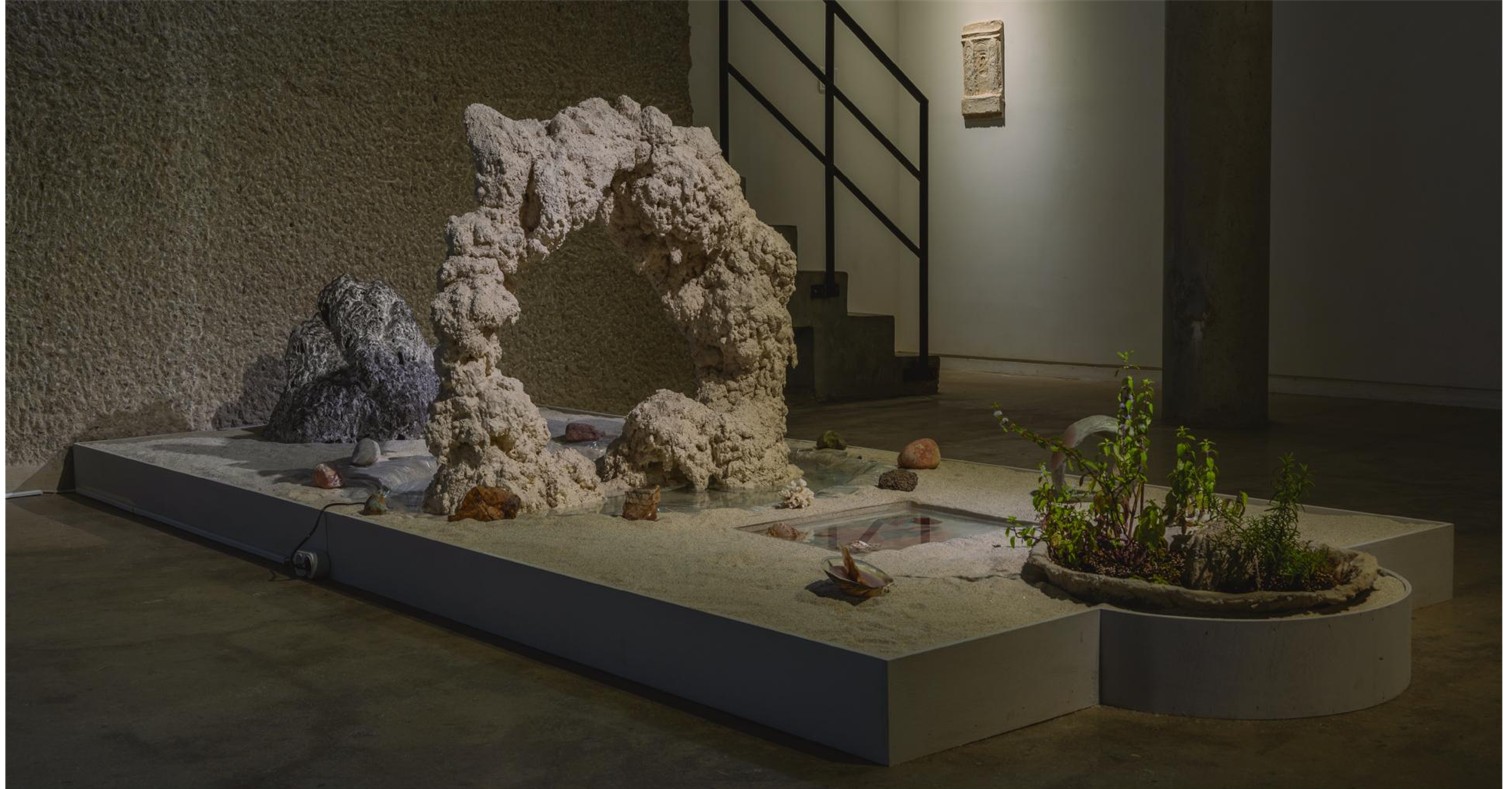
dynamic movements of water appear in other works: the fountains of 12
Mountains 9 Stones 6 Liters of Water, Waterplace(2021),
and Wall Fountain(2022) continually spout water, their
vitality inviting close attention. In Sansu Sculpture,
the form itself becomes enveloped in mist and water. Droplets splash onto the
surface, mist whirls around it, and the static sculpture is transformed into a
kinetic event. Viewers must peer through drifting vapor to discern the
contours, their eyes tracing a landscape in flux.
This
tactile visuality also characterizes her engagement with architectural
ornament. Columns, murals, and rock pedestals from traditional contexts are
reproduced in sculptural form. By extracting and reconfiguring fragments of
elaborate decoration, Hong highlights details that might otherwise remain
overlooked. In works such as Waterwall(2021), Pillar
Head(2021), and Temple Facade(2021),
architectural motifs are affixed to gallery walls like reliefs, forming new
scenes. Although modeled after historical originals, they are remade in
materials like sand mixed with wax or sponge covered in gesso, producing coarse
textures that contrast with the originals’ polish. The resulting delicate yet
rough surfaces emphasize vision’s tactile capacity.
In
the current exhibition, Octagonal Rock Pedestal(2023),
supporting Sansu Sculpture, is modeled after a
stone base at Changgyeonggung’s Jagyeongjeon. In its original setting, it is a
quotidian element beside a bench, easily ignored. Relocated into Hong’s
constructed scene, it emerges as a focal point. Behind it, The
Gate of Wind and Water(2023) spreads out like a folding screen,
situating both pedestal and sculpture within a newly staged environment.
Detached from their original contexts, these once-overlooked details command
attentive looking within the artist’s constructed vision.
The
new scenes that Hong constructs often imply a definitive “front” from which to
view them. Standing before this orientation, the audience diligently traces the
sculptures with their eyes. Yet in these latest works, the artist also strongly
urges the viewer to move their bodies and explore the backs. Even as she
suggests a direction for viewing, she simultaneously compels audiences to seek
alternative vantage points. Having transformed a two-dimensional painting into
a three-dimensional Sansu Sculpture, Hong insists that
it be viewed from multiple sides. What was once a fixed scene oriented to a
single viewpoint is now dispersed into scenes requiring mobile, shifting
perspectives. Her work, now configured with multiple directions of looking,
gestures toward the future trajectories of her practice.
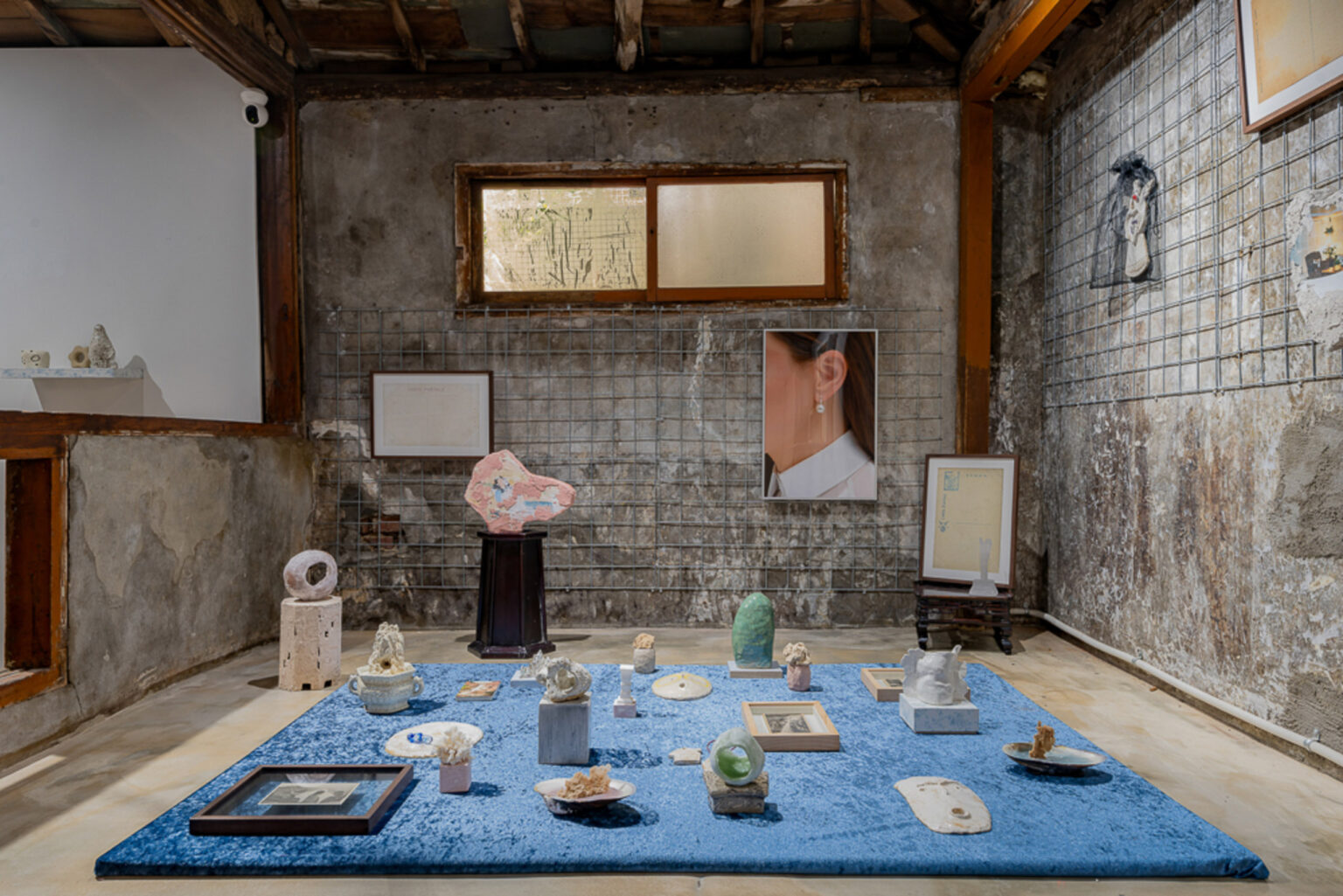
On
the archive table of the exhibition 《Defragmentation》, small sculptural fragments
from Hong’s working process were displayed. These pieces combined rough planes
with smooth surfaces, gentle curves with sharp ridges, concave hollows with
protruding edges. Even without touching them, one’s eyes instinctively wander
along their valleys and peaks, visually groping their forms.
We
live in an age where endless new content is mediated by digital media. Visual
information overflows, but the eyes themselves are rarely required to actively
seek, probe, or grasp. Everything is flattened on screens and consumed at a
glance. In contrast, Hong’s sculptures demand a more proactive use of vision,
urging viewers to trace and linger with their eyes.
Through
this, her work resists static and flat modes of seeing, instead cultivating a
dynamic, multi-dimensional gaze. By provoking viewers to “touch with their
eyes,” Hong’s practice reinvigorates the act of looking as an embodied,
exploratory experience.