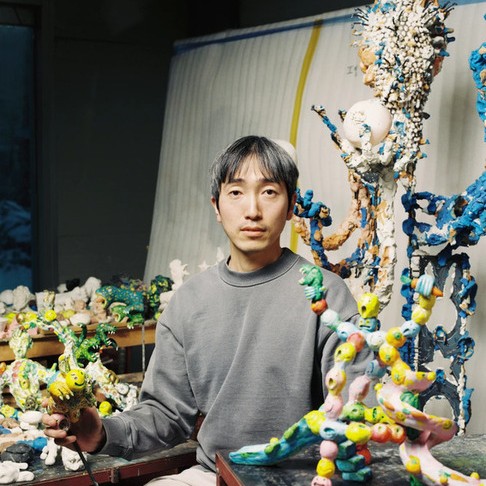
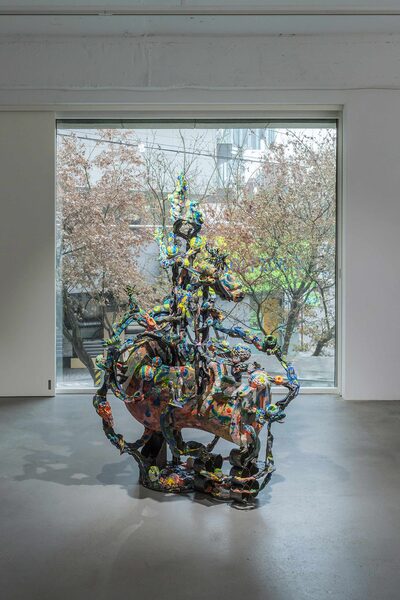
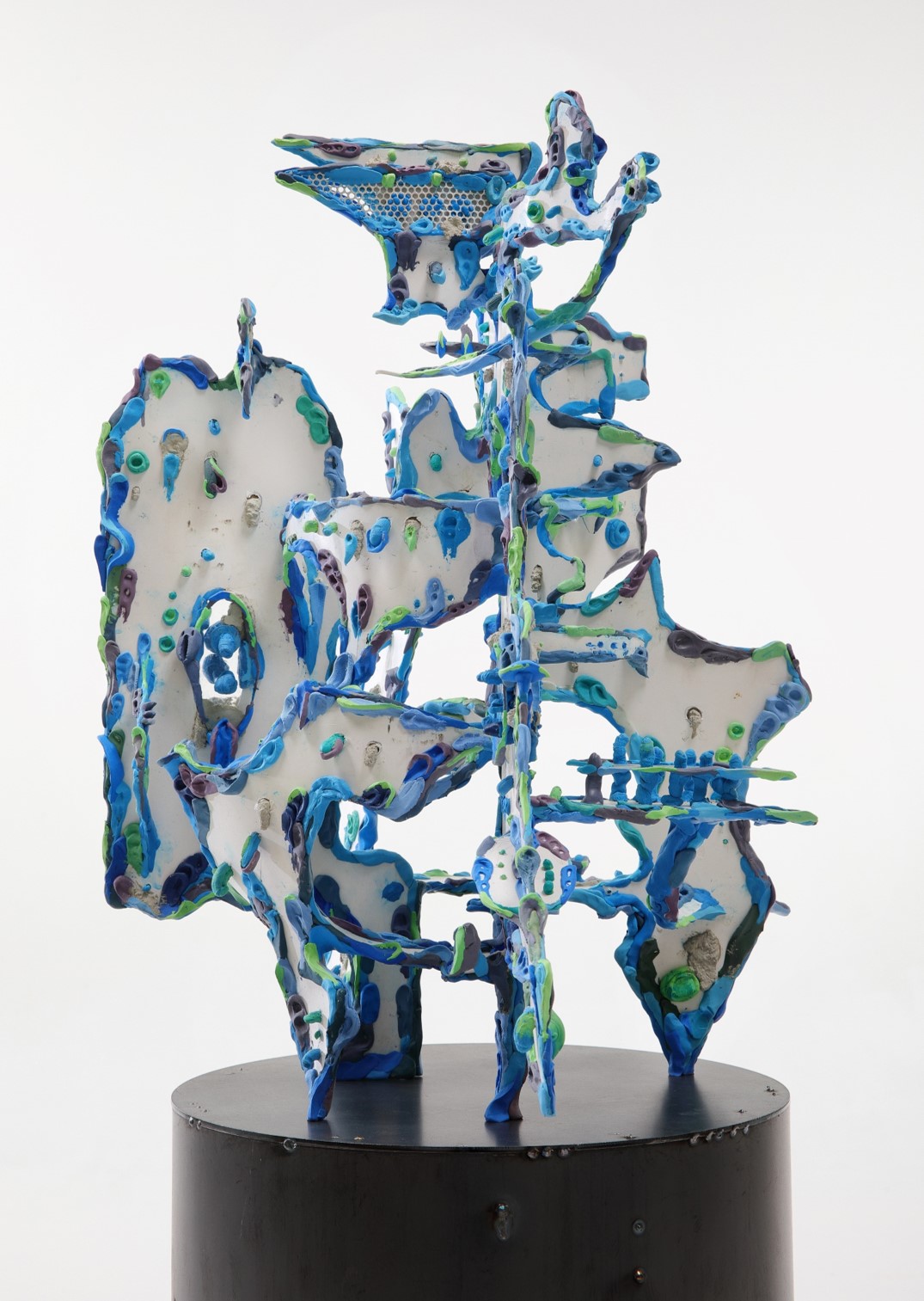
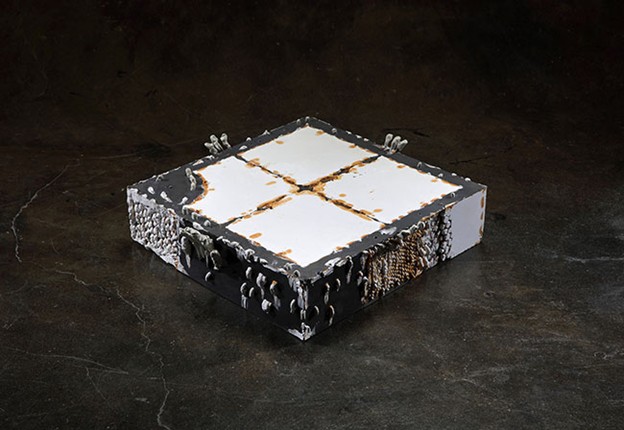
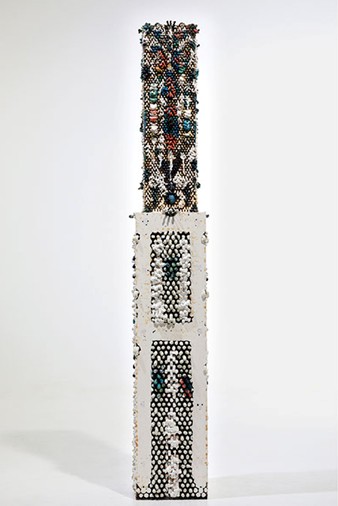
Kwak Intan, Sculpture Gate: Sitting Figure, 2020, Plaster, resin, steel, perforated metal mesh, 15×57×57 cm © Kwak Intan

When describing Kwak Intan’s work, certain words frequently recur: obsession and freedom. The painful repetition and accumulation of compulsions, and the psychological drive to break away from them to achieve freedom—these two opposing forces serve as the starting point for his sculptures. In other words, sculpture is gestated in the space between obsession and freedom, within the process of striving for existence. As is well known, the human will for existence was also a condition for the emergence of modern sculpture. Experiencing compulsion within the overwhelming reality, the artist launches his work through classical themes.

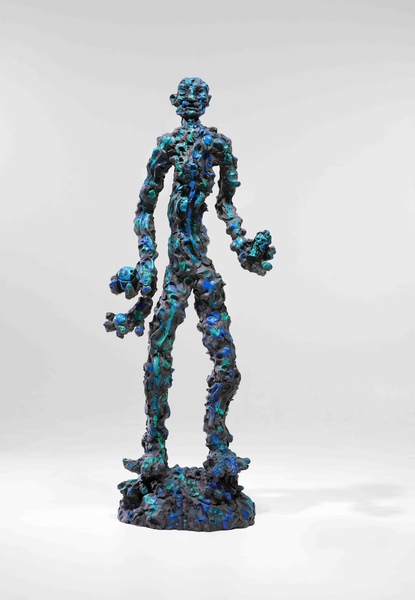
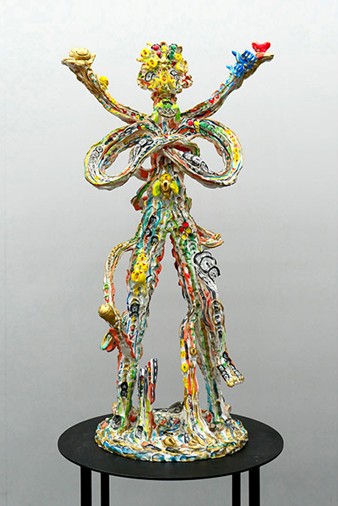
Accordingly, in his early works, one often encounters figurative sculptures that seem to externalize agonizing obsessions. From distorted busts with furrowed brows and closed eyes to small sculptures obsessively layering parts of the body, his earlier practice bore the marks of this. And perhaps the fact that he worked under such classical themes could also be taken to mean that he did not yet participate in (relatively) newer themes of sculpture. Indeed, his works often remained within the realm of sculpture, rather than opening up into the “expanded field” or crossing dismantled boundaries into the world of objects and immateriality.

Thus, early on, some of his works felt somewhat conventional. However, by 2019, Kwak’s work began to temporarily depart from the compulsive representation of the body and move toward abstraction (Group Exhibition 《coverversion》). The catalyst was history. The artist began to turn to art history and imitate historical works—from Vladimir Tatlin’s famous sculptures to those of Naum Gabo, Anthony Caro, as well as Korean artists Lee Ungno and Ha Jonghyun. By appropriating past abstraction, the forms of his sculptures shifted dramatically. Yet there was something suspicious about this transformation: the pasts were arbitrarily and opaquely jumbled together, without clear rules or stylistic consistency.

However, this arbitrariness—or opacity—was also inevitable. Reality itself had become arbitrary and opaque. Since the digital environment became widespread, reality has transformed. A world where everyone takes photos or screenshots with their phones and sends them into the digitally connected sphere that transcends time and space. In such a time, the accumulation and dispersal of random images appear more overwhelming than reality itself. While arbitrary images overflow and mobilize every conceivable time, linear time becomes incomprehensible. In a world where linear time no longer functions, the past becomes clearer than the present and arrives arbitrarily, in opaque form.

The phenomenon of the present being influenced—even invaded—by high-resolution images of the restored past paradoxically presents a new situation to which humanity must respond. And because sculpture, as an old discipline, is always intertwined with the past, it was able to seize upon this phenomenon of the past overtaking the present. The anachronism of conventional sculpture thus contributed to creating the artist’s unique way of responding to a transformed world.

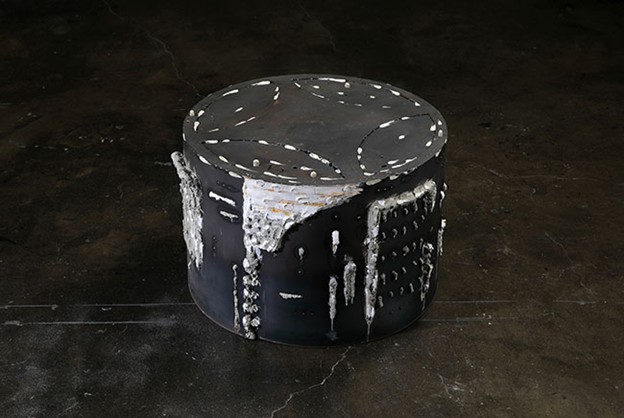
Kwak Intan, Sculpture Gate: Development of the Head, 2020, Steel, perforated metal mesh, stainless steel, cement, plaster, resin, 52×80×80 cm © Kwak Intan

Yet, as mentioned, the past was not something the artist sought but something that suddenly arrived. If the appropriated pasts above feel chaotic or suspicious, it is not because they were intentionally staged but because they emerged as immediate reactions. In a digitized media environment, everything appears transparent yet is profoundly opaque.

Webpages disappear suddenly, news is shared without sources, software hides its code, and the grammar of binary does not follow human language. The reconfigured reality’s most important actors—platform economies—exploit individuals as invisible victims while also inducing them to become invisible perpetrators. Perhaps the opacity of sculpture’s jumbled past also reflects this: suffering invisible damage from the past (the changed reality) while inflicting invisible harm (arbitrary appropriation).


Kwak Intan, Movement 21-2, 2021, Resin, acrylic, steel, 110×60×40 cm © Kwak Intan

Thus, the opacity itself, as well as the increasingly chaotic landscape of Kwak’s work within it, are not awkward developments. In his 2019 solo exhibition 《Unique Form》, the artist dissected and reconstructed busts he had previously made—sculptures embodying the psychology of obsession and freedom—and juxtaposed them with new works that appropriated the past. When he appropriates historical pasts and then re-appropriates his own past, a sculptural space-time emerges in which history and self are no longer clearly distinguishable.

And if one can say so, in this hybrid spatio-temporal field, many things intermingle: the artist and history, Korean art history and European or American art histories, the material flow of ink compared with the welded flow of metal fragments, ink painting and sculpture, resin and acrylic paint adhering to steel frameworks—traditional media of different hierarchies and histories are all mixed together.


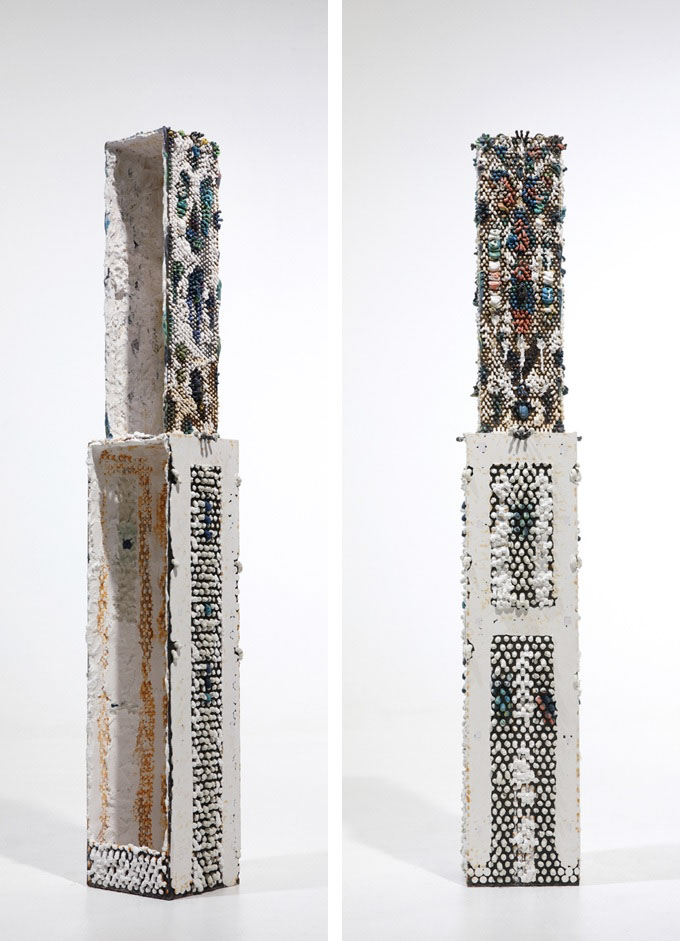
Kwak Intan, White Head, 2020, Plaster, resin, perforated metal mesh, steel, stainless steel, 142×25×23 cm © Kwak Intan

Furthermore, finished sculptures and leftover fragments intermingle, blurring the line between the artwork itself and the pedestals supporting it. The result is a complex and unruly mixture that, rather than blending smoothly, bursts apart and spills over—sometimes to the point of being indecipherable. Yet one thing remains certain: this process of incomprehensible mixing becomes a suitable foundation for exploring the principles and elements of sculpture anew.

How long can an individual endure arbitrariness and opacity? Won’t sculpture, jumbled and chaotic, ultimately dissolve into mere noise? And yet, some of Kwak’s works show themselves bursting forth beyond noise. Surpassing opacity—though bearing its traces fully—the works return from sculpture back into sculpture once again.

References