Let’s focus on the title of the performance. It is Raw Proof. Among the works presented in 《Kind》, the solo exhibition of the two-person collective Yagwang—composed of Jeonin and Kim Taeri—the video piece is titled Intruder. Who is doing the intruding? Into where, exactly? Before asking such questions, the title of the performance comes back to mind: Raw Proof. This performance is the raw proof of Intruder.

At the start, the performers enter in a line wearing masks that cover almost all of their faces. Passing through the narrow corridor of PS Center, the performers keep their faces expressionless even behind the already-concealed masks. Still wearing these masks, the performers stand before the work Portrait of Visitor and are documented in photographs. The performer’s name is called, and for each one, their front and side profiles are photographed. After that, a voice announces the first scene.

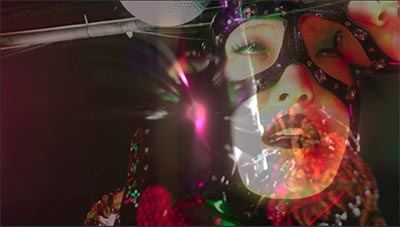
Throughout the performance, one performer continues to play the role of relaying or directing the current situation. Before the performance begins, the audience is informed that filming will take place during the show and asked for their understanding regarding movement paths. Once the performance starts, a videographer holding a gimbal moves between roughly three separate rooms, filming the performers’ actions. The room where techno music plays is divided by a large screen, onto which the gimbal’s footage is simultaneously transmitted in real time.

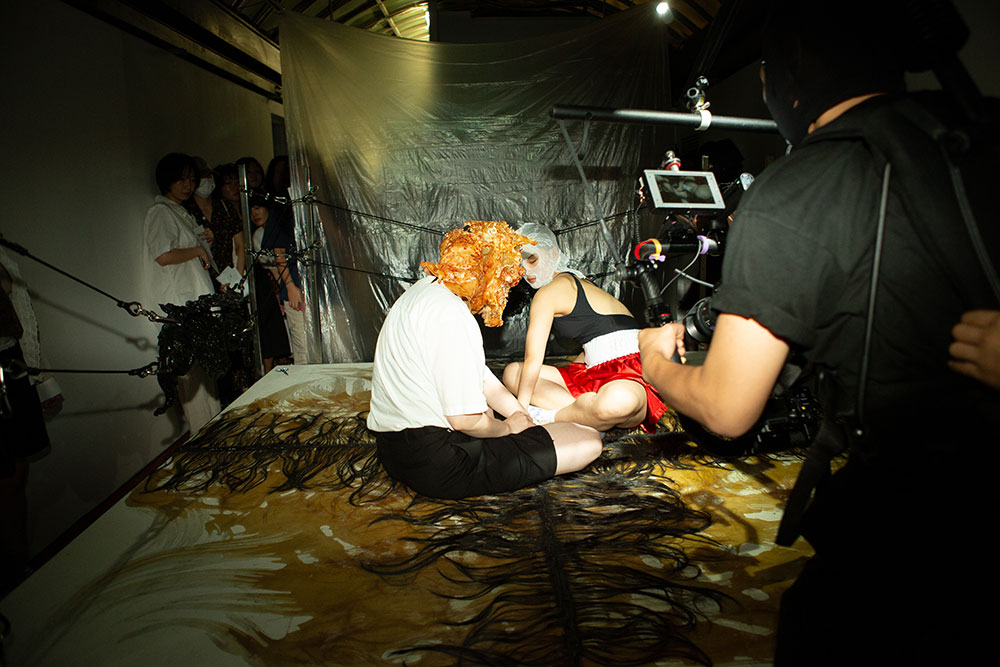
In the early part of the performance, I was in the largest space, where a wrestling ring was set up, so I did not realize that the footage was being simultaneously transmitted. Of course, even the sight of the two performers wrestling in front of me was not entirely clear—because they were obscured by a vinyl sheet. From their silhouettes and shadows, one could only discern that they were attacking each other or rolling on the floor. After the performance progressed a little, the vinyl sheet was cut apart by the performers using scissors. I did not see this moment directly; I only saw it on the simultaneously transmitted screen.

Wherever I stood, I could not tell what exactly the raw proof was. Perhaps the reason why the tearing of the vinyl as captured by the camera felt more real was not only because my own field of vision was limited.

Performance view © Yagwang

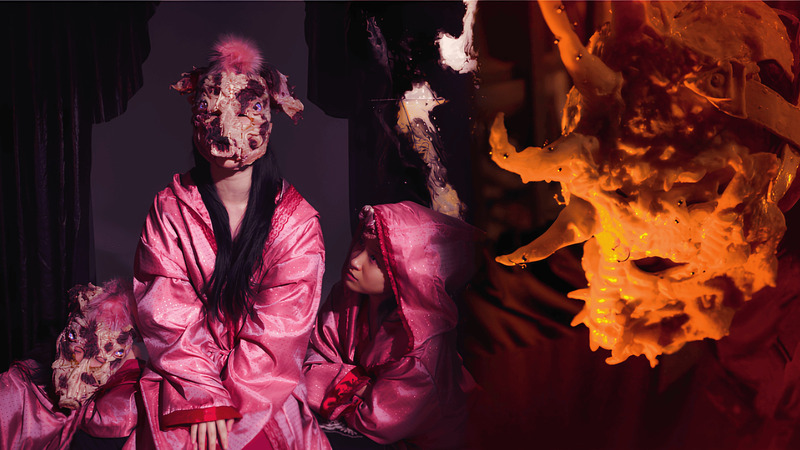
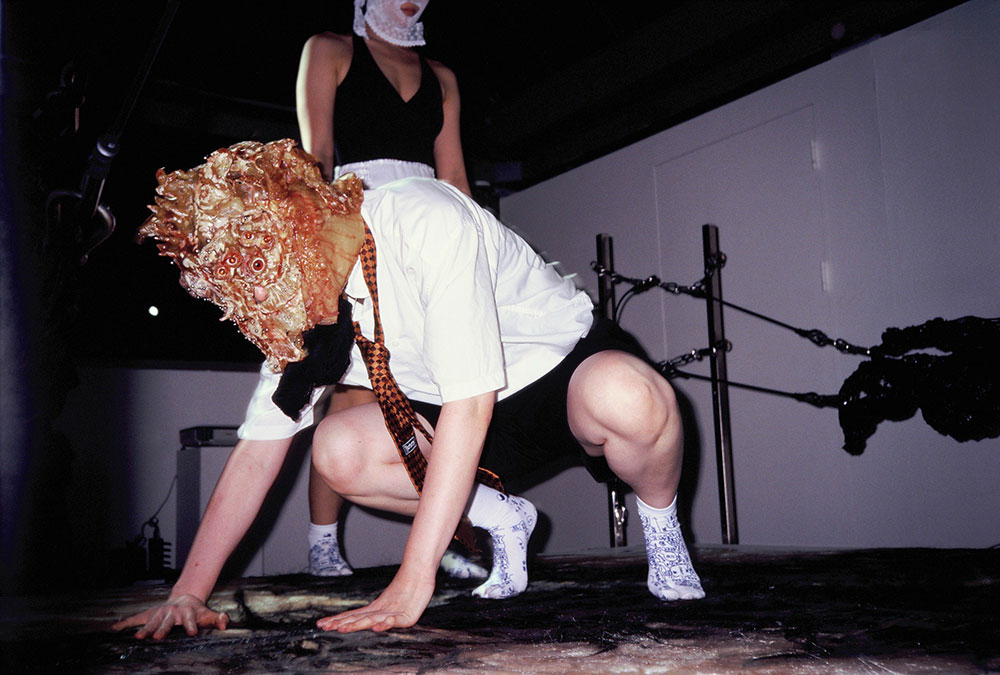
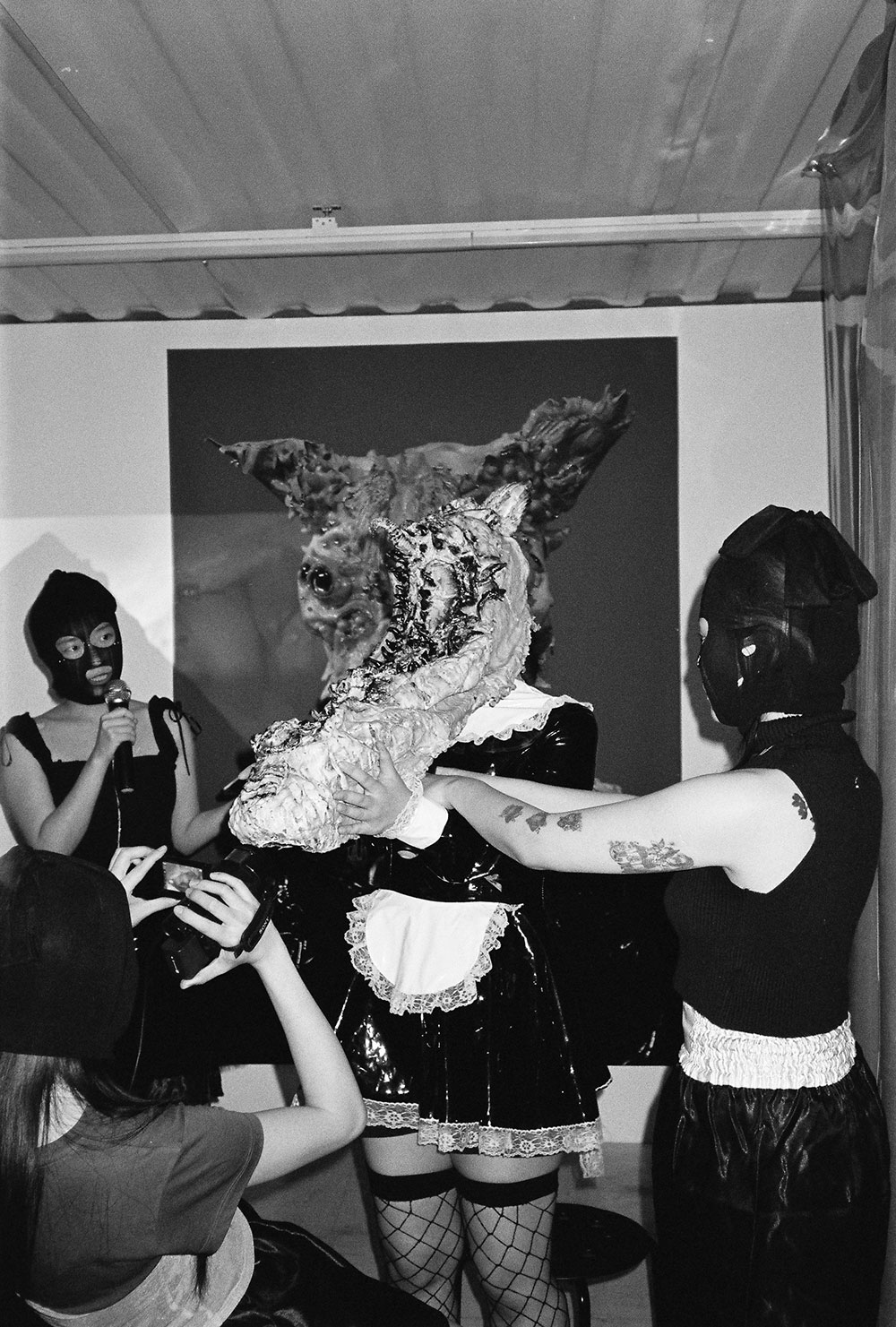
The costumes of the six performers also merit attention. Among the two wrestling performers, one wore a mammal-like mask, a necktie, and somewhat long shorts. The other wore a mesh-like mask, a thin sleeveless top, and red athletic shorts. Another performer, dressed in a maid costume with fishnet stockings and wearing a mammal-shaped cap, wandered around the venue wiping various spots with a rag attached to their palm. The performer playing the director role also had their face covered except for the eyes, nose, and mouth, and another performer was completely encased in a large shell in the corner. The only one whose face, skin, and body were fully visible was the performer who had cupping marks on their body.

The masks worn by the performers resemble mammals in form, but their texture is like the exoskeleton of an insect. In photographs, they might evoke a moist, visceral texture close to internal organs, but in person, they seem as though they might crackle or snap when broken. Considering the masks in relation to the costumes, the performers’ bodies look “less like human bodies and more like something from a B-movie populated by monsters, aliens, or creatures that terrify the protagonist”¹ — an alien form, but one whose extreme exaggeration is also palpable.

Performance view © Yagwang

These moments witnessed by the audience: two strangely dressed people wrestling; a person with a rag in hand; a person filming like a director; a person with cupping marks protruding like lumps on their back; a person trapped in a shell; and the constant beat of techno music. This techno music even makes one wonder if they are in a club, while also making the performers’ voices harder to hear. Could all these audiovisual elements and this atmosphere be causing the audience to believe they are seeing an illusion? Thoughts turn to hallucinations. Are hallucinations truly things that do not exist? When the voice calling for the next scene to be filmed is so clearly audible, when the fact that someone is directing the event is so distinctly perceivable—even if not sharply—can that really be called a hallucination?

A hallucination does not originate outside of reality. It always begins with something small. In this case, the hallucination begins in the chrysalis that a butterfly has shed. Because of it, the performers take on strange forms. In the close-up shots of cupping marks shown in the simultaneous transmission, the product number of the cupping device was clearly visible. If one took off their glasses, the number would no longer be clear, and taking off one’s glasses is undoubtedly a dulling of sensory acuity. In that process of dulled sensitivity, hallucinations can occur. Such alien forms emerge in this way. Like turning a soft knob, as we adjust the things we can perceive here and there, there comes a moment when the degree of what we know aligns precisely within what we know—and precariously, that value holds. We feel the hallucination.

Performance view © Yagwang

The performers also see hallucinations within the fragments. One performer says: “Prepare a place for me to lie down. Prepare a place for me to die. Prepare a place for me to practice dying.” Another performer responds: “Okay. Good. This time, please do it more emotionally.” The first performer cries out with more anguish: “Prepare a place for me to die.” The audience sees hallucinations in the scattered fragments even more intensely. The audience knows less than the performers. Why does this figure speak that way? Why, in delivering such an overtly emotional line, did they not speak it emotionally at first? In Intruder, the figure who ends up covered in cupping marks without ever having needles inserted says they want to cut them off. Another performer says: they cannot cut them off, but “I can make it prettier for you.” What exactly are they making prettier, and how?

The audience becomes the witness to the raw proof of how the exhibition unfolds. Just as a visitor can become an intruder, there is no way to claim that a witness is inherently more objective than an intruder.


1. Excerpt from the Foreword to Yagwang’s Solo Exhibition 《Kind》

References