The
spaces produced by Boma Pak or fldjf studio—whether online or offline—remain in
a state of incompletion. They evoke a kind of atmosphere that feels oddly
familiar but from which one can never quite pinpoint an exact reference. The
questions of what, how, and why she does what she does in these spaces never
seem to land anywhere; instead, a faintly eerie haze lingers persistently. Yet
she repeatedly invites us into her work by calling it a “service”—through
broken syntax, or sometimes through jumbled foreign-language sentences. In that
case, there’s nothing left to do but respond to the invitation—and submit a
service satisfaction survey in return. [1]
1.
fldjf–Material, Sample, Substitute
“Hello?
I’m writing because I have a question for the owner of Real Stone. I was drawn
to the Real Stone store after seeing the neatly cut stones laid out in perfect
sizes… I often feel like ‘samples’ are being sacrificed for the sake of the
‘product,’ and I want to display the ‘sample’ in a way that’s not just a
sample.”—from the webpage for fldjf material suite 33, presented in 《Silky Navy Skin》 [2]
I
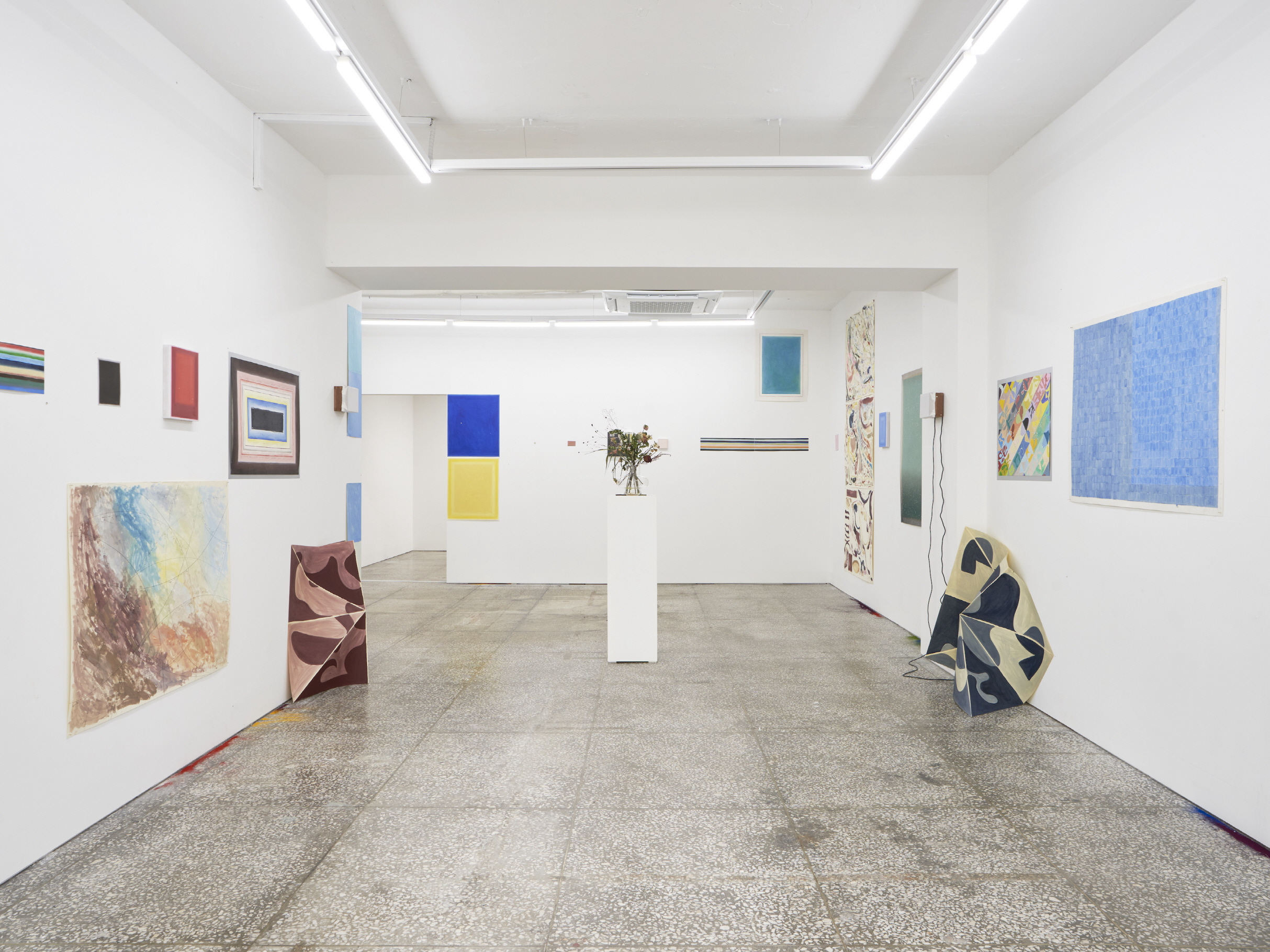
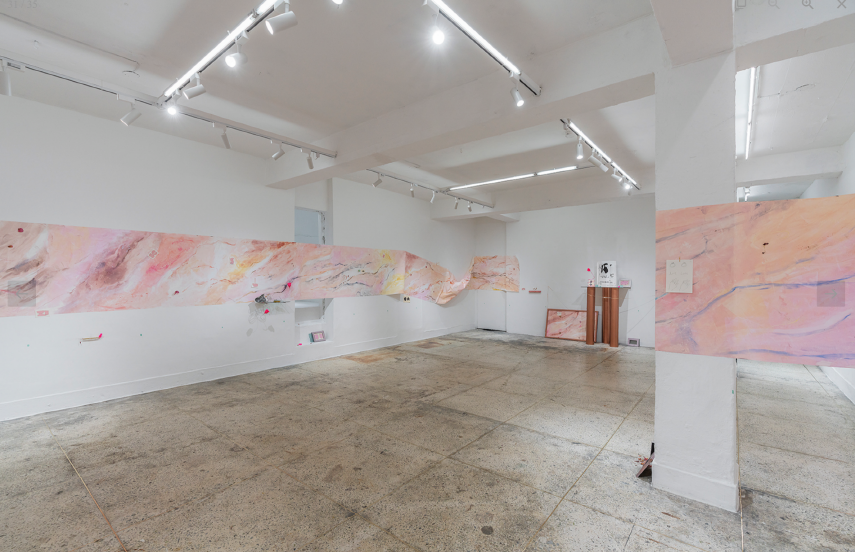
first encountered fldjf studio’s samples at 《Silky Navy Skin》 (@ Insa Art Space,
2016.4.15–5.14). Although promotional materials listed Boma Pak as a
participating artist, she was responsible for “decoration,” one of fldjf
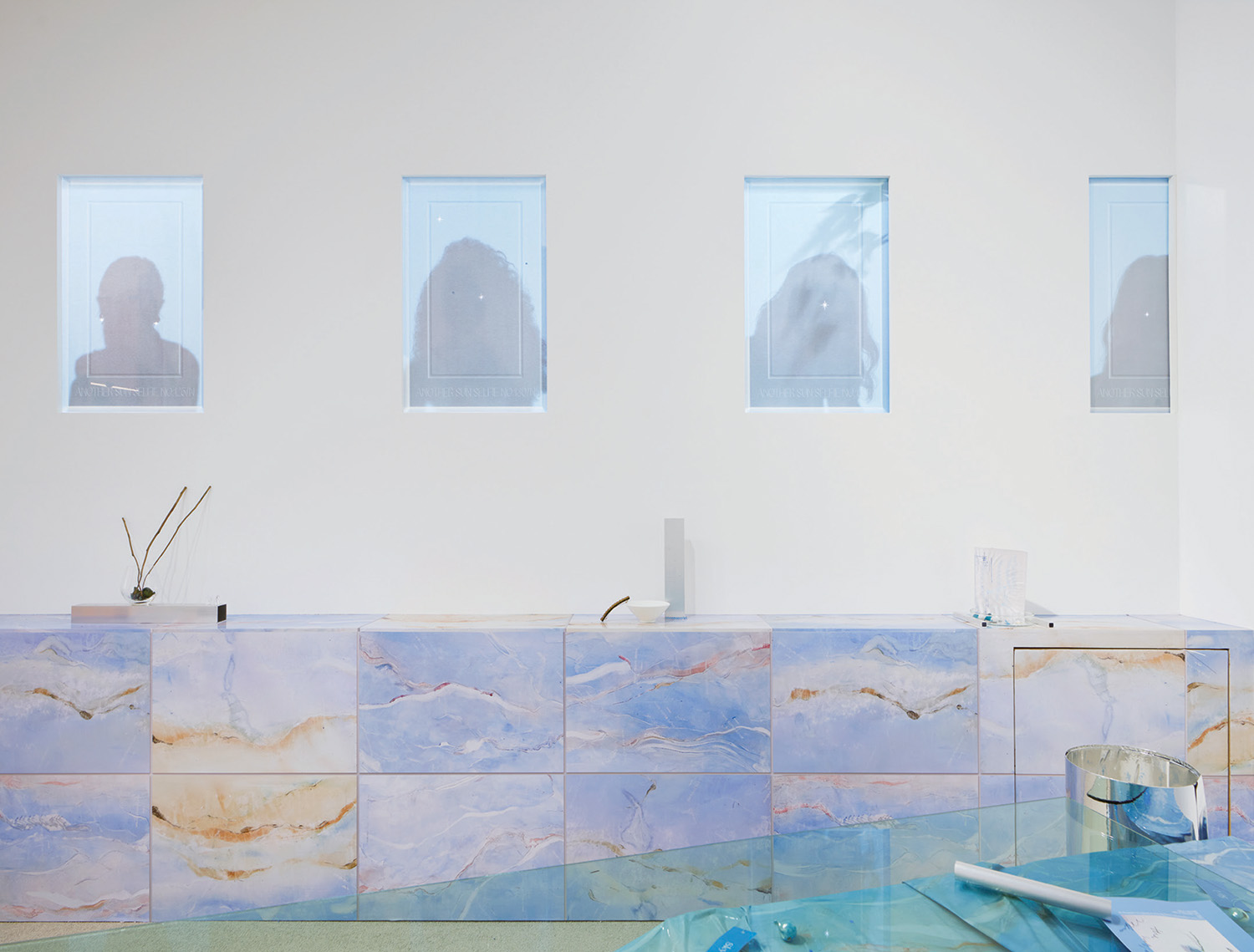
studio’s primary service items. One of the main materials, fldjf-marble,
mimicked the texture of real rock while removing its heft, rendered instead as
printed sheets or sprayed surfaces.
Other
materials—muted, painted flowers, pearlescent white balls, copper-toned
glitter—were spread across the space, each tagged with numbered labels. These
items didn’t necessarily reference anything beyond themselves, but the mention
of “samples” on the project’s material suite 33 webpage offers a clue. A sample
stands in for an entire line of products. It’s something anyone can touch, but
no one can own. Placed up front, torn open and exposed, the sample remains
while the actual products sit neatly packaged in the back.
Materially
speaking, there’s no difference between the sample and the actual product, but
the sample can no longer fulfill its original function. The fldjf-materials
provided by fldjf studio could thus be understood as substitutes—objects that
resemble “real” ones in appearance but displace them.
However, what sets
material suite 33 apart from standard sampling contexts is that no real objects
being substituted for can be found. It’s more akin to walking into an Etude
House store where all the actual products have vanished and only samples and
packaging scraps remain.
To
be fldjf is to be a substitute installed in the place of something that has
disappeared. The crumpled papers resemble copies of something, but it’s
impossible to imagine what the original might have been. Samples can be wasted,
but they cannot be purchased. The flimsy things leaning against walls or
scattered across floors may seem endlessly consumable but are never yours to
claim. Decorative items exist somewhere between leased property, priceless
goods, sample stock, replicas, advertisement images, and discarded wrappers.
So
if the texture of a coarse, thin ribbon leads you forward, all you can do is
walk across light flecks of glitter. In a “suite” where nothing can be properly
priced—and therefore nothing rightfully paid for—you’re free to luxuriously
consume a service that ultimately slips through your grasp. If what you want
isn’t marble but marble wallpaper, not a copper plate but a thin sheet sprayed
with copper paint, then respond to the promotional phrase: “our market
minimum material we miss you happㅛ. scan the qr code to ghkrdlsgk our company’s ad!”
2.
fldjf – Invitation, Code, Mimicry
In
the landscape where weight and thickness have been evaporated and only surface
remains, the empty promises scattered by fldjf studio are left drifting. fldjf
studio’s activities are carefully documented on its webpage. (More precisely,
the pages themselves constitute the work.) One such work, VILLA-A,
introduced on TANSAN in 2015, takes the form of a website that appears to offer
lodging services. [3] Scenes overlooking the Mediterranean and promotional
phrases seem pasted onto a standard template. The landing page reads, “We are
fldjf. We are behind you. We will be here for you. We were very luxurious,
remember?”—as if generated by an auto-translator. In the section where guest
reviews would normally go, a default placeholder appears in pale gray: “I am a
sample text. Click me and change it. Add your text and say something nice about
you and your services. Let your customers leave reviews to show their friends
how great you are.” The images used are stereotypical—ones that might pop up if
you searched for “resort” or “vacation.”
In
this way, fldjf studio invites the general public to try its services, while
simultaneously displaying and scrambling the very codes associated with
service: overt yet glitching language, insistent yet broken
pledges—fldjf-promises. fldjf-speak, in particular, seems like the speech of a
fldjf-human—someone who has just acquired language but hasn’t yet been
socialized, cobbling together coded vocabulary as best they can in an effort to
mimic a real human. Typical expressions tumble out via syntactic misfires. As a
result, these sentences fail to articulate any genuine desire. Statements such
as: “If you want... lick our tiles on this white wall... we’re so
transparent... love you... call for inquiry,” [4] “cooper silk (men 1/n) / now
/ wants you / in the building / you in,” [5] “YOU KNOW, NOW YOU ARE MY
SUNSHINE… every time I go into the company / and show it just like that /
undress it, peel it / bring it in / slightly curve it / don’t look back,” [6] Even
these seemingly direct flirtations are not exempt. fldjf-service makes promises
but does not deliver any tangible satisfaction. fldjf-invitations use
unmistakably seductive rhetoric, but they feel dubious at best. One empty check
is continually replaced with another.
It
may appear as if fldjf-invitations twist and clumsily mimic real
invitations—but is there anything real that isn’t mimicry? Acquiring real
language begins with parroting words that are mere wrappers, devoid of precise
meaning. Even if one utters a phrase that has never been said before, it is
still repeating promises made a thousand times over. Ultimately, it’s a matter
of following and repeating codes. Even when we speak in more refined language,
it’s no different. What distinguishes fldjf-language is that it parasitizes and
mimics—but does so with no center, spinning in vain. And from this flat surface
onto which such language is etched, a strange economic system begins to
amplify. A marketplace emerges in which we indulge in the luxurious consumption
of useless things we cannot be held accountable for. These flimsy printouts,
like two facing mirrors reflecting one another endlessly into a vertiginous
abyss, split open a crevice filled with excess and surplus—a place where
traditional economies of commodity and desire become unraveled, and only
“things that seem like something” remain, rather than “things that are.” Some
may get angry and say they’ve been deceived. But this is only the beginning.
Much more deception awaits.
3.
fldjf – Relations, Gaze, Light
Just
like fldjf-materials, the fldjf-relations offered by fldjf studio's services
only skim the surface of the process of “inviting—responding—entering into a
promised relationship.” Even when the artist Boma Pak’s own body intervenes in
the most realistic presence, it is no exception. fldjf-relations are limited
not to direct contact or satisfaction, but to intersecting gazes.
《BCSM of SLSM Touching Massage SVC》 (@ Art
Sonje Offsite, Nov. 9–15, 2016) was a service in which only a small number of
pre-registered guests could stay for 30 minutes in a space arranged by Boma
Pak. At the appointed time, guests would arrive to find receptionist Boma Pak
seated at a counter. During their scheduled time, visitors were free to roam
the space where items like hair ties or crumpled bells lay on the floor and
ribbons were casually stuck to the walls. They were guided to read a service
manual containing stories about “Lucy,” a pink perfume, and recollections like
“... I didn’t think I could take things in exchange for money. So I took the
items without paying.” The receptionist would occasionally toss ten-won coins
into the air at the desk or spray strong alcohol-scented perfume on the wall,
rubbing her fingers against the wall or the empty air.
There
was no eye contact with the guests, nor any direct interaction. During the
performance, speaking was also prohibited as a rule. In that space, the ten-won
coin was not currency but a flat, copper-toned item. No literal “touch” ever
occurred. The body of Boma Pak, performing as the receptionist, did not form
relationships with objects or guests; instead, it was exhibited as just one
object among others. Yet, it was an object that was uncannily distracting,
subconsciously drawing attention and dispersing focus. The gaze I cast upon her
did not return to me—it simply dissipated into the air. The movements of three
guests meandering through the space were recorded by a camera placed on a small
desk. This was a space where mediated and disrupted gazes were exchanged.
Occupying
the space in this way, she was unmistakably female. It is her female body that
both produces these curious flows of gaze and generates an indefinable erotic
atmosphere. Her femininity bursts forth in exaggerated form in Summer
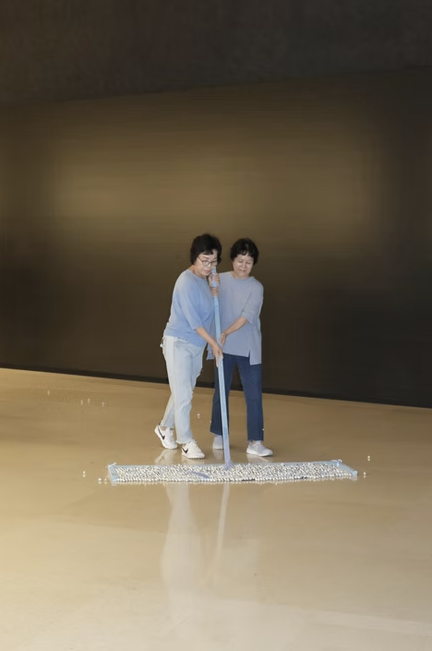
Debris [7]. Dresses made of shimmering, semi-transparent fabrics tightly
hug the body, ornamentally reproducing femininity. The two performers wore
“female” attire to an extent that seemed slightly excessive for walking through
Gwanghwamun Square. Their appearance cultivated a kind of aesthetic that could
hardly be called “beautiful” in the conventional sense, yet the signifiers of
femininity that adorned them still attracted unilateral gazes in the square.
However,
those gazes never met the performers’ eyes. They clung for a moment to their
backs or silhouettes before quickly springing off in entirely different
directions. As they walked through Gwanghwamun Square embodying codes of
femininity itself, the direction and order of the surrounding gazes were
momentarily thrown into disarray. Or perhaps this was not a disruption at all,
but a return to the original order. Gaze, like light, cannot be stored or
touched; it can only travel in straight lines and reflect. Thus,
fldjf-relations do not consist of surface-to-surface contact or reciprocal
exchange, but rather possess the materiality of light—refracting, bouncing, and
deflecting.
4.
fldjf-Satisfaction Evaluation: Reflecting “Satisfaction”
Boma
Pak’s fldjf does not aim for the “real.” The derivative products of fldjf
studio—fldjf-materials, fldjf-invitations, and fldjf-relations—are merely
samples or plausible facsimiles of reality, or else they are trapped in a
disordered exchange like light, without declaring any other purpose. Rather
than being a strategy to better expose something, they are closer to a mode of
existence in and of themselves. Because of this, interpretations and judgments
of her space-time are often dismissed as matters of taste.
The work does not
enter into a communicative structure in which a message is transmitted via a
medium and received with interpretive vocabulary; instead, a certain
sensibility or unique affect becomes the gateway into the work. Thus, the
fldjf-like is something that cannot be precisely explained, but if you feel
like you get it, you do; and if you don’t, you don’t. However, for those who
are willing to traverse the real and the fake simultaneously—borrowing and
stealing without owning, enjoying the staged nature of it all—it manifests as
an extraordinarily appropriate space-time. At the same time, however, it may
descend upon others as a hollow or even threatening form of existence.
Then
how can we evaluate the satisfaction derived from fldjf studio’s service? When
Boma Pak characterizes her work as “service,” she allows the relational
framework of “artist-work-viewer-experience” to be overlaid with the economic
terms “seller-product-customer-service.” In fact, perhaps we were already
accustomed to viewing works and exhibitions through this economic lens, even
before Boma Pak made it explicit. Although different in kind from the
satisfaction we gain by consuming manufactured goods or the expectations we
place on various services, there must have been some desire for fulfillment in
the effort of taking time to go see an exhibition. Yet the services provided
via fldjf studio seem not to offer such fulfillment. They exist within a bumpy,
uncanny economy.
The seductive message is fragmented, the samples deliberately
fail to satisfy the customer smoothly. The slogans deflect or bounce back
instead of stimulating desire. The invitations are quickly replaced by other
promises without content. Faced with this, unless “satisfaction” itself is
fldjf-like, it is difficult to align it with this service. That is,
fldjf-satisfaction might be the moment of discovering an economy that
substitutes, imitates, and refracts real and full experiences—an economy that
seeps into that moment when we come to doubt the authenticity of the real. What
did you expect from the exhibition as service? What did you want Boma Pak’s
body to do for you? What kind of void were you hoping it would fill? …
Footnotes
[1]
Works by Boma Pak and fldjf studio can be found on the following website. If
you have never encountered her work, it is recommended to visit the website
before reading the article: http://fldjfs.wixsite.com/qhak
[2] http://fldjfs.wixsite.com/qhak/material-suite-33-silky-navy-skin
[3] http://fldjfs.wixsite.com/villa-a
[4]
Phrase used in “fldjf Transparent Tile Light Bubble 6” in Void, MMCA,
2016.10.12–2016.2.7
[5]
Phrase on the surface of a decorative element from “fldjf Material Suite 33” (http://fldjfs.wixsite.com/qhak/ad-light-covers-33)
[6]
A caption from Boma Pak’s video screened in “purple neon(+) ~ nude
reflection(-) ~ white ray(+)” (5TH Video Relay TAANSAN, 2016.8.23)
[7]
A performance curated by fldjf studio in 2013. The results, filmed and edited
by artist Suhyun Baek, can be found on her website: http://fakeorchidbecky.tumblr.com/2016