1.
Boma
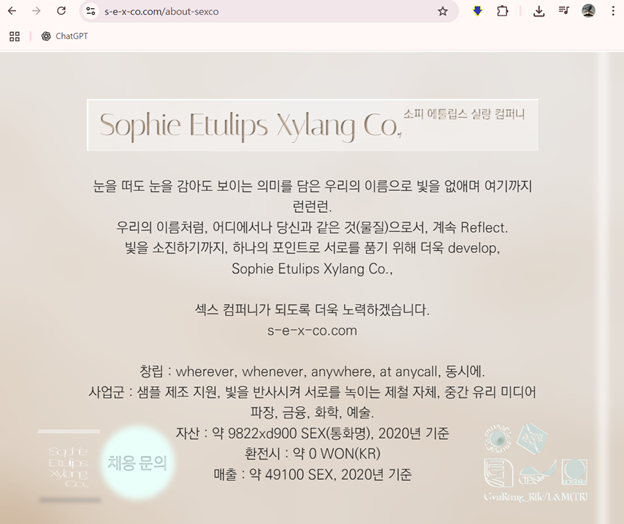
Pak’s solo exhibition 《Sophie Etulips
Xylang Co.,》 confers a concrete worldview and narrative
upon the various “fakes” she has experimented with over the past few years,
thereby more assertively revealing the underlying structure of her practice.
The title of the exhibition is also the name of a fictional company created by
the artist. Broadly speaking, what this company does is reproduce a particular
kind of hierarchy—a system that distinguishes between the real and the fake,
the sublime and the trivial, the valuable and the incidental. Considering that
the exhibition borrows the visual format of official websites of “real”
corporations only to erase the content one might expect from them, some viewers
may be inclined to interpret it through the lens of “mirroring,” a feminist
strategy.
Originally,
this exhibition was to be installed by “emptying out” an entire “respectable”
building with actual marble flooring. However, for various reasons, it was
produced instead using the unique affordances of the website medium. Like many
of Pak’s previous web-based works, 《Sophie Etulips Xylang Co.,》 also presents a
highly unfriendly (or “experimental,” in other words) impression due to its
absurdly long vertical scrolling, the background sound that gradually dissolves
into white noise, and the maze-like hyperlinks without any hierarchical
structure.
Moreover,
each menu and description that constitutes the website refuses to be captured
by any coherent “meaning”—whether that be as a capitalist commodity or in
patriarchal language. This reveals something that deviates from or exceeds the
simplistic one-to-one logic of “mirroring,” that is, the cyclical chain of
“returning what one has received.” It would therefore not be a stretch to say
that Boma Pak’s language—described as “like running it through Google
Translate”¹—deliberately targets communicative failure and heightens entropy,
staging the process through which she “becomes an object herself.”²
But
is that enough? In other words, is this steadfast “opacity,” which renders her
work difficult to access, merely an artistic gesture aimed at resisting
interpretation? Perhaps it is. This essay, which is closer to a preliminary
study of Boma Pak’s artistic world, is nevertheless written with the intention
of establishing a critical framework for what her work persistently references
as “the feminine.” How does Boma Pak’s work relate to the feminine? Why, of all
things, through such “opaque” methods? To answer these questions, we must
return to the concept of “mirroring.” That is, we must reconsider the
historically specific feminist (artistic) strategy of “mirroring” as a
still-useful premise that actively operates throughout Pak’s body of work. In
this particular case, however, Boma Pak’s black mirror does not reflect. It
absorbs.
2.
Can
we call Boma Pak’s work “feminine”? As I use the word “feminine,” I feel both
an urge to clarify what the term actually means and, simultaneously, a desire
to abandon the attempt altogether. The adjective “feminine” naturally
corresponds to the initial impression I had of Boma Pak’s work—“light and
pretty”—and that very description reinforces the prejudices produced by the
sex/gender system in which it is deeply entangled. In other words, if it’s
permissible to describe Boma Pak’s work as “feminine” simply because it deals
primarily with “light and pretty” immaterial elements such as “atmosphere,”
“scent,” “light,” and “surface,” then what exactly do I (and those who agree
with me) believe “woman” to be? “Woman” is pretty.
“Woman” is the light
reflected in a glass window, the scent that leisurely fills a space, the
surface of polished marble. “Woman” is an empty illusion. “Woman” is everything
that exists outside the material we can see and measure—in short, dark matter. What
I want to address here is the mode of existence of “women” that is already
embedded in the adjective “feminine.” If “masculinity” evokes a completed
heroic narrative earned through a kind of credentialing, then “femininity”
lacks content. “Femininity” is merely the atmosphere that surrounds something
deemed to be an essential quality shared by all women.
Borrowing
from Anne Carson—whom Boma Pak references in other works—we might say that
atmosphere, unlike nouns and verbs that name the world and set those names in
motion, aligns more with adverbs, which play a “purely incidental” role.
Atmosphere can always be manufactured if necessary (incidental), it is
naturally backgrounded (dependent), and if a similar effect can be produced, it
doesn’t have to be that exact thing (substitutable). Because of these traits,
one atmosphere can be swapped for another, and they all hold the same value.
But this variable, value-less quality of atmosphere—of the “feminine”—is not
biologically intrinsic to the female sex. In fact, an obsession with anatomy
and morphology would only hinder our effort to deal with what concerns us here:
atmosphere. The question is: what renders the “feminine” continually
worthless—and how?
In The
Market of Women, Luce Irigaray argues that civilization is
fundamentally based on a male exchange system that trades women while
simultaneously excluding them from that exchange. Since women hold value only
as evidence or products of male labor, they are abstracted and othered. Even as
“crude” commodities, the use value of women is only estimable by comparison
between products.
“Thus,
woman has no value other than her exchangeability. (...) As commodities, women
reflect the value of the male/for-the-male. Through this operation, women
surrender their bodies—sites of reflection and the material-medium of
contemplation—to men.”³
Before
Irigaray, Gayle Rubin had already applied Claude Lévi-Strauss’s notion of “the
exchange of women” to the framework of female oppression in her essay The
Traffic in Women. She writes: “If women are the exchanged, the ones
giving and receiving them are none other than men. Therefore, women exist not
as partners in exchange, but as conduits of relation.”⁴
From
this perspective, woman is a “material-medium of reflection and contemplation”
for the man; she is the adverb that links the male subject (noun) with the act
of exchange (verb). In other words, the woman-as-commodity, meaningful only as
exchange value, becomes both the “mirror” that reflects the male
producer/consumer’s desire and the “atmosphere” that fills the space between
them. The concept of “the traffic in women” should not be seen as the only or a
reductive analytic framework for understanding the sex/gender system. Still,
let’s hypothesize that this mechanism is indeed one of the essential
foundations of the economy, culture, and language of the civilization we live
in. From that angle, we could arrive at the conclusion that the historical
authority of the values we’ve “believed in” and been loyal to was actually
accumulated through the exchange of women by men.
And thus, the expectation
that one could earn equivalent value if one serves long and faithfully enough
is merely an illusion. Boma Pak’s work—particularly the worldview subtly
exposed in 《Sophie Etulips Xylang Co.,》—may well be understood from this perspective. After the site
finishes loading, the very first page we encounter on the fictional company’s
website is Words of fldjf studio. Unlike the following
pages that reveal the company’s “substance,” this page metaphorically conveys
the internal perspective of “fldjf studio” (hereafter “the studio”), which has
worked for “those distant companies” over the past several years.
Simultaneously,
it allegorically confesses the illusion and (perhaps still persistent?) faith
held by the feminine subject in relation to the
masculine/authoritative/traditional value system embodied by the “company.” The
company has only ever sent the studio “cigarette butts, paper scraps, and a
handful of air,” and it already ceased to exist 8 minutes and 20 seconds before
the two were to meet. Nevertheless, the studio not only prepares for the
company “the missed lights, images, and shadowed faces created by the suns that
live there,” but continues to “wait” for the company, describing their
relationship as one of “romance and magical aura.” Why? “Therefore, the
commodity worships the father, constantly mimicking and resembling the one who
substitutes for the father.”⁵
Could it be that the studio, like Boma Pak herself often does,
has simply “forgotten” that it has never had a relationship with the
father–man–company and never will? If we were to remember every minute of every
day that we had been eternally deceived, betrayed, and abandoned—if we could
never forget—we would lose all language. “‘I never wanted it, but the world
replicated and rapidly replaced for me sky, emotion, material, time... I took
it all thoughtlessly and was deceived into believing these things were given to
me, but soon realized they were merely images I could not control. Yet I forget
again. My artistic practice began from this feeling of betrayal and shame.’”⁶ Here, Boma Pak calls it “the
feeling of betrayal and shame.” So let us return to the question of
“mirroring.” Is what 《Sophie Etulips
Xylang Co.,》 presents simply a voided company, covered
over with meaningless “atmosphere”? Is it an attempt to return her own sense of
betrayal and shame? (But to whom?)
Footnotes
1.
Jiwon Yoo, “fldjf—Evaluating Satisfaction with the Service,” Pre-opening
Glass Emerald, The False Sacrifice of White, 2017, p. 4.
2.
Yully Yoon, “Invitation Text,” same publication, p. 2.
3.
Luce Irigaray, translated by Eunmin Lee, “Women on the Market,” in This
Sex Which Is Not One, Dongmunseon, 2000, p. 230.
4.
Gayle Rubin, translated by Hyesoo Shin, Okhee Lim, Hyeyoung Cho, and Yoon Heo,
“The Traffic in Women,” in Deviation, Hyunsilmunhwa, 2015, p. 110.
5.
Luce Irigaray, This Sex Which Is Not One, ibid., p. 232.
6.
Boma Pak, “Acknowledge Abstraction – Material, Volume, Mood, Filter,
Reduction,” Webzine SEMINAR (Issue 8), 2021.
http://www.zineseminar.com/wp/issue08/pakboma/
7.
Luce Irigaray, This Sex Which Is Not One, ibid., p. 233.
8.
Dark matter is a form of matter that is widely distributed throughout the
universe and interacts with neither light nor electromagnetic waves, but
possesses mass. Areas with concentrated dark matter disturb the motion of
nearby stars and galaxies through gravitational effects based on Einstein’s
general theory of relativity, and even bend the path of light.
Dark matter is estimated to make up about 22% of the universe’s total energy.
The rest consists of observable matter and dark energy. Considering only matter,
dark matter is believed to comprise 84.5% of all matter in the universe—far
exceeding that of visible matter.
(See: Wikipedia, “Dark Matter”)
9.
Mladen Dolar, translated by Sungmin Lee, The Dark Point, B Publishing,
2004. I first encountered this book through Boma Pak.
10.
Ibid., p. 161.