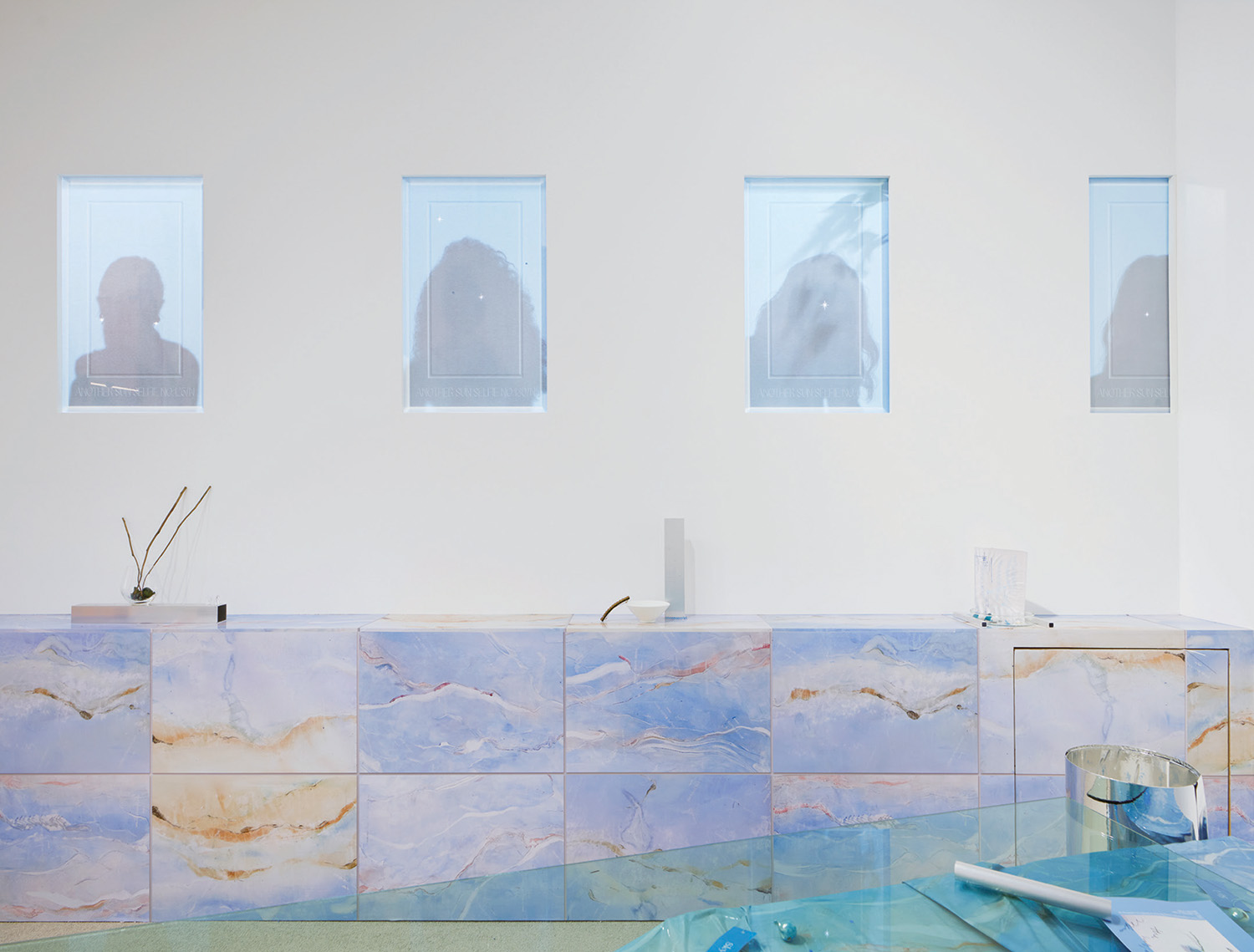
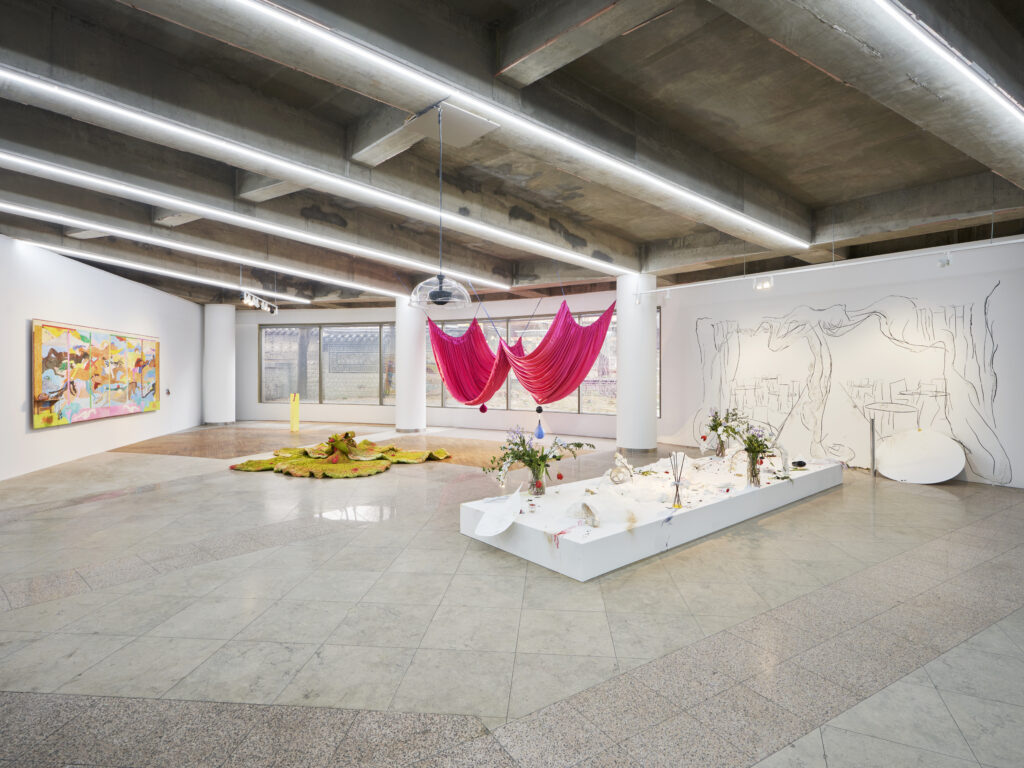
The
speed of sound is slower than that of light. But it is faster than that of
things. If there exists a space that serves as a reference for comparing the
speeds of things, sound, and light, it would be the distance between where it
exists and you. Speed refers to the time it takes for those things to reach you
from where they are. Yet if we consider their different weights, the impact
they give you might feel surprisingly similar. This writing is about the
ambiguous time of sound that ambles toward you, somewhere between objects that
approach very slowly and light that appears and disappears in an instant. It is
a stage prepared for objects, an echo of light returning, and also a gentle
vibration like a scent.
Archetypes
Last fall, the exhibition 《Living
Relationship》, curated by Lee Sangyeop in the Namsan
forest, clearly revealed something crucial about Boma Pak’s work—that is, how
her objects come to inhabit a place. In this one-day show, Boma Pak
participated under the name of her alter ego, WTM decoration & boma, which
produces material objects such as jewelry, accessories, and crafts, alongside
the paintings of Haesleyn Jung. Their objects and images were placed at the
edges of hiking trails, among the underbrush, and between trees. They weren’t
exactly hidden, but if you didn’t pay close attention, you might easily walk
past them. This exhibition, in many ways, demanded that the viewer “discover”
the works. Active viewing was naturally required. As one continued walking,
observation sharpened to such a degree that it not only led to the discovery of
the work but also to seeing the space it occupied and how it related to its
surroundings.
Boma
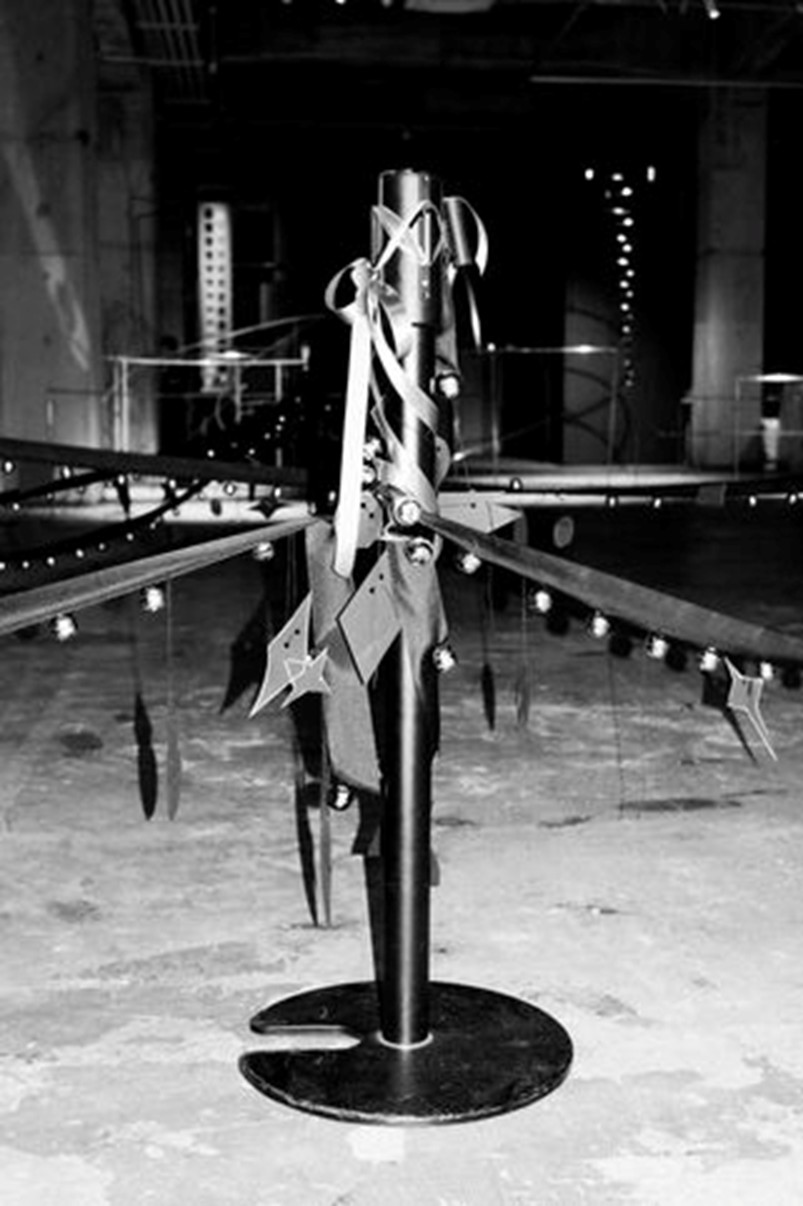
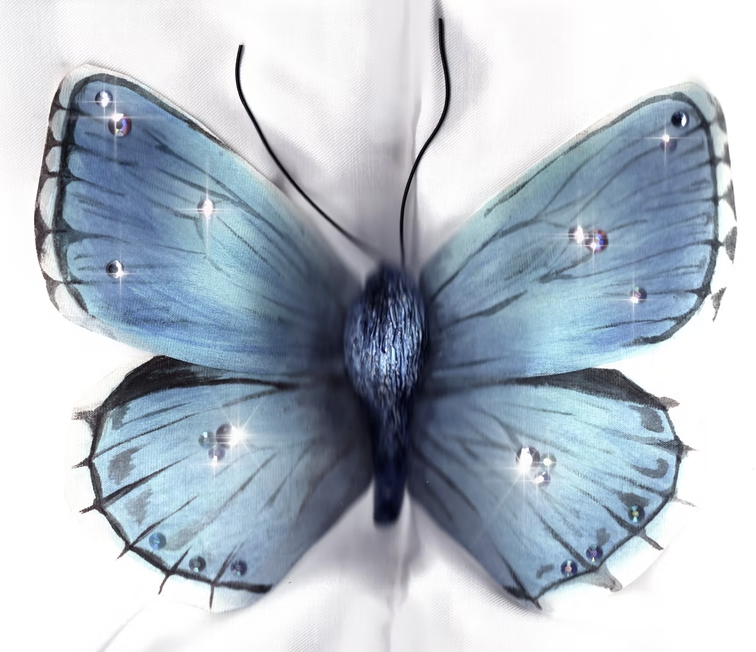
Pak’s objects were composed of small clay fragments, a few strands of ribbon,
toy butterflies, and crumpled paper painted in chaotic colors—things in a
highly primordial state, difficult to define as anything specific. It was as
if, before taking on a form, the objects were contemplating where they had come
from and what they were connected to. Her objects resembled scars on trees,
faded papers long discarded in the bushes, or piles of stones someone had
arranged. I often had to check the leaflet to confirm whether what I saw had
always been there or was part of the exhibition. Gradually, the distinction
between artwork and nature became blurred, and the artwork guided one to
perceive the space integratively—where heterogeneous elements simultaneously
existed in multiple directions. Her objects formed a calm solidarity with the
forest. What I saw wasn’t the work itself, but the fluid relationships that the
work revealed in space. I came down from the mountain thinking that perhaps
Boma Pak’s objects were performing the act of remembering their own archetypes.
As
I carried thoughts about Boma Pak’s archetypal objects for a while, I began to
think about their many places. If the objects I had mostly seen in exhibition
venues had actually migrated from somewhere else—if they hadn’t entered the
forest but rather emerged from a mysterious place one might call “the
forest”—then I came to understand that the images and objects Boma Pak creates
under various names, and the actions she performs under other names, are not
about constructing something new, but rather about discovering and retrieving
what already existed within some vast totality.
This
may appear as an extension of the legacy of the readymade, but what she
retrieves are not products or goods. They are entities thought to have
disappeared—like a fleeting moment of light or the ever-changing sky. The range
of movement she deals with is not defined by geography or institutional
boundaries but by time itself. In other words, she transports what has vanished
across boundaries created by time. Naturally, her act of retrieval does not
trigger the semiotic confusion or perceptual irony that readymades typically
do. Instead, it awakens a painful amnesia. It manifests as a confusion where
one cannot recognize what is right before them, or a discomfort when something
that ought not remain continues to exert influence. Most often, it invokes a kind
of mourning. And here, politics arises.
This
politics is far more complex than it appears. What Boma Pak persistently
retrieves and brings forth may seem to have disappeared, but in truth, it is
something archetypal that still recurs and permeates somewhere. In other words,
her politics does not form a front line—it questions the very existence or
non-existence of being.
Sometime
later, I watched ‘Undine’ by Christian Petzold, and I came to think
that what Petzold attempts through film is not so different from what Boma Pak
attempts through images and objects. It is an inquiry into how the archetypal
still operates close at hand through repetition and deep infiltration. It is
about discovering the archetypal within various heterogeneous, secular, and
homogenized superficial forms. For Petzold, this may take the shape of myths
such as the phoenix or the water nymph; for Boma Pak, it is the ceaseless
ripple or motion of shadows wavering inside Plato’s cave. The ubiquity and
repetition of the archetype form a kind of truth, and that truth is tied, each
in their own way, to beauty.
However,
Boma Pak always speaks of failure at this juncture. She says that she only
“pretends” to capture and bring forth the archetypal world of abstraction
through images and objects—and what she presents is this very failure. She
repeatedly insists that the abstract world she is fascinated by and desires
cannot be reduced, reproduced, visualized, or objectified by any institutional
or material tool. Declaring success in abstract materialization or
visualization is, in her words, a male institutional gesture. Therefore, to
genuinely desire abstraction, Boma Pak has no choice but to situate herself
“outside.” If the effort to reproduce the ripple of shadows in the cave or to
materialize its idea can be considered masculine, Boma Pak merely contemplates
the movement and questions the relationship with the outside. She demonstrates
only the impossibility of defining that relationship. In a way, Boma Pak
regards impossibility as a form of truth. A display of impossibility is a
statement about truth. Perhaps the reason she must accept impossibility as a
condition is because Boma Pak herself is a human bound to the time of the here
and now.
In Living
Relationship, Boma Pak had the audience walk along a forest trail while
listening to her sound work a clue of truth: Now is yet to come
because… once it was delayed through earphones. She
reconstructed a 35-minute soundscape by layering various sounds based on field
recordings she had made while walking through the forest beforehand. But this
soundscape never aligned with the reality encountered by “me” in the present.
The low-pitched, labored rhythm—like a heartbeat—moved much faster than my
walking pace, and the sounds of water or wind came regardless of what I was
seeing. Most notably, the viewing time was shorter than the sound’s 35-minute
running time. I had to listen to the remaining part on a bench at the foot of
the mountain. This work resembled the trace of a brief moment in reality and
echoed the reality I was experiencing—but it never fully matched it. There were
fleeting moments when the sound overlapped with reality, moments of encounter
when they coincided—but they quickly drifted away again. This sound work
existed solely to prove time lag.
Therefore,
sound could serve as a stage. That stage repeats a reality that is almost—but
not quite—alike. What made sound in Boma Pak’s work feel so meaningful to me,
more than images, objects, or actions, was that it not only evoked something
archetypal but also became a stage to reveal that archetype. Sound, in her
work, is more functional than other elements. (If there is anything that
functions similarly in her work, it would be “scent.”) Her sound is always held
back, hidden in places. Compared to objects and light, it is crouched. It
arrives at its own pace.
Melody
Earlier, I mentioned that Boma Pak adopts failure and impossibility as forms of
truth. To be more precise, she does not simply assert impossibility and walk
away; rather, she persistently attempts to recover alternative ontologies and
language systems from the spaces impossibility leaves behind. In fact, it would
not be a stretch to say that her entire practice is a continuous test—of how
objects, images, and bodies should appear and disappear—without ever letting go
of that impossibility.
One
such project is melody. meladies: Pour la illusion de
l’Odyssée, la mère d’Atom et la princesse dans la glace is
something Boma Pak has been continuing since a long time ago (according to her,
since 1998 when she was ten years old). She considers it “a method to capture
the emotions and sentiments of a moment, and a mourning for them.” Because it
is “the memory and self-portrait of one’s own self—of something that passed by,
echoed through one’s ears, but was only recognized belatedly, and never fully
understood.” In other words, melody is a form and method of
remembering a moment that cannot be explained or expressed in specific words.
These melody works are short musical compositions with slowly
flowing, simple melodies made from only a few notes—like humming or murmuring
that lingers in the mouth. They evoke a sense of a personal tune, like a hum or
a soft chant. This allows us to most directly and effectively understand what
Boma Pak refers to as “atmosphere.” That which clearly exists but is difficult
to capture; that which persists, but seems as though it has disappeared—she
speaks to this kind of presence and power.
It
is not a private emotional landscape reducible to personal sentiment, but
rather, it might be the empirical reality of infancy as Giorgio Agamben
describes.
Recently,
Boma Pak presented the work If You Are Brave, Come Play with the
Butterfly… Wave 1/n in collaboration with curators Yong Sunmi
and Som Yi through the PerformCollectionSystem (PCS). This work was a
reconfiguration, in the form of sound transmission, of the script she used in
her 2010 performance If You Are Brave, Come Play with the Butterfly. I
happened to encounter this work while walking a different path, and I was
naturally drawn to it by a peculiar and lyrical melody and an echoing voice
reciting incomprehensible words, resonating multiple times as it drifted across
a rooftop garden in the city.
If
You Are Brave, Come Play with the Butterfly… Wave 1/n was a work
performed only for a very limited time, and soon disappeared back into the
long-standing air. The melody, laced with white noise, reminded me that it was
not the original but a recombination of past time. Simultaneously, the
reverberating, repeated voice implied that it could reappear at any time.
This
work seemed like an imagination about how to allow things that appear to have
vanished to autonomously reveal themselves in invisible and immaterial forms.
Among the thirty or so works proposed by the PerformCollectionSystem, Boma
Pak’s was the only one labeled “uncollectible.” Her abstraction, once again,
can appear to us as something that brushes past—but still cannot be objectified
or fixed. And it is only when it arrives in a time-displaced manner, only when
it collides into something and bounces back, that it can be realized. To
repeat: she wishes to remain faithfully and fully together with the forgotten
archetypes of the world, using impossibility as her condition.
To Bring Back Light as Light as Air and Objects as Heavy as the
World
Once again, sound—proving time lag—often becomes a stage for her objects and
images. This was the case in the online webpage exhibition Defeat of
Abstraction: Marbles, and again in her recently launched virtual company Sophie
Etulips Xylang Co. (SEX Company). Here, melody exists
not only as something personal but also as the “atmosphere” or “feel” of the
platform, existing without concealing its emptiness. Like a corporate theme song,
her melodies instantly recall library music.
Library
music is a musical category that emerged alongside the rise of commercial media
such as TV, radio, and film. It is produced, distributed, and consumed within
an ecosystem where various kinds of music—presumed to be needed by
broadcasters, content producers, or companies—are made in advance and sold.
Buyers select the sounds they need—ones that evoke narrative, describe specific
actions, or conjure certain moods—and use them to achieve intended effects.
Thus, the world of library music is filled with all sorts of atmospheres and
emotions.
SEX
Company, using melody as a stage for mumblings of loss and
time-lagged memories, then—what kind of place is it? Whatever it may be, it
will always remain empty. It continually embraces failure, continually proves
impossibility.
1.
Boma Pak, “Acknowledging Abstraction – Material, Volume, Mood, Filter,
Reduction,” SEMINAR vol.8, Visual Art Web Journal.
2.
On how the scent used in Boma Pak’s solo exhibition Pre-opening Glass
Emerald, The False Sacrifice of White (Archive Bomm, 2017) created a
“different place” and momentarily unsettled the viewer’s present, see: Lee
Hanbum, While Thinking About the Tightrope Between Fleas and Acrobats:
Thoughts on the Exhibitions of YHCH and Boma Pak, and the Works of Sojung
Jun, Oculo online review.
3.
From the artist’s own website introduction.