The
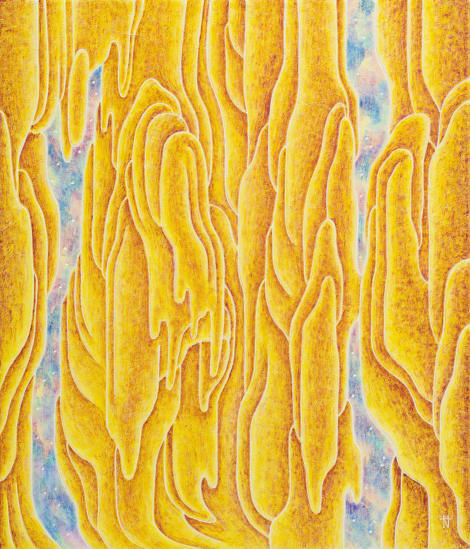
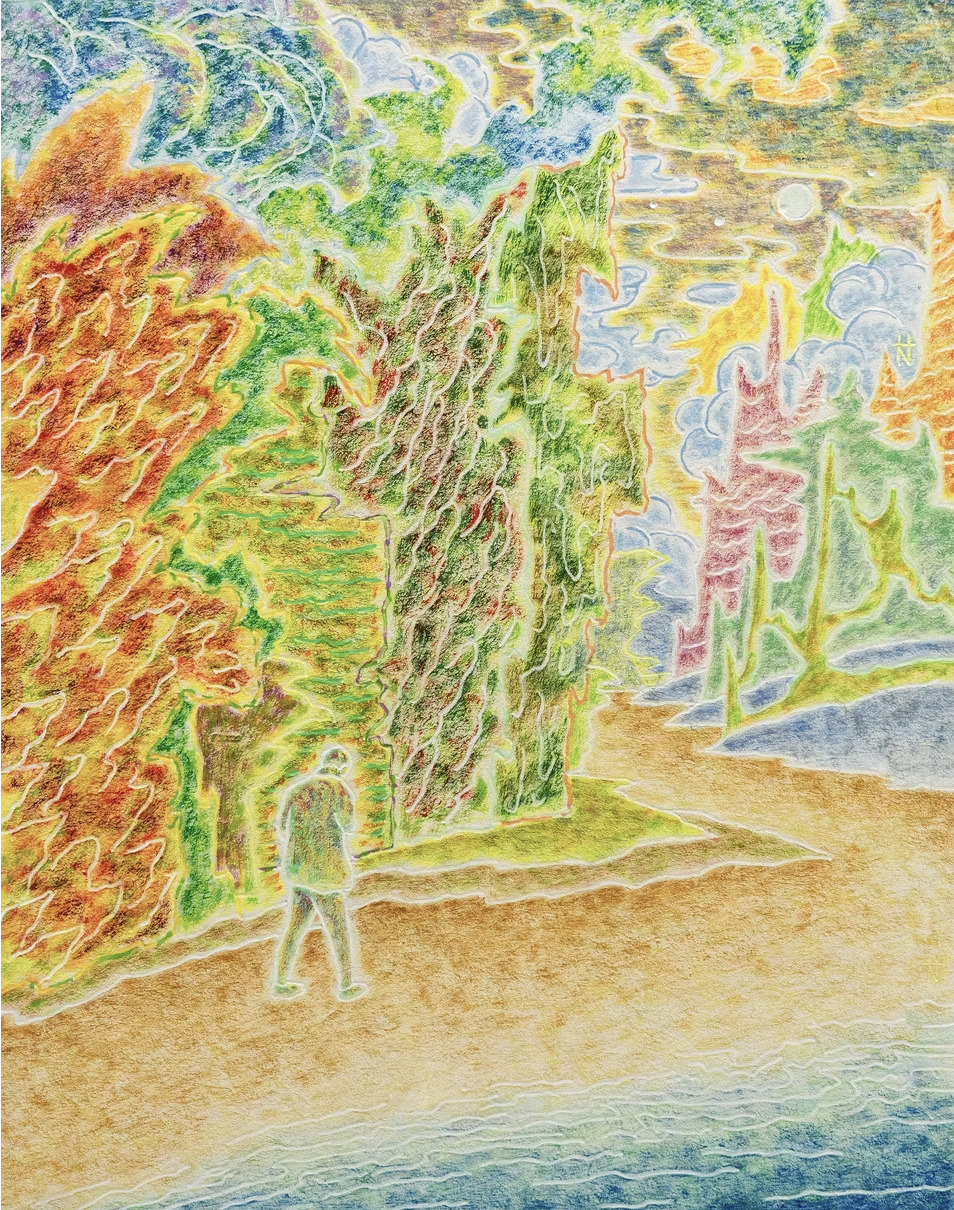
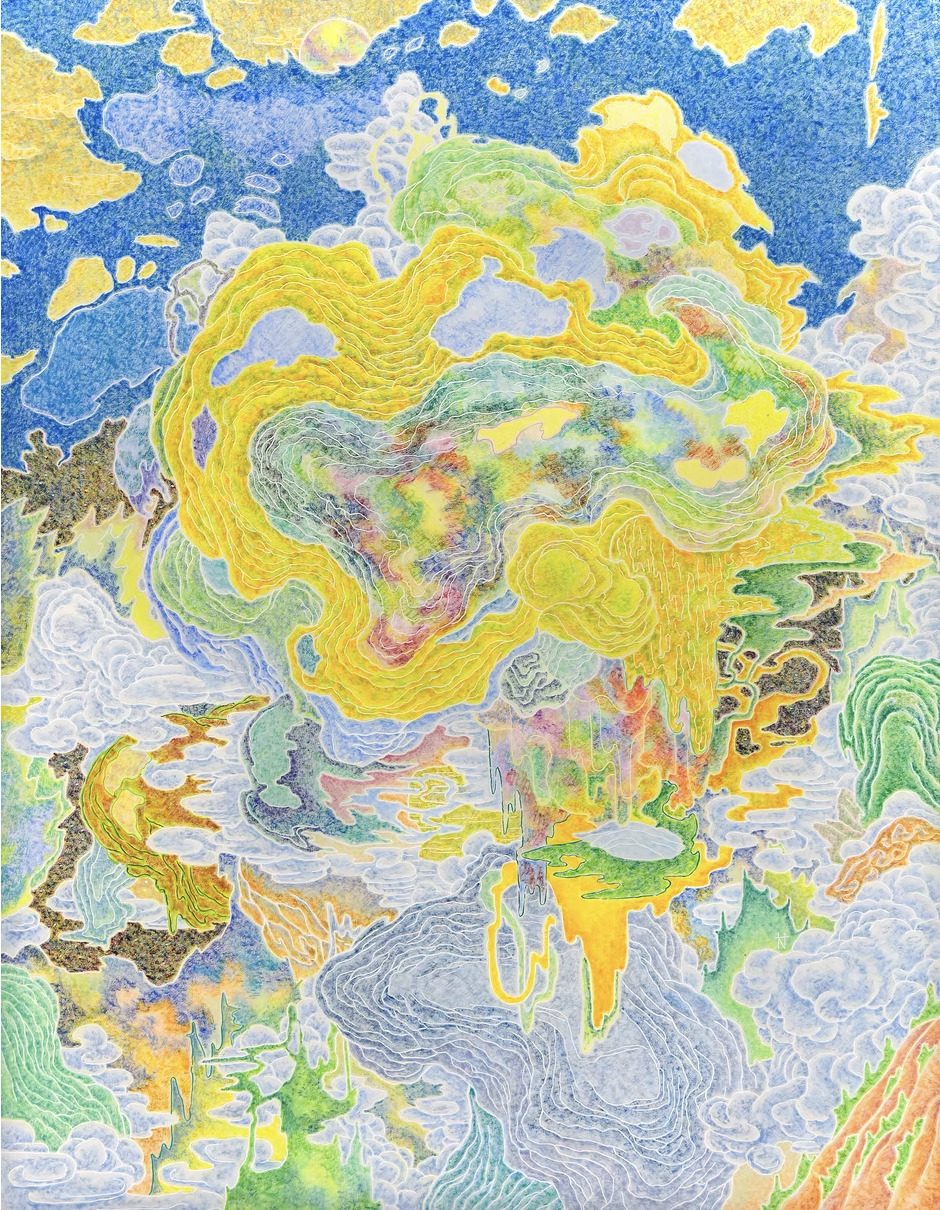
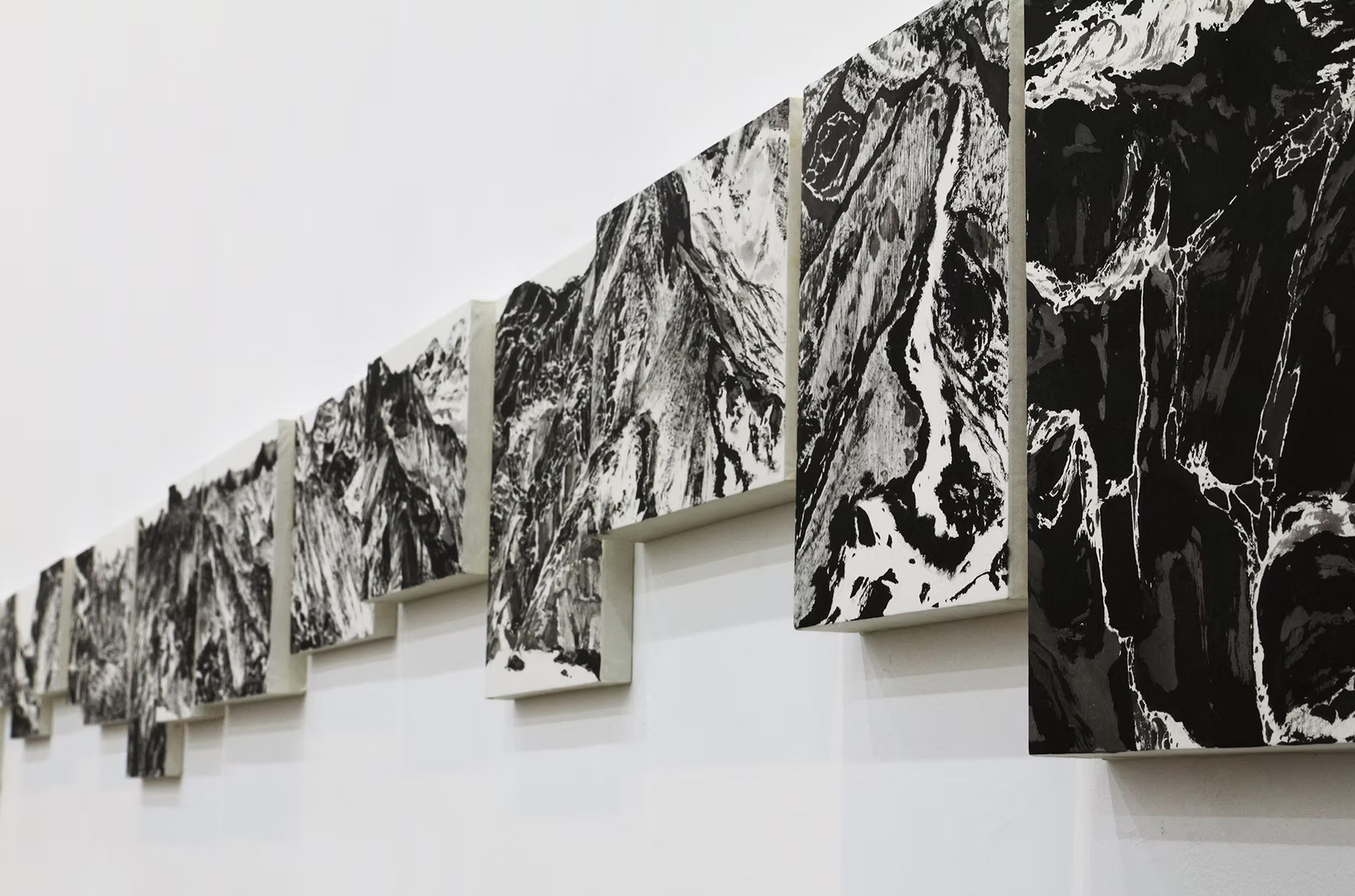
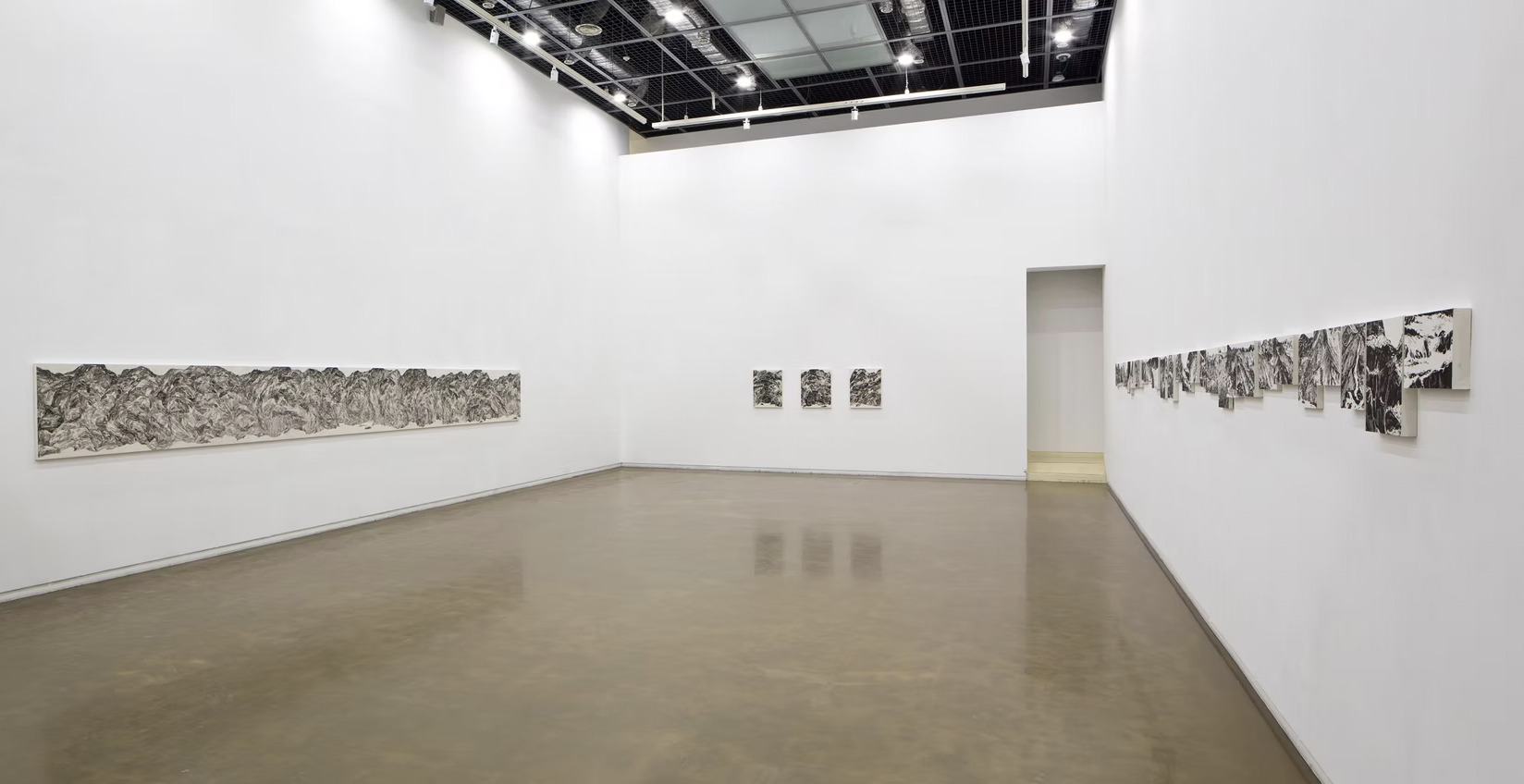
first impression I had upon encountering Cha Hyeonwook’s work was a surface
filled with ink. There’s certainly a resemblance to traditional landscape
painting, but this is quickly followed by the impression that it’s difficult to
detect any traditional techniques or motifs. Only upon closer inspection does
one begin to notice traces of traditional techniques and subject matter
scattered throughout the work. There are also some signs of borrowing from or
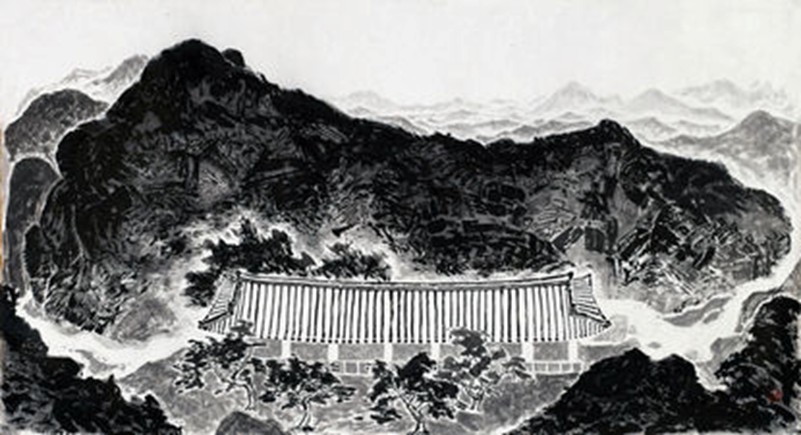
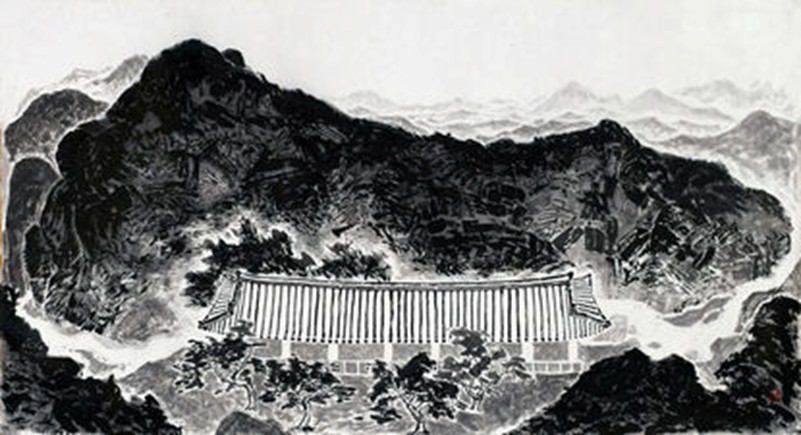
studying old paintings. The entire surface evokes a massive mountainous
structure reminiscent of the Travelers Among Mountains and
Streams by Fan Kuan of the Northern Song dynasty. The
composition that draws the eye upward toward the sky, or the bird’s-eye
placement of water at the lower portion of the painting, are also traces of
traditional landscape painting. But that’s about it. It offers nothing more.
The
surfaces he devotes himself to seem to resist the temptation to depict or
represent objects. “Language, only when it gives up the expression of the
object itself, can truly be considered speech.”¹ Description that does not
replicate is closer to ambiguity that touches upon the various potentialities
of things, rather than a regulated conceptual language.
Perhaps
because of this ambiguity, his work is slippery to read.
Following
the ink tones that dominate his canvas, one encounters marks that seem like
surfaces when seen as lines, and traces when read as planes. Yet to call these
mere accumulations of ink would be misleading, for they are highly figurative.
The representations of rocky masses reminiscent of landscapes show states of
ink saturation that could be called accumulations, but they are not structured
through such accumulation. While clearly repainted multiple times, the result
is too flat and lacks the density required to qualify as built-up ink layering.
If
this were a traditional landscape painting, one would expect to see
compositional logic such as upward-looking (angshi), bird’s-eye (bugam), or
level-distance (pyeongwon) perspective. But that is not the case here. The
impressions of mountain peaks or riverbanks at the bottom of the canvas are at
most minimal suggestions or clues for interpretation, not metonymic signifiers
to be read as landscape. In this sense, his understanding of landscape seems
less rooted in experiencing real scenery and more akin to acquiring landscape
as a language. It is close to dismantling or reconstructing the landscape
through conceptual inference, rather than perceiving it as a spatial domain.
When
examining some of his unfinished works, one can observe how a landscape starts
to take shape, only to dissolve mid-way as ink traces take over. The images
recede, and the ink marks linger as gestures in motion. Rather than
constructing landscape painting as a montage, these traces hesitate and delay
the formation of form, acting as smudged ink that leans toward dissolution. The
impression that emerges—of a transition from form to formlessness, from
tradition to de-tradition, from flatness to figuration, from ink to blackness,
and from line to plane—stems from here.
The
traces of ink—his ink tones or the sequences of strokes that compose the ink—do
not depict forms but rather exclude them and, to a certain extent, restrain
them, thereby advancing toward disintegration. However, this is not entirely
deconstructive, but rather a state in which potentiality is left intact. Even
when he leaves the lower edge of the canvas white and sparsely arranges ink
marks, it is difficult to view this as a composition intended to depict rocks
or stream banks. While such associations cannot be entirely denied, these
merely serve to structure the white space, presenting the presence of water and
sky. This structure functions, in part, as a point of distinction from the
full-surface treatment of Western painting. Without the white margins at the
top and bottom, the work would readily be read as a type of abstraction
characterized by all-over composition, and the technique of using ink marks
would not easily escape appropriation from Abstract Expressionism.
However,
these features do not appear to reflect a conscious effort or understanding of
the juncture between the contemporary and the traditional. Rather, it seems he
adopts certain elements of tradition as aesthetic positions or as methods of
structuring and conceptualizing his work. This may be why, even while pursuing
modernization, he cannot completely discard the compositional strength of
tradition in one sweep.
In
some of his works, the uneven texture of the collaged backgrounds functions as
a latent force that interrupts ink, line, and movement, preparing for a new
kind of motion. The absorbent quality of Korean paper naturally accepts lines
and ink, but the ridges and seams of attached paper fragments hinder, restrain,
and disrupt this flow at unexpected moments. They create dissonance rather than
harmony. “Strictly speaking, the unrepresentable resides in the impossibility
of a particular experience being expressed in its own distinct language.”² This
is why I have described his work as a deconstruction of traditional landscape
painting.
It
is a method of escaping depiction and representation, and at times functions to
block the artist’s intervention. It creates movement led by chance across the
surface. The aggregation or parallel arrangement of traces—fragmented into
movement, time, and gesture—does not compose the image but flattens it,
directing the viewer’s gaze toward the deconstruction of time. These are not
forms structured by time, but movements that have been flattened, liberating
the image from specific representations of landscapes. The white space and
representational character of the surface become the only points of connection
with reality. These characteristics shift the work away from depiction and
representation, toward movement and deconstruction, or toward new ink landscapes
as movement itself; they guide the viewer toward landscape as gesture, toward
abstraction as surface, and toward a surface effect of modernization departing
from traditional ideas.
This
guided perspective of his does not lead to concrete forms but to disassembled
traces. While the overall impression may be entrusted to general notions of
mountains or water, the absence of specific depictions—of what mountain or what
water—suggests the work is closer to conceptual understanding or presentation.
It only reaffirms the word “mountain.” In this regard, his work is rich in
conceptual elements and reveals characteristics of ideational landscape
painting. The configuration of forms composed of ink marks that come together
and disperse fills the entire surface, and this association with the
understanding of conceptual landscape painting stems from such a context.
Nevertheless,
the issue is that the characteristics seen in his work are, in fact, familiar
techniques and familiar landscapes. These are forms that have already been
attempted by various artists under the aim of modernizing Korean painting, and
his work exists within that very context.
It
is at this point that he must ask questions about the properties of ink as a
material—ink as an autonomous element—and about his own choices. If his use of
ink aligns with the traditional sense of the medium, then he must ask what that
choice of ink truly means. If he is employing ink as a material through which
tradition is used to implode tradition itself, then he must ask what this
deconstruction entails. The reasons for his use of collage or montage must also
be made clear. If the intention is to deconstruct landscape rather than newly
interpret it through collage or montage as a way of understanding landscape
painting, then a more precise examination of the meeting point of those
elements is necessary. If the purpose of deconstruction is not landscape but
rather the ink itself, then an active inquiry is required—one that approaches
the ink work as a question of fragmented and recombined consciousness, or
interpretation, or as a method of decoding landscape painting.
“Language only gains meaning when it gives up copying thought and is
dismantled, only to be recombined through thought. Just as a footprint reflects
the movement and effort of the body, language carries the meaning of thought.
Therefore, the empirical use of established language and the creative use of
language must be distinguished. Empirical use is merely the result of creative
thought. Parole as empirical language—that is, the use of already established
signs—cannot be considered parole in the true linguistic sense.”³ If tradition
merely acts as a norm for me, we are simply looking at formulaic images, and
things appear as such. In that space, neither individuality nor history can
arise. Nor can we expect an expansion of consciousness toward newness. However,
if tradition is a path of prior understanding for parole, and if it can lead us
to a universal mode of understanding, then tradition will guide us to the
richness of experience.
Rather
than hastily assigning completed meaning or structure to Cha Hyeonwook’s work,
what is more necessary is to recognize the possibilities of movement that it
presents. His landscape or ink-based works do not lack urgency in the questions
they must answer, but the structure with empty top and bottom and tightly
packed left and right becomes a closed space laterally and an open space
vertically—yet one that cannot move. This paradoxical composition of
traditional space, like his attempt to achieve deconstruction of landscape
painting through the irregular textures of collage and montage, allows us to
see his landscape work as one where the natural compositional power given by
traditional placement is interpreted instead as a feature of disassembly. It is
about dismantling and reconstructing an existing language into his own.
And
in that place, we witness a different kind of experience—an impact from latent
languages.
¹
Maurice Merleau-Ponty, Indirect Language and the Voices of Silence, trans.
Kim Hwaja, Chaek Sesang, 2005, p. 26.
² Jacques Rancière, The Destiny of Images, trans. Kim Seongwoon, Hyeonsil
Munhwa, 2014, p. 222.
³ Maurice Merleau-Ponty, ibid., pp. 26–27.