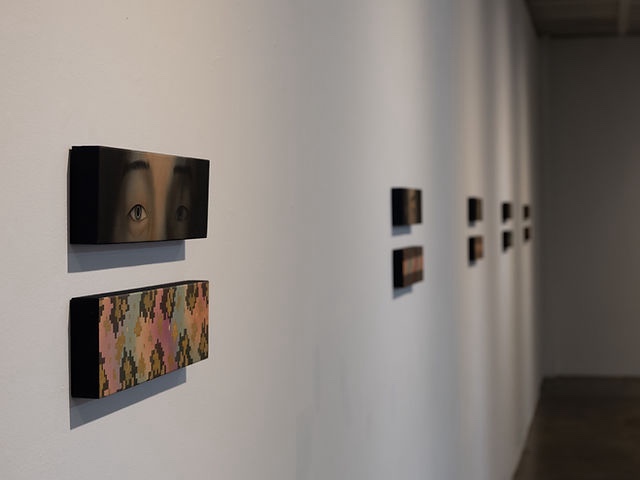
The
imagination of self-identity in 《44》 is expressed through a kind of
autobiographical narrative, which seems to be emphasized once again by the
“overlapping” of the artist’s past works and their various relationships. The
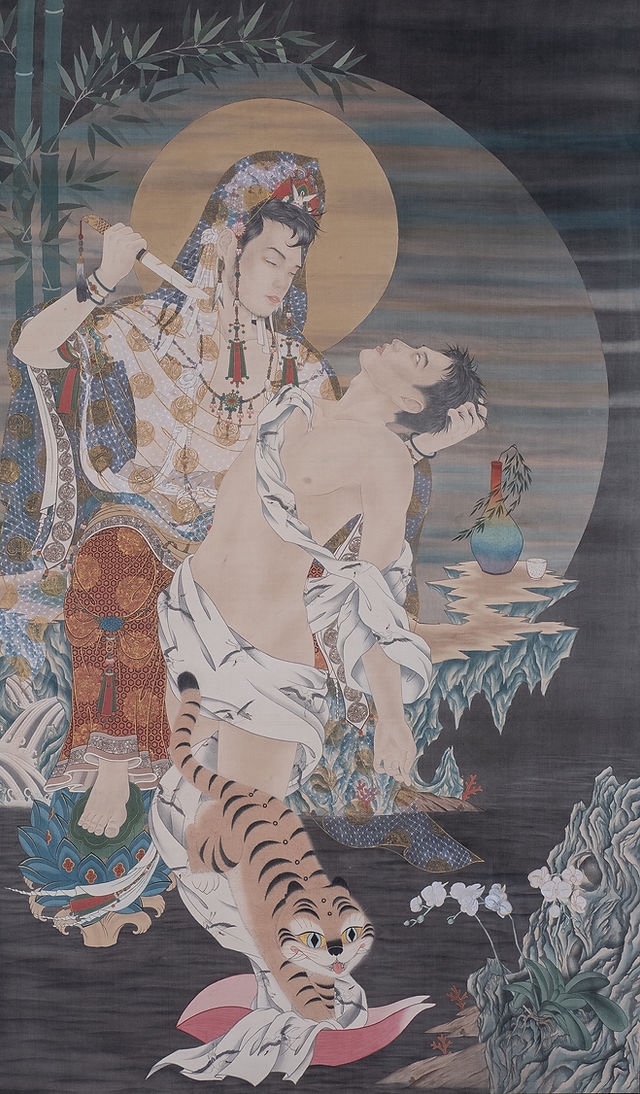
most vividly self-conscious image is the aforementioned simhodo. In his
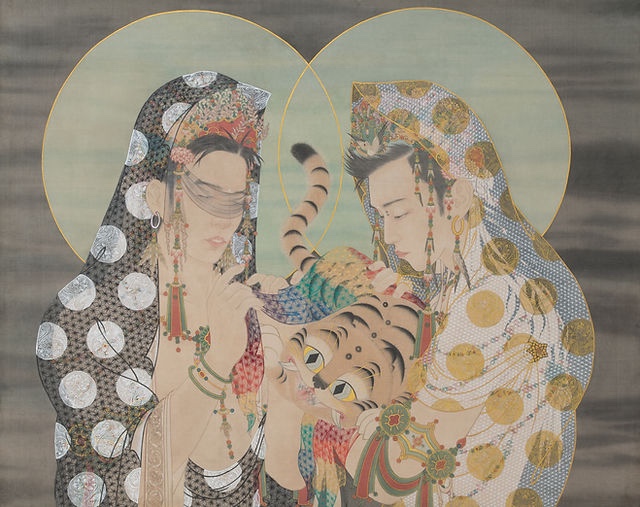
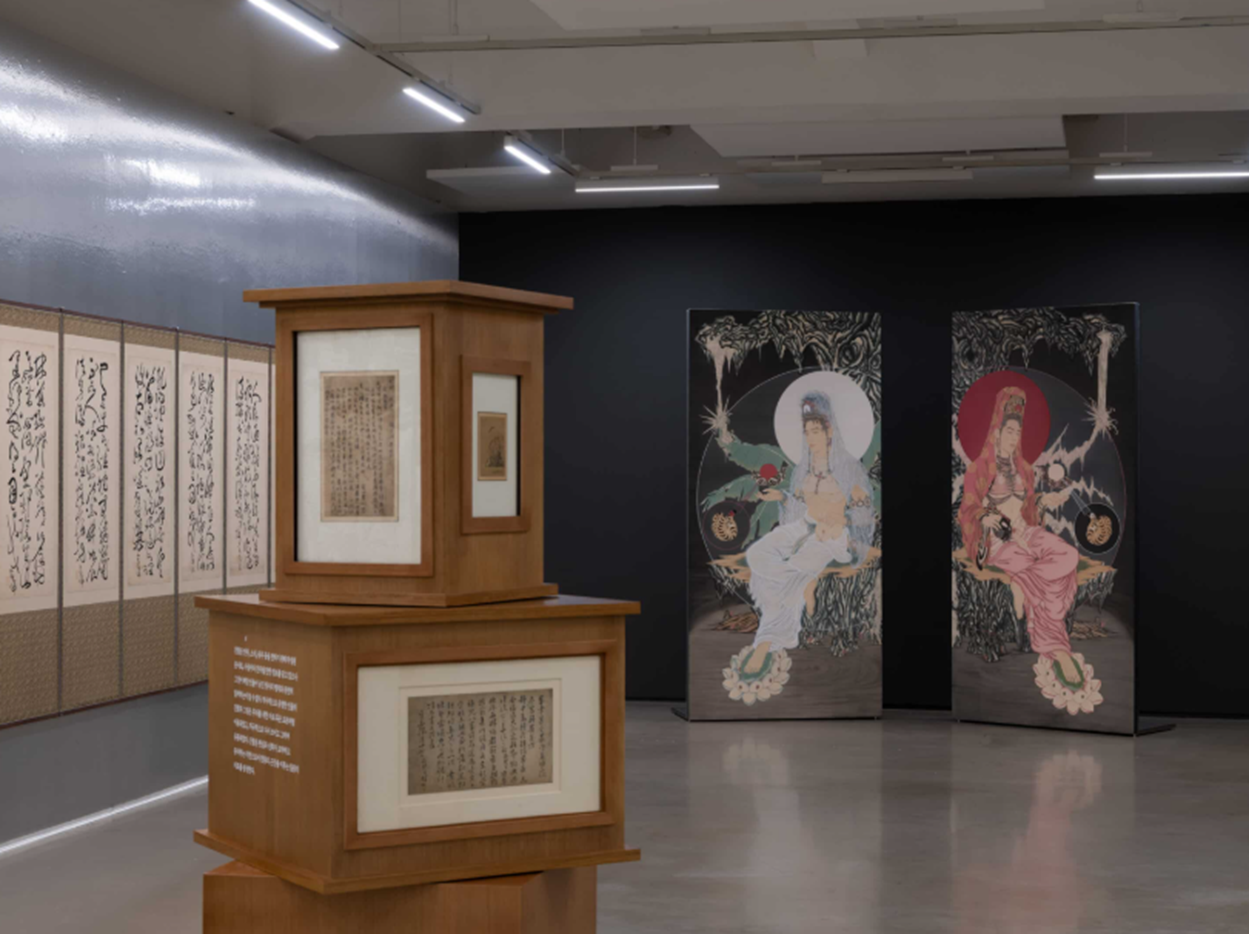
previous work, 〈Shimhodo_Vegabond 尋虎圖_樂流〉(2019), the artist depicted a scene in
which a tiger is born after a bodhisattva stabbed the artist. Here, the artist
juxtaposes the tiger, which he identifies with as an embrace of loss, in a
relationship with another figure (bodhisattva). However, in this solo
exhibition, the figures are nowhere to be seen. Some of the works appear as if
they are posthumous scenes in which the artist/tiger has eliminated the
bodhisattvas around him. Where have the Bodhisattvas gone? What has happened to
the tiger?
In 〈Shimhodo_Chosen 尋虎圖_柬擇〉(2018), the artist/tiger relationship is
situated within and relies heavily on the relationship. In a similar vein, in
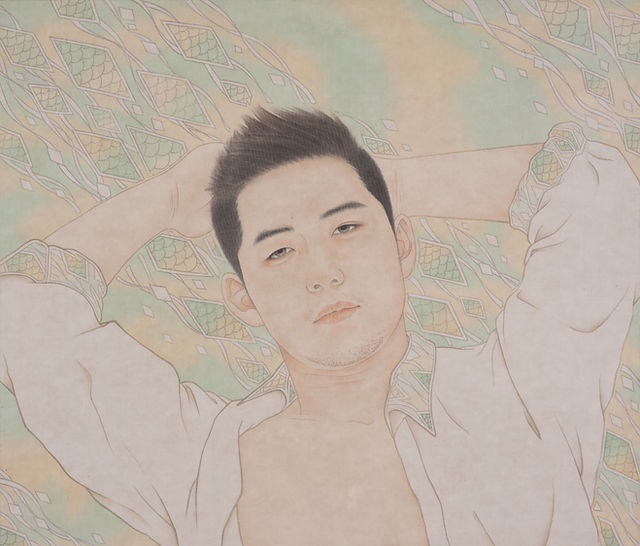
his first solo exhibition in 2018, 《Hwarangdo 花郞徒》, the artist drew figures from his surroundings, aspiring to a ‘gay’
image, and at times, he was self-loathing. If we apply the aforementioned dual
structure to the dimension of self-awareness, Park’s fourth solo exhibition, 《44》, can be understood as a reconsideration
of the past iconography through which he recognized and identified himself
within relationships. In other words, the tiger on the screen of 《44》, where the bodhisattvas have
disappeared, is a form and iconography that examines itself, not the
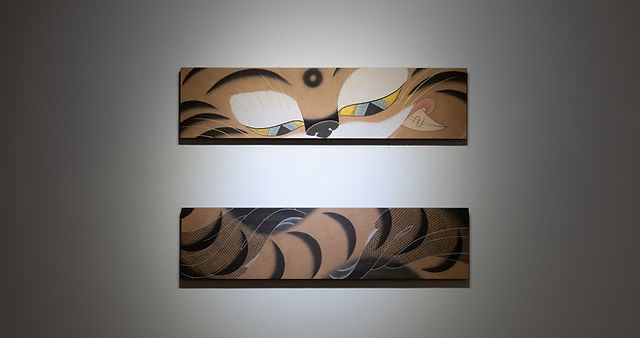
relationship with its surroundings, but itself. In the aforementioned 〈Sun play 日劇〉 and 〈Moon
play 月劇〉, the tiger (usually depicted in the form of a
Buddha) wearing a shin-gwang/du-gwang[3] seems to attain the enlightenment of
good behavior in the midst of the different qualities of the outer and inner
world. In today’s world, where all human relationships are theatrical and
dramatic on a curtained stage, the tiger comes across as a symbol of the will
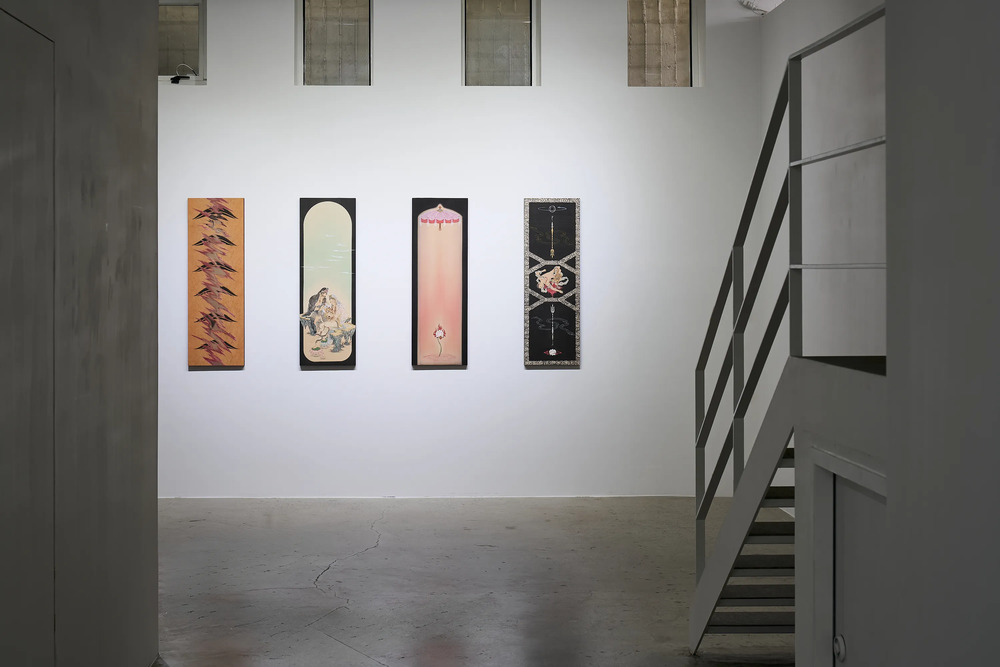
to affirm one’s identity. In the same vein, we can read the images in 〈Zero two 無二〉(2024), where the bodhisattvas
from past works have been erased, leaving only the figures of spears piercing
from above and below, and 〈Tailless 無尾〉(2024), where the figures have disappeared, leaving only the helmet
and trident of Dongjin Bodhisattva.
In
the end, the confrontation, repetition, and rewriting of 《44(Sasa)》 simultaneously pass through “Sasa 師事”, which means to be taught, “Sa 辭”, which
means to refuse, “Sa 死”, which means to die, and “Sa 些”, which refers to something insignificant and small. The very
structure of the exhibition already implies the meaning of reminding us of
something trivial, something private, and the act of erasing something. Perhaps
the exhibition invites us to see not only the individual works, but also the
more distant traditions and the artist’s previous works together in a
three-dimensional relationship, to ‘layer’ what is being repeated and
transformed, and to see what feelings and allusions are being conveyed. The
intertextuality of the exhibition is both a cohesion in which multiple forms,
contents, and narratives are brought together and an expansion in which they
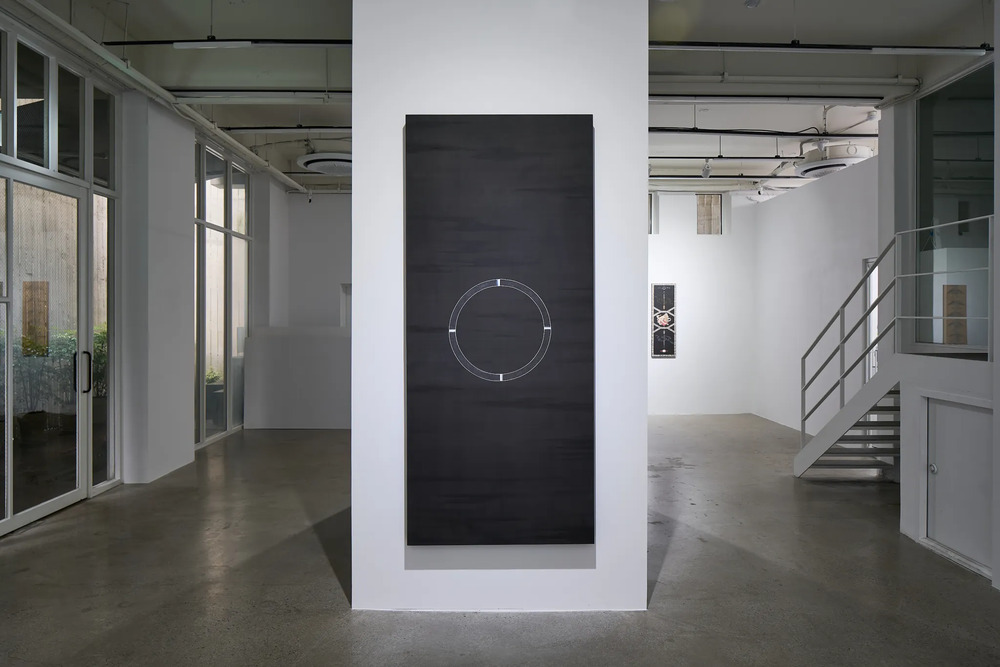
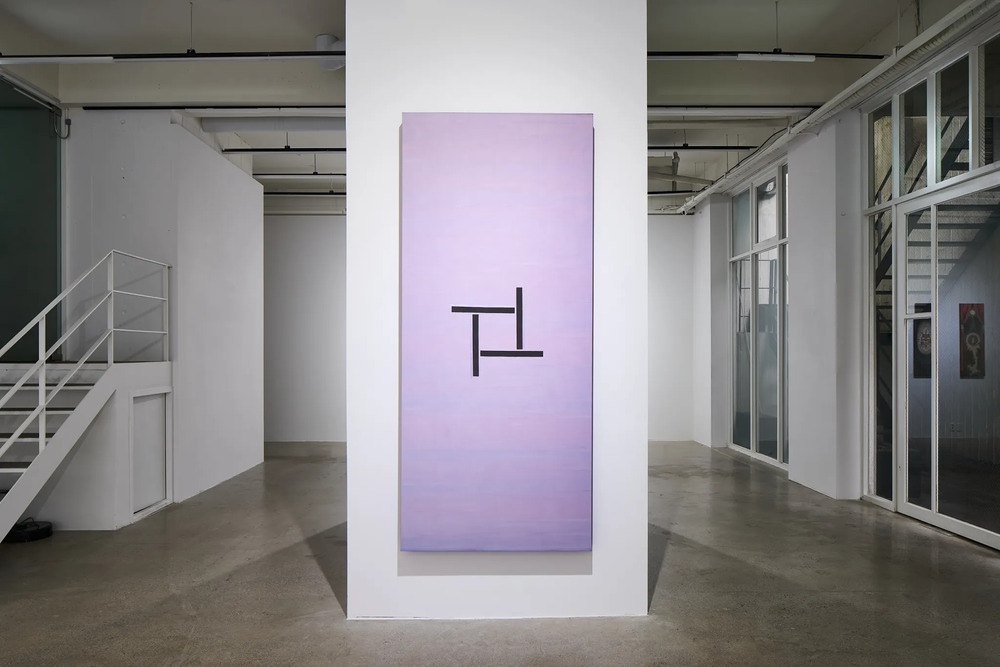
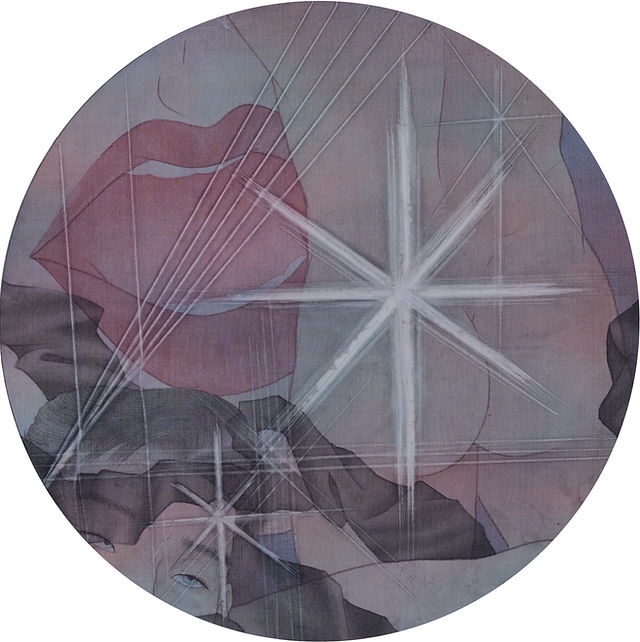
are layered. The relatively large-scale images of 〈Return
回〉(2024) and 〈Wheel 輪〉(2024) in the center of the exhibition, such as the Shimwudo’s “人牛俱忘”[4] iconography, clearly reveal the duality and complexity of
Park’s work throughout the exhibition, as well as its cohesion and expansion.
Stripped of any superficial temporal narrative, or of the events that occurred
between the cow and the herdsman, any relationship in these works, like
Shimwudo’s “人牛俱忘”, offers no basis for interpretation
beyond their simple markings. Such starkly simple images, “self-conscious
scenes that overcome dichotomies such as “beginning and end, inside and
outside, me and the other, past and present, tradition and newness,”
backgrounds and margins support the superimposition and circularity of the
seeker’s journey.
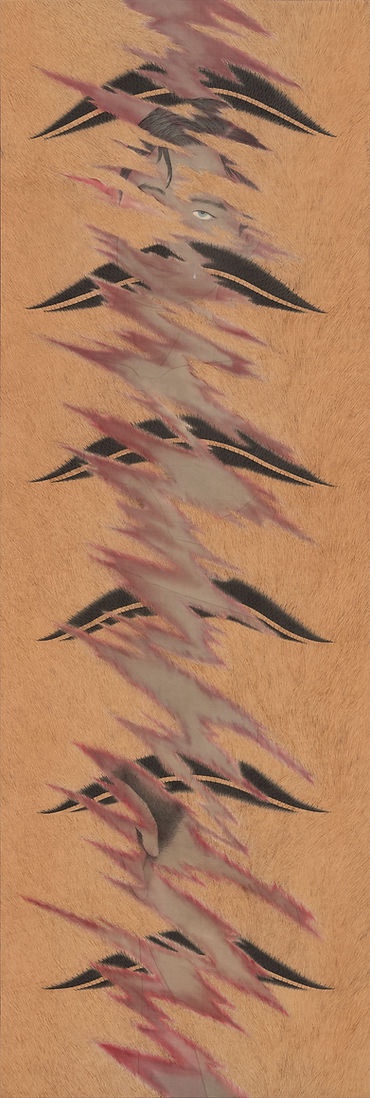
In
〈Enigma 我尾〉(2024), a
self-portrait included in 《44》,
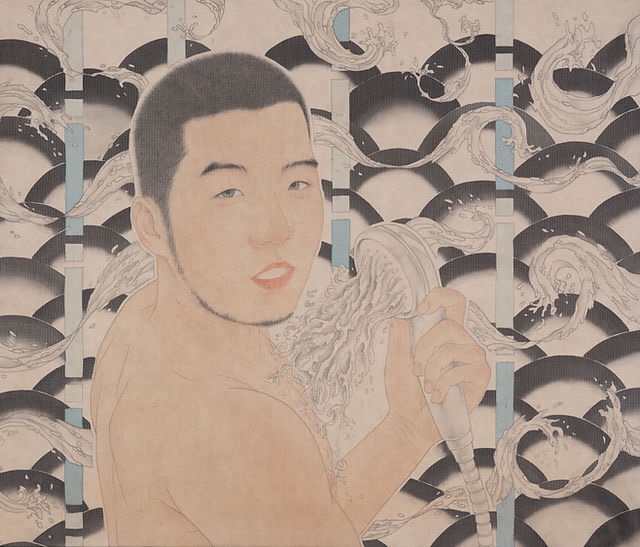
the artist’s figure appears within a gap, or even torn state. This “appearance
as torn state” is a different kind of image than the appearance of the artist
in his surroundings in the aforementioned works such as 〈Shimhodo_Chosen 尋虎圖_柬擇〉(2018) and 〈Shimhodo_Amrita 尋虎圖_不二〉(2021). It’s also a different kind of
personality image than self-loathing and admiring others.
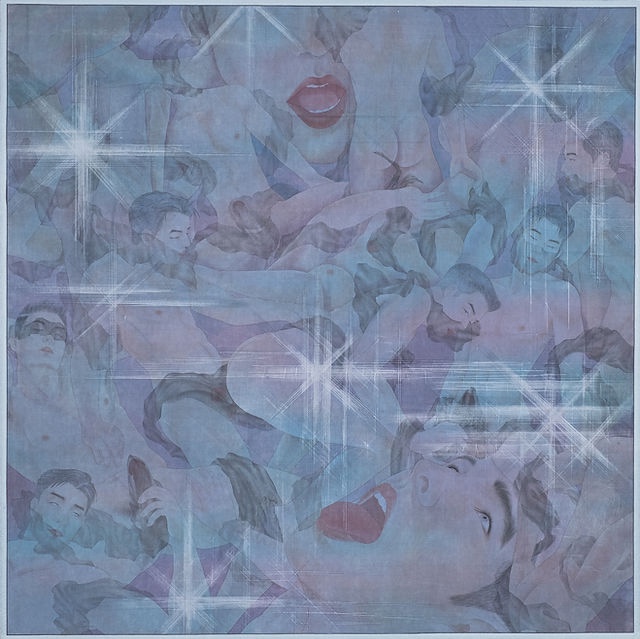
The
facing of the 《44》
can also literally refer to the collective confrontation of the different
elements that make up the artist’s work, such as the Buddhist art tradition,
queer identity, relationships, and past experiences and events. While the work
that traverses different times, experiences, forms, and narratives cannot be
categorized as autobiographical, it is possible to present this solo exhibition
as a sharing and expansion of queer identity and its relationship to the other,
as well as various rituals and forms of thinking about its manifestation. I try
to perceive the seemingly monotonous works with enlarged margins and bland
backgrounds as attempts to confirm, juxtapose, and superimpose their
heterogeneity within a more intimate space-time, or to expand them into an
infinite screen. In this way, I imagine a scene in which the artist’s queer
identity and contemporary narratives are grafted onto the form and content of
Buddhist art, explored anew, overcome, and then confronted and confused again.
Hyukgue
Kwon(Curator)
[1] study under. (The English exhibition title “44” and the
Korean exhibition title “사사四四 ” and all
references to “sasa” in the text are homophones in Korean.)
[2] “A drawing that illustrates the stages of Zen practice using
the analogy of a cow and a child, and is also known as the ten cow drawing
because it has ten stages of practice.”, 「Shimwudo」, 『The
Encyclopedia of Korean National Culture』: https://encykorea.aks.ac.kr/Article/E0033873.
[3] head aureole
[4] ‘Both Bull and Self Transcended.’, The eighth of the ten
figures of the Simwudo, “人牛俱忘” depicts
the state of forgetting the cow and then forgetting oneself, and is drawn as an
empty circle. It symbolizes the state before the separation of the subject and
object, that if the object, the cow, is forgotten, the subject, the child,
cannot be established, and only when this state is attained is one said to be
fully enlightened.”, cited above.