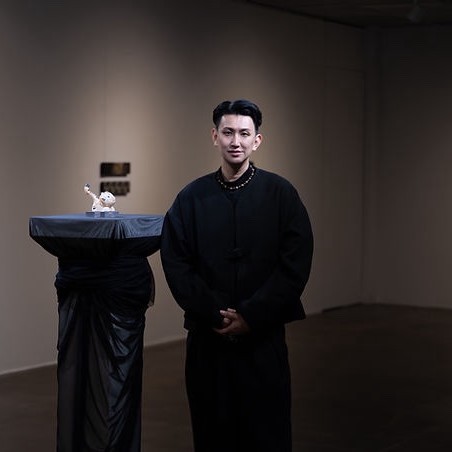
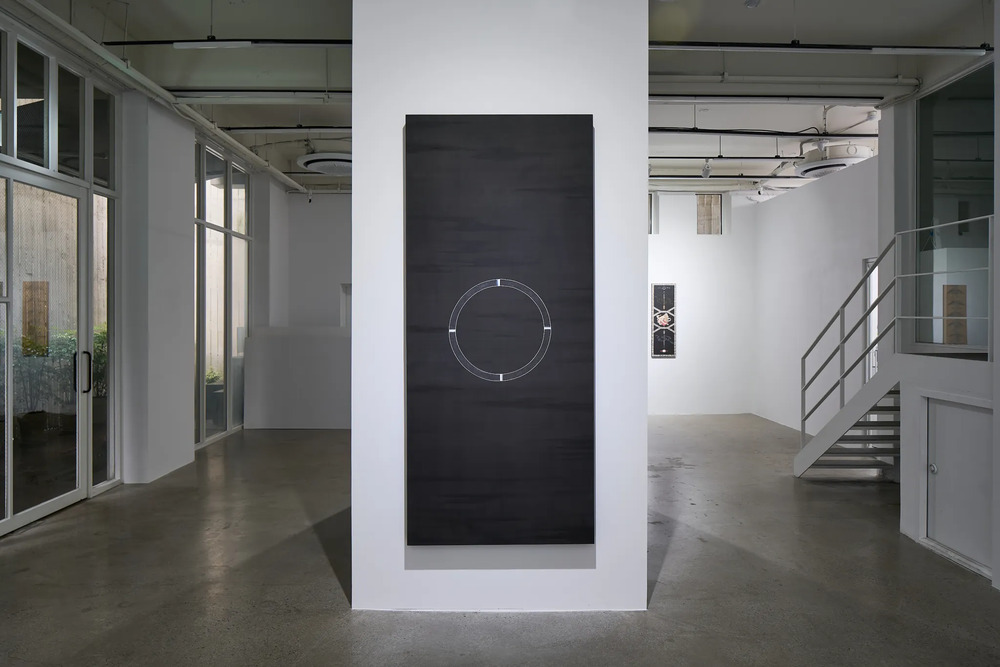
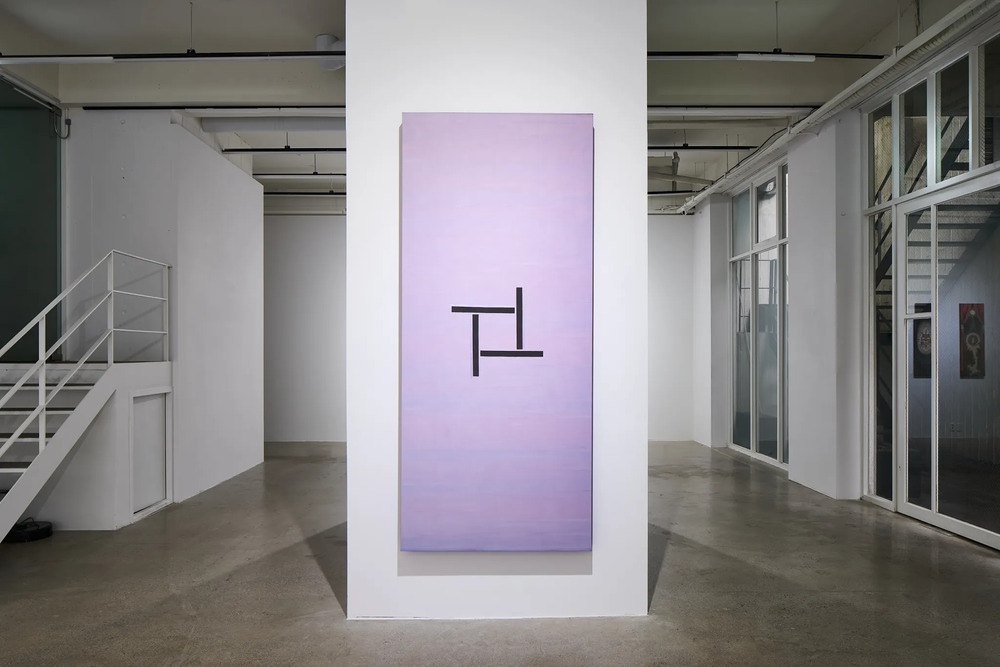
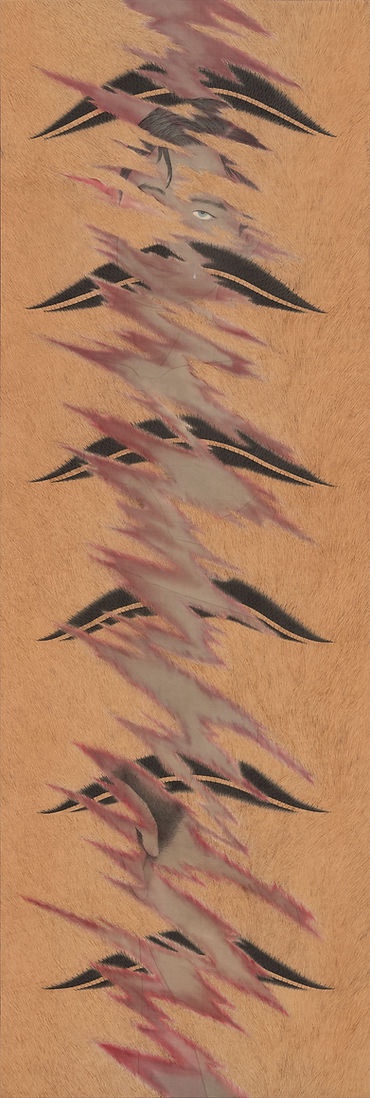
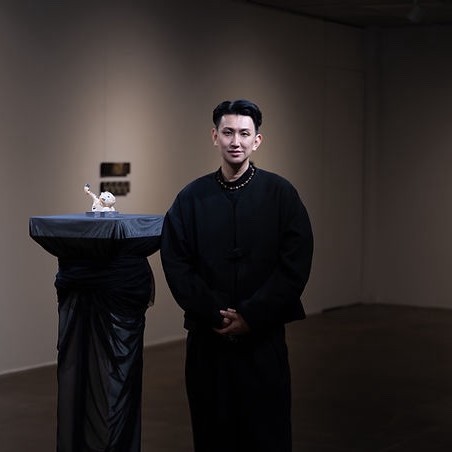
00. The Narrative of Artist Grim Park (朴그림, b. 1987) Can Be Largely Summarized in Two Themes
One
is the story of overcoming as a Buddhist painter trained through
apprenticeship, who entered a university department for Buddhist art and
experienced hierarchical discrimination and conflict. The sense of bewilderment
and confusion felt between the academy system—which tends to devalue
apprenticeship education—and the traditional world of master-disciple
relationships narrowed his place in the art world, compelling him to find a new
path in order to survive as a painter.
The
other is the narrative of a queer man born in Jeongeup, North Jeolla Province,
who studied in Gyeongju and later encountered cultural barriers and conflicts
within Seoul’s gay community. Unlike the identity confusion he experienced as a
gay man during his university years, the alienation and difficulties he
encountered in Seoul led him to critically reflect on the mechanisms of
personal/social identification and strategies of assimilation/differentiation
that queer men navigate. By reinterpreting the narcissism, envy, and desire
present among gay men as a Buddhist artist, he has been weaving new meanings
into both his private and public identities. These narratives are inextricably
linked to his ambiguous position as a contemporary artist.
Ultimately, these two
threads converge into a singular narrative of Grim Park as an artist.
Furthermore, they raise critical questions within the flow of contemporary art:
What place can Buddhist painting occupy in contemporary art? How might Buddhist
painting be reinvented as contemporary art? Thus, Park's work goes far beyond
the scope of autobiographical art.
01. Grim Park
was accepted into the Buddhist Art Department at Dongguk University’s Gyeongju
Campus in 2006 but was unable to enroll due to personal circumstances. For
about half a year, he attended a design college, and from late 2006 to early
2008, he studied sculpture under his high school mentor, sculptor Son
Chang-yeop, while working as an assistant. From 2009 to 2010, he served as a
social service agent as an alternative to military service. In 2012, he entered
the Buddhist Art Department at Dongguk University’s Gyeongju Campus and
graduated in 2016. In April 2017, he relocated to Seoul.
In
2009, he met a Buddhist painter (whose name cannot currently be disclosed) and
began learning traditional painting through apprenticeship. Encouraged by this
mentor, he pursued formal education in Buddhist art, but since 2016, he has
been outside of that master-disciple relationship.
(Note: In his first year at university, in 2012, he won a special prize at the
Seorabeol Art Exhibition.)
Starting
with the creation of Lotus Altar Painting at
Okcheon Temple in Yeongdeok in 2015, and Mother Kṣitigarbha Bodhisattva (produced in 2016) at Eungsin
Hermitage in Gwangyang in 2017, he began his independent path as a painter.
With that, he also started his life in his 30s in Seoul and made a determined
choice to forge a new path as a contemporary artist, even formally changing his
name.
(Other
major records of Buddhist painting production include:
2017: Solitary Sage Painting at Gaeseong Hermitage
in Uijeongbu;
2018: Willow Avalokiteśvara at Muam Temple in Jecheon;
Water-Moon Avalokiteśvara at Bohyeon Temple in Bucheon;
Mountain Spirit Painting at
Bodeok Hermitage in Seoul;
Fierce Tiger Painting at
Hyeonmyeo Hermitage in Sancheong.)
He
began gaining attention in the contemporary art world with his first solo
exhibition Hwarangdo – Men as Beautiful as
Flowers (April 6–14, 2018, Bulil Art Museum Hall 1 at
Beopryeonsa Temple). That same year, he won the ABSOLUT ARTIST AWARDS, and has
since actively participated in a variety of projects, including the group
exhibition Flags (2019, Doosan Gallery New York)
and the two-person exhibition Male Forms: Hwa-hyeon Kim and Grim
Park (2020).
Through
his second solo exhibition CHAM: The
Masquerade (April 21–May 29, 2021, YOU ART SPACE), artist Grim
Park finally began to critically respond to the way he had been interpreted in
major media outlets—namely, as someone applying and reinventing traditional
painting within contemporary contexts. This exhibition marks his first
exploration in which he poses and reflects on his own plastic identity as a
modern painter.
-01. Even
though the Joseon royal court outwardly upheld a policy of promoting
Confucianism and suppressing Buddhism, the current of Buddhist art steadily
continued, with uniquely Joseon styles and conventions emerging, such as
the Sweet Dew Paintings (Gamro Taenghwa). Whether
created by individual painters or by groups of monk-painters led by principal
monks and editors, these works can clearly be traced through the recorded
painting inscriptions (hwa-gi, 畵記). However,
during the modernization process of the late modern and contemporary eras, as
Western concepts of art were introduced and hybrid educational systems mixing
Japanese, Korean, and Western styles (wa-seon-yang, 和鮮洋)
took root, Buddhist art was relegated to the realm of the vernacular, outside
the academy system.
Awareness
of this marginalization began to rise in the late 1960s, following the
normalization of diplomatic relations between Korea and Japan in 1965 and the
subsequent push for industrialization. To prevent the extinction of traditional
skills related to temple painting, Buddhist sculpture, and temple architecture,
the Ministry of Culture and Public Information and the Cultural Heritage
Administration began discussing the establishment of a Buddhist art department
in universities in 1968. This led to the founding of the Buddhist Art
Department within the College of Buddhist Studies at Dongguk University in
1971. As a newly established department offering government scholarships, the
university expressed pride, stating that it was launching a department that
should already exist in a national university.
Since
the department’s founding mission was to preserve tradition and transmission
techniques, it did not lead to the modernization or contemporization of
Buddhist art. Moreover, conflicts and frictions with apprenticeship-based
training outside the university system emerged early on and persisted for
decades. (This binary conflict structure between academia and vernacular
tradition has continued even after the Cultural Heritage Administration
established the Korea National University of Cultural Heritage in 2000, which
was reorganized into a university in 2011.)
As
early as 1935–1936, the sculptor Kim Bok-jin (1901–1940), in his mid-thirties,
attempted to develop a new path for modern and contemporary art rooted in Silla
tradition through his studies and production of Buddhist sculpture. In 1938,
the painter Jeong Jong-yeo (1914–1984), in his mid-twenties, produced a
modern Large Hanging Painting (gwaebul) for
Uigoksa Temple in Jinju. These were significant pioneering efforts, but the
momentum was soon lost. Artists who defected to the North could not pursue
Buddhist art under the socialist regime of North Korea, and artists in South
Korea largely ignored the challenging path of engaging with Buddhist art as a
means of entering modernity.
The
rare exception was Park Saeng-kwang (1904–1985), who from 1977 began developing
a new style of modern Korean painting based on Buddhist imagery such
as non-paintings (muhwa). Amid the rediscovery of
traditional culture sparked by the touring exhibition Five
Thousand Years of Korean Art in Japan in 1976, Park freed
himself from the stigma of being a “Japanized painter inheriting the new
Japanese style.” However, his accomplishments only indirectly influenced a few
Minjung art (people’s art) practitioners, and no one explicitly took up the
unfinished task he left behind.
Thus,
experiments to extract the stylistic and structural logic of Buddhist painting
from its medieval formal system and reintegrate them within pluralistic spatial
frameworks—then imbue that with Baroque dynamism, and finally deconstruct and
reinvent it in a contemporary or contemporaneous context—were never even
recognized as valid artistic endeavors. Sporadic attempts to modernize
the Sweet Dew Painting format or create
contemporary transformations of similar Buddhist paintings often resulted in awkward
and clumsy outcomes.
To
put it simply, Kim Bok-jin was a sculptor who believed that one could achieve a
Renaissance-like artistic leap by using Unified Silla Buddhist sculpture as a
benchmark. Therefore, when he was selected in a five-person competition
(including the monk-painter Ilseop) to restore the main Buddha statue at
Geumsansa Temple on Moaksan Mountain in 1935, and the winning piece exhibited a
fairly modern character, it reflected the zeitgeist of the time—hoping to
resurrect national identity from the ruins of Silla.
If
the colonial-era dream of a Renaissance-like cultural revival rooted in
Buddhist painting and sculpture had been more broadly realized, what kinds of
achievements might it have yielded?
Though
there are no “ifs” in history, let us imagine alternate possibilities:
—What if Jeong Jong-yeo or Kim Yong-jun had not defected to the North and
instead stayed in South Korea, advocating for a national contemporary art
rooted not only in Confucian literati tradition but also in Buddhist and
shamanistic practices?
—What if Chang Bal, who led the Seoul National University College of Fine Arts
until the fall of the Jang Myeon–Yun Bo-seon administration, had been a
Buddhist believer rather than a Catholic?
—What if a modern art movement inspired by Cheondogyo had emerged?
—What if a Buddhist ink abstraction movement comparable to the neo-Confucian
Moklimhoe had taken shape?
—What if a contemporary Korean art movement based on Taoist or shamanistic
worldviews were to develop? What would those experiments look like?
Architectural
works like the National Museum of Korea designed by Kang Bong-jin (1966–1972),
the Sejong Center for the Performing Arts by Eom Deok-mun (1973–1978), and the
Ho-Am Art Museum by Samoo Architects & Engineers (1975–1978)—though derided
and mocked by the Korean architectural community—cannot be dismissed merely as
grotesque artifacts born of regime competition with North Korea. Rather, these
buildings and the art and craft objects housed within them embodied the
lingering dreams of colonial-era Koreans who sought to revive the essence of
Unified Silla to forge a better national modernity. (Note: The bas-relief of
the flying celestial being at the Sejong Center, modeled after the Emile Bell,
was a masterwork by sculptor Kim Young-jung.)
02. Grim
Park’s first solo exhibition, Hwarangdo, had—by the
standards of the contemporary art world—certain aspects that made it resemble
an “Insadong-style” exhibition, meaning it didn’t clearly appear to be a
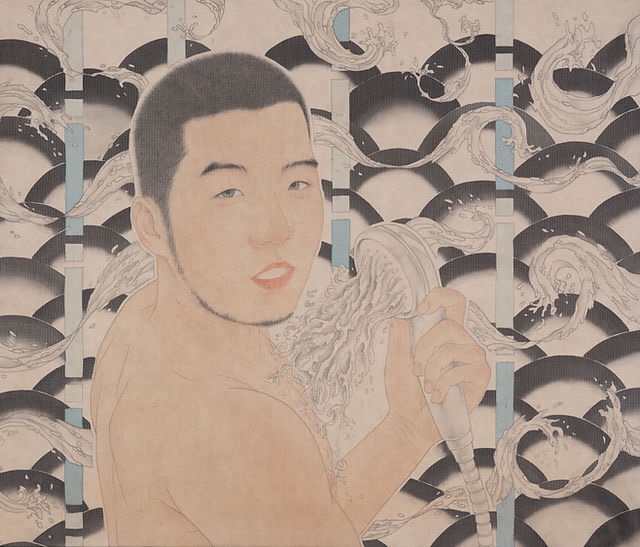
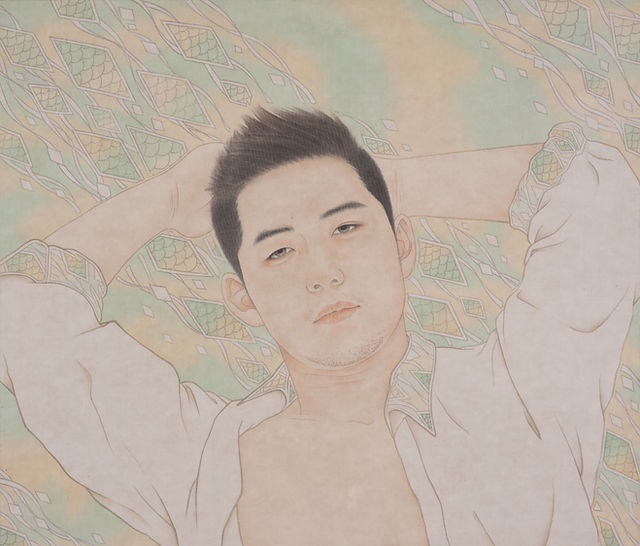
contemporary art exhibition. As a gay/male/painter who began to capture the
narcissism of gay men expressed on social media using the visual language of
traditional Buddhist painting, it’s difficult to say that Grim Park had a clear
self-awareness as a contemporary artist at that point. However, despite the
modest scale of the exhibition, it conveyed a problematic tension that is rare
even in contemporary art shows that try hard to impress.
Park
held a dual identity as a traditional Buddhist painter and a vernacular
contemporary artist. Having trained in both an apprenticeship system and formal
university education, he possessed the capacity of a painter-craftsman
(hwajang, 畫匠) skilled in rendering
traditional Buddhist iconography such as Goryeo Buddhist paintings. Yet, he had
also been observing how gay men showcased their sexual beauty on social media
and, since 2015, began producing experimental portrait series of gay men.
Though
he used photographic images as references to create portraits, he restructured
the iconography based on his own interpretation. In some cases, the results
became subtly psychoanalytical critiques. His artist statement read like a
direct confession, yet still contained layers of allegory and polysemy.
“Just
like everyone else in the world, I came to use SNS. Within it, I encountered
countless beautiful people. All of them, with confident expressions and poses,
attracted attention and flaunted their beauty. / I envied their self-love. They
became objects of longing for me, and I wanted to make their beauty—what I
lacked—my own through my painting. This is how I began to work on male beauty.
/ I portrayed them using the material I handle best. I captured their beauty
with subtle coloring on fine silk. I believed that the soft and sensitive
nature of silk resonated with their beauty. The effort of layering pigment
dozens of times to achieve color seemed to align with the truth that ‘the
pursuit of beauty requires just as much struggle,’ and that’s why I chose this
method.”
Each
portrait contained a hidden backstory or foreshadowing. While such details were
excluded from this review out of respect for personal privacy, the artist’s
interpretations of each subject were embedded in every work. In some,
traditional patterns were arranged with care; in others, such motifs were
juxtaposed symbolically. Some portraits featured elements like flamingos or
digital camouflage patterns inspired by military uniforms.
The
artist deployed two types of analogies in his critique. One was to identify the
Buddha—who achieved enlightenment by overcoming Mara (Māra, the demon who hinders one’s path to Buddhahood)—as the ultimate narcissist. In doing so, and drawing on the
Buddhist teaching that anyone can attain enlightenment, he considered today’s gay Narcissuses through both
their positive expressions of self-love and the negative manifestations of
self-hatred. He saw the flood of self-loathing among social media users as a form
of interference by Mara.
The
second analogy, based on the first, involved identifying gay men on
“Gaysbook”—a nickname for a gay-specific network on Facebook—as modern-day
Hwarang (flower youths), who both positively expressed their narcissism and
compulsively promoted their looks to gain recognition from others. These
“Gaysbook gays,” caught in a paradoxical state of simultaneously wanting
visibility to fulfill desire and happiness while also wanting to hide from a
heteronormative society, were called forth by the artist as enlightened beings,
as the Hwarangdo of our times.
(The
dictionary definition of “Hwarang” includes the following:
1.
A youth training organization in Silla, composed of well-born, scholarly, and
good-looking individuals with the ideals of cultivating mind and body and
leading society;
2.
The leader of the Hwarang;
3.
A group of entertainers similar to jesters, known for their festive attire,
dancing, and merrymaking, often the male consorts of shamans.)
The
fact that Grim Park’s solo exhibition was held at the Bulil Art Museum, run by
Beopryeonsa Temple, allowed for a meaningful reading of the connection between
the artist’s background—he uses the art name Jeongwol (井月)—and the new body of work. In short,
the Hwarangdo series could be interpreted as
Buddhist paintings, or conversely, existing Buddhist paintings could be
reinterpreted through a queer lens. Until now, no gay artist in Korea or abroad
had attempted to appropriate the queer aspects of traditional Buddhist painting
to reinvent it into a form of queer contemporary painting.
Another
point to consider is the inclusiveness of Buddhism. Even though there was
special support from Venerable Yeo-seo, chief curator of Bulil Art Museum, the
fact that this exhibition took place without a single protest at a
temple-affiliated museum in Korea is remarkable. (Had it been at a Christian
church, exhibiting a series of gay portraits filled with seductive gazes would
have been extremely difficult.)
03. Since Grim
Park began exploring the dilemmas of queer subjectivity through iconographic
reinterpretation based on the grammar of Buddhist painting, he has worked to
develop his own stylistic idiom and iconographic structure.
In
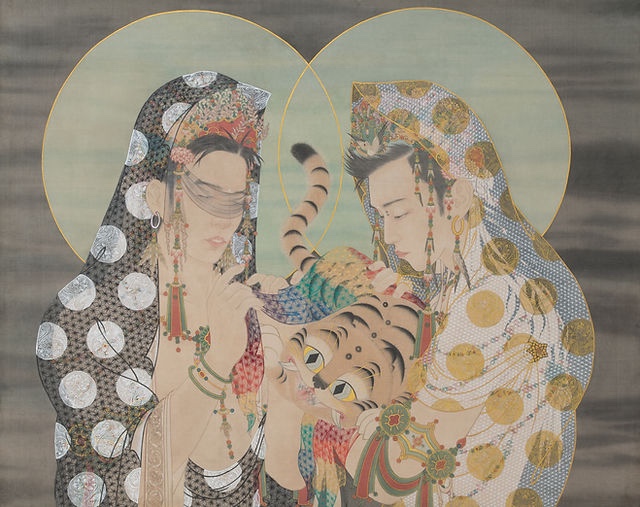
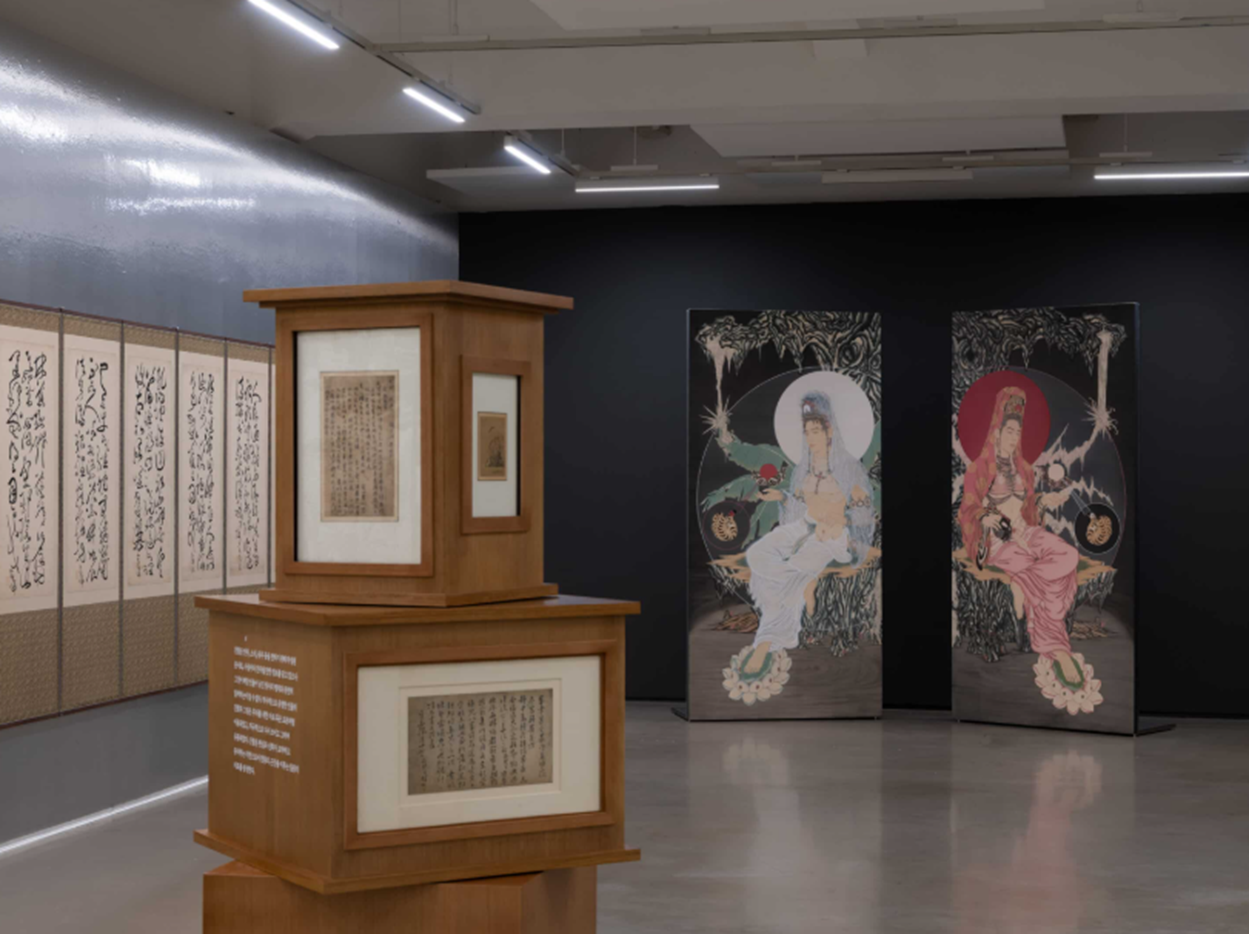
the 2018 work Seeking the Tiger – Selection (尋虎圖―揀擇), Park responds to the
traditional Buddhist painting Seeking the Ox (尋牛圖) and weaves new queer iconography and
allegory. Seeking the Ox (also
called Ten Oxherding Pictures) is a Zen Buddhist visual
metaphor for the process of finding one’s true nature, comprising ten stages of
spiritual development. However, in Park’s version, the animal symbolizing
enlightenment is not an ox, but a tiger.
The
cute and pretty baby tiger, painted in a somewhat folk-art manner, appears
repeatedly in his work and is interpreted as the artist’s persona.
In Seeking the Tiger – Selection, the tiger held by two
beautiful young gay Bodhisattvas who illuminate the meaning of life becomes a
symbol of the artist’s own artistic journey. (The figure on the left drapes the
tiger in a six-colored rainbow veil.)
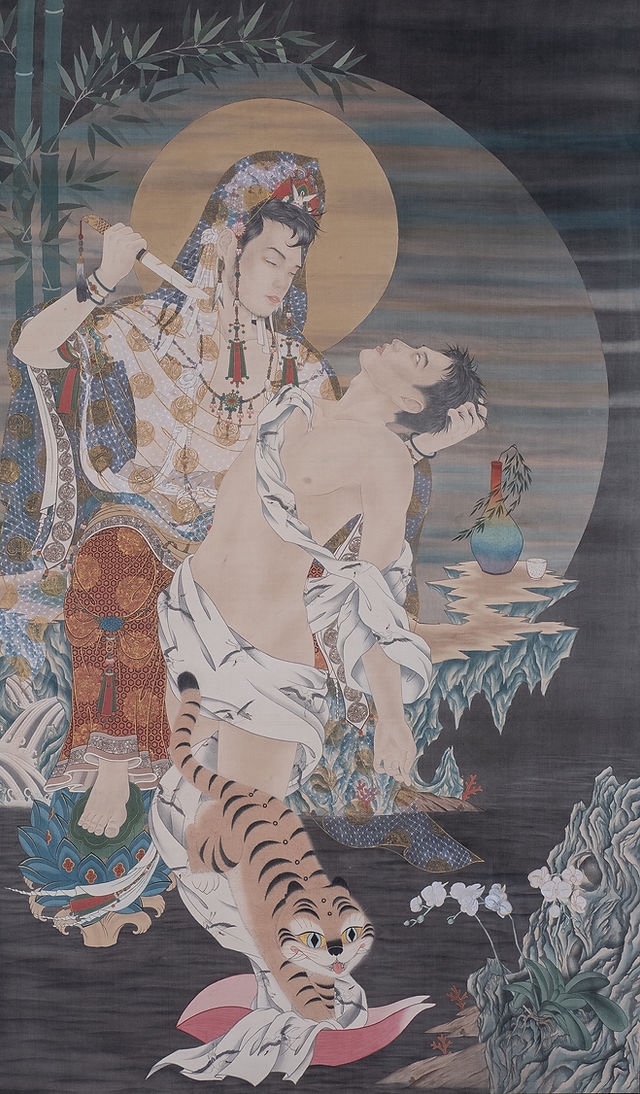
In
the 2019 painting Seeking the Tiger – Falling Stream (심호도 – 낙류), one young gay Bodhisattva
is shown trying to stab the other with a knife. The rainbow-colored ritual vase
clearly refers to the queer world, but what does the crane motif embroidered on
the cloth that wraps around the body of the figure in peril (possibly
symbolizing a crisis of love?) signify? While the crane is one of the ten
symbols of longevity, when contrasted with the tiger, it can also represent the
scholar-official, the refined literati.
(The
white crane motif had previously appeared in one of
the Hwarangdo series paintings, I
SLAY [2016].)
In
any case, within the conflict between the two gay Bodhisattvas, the tiger sets
off on a new journey, floating atop a lotus petal. Before the tiger bloom white
orchids, which in ancient Greece symbolized virility, in the Victorian era
wealth, and in contemporary times hope and purity.
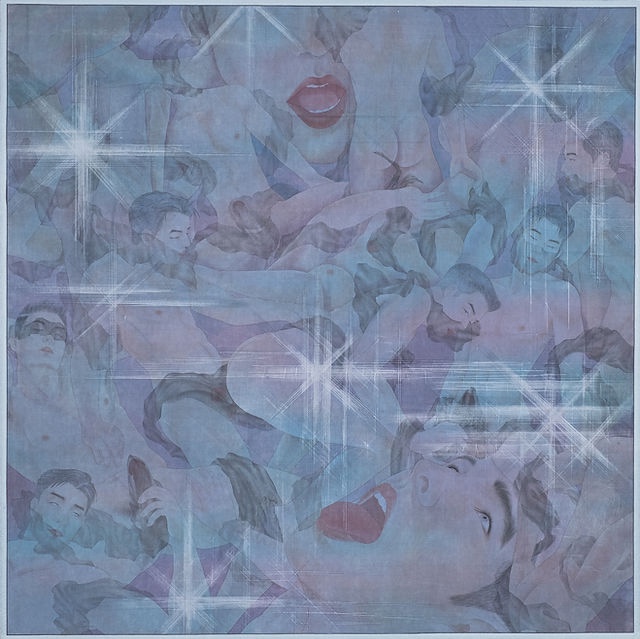
By
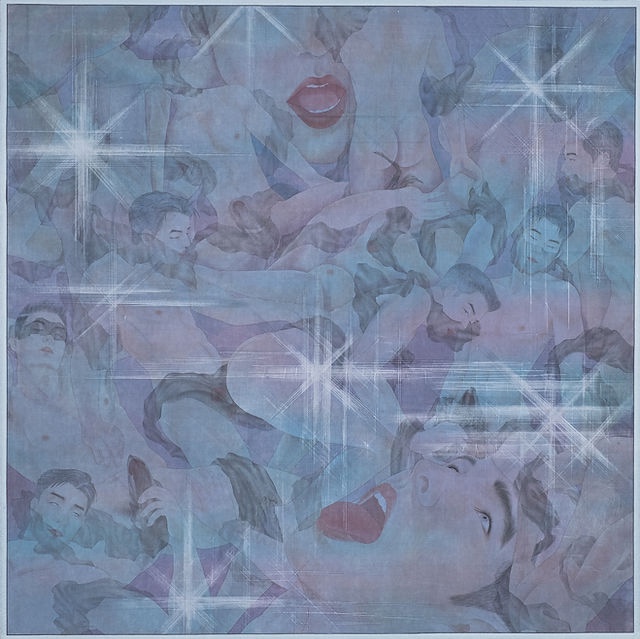
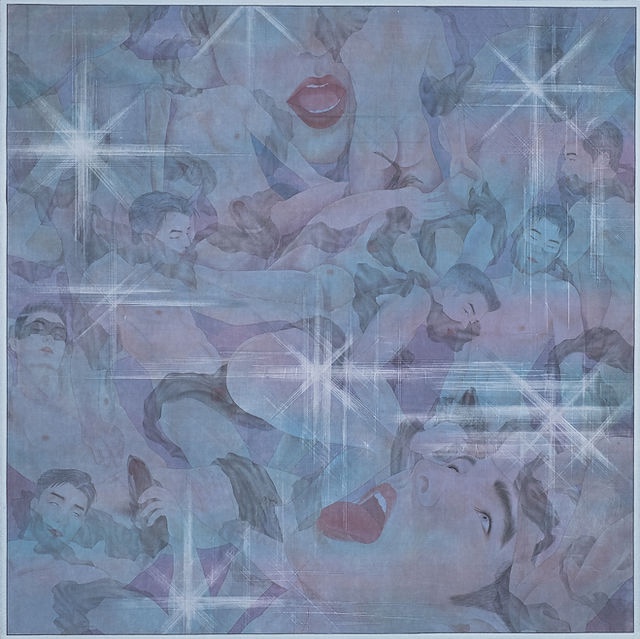
contrast, in the 2020 work Bel Ami, the artist reveals
his desire to break away from previous visual grammar. He attempts to visually
strip away the "Buddhist colors" that had come to define his identity
as a "queer artist who uses the forms and techniques of Buddhist
art." Within a square format borrowed from Instagram’s interface, Park
paints a group of nude gay men engaging in a variety of erotic poses.
The
title Bel Ami first refers to a gay porn label,
but secondarily evokes the protagonist of Maupassant’s novel Bel-Ami—a man
who uses his beauty to fulfill his ambitions—and thirdly, quite literally means
“beautiful gay friends,” referencing the narcissistic gay youths depicted in
the earlier Hwarangdo series.
Each
figure is connected by a sheer black fabric that partially conceals their
genitals. According to the artist, this cloth is analogous to the veils (sara, 紗羅) traditionally worn by Bodhisattvas in Buddhist paintings. This
sacralization of erotic imagery through “sacred veiling” attempts to create a
form of aesthetic sublimity—extracting noble value from a sexual network that
might otherwise be dismissed as vulgar. In other words, it is a pursuit of new
harmony between the sacred and the profane.
In
terms of form, Bel Ami can be seen as an effort to
render the human body, typically confined within the medieval iconographic
system of Buddhist painting, more freely within a Renaissance-like visual
order. Park has mentioned wanting to try a neoclassical nude group painting in
the style of William-Adolphe Bouguereau. With this in mind, comparisons can be
drawn to works such as Combat I & II (1928)
from Grande Composition by Tsuguharu Foujita, or
to Military Immortals (군선도) (2017) by Hwa-hyun Kim, who sought to respond to
Foujita’s iconic “milky white” skin tones for Asians.
04. In his
second solo exhibition CHAM: The Masquerade, Grim Park
prepares and signals a transition to the next phase of his work. The title
“CHAM” was taken from the Tibetan Buddhist ritual mask dance, which is
performed to expel disease, ward off misfortune in communities and villages,
and bring good harvests. Accordingly, Park suggests that the masked play of
identity among gay men may be sublimated into a kind of purification ritual.
(Since
it is said that Korea’s Cheoyongmu dance was
influenced by the Tibetan cham, it is also interesting to reinterpret the
exhibition title as Cheoyongmu.)
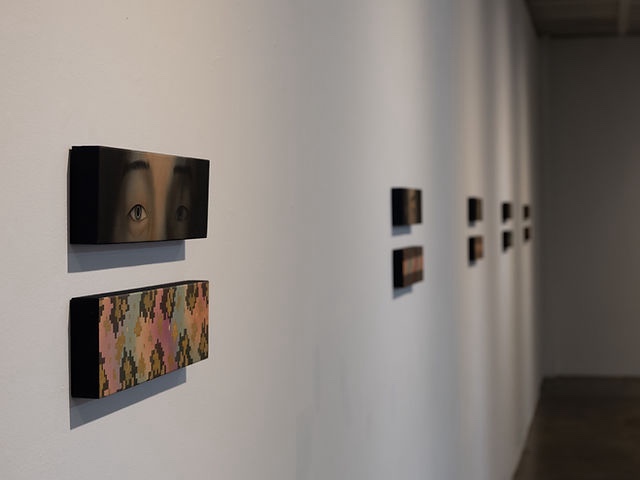
Using
an “equal sign” composition, the upper part of each work features a close-up of
the eyes of men known as “Gaysbook stars,” while the lower part displays motifs
representing the characters and temperaments of the depicted individuals.
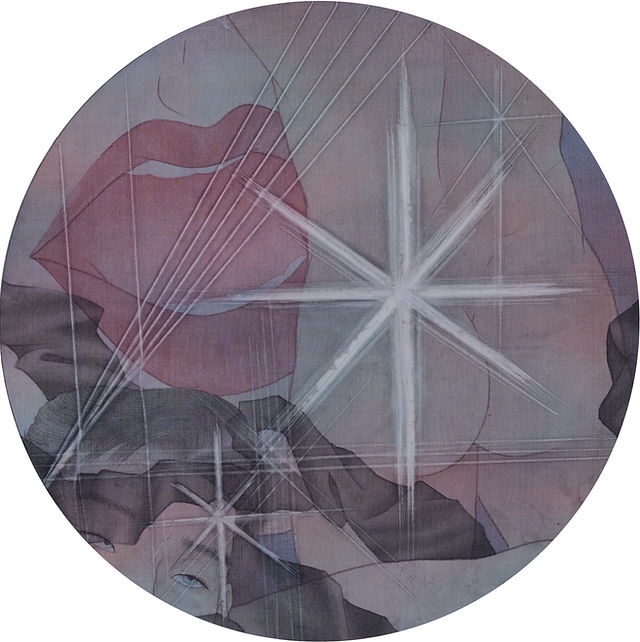
The
18-piece MSQ (Masquerade) series, which
self-references the Hwarangdo series, exudes a
darker, more ominous tone than his previous works. Though the same eyes are
depicted, they appear empty, as if devoid of self-assurance. Consequently, the
ornamental patterns once bestowed upon the figures in
the Hwarangdo series now invite a new
interpretation.
For
example, the new work MSQ49548, derived
from Portrait of a Boy (2018), which portrayed a
well-known go-go boy, features new Buddhist-inspired iconography composed of
flamingos and leather straps, conveying semiotic messages. Amid the coexistence
of feminine qualities and masculine strength, the artist captures the resolve
of a figure who reshapes and refines his identity through sheer will.
(The
protagonist of this painting once commented that he works out “like a damn
beast,” and thus the “damn” intensity can be read in his eyes.)
(Note: Since the Hwarangdo series originally
consisted of 18 works, the MSQ series was also
planned as 18 pieces.)
Alongside
the MSQ series, a ceramic sculpture of a baby
tiger titled Hogu and the earlier
painting Bel Ami were also exhibited. However, the
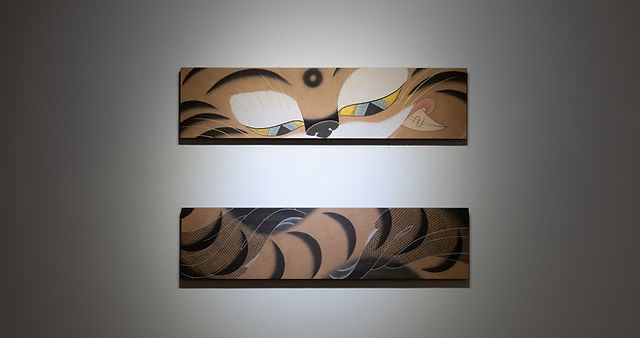
true centerpiece of the show was Bihu, constructed
using the same “equal sign” format.
One
painting shows the eyes of a baby tiger, while the other depicts its tail and a
veil (sara) leaping across it, foretelling a future narrative and temporal
unfolding. In the tiger skin pattern—rendered using the six-fold line technique
typically reserved for depicting human skin—an anthropomorphic personality
emerges. The two golden eyes reflect both mischief and the aura of
enlightenment.
The
artist explained that the Buddha’s eyes consist of five types:
1.
The physical eye (육안, eye of the
flesh);
2.
The divine eye (천안, which
perceives minute details and the future from the heavens);
3.
The wisdom eye (혜안, which sees
through illusions and penetrates universal truths);
4.
The Dharma eye (법안, which
illuminates all things through the light of truth);
5.
The Buddha eye (불안, the eye of
the cosmic creator).
Thus,
the tiger’s eyes are symbols of these five stages of awakening.
Meanwhile,
the white curl between the tiger’s brows (the urna, or “white hair mark,”
baekhosang) is rendered as a black ring, suggesting it may transform into
various forms in the future.
And
the veil (sara) leaping over the tiger’s tail signifies Indra’s Net (Indrajāla), the vast web that stretches above the palace of Śakra (Indra), the king of the gods who presides over the Buddhist
Desire Realm (욕계, yulgye). The metaphor
describes a boundless net, with a jewel at each node. Every jewel reflects all
others, and each reflected image reflects again into every other, creating a
universe of infinite interconnection.
Considering
that Indra’s Net symbolizes the Dharmadhātu of Unimpeded Interpenetration of All Phenomena (사사무애법계), it embodies a
worldview where all phenomena arise in mutual interdependence, each seamlessly
penetrating the others (원융상즉, perfect
interpenetration). In this light, the characters
of Hwarangdo and their eyes become the beads of
this web of connection. Therefore, Grim Park’s new works may be seen as a
contemporary Dharma Wheel (법륜) — a manifestation of the Buddhist teaching that all beings are
infinitely interconnected.
The
artist also remarked that this solo exhibition, which focuses on the eyes of
gay men and baby tigers, was conceived as a kind of Eye-Opening
Ceremony (점안식). This
ritual—also known as the Opening of the Eyes (개안식)—is performed when a Buddhist statue, painting, mandala, pagoda, or
altar is created or restored, in order to consecrate it and activate its sacred
vow.
In
simpler terms, the ritual transforms an object—whether carved, painted, or
constructed from wood, stone, or paper—into a spiritual entity capable of
emitting divine power. (In Catholicism, this would be akin to priestly
consecration.)
By
orchestrating an encounter between the gaze of the audience and the figures
within the paintings, Grim Park endows the queer subjects—who live with dual
strategies of visibility and invisibility—with a sacred aura and a fetishized
sublimity.
Postscript
1) The planning-stage title for the
18-piece MSQ series
was Set. The numbers attached to each
individual MSQ work are the result of converting
the original titles from the Hwarangdo series into
Unicode.
Postscript
2) In the 2020 work Mimi, Grim Park depicted the white
tiger’s tail as a symbol of “the wounds and love that come through connection,”
and the yellow tiger’s tail as a symbol of “the person who cannot resist him.”
The artist explained that this work was “meant to prompt the viewer to ask
whether, like the connections we form in life—where we hurt and heal each
other—this tail is a strangling wound or a warm embrace.” Accordingly, the
yellow tiger that appears in the new work Bihu becomes
both the artist’s persona and a divine beast representing human vulnerability.
Postscript
3) Regarding the double-sided 2020 painting Master &
Subordinate (주종), the artist
explained, “The raised paw is meant to scratch downward, while the lowered head
symbolizes submission—together they represent dominance (DOM) and submission
(SUB).” This composition can also be interpreted as a mudra or symbolic hand
gesture of the yellow tiger, thus becoming a symbol of a world where submission
becomes dominance, and dominance becomes submission.
Postscript
4) The 2020
works Yaho and Hodu offer
hints for the future development of the Seeking the
Tiger painting world.
Postscript
5) Among contemporary Korean artists hailing from Jeongeup, the notable names
include Yoon Myung-ro (b. 1936) and Chun Soo-chun (1947–2018).