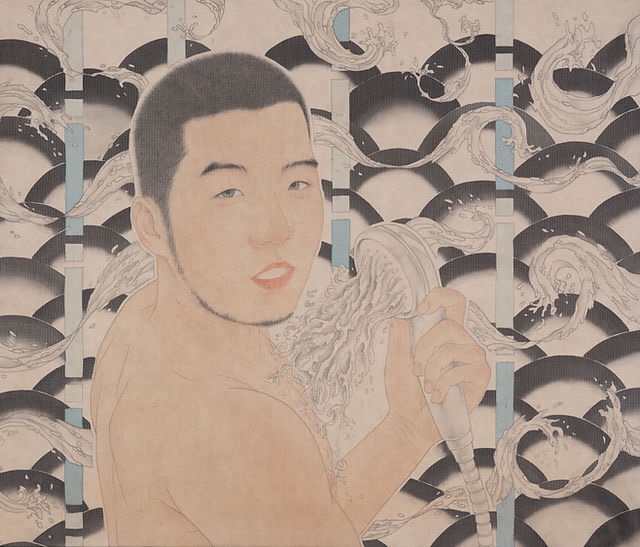
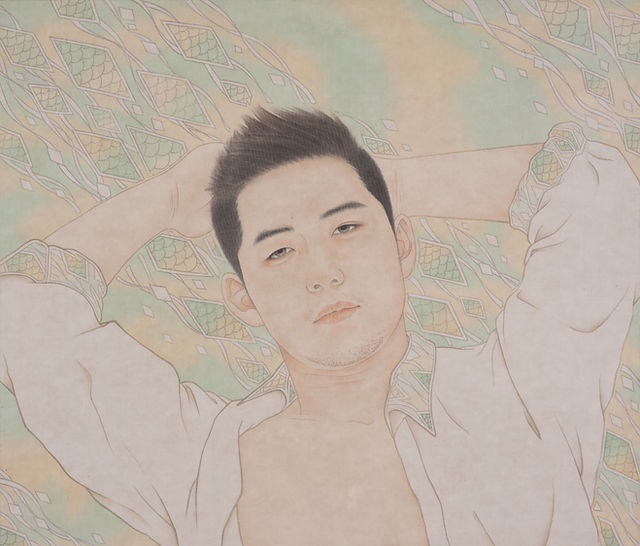
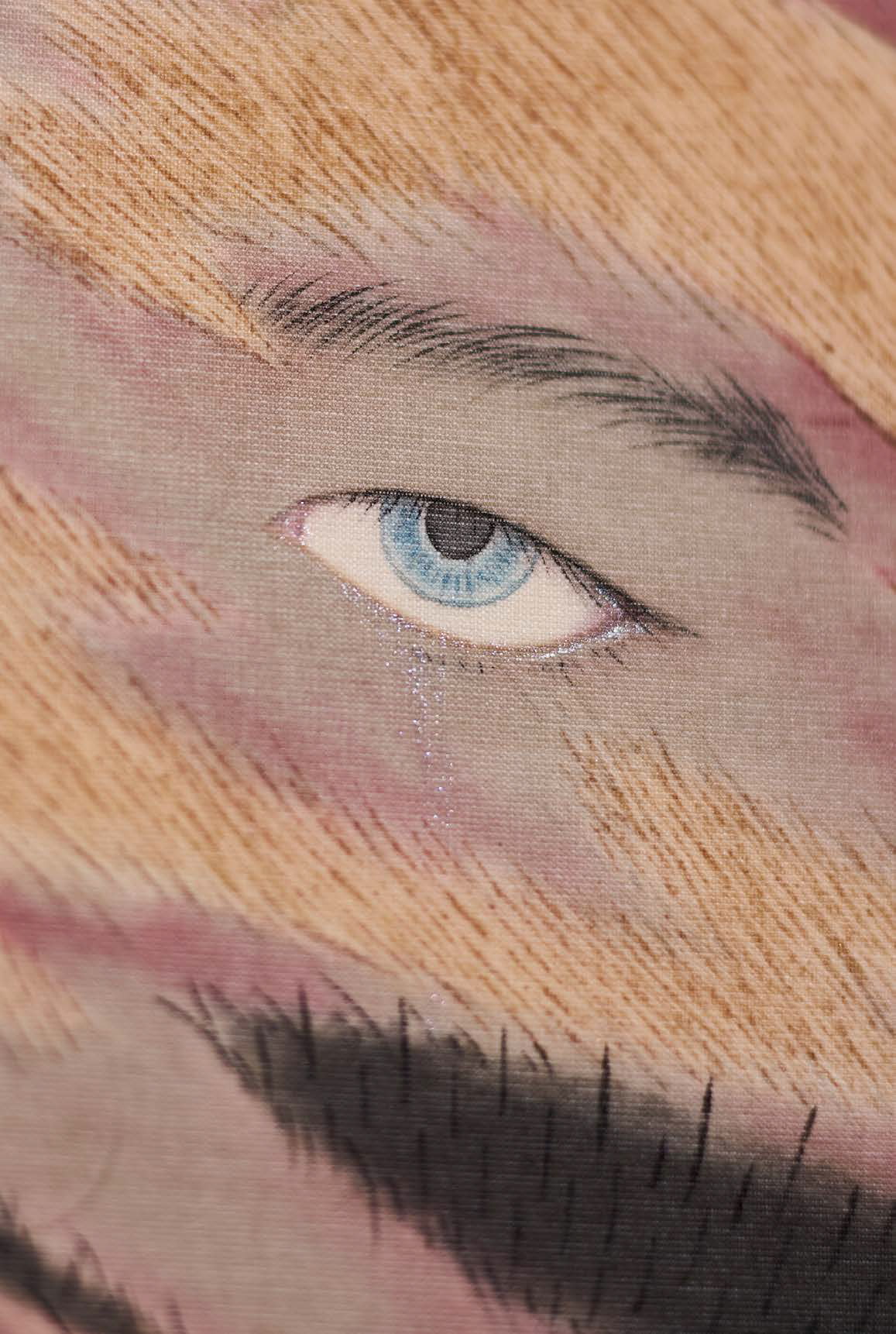
In
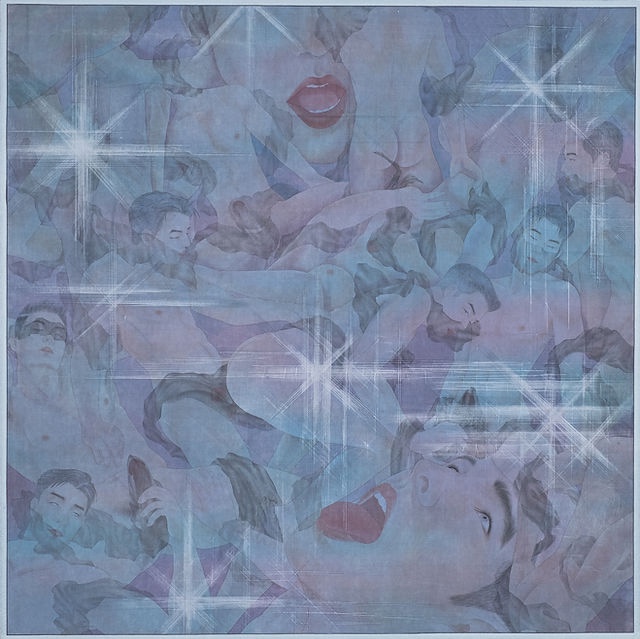
fact, it would not be an exaggeration to say that all of Grim Park’s works are
related to homosexuality. Because of the specificity of this subject, there is
the potential for certain (e.g., heterosexual) viewers to feel alienated or
resistant. Indeed, such reactions do occur. Nevertheless, Park’s works
transcend the boundaries of that theme. What stands out most is the Zen
Buddhist metaphysical narrative that runs through his artistic worldview. Among
them, the most deeply explored motif is the Ten Ox-Herding
Pictures (Shimu-do or Simwoo-do), a series of illustrations
representing the ten stages of enlightenment in Zen practice.
The Simwoo-do depicts
a young herdboy setting out to find an ox, leading it home once discovered, and
ultimately transcending the distinction between self and other, reaching a
level of enlightenment so complete that he returns to the secular world to
share it. In Park’s own universe, the ox is replaced by the tiger. Through the
theme of Shimhodo (“Seeking the Tiger”), he follows a journey in
search of the tiger. The tiger’s salient features—its fierce expression, teeth,
limbs symbolizing genitals, and tail—are prominent. Its violence, cruelty,
desire, power, and overwhelming charisma symbolize the artist’s own
self-identification as the tiger: a being that receives care and love among
beautiful male bodhisattvas, yet one that is still young, weak, and endearing—non-threatening.
This duality is clearly expressed in the artist’s wish to be accepted by the
objects of his desire as an adorable, fragile creature.
In
the exhibition 《Sasa》(Gallery TTO), the artist placed the iconography of the eighth stage
of the Ten Ox-Herding Pictures, Inwoo Gumang (“both man and ox
forgotten”), at the center of the show. Inwoo Gumang represents “a
state in which not only the ox but even the self is forgotten—depicted as an
empty circle. Once the objectified ox is forgotten, the subject (the boy) no
longer exists either. This state, prior to the dualism of subject and object,
is the moment of complete enlightenment.”² From this, we understand that the
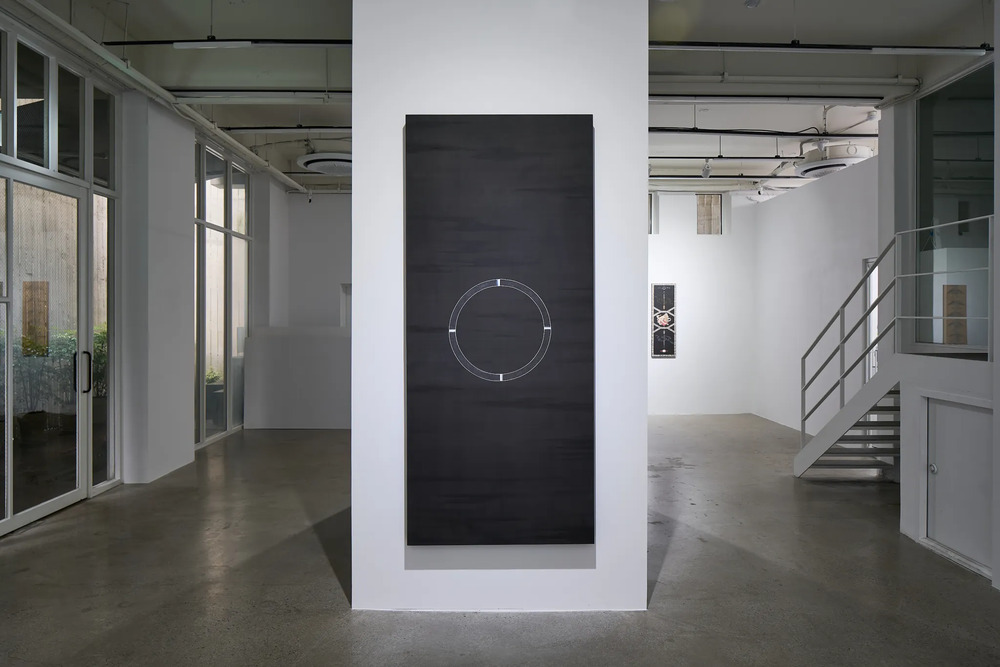
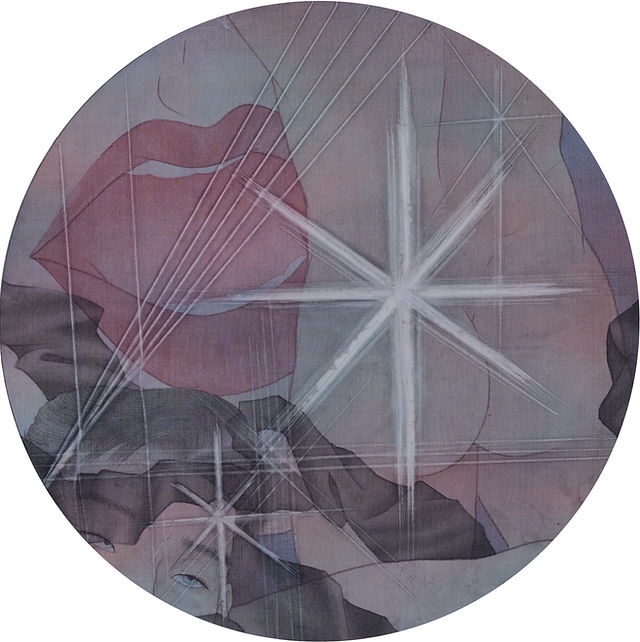
four circular paintings
titled Hui ("Return") shown in the
exhibition symbolize the essence of Inwoo Gumang.
The
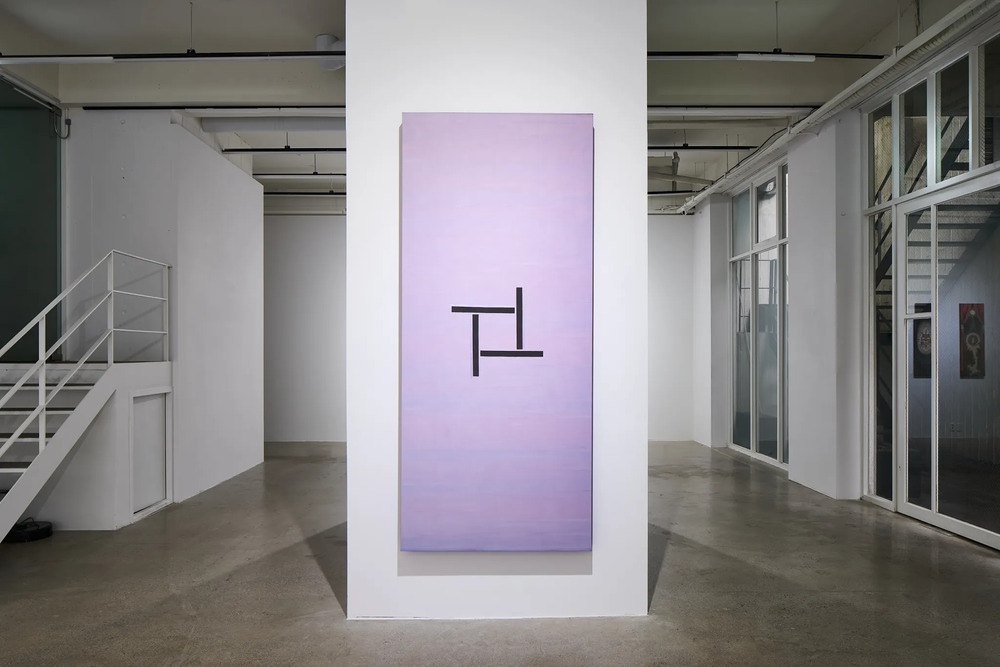
artist’s teacher gave him the pen name Jeongwol (井月), meaning “Moon in the Well.” The image evokes the reflection of
the moon in a small well. Park transforms the character for “well” (井) into a symbol resembling an endlessly turning wheel or the
Buddhist swastika (卍), naming
it Wheel (Ryun 輪). On
the opposite side, he depicts a circle made of four arcs and titles
it Return (Hui 回).
The compound “輪回” (transmigration
or metempsychosis) denotes the infinite repetition and intersection of spatiotemporal
events—a foundational concept in Buddhist cosmology. What prompts Grim Park to
link his identity to this worldview?
Solipsism
is a doctrine in which the self is considered the center or vanishing point of
the world. While such an idea could be dismissed as egocentric, it lies at the
core of self-perception for all beings. The quintessential solipsist artist is
Marcel Duchamp. His work The Bride Stripped Bare by Her Bachelors, Even
(La mariée mise à nue par ses célibataires, même), which can be interpreted as
“The Bride Loves Only Me,” is a definitive statement of solipsistic thought.
When
Grim Park discusses his queer identity and the dualism of narcissism and
self-hatred, or when he portrays the birth and growth of the tiger—a stand-in
avatar of himself—what we witness is a unique variation of solipsism. The
universe is built around the self. The disappearance of the self implies the
end of the universe. Within this passive-active world, the artist contemplates
the self and its history, expanding into a transcendental narrative. Even his
mother, within this mythos, is depicted as the Virgin Mary, Mary Magdalene,
Avalokiteśvara (the Bodhisattva of
Compassion), and Kṣitigarbha
(the Bodhisattva who severs karmic cycles)—all embodiments of benevolent
compassion.
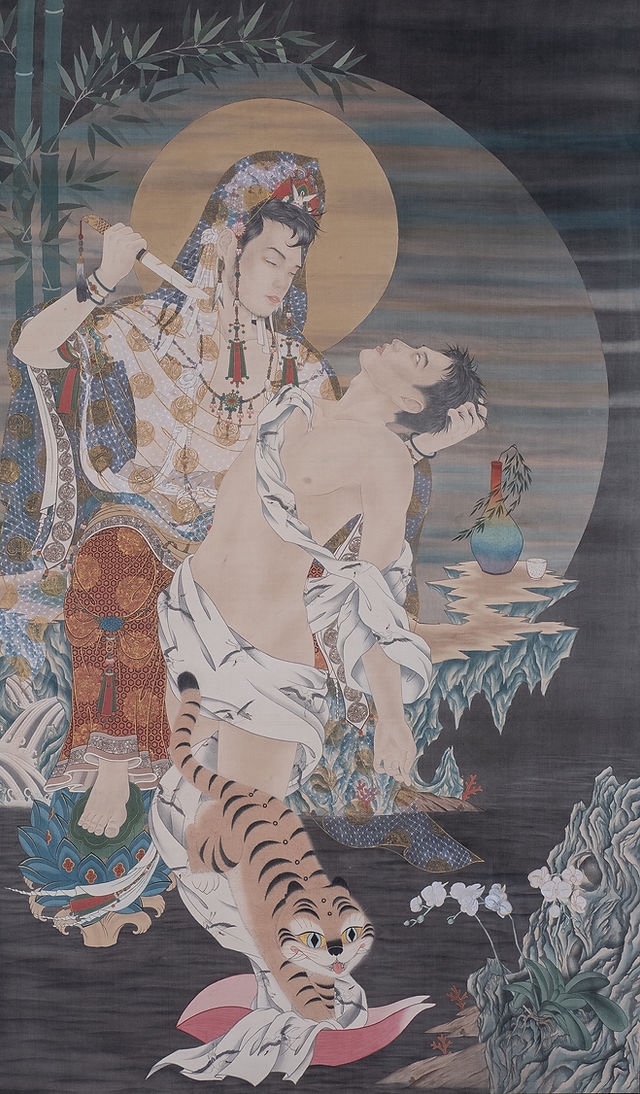
The
painting Shimhodo - Spring Water(2022) is composed in a
triptych format reminiscent of Renaissance painting. It is one of Park’s rare
works featuring women as central subjects. The figures can be interpreted as
women of various ages representing the artist’s mother, as well as his sisters.
Still, all three seem to symbolically encapsulate his mother. The young woman
on the left cradles a baby tiger, the central older woman with a golden halo
sits on a lotus flower holding a nude adult male, and on the right, a maturing
tiger boy leans on a more mature female figure. The temporal flow and narrative
progression are evident.
This
large-scale painting, measuring 250×340cm, not only adopts the
traditional Pietà composition but also shows how the artist’s self
and its development parallels the transcendental sublimation of a Christian
subject. The astounding emotional projection toward his mother is reminiscent
of Roland Barthes—who was also homosexual—expressing his trans-temporal
attachment to his mother in Camera Lucida. This work, overlapping themes
of salvation and agape love with Park’s fated identity, offers a critical turning
point for understanding his work from a new dimension.
Inwoo
Gumang encapsulates the solipsistic reflection on the self, the Buddhist
doctrine of self-effacement, the ambivalent emotions toward an inescapable
identity rooted in endless suffering and wandering, and the unresolved question
of how to mediate the relationship between self and world. At the bottom of all
this lies the yearning to arrive at Inwoo Gumang.
Regarding
the two instances of the word “sa” (사, 四四) in the title 《Sasa》, exhibition curator Hyukkyu Kwon wrote in the preface: “Facing each
other, repetition, and rewriting all pass through sasa (師事, to learn from a master), as well as sa (辭, to reject), sa (死, death),
and sa (些, something trivial).” According to
the artist, the title also refers to sasa (賜死,
bestowal of death), where a king grants death to his subject, and to the memory
of his own early apprenticeship (sasa 師事) under a
master of Goryeo Buddhist painting. The binary structures of birth and death,
transcendence and embodiment, warmth and coldness, purity and desire,
narcissism and self-hatred, reincarnation and return are consistently repeated
throughout Park’s paintings. It is perhaps reasonable to
interpret Sasa as signifying “a second death.” This refers to the
acceptance of death through individual birth, and the overlapping narrative of
the self’s dissolution and resurrection through the learning of Buddhist
painting. The artist’s work invites deeper analysis through its multilayered
symbolism, ambiguous wordplay, and systematic use of iconography.
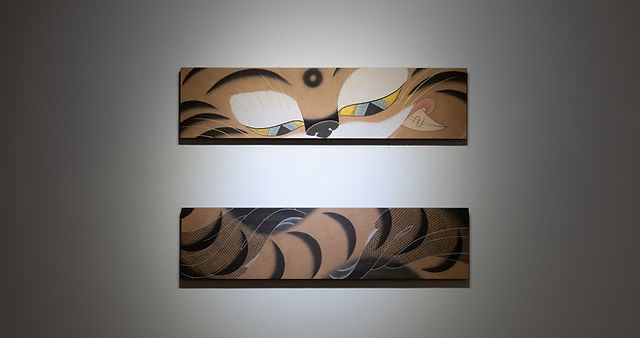
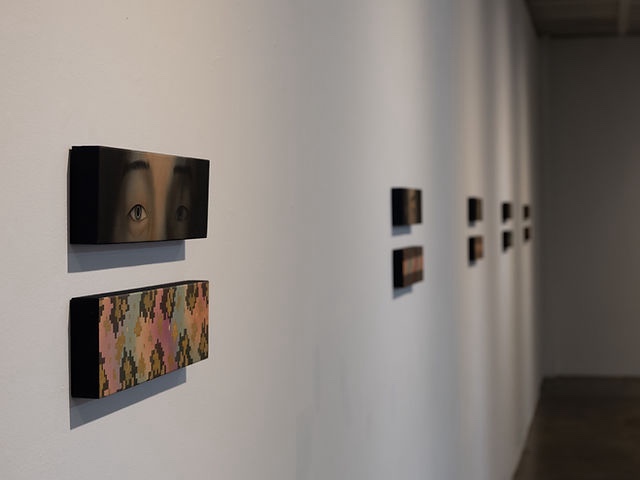
Among
the new works presented in the 《Sasa》 exhibition are eight vertically formatted paintings, each measuring
120×40cm. These are displayed in two groups of four and titled with enigmatic
names such as Enigma (我謎), Double
Selection (二揀), Spring Canopy (春蓋), No Two (無二),
and on the opposite wall, Solar Drama (日劇), Tiger
Flow (虎流), No Tail (無尾), and Lunar Drama (月劇). The central narrative of this series revolves around
the birth and growth of the “tiger,” which functions as the artist’s avatar.
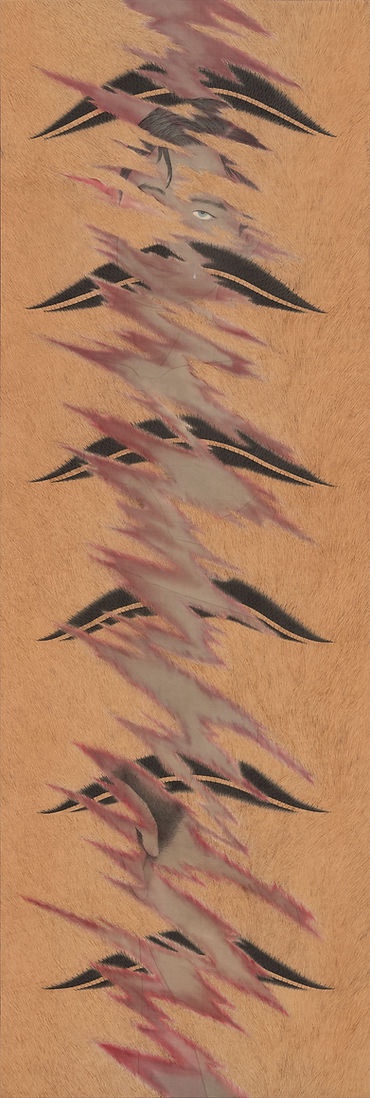
In Enigma, the tiger’s skin is torn open to reveal the
artist’s own body beneath. In Double Selection, two
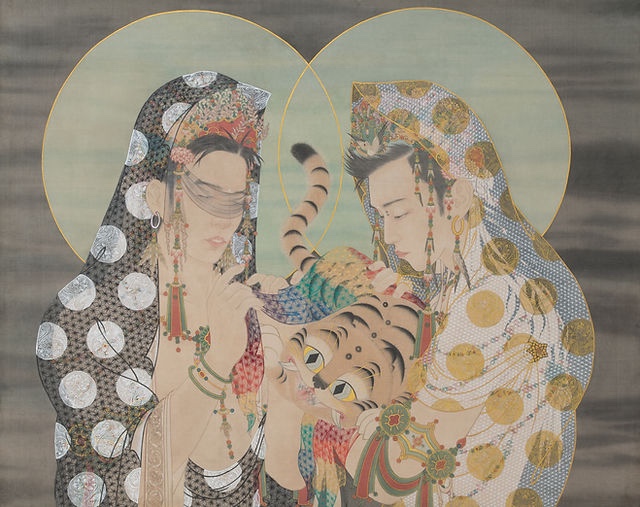
male Avalokiteśvaras—recurring figures in Park’s work—tend to a young tiger while
blindfolded. Spring Canopy features a symmetrical, vertically mirrored drapery and a moth
orchid engulfed in flames beneath it. In No
Two, two tridents from above and below are pointed at the fallen
artist, while a young tiger devours his heart. The symbols for “wheel”
(ryun 輪) and a moth orchid are
engraved at the top and bottom, respectively.
On
the opposite wall, Solar Drama shows warm fluid
gushing from the tail of a young tiger emerging from behind red curtains,
flooding the surrounding space. Tiger Flow depicts
a young tiger emerging from a womb, surrounded by blossoming orchids.
In No Tail, the tiger’s tail is sliced by a vertical
beam of light resembling a blade, while a vanished man’s helmet floats in
midair. Finally, Lunar Drama mirrors Solar
Drama—a cold fluid instead of warm gushes from the tiger’s tail,
emerging between white curtains and freezing the space around it. The symbolism
of these motifs is relatively clear. The young tiger, as the artist’s ideal
self, is his “alter ego” that must be tamed and led, just like the ox in
the Ten Ox-Herding Pictures. Like the ox, the tiger is stubborn and
difficult to control, yet evokes various passions and attachments.
The
Avalokiteśvaras are both the artist’s objects of admiration and
inaccessible beings. The tiger’s tail symbolizes the phallus, and the semen-like liquid gushing
from it—warm or
cold—embodies
both heat and chill. This binary worldview forms the foundational structure of
Park’s
painting. The moth orchid represents the anus, a central motif in gay
sexuality. In Spring Canopy,
a flame-engulfed orchid is visible beneath a beautifully adorned canopy. The
phallus seen underneath hints at latent erotic allure that spans the queer
universe.
What
makes Grim Park’s pictorial narrative compelling is that it reflects a person’s
growth and the search for identity—and the arduous struggle (guto, 苦鬪) involved in that search—while also being visually astonishing in
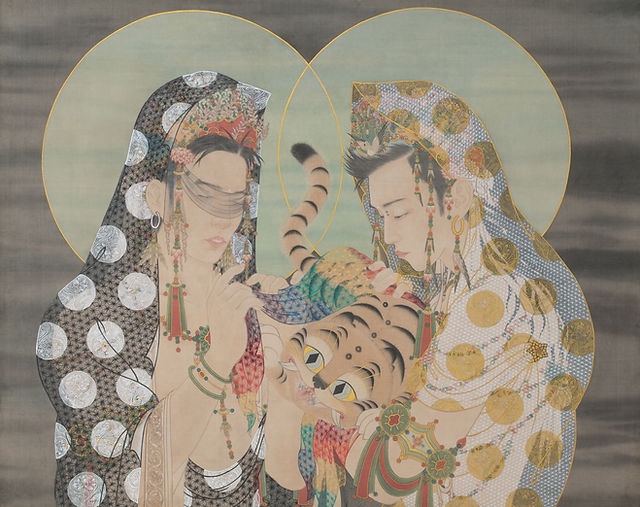
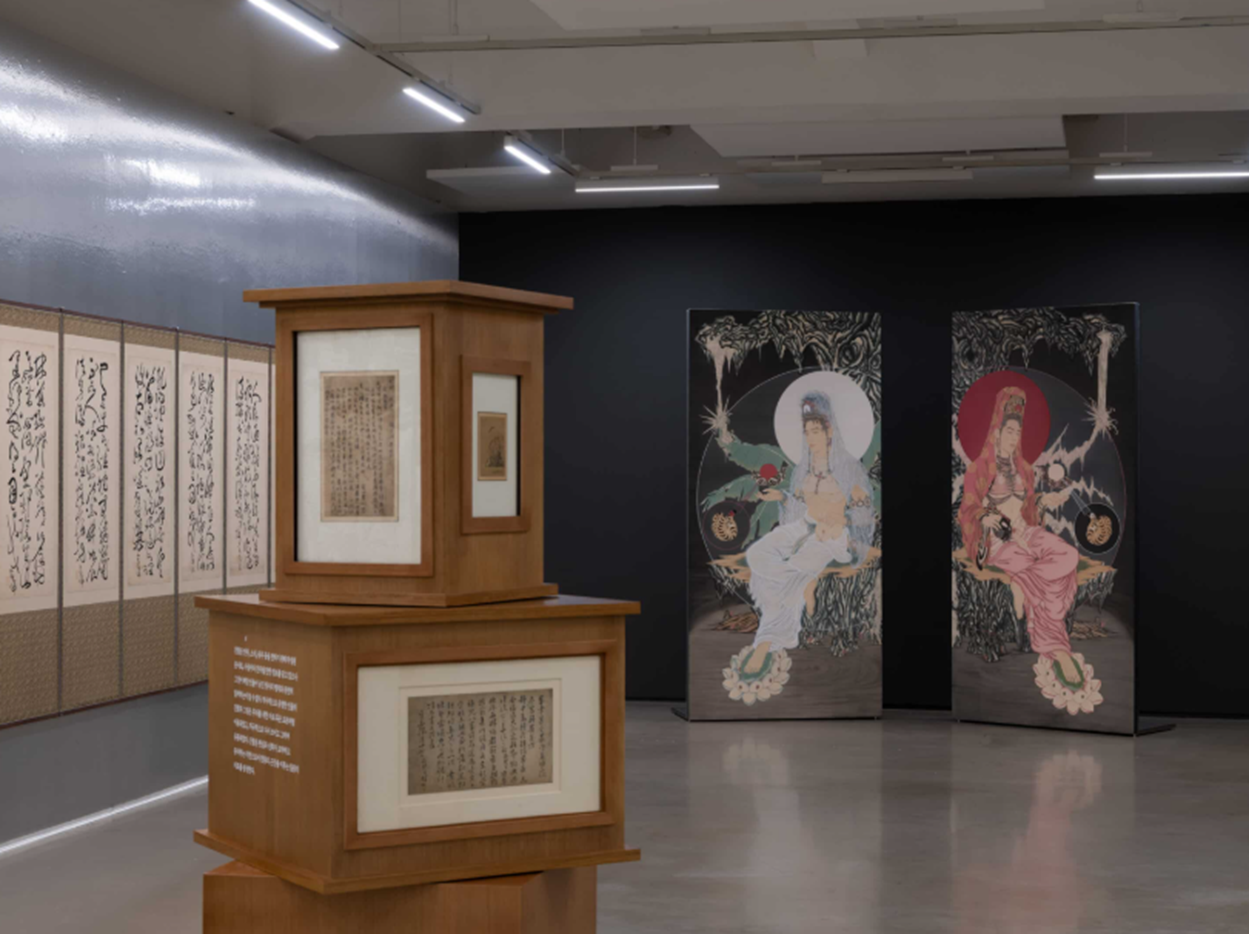
its beauty. Shimhodo -
Sunlight and Shimhodo -
Moonlight are double-sided portraits featuring two beautiful
male bodhisattvas facing each other. As in Goryeo Buddhist painting, they are
surrounded by various ornaments and objects, seated within large halos emitting
golden auras. Against a deep black background, the dazzling colors and gilded
hues create overwhelming iconography. One bodhisattva, radiant with warmth in a
cold world; the other, harboring chill in a warm world—each sits gracefully in
opposition. Between them, a tiger cub—resembling a fetus—floats in midair, born
once (or twice) from these bodhisattvas. This icon encapsulates all the
variations currently unfolding in Grim Park’s work. Looking at these dizzying
paintings, one can’t help but wonder what kind of new worldview awaits in the
next phase of this artist now approaching his late 30s.
*This
article is a special contribution to the “2024 Korean Art Criticism Support”
project by the Korea Arts Management Service.