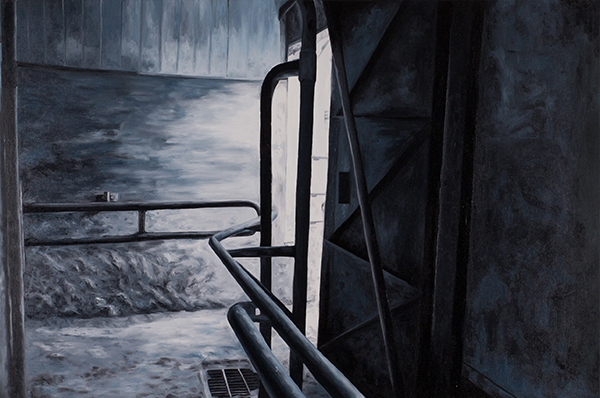
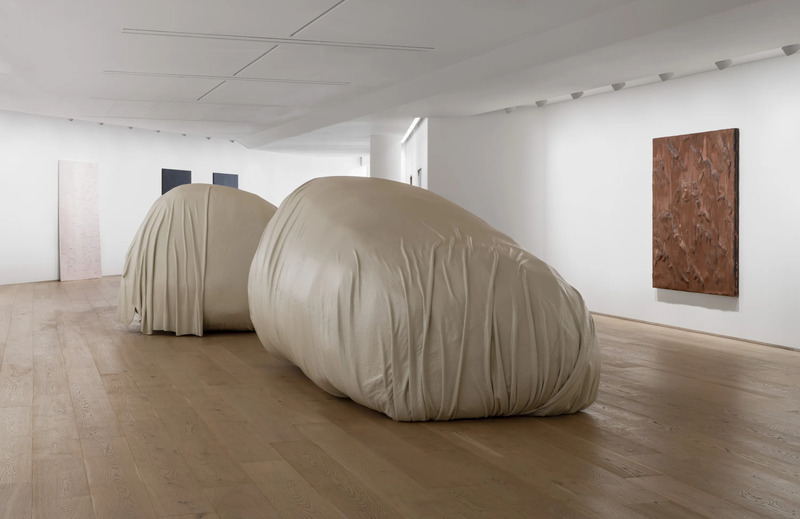
The
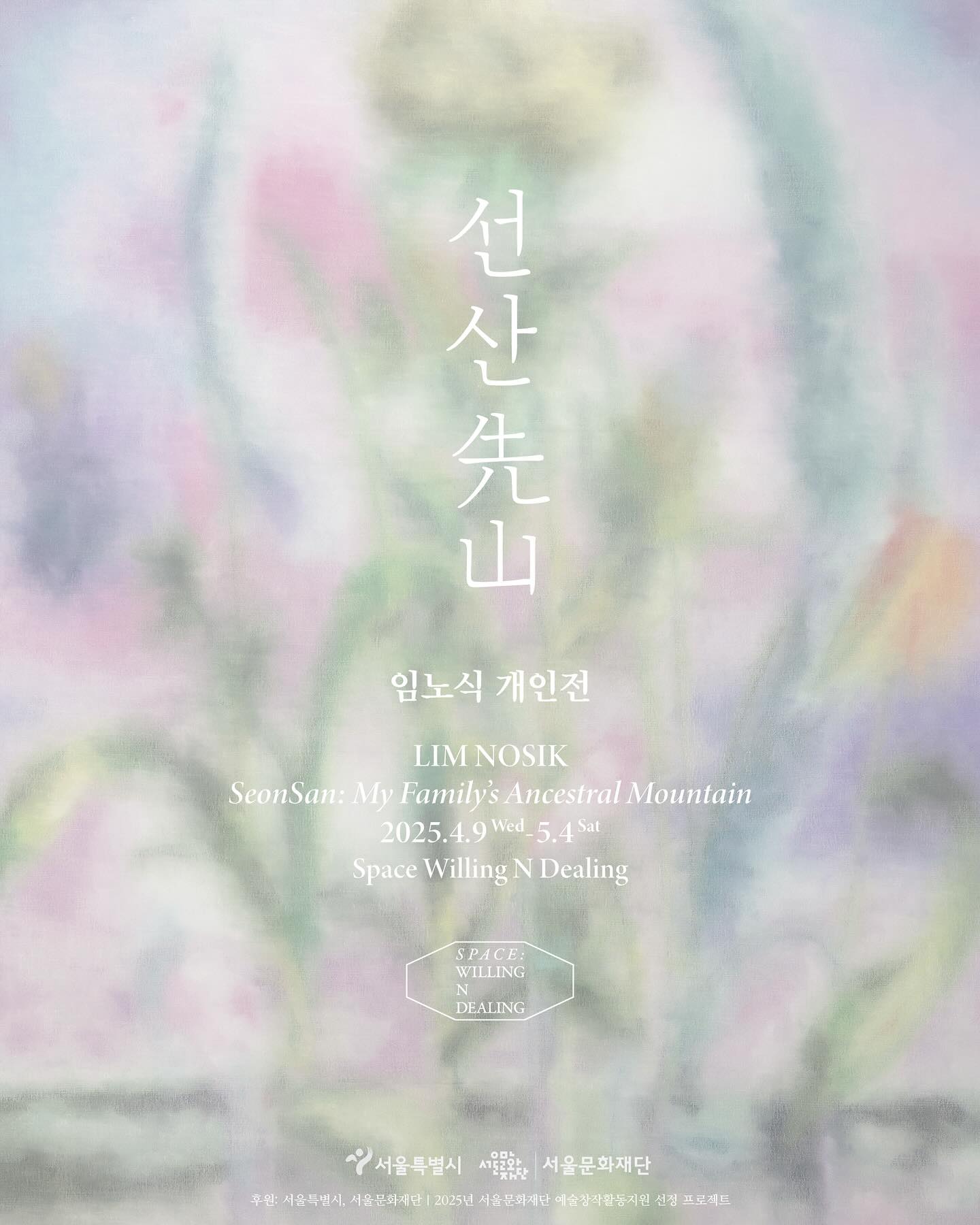
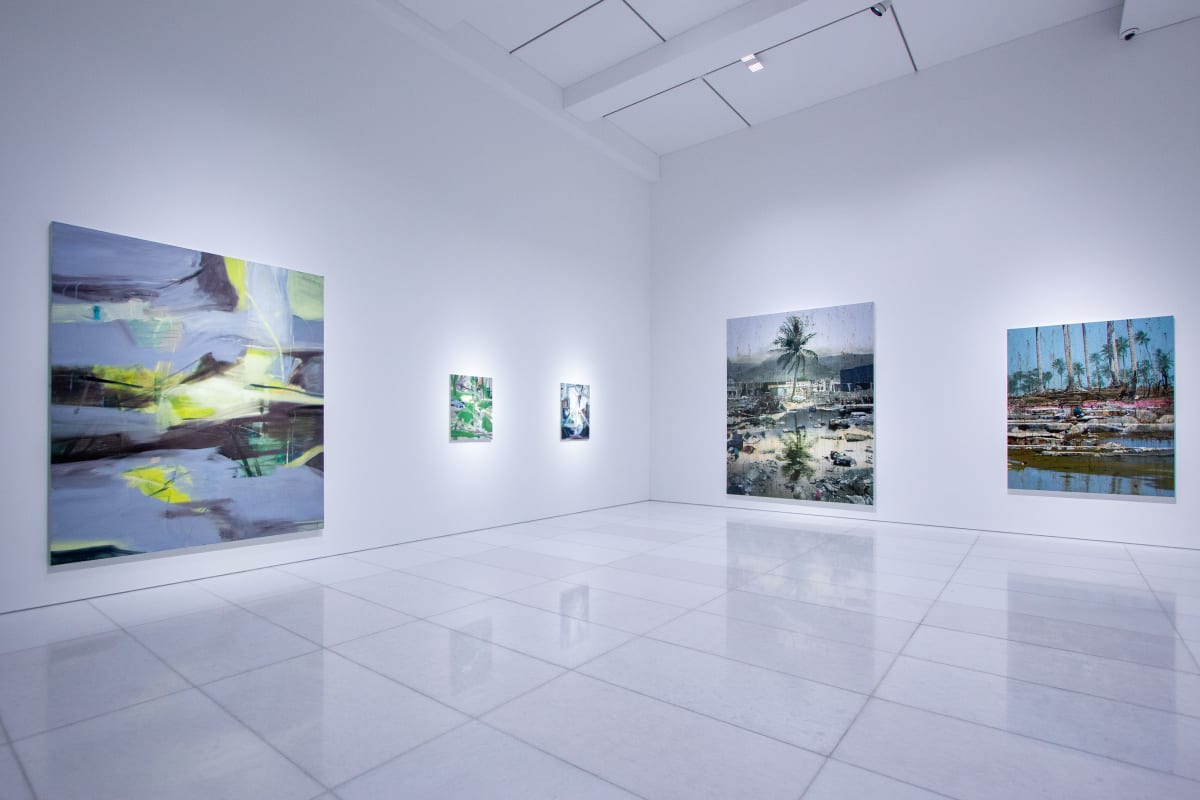
young painter Nosik Lim presents his solo exhibition SeonSan(April
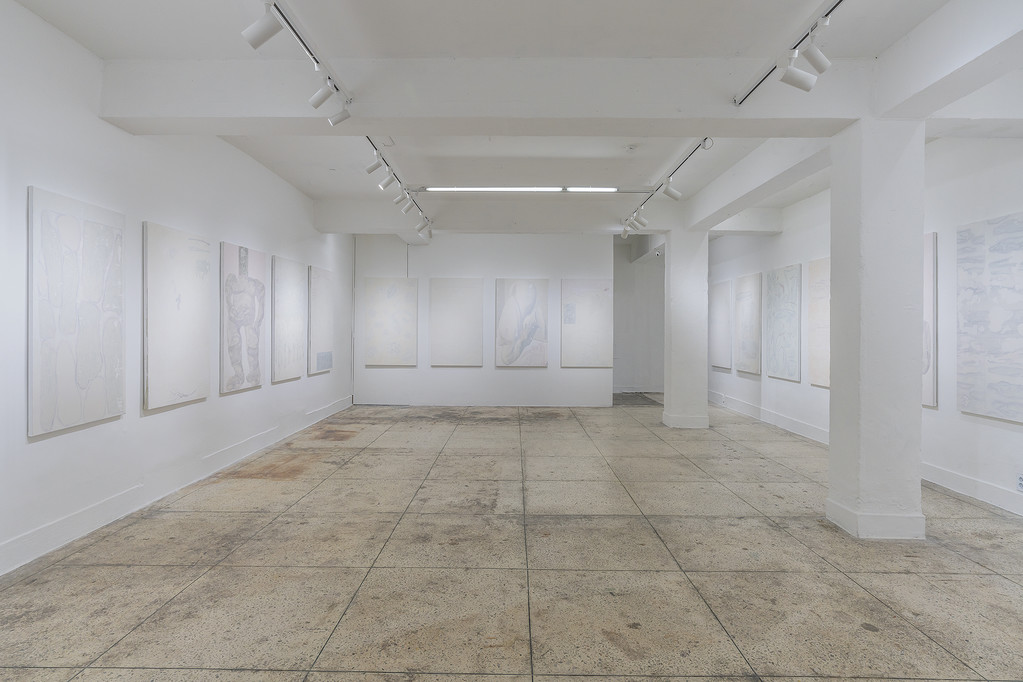
9 – May 4). The exhibition showcases 17 new paintings set against the backdrop
of Seonsan, the ancestral mountain in Yeoju where his family graves lie. Lim’s
painting practice has always begun with Seonsan—the land where he was born and
raised, and where his family’s burial grounds remain. The artist frequently
traveled to Seonsan on weekends to help his parents with farming and to collect
scenes that would later become the seeds of his works. Seonsan serves as a
hometown not only for Lim but for his works themselves. However, while
nostalgia may be a point of departure, it is not the essence.
“For
some, the rural village may seem stagnant, but to me, the countryside is
undeniably a generative space. Over the past 30 years, Yeoju has changed
ceaselessly. Mountains were cut down, people disappeared, and foreign laborers
filled the void. It wasn’t merely buildings rising and falling, but the terrain
and people themselves undergoing upheaval. That’s what moved me.”
Layering of Memory, Blurring of Landscape
Nosik
Lim did not always paint by blurring forms. From his first solo
exhibition Landscape Seen from Inside(OCI Museum of
Art, 2016) to Skipping Stones(Art Space Boan2, 2020),
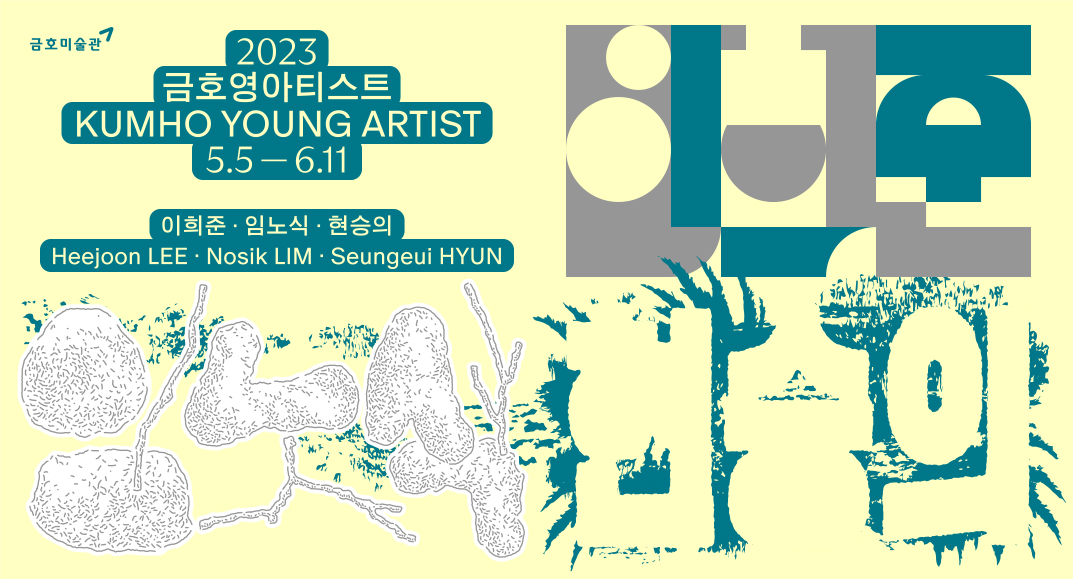
he depicted subjects with clarity. Even in Deep Line(Kumho
Museum of Art, 2023), although he erased parts of the image, he never strayed
from the boundaries of representation. His current painting style fully emerged
with the solo exhibition The Place Where Shadows Stay(Space
After, 2024).
“Nature
is not a fixed form but a continuously shifting flow of vitality.”
As long as beings exist, they change; as long as they change, they lie beyond
fixed forms. With this realization, Lim made “air” the subject of his paintings
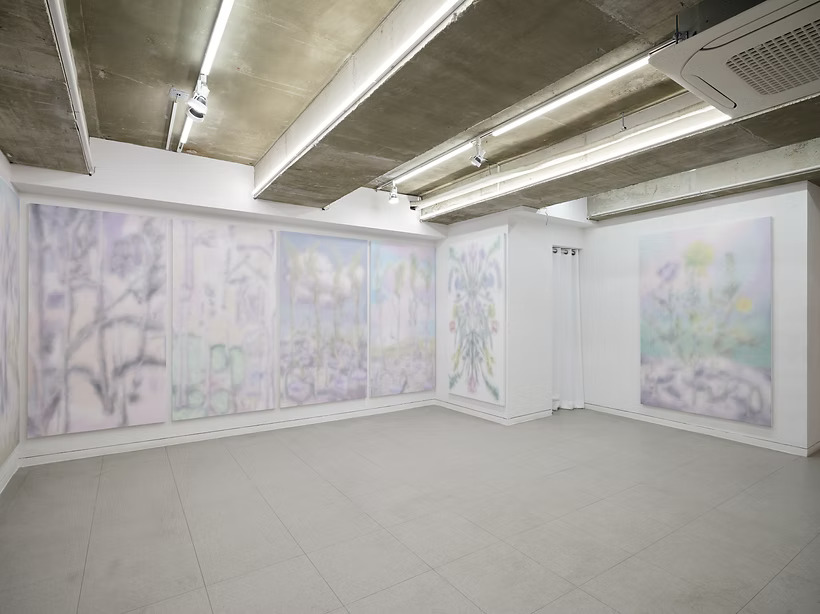
in last year’s solo exhibition. He layered transparent colored pencils and
transparent oil pastels repeatedly over brushstrokes, depicting the air that
floats between beings, between spaces.
In SeonSan,
Lim undertakes another transformation. The method of layering transparent
colors to “paint air” has shifted to the act of erasing forms with transparent
colors, leaving behind “space.”
“At the time, I thought I was painting air, but in fact, I was erasing. When
the subject vanishes, the existence of ‘me’ as the painter disappears too. In
the end, only space remains.”
The space evoked through erasure condenses into a single sentence that
permeates Lim’s artistic world:
“Absence is existence.”
This proposition takes concrete form through three levels in Lim’s paintings.
First,
the act of erasing forms simultaneously eliminates the subject and reveals an
essence that cannot disappear. Erasure does not obliterate everything. On the
contrary, what remains after being erased—the single, unerasable core that
survives all change—is what the artist calls “space.” In Yeoju, a place of
constant upheaval, Lim erased Seonsan to leave behind its “core.”
Second,
the artist removes the distance between subject and object to create a
generative space. If a landscape is a target of gaze observed from the outside,
space is an experiential field one enters and senses with the body.
“My goal wasn’t to compress and capture vast landscapes but to depict spaces
into which one can fully enter.”
It is an experience born from the body traversing nature, beyond mere looking.
But how is this experience possible? The artist presents as an answer: “a
unique perspective that eliminates the distinction between foreground and
background.” Perspective depends on distance. As the body moves, the distance
between subject and object constantly changes. Whenever Lim went out to sketch,
he walked the fields, shifting his gaze, collecting fragments of landscape. On
the canvas, figures, vegetation, sky, and earth overlap with equal
density—there is no focal point, no center. This composition reveals not the
perspective of an external observer, but that of an insider who passes through space
and experiences it. The moving body continuously encounters nature in its
ever-changing state. At the point where these flows meet, the sensation of
generation emerges.
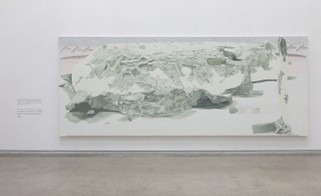
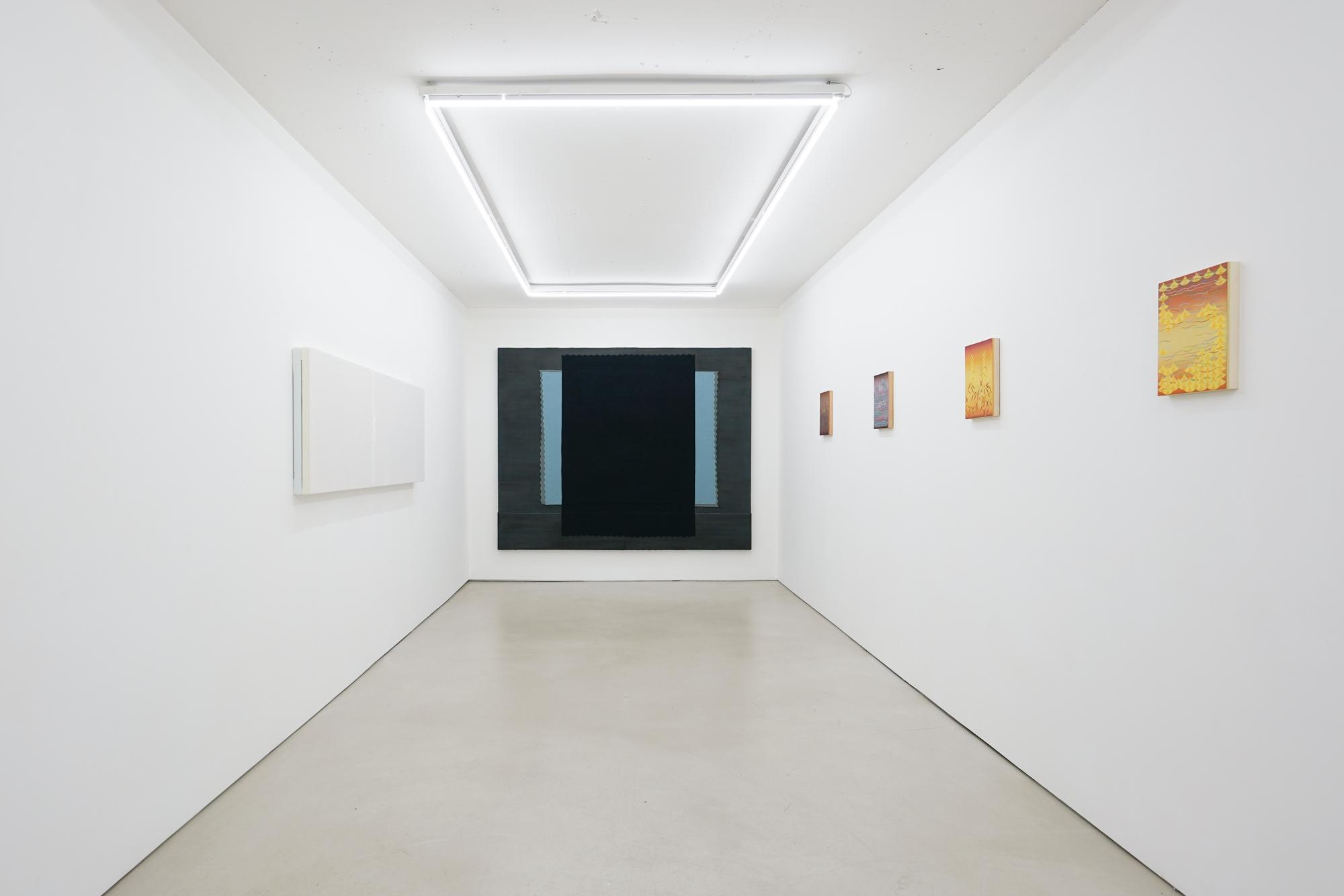
The
experience of space extends to the viewing method of the SeonSan exhibition.
The works are densely hung along the gallery walls at the same height,
functioning as a panoramic whole. Viewers feel as though, like Lim entering the
landscape, they are entering the “place” constructed by the paintings. The
walls transform into grand nature, and viewers walk within it, experiencing
nature firsthand.
Third,
the artist projects existence onto the “absence of form.” Though Nosik Lim
majored in traditional Korean painting, he does not directly reference
traditional formats or motifs. Nevertheless, his paintings evoke “baechae (背彩),” the technique of applying color to the back of paper so it seeps
through to the front. Similarly, Lim’s surfaces are not constructed upon the
exterior of the landscape but with sensations that seep outward from within.
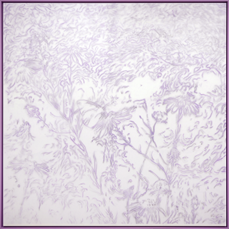
The artist first renders the subject in detail, then completes the canvas by
rubbing, erasing, and blurring the form. What remains in the place of erased
forms are mere traces, but the blank spaces draw in even more stories.
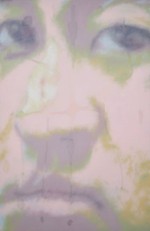
We
can insert any face into the hazy mist—faces that were, that are, or that will
be in the fields.
Opacity,
paradoxically, allows for infinite projection and association. The “life” of
space—traversing past, present, and future—permeates the canvas surface.
“When I strip away the form, color, space, and people naturally flow in. Maybe
I’m not the one painting—perhaps the space left behind calls something in….”