Kim
Shinrok × Son Hyunseon’s Absent Time ultimately
pursues the medium of theater. This is possible because Kim Shinrok accepts Son
Hyunseon’s work as a task, and as a result, the work is incorporated into the
present as a backdrop or object that organically connects with existence. How Son
Hyunseon’s works, which ‘cast themselves’ upon the stage, are treated, and how
they are included within the world of the play, determines whether they
function as pure backgrounds or as imperfect points of departure. The fact that
they emerge somewhat awkwardly, rather than seamlessly, reveals not the
impossibility of collaboration but certainly the difficulties inherent in it.
The
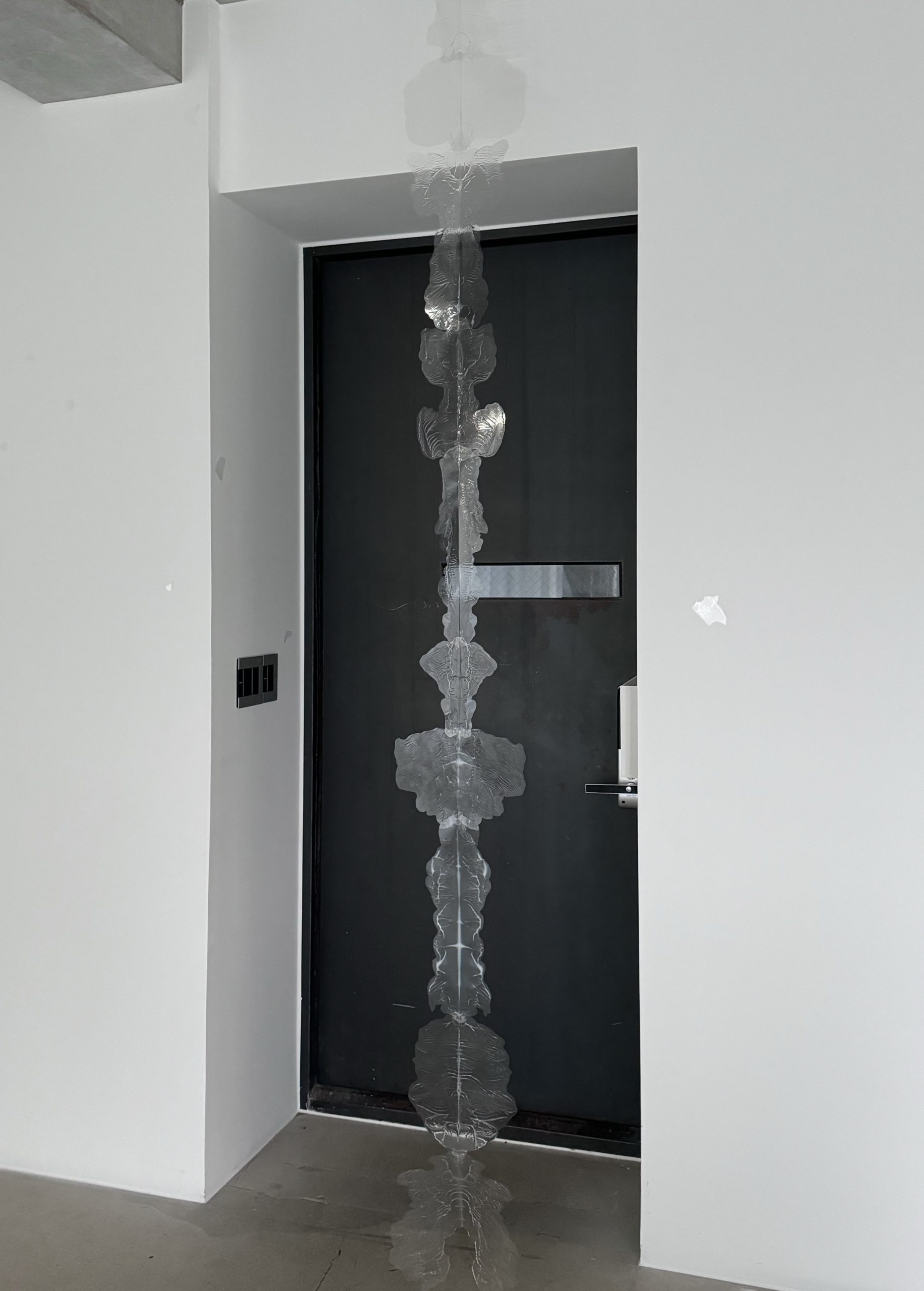
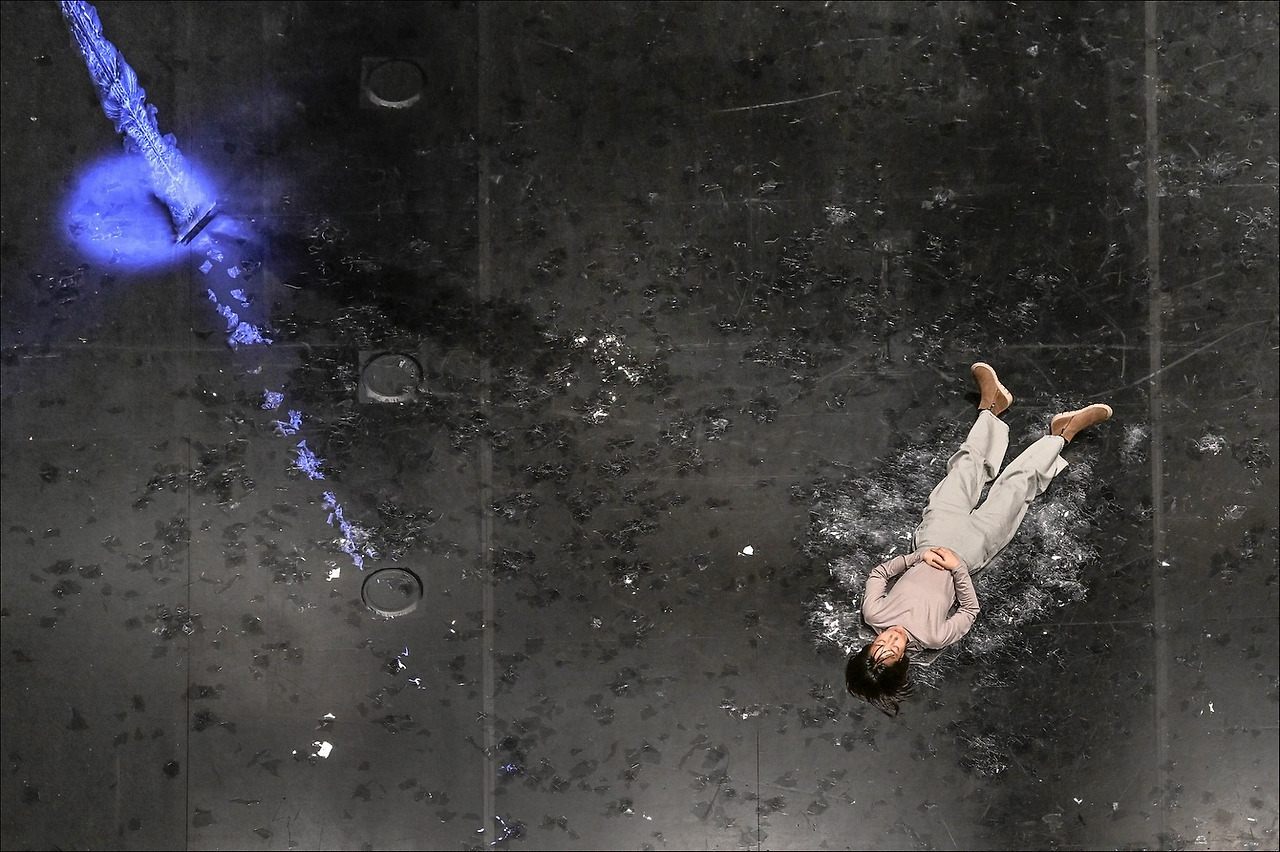
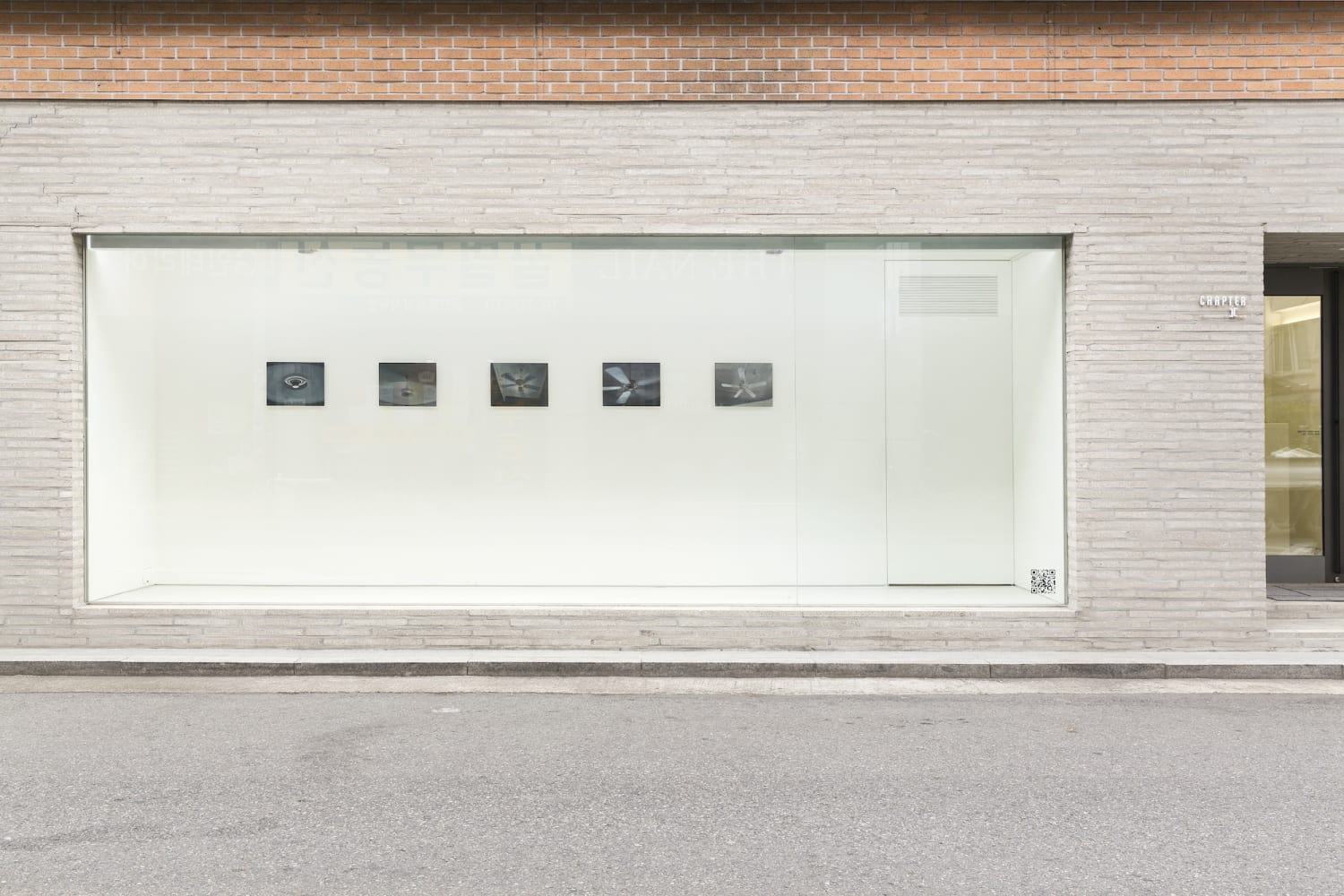
text regarding Transparent-Body (gel medium on
transparent film, 2024, dimensions variable) reads more like an abstract poem
at first, which seems intended to converge, to some degree, with the recursive
nature of the artwork itself. Standing before Transparent-Body,
Kim Shinrok’s narration refers to the ‘transparent’ integration of their own
body, and ultimately, the body that exists as a translation, explanation, or
expression of Transparent-Body concludes with the
utterance of the artwork’s caption information, as if the body is absorbed back
into Transparent-Body, acting as its proxy or
substitute. In short, it erases the distance between Transparent-Body and
the body, treating the body itself as if it were transparent.
While
this could be considered a gesture of respect and a performative homage to the
work, it also takes on a peculiar dimension. Since this is expressed through
spoken text, the final utterance of the caption, “Kim Shinrok,” should replace
the conclusion. The notion that the artwork title has read itself is based, of
course, on Kim Shinrok’s ghostly presence—on Kim Shinrok becoming a ghost. To
be precise, the correct, complete caption should begin with “Son Hyunseon,” but
this is omitted. Is it an exaggeration to view this act of caption-reading as a
safeguard for establishing an equal footing in the collaboration?
If
the incomplete caption serves as a ritual to firmly distinguish Son Hyunseon’s
work as “artwork,” then perhaps the absent names “Kim Shinrok” and “Son
Hyunseon” are excluded to avoid transgressing the boundaries of Absent
Time. Nevertheless, could this omission be the decisive clue
revealing that it is not Son Hyunseon’s work or Kim Shinrok’s theater that
constitute the artwork, but rather Son Hyunseon and Kim Shinrok themselves who
have become the artwork? Rather than the work itself, is the context
surrounding this project perhaps inclined toward the star-like presence of “Kim
Shinrok”? What matters, therefore, is evaluating Kim Shinrok’s trajectory as an
artist and creator—what path they have walked, and what significance this work
holds within that trajectory. As stated at the outset, Absent
Time extends into the stage as Kim Shinrok’s theatrical
platform, with Son Hyunseon’s work accepted as a task to be carried. Even if
Son Hyunseon’s works are decisive, it is Kim Shinrok who ultimately extends
them purely into performance.
Transparent-Body appears
once more at the end to close the play, but it is not strictly connected to the
theatrical narrative. The textual purity of Transparent-Body is
preserved. It does not seamlessly blend with the rest. What occupies the
middle—what takes up most of the duration—is the decisive text of playwright
Kim Yeonjae. Is that text itself titled Absent Time? Or
has this collaboration merely circled around a promotional model typical of
contemporary art? The play’s text is fragmented and treated as such. It
disperses throughout the space, much like Son Hyunseon’s works are dispersed
across the theater, deriving from the performers’ actions. The absence of a
stage is decisive—it reveals the “absent time” of this theater.
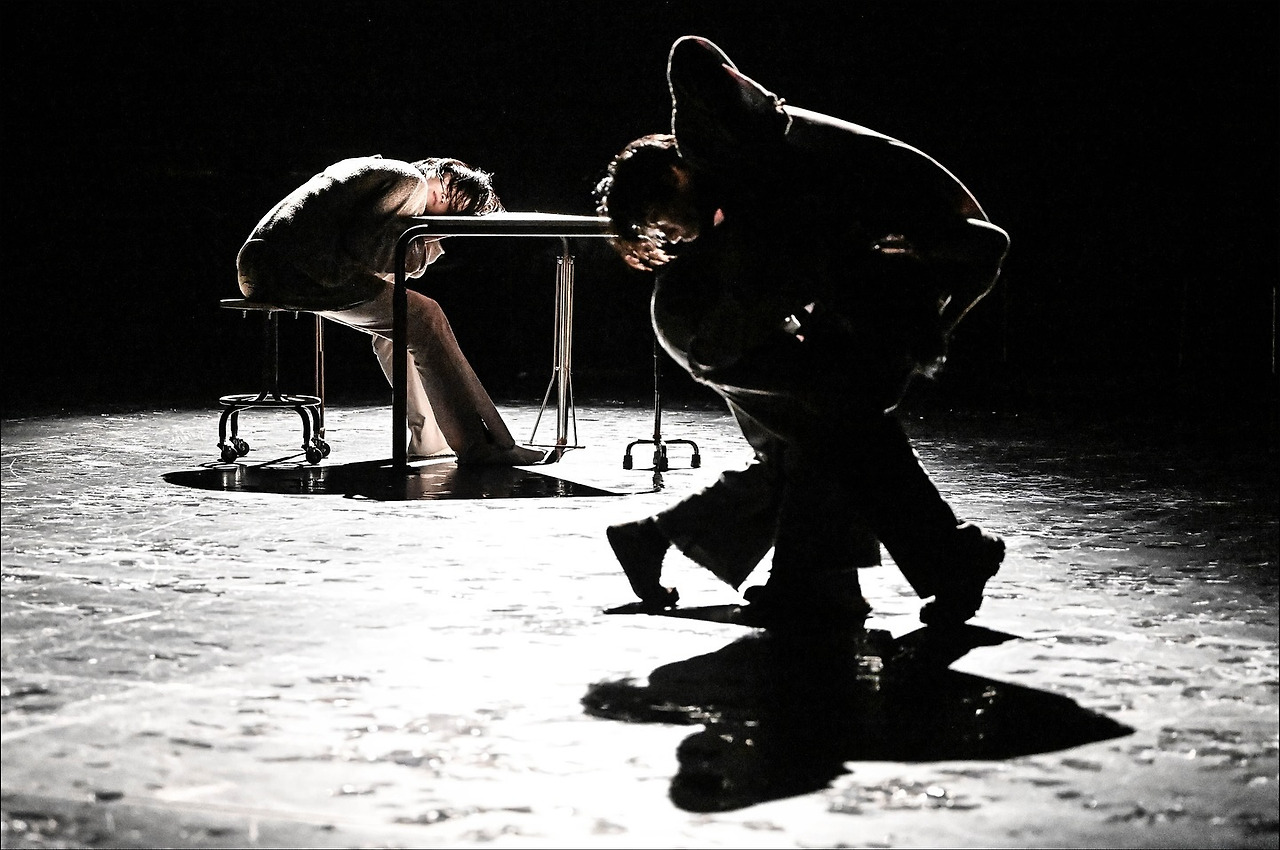
Rather than a
singular, constructed stage organizing the multilayered nature of the world,
the dispersed objects and the bodies wandering among them—filling the empty
spaces throughout the theater—become the stage. As the bodies act as
substitutes for the stage, Absent Time becomes,
true to its title, a time that erases itself, a time that witnesses its own
disappearance.
At
this point, closely handling the play's text itself does not seem particularly
crucial. Rather than purely implementing its content, the text exists as a kind
of appropriation to demonstrate how it is treated. If Son Hyunseon’s works are
the visible task, then Kim Yeonjae’s play becomes the invisible task. That task
functions as a kind of proof regarding the actor, regarding the very nature of
performance itself.
This
can be summarized into a few techniques: speech that follows a simulation where
words are thrown slowly toward a distant space, speaking methods that result
from a sharp balancing act between bodily relaxation and extension, the
concretization of speech through non-ordinary vocabulary expressed as
utterances—all these elements come into play. Though labeled under the
director’s domain, Kim Shinrok appears to occupy an ambiguous or faintly drawn
position as an expanded actor, who prioritizes testing their own performative
domain by incorporating differences in each actor's share of responsibility.
Broadly
speaking, the characters seem to share a deep layer of time, a stratum of old
memories, and as this disperses throughout the space, vague correlations of
different relationships are physically enacted. (One might wonder whether this
fragmentation originates from an inherently dispersed text, or whether it
results from intentionally fragmenting the text for spatial dispersion.) Direct
connections emerge as tightly interwoven interactions between bodies, forming a
stark contrast to the otherwise diffused relationships. These memories are
presented through leaps in time, and while actor Jo Yeonhee, who appears first,
struggles with the confusion of rapid temporal compression, those unaware of
the time shift maintain their presence in the past. Notably, the present state
of the child version of Kim Shinrok incorporates the identity of the child,
adding a unique resonance to Kim Shinrok’s otherness, which reverberates
peculiarly across all the characters.
The
rough narrative—where the wife, who suffered violence from the dog seller,
turns out to be Kim Shinrok’s friend, and upon discovering this, Kim Shinrok
kills the dog seller, who had always seduced and clung to her, and joins her
friend—is not conveyed with clarity. Fiction, by being witnessed directly in
front of one’s eyes, asserts its fictionality as the viewer’s domain—the fourth
wall is so close and distinct that it seems to replace the content altogether.
In other words, the fragments of narrative unfold less through development and
more through physical imprinting, quickly disappearing as each character's
portion of responsibility is treated and performed.