In
the mid-1990s, when I thought KBS, MBC, SBS, and EBS were about the only
broadcasting stations in the world, the instructor of a university survey
course titled "New Media and Contemporary Society" explained the
concept of VOD in their lecture and said that, in the future, people will enjoy
a different level of freedom in choosing what video content to watch and when
to watch it. Since this was when we had to sit in front of the television set
at scheduled times and record programs on videotapes to watch them again, the
words Video on Demand did sound quite fantastical. A flood of successive
changes later; now with cable television, Youtube and other Internet video
services, smart phones, and OTT services like Netflix; living while surrounded
by video is no longer a fantasy, but an ordinary and natural reality.
These days, when we are able not only to consume video on a daily basis but
also to easily produce it as a means of recording events, video has become a
means of expression as familiar as drawing had once been, sometimes even more
so, for a great majority of artists. However, the video here is a succession of
non-material and temporal images held in the rectangular frame of a monitor,
and its contents or narratives play a significant role. The theme and subjects
are frequently emphasized, so a video is necessarily a
video about something.
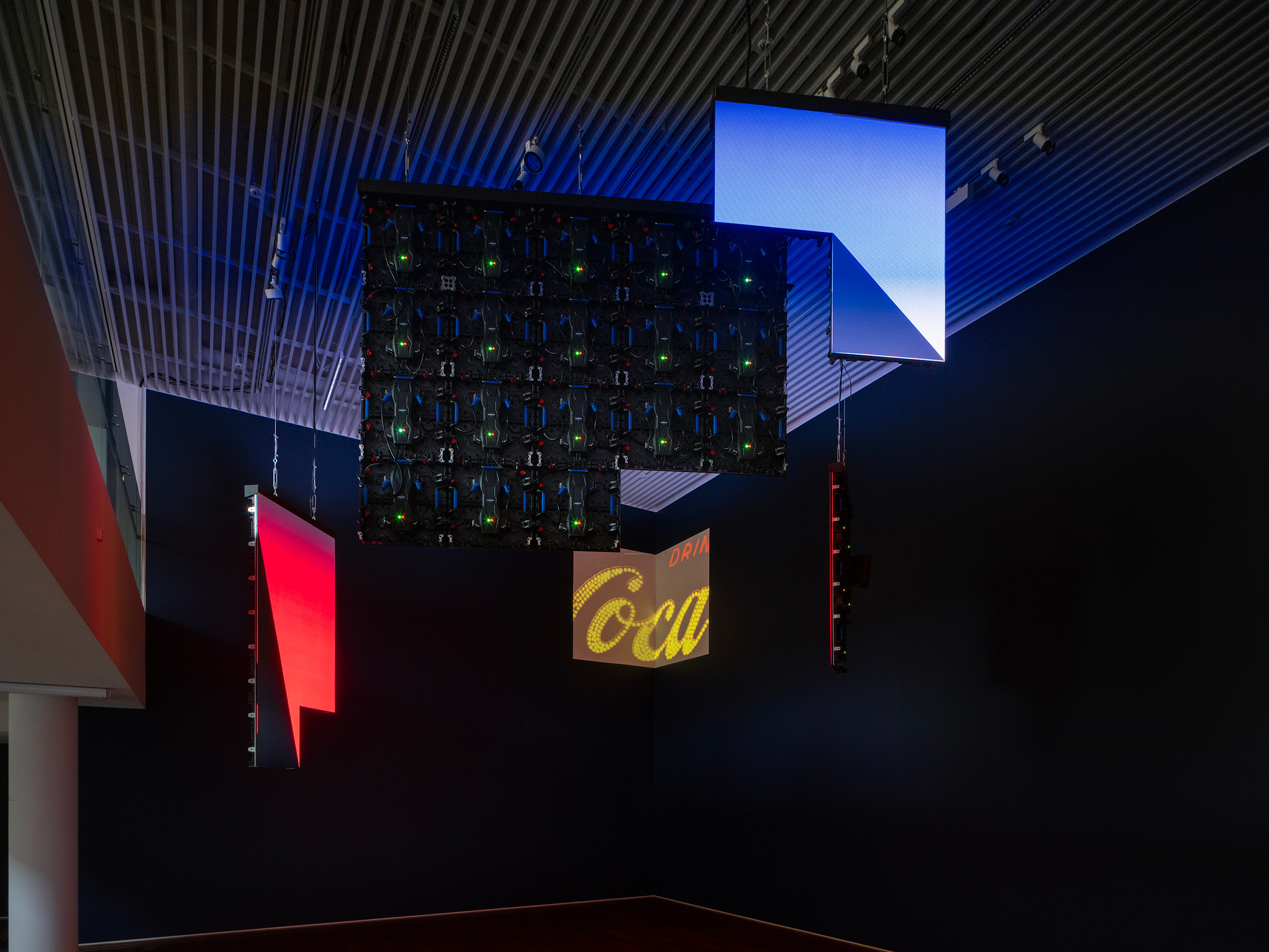
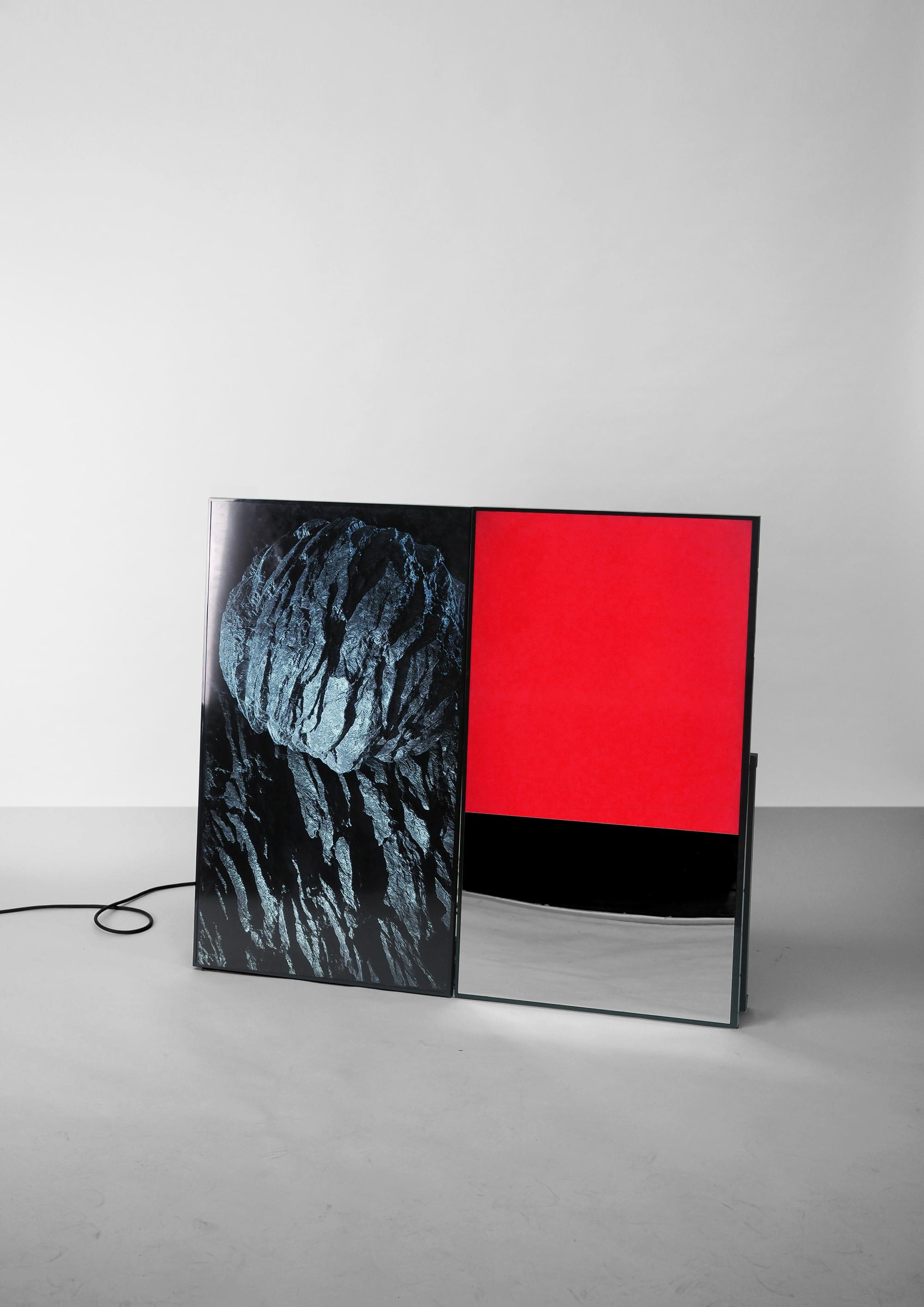
In that the video-displaying monitor, reflective mirror, and installation
within space are blended together in Kwon Ahram's work, one could think of the
work as video, video about something. However, Kwon's work could be seen as
something that is about video instead as its center of gravity is outside the
video, and it deals with the hierarchy between the video, the monitor, and the
monitor's surrounding objects and environment. Furthermore, it is a result of
the artist's sensibilities and perception of our cognitive systems surrounded
by video in that it points to our familiar behavioral styles viewing,
understanding, and consuming video, and faith or misunderstandings about video.
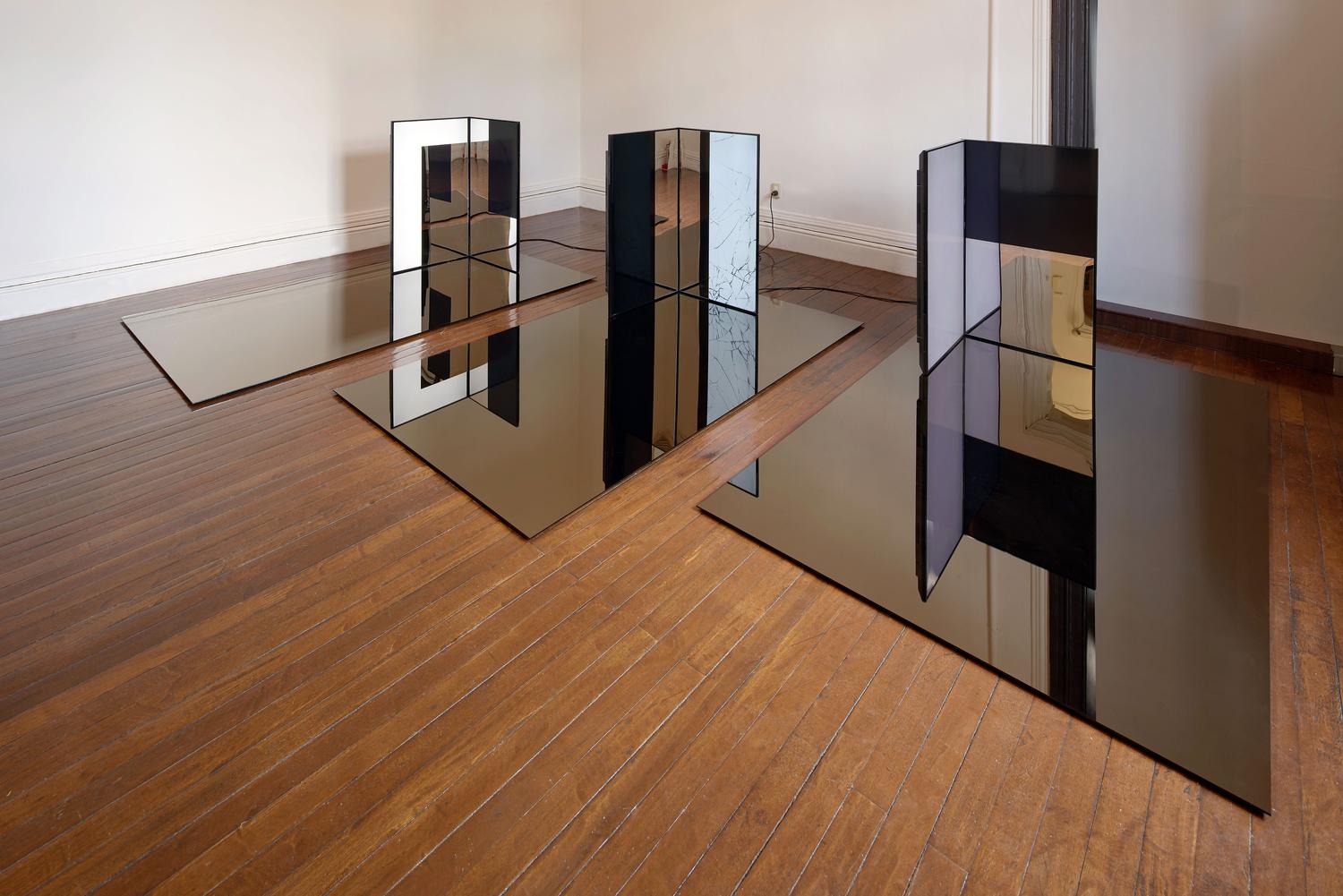
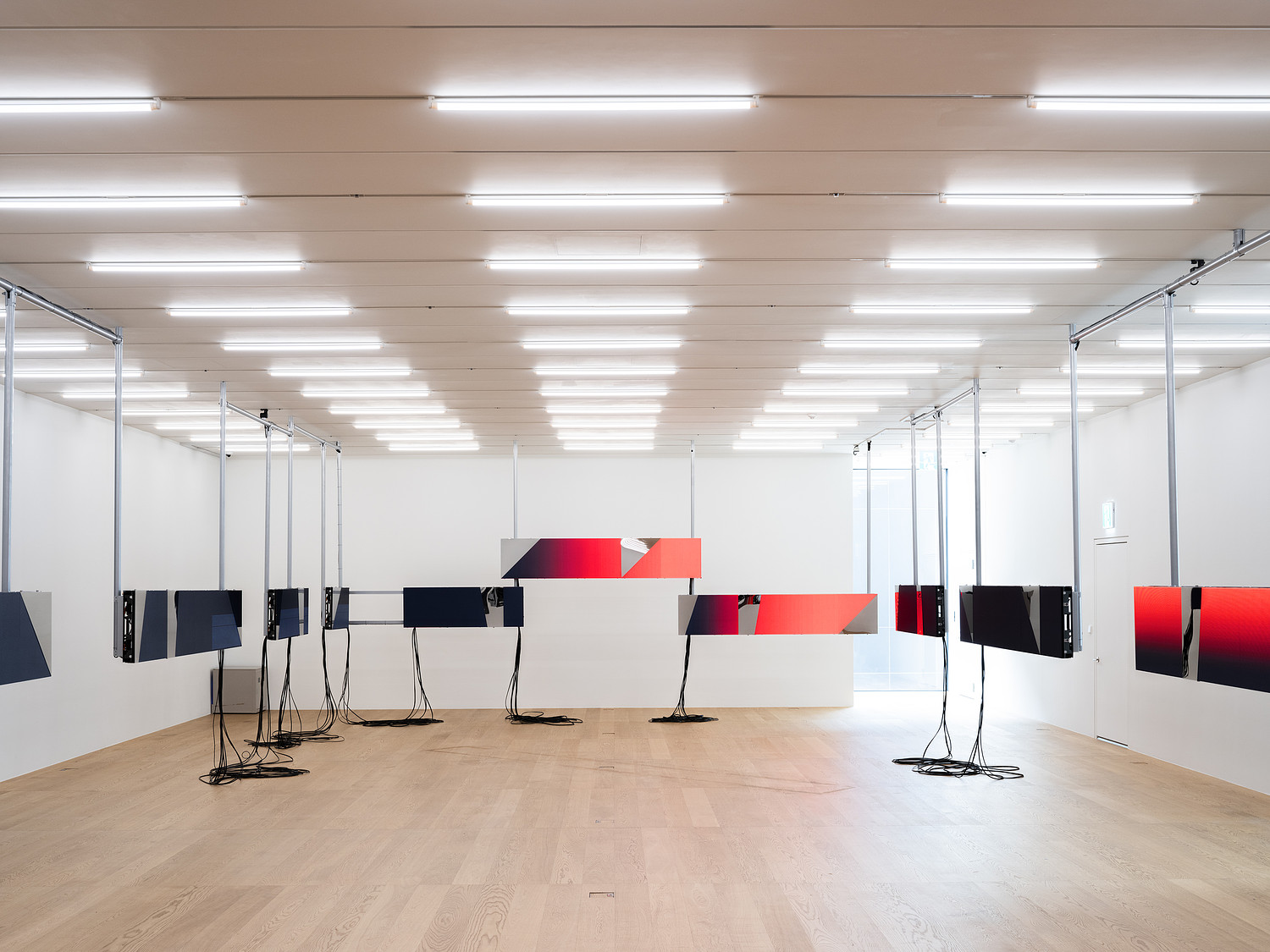
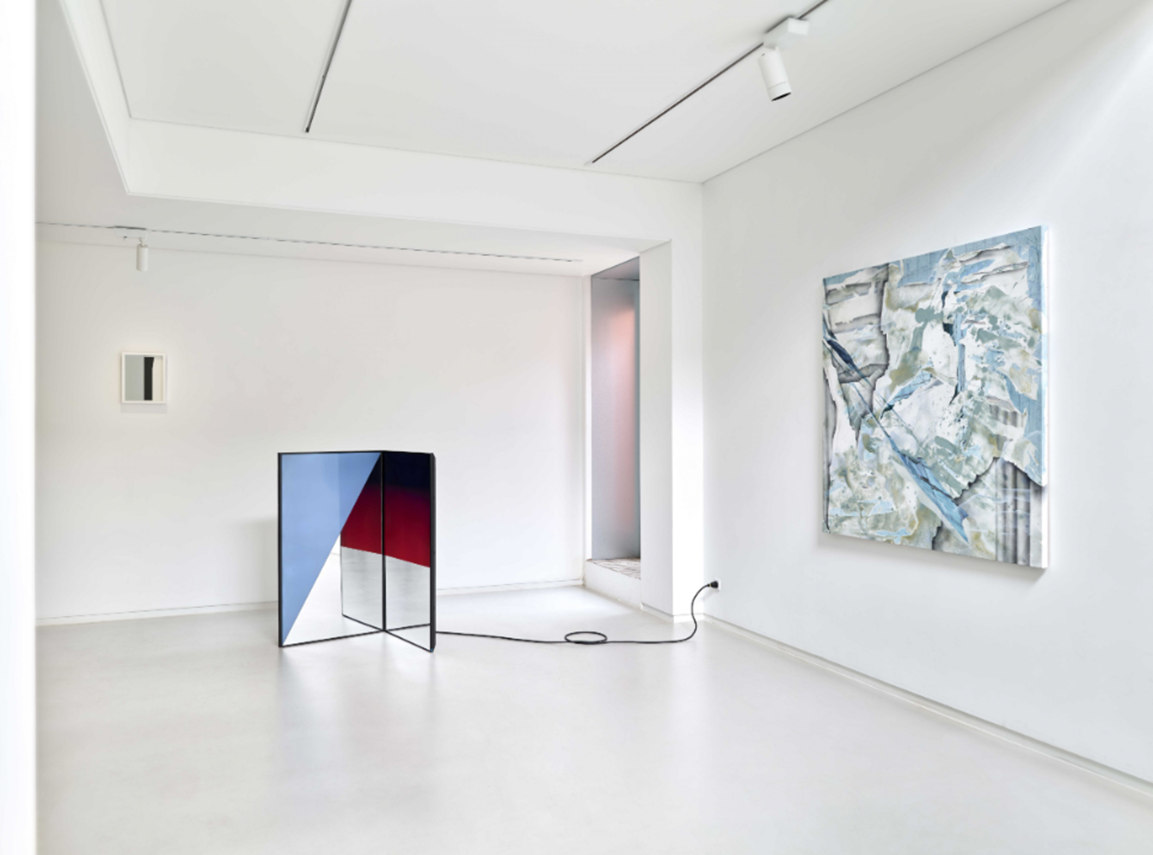
Viewers who confront Kwon Ahram's work first experience visual confusion,
followed by cognitive confusion. The particulars of the geometrically shaped
object consisting of the familiar TV monitor, clear color fields, and reflector
are not elements that are difficult to identify. However, right-angle-forming
monitors and the mirrors placed above them mix together as they hold the video
of neighboring monitors and the surrounding environment and objects. The
mirror, reflecting what is in front of it, draws the exterior to the interior,
and the monitor transmits video out from inside. Although they are both flat
and similarly thin, they both repeat drawing in and spitting out a world that
is deeper and broader than the monitor's thickness. Where is that image I see
coming from? Is what I am seeing actual or just a reflected image? Amidst such
questions, cracks form in the faith in visual and cognitive abilities I
believed to be sturdy and certain. Although it is called Flat
Matters, what Kwon's work reminds one of is an un-flat world, a
world that does not become flat, and Invisible Objects also
evokes the existence of objects of difficult-to-identify substances, i.e.,
opaque objects.
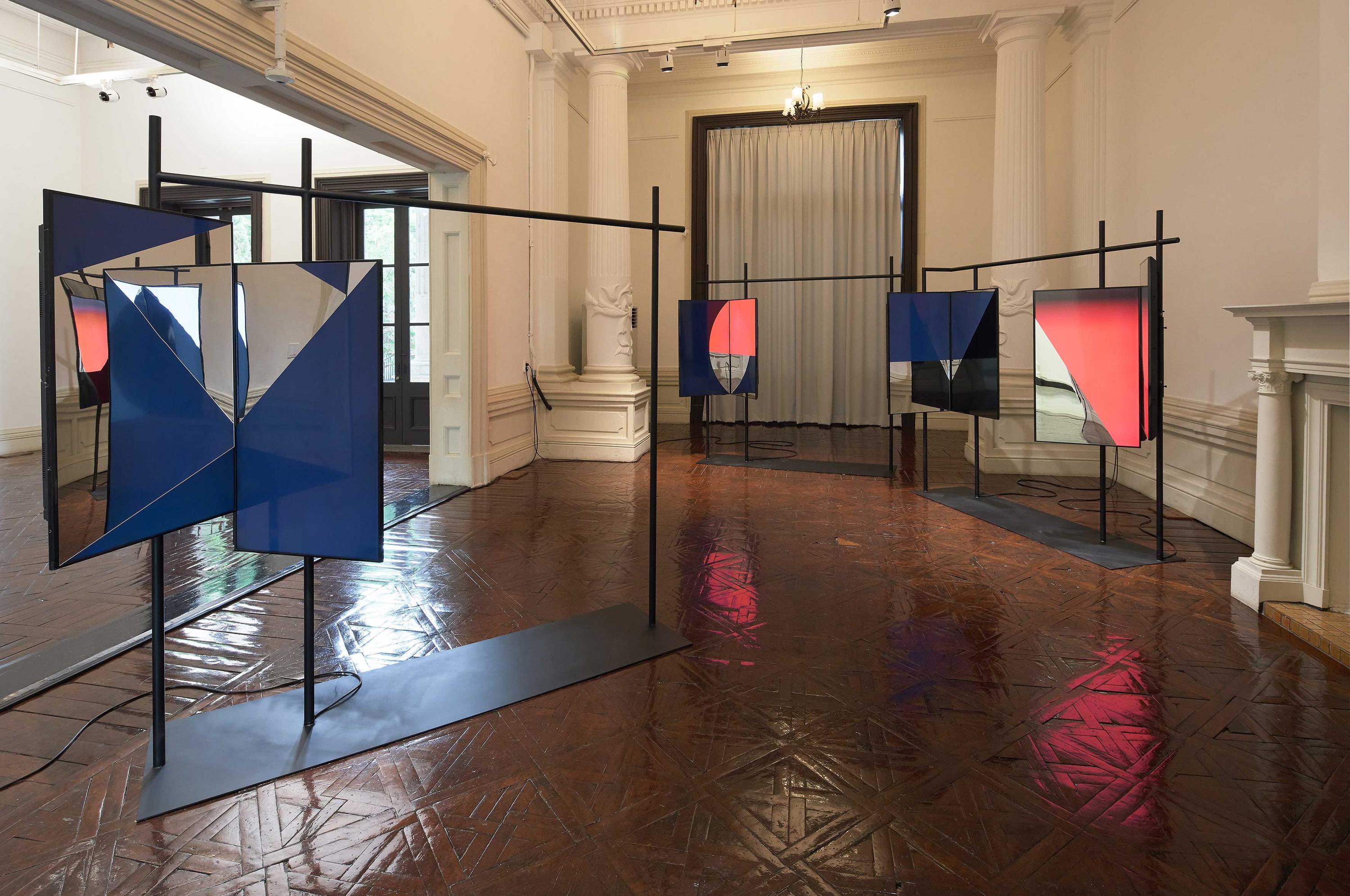
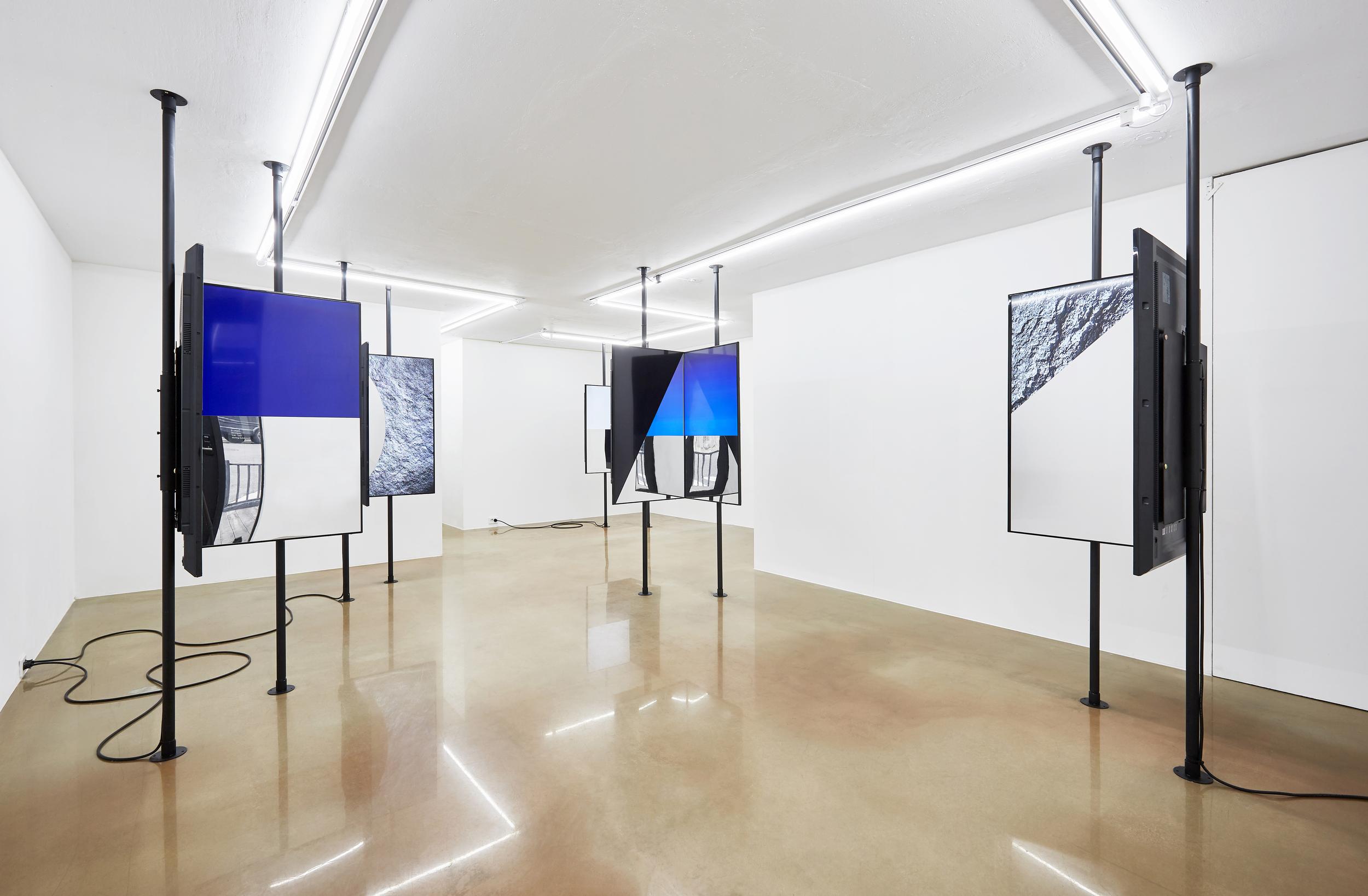
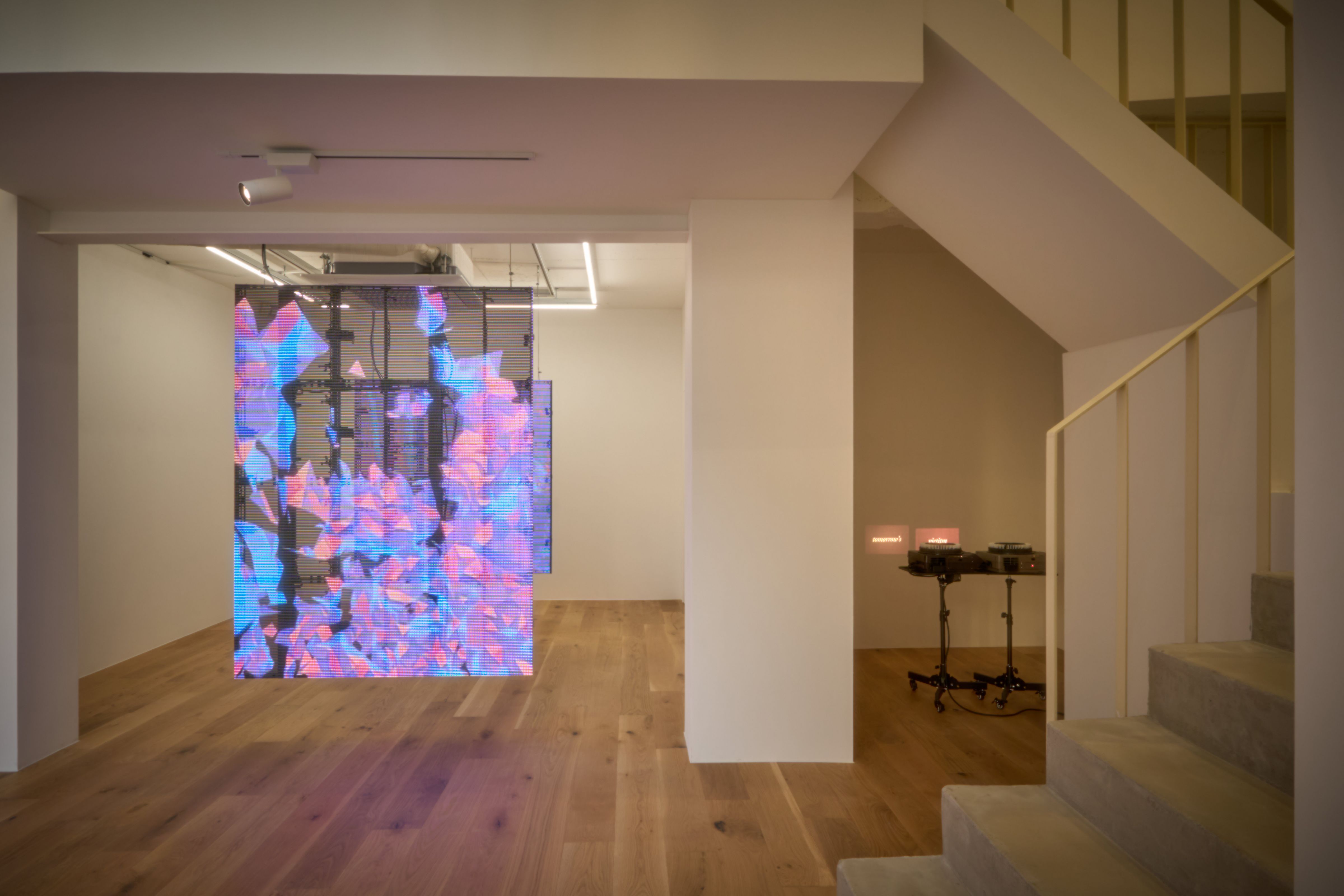
In Ghost Wall, exhibited at SeMA Nam-Seoul, the
mechanism bouncing between actual and unreal images is revealed more clearly
and dramatically. Part of the screen of each monitor, carefully produced to
seem as if it is floating in air so that gravity is not felt, consists of a
mirror. The mirror reflects details of the exhibition space viewers are
standing in- a fireplace of the former Belgian embassy, patterns on the
antiquated wooded floor. Initially certain it is a mirror because of such
elements, one becomes discomposed upon discovering elements nonexistent in the
actual space- red and blue geometric forms- with little or no idea where these
mirror-reflected forms came from. The mirror reflects what actually exists
while monitors send out video, or so we believe. By mixing the two properties
together, Kwon leads us to confusion and suspicion regarding what we are
viewing and whether we are not looking at something nonexistent. In contrast to
easily and unquestioningly believing much information accessed through video in
actual daily life, one grows confused with just the light trick Kwon produced.
The artist's shaking of the customary consumption methods regarding the monitor
screen as a bowl containing images can also be viewed from the same standpoint.
Faced directly, the 4:3 or 16:9 landscape-ratio monitor reminds one of the
medium of television or office PC screens, which we have grown familiar with at
length. The screen here is reduced to a video-holding tool. On the other hand,
when rotated to form a portrait ratio, covering the floor, or leaning at an
angle, the screen becomes strange in that it breaks a custom regarding the
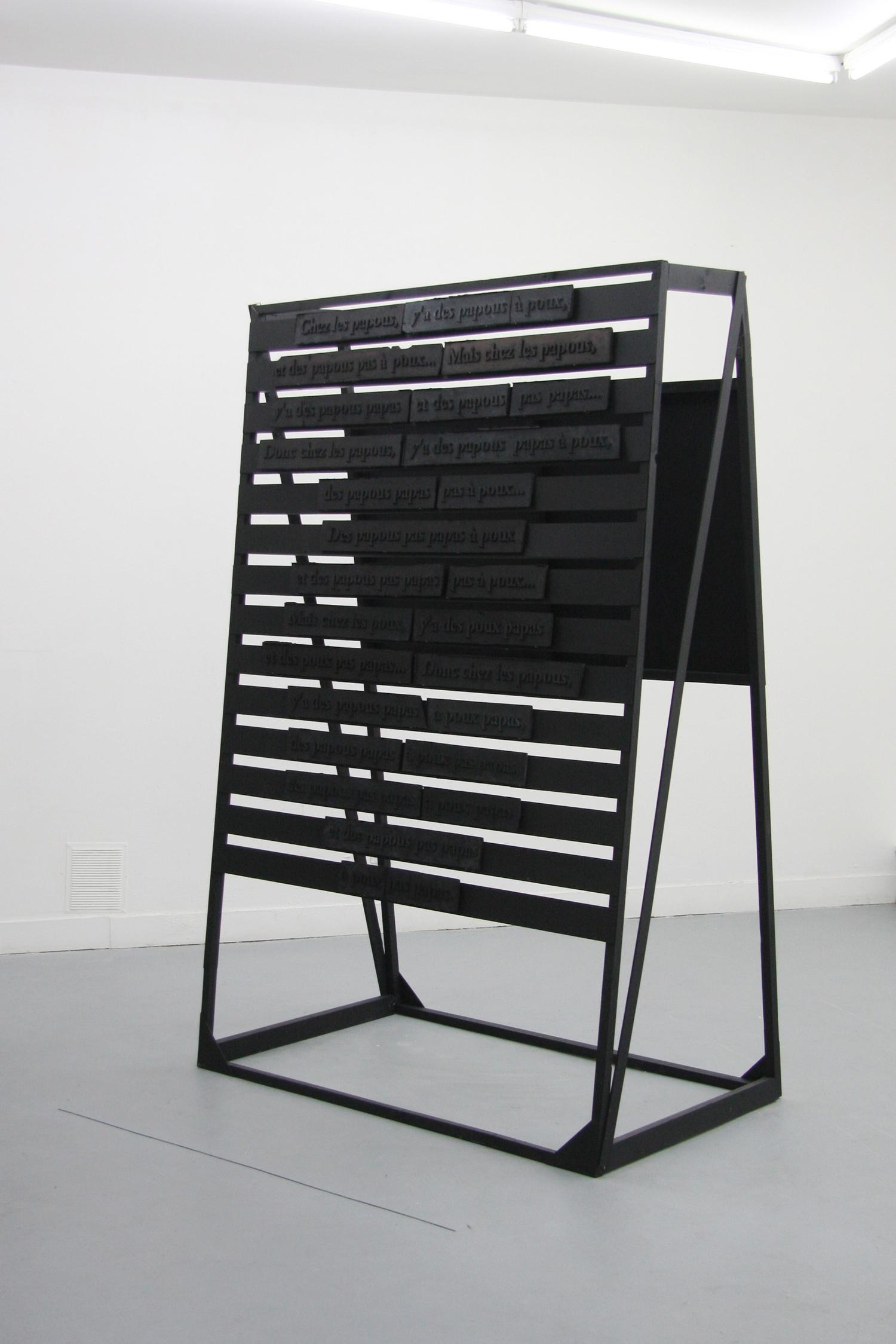
contents it holds. Kwon Ahram placed the monitor on a low cart on the floor
in Words in Fragments (2014), and she raised it
vertically and floated it in space in her recent series. As a result, one is
led to focus on the friction or unexpected harmony between the monitor and its
surroundings rather than concentrating on the monitor's contents. Through such
perceptual confusion, the artist creates moments of visual merriment while questioning
the stout and vague trust surrounding video.
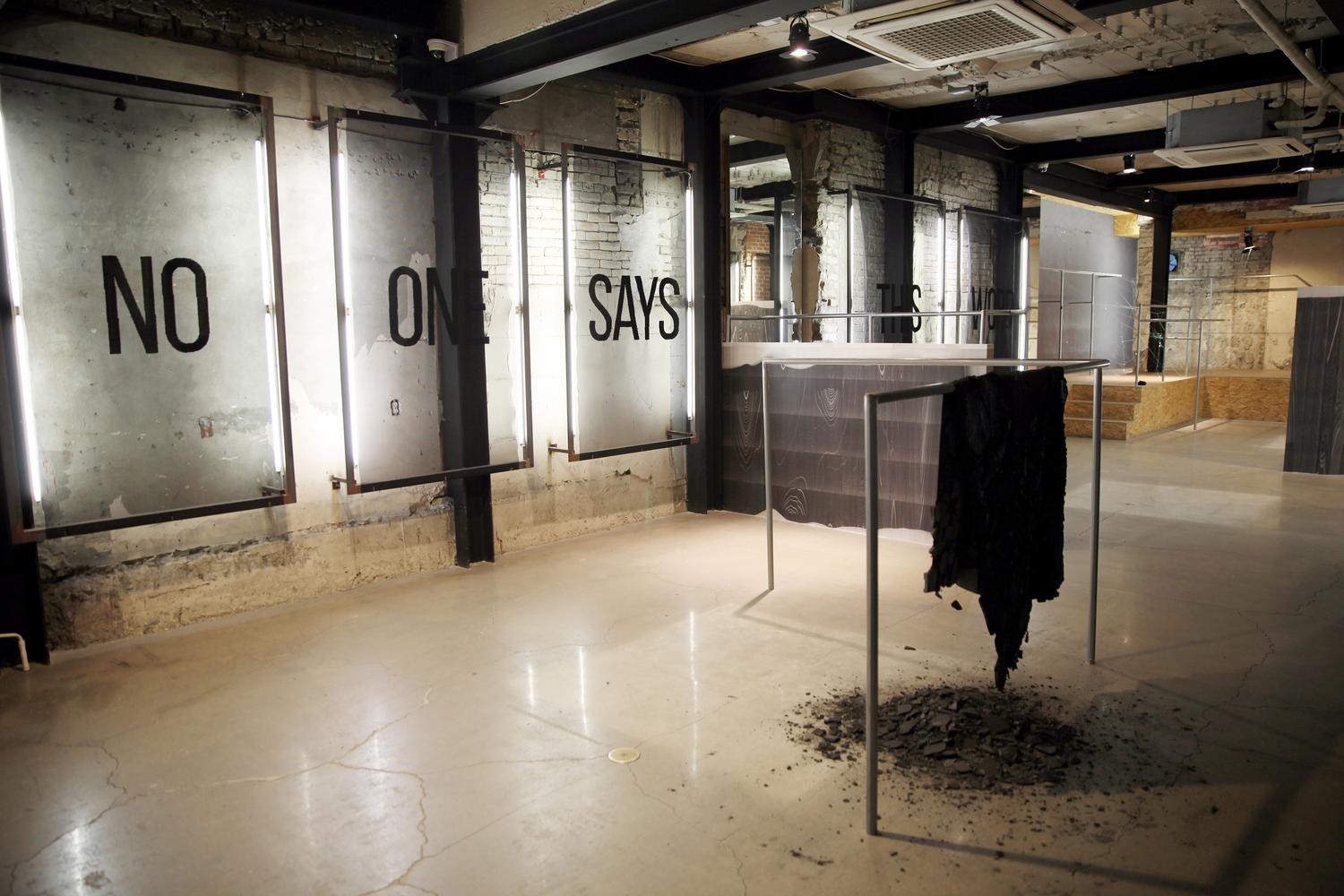
Also interesting is a pattern emerging in the titles, which are rather
expository compared to the visually clear and concise art. The solo exhibition
titles of Flat Matters (2018), Drifting
Coordinates (2016), and Words in Dissonance (2015),
and artwork titles of Invisible Objects, Words in Fragments,
and Words without Words consist of adjective and noun
combinations. Some, like Words without Words and Words
in Fragments, have ironic meaning in themselves, while the artist's
thoughts regarding situations that differ from predictions seem to be held
in Drifting Coordinates, Flat Matters, and Words in
Dissonance. They are associated with the experience, inconvenience,
and awkwardness of the situation in which everything shakes, impacts each
other, and is rearranged instead of being firmly planted in its place and
holding its coordinates; and discordant words conjure the image of a situation
in which words used toward mutual understanding and communication fail to
harmonize, bumping and colliding against each other instead. The interest in a
reality that is not flat and smooth behind an image that is manifested flatly
and smoothly like Surfaces also ironically
expresses the surface, a depth that cannot be reduced to words. Elusive
coordinates, a wrinkled world well-hidden behind flatly shaved surfaces, and a
world of languages building up perceived barriers exist in Kwon Ahram's art. So
perhaps her work could only be understood if we punctuated it with an
exclamation point or a question mark, as opposed to a period.