Earlier this year, as the novel coronavirus spread worldwide, the
WHO(World Health Organization) declared a pandemic on March 12, and on March
25, the Japanese government and the International Olympic Committee agreed to
postpone the Tokyo Olympics. Around this time, a scene from the 1980s Japanese
animation Akira was circulating on the Internet with the saying that
it accurately predicted the future. It is a scene with a billboard
advertisement saying, “The 30th Tokyo Olympics. 147 days until the event. Let’s
make it a success” and graffiti that reads “Smash” and “Stop, stop!” below it.
Initially, Akira drew attention in that the setting of preparing for
the 2020 Olympics in the future Tokyo became reality, but by February 28, which
was 147 days before the actual Olympic event, its meaning was reversed as
predicting today’s situation which seemed impossible to hold the event
successfully. After the postponement of the Olympics was confirmed, this scene
was framed and propagated as not just ominous or disturbing, but as a
shockingly accurate prophecy.
Prophecy is different from prediction. For example, when a
Japanese artist interviewed by the artist Eugene Jung in her piece Pirated Future says,
“The Olympics are actually next year,” it is not strictly a prediction. Because
at that time, it was a known fact that the 2020 Tokyo Olympics would be held.
It was a decided future and the present was planned and executed accordingly.
That is why, at this point when that future is canceled, he does not sound like
he is simply saying a wrong prediction, but it sounds like he is speaking from
the other side of the time that is already slightly different from now. In a
slightly different sense from not being able to go back to the past, it is
impossible to go back to the time when the 2020 Tokyo Olympics were supposed to
be held. When the future changes, the present and the past also change
together. We live in predictions and plans that have not yet been realized but
that are regarded as confirmed facts. When scheduled events are canceled and
plans are repeatedly delayed, but even the minimal forecast required to plan
again becomes difficult, the present becomes as fragile as a sandcastle on the
beach when the future is unilaterally pushed in and out.
When the uncertainty of the future engulfs the present, prophecy
gains strength. Prophecy is more in line with planned predestination than
probabilistic prediction in that it clearly depicts the future. But a prophet
is not a planner, but merely a person strongly obsessed with a story or scene.
Such fiction can be seen as a ‘revelation’ of some almighty one who can
determine and realize the future, or it can be the ‘prayer’ of curses or
blessings as the intense and infectious aspiration of the most helpless without
such power. However, the so-called Akira prophecy was neither a
revelation nor a prayer. Katsuhiro Otomo’s Akira depicts the
near-future Neo Tokyo preparing for the 2020 Olympics after World War III in
1988 which was caused by an unexplained explosion in Tokyo. Neo Tokyo is once
again destroyed by a flood of superpowers trained as war weapons. It was a
twisted projection of the time from World War II, which ended in Japan’s defeat
in 1945, to the 1964 Tokyo Olympics, which was the culmination of post-war
chaos and reconstruction plans. There is a memory of an indeterminate future
that is made possible by repeated history but not completely the same. It is
that dimension of the future that Pirated Future is attempting
to trigger and occupy.
Disaster in the form of shadows
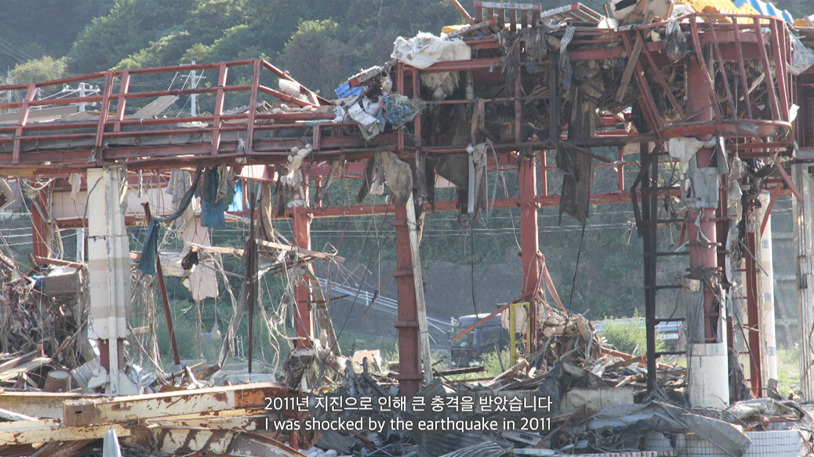
Basically, Pirated Future is a
documentary film that intersects the Chernobyl nuclear power plant explosion in
1986 and the Fukushima nuclear power plant leak in 2011 from the present point
of view. In 2019, Japan was preparing for the 2020 Tokyo Olympics and the 2025
Osaka Expo as if equating the Fukushima accident with the atomic bombing in
1945 or at least trying to repeat the successful reconstruction of the postwar
ruins once again in the future. In response, the film proposes to reflect on
today’s time in Chernobyl rather than Japan in the 1960s or the catastrophic
sci-fi image of the 1980s. What does Chernobyl, the site of the most
representative and deadly nuclear accident, look like now more than 30 years
later?
Regardless of the cause of a disaster, the aesthetics of
reconstruction emphasizing its heroic overcoming, or the aesthetics of
catastrophe enjoying the possibility of extermination by it, both fetishize
power and mobilize images as monuments of such power. However, Chernobyl and
Fukushima, visited by the artist, remain in a slow and wide time that does not
revert to the spectacle of disaster. Remaining in those times does not mean it
is completely stalled. Everything on-camera moves and changes at its own pace. Invisible
radioactive substances, soil and building debris covering fields, thickly
overgrown grass and trees on top of them, and people living amidst these and
those who left them all meet face-to-face or connect from afar with their own
clocks moving at different speeds. The complex time formed by such networks is
not given in advance as a single total era but slowly emerges through a
mediating process, connecting the lines of different times as if knitting. The
film witnesses the pervasive shadow of the disaster, traversing Chernobyl and
Fukushima, but carefully examines the mottled traces of the shadow before
rushing to generalize it as a symptom of the era.
Risks are unevenly distributed. For example, even within
Chernobyl, the degree and color of danger felt differ amongst different groups:
residents who farm and live, refusing to move outside the restricted area;
local residents who develop relatively low radiation level area in the
restricted area as tourist destinations; tourists who visit to experience the
abnormal risk which they have only seen through the media; and experts who
demand countermeasures while informing people of the dangers of nuclear power
and the long-term effects of nuclear accidents. One could say that another
nuclear accident occurred in Fukushima because the Chernobyl accident has not
been properly explained, socially convincing, and thoroughly dealt with for
such a long time. (In this case, Chernobyl is the past of Fukushima.) However,
in the context of Japan, where the accident site of Fukushima is tied into a
no-entry zone to exclude it from society and seek a seamless reconstruction,
Chernobyl’s lively appearance can be read as a positive process in which the
accident area slowly recovers after a long period of isolation and reintegrates
as a part of society. (In this case, Chernobyl is the future of Fukushima.)
On the other hand, from the point of view of Seoul, where there is
no exposure to radiation, accepting the chain of disasters from Chernobyl to
Fukushima as images of reality that can be grasped, not as a one-time news
image or a disaster movie or game contents resembling it, in short, assuming
Chernobyl and Fukushima can be the future of Seoul becomes another issue.
Between disasters that have already arrived and the disasters that have not yet
arrived, explosive events that destroy a place, and the probabilistic death
that shortens people’s life expectancy, the dangers of the future stir the
present as undeterminable but impossible to overlook. Eugene Jung accepts the
air of today as a state in which shadow-formed disasters ominously blur the
vision, and the past and the future reflect each other indeterminately and
appear in the present like a mirage. In that air that cannot be easily shaken
off by hand, disasters sometimes seem to be very close and sometimes very far
away. The artist wants to point out that it exists there anyway and ask what it
looks like.
Living in Uncertainty
Pirated Future consists mainly of
videos and visual materials taken in Ukraine and Japan, and interviews with
locals involved in or embroiled in disasters in various forms. The film tries
to delicately show things that are not covered well or that are confined in a
certain frame with a specific meaning in the media dealing with Fukushima or
Chernobyl. However, rather than presenting it as real reality, it keeps
reminding itself that it is also in the chain of media images.
Films typically try to subtly show things that are not covered
well in the media dealing with Fukushima or Chernobyl or that are locked in a
frame of a particular meaning, but rather than presenting it as real reality,
they keep reminding themselves that they are in a chain of media images. The
meaning of the media image is not fixed in itself but flows with other images
surrounding it. For example, the scenery seen by tourists visiting Chernobyl
after encountering the game series ‘Stalker’, a game set in Chernobyl
developed by a Ukrainian company, is not natural in many ways. On the one hand,
the image and the actual scenery are imitating each other, and on the other
hand, the tourists themselves are looking at the actual scenery while
reflecting on the scenery on the screen. To accept the place as a reality, not
consuming the image of the reality as just a bizarre spectacle, but to
recognize it as a problem in the world to which one belongs, goes beyond simply
making an image well.
Rather than solving this problem, the artist left room for the
audience to realize it on their own and to some extent to make their own
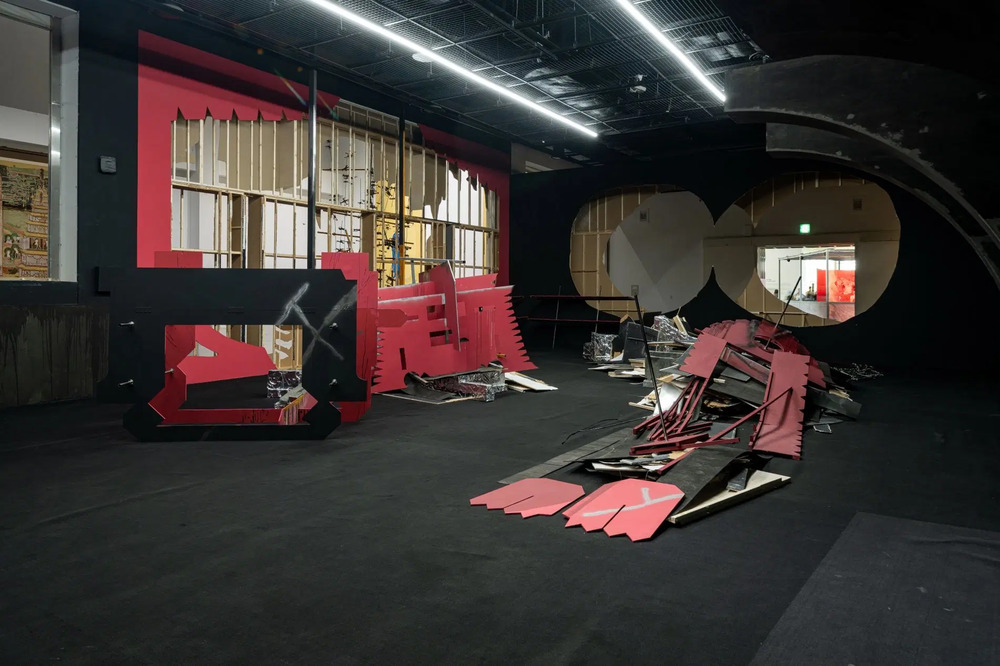
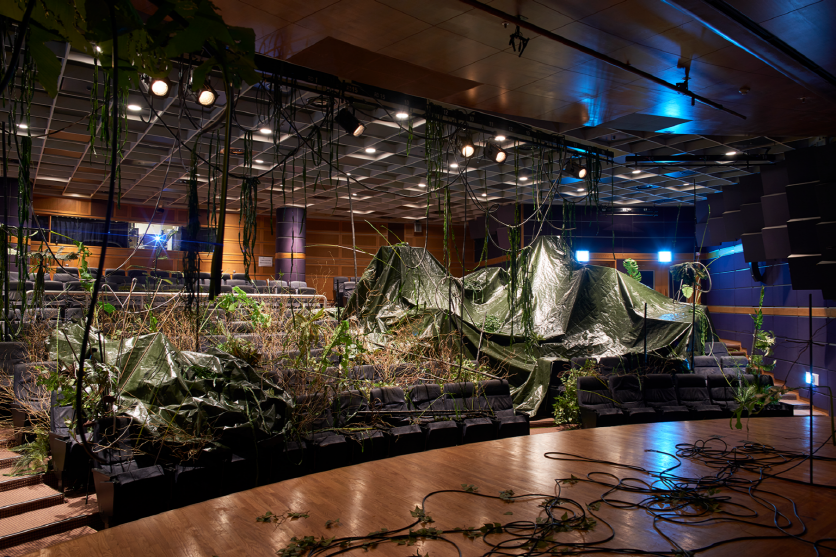
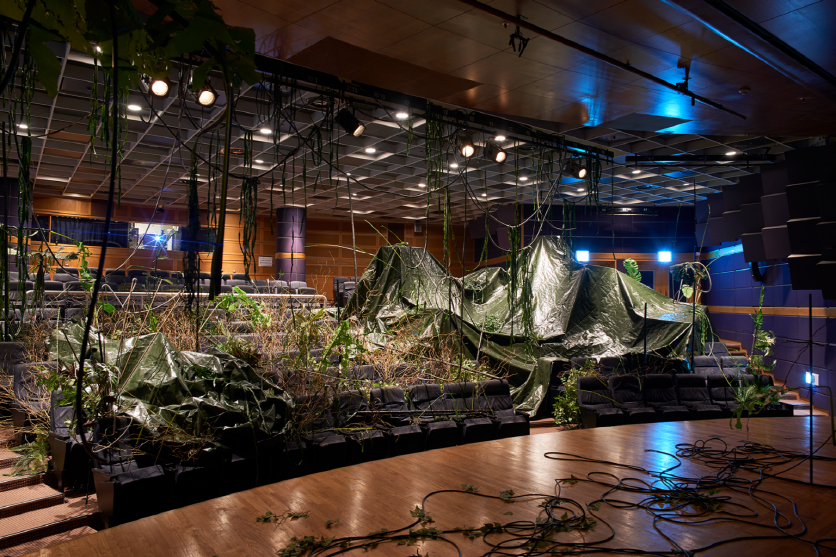
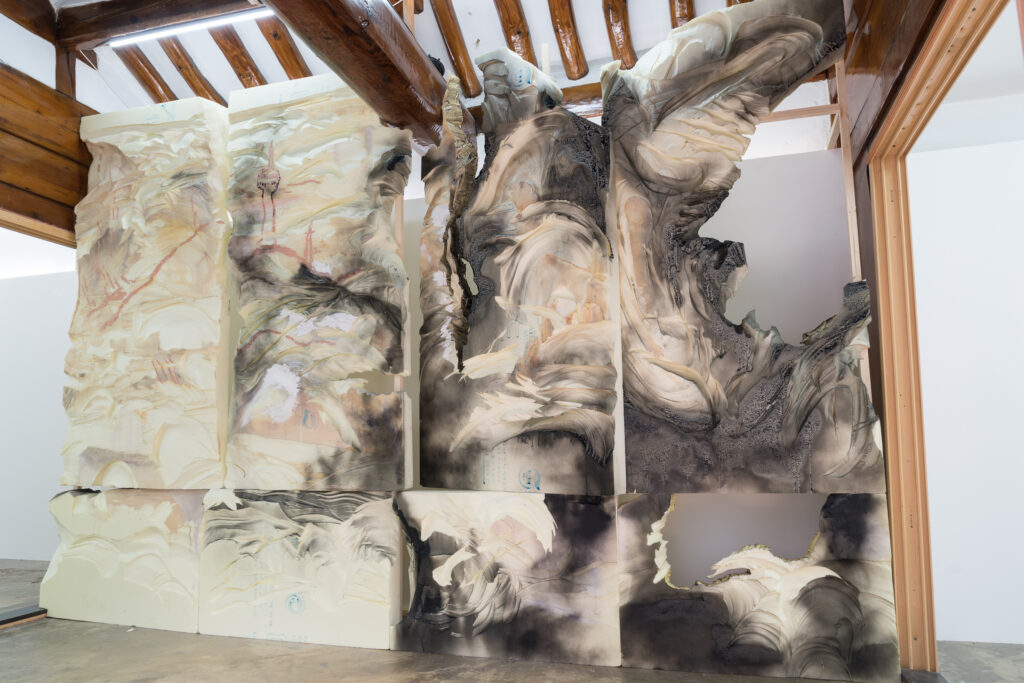
choices. Pirated Future was first screened
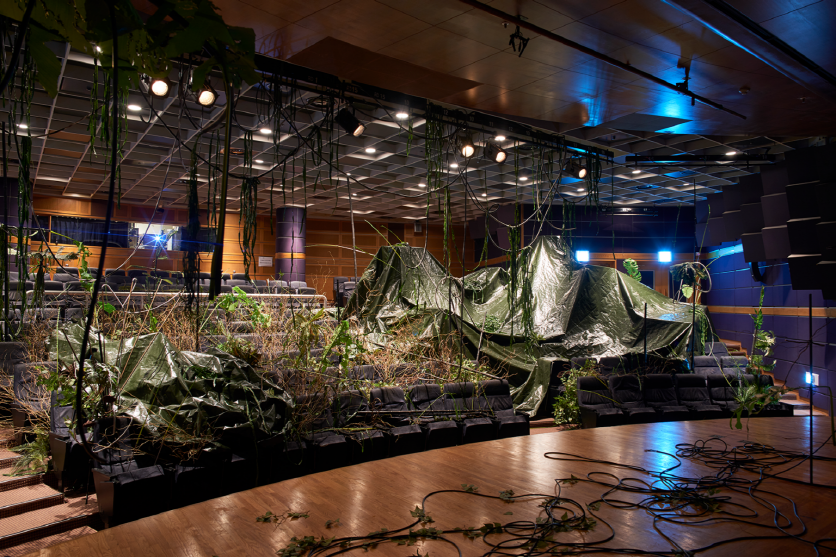
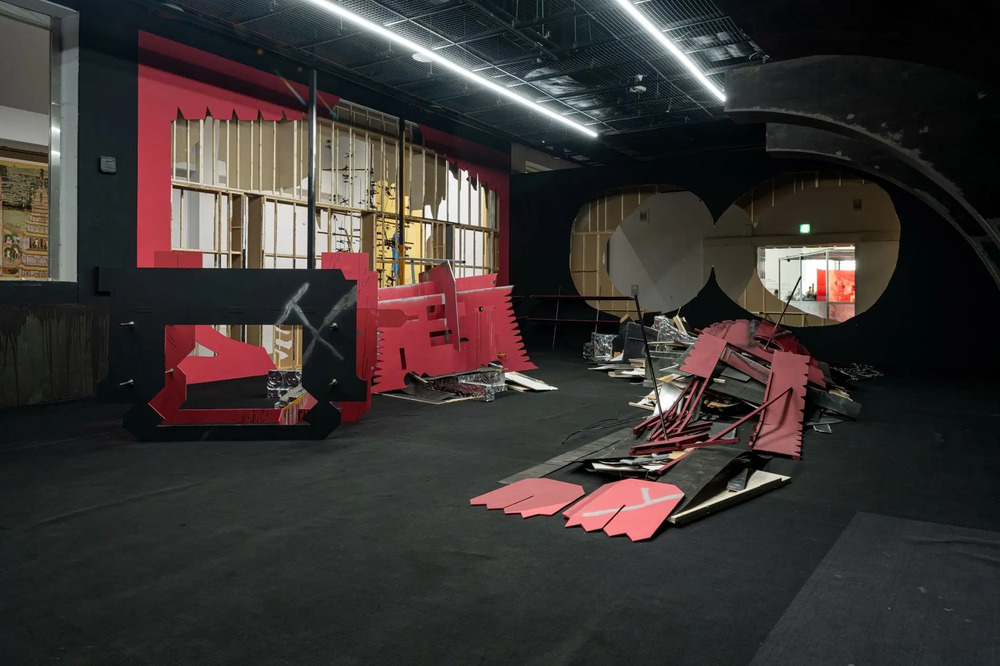
inside the installation work Doomsday Garden, which was
created like a movie theater after the extinction of mankind, covered with lush
artificial plants all over the stage and the seats. Who we are, when and where
we remain undecided as we watched the film together in a futuristic space where
if we say it’s fake, it seemed fake and if we say it’s real it seemed real.
This blank could lead the audience to a world of the post-apocalyptic genre but
could have also slipped into a space-time that would not be trapped in any
official narrative of Seoul in 2019. The shadow of disaster has sparked a new
terrain of time in which things contend: a series of timelines that consider
what has already happened to what has not yet happened as objective reality;
fragments of foreboding and memories that have not attained that degree of
certainty; and unexpected expression of non-visible things that have not even
been given such a hazy image. Pirated Future in Doomsday
Garden tried to amplify the sense of swimming through the opaque and
multifaceted flow.
At a time when film festivals and various festivals around the
world have been canceled and all screenings and conversations with artists have
been replaced by video streaming and remote conferences, the exhibition
landscape of Pirated Future + Doomsday Garden is
again dispersed into multiple layers of images that were unexpected at the
time. On the one hand, things that were difficult to get into the screen, above
all, the future of people’s bodies and spaces where they can gather together
became rapidly unclear. On the other hand, fighting the opaque and uncertain
has become an even more pressing and realistic issue. One might say that
maintaining an ambiguous attitude in art in such a situation where uncertainty
is already overflowing is either a tautology or an unnecessary surplus. But
when our own bodies were isolated individually as a place of danger and a place
of increased danger, all they could do was struggle with tentative words and
images that claimed their certainty more violently than ever before. In a world
where disasters in the form of shadows, which cannot simply be put as an end or
victory, unexpectedly come to the fore, Pirated Future exerts
a bizarre realism effect. It is not a “shocking prophecy of the future” and the
scenes in the film where people are gathered without masks already feel like a
bit of an unfamiliar past, but we are staying in a time that cannot be
confirmed.